Water leakage in a high-rise building is rarely just a small maintenance issue. A damp ceiling, stained wall, wet bathroom floor, or unexplained increase in water consumption can indicate a problem involving plumbing, waterproofing, drainage, façade joints, roof systems, chilled-water lines, condensate drainage, or building movement.
In Dubai, where residential towers, commercial buildings, mixed-use developments, and high-rise communities are widespread, identifying the source of water intrusion requires a systematic approach. A visible water stain does not necessarily appear directly below the point where water entered the building. Water can travel through concrete slabs, blockwork, service shafts, insulation layers, suspended ceilings, pipe penetrations, and façade cavities before becoming visible.
Dubai Municipality’s Building Code establishes minimum requirements relating to building health, safety, welfare, environmental impact, and sustainable development, while Dubai Municipality also maintains specific regulatory material covering waterproofing systems and building maintenance.
This makes professional diagnosis and preventive maintenance particularly important for high-rise properties.
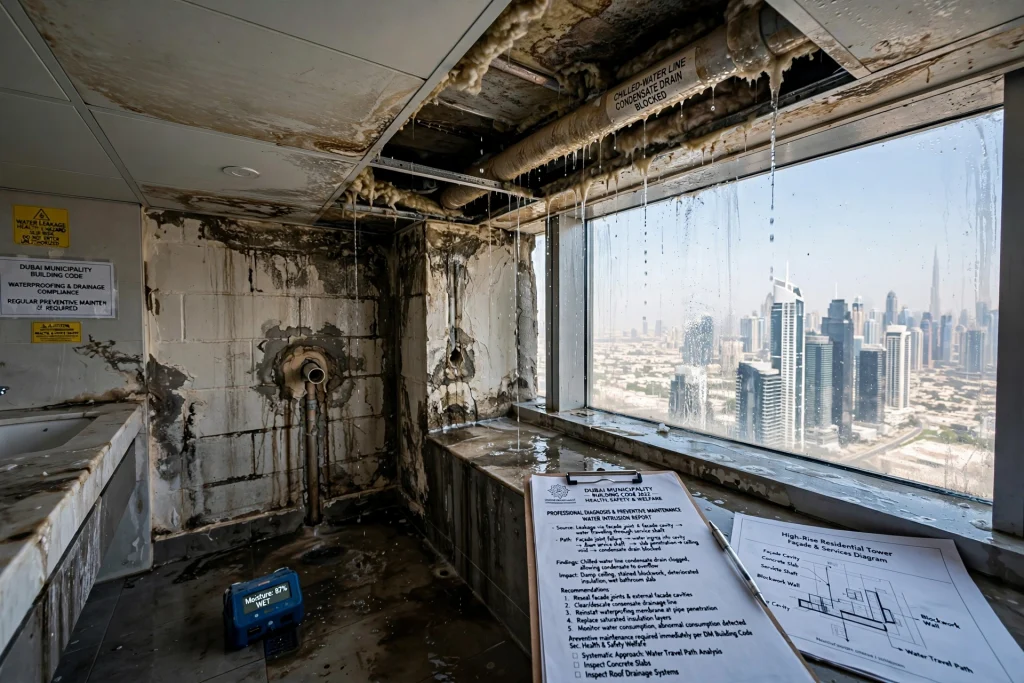
Why Water Leakage Is More Complicated in High-Rise Buildings
A high-rise building contains multiple interconnected systems. Domestic water supply, drainage, rainwater disposal, air-conditioning condensate, chilled-water systems, fire-water infrastructure, bathrooms, kitchens, balconies, roofs, façades, and mechanical rooms can all become potential sources of moisture.
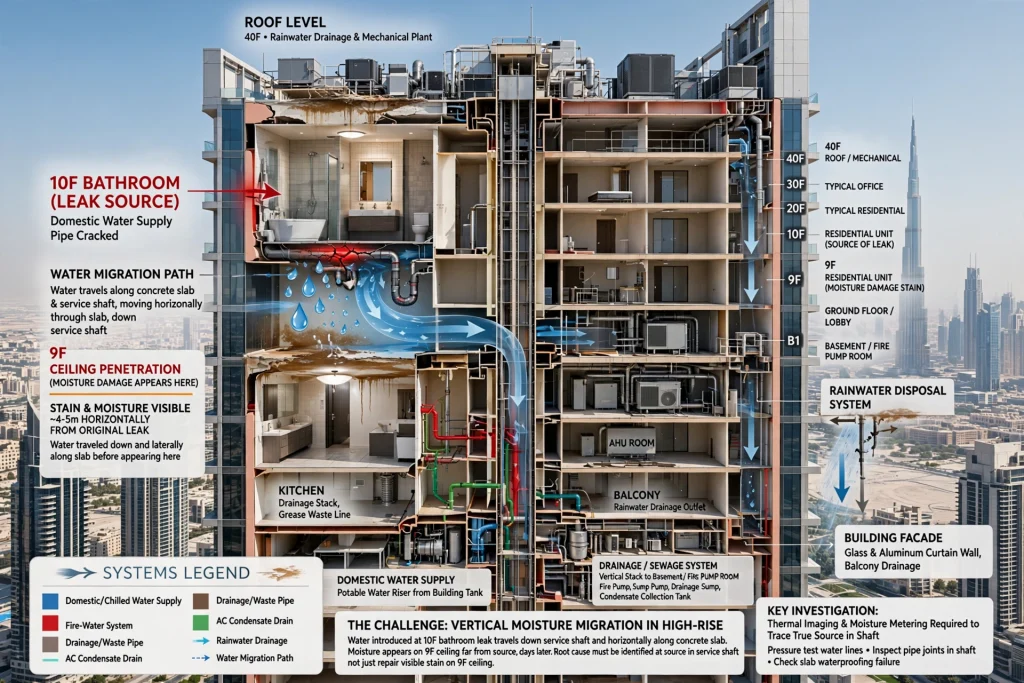
The vertical nature of a tower creates another challenge. Water introduced at one floor can migrate horizontally or vertically before appearing somewhere else.
For example, a leak from a bathroom on the tenth floor could travel through a concrete slab and become visible around a ceiling penetration on the ninth floor. Similarly, a damaged pipe inside a service shaft may produce moisture several meters away from the original failure point.
This is why simply repairing the visible stain is rarely a complete solution.
The source must be identified first.
Common Causes of Water Leakage in Dubai High-Rise Buildings
Water leakage can originate from several building systems. The most common causes include deteriorated waterproofing membranes, failed sealants, damaged plumbing connections, leaking drainage pipes, blocked rainwater outlets, defective bathroom waterproofing, cracked grout, façade joints, roof penetration points, air-conditioning condensate lines, and aging pipework.
Construction defects can also contribute to future leakage.
Poorly sealed pipe penetrations, inadequate drainage slopes, insufficient waterproofing upstands, improperly installed membranes, and poorly executed expansion joints can create pathways for water.
In older buildings, deterioration becomes another factor. Sealants lose elasticity, membranes age, pipes corrode, joints deteriorate, and repeated temperature changes can gradually weaken building components.
Dubai’s environmental conditions also place considerable demands on exterior building materials. High temperatures, strong solar exposure, dust, humidity, and occasional heavy rainfall all make appropriate maintenance important.
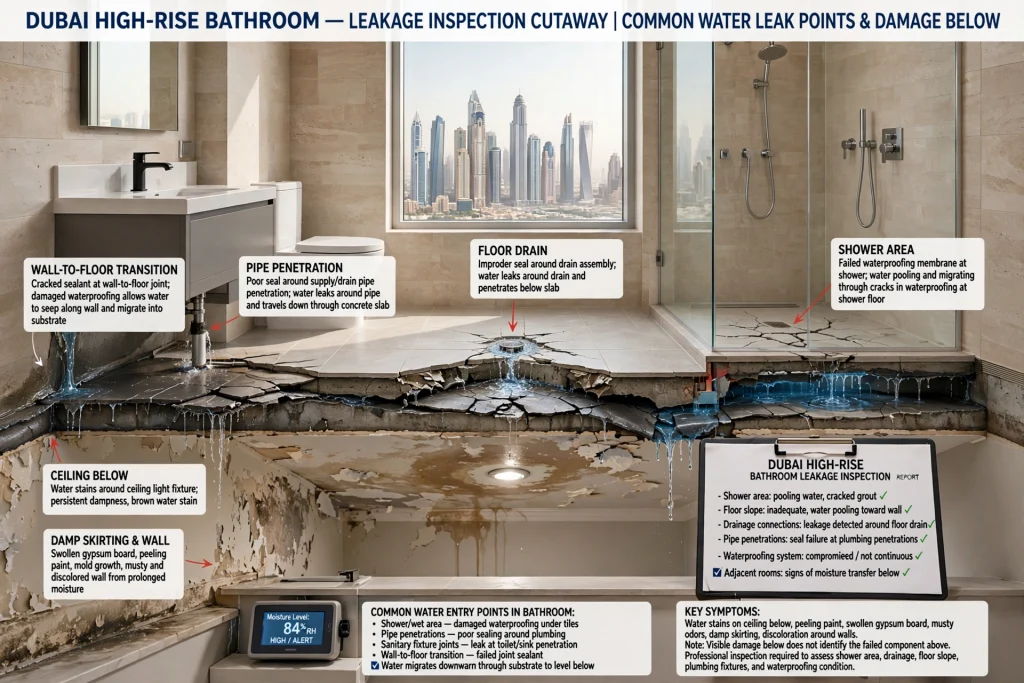
Bathroom Leakage in High-Rise Apartments
Bathrooms are among the most common locations where water leakage develops.
The bathroom floor contains multiple potential water entry points, including shower areas, floor drains, pipe penetrations, sanitary fixtures, joints, and wall-to-floor transitions.
A waterproofing system should create a continuous barrier beneath the finished surfaces. If that system becomes damaged or was incorrectly installed, water can migrate into the substrate.
A bathroom leak may appear as:
- Dampness on the ceiling below
- Water stains around light fixtures
- Peeling paint
- Swollen gypsum board
- Musty odors
- Damp skirting
- Discoloration around walls
- Persistent moisture near bathroom walls
The visible symptom does not always identify the failed component.
A professional investigation may need to examine the shower area, drainage connections, floor slope, plumbing fixtures, waterproofing condition, and adjacent rooms.
Plumbing Pipe Leaks Inside High-Rise Buildings
Plumbing networks are another major source of water leakage.
A high-rise building may contain extensive networks for potable water, hot water, drainage, and other building services. Pipe connections can deteriorate over time, while pressure fluctuations and mechanical stress can affect joints and fittings.
Common problem areas include:
Pipe joints: Connections can develop leaks when seals deteriorate or fittings loosen.
Flexible connections: Hoses serving fixtures such as sinks and toilets can fail unexpectedly.
Drainage pipes: Cracks, damaged joints, and blockages can allow wastewater to escape.
Concealed pipes: Leaks inside walls or ceilings can remain unnoticed until significant moisture damage occurs.
Vertical risers: Service shafts contain multiple pipes and connections, making inspection particularly important.
Water leakage from plumbing should be addressed quickly because prolonged moisture can damage structural finishes, insulation, cabinetry, ceilings, and electrical components.
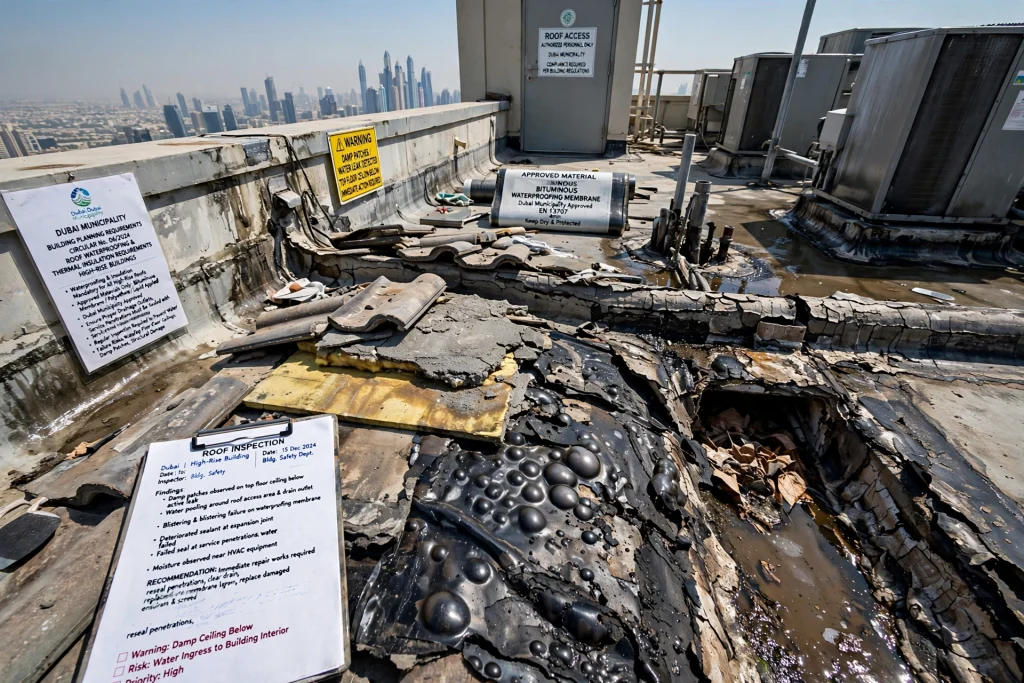
Waterproofing Failure on Roofs and Terraces
Roof waterproofing is particularly important in high-rise buildings because the roof is exposed to weather and thermal movement.
A roof system can include a waterproofing membrane, protection layer, insulation, screed, tiles or other finishes, drainage outlets, expansion joints, and service penetrations.
Failure at any of these points can allow water to enter the building.
Typical warning signs include damp patches on the ceiling of the top floor, water around roof access areas, blistering finishes, deteriorated sealants, and moisture near mechanical equipment.
Dubai Municipality maintains specific building-planning requirements and circulars related to waterproofing and insulation, highlighting the importance of appropriate waterproofing systems and approved materials.
Balcony and Terrace Water Leakage
Balconies are another vulnerable area because they combine exposed surfaces, drainage systems, waterproofing, doors, thresholds, and façade interfaces.
A balcony should direct water toward appropriate drainage outlets rather than allowing it to remain against walls or doors.
Potential problems include inadequate slope, blocked drains, cracked tiles, failed grout, damaged waterproofing, and deteriorated sealant around door frames.
Water can also enter through the junction between the balcony slab and building façade.
A recurring balcony leak should therefore be investigated at the complete assembly rather than simply replacing visible grout.
Façade and Window Leakage in Dubai Towers
Not every water leak comes from plumbing.
External water intrusion can occur through façades, windows, curtain-wall systems, joints, sealants, louvers, and façade penetrations.
High-rise façades are particularly complex because they must accommodate thermal movement, wind loads, building movement, and weather exposure.
Sealant deterioration around windows can create pathways for rainwater.
Cracks or defective joints can allow moisture to enter wall assemblies.
A leak near a window may therefore require inspection of the external façade rather than the internal wall alone.
This is one reason façade-related water intrusion can be difficult to diagnose from inside the apartment.
Air-Conditioning Condensate Leaks
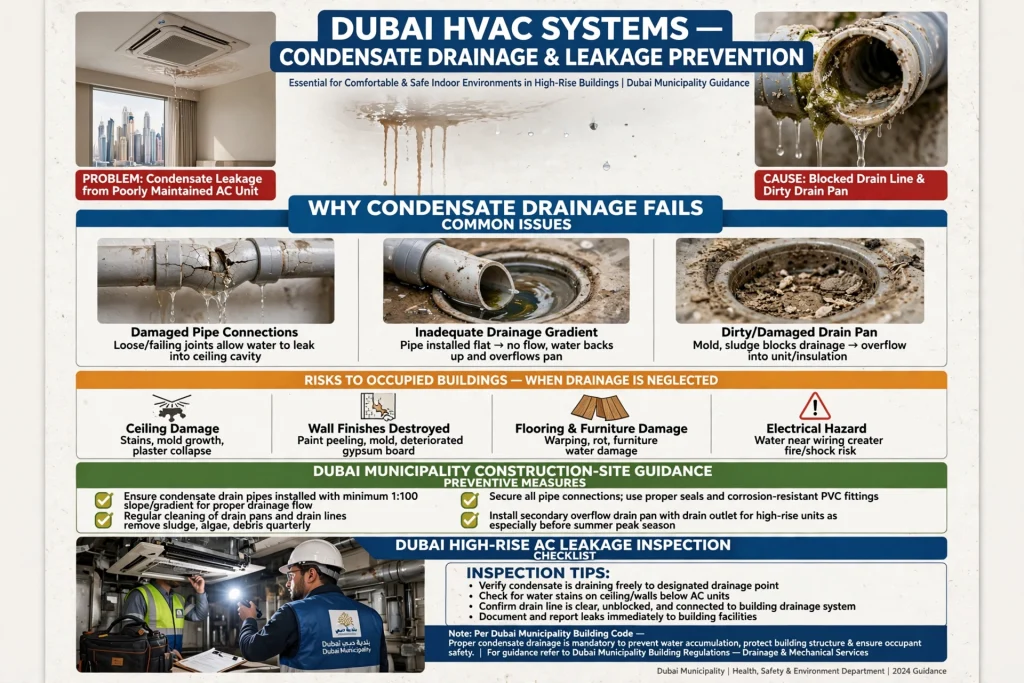
Air conditioning is essential for comfortable indoor environments in Dubai, but HVAC systems can also become sources of water leakage when condensate drainage is poorly maintained.
Air-conditioning units remove moisture from indoor air. That moisture collects as condensate and must be drained correctly.
Problems can occur when condensate drain lines become blocked, drain pans become dirty or damaged, pipe connections fail, or drainage gradients are inadequate.
Dubai Municipality’s construction-site guidance specifically addresses proper drainage of air-conditioning water and the need to prevent water accumulation.
In occupied buildings, persistent AC condensate leakage can damage ceilings, wall finishes, flooring, furniture, and electrical components.
Drainage and Sewer Pipe Problems
Drainage leaks can be particularly serious because they may involve contaminated wastewater.
A leaking waste pipe can produce unpleasant odors, staining, dampness, and hygiene concerns.
Blockages can increase pressure within drainage systems and cause wastewater to escape through weak joints.
Drainage systems should therefore be inspected when there are repeated backups, unexplained dampness near bathrooms or kitchens, sewer odors, or recurring ceiling stains.
The correct solution may involve drain cleaning, pipe repair, joint replacement, or partial pipe replacement depending on the cause.
Water Tank and Pump-Related Problems
High-rise buildings require sophisticated water distribution systems.
Water tanks, transfer pumps, booster pumps, valves, pressure-reducing systems, and distribution pipes all need appropriate inspection and maintenance.
A faulty valve or connection in a plant room can produce significant water accumulation.
Pressure-related issues can also affect plumbing components.
Dubai Civil Defence’s building monitoring information demonstrates how larger buildings may incorporate monitoring for water tank levels and pump operating or fault conditions as part of building systems.
For facility managers, monitoring mechanical rooms and water infrastructure can therefore form part of broader preventive maintenance.
How Water Leakage Travels Between Floors
One of the most misunderstood aspects of high-rise water leakage is water migration.
Concrete is not completely impermeable. Water can move through cracks, joints, penetrations, and porous materials.
A leaking bathroom may send water sideways before it reaches a lower ceiling.
A pipe inside a shaft can leak onto multiple surfaces.
A façade leak can travel behind finishes before becoming visible around a window.
This means the location of a stain should be treated as a clue rather than definitive proof of the source.
Professionals should trace the moisture pathway rather than simply repair the most visible area.
Warning Signs That Should Not Be Ignored
Small signs can precede significant damage.
Residents and building managers should pay attention to recurring ceiling stains, peeling paint, bubbling wall finishes, damp smells, warped flooring, swollen cabinetry, mold-like growth, deteriorating grout, water around windows, unexplained moisture, and repeated plumbing repairs.
Another important warning sign is a stain that disappears and then returns after rainfall or after using a bathroom.
This pattern can provide valuable diagnostic information.
For example, moisture appearing after rainfall may indicate an external waterproofing or façade problem, while moisture that appears after shower use may point toward bathroom plumbing or waterproofing.
How Professionals Diagnose High-Rise Water Leakage
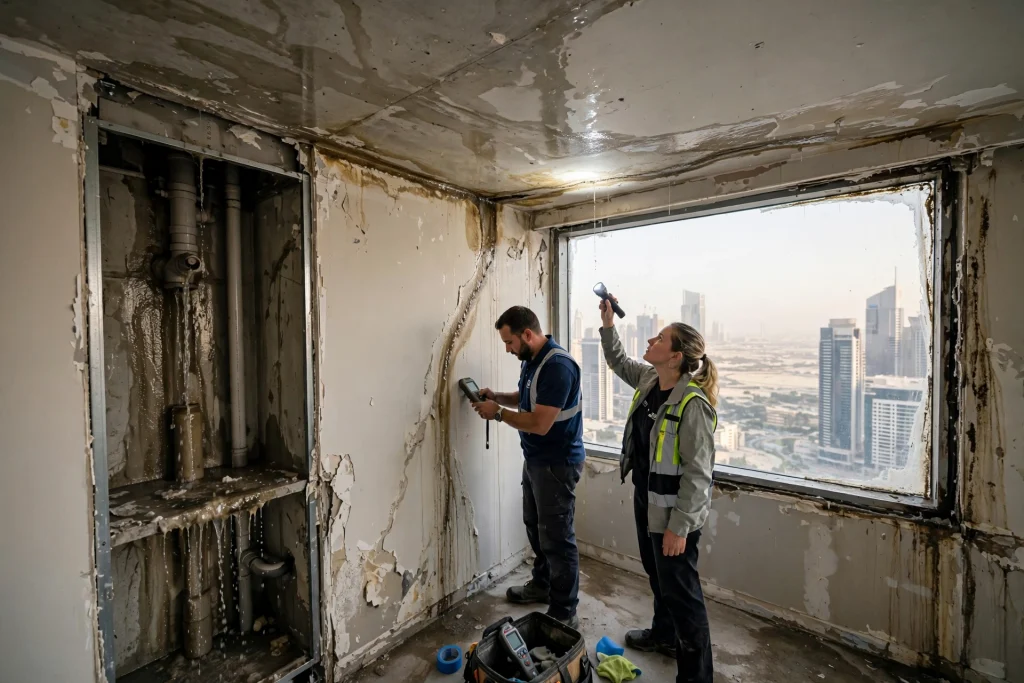
A professional investigation should begin with a detailed inspection rather than immediately opening walls.
The first stage is understanding the symptoms.
When does the moisture appear? Is it continuous or intermittent? Does it occur after rainfall? Does it correspond with bathroom use? Is there an apartment above? Is there a mechanical room nearby?
The next stage is visual inspection.
Professionals can examine ceilings, walls, pipe connections, drainage points, fixtures, windows, expansion joints, and accessible service areas.
Moisture measurement equipment can help determine whether materials contain elevated moisture.
Where appropriate, additional diagnostic methods may include pressure testing, drainage testing, controlled water testing, thermal imaging, or other non-destructive techniques.
The objective is to identify the source before carrying out invasive repair work.
Why Moisture Detection Matters Before Repair
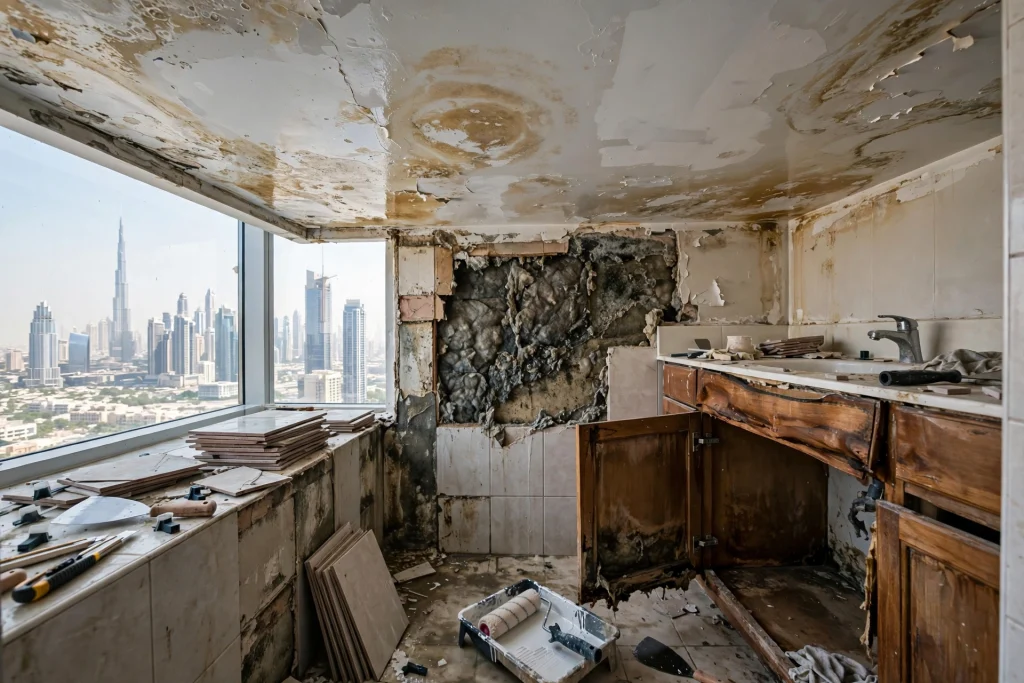
Repairing a water stain without identifying the moisture source can lead to repeated failures.
For example, repainting a damp ceiling may temporarily hide discoloration, but if the leak above remains active, the stain will eventually return.
Similarly, replacing bathroom tiles without addressing failed waterproofing may leave the underlying problem untouched.
Moisture detection helps establish the extent of the problem.
This is particularly important where gypsum board, insulation, timber, cabinetry, or other moisture-sensitive materials have been affected.
Waterproofing Repair Versus Plumbing Repair
These two problems can appear similar but require very different solutions.
A plumbing leak may require pipe repair, joint replacement, fixture repair, or drainage maintenance.
A waterproofing failure may require surface preparation, crack treatment, membrane repair, joint sealing, protective layers, and reinstatement of finishes.
Sometimes both problems exist simultaneously.
A bathroom could have a leaking flexible pipe connection and deteriorated waterproofing.
This is why diagnosis should precede the selection of repair materials.
Choosing a waterproofing membrane for a plumbing leak will not solve the underlying problem.
Preventive Waterproofing Maintenance for High-Rise Buildings
Preventive maintenance is usually more economical than repeatedly responding to major leakage incidents.
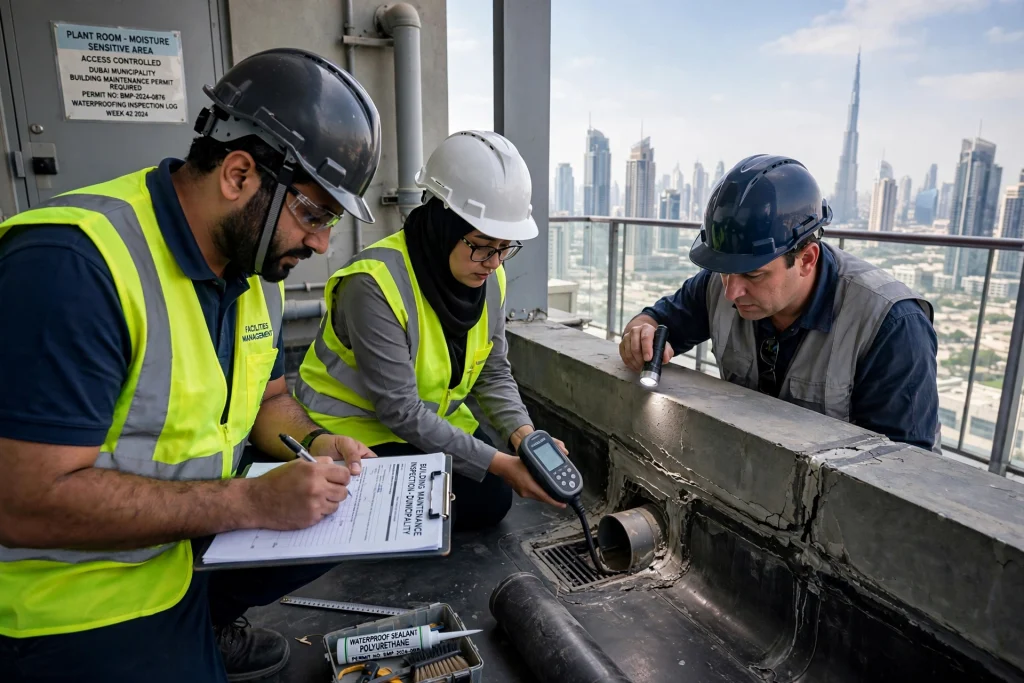
Building managers should monitor roofs, terraces, balconies, wet areas, façade joints, drainage outlets, plumbing systems, plant rooms, and other moisture-sensitive locations.
Drainage outlets should remain clear.
Sealants should be inspected for cracking, separation, and loss of adhesion.
Roof and terrace waterproofing should be checked for deterioration.
Bathroom areas should be monitored for recurring moisture.
External façade interfaces should be inspected as part of appropriate building maintenance programs.
Dubai Municipality has a dedicated regulatory framework covering building maintenance permits and waterproofing-related requirements, reinforcing the importance of managing building systems systematically rather than treating maintenance as an afterthought.
Water Leakage in Dubai Marina High-Rise Buildings
Dubai Marina contains a large concentration of high-rise residential towers and mixed-use developments.
The combination of high-density occupancy, balconies, glazed façades, wet areas, HVAC systems, and extensive vertical plumbing infrastructure means building maintenance must be systematic.
Residents experiencing water stains around windows or balconies should not automatically assume the source is inside their apartment.
External façade joints, balcony waterproofing, drainage, or neighboring units can all be potential sources.
A proper investigation should consider the entire building interface.
Water Leakage in Downtown Dubai and Business Bay
High-rise properties around Downtown Dubai and Business Bay also contain complex combinations of residential, commercial, mechanical, and shared building systems.
Water leakage in these environments can affect multiple units or commercial areas if a problem within a riser, plant room, drainage system, or common area is not addressed promptly.
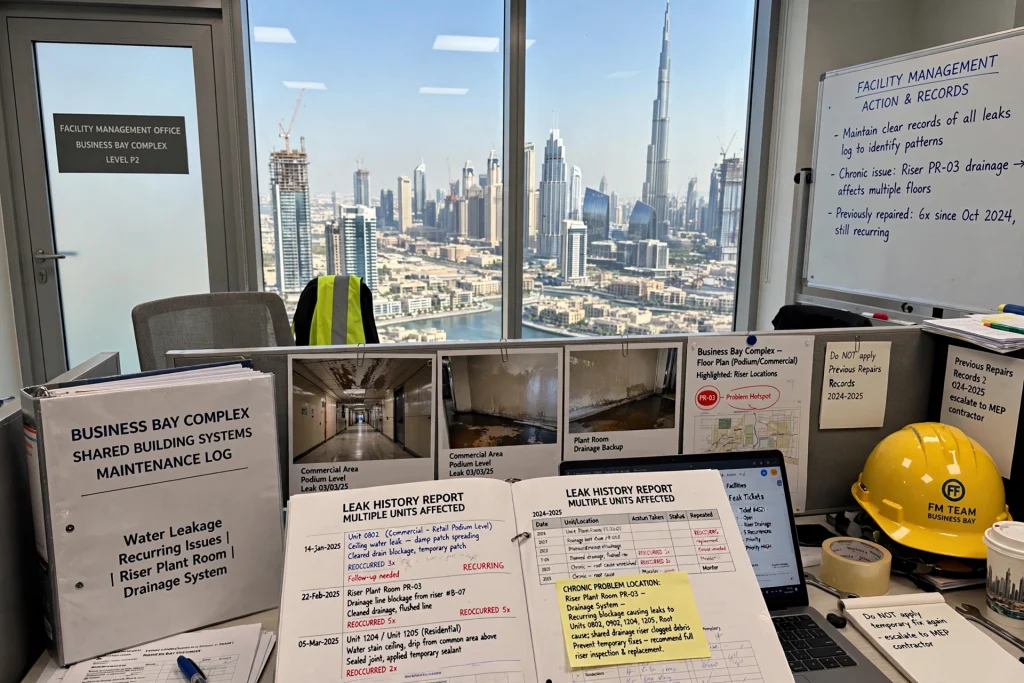
Facility management teams should maintain clear records of recurring leaks.
A history of previous repairs can help identify chronic problem locations and prevent repeated temporary fixes.
Water Leakage in Dubai Marina, JLT and Jumeirah
Different building types require different approaches.
Older towers may experience deterioration of pipes, sealants, and waterproofing components.
Newer buildings may experience defects related to construction, installation, settlement, or finishing interfaces.
In Jumeirah, villa and low-rise properties have different waterproofing configurations from high-rise towers.
In JLT, Dubai Marina, and other dense high-rise communities, vertical service shafts and shared building infrastructure can make leak tracing more complex.
The important principle is to investigate the building according to its construction type rather than applying the same repair method everywhere.
Why Temporary Leakage Repairs Often Fail
A temporary repair can sometimes stop visible water for a short period, but it may not resolve the underlying cause.
Examples include repainting stained ceilings, applying surface sealant over an active joint, replacing only visible grout, or patching a small section of waterproofing without investigating adjacent areas.
Such repairs can create a false sense of resolution.
A professional repair should address the pathway through which water is entering.
This may involve removing damaged finishes, repairing the source, reinstating waterproofing, testing the repair, and then restoring the affected surface.
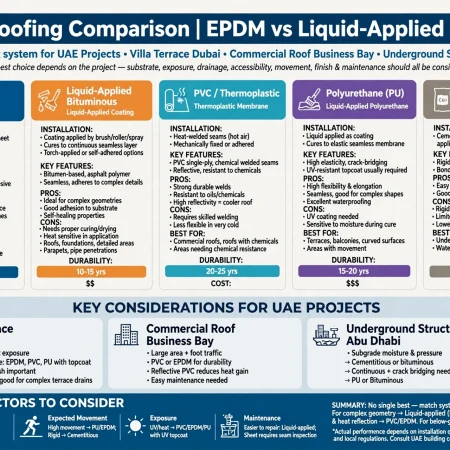
Choosing the Right Waterproofing Approach
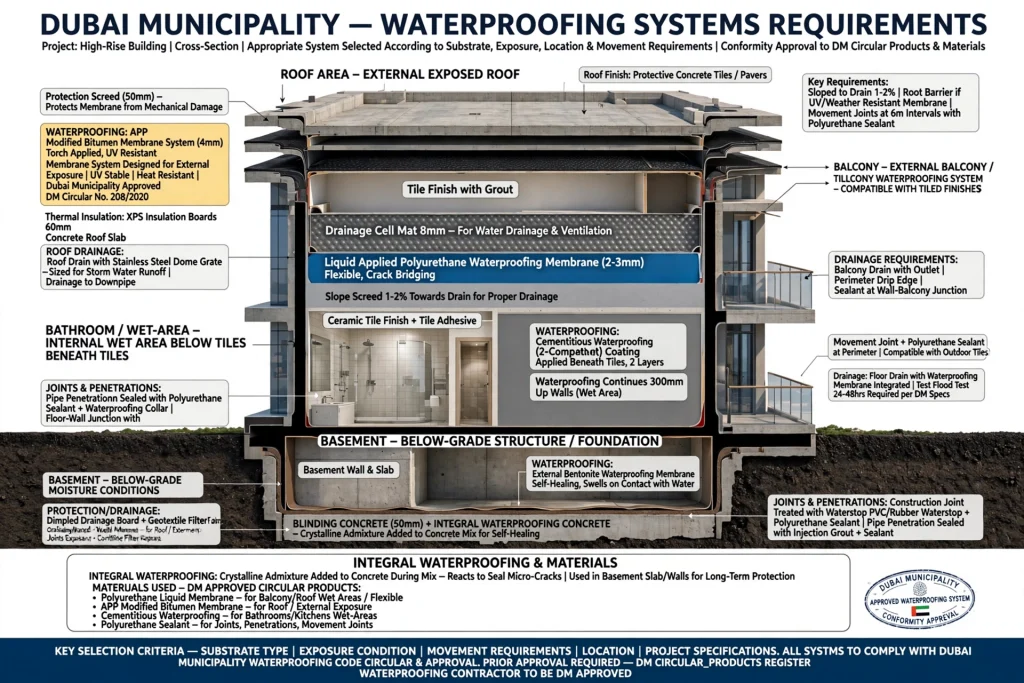
Different building elements require different waterproofing systems.
Roof areas may require membrane systems designed for external exposure.
Bathrooms may require wet-area waterproofing beneath tiles.
Balconies may require systems compatible with tiled finishes and drainage requirements.
Basements may require solutions designed for below-grade moisture conditions.
Joints and penetrations may require specialized sealants or detailing.
Dubai Municipality’s waterproofing circular specifically addresses products and materials used in waterproofing systems and sets requirements for certain integral waterproofing systems, including conformity and approval considerations.
The appropriate system should therefore be selected according to the substrate, exposure, location, movement requirements, and project specifications.
When Building Owners Should Call a Specialist
Professional assessment becomes particularly important when a leak is recurring, the source is unclear, multiple floors are affected, structural or façade areas appear involved, water reaches electrical components, or previous repairs have failed.
For building owners and facility managers, using qualified Waterproofing Contratcors in Dubai can help ensure that the investigation and repair process considers waterproofing, drainage, building movement, substrate conditions, and the actual source of water intrusion rather than only treating visible damage.
The wording and scope of the service should be confirmed carefully before work begins, particularly for high-rise properties where access, permits, common areas, façade work, and building management approvals may be involved.
How to Prevent Major Water Damage
The most effective strategy is proactive maintenance.
Building management should maintain inspection schedules for roofs, terraces, balconies, wet areas, drainage systems, plumbing networks, service shafts, mechanical rooms, and external interfaces.
Residents should report minor signs early rather than waiting until water begins dripping.
Facility teams should document recurring locations and repair history.
After major waterproofing work, appropriate testing should be conducted before finishes are permanently restored.
This approach can reduce the likelihood of hidden moisture continuing behind walls or ceilings.
Final Thoughts on Water Leakage in Dubai High-Rise Buildings
Water leakage in a high-rise building is rarely just a cosmetic problem. It can originate from plumbing, drainage, bathrooms, roofs, balconies, façades, windows, air-conditioning condensate systems, tanks, pumps, or waterproofing assemblies.
The biggest mistake is assuming that the location of the visible stain is automatically the location of the leak.
Water can travel through multiple building components before appearing.
A professional approach therefore starts with inspection, moisture detection, source identification, controlled testing, appropriate repair selection, and post-repair verification.
For Dubai’s high-rise residential and commercial buildings, preventive maintenance is especially valuable because a small leak can affect ceilings, wall finishes, flooring, insulation, cabinetry, electrical systems, and neighboring units if it remains unresolved.
The Dubai Building Code emphasizes health, safety, welfare, environmental considerations, and sustainable building performance, while Dubai Municipality’s published waterproofing requirements demonstrate the importance of appropriate waterproofing materials and systems.
Ultimately, successful water-leakage management is not about covering stains. It is about finding where water is entering, understanding why it is entering, correcting the underlying defect, and verifying that the building envelope or plumbing system is performing properly afterward. That is the approach that provides a more durable solution for apartments, towers, commercial properties, and high-rise buildings across Dubai.