Heating, ventilation, and air conditioning (HVAC) systems play a central role in the performance of modern green buildings. Although green building certification covers many areas, including energy, water, materials, indoor environmental quality, waste, and sustainable site planning, HVAC can influence several of these categories at the same time.
In the UAE, this is particularly important because air conditioning represents a major part of building energy demand. Dubai and Abu Dhabi experience long, hot summers, making efficient cooling essential for residential, commercial, hospitality, retail, healthcare, and industrial buildings.
Green building certification therefore requires more than installing an energy-efficient air conditioner. The complete HVAC system needs to be properly designed, sized, installed, commissioned, controlled, and maintained.
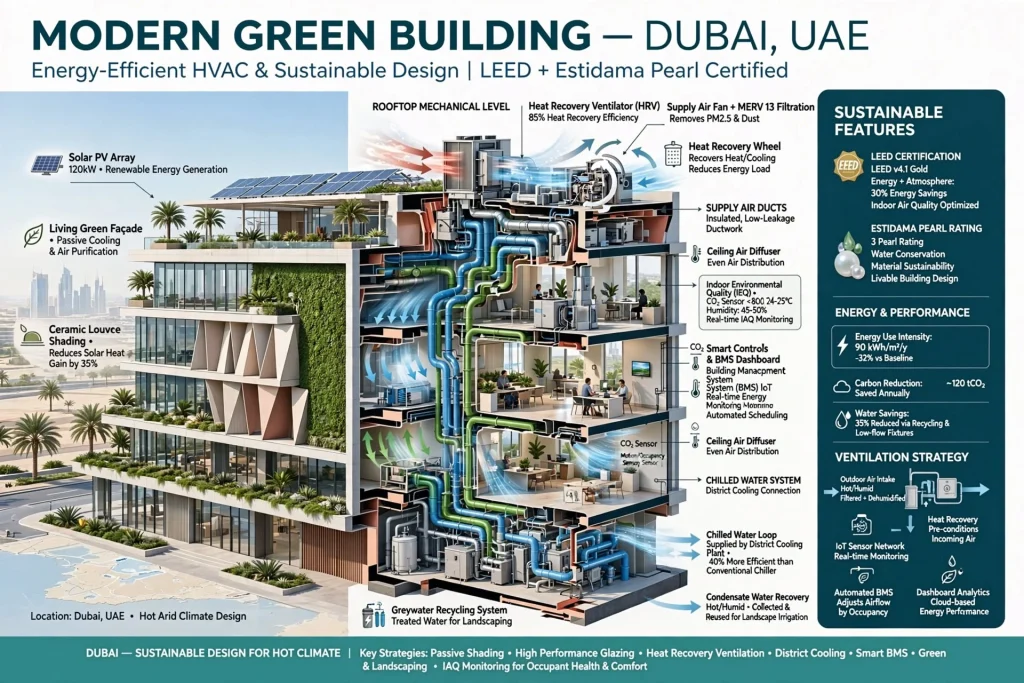
Certification frameworks such as LEED, Estidama Pearl Rating System, and WELL Building Standard place considerable emphasis on energy performance and indoor environmental quality. HVAC design can contribute directly to these objectives through efficient equipment, ventilation strategies, heat recovery, smart controls, commissioning, refrigerant management, and continuous performance monitoring.
What Is Green Building Certification?
Green building certification is a structured process used to evaluate how sustainably a building is designed, constructed, operated, and maintained.
Different certification systems use different assessment criteria, but common objectives include:
Energy efficiency, water conservation, indoor air quality, sustainable materials, waste reduction, occupant comfort, carbon reduction, and operational performance.
The certification process generally involves documentation, calculations, design reviews, inspections, testing, and verification.
For HVAC systems, this means energy-saving claims should be supported by proper engineering and project documentation rather than simply relying on equipment labels.
Why HVAC Matters to Green Buildings
HVAC systems have a direct relationship with building energy consumption.
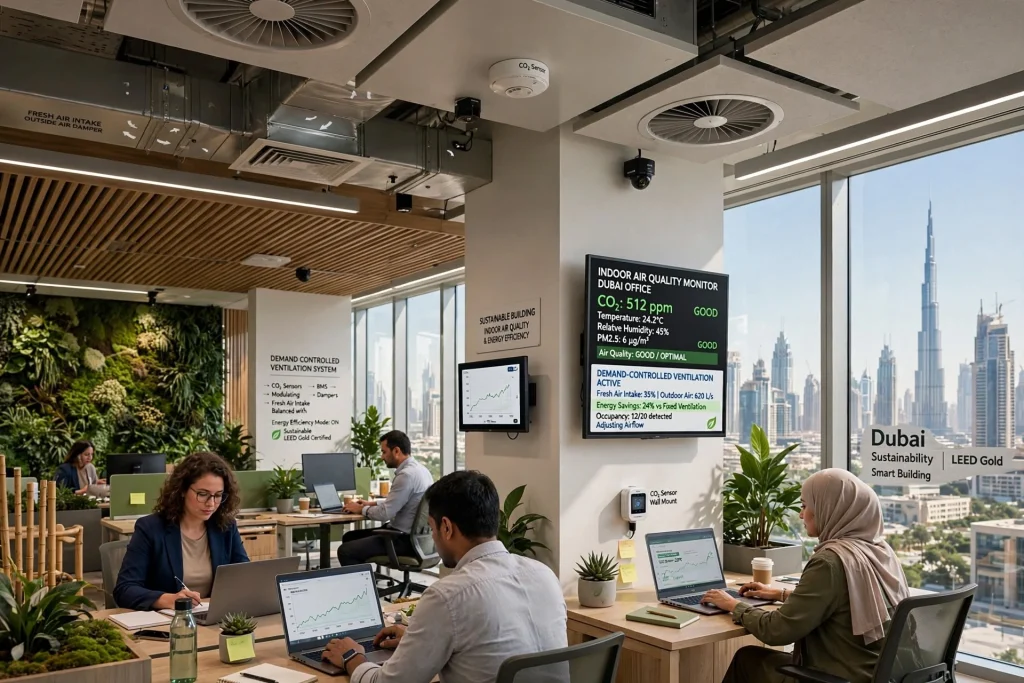
Cooling equipment must remove heat entering a building through:
Solar radiation, windows, walls, roofs, occupants, lighting, computers, appliances, and other equipment.
If an HVAC system is inefficient or incorrectly sized, it may consume more electricity than necessary.
A well-designed system can reduce energy demand while maintaining appropriate indoor temperature, humidity, ventilation, and air quality.
This makes HVAC an important component of sustainable building performance.
HVAC and Energy Efficiency
Energy efficiency is one of the most important connections between HVAC and green certification.
Efficient HVAC design can involve:
High-efficiency chillers, variable-speed drives, efficient pumps, optimized air-handling units, variable air volume systems, efficient fans, heat recovery, smart thermostats, and building automation.
However, equipment efficiency alone does not determine the building’s final energy performance.
The system must also operate under appropriate control strategies.
For example, a highly efficient chiller operating unnecessarily at full load can waste energy. Variable-speed operation and load-based control can help match system output to actual building requirements.
Chiller Plant Efficiency
Large commercial buildings often use centralized chilled-water systems.
A typical chilled-water plant may include:
Chillers, chilled-water pumps, condenser-water pumps, cooling towers, heat exchangers, valves, sensors, expansion systems, air-handling units, and building automation controls.
The efficiency of the complete plant is more important than the efficiency of a single chiller.
Plant optimization may involve sequencing multiple chillers according to demand, optimizing chilled-water temperature, adjusting pump speed, managing cooling tower operation, and monitoring condenser conditions.
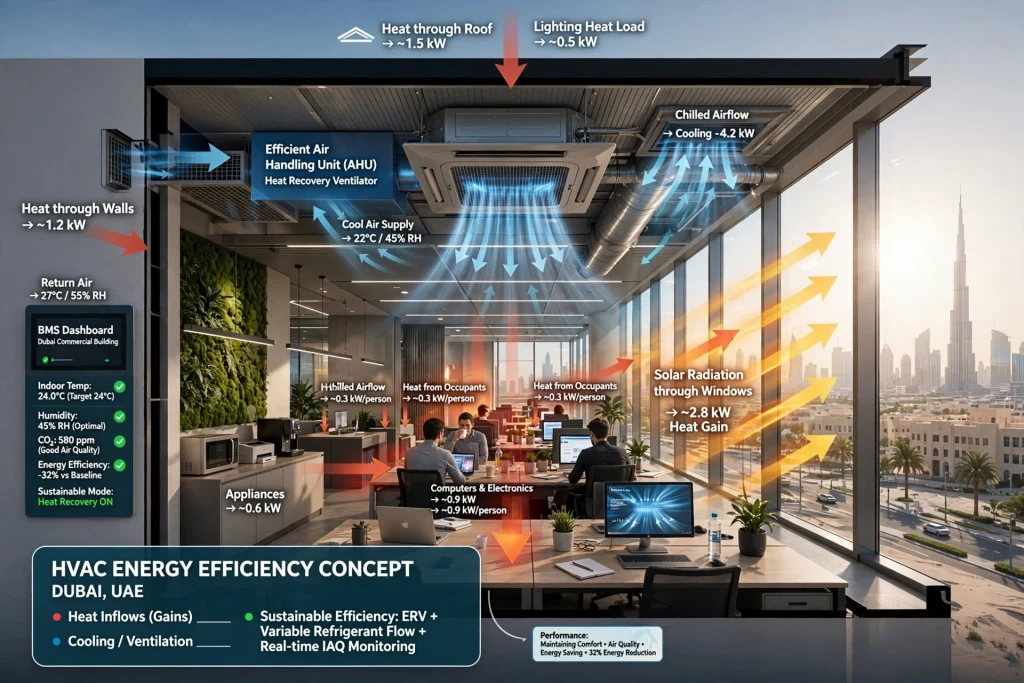
Variable Speed Drives
Variable speed drives (VSDs) can improve HVAC energy performance by allowing motors to operate according to actual demand.
They can be applied to:
Chilled-water pumps, condenser-water pumps, cooling tower fans, supply-air fans, return-air fans, and other motor-driven equipment.
Instead of operating continuously at maximum speed, a VSD can reduce motor speed when demand decreases.
This can produce substantial energy savings in systems where loads vary throughout the day.
Building Management Systems
A Building Management System (BMS) can connect HVAC equipment and controls into a centralized monitoring and automation platform.
A BMS may monitor:
Temperature, humidity, occupancy, airflow, chilled-water temperatures, equipment status, energy consumption, alarms, and operating schedules.
This allows building operators to identify inefficient operation and make adjustments.
BMS integration can also support green certification documentation by providing operational data that demonstrates system performance.
HVAC Automation and Smart Controls
Smart HVAC controls are increasingly important in sustainable buildings.
Control strategies can include:
Occupancy-based operation, temperature reset, supply-air reset, scheduling, demand-controlled ventilation, equipment sequencing, night setback, and fault detection.
These strategies help ensure that HVAC equipment operates when it is actually needed.
For example, an office floor with low occupancy outside working hours does not necessarily require the same ventilation and cooling capacity as it does during peak occupancy.
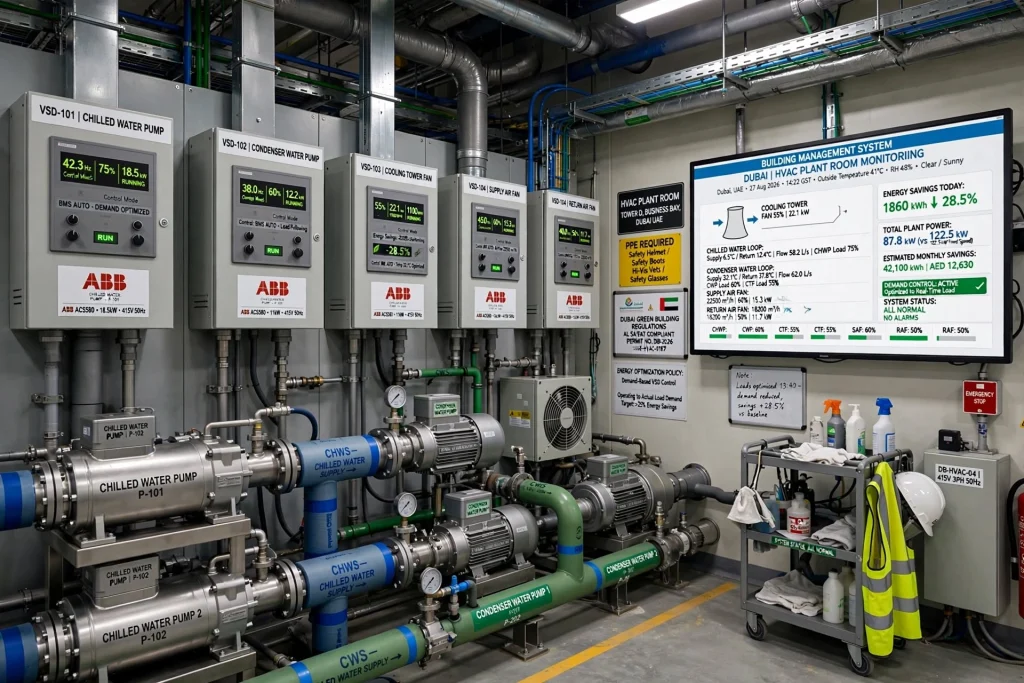
Demand-Controlled Ventilation
Ventilation is necessary for indoor air quality, but excessive ventilation can increase cooling loads.
Demand-controlled ventilation uses sensors to adjust outside-air quantities according to occupancy or indoor air conditions.
Carbon dioxide sensors are commonly used as one indicator of occupancy-related ventilation requirements.
When properly engineered, this approach can balance:
Fresh-air requirements, occupant comfort, indoor air quality, and energy efficiency.
Indoor Air Quality and Green Certification
Energy efficiency should not come at the expense of indoor environmental quality.
Green buildings need to provide appropriate ventilation and acceptable indoor air conditions.
HVAC systems influence:
Fresh-air delivery, filtration, humidity control, temperature, airborne contaminants, and air circulation.
Poorly maintained air-handling systems can negatively affect indoor conditions.
Therefore, sustainable HVAC design should consider both energy performance and occupant wellbeing.
Air Filtration
Filtration is an important part of indoor air quality.
HVAC systems can use appropriately selected filters to reduce airborne particles.
Filter selection should consider:
Particle removal performance, pressure drop, airflow requirements, maintenance frequency, and equipment capability.
Installing a filter with unnecessarily high resistance can increase fan energy consumption.
The goal is to achieve appropriate filtration without creating avoidable system inefficiency.
Humidity Control
Humidity affects thermal comfort and indoor environmental quality.
In hot and humid climates, HVAC systems must often remove both sensible heat and latent moisture.
Dubai’s environmental conditions make humidity management particularly important during certain periods.
Poor humidity control can contribute to:
Condensation, discomfort, mould risk, material deterioration, and indoor air-quality problems.
A properly designed HVAC system should account for latent cooling requirements rather than focusing only on temperature.
Heat Recovery Systems
Heat recovery can reduce the energy required for ventilation.
Depending on the system configuration, heat exchangers can transfer energy between outgoing exhaust air and incoming fresh air.
This can reduce the cooling or heating load associated with outside air.
Heat recovery is particularly valuable in buildings with significant ventilation requirements, including:
Hotels, hospitals, offices, schools, shopping centres, and large commercial facilities.
The design must consider climate conditions, airflow requirements, contamination risks, and system maintenance.
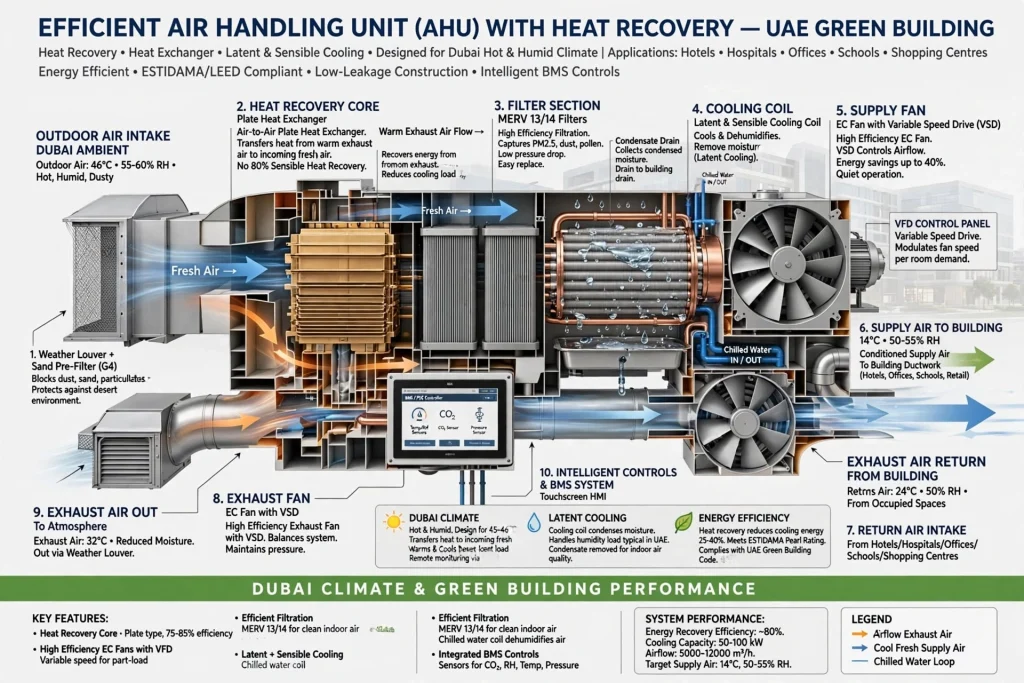
Efficient Air-Handling Units
Air-handling units (AHUs) are central components of many commercial HVAC systems.
An efficient AHU may incorporate:
High-efficiency fans, variable-speed drives, efficient filters, heat recovery, appropriate coils, low-leakage construction, and intelligent controls.
Coil selection also affects system performance.
Dirty coils increase pressure drop and reduce heat-transfer efficiency, forcing equipment to work harder.
Regular maintenance is therefore part of sustainable HVAC operation.
HVAC Commissioning
Commissioning is essential for achieving the performance intended during design.
A properly commissioned HVAC system should be tested to confirm that:
Airflow, water flow, temperature control, sensors, dampers, valves, equipment sequencing, controls, and safety systems operate according to the approved design.
Commissioning can identify issues that may otherwise remain hidden.
For example, a damper that remains partially closed, incorrectly calibrated sensor, or improperly balanced air system can increase energy consumption.
Testing, Adjusting and Balancing
TAB—Testing, Adjusting, and Balancing—helps ensure that air and water distribution systems deliver the required flow.
Air systems may require balancing of:
Supply air, return air, fresh air, exhaust air, and individual terminal outlets.
Hydronic systems may require balancing of:
Chilled-water flow, valves, pumps, and individual branches.
Correct balancing improves comfort and allows equipment to operate closer to its intended design conditions.
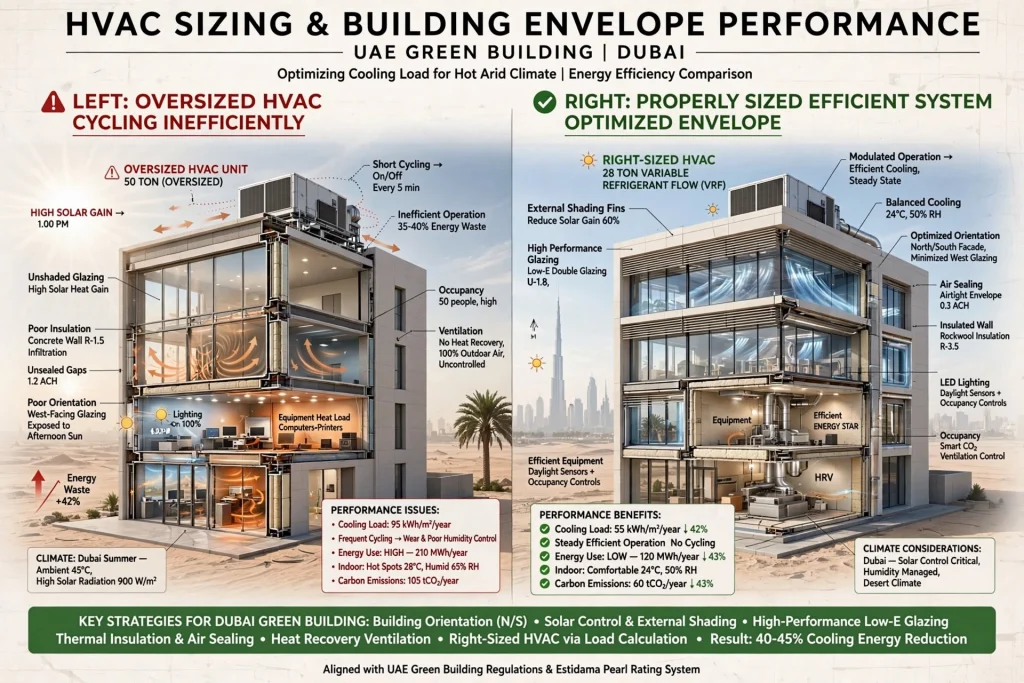
HVAC Sizing and Load Calculation
Oversized HVAC equipment is not automatically more efficient.
If a system is significantly oversized, it may cycle frequently or operate inefficiently at low loads.
Accurate load calculations consider:
Building orientation, solar gain, glazing, insulation, occupancy, lighting, equipment loads, ventilation, infiltration, and local climate conditions.
Proper sizing helps match HVAC capacity to actual building requirements.
Building Envelope and HVAC Performance
HVAC efficiency cannot be considered independently from the building envelope.
A building with:
High-performance glazing, effective insulation, air sealing, external shading, and appropriate solar control
can reduce the cooling load placed on the HVAC system.
This means architects, façade engineers, energy consultants, and HVAC engineers should coordinate early.
Improving the building envelope can sometimes reduce required HVAC capacity, which can subsequently reduce equipment and operating costs.
Solar Heat Gain in UAE Buildings
Solar radiation is a major consideration in UAE building design.
Large glazed façades can receive substantial solar heat, increasing cooling requirements.
Appropriate design may include:
Low-emissivity glazing, solar-control glass, external shading, architectural overhangs, fins, and appropriate building orientation.
Reducing solar heat gain reduces the amount of work required from the HVAC system.
HVAC and LEED Certification
LEED, developed by the U.S. Green Building Council, evaluates building sustainability across several categories.
HVAC systems can contribute to relevant areas through:
Energy performance, commissioning, refrigerant management, indoor environmental quality, monitoring, and efficient building operation.
The exact contribution depends on the certification version and project type.
Energy modelling may also be used to compare proposed building performance with applicable baseline requirements.
HVAC and Estidama in Abu Dhabi
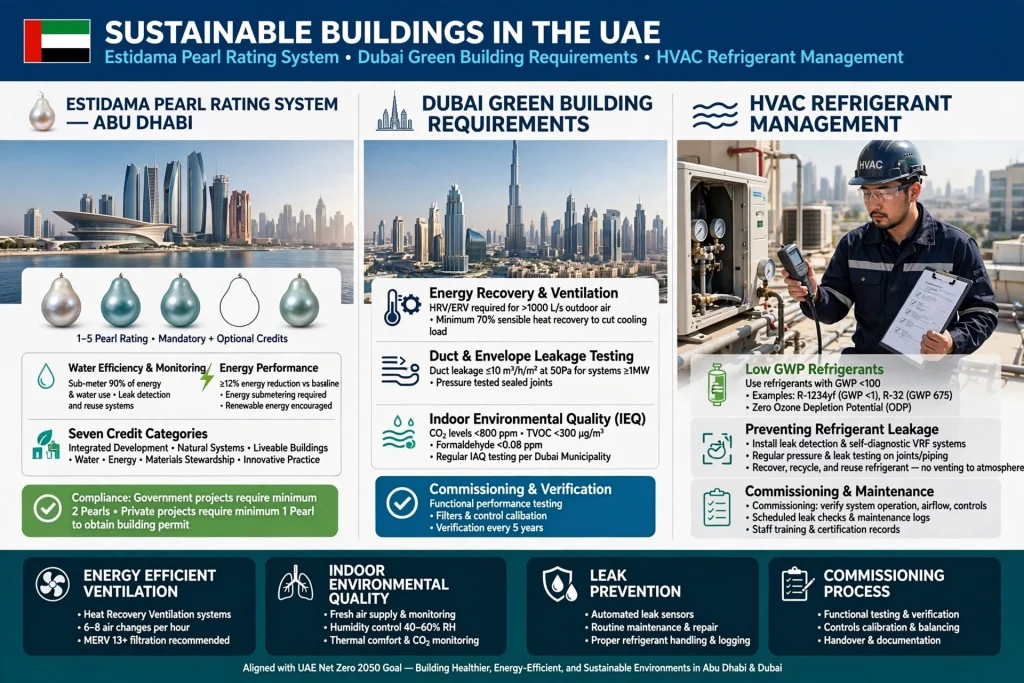
The Estidama Pearl Rating System is particularly relevant to sustainable building development in Abu Dhabi.
Its framework considers aspects of sustainable building design, including energy and indoor environmental considerations.
HVAC design can therefore be coordinated with the project’s wider Estidama requirements.
For projects in Abu Dhabi, HVAC engineers should understand the applicable local regulations, project specifications, authority requirements, and certification documentation.
Dubai Green Building Requirements
Dubai has its own sustainability and building-efficiency requirements, alongside internationally recognized certification systems.
Projects may need to consider:
Energy efficiency, mechanical system performance, ventilation, indoor environmental quality, equipment efficiency, controls, and commissioning.
The specific requirements depend on the building type, authority requirements, project scope, and applicable regulations.
Professional engineering teams should verify current requirements during project planning.
HVAC Refrigerant Management
Refrigerants are another important sustainability consideration.
Certain refrigerants can have significant environmental impacts through:
Global warming potential and, historically, ozone depletion potential.
Modern HVAC design increasingly considers refrigerants with lower environmental impact where technically and legally appropriate.
Proper refrigerant management also involves preventing leakage through correct installation, testing, maintenance, and repair.
Refrigerant Leakage Testing
Poorly installed or maintained systems can develop refrigerant leaks.
Leakage can reduce cooling performance and increase environmental impact.
Technicians should use appropriate procedures for:
Leak detection, pressure testing, evacuation, charging, recovery, and documentation.
Maintenance records can also help identify recurring problems.
Preventive HVAC Maintenance
A sustainable HVAC system must remain efficient throughout its operational life.
Preventive maintenance may include:
Filter replacement, coil cleaning, fan inspection, belt checks, refrigerant checks, electrical inspection, sensor calibration, valve testing, pump inspection, drain cleaning, and control-system verification.
Neglected maintenance can gradually reduce system performance.
For example, dirty condenser coils or blocked filters can increase system resistance and reduce heat-transfer efficiency.
Chiller Maintenance and Green Performance
Chiller plants require particularly careful maintenance because they can represent a significant portion of commercial building energy use.
Maintenance may involve:
Condenser cleaning, evaporator inspection, refrigerant checks, oil analysis, vibration monitoring, tube cleaning, water treatment, pump inspection, and control optimization.
Water quality is also important in chilled-water systems.
Scale, corrosion, and biological growth can reduce heat-transfer efficiency.
Condenser and Cooling Tower Performance
Air-cooled and water-cooled systems have different performance characteristics.
Water-cooled chiller plants generally use cooling towers to reject heat.
Cooling tower performance depends on:
Water temperature, airflow, fan operation, water distribution, fill condition, approach temperature, and maintenance.
Poor cooling tower performance can increase condensing temperature and cause chillers to consume more energy.
Energy Monitoring and Metering
You cannot effectively manage what you do not measure.
Energy monitoring systems can track:
Whole-building electricity, HVAC energy, chiller plant consumption, pump energy, fan energy, and other major loads.
Submetering can help building operators identify where energy is being consumed.
Trend data can also reveal unusual performance.
For example, an HVAC system that consumes significantly more energy than expected during similar operating conditions may require investigation.
Predictive Maintenance and HVAC
Modern buildings can use sensors and analytics to identify potential HVAC problems before major failures occur.
Predictive maintenance can analyze:
Temperature trends, vibration, pressure, energy consumption, equipment runtime, valve positions, and fault codes.
This can help maintenance teams prioritize interventions.
The approach can reduce unexpected downtime while helping equipment remain close to optimal operating conditions.
Artificial Intelligence in Sustainable HVAC
AI and machine-learning technologies are increasingly being explored for HVAC optimization.
Potential applications include:
Demand forecasting, fault detection, equipment optimization, occupancy prediction, energy-use analysis, and automated control adjustment.
For example, an intelligent system could analyze historical occupancy and weather patterns to predict cooling demand.
However, AI does not replace sound engineering.
Sensors, controls, equipment, commissioning, and reliable data remain essential.
Renewable Energy and HVAC
HVAC systems can also interact with renewable energy strategies.
Buildings equipped with solar photovoltaic systems can potentially offset electricity consumed by air-conditioning equipment.
Energy storage can further help manage demand.
The overall objective is to reduce the building’s dependence on high-carbon energy sources while maintaining reliable indoor comfort.
HVAC and Net-Zero Buildings
Net-zero and low-carbon buildings require significant reductions in operational energy.
HVAC optimization can support this goal through:
Passive cooling strategies, high-performance building envelopes, efficient equipment, heat recovery, smart controls, renewable energy, energy monitoring, and demand management.
In hot climates, achieving low-energy cooling performance can be particularly challenging.
This makes early HVAC and architectural coordination essential.
Importance of HVAC Design During the Early Project Stage
HVAC should not be treated as a system that is added after the architectural design is complete.
Early coordination allows engineers to determine:
Plant-room requirements, duct routes, equipment locations, shaft sizes, ceiling spaces, service access, façade requirements, ventilation paths, and electrical loads.
This reduces conflicts during construction.
It also allows the building team to compare different system strategies before significant capital has already been committed.
Choosing an HVAC Specialized Company
Green building projects require more than basic air-conditioning installation.
The HVAC contractor or engineering company should understand:
Energy-efficient HVAC design, BMS integration, commissioning, TAB, ventilation, controls, chiller systems, refrigerant management, local regulations, maintenance, and sustainability objectives.
Working with an HVAC Specialized Company can help coordinate mechanical installation and operational requirements with the wider sustainability strategy.
The contractor should also be capable of producing appropriate testing and commissioning documentation when required by the project.
HVAC Documentation for Green Certification
Documentation is a critical part of certification.
Depending on the project and certification system, documentation may include:
Equipment schedules, efficiency data, design calculations, commissioning reports, testing results, refrigerant information, control sequences, energy models, operation manuals, and maintenance records.
Incomplete documentation can make it difficult to demonstrate that the installed system meets the intended performance.
Common HVAC Mistakes in Green Buildings
Several mistakes can reduce the sustainability benefits of a building.
These include:
Oversized equipment, inadequate commissioning, poor duct sealing, insufficient insulation, incorrect sensor calibration, poor air balancing, inefficient controls, neglected maintenance, inappropriate ventilation rates, and inadequate equipment sequencing.
Another common mistake is selecting equipment solely according to its efficiency rating without considering complete system performance.
A holistic approach is more effective.
HVAC Insulation and Duct Sealing
Ductwork carries conditioned air throughout a building.
Poor insulation can increase unwanted heat transfer.
Air leakage can also cause conditioned air to escape before reaching the intended space.
Properly installed:
Duct insulation, vapor barriers, seals, joints, flexible connections, and access panels
can improve system performance.
The exact insulation requirements should follow applicable standards, specifications, and climate conditions.
The Role of HVAC in Occupant Comfort
Green buildings are ultimately designed for people.
HVAC contributes to:
Thermal comfort, indoor air quality, humidity control, ventilation, noise management, and consistent temperatures.
A building that saves energy but creates uncomfortable indoor conditions may not deliver a successful occupant experience.
Modern HVAC design therefore seeks to optimize both energy efficiency and human comfort.
Future of Green HVAC Systems
The future of sustainable HVAC is likely to involve greater integration between mechanical equipment, building automation, sensors, energy management, and data analytics.
Emerging strategies include:
AI-assisted optimization, advanced heat pumps, low-GWP refrigerants, thermal energy storage, predictive maintenance, smart ventilation, digital twins, advanced metering, and demand-response systems.
The HVAC system of the future will increasingly operate as part of a connected building rather than as an isolated mechanical system.
Frequently Asked Questions
Why is HVAC important for green building certification?
HVAC can have a major impact on building energy consumption, indoor air quality, thermal comfort, and operational performance. Efficient design, controls, commissioning, and maintenance can therefore contribute to sustainability objectives.
Does an energy-efficient air conditioner automatically make a building green?
No. Building sustainability depends on the complete system, including the building envelope, HVAC design, controls, ventilation, lighting, water systems, materials, renewable energy, and operational practices.
Can a BMS improve HVAC energy efficiency?
Yes. A properly designed BMS can monitor and control HVAC equipment according to schedules, occupancy, temperature, demand, and system conditions.
Why is HVAC commissioning important?
Commissioning verifies that equipment, controls, airflow, water flow, sensors, and sequences operate according to the design intent. It can identify problems that waste energy or reduce comfort.
How does HVAC affect indoor air quality?
HVAC controls ventilation, filtration, airflow, temperature, and humidity. Correct design and maintenance can help provide healthier and more comfortable indoor environments.
Is HVAC maintenance important for green buildings?
Yes. Poorly maintained equipment can lose efficiency over time. Regular maintenance helps preserve heat-transfer performance, airflow, controls, and equipment reliability.
Conclusion
HVAC is one of the most important technical systems contributing to green building performance. Its influence extends beyond cooling and ventilation because it affects energy consumption, carbon emissions, indoor air quality, thermal comfort, operational costs, and building performance.
For buildings in Dubai, Abu Dhabi, and the wider UAE, efficient HVAC design is particularly important because of the region’s demanding cooling requirements. Chiller plants, AHUs, FCUs, ventilation systems, pumps, cooling towers, ductwork, controls, and BMS platforms must operate as an integrated system.
Green building certification should therefore be approached from a whole-building perspective. High-efficiency equipment should be supported by accurate load calculations, proper sizing, quality installation, duct and pipe insulation, testing and balancing, commissioning, smart controls, energy monitoring, and preventive maintenance.
Whether a project is targeting LEED, Estidama, WELL, local sustainability requirements, or simply better operational efficiency, HVAC professionals have an important role in turning sustainability objectives into measurable building performance.
The most successful green HVAC strategy is not simply about installing newer equipment. It is about designing a system that uses less energy, delivers appropriate ventilation, maintains occupant comfort, responds to real building demand, and continues performing efficiently throughout its operating life.