Heating, Ventilation, and Air Conditioning (HVAC) systems play an essential role in maintaining comfortable indoor environments across residential homes, commercial buildings, hospitals, hotels, shopping malls, educational institutions, and industrial facilities. In Dubai, where temperatures remain extremely high for much of the year, HVAC systems are not considered a luxury, they are a necessity for ensuring occupant comfort, maintaining indoor air quality, and supporting efficient building operations.
Although residential and commercial HVAC systems serve the same basic purpose of controlling indoor temperature, humidity, and airflow, they differ significantly in design, capacity, installation, maintenance requirements, energy consumption, and overall complexity. Understanding these differences helps property owners, facility managers, and businesses choose the most suitable system for their specific needs.
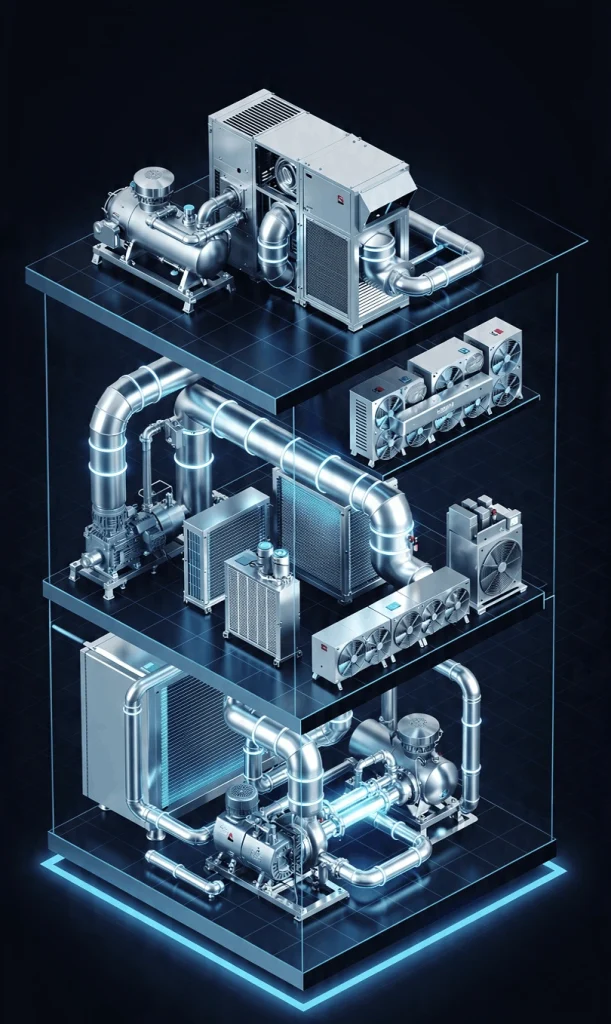
Modern HVAC systems consist of several integrated components including compressors, condensers, evaporator coils, ductwork, air handling units (AHUs), fan coil units (FCUs), thermostats, ventilation equipment, filters, refrigerant lines, and smart building controls. Commercial properties often include advanced technologies such as Building Management Systems (BMS), Variable Air Volume (VAV) systems, chilled water plants, and energy recovery ventilation, while residential buildings typically use split air conditioners, ducted split systems, packaged units, or VRF systems designed for smaller cooling loads.
Understanding how these systems operate allows property owners to improve energy efficiency, reduce operating costs, and maintain healthier indoor environments.
Understanding Residential HVAC Systems
Residential HVAC systems are designed to provide heating, cooling, ventilation, and humidity control for homes, villas, apartments, and townhouses. Unlike commercial buildings, residential properties usually accommodate fewer occupants and have lower cooling demands. As a result, residential HVAC equipment is generally smaller, less complex, and easier to maintain.
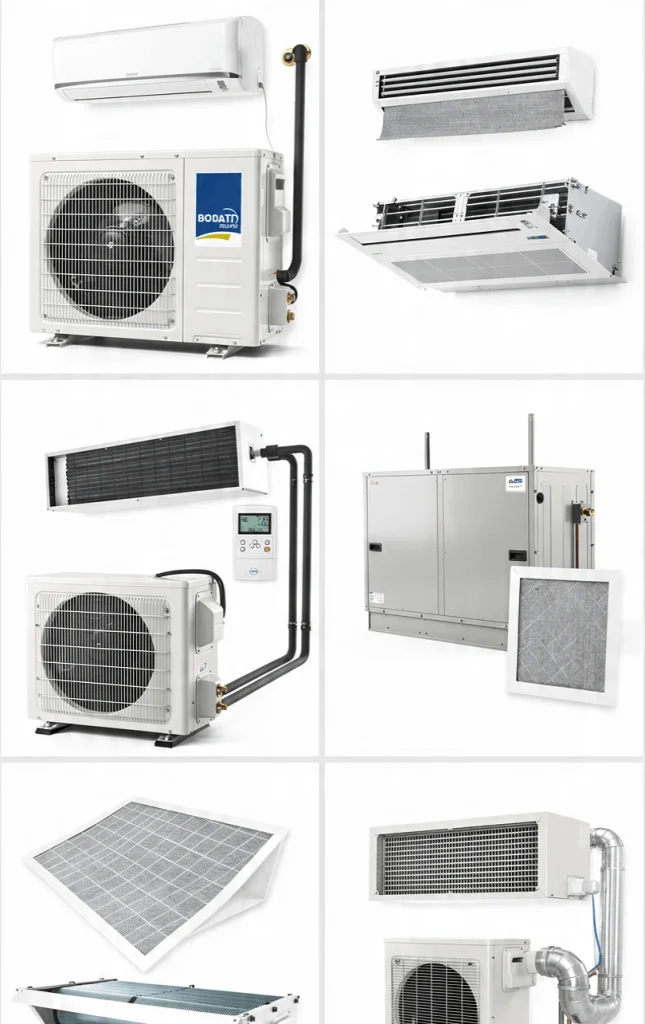
The most common residential cooling systems in Dubai include split air conditioners, ducted split units, packaged units, VRF systems for larger villas, and centralized air conditioning in premium residential developments. These systems are designed to provide consistent cooling while operating quietly and efficiently throughout the year.
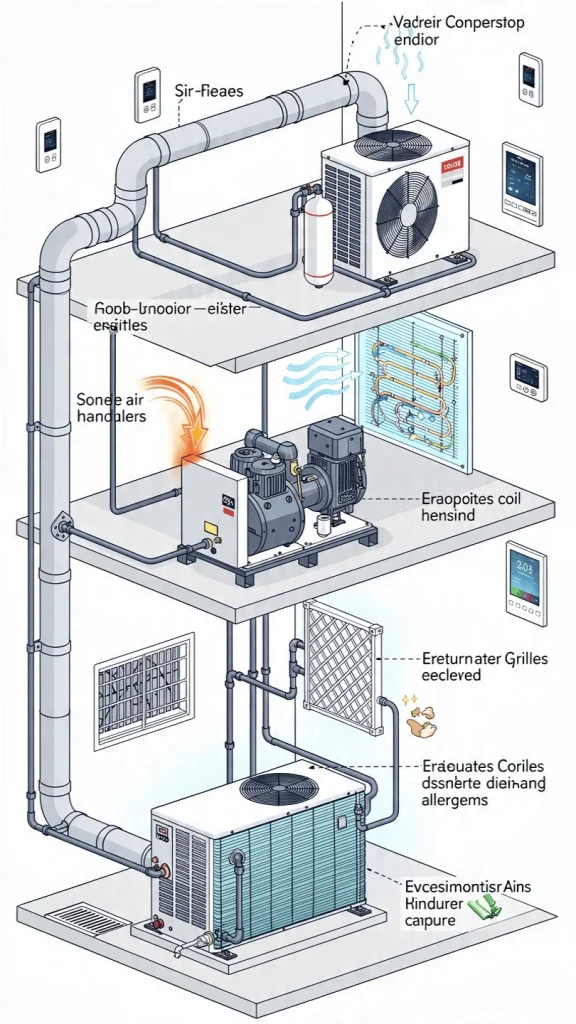
A residential HVAC system typically includes an outdoor condensing unit, indoor evaporator coil, air handler, thermostat, refrigerant piping, ductwork, return air grilles, supply diffusers, and filtration components. Together, these elements distribute conditioned air evenly throughout the living space while maintaining comfortable temperatures.
Indoor air quality also plays an important role in residential environments. Clean air filters, balanced airflow, proper ventilation, and regular duct cleaning help reduce airborne dust, allergens, pollen, mold spores, and other contaminants that affect occupant health.
Modern residential HVAC systems also incorporate programmable thermostats and smart controls, allowing homeowners to optimize cooling schedules, reduce electricity consumption, and improve comfort levels.
Key Components of Residential HVAC Systems
Although residential HVAC systems appear simple from the outside, they rely on several interconnected components working together efficiently.
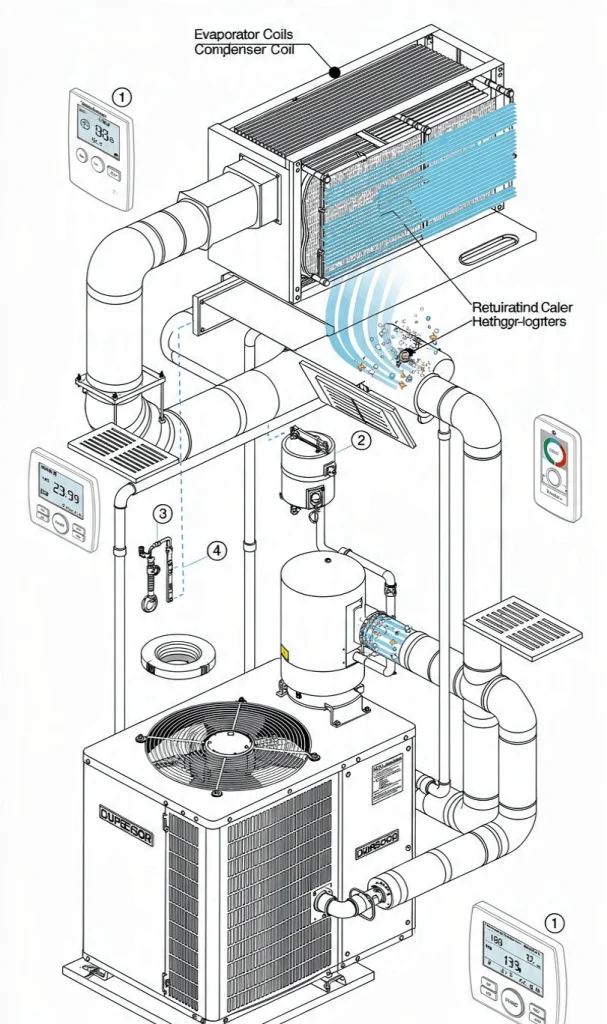
The compressor is considered the heart of the cooling system because it circulates refrigerant between indoor and outdoor units. The condenser coil releases heat collected from inside the building, while the evaporator coil absorbs indoor heat and cools circulating air.
The air handler distributes conditioned air through ductwork, ensuring each room receives adequate airflow. Supply diffusers deliver cooled air into occupied spaces, while return air grilles allow warm air to return to the HVAC system for recooling.
Air filters capture dust particles, allergens, and airborne contaminants before they circulate through the home. High-quality filtration improves indoor air quality while protecting mechanical components from dust accumulation.
Thermostats continuously monitor indoor temperatures and communicate with HVAC equipment to maintain desired comfort levels. Smart thermostats provide remote access, automated scheduling, and energy-saving features that improve operational efficiency.
Understanding Commercial HVAC Systems
Commercial HVAC systems are engineered to serve larger buildings with significantly higher cooling demands. Office towers, hotels, shopping malls, hospitals, educational institutions, manufacturing facilities, warehouses, airports, and mixed-use developments require sophisticated HVAC infrastructure capable of supporting hundreds or even thousands of occupants simultaneously.
Unlike residential systems, commercial HVAC installations are highly customized based on building size, occupancy levels, operational schedules, internal heat loads, and architectural design.
Commercial buildings commonly utilize chilled water systems, air handling units (AHUs), fan coil units (FCUs), rooftop packaged units, Variable Refrigerant Flow (VRF) systems, cooling towers, chillers, pumps, heat exchangers, and centralized Building Management Systems (BMS).
These components operate together to maintain temperature consistency across multiple floors, departments, and occupancy zones. Individual areas within the same building often require different cooling conditions depending on usage. For example, server rooms, conference halls, restaurants, office spaces, and retail outlets each have unique cooling requirements.
Commercial HVAC systems also emphasize ventilation, fresh air intake, humidity control, smoke management, and energy efficiency to comply with local building regulations and international indoor air quality standards.
Major Differences Between Residential and Commercial HVAC Systems
Although both residential and commercial HVAC systems regulate indoor climate, their engineering principles differ considerably.
Residential systems are generally standardized and manufactured in predefined capacities suitable for homes. Installation is relatively straightforward because equipment serves a limited number of rooms with predictable cooling loads.
Commercial HVAC systems require customized engineering calculations before installation begins. Mechanical engineers analyze building orientation, occupancy density, equipment heat generation, ventilation requirements, insulation performance, glazing characteristics, and operational schedules before selecting HVAC equipment.
Capacity also differs substantially. Residential units typically range from one to five tons of cooling capacity, while commercial chillers and packaged units may provide hundreds of tons of cooling to support large buildings.
Control systems represent another major distinction. Residential HVAC relies primarily on individual thermostats, whereas commercial buildings use centralized Building Management Systems that monitor equipment performance, temperatures, humidity, airflow, energy consumption, and maintenance alerts in real time.
Maintenance requirements are equally different. Residential systems generally require seasonal servicing, while commercial HVAC equipment demands preventive maintenance programs involving multiple technicians, scheduled inspections, filter replacement, airflow balancing, refrigerant monitoring, and mechanical performance testing.
Residential HVAC Systems in Dubai Hills
Dubai Hills features luxury villas, townhouses, and premium residential communities where efficient residential HVAC systems are essential for maintaining indoor comfort throughout the year.
Many villas use centralized ducted split systems or VRF technology capable of cooling multiple rooms independently. Homeowners increasingly invest in smart thermostats, zoning controls, and energy-efficient equipment to reduce electricity costs while improving comfort.
Proper maintenance is especially important because dust accumulation inside filters and air ducts reduces cooling efficiency. Routine inspection of evaporator coils, condensers, refrigerant levels, and ventilation systems ensures consistent performance during Dubai’s hottest months.
Indoor air quality has also become a growing concern for families. Clean filters, balanced airflow, and professional duct maintenance help reduce allergens, dust, and airborne contaminants circulating throughout residential properties.
Commercial HVAC Applications in Business Bay
Business Bay is one of Dubai’s busiest commercial districts, housing office towers, hotels, retail centers, and mixed-use developments. These buildings require advanced HVAC systems capable of supporting varying occupancy levels throughout the day.
Commercial facilities in Business Bay commonly utilize chilled water systems connected to large air handling units and fan coil units. Variable Air Volume systems adjust airflow according to occupancy, reducing unnecessary energy consumption while maintaining comfortable indoor conditions.
Building Management Systems continuously monitor equipment performance, allowing facility managers to optimize energy usage and schedule preventive maintenance before equipment failures occur.
Commercial properties also require specialized ventilation systems that introduce fresh outdoor air while removing indoor contaminants. Maintaining clean ducts and mechanical equipment becomes essential for protecting indoor air quality and ensuring efficient building operation.
Professional maintenance combined with Residential and Commercial HVAC Cleaning Service in Dubai Downtown helps improve airflow, reduce dust accumulation, maintain healthy indoor environments, and extend the operational lifespan of HVAC equipment.
Commercial HVAC Systems in Dubai Marina
Dubai Marina is one of the busiest mixed-use communities in Dubai, combining residential towers, luxury hotels, restaurants, retail outlets, fitness centers, and commercial offices. Buildings in this district require sophisticated HVAC systems capable of maintaining comfortable indoor environments despite varying occupancy levels throughout the day.
Unlike residential cooling systems, commercial buildings in Dubai Marina often operate twenty-four hours a day. Hotels require continuous air conditioning for guest rooms, restaurants generate significant internal heat from kitchens, and office towers experience fluctuating cooling demands during business hours.
To meet these requirements, commercial buildings frequently use centralized chilled water systems connected to Air Handling Units (AHUs), Fan Coil Units (FCUs), cooling towers, condenser water pumps, chilled water pumps, and Building Management Systems (BMS).
Each floor or zone can operate independently, allowing facility managers to optimize cooling according to occupancy. This zoning approach improves energy efficiency while reducing unnecessary operating costs.
Routine inspection of ductwork, air filters, evaporator coils, condensers, dampers, and ventilation systems ensures that cooling performance remains consistent throughout the year.
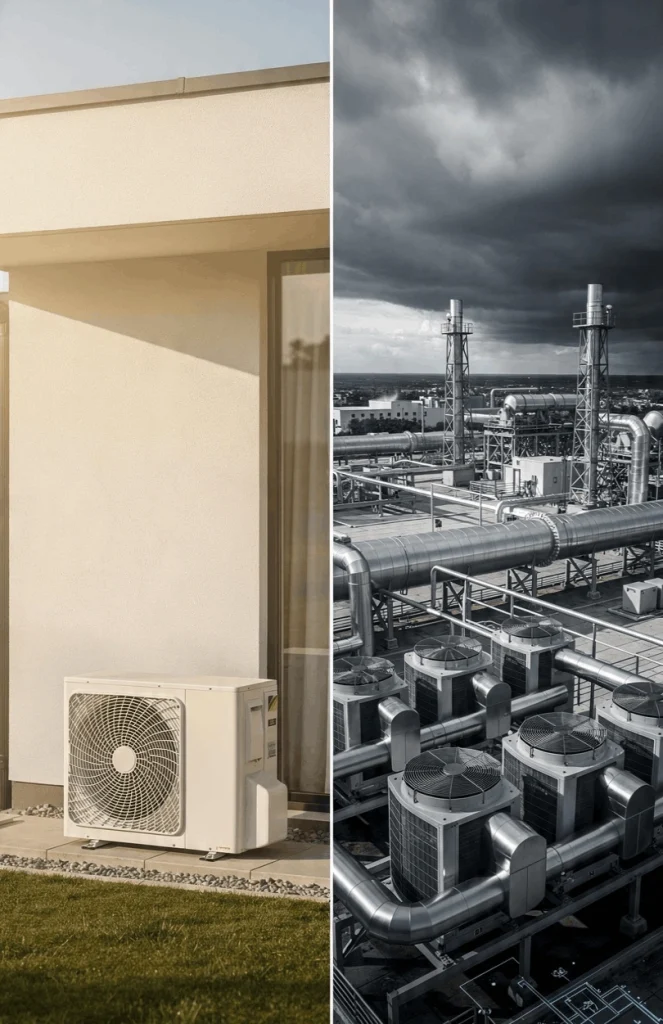
Residential HVAC Solutions in Palm Jumeirah Villas
Palm Jumeirah is home to luxury waterfront villas and premium residential developments where indoor comfort is a priority throughout every season.
Large villas often require multiple indoor units connected to a Variable Refrigerant Flow (VRF) system or centralized ducted air conditioning capable of serving several floors simultaneously.
Unlike commercial buildings, residential HVAC systems focus primarily on occupant comfort rather than large-scale operational efficiency. Homeowners value quiet operation, precise temperature control, low energy consumption, and healthy indoor air quality.
Modern villas increasingly integrate smart thermostats with mobile applications, allowing homeowners to control temperatures remotely while reducing electricity usage during unoccupied periods.
Proper maintenance of refrigerant levels, condensers, evaporator coils, return air filters, and duct systems helps maintain cooling performance while preventing unexpected breakdowns during Dubai’s peak summer months.
HVAC Systems for Commercial Offices in DIFC
Dubai International Financial Centre (DIFC) accommodates banks, multinational corporations, investment firms, legal offices, and financial institutions that depend on reliable climate control.
Office buildings in DIFC contain numerous workspaces, conference rooms, server rooms, executive offices, and reception areas, each requiring different cooling conditions.
Commercial HVAC systems maintain these conditions through advanced zoning strategies using Variable Air Volume (VAV) systems and centralized Building Management Systems.
Meeting rooms may require additional cooling during presentations, while server rooms operate continuously to protect sensitive equipment. The HVAC system automatically adjusts airflow and temperature based on occupancy and operational requirements.
Because financial institutions require uninterrupted operations, preventive maintenance programs are carefully scheduled to minimize disruption while ensuring mechanical reliability.
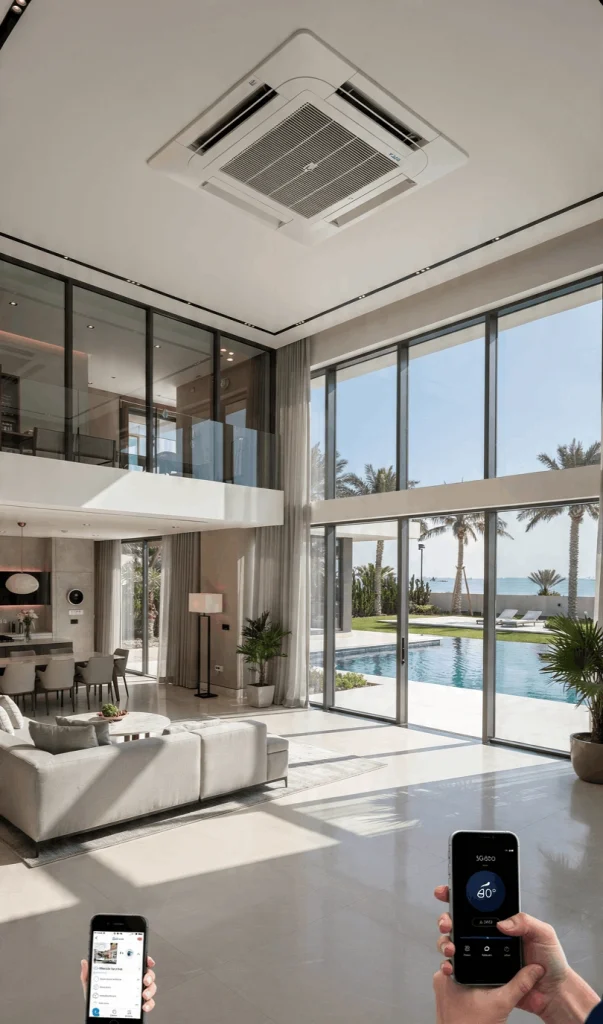
HVAC Requirements for Residential Communities in Arabian Ranches
Arabian Ranches consists primarily of villas, landscaped communities, and family-oriented residential developments.
Unlike commercial properties, cooling demands vary according to family size, daily routines, and seasonal occupancy. Residential HVAC systems prioritize comfort, energy efficiency, and low operating noise.
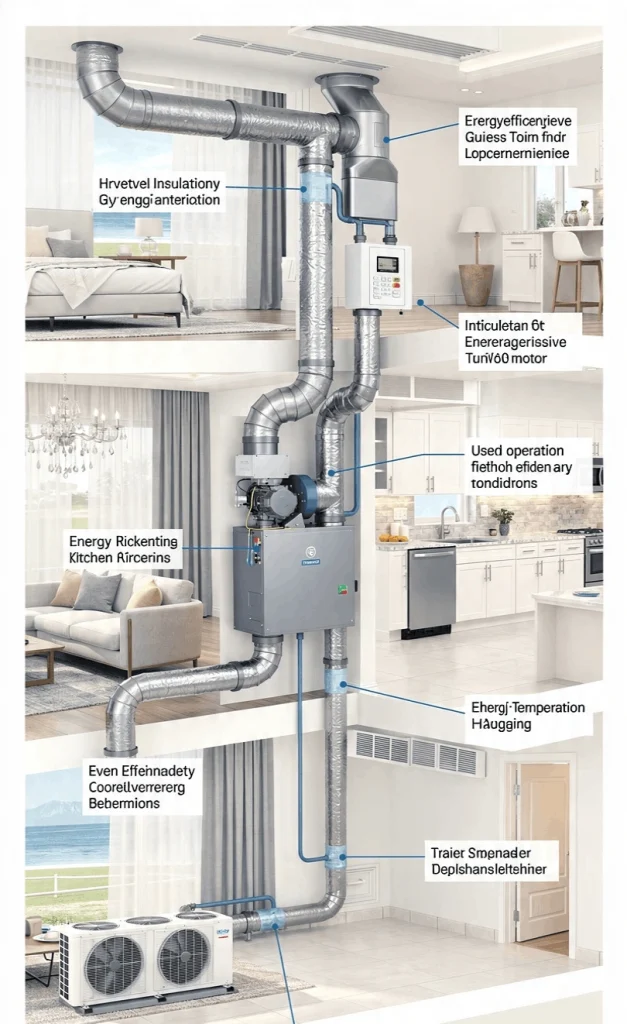
Well-designed duct systems distribute conditioned air evenly throughout bedrooms, living areas, kitchens, and common spaces without creating uncomfortable temperature variations.
Homeowners benefit from regular inspection of duct insulation, air filters, drain lines, condensers, thermostats, and blower motors to maintain efficient operation.
Professional servicing also improves equipment lifespan while reducing electricity consumption.
Air Distribution: Residential vs Commercial HVAC
Air distribution represents one of the biggest engineering differences between residential and commercial HVAC systems.
Residential systems usually rely on relatively simple duct networks serving individual rooms from a single air handler. Supply diffusers distribute conditioned air while return grilles collect warmer indoor air for recirculation.
Commercial buildings require significantly more complex air distribution systems.
Large office towers may contain hundreds of supply diffusers, return air pathways, fire dampers, balancing dampers, variable air volume boxes, and multiple air handling units operating simultaneously.
Engineers perform airflow balancing to ensure every occupied space receives the correct amount of conditioned air.
Proper balancing improves occupant comfort while preventing excessive energy consumption.
Ventilation Requirements
Ventilation is another area where residential and commercial systems differ considerably.
Residential ventilation generally focuses on introducing adequate outdoor air while removing indoor pollutants generated through cooking, cleaning, and daily living activities.
Commercial buildings require significantly greater ventilation capacity because they accommodate larger numbers of occupants.
Restaurants require dedicated kitchen exhaust systems.
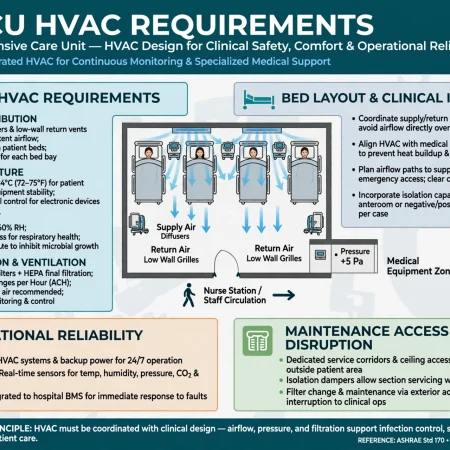
Hospitals require specialized filtration and pressure-controlled environments.
Shopping malls require continuous fresh air supply throughout large public spaces.
Office buildings must comply with ventilation standards that maintain healthy indoor air quality while minimizing energy losses.
Mechanical ventilation systems often include Energy Recovery Ventilators (ERVs) that transfer heat between incoming and outgoing air streams, improving overall efficiency.
Indoor Air Quality in Residential Buildings
Indoor Air Quality (IAQ) has become increasingly important for homeowners across Dubai.
Dust, allergens, mold spores, pollen, bacteria, pet dander, and airborne contaminants accumulate inside residential HVAC systems over time.
Dirty filters reduce airflow while allowing pollutants to circulate throughout the home.
Proper filtration, balanced humidity levels, clean ductwork, and routine maintenance significantly improve indoor air quality.
Many homeowners now install HEPA filtration systems, ultraviolet disinfection devices, and advanced air purification technologies to create healthier indoor environments.
Regular maintenance helps protect vulnerable family members suffering from asthma, allergies, or respiratory conditions.
Indoor Air Quality in Commercial Buildings
Commercial buildings present much greater IAQ challenges due to higher occupancy and longer operating hours.
Hundreds of employees, customers, visitors, and tenants continuously generate indoor pollutants that circulate through HVAC systems.
Dust accumulation inside air handling units, ductwork, cooling coils, and ventilation systems reduces airflow while affecting occupant health.
Poor indoor air quality may contribute to headaches, fatigue, allergies, respiratory irritation, and reduced workplace productivity.
Facility managers therefore implement preventive maintenance schedules involving filter replacement, coil cleaning, airflow balancing, ventilation inspection, humidity monitoring, and duct cleaning.
Maintaining healthy indoor environments improves employee comfort while supporting business operations.
Building Management Systems (BMS)
Most commercial HVAC systems are integrated with sophisticated Building Management Systems.
A BMS continuously monitors HVAC equipment throughout the building, collecting information about temperatures, humidity, airflow, equipment performance, energy consumption, alarms, and maintenance schedules.
Unlike residential thermostats that control individual systems, Building Management Systems coordinate multiple chillers, pumps, cooling towers, AHUs, FCUs, and ventilation equipment simultaneously.
Facility managers receive real-time performance data that allows them to identify problems before equipment failures occur.
Predictive maintenance reduces repair costs while improving overall building efficiency.
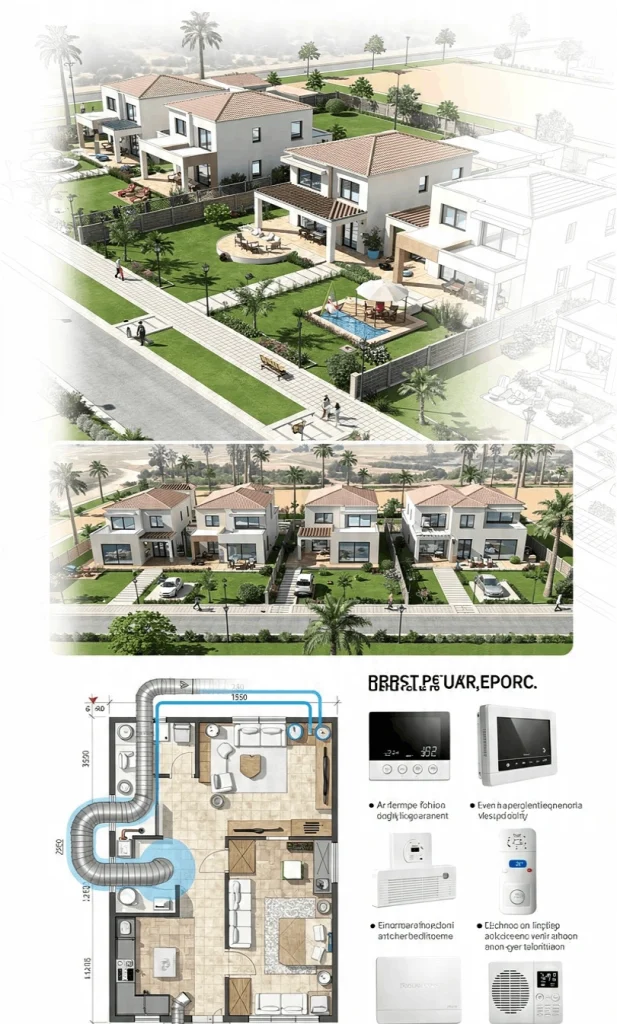
Energy Efficiency Comparison
Energy efficiency remains a priority for both residential and commercial properties.
Residential homeowners often reduce electricity consumption by installing inverter air conditioners, programmable thermostats, improved insulation, double-glazed windows, and high-efficiency filters.
Commercial facilities adopt larger-scale energy-saving strategies including chilled water optimization, Variable Frequency Drives (VFDs), Building Management Systems, occupancy sensors, demand-controlled ventilation, and Energy Recovery Ventilation.
Regular maintenance also contributes significantly to energy efficiency.
Dirty filters, blocked coils, leaking ducts, and poorly balanced airflow increase mechanical workload, forcing equipment to consume more electricity.
Professional maintenance and Residential and Commercial HVAC Cleaning Service in Dubai Downtown help restore airflow, improve cooling efficiency, reduce energy costs, and maintain healthy indoor environments for both residential and commercial properties.
HVAC Maintenance Requirements for Residential Systems
Routine maintenance is one of the most important factors in extending the lifespan of a residential HVAC system. Although residential units are less complex than commercial systems, they still require regular servicing to maintain cooling efficiency and indoor comfort.
A standard residential maintenance program includes cleaning or replacing air filters, inspecting evaporator and condenser coils, checking refrigerant pressure, testing thermostats, cleaning drain lines, inspecting electrical connections, lubricating moving components, and verifying proper airflow throughout the home.
During Dubai’s long cooling season, residential air conditioning systems often operate for extended periods every day. Dust and sand particles gradually accumulate inside filters, coils, blower assemblies, and ductwork. If left untreated, these contaminants reduce airflow, increase energy consumption, and place additional strain on compressors and fan motors.
Preventive maintenance allows technicians to identify worn components before they fail. Replacing inexpensive parts during scheduled servicing often prevents expensive emergency repairs and reduces system downtime.
Commercial HVAC Maintenance Programs
Commercial HVAC maintenance is considerably more detailed because buildings contain larger equipment operating under heavier workloads. Hotels, shopping malls, hospitals, educational institutions, office towers, and industrial facilities rely on uninterrupted cooling to maintain daily operations.
Maintenance programs usually follow monthly, quarterly, semi-annual, and annual schedules depending on equipment type and building usage.
Technicians inspect chillers, cooling towers, pumps, Air Handling Units (AHUs), Fan Coil Units (FCUs), Variable Air Volume (VAV) boxes, ductwork, Building Management Systems (BMS), refrigerant circuits, electrical panels, and ventilation systems.
Cooling towers require water treatment to prevent scale buildup and bacterial growth. Chilled water systems undergo performance testing to ensure efficient heat transfer, while air handling units receive coil cleaning, filter replacement, and airflow balancing.
Commercial maintenance also includes vibration analysis, motor inspections, belt replacement, damper calibration, and energy performance monitoring. These preventive measures reduce operating costs while extending equipment lifespan.
Common Residential HVAC Problems
Residential HVAC systems develop problems gradually if routine maintenance is neglected. One of the most common issues is clogged air filters, which restrict airflow and reduce cooling performance.
Dirty evaporator coils reduce heat transfer efficiency, forcing compressors to work harder and increasing electricity bills. Refrigerant leaks can also reduce cooling capacity while causing compressors to overheat.
Blocked condensate drain lines may result in water leakage, ceiling stains, or mold growth inside the property. Faulty thermostats often create inconsistent temperatures, while damaged blower motors reduce airflow throughout the home.
Poorly insulated ductwork can cause conditioned air to escape before reaching occupied rooms, reducing system efficiency.
Early diagnosis of these problems helps homeowners avoid expensive repairs while maintaining comfortable indoor temperatures.
Common Commercial HVAC Challenges
Commercial HVAC systems experience different operational challenges because they serve larger buildings with varying occupancy levels.
Uneven cooling between departments often results from improper airflow balancing or malfunctioning VAV systems. Dirty cooling coils reduce energy efficiency, while damaged dampers prevent proper airflow distribution.
Building automation failures may affect temperature control across multiple zones simultaneously. Cooling tower issues, pump failures, refrigerant leaks, sensor malfunctions, and electrical faults can significantly impact building operations.
Commercial facilities also face greater indoor air quality challenges due to higher occupant density. Dust accumulation inside ductwork, ventilation systems, and air handling units reduces airflow while circulating contaminants throughout occupied spaces.
Preventive maintenance programs minimize these risks while improving equipment reliability.
HVAC Energy Consumption
Energy consumption represents one of the largest operating expenses for both residential and commercial buildings in Dubai.
Residential systems consume electricity based primarily on house size, insulation quality, occupancy, thermostat settings, and outdoor temperatures.
Commercial buildings require much larger cooling capacities because of lighting systems, office equipment, elevators, computers, kitchens, and continuous occupancy.
Energy-efficient HVAC operation depends on proper equipment sizing. Oversized systems cycle on and off frequently, reducing efficiency, while undersized systems operate continuously without reaching desired temperatures.
Routine maintenance, clean filters, properly sealed ducts, optimized airflow, and smart controls all contribute to lower electricity consumption.
Many commercial facilities now implement predictive maintenance using Building Management Systems to monitor energy performance continuously and identify opportunities for optimization.
The Role of Ductwork in HVAC Performance
Ductwork is often overlooked, yet it plays a major role in HVAC efficiency.
Residential duct systems distribute conditioned air from the indoor unit to bedrooms, living rooms, kitchens, and other occupied spaces. Leaking or poorly insulated ducts reduce airflow and waste energy.
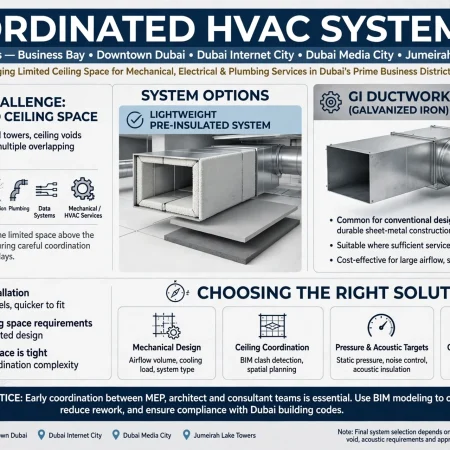
Commercial duct systems are significantly more extensive, serving multiple floors, departments, conference rooms, retail spaces, restaurants, and common areas.
Properly designed ductwork maintains balanced airflow while minimizing pressure losses. Fire dampers, balancing dampers, insulation, acoustic treatment, and access panels are incorporated into commercial systems to improve safety and maintenance accessibility.
Over time, dust accumulates inside ducts, reducing airflow and affecting indoor air quality. Professional duct inspection and cleaning restore system performance while improving occupant comfort.
Sustainability and Green HVAC Technologies
Sustainability has become a major priority in modern building design across Dubai.
Residential homeowners increasingly invest in inverter air conditioners, smart thermostats, high-performance insulation, solar-assisted cooling technologies, and energy-efficient windows.
Commercial developments pursue green building certifications by integrating advanced HVAC technologies such as chilled beam systems, Energy Recovery Ventilators (ERVs), Variable Frequency Drives (VFDs), demand-controlled ventilation, and intelligent Building Management Systems.
Environmentally responsible refrigerants with lower Global Warming Potential (GWP) are also replacing older refrigerants to reduce environmental impact.
Efficient HVAC systems not only lower operating costs but also improve occupant comfort while supporting sustainability objectives.
Future of HVAC Systems in Dubai
Rapid urban development and technological innovation continue transforming HVAC design throughout Dubai.
Artificial intelligence is increasingly being integrated into Building Management Systems, enabling predictive maintenance, automatic fault detection, and real-time performance optimization.
Internet of Things (IoT) sensors continuously monitor indoor air quality, humidity, occupancy, equipment vibration, and energy consumption.
Smart buildings automatically adjust cooling based on occupancy patterns, weather conditions, and operational schedules, reducing unnecessary energy usage.
Residential systems are also becoming more intelligent through voice-controlled thermostats, mobile applications, and machine learning algorithms that optimize cooling preferences for homeowners.
These technologies improve reliability while reducing maintenance costs and electricity consumption.
Choosing the Right HVAC System
Selecting the appropriate HVAC system depends on building type, occupancy, operational requirements, available space, energy goals, and long-term maintenance considerations.
Residential properties generally benefit from split systems, ducted split units, packaged systems, or VRF technology depending on property size and cooling requirements.
Commercial buildings require detailed engineering analysis before selecting chillers, rooftop units, AHUs, FCUs, VAV systems, ventilation equipment, and Building Management Systems.
Professional HVAC engineers evaluate cooling loads, building orientation, insulation performance, occupancy density, internal heat gains, ventilation requirements, and future expansion before recommending suitable equipment.
Proper system selection ensures optimal comfort, energy efficiency, and operational reliability.
Why Professional HVAC Cleaning Matters
Even the most advanced HVAC equipment cannot perform efficiently if dust, debris, and contaminants accumulate inside mechanical components.
Air filters, evaporator coils, condensers, ductwork, ventilation systems, and air handling units gradually collect dust that restricts airflow and reduces cooling capacity.
Professional cleaning restores airflow, improves indoor air quality, reduces equipment strain, and extends the operational life of HVAC systems.
For commercial facilities, routine cleaning also supports compliance with health and safety standards while improving employee productivity and customer comfort.
Businesses and homeowners alike benefit from scheduled Residential and Commercial HVAC Cleaning Service in Dubai Downtown, ensuring cleaner indoor air, better cooling performance, lower energy consumption, and reduced maintenance costs throughout the year.
Conclusion
Residential and commercial HVAC systems may share the same objective of providing comfortable indoor environments, but they differ significantly in design, capacity, complexity, operation, and maintenance requirements. Residential systems prioritize comfort, simplicity, and energy efficiency for homes and villas, while commercial HVAC systems are engineered to support large buildings with diverse occupancy patterns, sophisticated zoning requirements, and advanced automation.
From Dubai Hills and Arabian Ranches to Business Bay, DIFC, Dubai Marina, and Palm Jumeirah, selecting the right HVAC solution depends on the unique needs of each property. Understanding these differences enables homeowners, business owners, and facility managers to make informed decisions regarding equipment selection, maintenance planning, and long-term operational efficiency.
Regular preventive maintenance, clean ductwork, balanced airflow, quality filtration, and modern HVAC technologies contribute to healthier indoor environments, lower operating costs, and longer equipment lifespan. Whether managing a residential villa or a large commercial complex, investing in professional HVAC care ensures reliable performance and year-round comfort in Dubai’s demanding climate.