Water pipes are designed to deliver clean water safely and reliably, but no plumbing system lasts forever. Over time, pipe corrosion, mineral deposits, chemical reactions, pressure fluctuations, temperature changes, and poor installation conditions can affect the condition of a water distribution system.
Corrosion can be particularly concerning when it develops inside concealed pipes. A pipe may continue supplying water normally while its internal wall gradually deteriorates. By the time a property owner notices discolored water, low pressure, recurring leaks, or damp walls, the underlying problem may already have progressed.
For properties in Dubai, Abu Dhabi, Sharjah, Ajman, Ras Al Khaimah, Fujairah, and Al Ain, understanding the early warning signs is important. Local environmental conditions, water chemistry, building age, pipe material, temperature, and maintenance practices can all influence plumbing performance.
This guide explains the major signs of water-pipe corrosion, what causes them, how professionals investigate the problem, and when repair or replacement becomes more appropriate.
What Is Water Pipe Corrosion?
Water pipe corrosion is the gradual deterioration of a pipe material caused by chemical or electrochemical reactions with its surrounding environment.
The process differs according to the material.
Copper pipes can experience corrosion under certain water-chemistry conditions.
Galvanized steel pipes can develop internal rust and scale as their protective coating deteriorates.
Cast iron systems can experience internal corrosion and external deterioration.
Modern polymeric materials such as PPR and PEX do not rust in the same way as metallic pipes, although they can still experience other forms of degradation if exposed to unsuitable conditions.
Corrosion does not always mean that the entire plumbing network needs immediate replacement. The correct response depends on the pipe material, severity, location, leakage history, water quality, remaining wall thickness, and overall condition of the system.
1. Brown, Yellow, or Rust-Colored Water
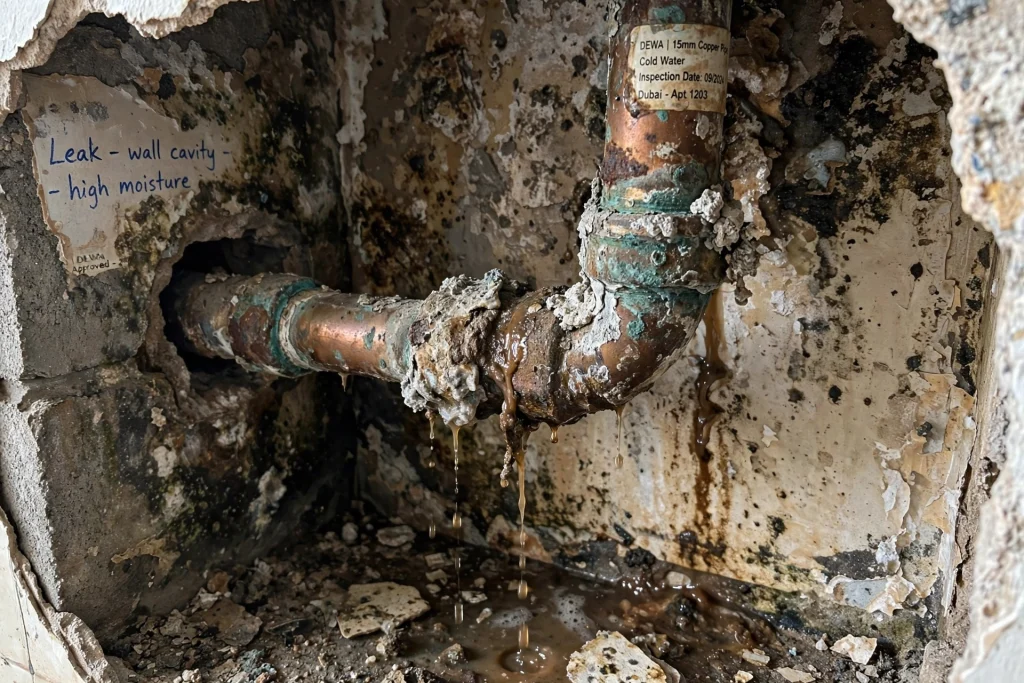
One of the most recognizable warning signs is unusual water discoloration.
If water appears brown, orange, yellow, or reddish, corrosion or sediment inside metallic plumbing may be responsible.
Rust-colored water can occur when iron-containing materials corrode and release particles into the water. It can also happen when deposits inside older pipes are disturbed by maintenance work, changes in water flow, or pressure fluctuations.
However, discoloration does not automatically prove that the building’s pipes are corroding.
The source could also involve:
- Water-storage tanks
- Building supply lines
- Municipal connections
- Internal valves
- Water heaters
- Sediment
- Nearby plumbing repairs
A professional inspection should therefore determine where the discoloration originates rather than replacing pipes based solely on water color.
2. Metallic Taste or Unusual Water Odor
Changes in the taste or smell of water can sometimes indicate a plumbing-related issue.
Copper, iron, stagnant water, sediment, and other materials can influence water characteristics.
If water develops an unusual metallic taste, especially after sitting in the plumbing system, the property’s water distribution system should be investigated.
For potable-water systems, the investigation should consider the complete pathway from the incoming supply through storage tanks, pumps, filters, valves, water heaters, risers, branch pipes, and fixtures.
A water-quality test can provide useful information when the cause is unclear.
3. Low Water Pressure
Low water pressure is another important warning sign, although corrosion is only one possible cause.
As metallic pipes deteriorate internally, corrosion products and mineral scale can accumulate inside the pipe.
The effective internal diameter gradually becomes smaller.
This restricts water flow and can result in noticeably weaker pressure at faucets, showers, or other fixtures.
For example, an older galvanized steel water line may have an apparently normal external diameter while the internal passage has become significantly restricted.
Low pressure can also result from:
- Blocked filters
- Faulty pressure-reducing valves
- Partially closed valves
- Pump problems
- Leaking pipes
- Incorrect pipe sizing
- Municipal supply conditions
Therefore, a professional diagnosis should distinguish between pipe corrosion and other hydraulic problems.
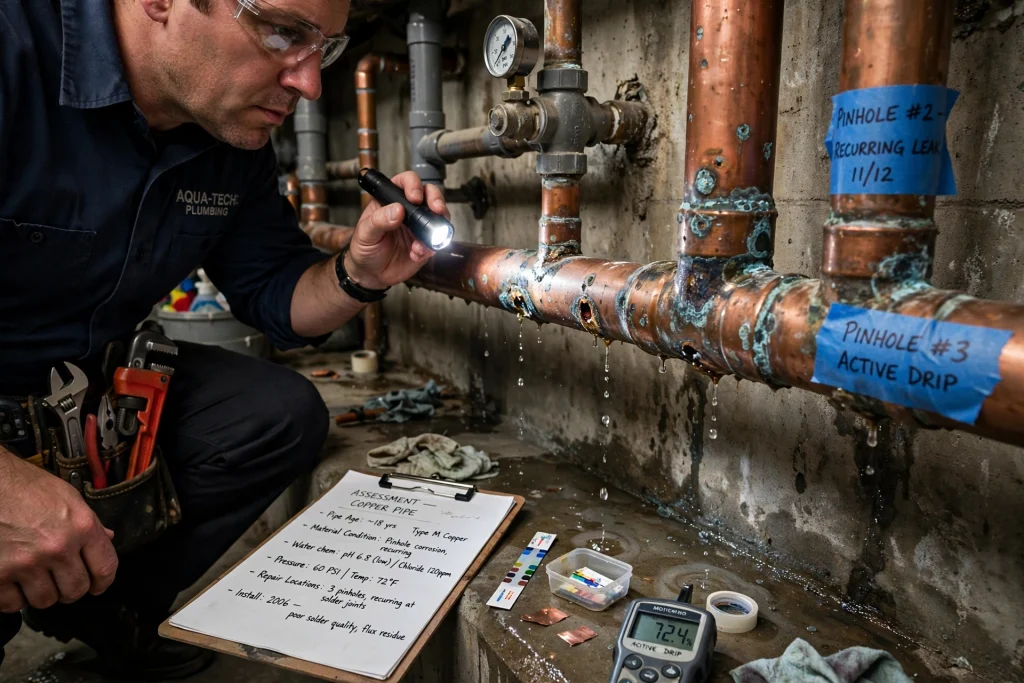
4. Frequent Pin-Hole Leaks
Small recurring leaks are one of the more serious signs of pipe deterioration.
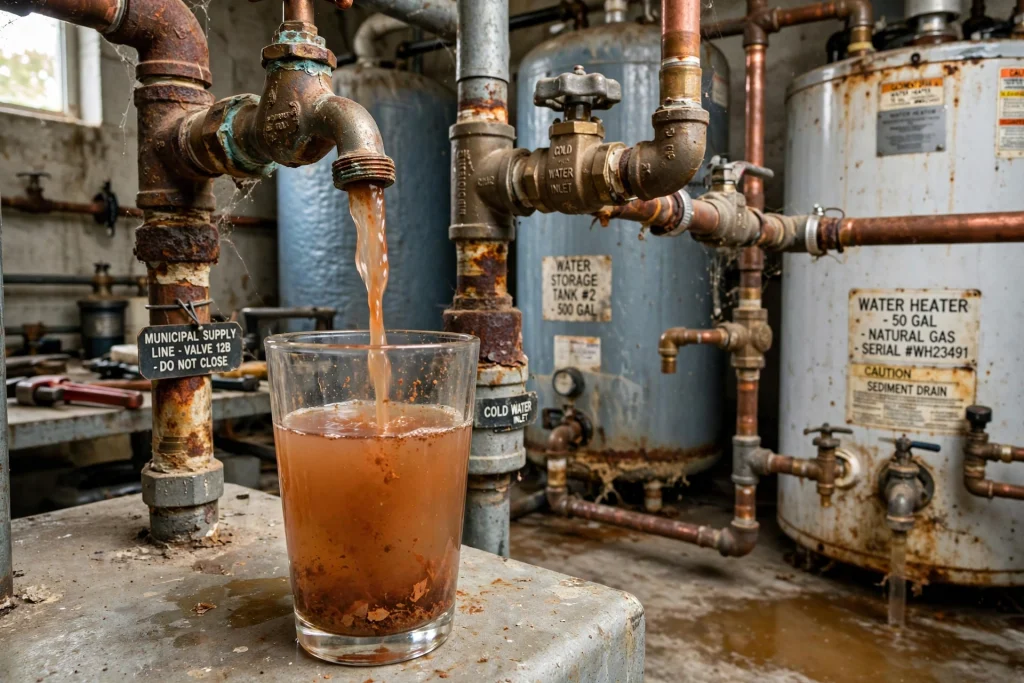
Copper pipes can develop pin-hole leaks, where localized corrosion creates tiny openings through the pipe wall.
The initial leak may appear insignificant, but repeated failures in the same plumbing network can indicate a broader material or water-chemistry problem.
If a property has experienced several pipe leaks over a relatively short period, repairing each individual hole may not address the underlying issue.
A professional assessment should examine:
- Pipe age
- Pipe material
- Water chemistry
- Previous repair locations
- Operating pressure
- Temperature
- Installation quality
- External environmental conditions
The objective is to determine whether the leak is an isolated defect or evidence of systemic deterioration.
5. Damp Walls and Ceiling Stains
Corroded water pipes can eventually leak inside walls, ceilings, floors, or service shafts.
The first visible indication may not be the pipe itself.
Instead, property owners may notice:
Brown ceiling stains, peeling paint, bubbling plaster, damp patches, mold-like growth, swollen cabinetry, or damaged flooring.
Concealed leaks can be especially problematic in apartments and villas because water can travel along building structures before becoming visible.
Properties in Jumeirah, Dubai Hills, Arabian Ranches, Palm Jumeirah, Business Bay, and Dubai Marina contain many different building configurations, so the location of a visible stain does not necessarily identify the exact leak location.
Professional leak detection can help identify the source before extensive finishes are removed.
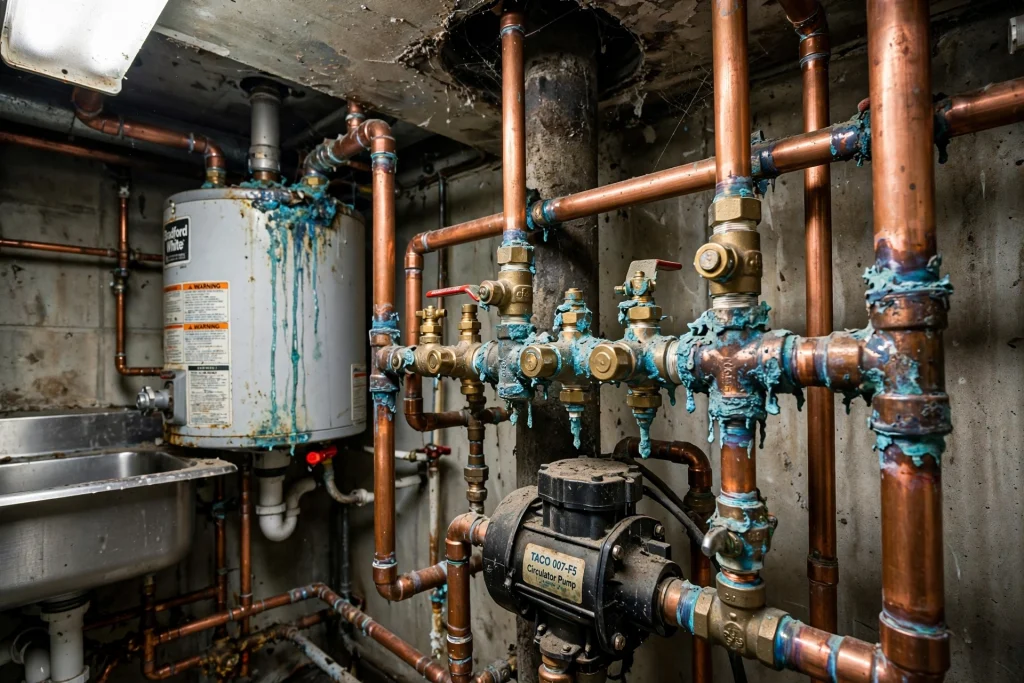
6. Green or Blue Deposits Around Copper Pipes
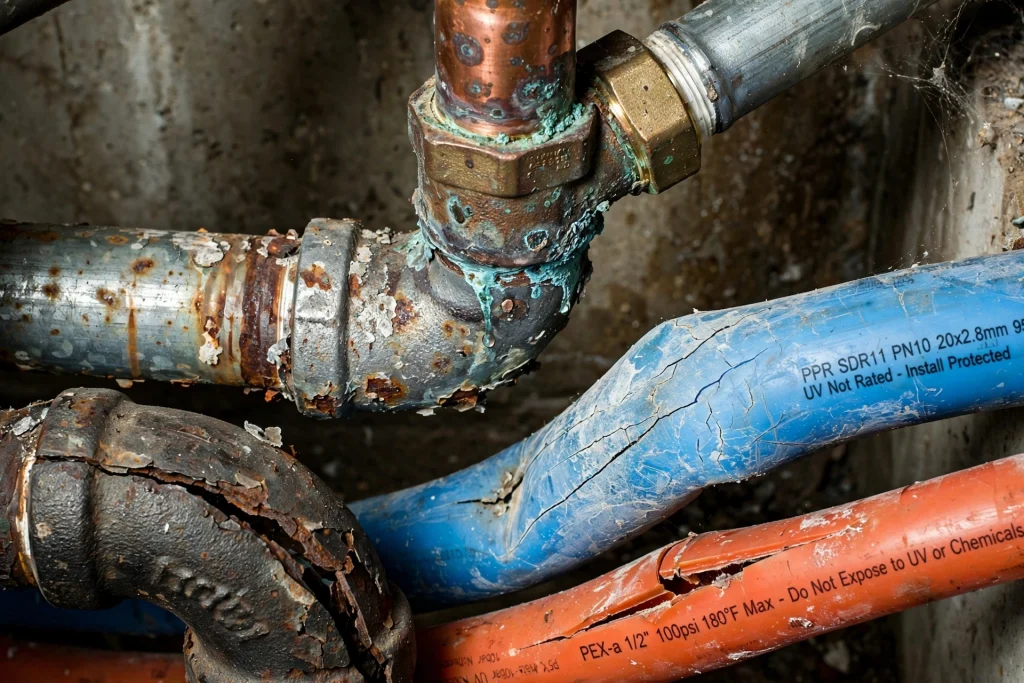
Copper corrosion can sometimes produce blue-green deposits around pipe joints, fittings, valves, or exposed sections.
These deposits can be associated with copper compounds formed during corrosion.
They should not automatically be interpreted as proof that the entire plumbing system has failed, but they are a useful visual warning.
Inspect exposed pipework around:
- Water heaters
- Valves
- Mechanical rooms
- Under sinks
- Ceiling service areas
- Pump rooms
- Plumbing shafts
If corrosion is visible externally, the surrounding pipework and concealed sections should also be evaluated where appropriate.
7. Visible Rust on Metal Pipes
Rust is an obvious warning sign on ferrous metal plumbing.
Galvanized steel and other iron-containing pipes can develop surface rust when protective coatings deteriorate.
External rust may result from:
- High humidity
- Condensation
- Damaged protective coatings
- Water leakage
- Poor insulation
- Contact with incompatible materials
Surface rust does not necessarily mean that the pipe wall has lost significant structural integrity, but advanced corrosion can eventually weaken the pipe.
If rust is widespread, inspect the system rather than treating each rusty section independently.
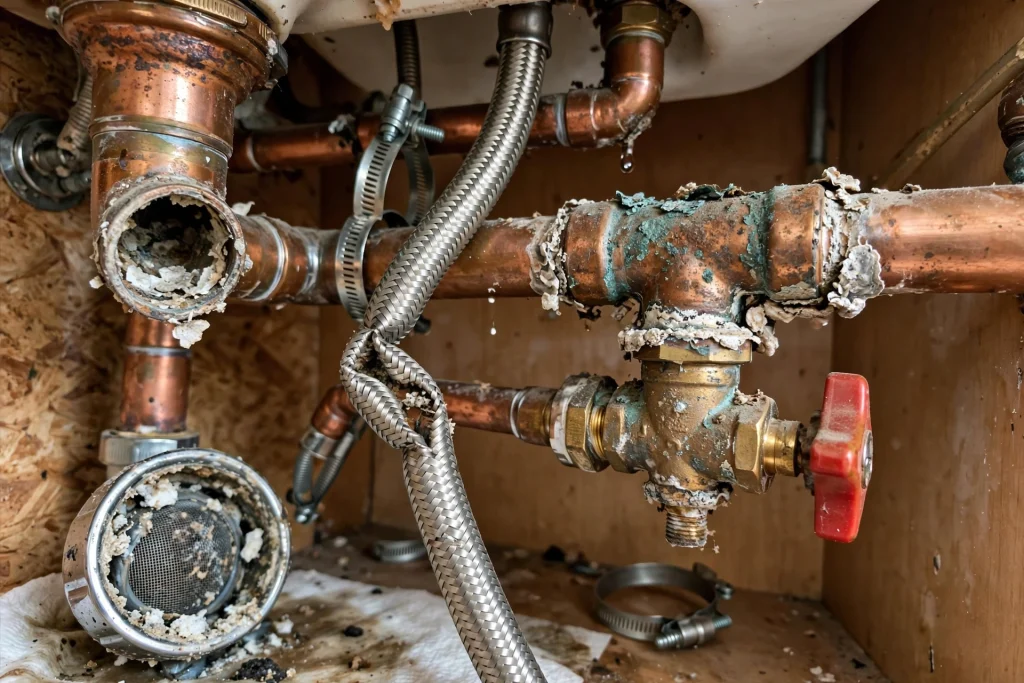
8. Water Leaks Around Pipe Joints
Corrosion does not always damage the middle of a pipe.
Joints, threaded connections, fittings, and transitions between different materials can become vulnerable points.
A leaking joint may be caused by:
- Corrosion
- Incorrect installation
- Mechanical stress
- Thermal expansion
- Deteriorated seals
- Excessive pressure
- Movement of the pipe
Repeated joint failures can indicate a larger problem with system design or material compatibility.
9. Reduced Flow From Individual Fixtures
If one faucet has gradually developed weaker flow while others remain normal, the problem could be local.
Possible causes include:
- Aerator blockage
- Valve restriction
- Flexible hose obstruction
- Localized pipe scaling
- Corroded branch piping
If multiple fixtures supplied by the same branch experience reduced flow, the problem is more likely to involve the plumbing line itself.
This is where understanding the building’s pipe network and hydraulic layout becomes important.
10. Unusual Noises From the Plumbing System
Whistling, banging, rattling, or vibrating pipes do not automatically mean corrosion.
However, changes in internal pipe conditions can alter water flow.
Pipe noise may also be associated with:
- Water hammer
- High velocity
- Loose supports
- Pressure fluctuations
- Faulty valves
- Thermal expansion
- Air in the system
If unusual noises appear together with low pressure, discoloration, or recurring leaks, the plumbing system deserves a more detailed inspection.
Why Do Water Pipes Corrode?
Understanding the cause is just as important as identifying the symptom.
Several factors can contribute to pipe corrosion.
Water Chemistry
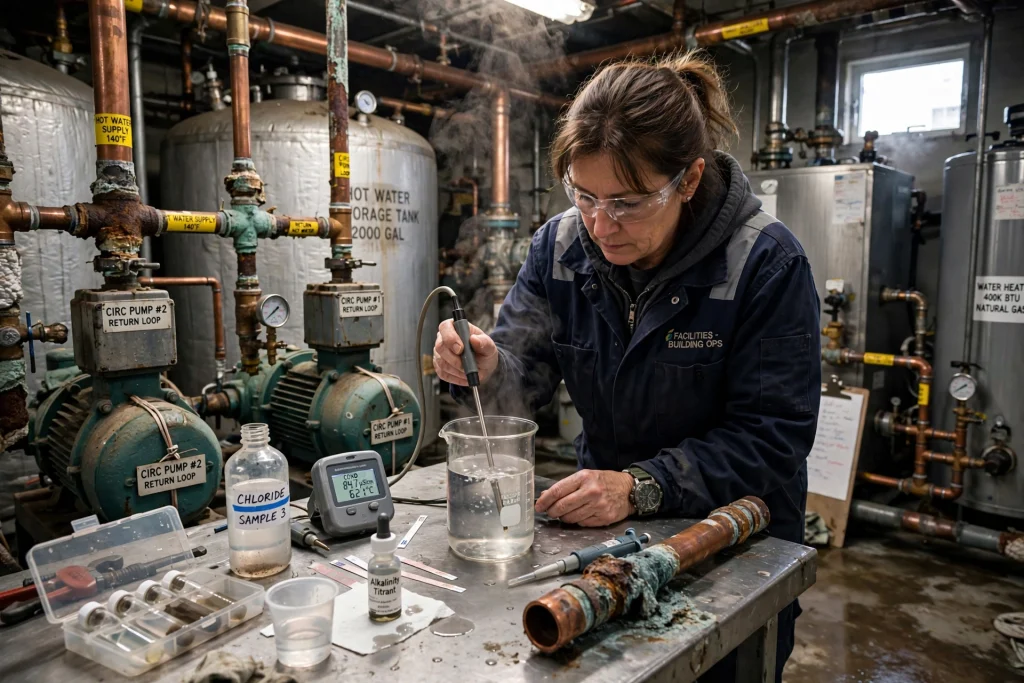
Water chemistry has a major influence on metallic pipe performance.
Factors such as pH, dissolved oxygen, alkalinity, chloride concentration, conductivity, temperature, and mineral content can affect corrosion behavior.
The same pipe material can perform differently under different water conditions.
This is why material selection should consider the actual application rather than relying on generic assumptions.
High Water Temperature
Temperature can accelerate certain corrosion processes and also increase material stress.
Hot-water systems require appropriate pipe materials, fittings, insulation, circulation design, and temperature control.
Commercial buildings with hot-water storage tanks, circulation pumps, water heaters, and return loops need particularly careful design.
Excessive Water Velocity
Water moving too quickly through a pipe can contribute to erosion-corrosion under certain conditions.
Poorly designed pipe sizes, excessive pump pressure, and inappropriate flow conditions can increase stress on the plumbing system.
Hydraulic design should therefore consider flow rate, pipe diameter, velocity, pressure loss, and fixture demand.
Dissimilar Metals
Connecting different metals without appropriate engineering consideration can contribute to galvanic corrosion.
For example, direct contact between certain dissimilar metals can create an electrochemical reaction.
This is why material transitions and fittings should be selected carefully.
Which Pipe Materials Are Most Vulnerable?
Different materials have different failure mechanisms.
Copper
Copper generally provides good durability but can experience localized corrosion under certain water conditions.
Galvanized Steel
Older galvanized steel systems are particularly susceptible to internal rust and mineral buildup as the protective zinc layer deteriorates.
Cast Iron
Cast iron can experience internal and external corrosion and may eventually become structurally weakened.
PPR
PPR does not rust like metallic piping. Its performance depends on temperature, pressure, UV exposure, installation quality, and product specifications.
PEX
PEX is corrosion-resistant but still needs to be protected from unsuitable UV exposure, excessive temperatures, mechanical damage, and incompatible chemicals.
How Professionals Diagnose Corroded Pipes
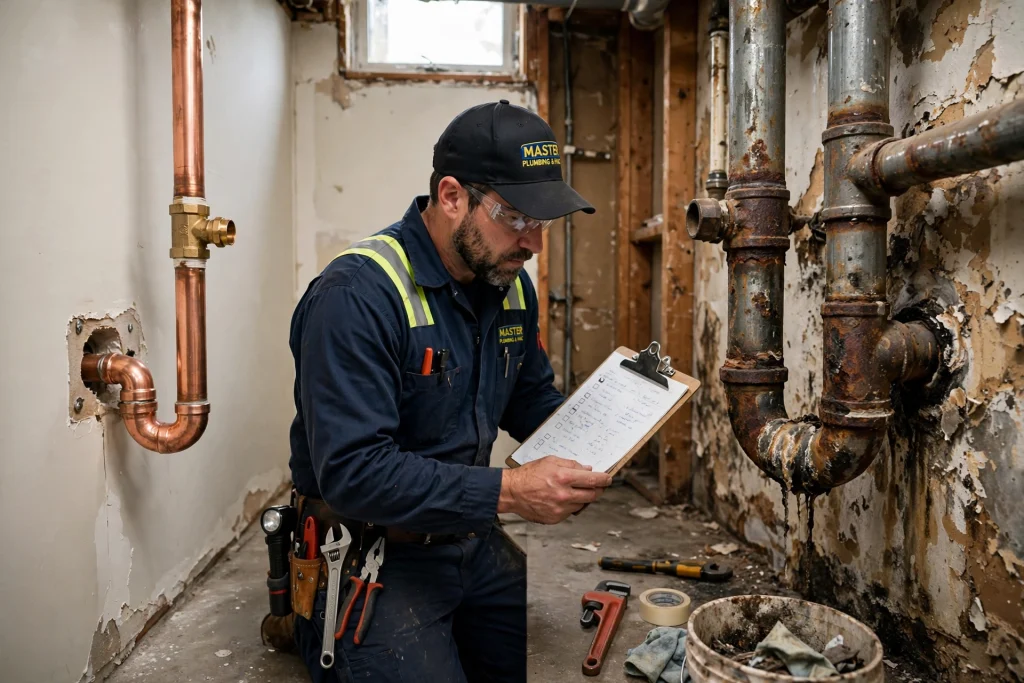
A professional assessment should begin with the building’s plumbing history.
The technician may review:
Pipe age, material, previous leaks, water pressure, water quality, repair records, and the locations of recurring problems.
Visible inspection comes next.
Where necessary, professionals may use:
- Moisture meters
- Thermal imaging
- Acoustic leak detection
- Pressure testing
- Camera inspection where applicable
- Water-quality testing
- Pipe-wall assessment
- Flow and pressure measurements
Not every project requires every method.
The inspection method should match the suspected failure mechanism.
For example, a concealed water leak may require a different diagnostic approach from widespread corrosion inside an accessible mechanical-room pipe.
When Should Corroded Pipes Be Repaired?
Repair may be appropriate when the problem is isolated.
For example, a single damaged fitting or short pipe section can sometimes be replaced without disturbing the entire plumbing system.
This approach may be reasonable when:
- The rest of the pipe network is in good condition
- The failure is localized
- Replacement parts are available
- There is no evidence of widespread corrosion
- The pipe system remains suitable for the building
However, repeated repairs in multiple locations can become a sign that replacement should be considered.
When Should Old Pipes Be Replaced?
Replacement becomes more compelling when corrosion is widespread or failures are recurring.
Important indicators include:
Repeated leaks, severe internal scaling, widespread rust, poor water pressure, deteriorating pipe walls, obsolete materials, frequent emergency repairs, and increasing maintenance costs.
For an older building, replacing only the visibly damaged section may provide temporary relief while leaving deteriorated pipework elsewhere.
A plumbing professional should evaluate whether partial replacement, sectional replacement, or complete repiping provides the best long-term result.
Preventing Pipe Corrosion
Prevention begins with correct material selection and installation.
Property owners and facility managers should maintain appropriate water pressure, inspect storage tanks, address leaks quickly, protect exposed piping, and monitor recurring changes in water quality.
For commercial properties, preventive maintenance should include inspection of:
- Water tanks
- Booster pumps
- Pressure-reducing valves
- Water heaters
- Hot-water circulation systems
- Isolation valves
- Pipe supports
- Accessible pipework
- Insulation
- Mechanical-room piping
Early intervention is usually less disruptive than waiting for a major pipe failure.
Dubai and UAE Properties Need a Practical Inspection Strategy
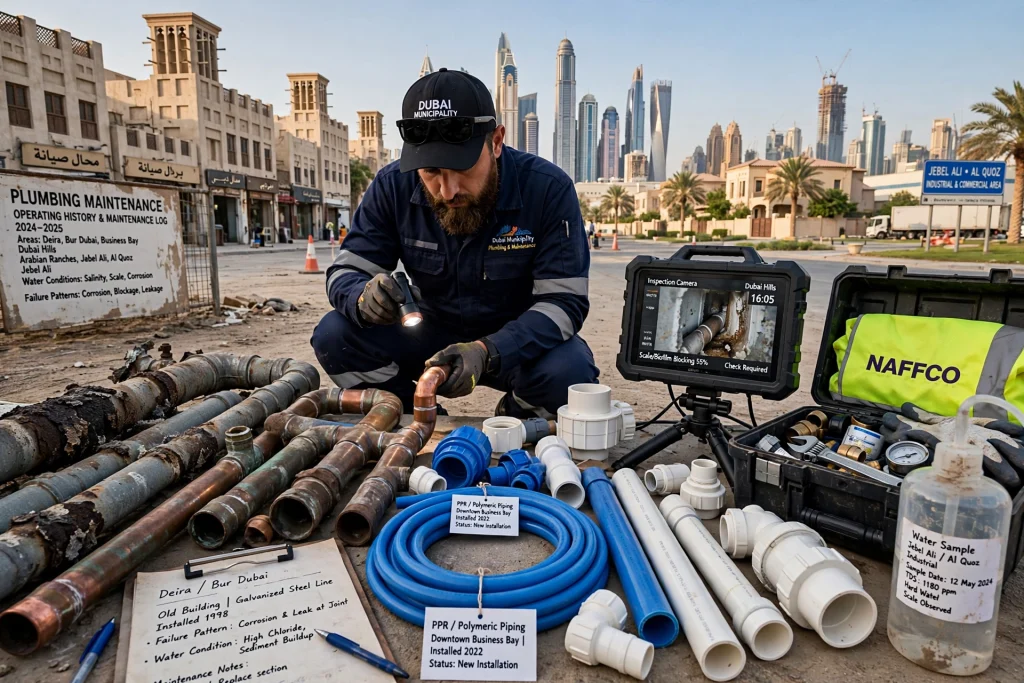
The UAE has a wide range of property types, from older residential buildings in Deira and Bur Dubai to modern towers in Downtown Dubai and Business Bay, villas in Dubai Hills and Arabian Ranches, and large commercial facilities in Jebel Ali and Al Quoz.
Each property has a different plumbing history.
A newer tower may have modern polymeric piping, while an older building may contain galvanized steel or copper systems.
This is why property age alone cannot determine whether pipes need replacement.
A practical inspection should consider the actual material, installation environment, operating history, maintenance records, water conditions, and failure pattern.
Final Thoughts
Corroding water pipes rarely fail without warning. Discolored water, metallic taste, reduced pressure, pin-hole leaks, damp walls, green deposits around copper, visible rust, recurring joint failures, and unusual plumbing behavior can all provide clues that the system needs investigation.
The most important step is not to assume that every symptom means the entire plumbing network must be replaced. Some problems are caused by valves, pumps, filters, fixtures, water heaters, or localized blockages.
A professional assessment can identify the actual cause and determine whether repair, sectional replacement, or complete repiping is appropriate.
For UAE homeowners, landlords, facility managers, hotels, offices, restaurants, and commercial property owners, proactive plumbing inspections can prevent small corrosion problems from becoming major water-damage events.
The goal should always be the same: identify deterioration early, determine its root cause, select the correct pipe material and repair strategy, and maintain the water distribution system before a preventable failure disrupts the property.
When selecting a contractor for assessment or replacement, look for a team that can evaluate the entire plumbing system rather than simply replacing the first leaking section. A technically sound approach considers pipe material, water chemistry, pressure, temperature, hydraulic performance, fittings, concealed pipework, installation conditions, and long-term maintenance.