Chillers are at the heart of many large cooling systems across Dubai. Commercial towers, hotels, shopping centres, hospitals, schools, industrial facilities, residential developments, and mixed-use properties often depend on central chilled-water systems to maintain comfortable indoor temperatures throughout the year. When a chiller plant is properly maintained, it can deliver stable cooling, operate more efficiently, and provide greater reliability during periods of high demand.
Dubai’s hot climate makes dependable cooling particularly important. Chillers may operate for long hours while dealing with high outdoor temperatures, dust, demanding occupancy patterns, and changing building loads. Without regular inspection and servicing, dirt, scale, poor water flow, electrical faults, refrigerant problems, and component wear can gradually reduce system performance.
Regular maintenance is therefore not simply about repairing equipment after a breakdown. It is a proactive approach to preserving the performance of the complete cooling plant.
Why Chiller Maintenance Matters in Dubai
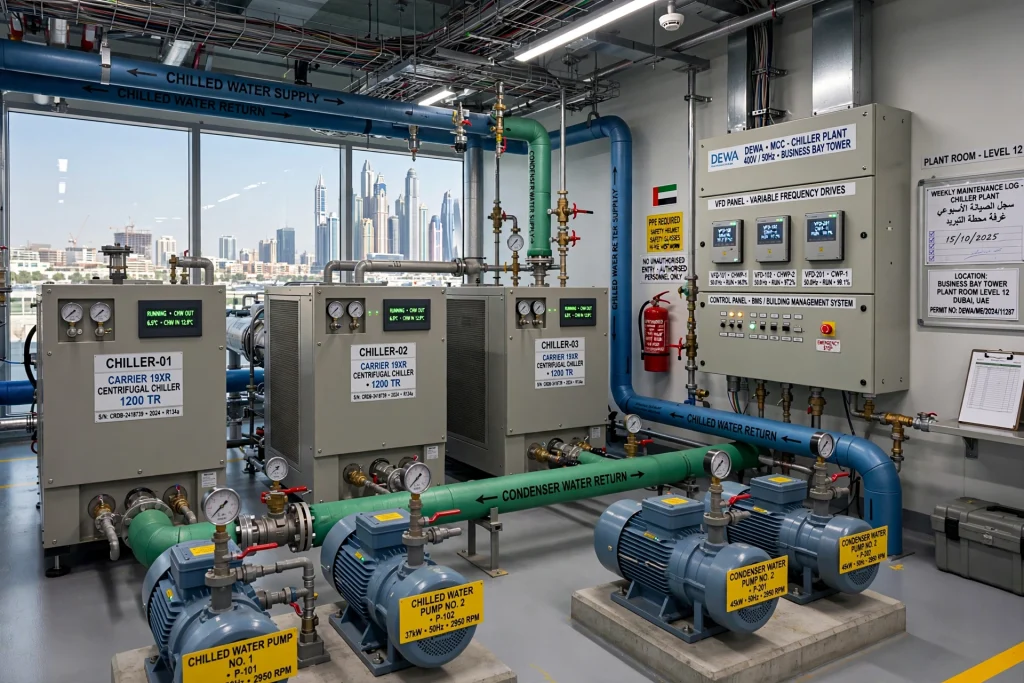
A commercial chiller plant is a complex mechanical system containing numerous components that must work together. Depending on the installation, the system can include chillers, chilled-water pumps, condenser-water pumps, cooling towers, valves, strainers, heat exchangers, expansion tanks, sensors, electrical equipment, variable frequency drives, and building management controls.
When one component begins to perform poorly, the effect can spread across the system.
For example, a blocked strainer can restrict water flow. Poor water flow can affect heat transfer. Reduced heat transfer can increase operating temperatures and place additional demand on the chiller.
Similarly, dirty condenser coils or cooling-tower problems can prevent heat from being rejected effectively.
Regular maintenance helps identify these issues before they develop into major performance problems.
How a Chiller Supports a Building
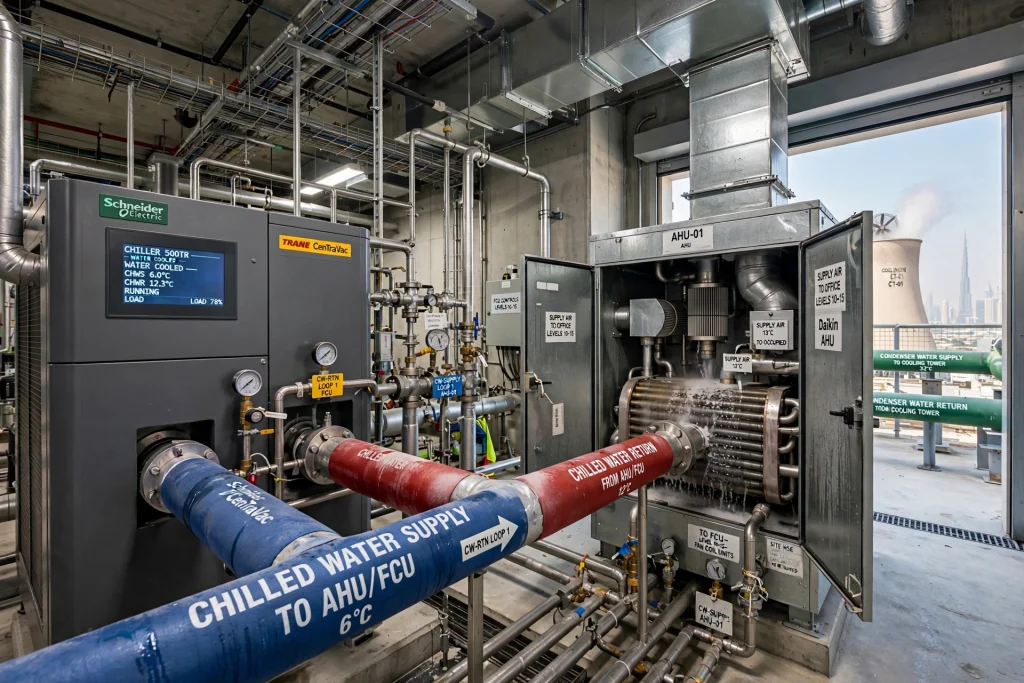
A chiller removes heat from water and produces chilled water that is circulated throughout the building.
The chilled water travels through pipes to equipment such as air handling units (AHUs) and fan coil units (FCUs).
Inside an AHU or FCU, chilled water passes through a cooling coil. Air flowing across the coil is cooled before being distributed into occupied areas.
In a water-cooled chiller system, heat is transferred to the condenser-water circuit and eventually rejected through a cooling tower.
This means that effective cooling depends on the complete system rather than the chiller alone.
Maintenance should therefore cover the entire chilled-water plant.
Regular Maintenance Helps Maintain Cooling Capacity
One of the most important benefits of preventive maintenance is maintaining the system’s ability to provide the required cooling capacity.
A chiller that is operating under poor conditions may struggle to achieve the desired leaving-water temperature.
Potential causes include:
- Dirty heat-transfer surfaces
- Restricted water flow
- Fouled condenser tubes
- Poor cooling-tower performance
- Refrigerant-related problems
- Sensor faults
- Incorrect control settings
- Pump problems
Regular inspection can identify these conditions.
Keeping heat-transfer surfaces clean and ensuring appropriate water circulation allows the chiller to operate closer to its intended performance.
Clean Heat-Transfer Surfaces Improve Performance
Heat exchangers are fundamental to chiller operation.
In a water-cooled chiller, condenser and evaporator surfaces need to transfer heat efficiently.
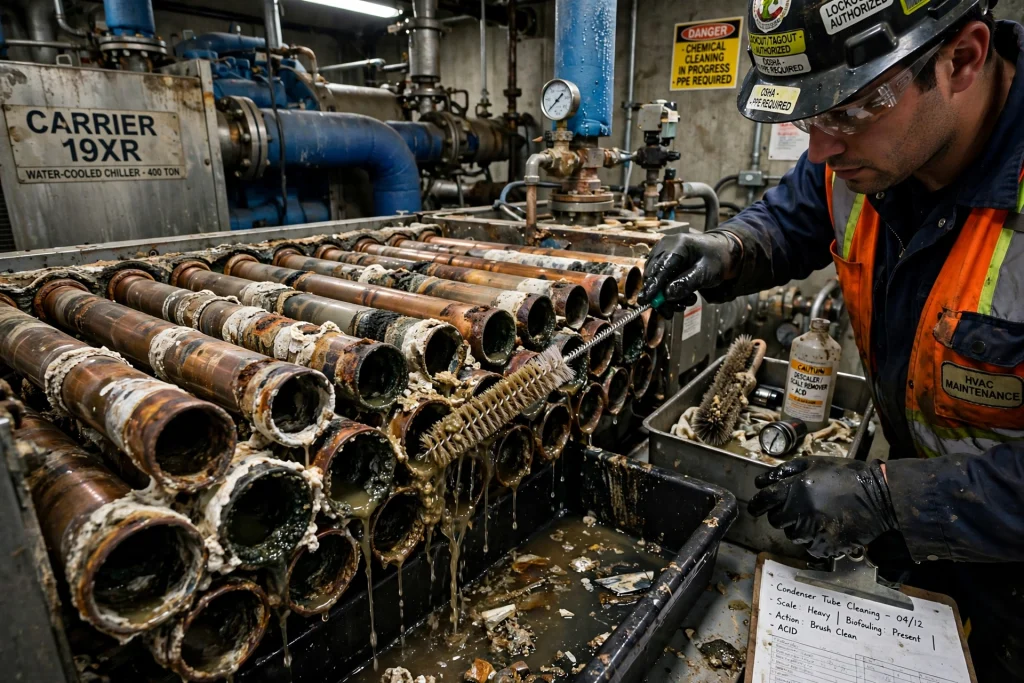
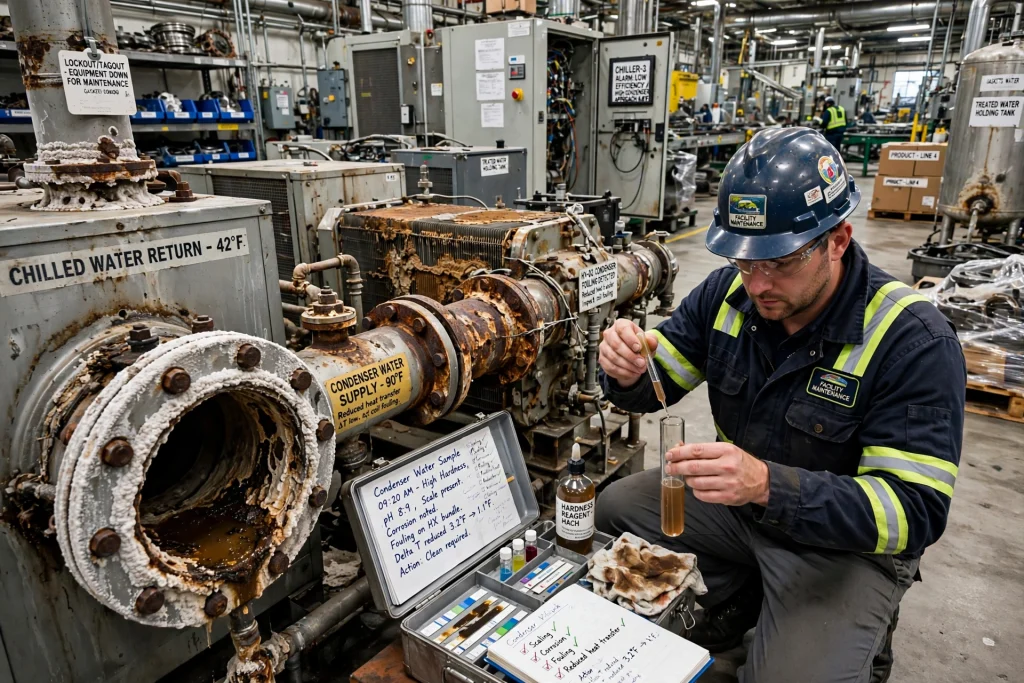
Over time, mineral deposits, scale, corrosion products, biological contamination, and other materials can accumulate on water-side surfaces.
This creates additional resistance to heat transfer.
As heat transfer becomes less effective, the chiller may need to work harder to achieve the same cooling result.
Regular inspection and appropriate cleaning can help preserve heat-transfer efficiency.
Condenser Tube Cleaning
For water-cooled chillers, condenser tubes deserve particular attention.
Water quality can affect the condition of the tubes. Poorly controlled water can contribute to scale and deposits.
Tube fouling can increase the temperature difference required for effective heat rejection.
A professional maintenance programme can include inspection and cleaning according to equipment condition and manufacturer recommendations.
Maintaining clean condenser tubes can help the chiller reject heat more effectively.
Cooling Tower Maintenance Is Part of Chiller Maintenance
A water-cooled chiller cannot operate efficiently if the cooling tower is performing poorly.
The cooling tower rejects heat from the condenser-water loop.
A maintenance programme should therefore consider:
- Cooling-tower fill
- Fans
- Motors
- Belts
- Spray nozzles
- Basins
- Drift eliminators
- Water quality
- Pumps
- Temperature performance
Dubai’s dusty environment can increase the amount of contamination entering outdoor equipment.
Regular cooling-tower inspection helps maintain the heat-rejection process that supports the chiller.
Maintaining Correct Chilled-Water Flow
Water flow is another important factor in chiller performance.
The chilled-water system typically includes pumps, valves, strainers, pipes, control valves, and terminal equipment.
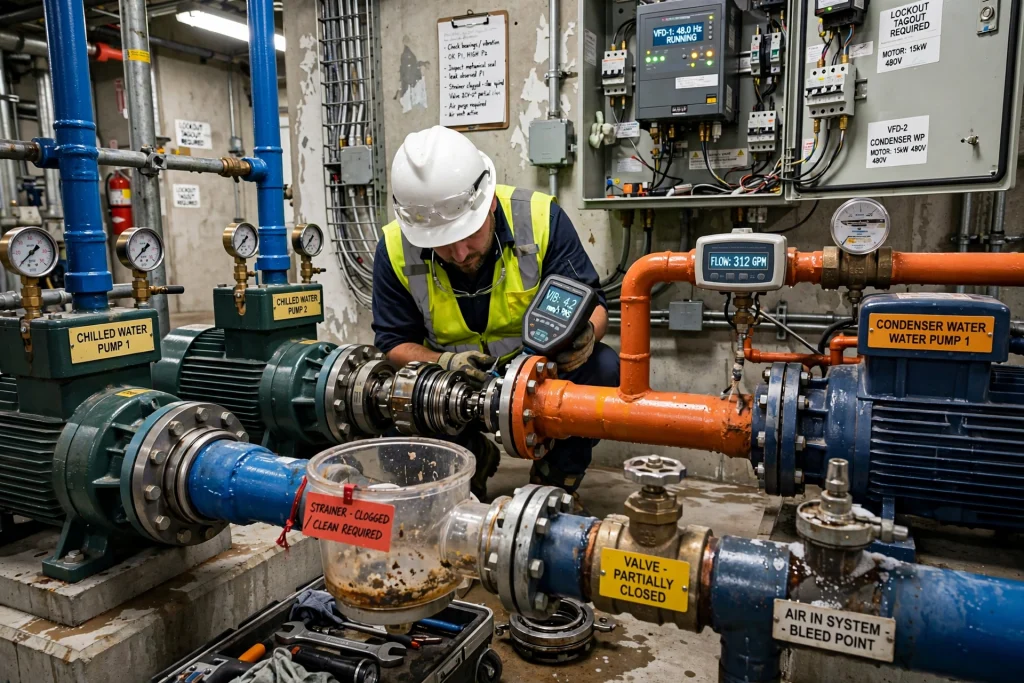
If flow becomes restricted, the chiller may not receive or deliver the required amount of water.
Potential causes include clogged strainers, partially closed valves, pump problems, air in the system, or control issues.
Regular maintenance allows technicians to inspect these components and identify flow-related problems.
Pump Maintenance Protects the Cooling System
Chilled-water and condenser-water pumps are essential to central cooling systems.
A pump operating inefficiently can affect the entire plant.
Maintenance can include inspection of:
- Bearings
- Mechanical seals
- Couplings
- Motors
- Vibration
- Pressure
- Flow
- Electrical connections
- VFD operation
Unusual vibration or noise can indicate developing mechanical problems.
Addressing these issues early can reduce the risk of unexpected pump failure.
VFDs and Variable-Speed Operation
Many modern chiller plants use variable frequency drives to adjust pump or fan speed according to cooling demand.
Instead of operating at full speed continuously, a variable-speed system can adjust equipment operation to match actual requirements.
VFD maintenance may include checking electrical connections, cooling, alarms, control signals, and operating parameters.
A fault in the control system can prevent the equipment from responding correctly to changing loads.
Refrigerant System Inspection
Chillers use refrigerant as part of the refrigeration cycle.
Depending on the chiller type, technicians may monitor operating pressures, temperatures, compressor performance, oil conditions, and other parameters.
A refrigerant issue can affect cooling performance.
A professional technician should investigate the underlying cause of abnormal readings rather than simply adding refrigerant without determining why the system has changed.
Leak detection and appropriate repair can help preserve system performance and protect the refrigeration circuit.
Compressor Maintenance
The compressor is one of the most important components of a chiller.
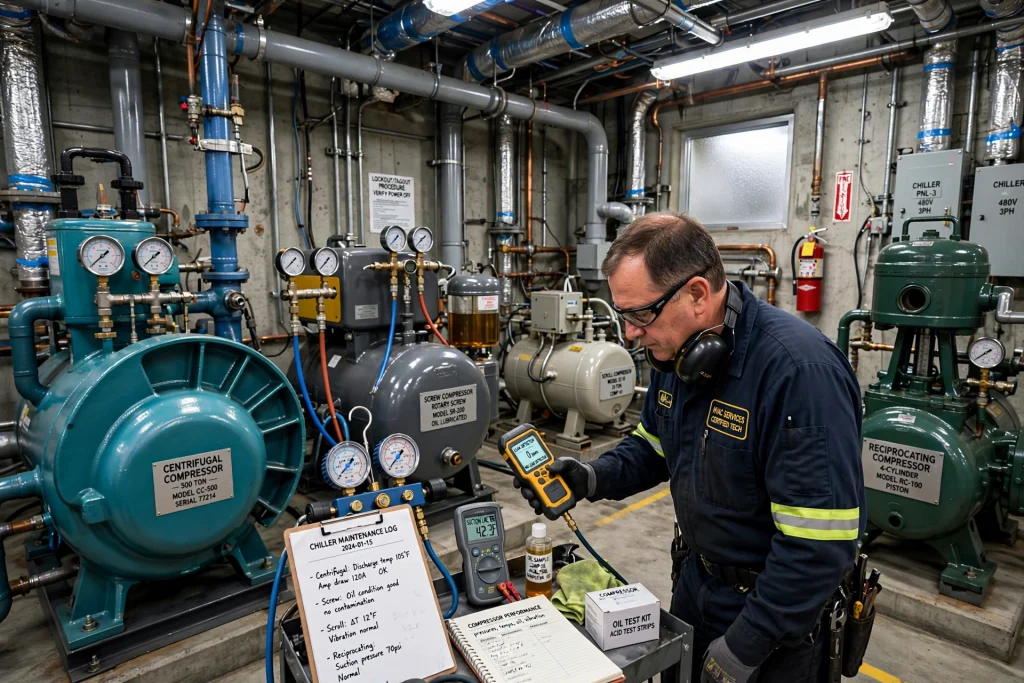
Commercial systems can use different compressor technologies, including:
- Centrifugal compressors
- Screw compressors
- Scroll compressors
- Reciprocating compressors
Each technology has different service requirements.
Maintenance may involve monitoring operating conditions, vibration, oil systems, electrical parameters, temperatures, and control signals.
Early identification of abnormal compressor behaviour can help prevent more serious damage.
Electrical Maintenance Improves Reliability
Chiller plants contain numerous electrical components.
These can include motor starters, contactors, breakers, control panels, sensors, variable frequency drives, wiring, and protection systems.
During preventive maintenance, technicians can look for signs of:
- Loose connections
- Overheating
- Damaged wiring
- Abnormal current
- Faulty sensors
- Component deterioration
Electrical faults can cause unexpected shutdowns and may affect other parts of the cooling plant.
Regular inspection provides an opportunity to identify potential problems before they become operational failures.
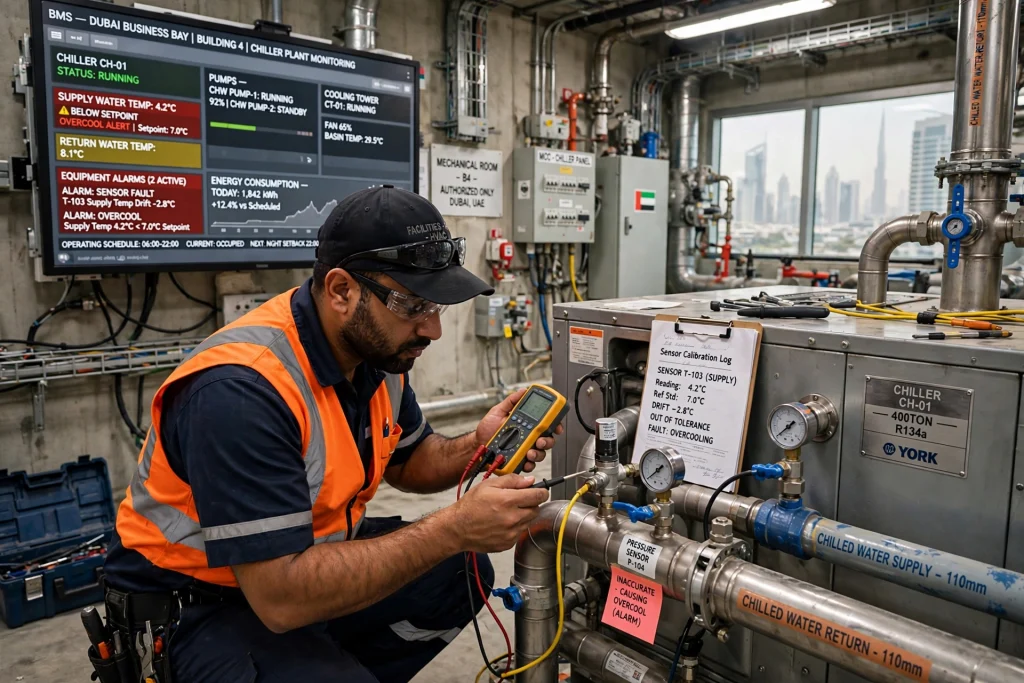
Sensor Calibration and Control Accuracy
Modern chillers rely on sensors to measure temperatures, pressures, flow conditions, and other operating parameters.
Incorrect sensor readings can cause the control system to make inappropriate decisions.
For example, an inaccurate temperature sensor could cause the system to overcool or undercool.
Maintenance should therefore include checking important sensors and control devices.
Accurate instrumentation helps the chiller plant respond appropriately to actual building demand.
BMS Integration and Chiller Performance
Many commercial buildings in Dubai use a Building Management System (BMS) to monitor and control HVAC equipment.
A BMS can provide information about:
- Chiller status
- Supply-water temperature
- Return-water temperature
- Pump operation
- Cooling-tower operation
- Equipment alarms
- Operating schedules
- Energy consumption
During maintenance, the BMS should be reviewed alongside the physical equipment.
A mechanical component may be functioning correctly while a control setting or sensor is producing incorrect operation.
Checking both sides of the system provides a more complete assessment.
Regular Maintenance Can Help Control Energy Consumption
Chillers can represent a significant portion of the energy consumption of a large commercial building.
When equipment becomes dirty, poorly adjusted, or mechanically inefficient, it may require more energy to produce the same cooling output.
For example, fouled heat-transfer surfaces can increase the effort required for heat rejection.
Poor condenser-water flow can have a similar effect.
A properly maintained system can operate under more favourable conditions.
Energy performance should therefore be considered as part of maintenance rather than treated as a separate concern.
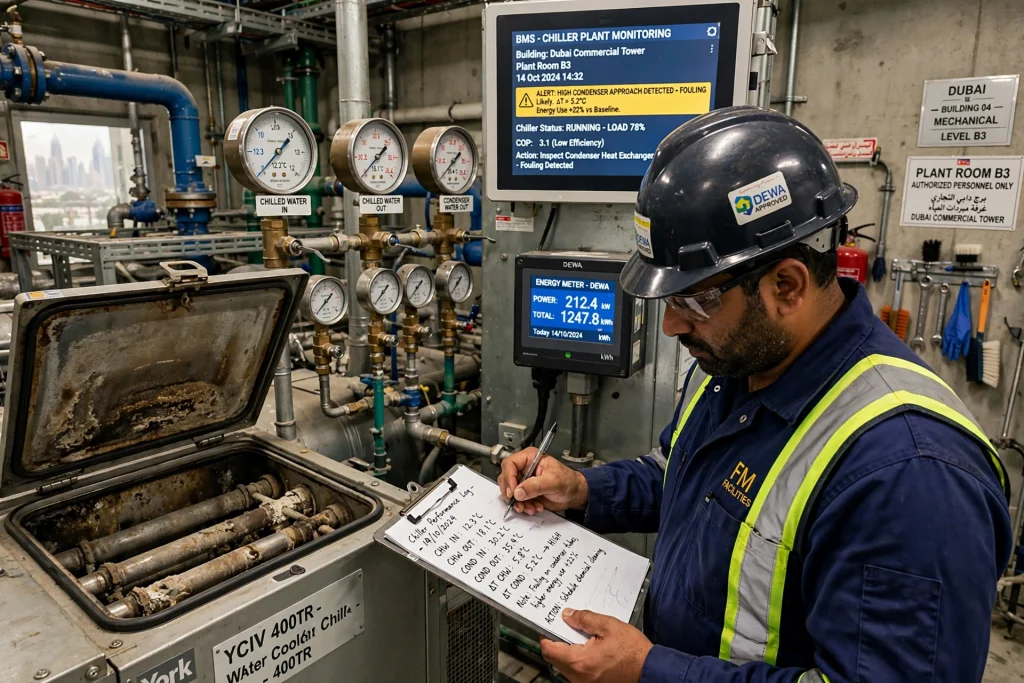
Monitoring Temperature Differences
Temperature measurements provide valuable information about chiller operation.
Technicians can compare:
- Chilled-water entering temperature
- Chilled-water leaving temperature
- Condenser-water entering temperature
- Condenser-water leaving temperature
Changes in these values can help indicate developing problems.
For example, an unexpected change in chilled-water temperature difference may indicate flow problems, load changes, sensor issues, or heat-transfer problems.
Regular recording makes it easier to identify trends.
Why Maintenance Records Matter
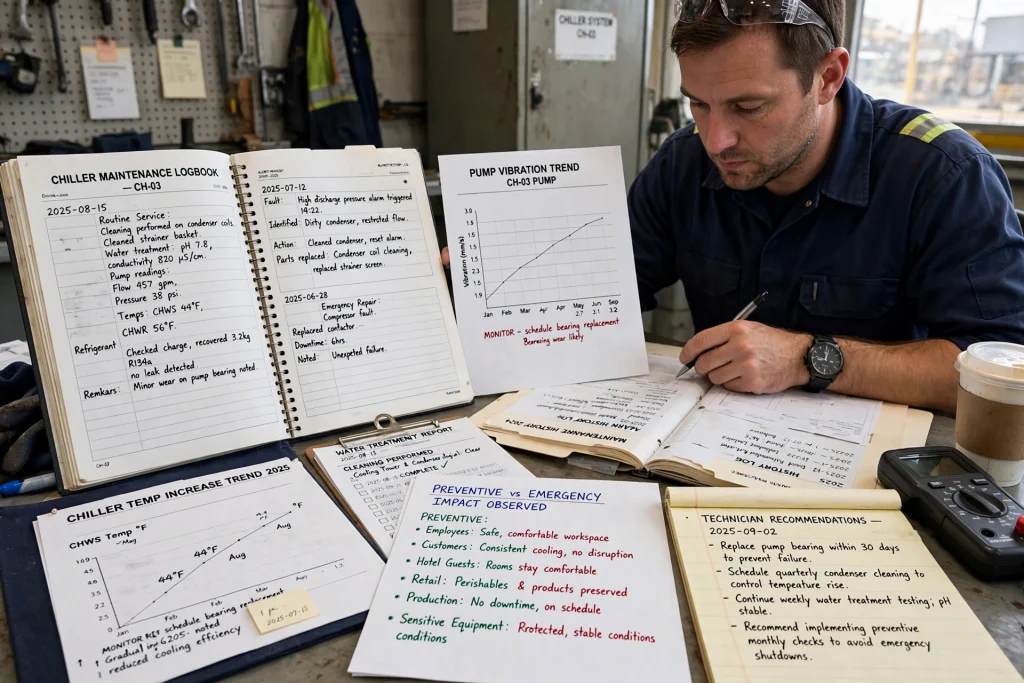
A single maintenance visit provides only a snapshot of equipment condition.
A maintenance history provides a much more useful picture.
Records can include:
- Equipment readings
- Service dates
- Cleaning performed
- Parts replaced
- Faults identified
- Refrigerant work
- Water-treatment observations
- Pump readings
- Temperature readings
- Alarm history
- Technician recommendations
Over time, these records can reveal patterns.
If a particular pump repeatedly develops vibration or a chiller consistently shows increasing operating temperatures, the maintenance team can investigate the underlying cause.
Preventive Maintenance vs Emergency Repairs
Waiting for a chiller to fail can be expensive for a commercial property.
A major breakdown can affect:
- Employees
- Customers
- Hotel guests
- Retail operations
- Production
- Building occupants
- Sensitive equipment
Emergency repairs can also be more difficult to coordinate during periods of high cooling demand.
Preventive maintenance provides an opportunity to identify worn components and abnormal operating conditions while the system is still functioning.
The objective is not to eliminate every possible failure but to reduce avoidable failures and improve system reliability.
Maintenance Frequency for Dubai Chillers
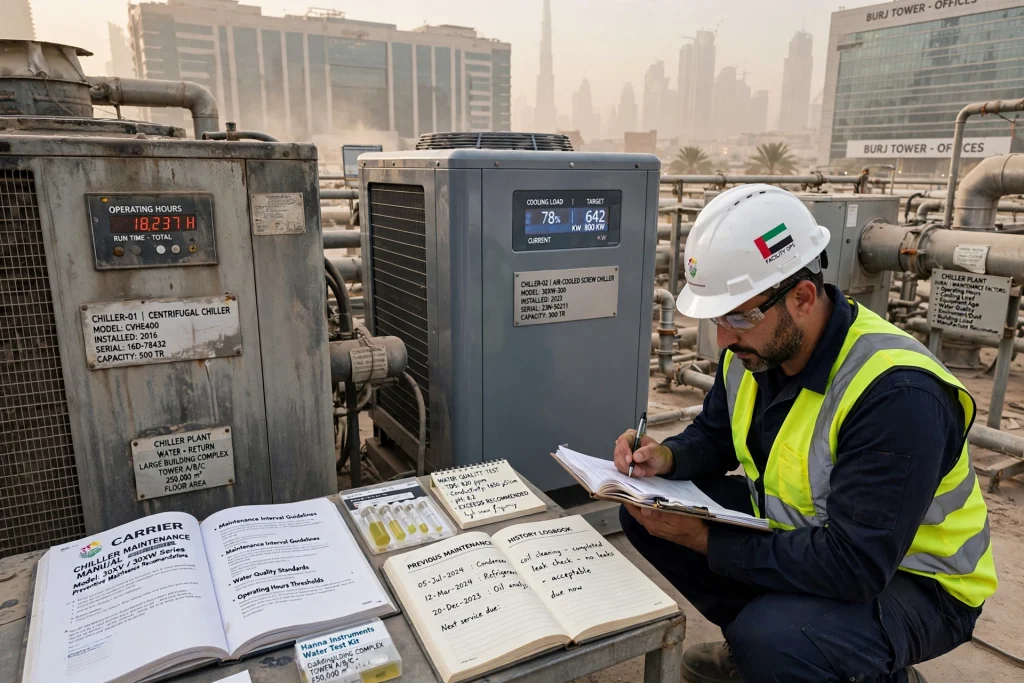
There is no single maintenance interval suitable for every chiller.
The appropriate frequency depends on:
- Chiller type
- Operating hours
- Building size
- Cooling load
- Equipment age
- Water quality
- Outdoor conditions
- Manufacturer recommendations
- Previous maintenance history
A heavily used hotel or shopping centre may require more frequent inspection than a small office.
Critical facilities may also require enhanced monitoring and maintenance.
A professional maintenance plan should therefore be based on actual equipment conditions.
Chiller Maintenance for High-Rise Buildings
High-rise buildings in Dubai Marina, Downtown Dubai, Business Bay, Jumeirah, Palm Jumeirah, and Sheikh Zayed Road can contain complex central cooling systems.
Access to mechanical rooms, plant rooms, basements, rooftops, and equipment areas can affect maintenance planning.
Technicians may need to coordinate with building management to schedule shutdowns and access equipment without disrupting occupants.
For multi-tenant buildings, maintenance planning is particularly important because a cooling interruption can affect many individual spaces simultaneously.
Chiller Maintenance in Commercial Buildings
Commercial properties often have varying cooling requirements throughout the day.
An office may experience its highest demand during working hours.
A hotel may require cooling continuously.
A shopping centre can experience large changes in occupancy throughout the day.
A restaurant may experience high cooling loads during meal periods.
The maintenance strategy should take these operating patterns into account.
Monitoring actual equipment performance can help identify when the cooling plant is under the greatest stress.
Maintenance for Industrial Chillers
Industrial facilities can have cooling requirements that differ considerably from commercial buildings.
Chillers may support manufacturing processes, machinery, storage environments, production areas, or other temperature-sensitive operations.
A cooling interruption can affect production rather than simply indoor comfort.
Industrial chiller maintenance therefore needs to consider process requirements, redundancy, operating temperatures, water quality, and equipment criticality.
Why Water Quality Matters
Water quality can have a major effect on chilled-water and condenser-water systems.
Poor water chemistry can contribute to:
- Scaling
- Corrosion
- Fouling
- Reduced heat transfer
- Component deterioration
Water treatment and monitoring should therefore form part of the overall maintenance strategy where applicable.
For water-cooled systems, condenser-water treatment is particularly important because the cooling tower is exposed to the atmosphere.
Signs Your Chiller Needs Maintenance
A chiller may require inspection before its scheduled service if unusual conditions appear.
Warning signs can include:
- Reduced cooling capacity
- Increasing energy consumption
- Unusual compressor noise
- Excessive vibration
- Water leakage
- Frequent alarms
- Abnormal operating temperatures
- Poor chilled-water flow
- Cooling-tower problems
- Repeated shutdowns
- Unusual pressure readings
Ignoring these signs can allow a manageable problem to become a major failure.
How a Regular Chiller Maintenance Company Helps
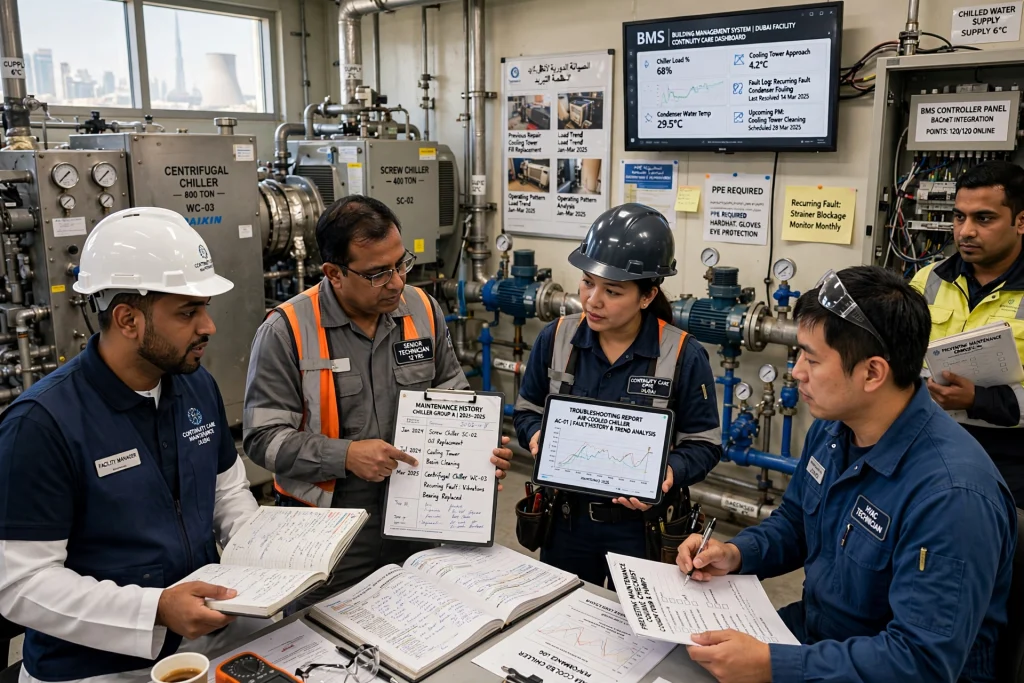
Working with a Regular Chiller Maintenance Company provides continuity in the care of the cooling system.
A consistent maintenance team can become familiar with the equipment, previous repairs, operating patterns, recurring faults, and maintenance history.
This can make troubleshooting more effective because technicians have access to previous records rather than starting from zero during every service visit.
A professional maintenance provider can also help establish an appropriate preventive maintenance schedule for the specific installation.
Choosing a Chiller Maintenance Provider in Dubai
When selecting a maintenance provider, property owners and facility managers should look beyond the basic service description.
Consider whether the contractor has experience with the specific chiller type installed at the property.
Relevant experience may include:
- Water-cooled chillers
- Air-cooled chillers
- Centrifugal chillers
- Screw chillers
- Cooling towers
- Chilled-water pumps
- BMS integration
- Commercial HVAC systems
- Industrial cooling systems
It is also useful to understand whether the company provides preventive maintenance, emergency support, commissioning, troubleshooting, and replacement services.
A Complete Chiller Maintenance Approach
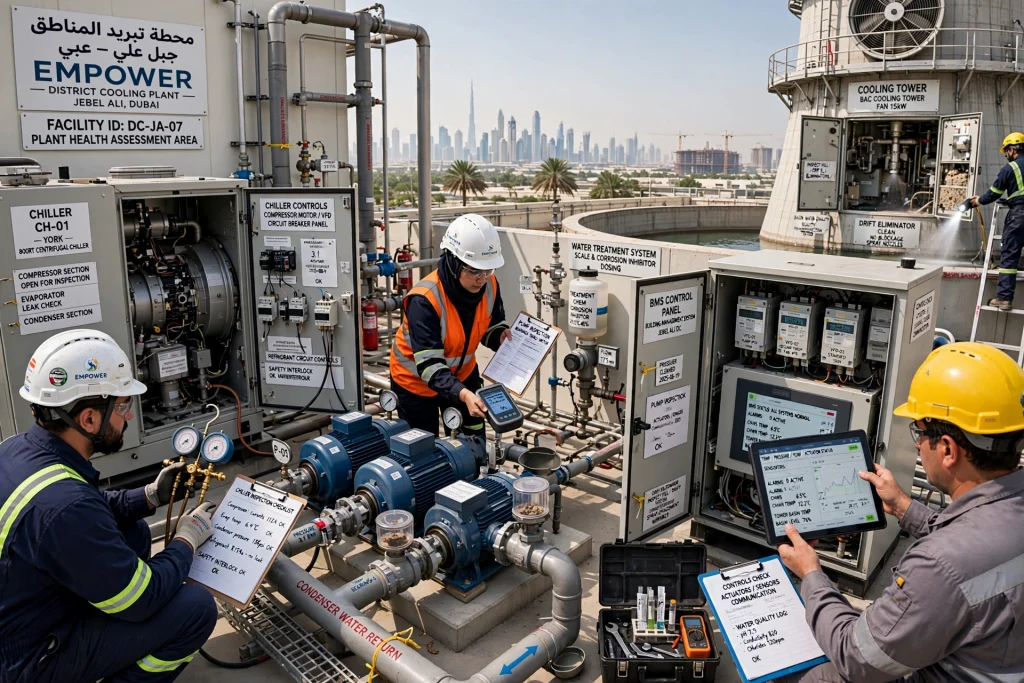
Effective maintenance should address the complete cooling system.
A typical programme may include inspection of:
Chiller: Compressor, evaporator, condenser, refrigerant circuit, controls, and electrical components.
Pumps: Bearings, seals, motors, vibration, pressure, and flow.
Cooling tower: Fans, fill, basin, water quality, spray system, and drift eliminators.
Piping: Valves, strainers, insulation, joints, and visible leaks.
Controls: Sensors, actuators, VFDs, alarms, and BMS communication.
Water systems: Flow, water quality, scaling, corrosion, and treatment requirements.
Looking at these components together provides a more accurate picture of overall cooling-system health.
The Long-Term Value of Preventive Maintenance
Regular maintenance is an investment in the reliability of the cooling infrastructure.
A well-maintained chiller plant can provide more predictable operation and allow facility managers to plan repairs and component replacement rather than responding exclusively to emergency failures.
It can also provide better visibility into the condition of major equipment.
As a chiller plant ages, maintenance records become increasingly valuable because they help determine whether a component should be repaired, refurbished, or eventually replaced.
Frequently Asked Questions
How often should a chiller be maintained in Dubai?
The frequency depends on equipment type, operating hours, cooling load, water quality, age, and manufacturer recommendations. High-use commercial systems may require more frequent inspections than lightly used equipment.
Does regular maintenance improve chiller efficiency?
Proper maintenance can help preserve heat-transfer performance, water flow, control accuracy, and mechanical condition, all of which can influence overall chiller efficiency.
Why is condenser cleaning important?
Dirty condenser surfaces can reduce heat-transfer performance and make heat rejection more difficult. Regular inspection and cleaning can help maintain proper operation.
Does chiller maintenance include cooling towers?
For water-cooled systems, cooling-tower condition is closely connected to chiller performance. Cooling-tower inspection should therefore form part of the overall plant maintenance programme.
Can maintenance prevent chiller breakdowns?
Preventive maintenance cannot eliminate every possible failure, but it can identify many developing mechanical, electrical, water-flow, and control problems before they become serious.
Is BMS maintenance necessary for chillers?
Yes. If a chiller plant is integrated with a BMS, control settings, sensors, alarms, communication, and operating data should be reviewed alongside the mechanical equipment.
Conclusion
Regular chiller maintenance plays an important role in maintaining the performance and reliability of commercial cooling systems in Dubai. A chiller does not operate in isolation; its performance depends on pumps, heat exchangers, cooling towers, water quality, piping, controls, electrical systems, and building automation.
Regular inspection helps identify issues such as fouled heat-transfer surfaces, restricted water flow, dirty cooling towers, pump problems, sensor inaccuracies, refrigerant faults, and electrical deterioration.
For buildings in Dubai Marina, Downtown Dubai, Business Bay, Palm Jumeirah, Jumeirah, Dubai Hills Estate, Deira, and other areas, a maintenance programme should reflect the property’s equipment, occupancy, operating schedule, and cooling requirements.
The most effective approach is proactive rather than reactive: monitor equipment, maintain critical components, record operating conditions, investigate abnormal readings, and address developing problems before they affect the building.
For facility managers and property owners, working with a reliable maintenance provider and maintaining a documented service history can make the cooling plant easier to manage throughout its operating life. In Dubai’s demanding climate, consistent chiller care is not merely a maintenance task—it is an important part of maintaining dependable building performance.