Heating, ventilation, and air conditioning (HVAC) systems are among the most important mechanical systems in modern buildings. In Dubai and across the UAE, where cooling is required for much of the year, HVAC equipment can account for a significant portion of a building’s operating expenses. Chillers, air handling units (AHUs), fan coil units (FCUs), pumps, cooling towers, compressors, ductwork, filters, thermostats, sensors, and controls must work together continuously to maintain comfortable indoor conditions.
When HVAC equipment is neglected, small performance problems can gradually become expensive operational issues. A dirty filter can restrict airflow, a blocked condenser coil can increase compressor workload, a refrigerant problem can reduce cooling capacity, and an incorrectly calibrated sensor can cause equipment to operate longer than necessary.
Preventive maintenance takes a proactive approach. Instead of waiting for equipment to fail, technicians inspect, clean, test, adjust, and service HVAC components according to equipment requirements and actual operating conditions.
For commercial properties, this approach can reduce avoidable energy consumption, emergency repair costs, equipment downtime, premature component replacement, and occupant complaints.
What Is Preventive HVAC Maintenance?
Preventive HVAC maintenance is a planned maintenance strategy designed to keep heating, ventilation, and air-conditioning equipment operating reliably and efficiently.
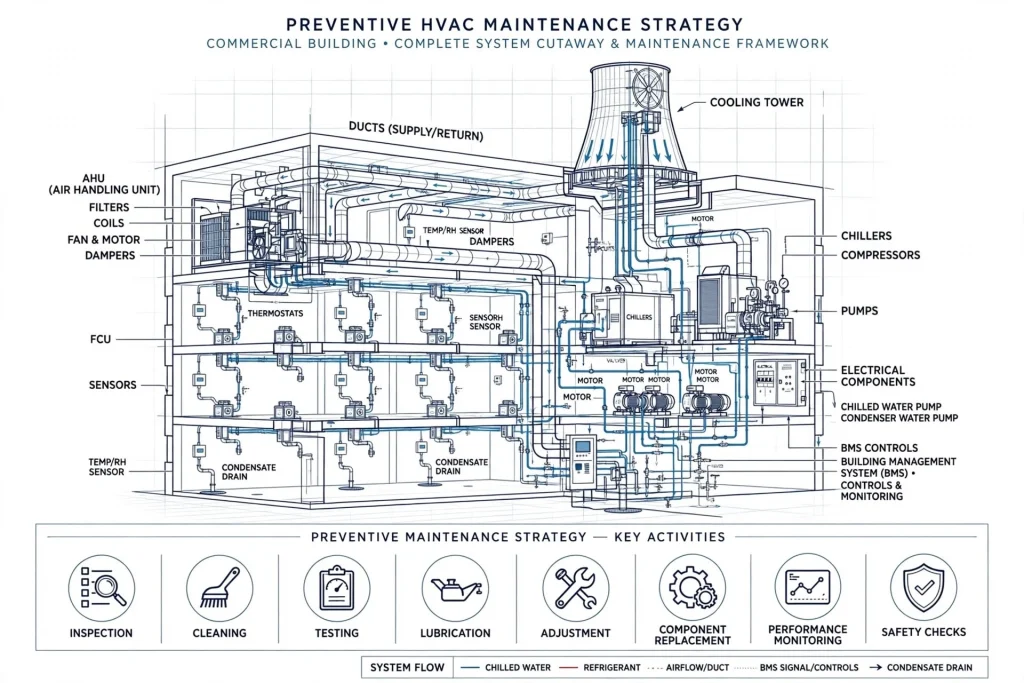
The process may include regular inspection, cleaning, testing, lubrication, adjustment, component replacement, performance monitoring, and safety checks.
Depending on the building and HVAC configuration, preventive maintenance may cover:
Chillers, compressors, AHUs, FCUs, cooling towers, pumps, motors, filters, coils, ducts, dampers, thermostats, sensors, valves, electrical components, refrigerant circuits, condensate drains, and BMS controls.
The objective is not simply to service equipment on a calendar. A good maintenance program considers the equipment manufacturer’s recommendations, operating hours, building occupancy, environmental conditions, system age, criticality, and historical performance.
Why HVAC Operating Costs Matter in Dubai
Dubai’s climate makes HVAC performance particularly important.
During periods of high outdoor temperatures, air-conditioning systems have to remove substantial heat from buildings. Commercial properties such as offices, hotels, shopping centres, restaurants, hospitals, warehouses, and industrial facilities may operate cooling equipment for extended periods.
Higher cooling demand means inefficient equipment can consume more electricity.
For this reason, maintenance should focus not only on preventing breakdowns but also on maintaining the conditions required for efficient operation.
How HVAC Efficiency Declines Over Time
HVAC equipment rarely becomes inefficient overnight.
Performance can gradually decline because of:
Dust accumulation, clogged filters, dirty coils, refrigerant issues, poor airflow, water-side fouling, worn bearings, incorrect settings, sensor drift, electrical problems, duct leakage, and inadequate maintenance.
Each issue may initially have a small effect.
However, when several problems occur simultaneously, the impact can become significant.
For example, a dirty filter can reduce airflow. Reduced airflow can affect heat transfer. The system may then run for longer periods to achieve the required temperature.
Preventive maintenance aims to identify these issues before they develop into major operational problems.
Lower Electricity Consumption
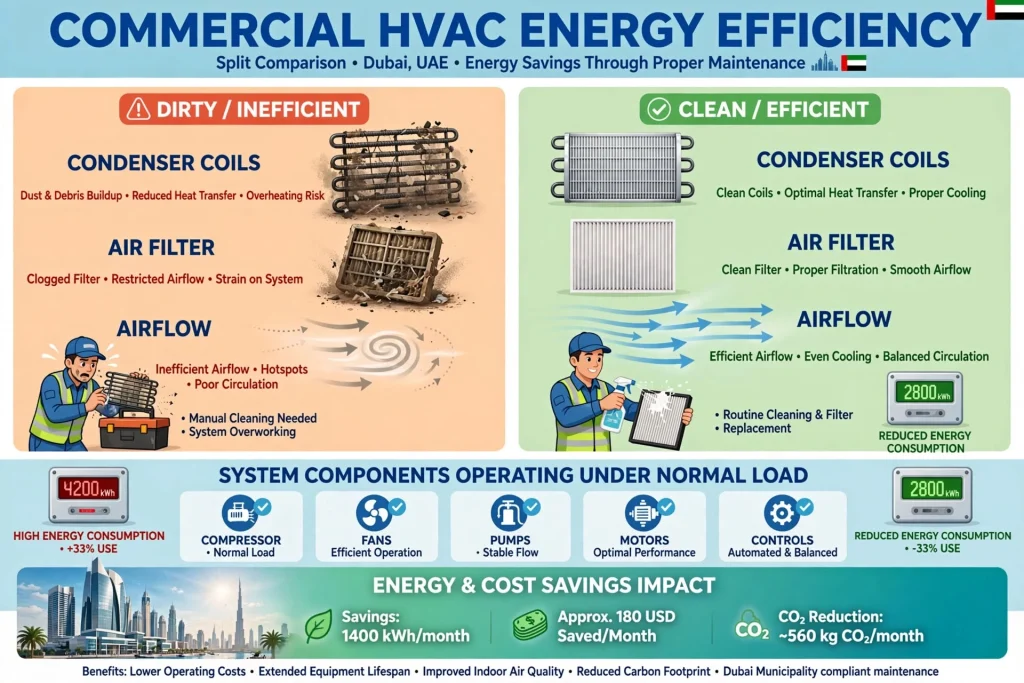
One of the most important financial benefits of effective HVAC maintenance is the potential to reduce unnecessary energy consumption.
HVAC equipment needs electricity to operate compressors, fans, pumps, motors, controls, and other components.
When these components operate under excessive load, energy consumption can increase.
Maintenance helps preserve the operating conditions intended by the system design.
Examples include:
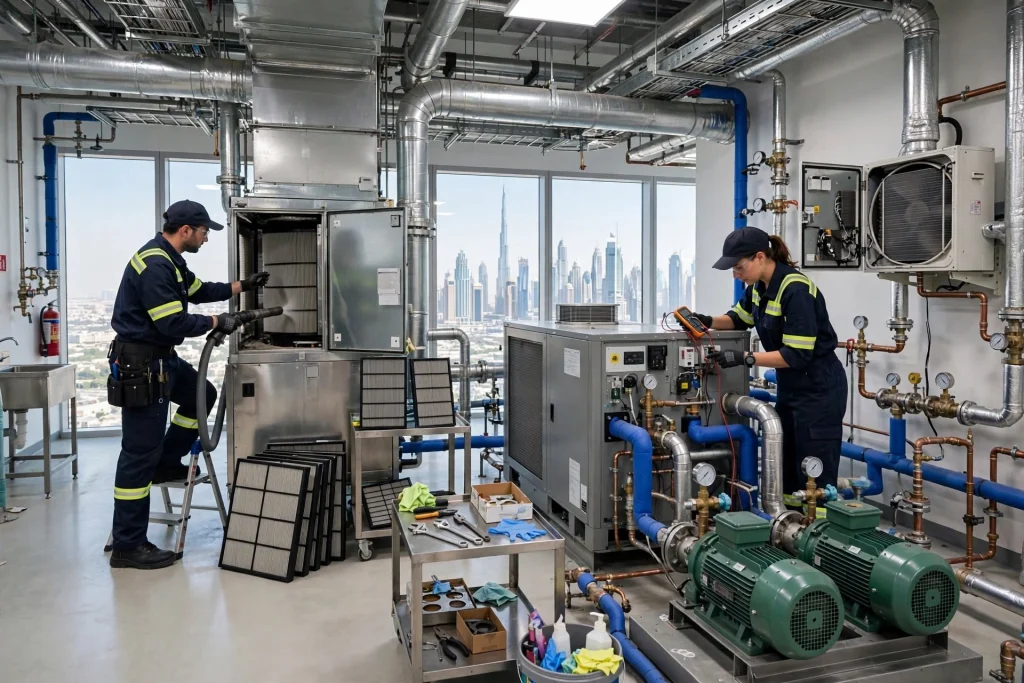
Cleaning condenser coils, replacing loaded filters, maintaining correct airflow, checking chilled-water flow, inspecting fans, verifying controls, and identifying refrigeration problems.
Energy savings vary by building and equipment condition, so maintenance should not be treated as a guaranteed fixed percentage reduction.
Maintaining Clean Filters
Air filters protect HVAC equipment from airborne particles.
Over time, filters can become loaded with dust and other particles.
A heavily restricted filter increases resistance to airflow.
The fan may need to work harder, while insufficient airflow can also affect cooling performance.
Regular filter inspection and replacement based on actual conditions can help maintain appropriate airflow.
In Dubai, dust exposure can make filter monitoring particularly important, especially for buildings near construction areas or busy roads.
Cleaning Evaporator and Condenser Coils
Heat-transfer surfaces are critical to HVAC performance.
In air-conditioning equipment, evaporator coils absorb heat from indoor air while condenser coils reject heat.
When coils become contaminated, heat transfer can deteriorate.
For air-cooled chillers and condensing units, dirty outdoor condenser coils can be particularly important because dust can restrict airflow through the coil.
Regular inspection and suitable cleaning can help maintain heat rejection.
Chiller Maintenance and Operating Costs
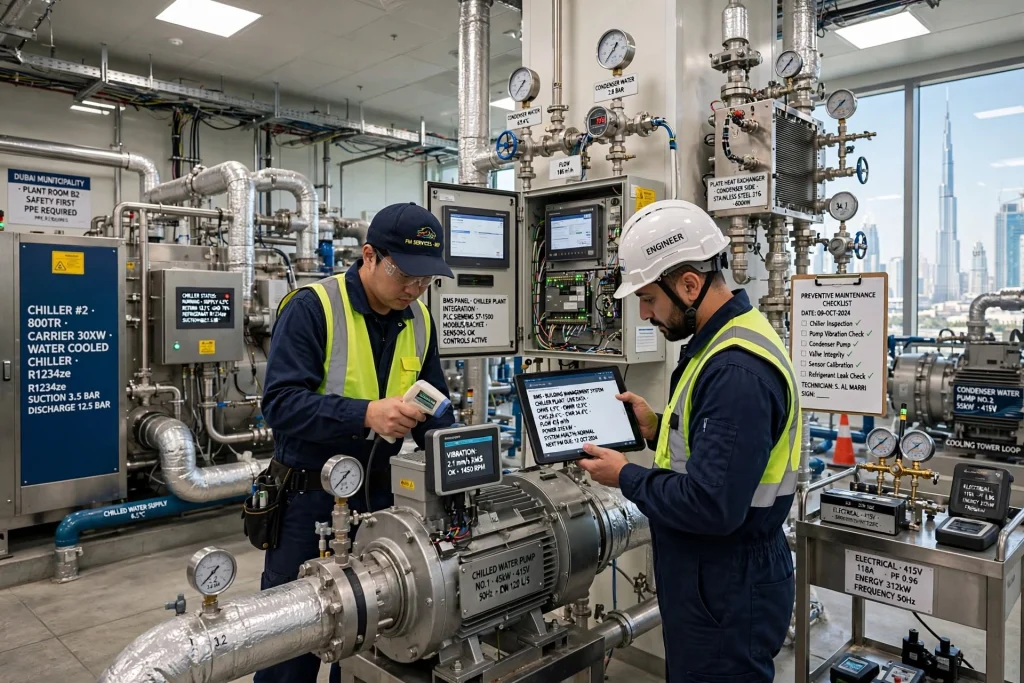
Chillers can be major energy consumers in large commercial buildings.
A chiller plant may include:
Chillers, chilled-water pumps, condenser-water pumps where applicable, cooling towers, heat exchangers, valves, sensors, controls, and BMS integration.
Preventive maintenance can help identify problems affecting chiller performance.
Technicians may review temperatures, pressures, flow rates, electrical conditions, vibration, refrigerant-related parameters, and control operation according to the equipment design.
Maintaining the chiller plant properly can help reduce avoidable operating inefficiencies.
Water-Cooled Chiller Considerations
Water-cooled chillers use a condenser-water circuit and cooling tower.
This introduces additional maintenance requirements.
Cooling-tower systems may require attention to:
Water quality, scaling, corrosion, biological control, basin condition, fill materials, fans, pumps, nozzles, and heat-transfer performance.
If heat transfer deteriorates, the chiller may operate under less favourable conditions.
Water treatment and regular system inspection can therefore be important components of preventive maintenance.
Air-Cooled Chiller Considerations
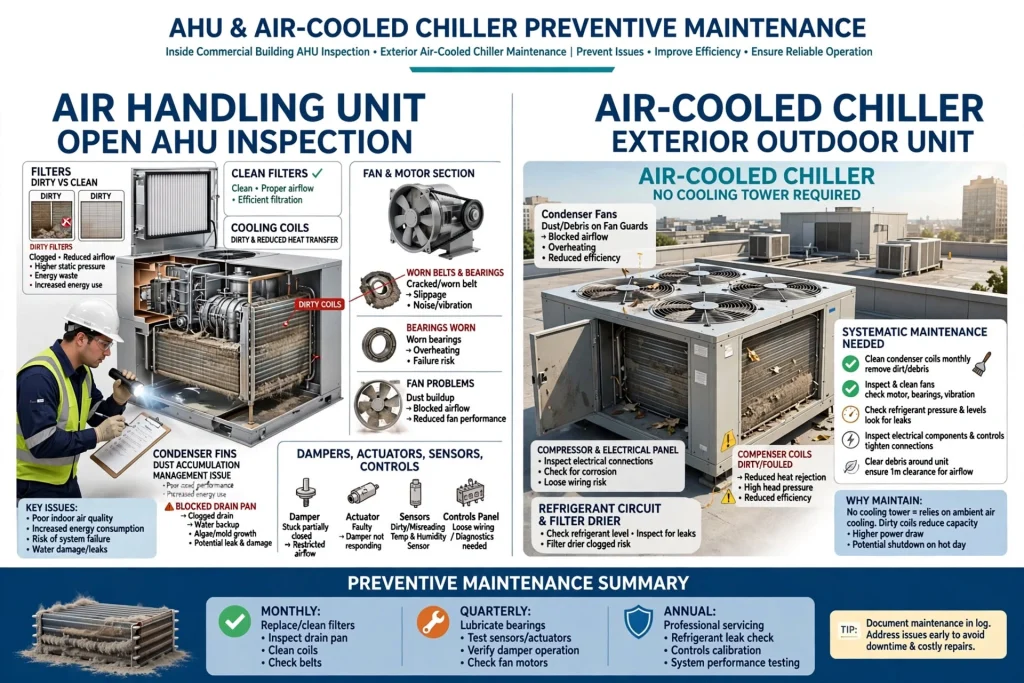
Air-cooled chillers reject heat directly into outdoor air.
Their condenser coils and fans are exposed to environmental conditions.
In Dubai’s dusty environment, condenser coil cleanliness is particularly relevant.
Regular inspection can identify:
Dust accumulation, blocked airflow, damaged fins, fan problems, electrical faults, and other conditions affecting condenser performance.
Air-cooled chillers do not require cooling towers, but they still require systematic preventive maintenance.
Maintaining Air Handling Units
Air handling units distribute and condition air throughout commercial buildings.
An AHU can contain:
Filters, cooling coils, fans, motors, belts, dampers, drain pans, actuators, sensors, and control components.
A maintenance program should consider each of these components.
Dirty filters can restrict airflow.
Dirty coils can reduce heat transfer.
Blocked drain pans can cause water-management problems.
Worn belts or bearings can affect fan operation.
Addressing these problems early can reduce the possibility of costly corrective repairs.
Fan Coil Unit Maintenance
FCUs are commonly used for individual zones in offices, hotels, apartments, retail spaces, and other buildings.
Preventive maintenance may include:
Filter inspection, coil cleaning, fan inspection, drain cleaning, condensate checks, thermostat testing, and electrical inspection.
Poorly maintained FCUs can contribute to uneven cooling, excessive noise, unpleasant odours, or water leakage.
A systematic service schedule helps facility teams identify these issues earlier.
Preventing Emergency HVAC Repairs
Emergency repairs can be significantly more disruptive than planned maintenance.
A failed HVAC component can affect:
Building occupants, business operations, tenant comfort, production activities, hotel guests, retail customers, or critical equipment.
Emergency service may also require expedited parts, specialist technicians, overtime labour, or temporary cooling arrangements.
Preventive inspections provide opportunities to identify components showing signs of deterioration before they fail completely.
Extending Equipment Life
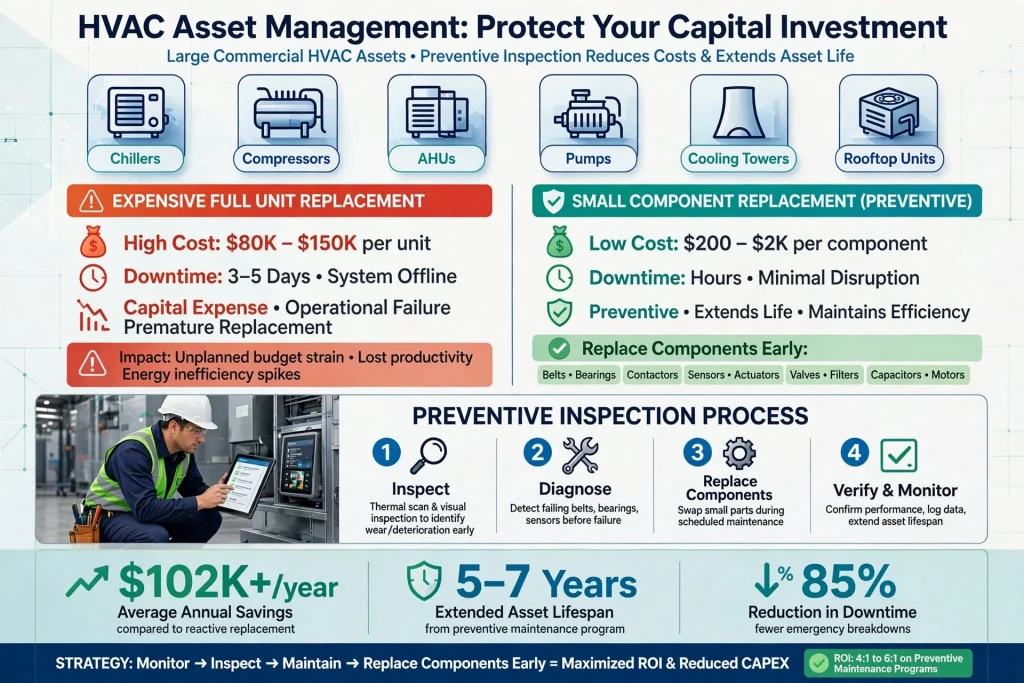
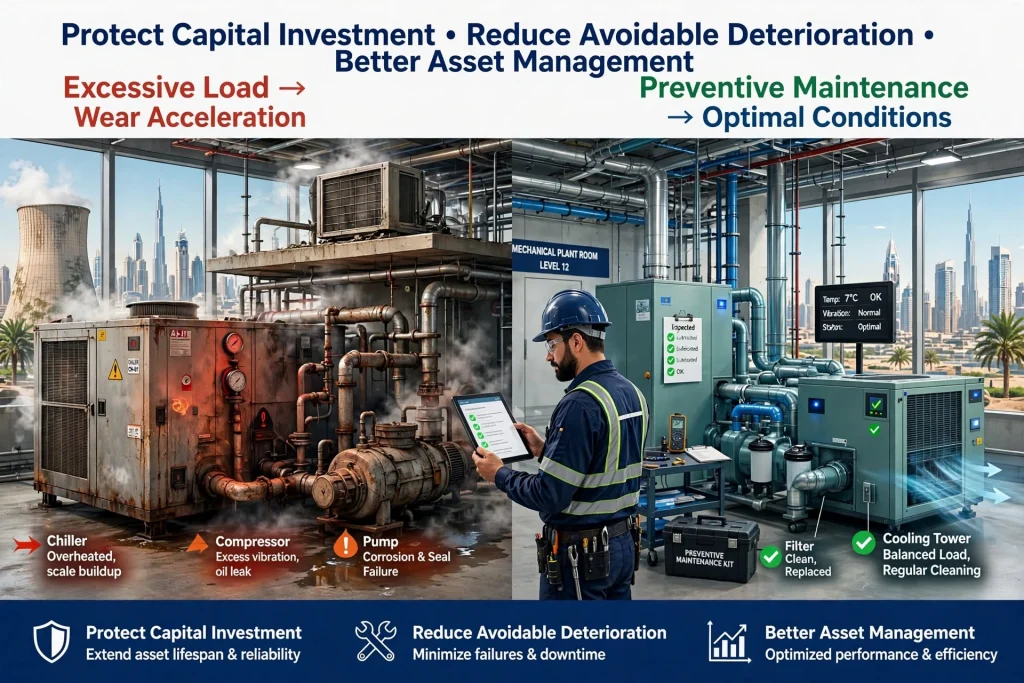
HVAC equipment represents a significant capital investment.
Chillers, compressors, AHUs, pumps, cooling towers, and rooftop units are not inexpensive assets.
Operating equipment under excessive load or with neglected maintenance can accelerate wear.
Preventive maintenance helps keep equipment within appropriate operating conditions.
This does not guarantee a specific service life, but it can support better asset management and reduce avoidable deterioration.
Reducing Premature Component Replacement
Not every HVAC problem requires replacing an entire unit.
Sometimes the problem is associated with a smaller component.
Examples include:
Belts, bearings, contactors, sensors, actuators, valves, filters, capacitors, motors, and other replaceable components.
Regular inspection can identify deteriorating parts early.
Replacing a relatively inexpensive component before it causes secondary damage can sometimes prevent a more expensive repair.
Refrigerant System Checks
Refrigerant is essential to vapor-compression air-conditioning systems.
Problems such as refrigerant leakage, incorrect charge, restrictions, or abnormal operating conditions can reduce cooling performance.
Technicians can assess system operating conditions and investigate suspected refrigerant problems.
Refrigerant handling should be carried out by appropriately trained personnel and in accordance with applicable requirements.
Simply adding refrigerant without identifying the cause of a loss is not an effective long-term maintenance strategy.
Maintaining Correct Airflow
Correct airflow is fundamental to HVAC performance.
Airflow can be affected by:
Dirty filters, blocked ducts, closed dampers, damaged flexible ducts, fan problems, coil contamination, incorrect balancing, or duct leakage.
If airflow is lower than intended, some areas may become uncomfortable while the HVAC system continues operating.
Air balancing and airflow measurement can help determine whether the distribution system is performing according to design requirements.
Ductwork and Energy Losses
Ductwork distributes conditioned air throughout a building.
Leaks in supply ducts can allow conditioned air to escape into ceiling voids, shafts, plant areas, or other spaces.
Damaged insulation can also increase heat gain.
During maintenance, accessible ductwork can be inspected for:
Air leakage, insulation damage, loose connections, disconnected flexible ducts, damaged supports, and other visible problems.
Correcting significant defects can help improve air-distribution performance.
Thermostat and Sensor Calibration
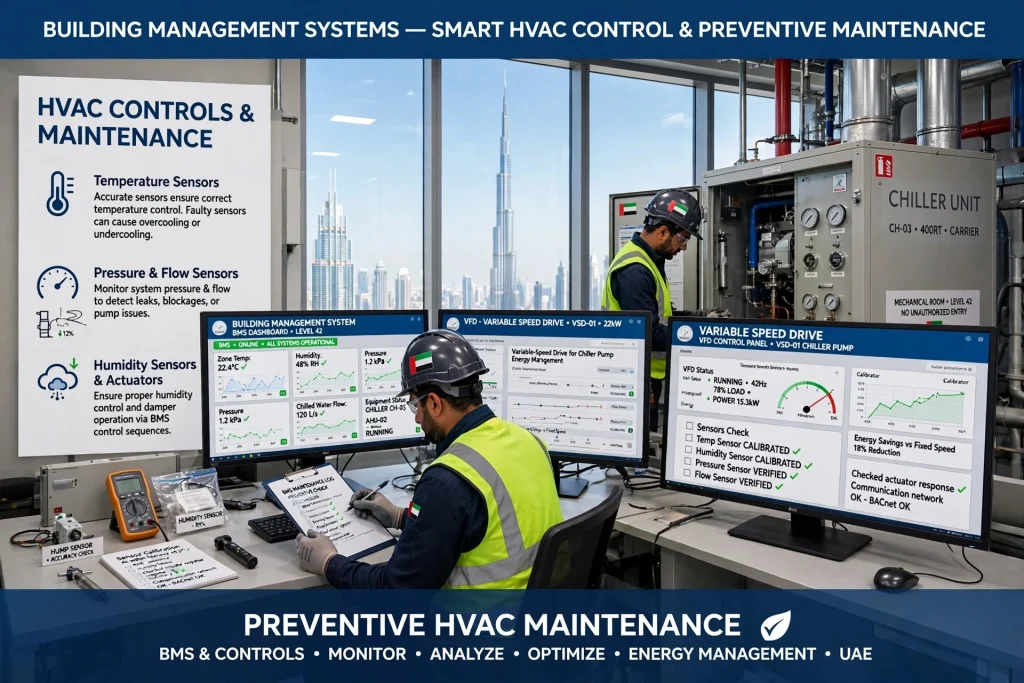
HVAC controls influence when and how equipment operates.
If a temperature sensor is inaccurate, the control system may receive incorrect information.
The HVAC system could then cool a space more or less than necessary.
Preventive maintenance can include checking thermostats, temperature sensors, pressure sensors, humidity sensors, flow sensors, and other control devices where applicable.
Accurate sensors support better automatic control.
Building Management Systems
Modern commercial properties increasingly use Building Management Systems (BMS).
A BMS can monitor and control HVAC equipment and provide information about:
Temperatures, equipment status, alarms, schedules, pressures, flow rates, energy consumption, and other operating parameters.
Preventive maintenance can include reviewing BMS data and checking whether sensors, actuators, communication networks, and control sequences are functioning correctly.
This creates an opportunity to identify unusual behaviour before it becomes a major failure.
Variable-Speed Drives and Energy Management
Variable-frequency drives (VFDs) allow motors to operate at different speeds depending on system demand.
They can be used with:
Fans, pumps, compressors, and other motor-driven equipment.
When correctly selected and controlled, variable-speed operation can reduce unnecessary energy consumption during periods of lower demand.
Maintenance should include appropriate inspection of VFDs and associated motors.
Condensate Drain Maintenance
Air-conditioning systems remove moisture from air as it passes over cold evaporator or cooling coils.
The resulting condensate needs to drain correctly.
Blocked condensate lines can cause:
Water leakage, overflowing drain pans, ceiling damage, unpleasant odours, and operational interruptions.
Regular inspection and cleaning of condensate systems can help prevent avoidable water-related problems.
HVAC Maintenance and Indoor Air Quality
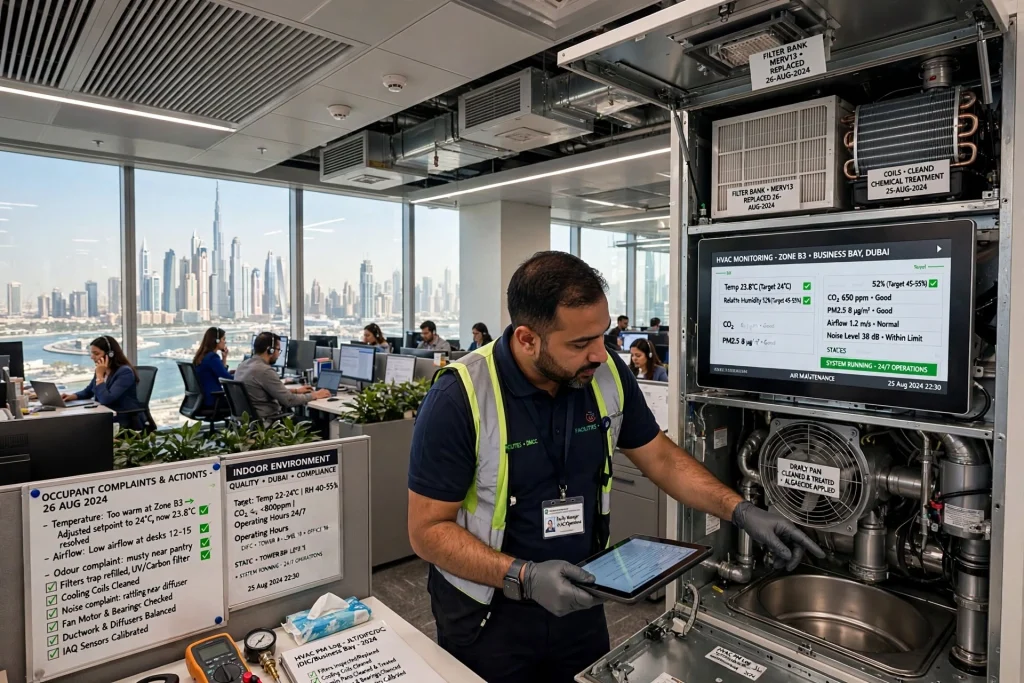
HVAC maintenance also contributes to the management of indoor environmental conditions.
Filters, ventilation systems, coils, drain pans, fans, and air-distribution components can all influence the indoor environment.
However, good indoor air quality requires more than HVAC servicing.
Building occupancy, ventilation rates, outdoor air quality, humidity, cleaning practices, construction materials, and pollutant sources also need to be considered.
Maintenance for Offices in Dubai
Office buildings may have long operating hours and high occupant density.
HVAC problems can quickly result in employee complaints about:
Temperature, airflow, odours, humidity, and noise.
Preventive maintenance allows facility managers to address equipment issues before they become widespread occupant problems.
Areas such as Business Bay, Dubai International Financial Centre (DIFC), Dubai Internet City, and Jumeirah Lake Towers (JLT) contain large numbers of commercial properties where structured HVAC asset management can be valuable.
Maintenance for Hotels and Hospitality
Hotels depend heavily on reliable air conditioning.
Guest rooms, lobbies, restaurants, conference rooms, kitchens, gyms, spas, and back-of-house areas can all have different HVAC requirements.
A failure during peak occupancy can affect guest satisfaction and business operations.
Preventive maintenance helps hospitality operators plan servicing around occupancy schedules and reduce unexpected interruptions.
Dubai’s hospitality areas, including Downtown Dubai, Dubai Marina, Palm Jumeirah, and Jumeirah, contain properties with substantial cooling requirements.
Maintenance for Retail Properties
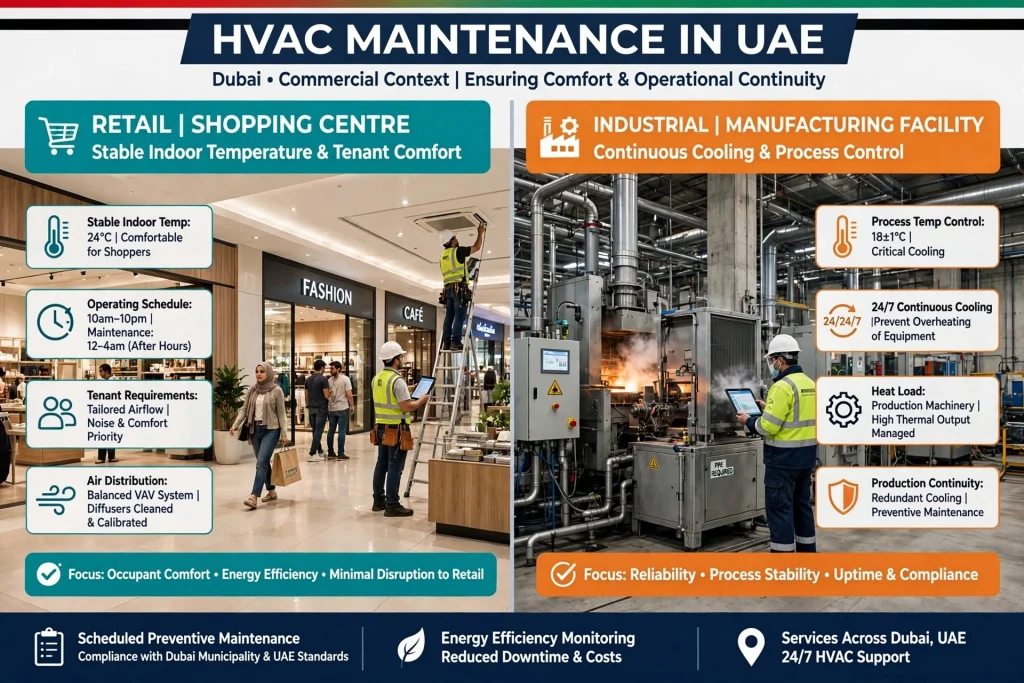
Shopping centres and retail stores require stable indoor temperatures to maintain customer comfort and protect certain products and equipment.
Retail properties may also have changing occupancy levels throughout the day.
HVAC maintenance should consider operating schedules, tenant requirements, air distribution, and central plant performance.
Maintenance for Industrial Facilities
Industrial HVAC systems may provide both comfort cooling and process temperature control.
Some facilities require cooling continuously because production equipment generates substantial heat.
Preventive maintenance can help protect production continuity by identifying HVAC problems before they cause temperature excursions or equipment shutdowns.
Industrial areas such as Al Quoz, Jebel Ali, and Dubai Investment Park (DIP) contain facilities where HVAC reliability can be an important operational consideration.
Maintenance for Restaurants
Restaurants have challenging HVAC environments because of:
Heat generation, cooking activities, high occupancy, odours, humidity, and kitchen exhaust requirements.
Kitchen exhaust systems should be maintained according to their specific requirements.
At the same time, comfort HVAC systems need appropriate inspection and servicing.
Keeping the different ventilation systems properly maintained can help support a safer and more comfortable commercial environment.
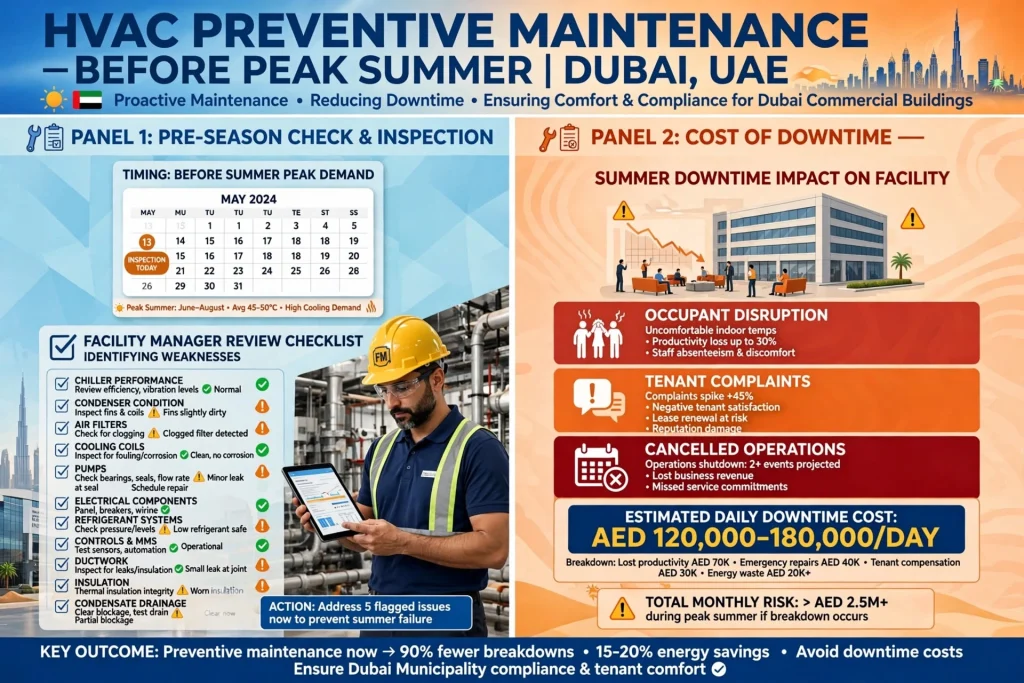
Preventive Maintenance During Dubai’s Summer
The period before peak summer cooling demand is an important opportunity to evaluate HVAC system performance.
Facility managers can review:
Chiller performance, condenser condition, filters, cooling coils, pumps, fans, electrical components, refrigerant systems, controls, ductwork, insulation, and condensate drainage.
The goal is to identify weaknesses before the system experiences sustained high demand.
However, preventive maintenance should continue throughout the year rather than being limited to one annual inspection.
How Maintenance Reduces Downtime
Downtime has an economic cost.
For a commercial property, HVAC failure can result in:
Occupant disruption, tenant complaints, cancelled operations, damaged inventory, reduced productivity, uncomfortable working conditions, or temporary closure of affected areas.
A preventive program helps shift maintenance from emergency response toward planned intervention.
This allows businesses to schedule work at suitable times and prepare required parts and resources.
Maintenance Records and Asset History
Good documentation makes preventive maintenance more effective.
Maintenance records can track:
Service dates, component replacements, faults, operating readings, inspection results, refrigerant-related work, filter changes, coil cleaning, repairs, and recurring issues.
Over time, this information can reveal patterns.
For example, repeated motor failures may indicate an underlying alignment, electrical, vibration, or operating problem.
Condition-Based Maintenance
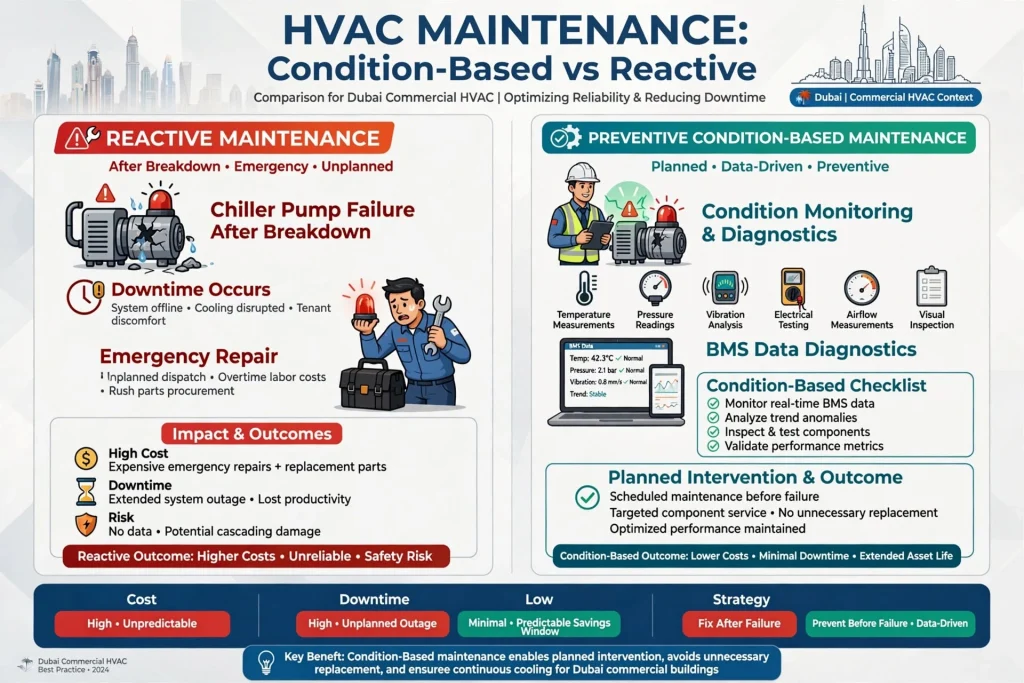
Not every HVAC component needs to be replaced simply because a certain amount of time has passed.
Condition-based maintenance uses inspection and performance information to determine when intervention is appropriate.
Technicians may use:
Temperature measurements, pressure readings, vibration analysis, electrical testing, airflow measurements, visual inspection, BMS data, and other diagnostic information.
This approach can help avoid unnecessary component replacement while still addressing genuine risks.
Preventive Maintenance vs Reactive Maintenance
Reactive maintenance responds after a failure occurs.
Preventive maintenance aims to reduce the likelihood of unexpected failures by identifying and correcting developing problems.
A reactive approach might involve waiting for a chiller pump to fail.
A preventive approach could identify abnormal vibration, bearing wear, electrical issues, or other warning signs during scheduled inspection.
The second approach provides greater opportunity for planned intervention.
Creating an HVAC Maintenance Schedule
A maintenance schedule should be based on the specific HVAC system.
A basic program may include:
Daily or routine monitoring: equipment status, alarms, temperatures, unusual noises, and visible abnormalities.
Monthly or periodic checks: filters, condensate systems, belts, electrical components, and operating conditions.
Quarterly or seasonal checks: coils, fans, controls, airflow, pumps, and system performance.
Annual or manufacturer-defined servicing: comprehensive equipment inspection, testing, cleaning, and performance review.
The exact frequency should follow manufacturer requirements, system criticality, operating conditions, and applicable project standards.
Choosing an HVAC Maintenance Contractor in Dubai
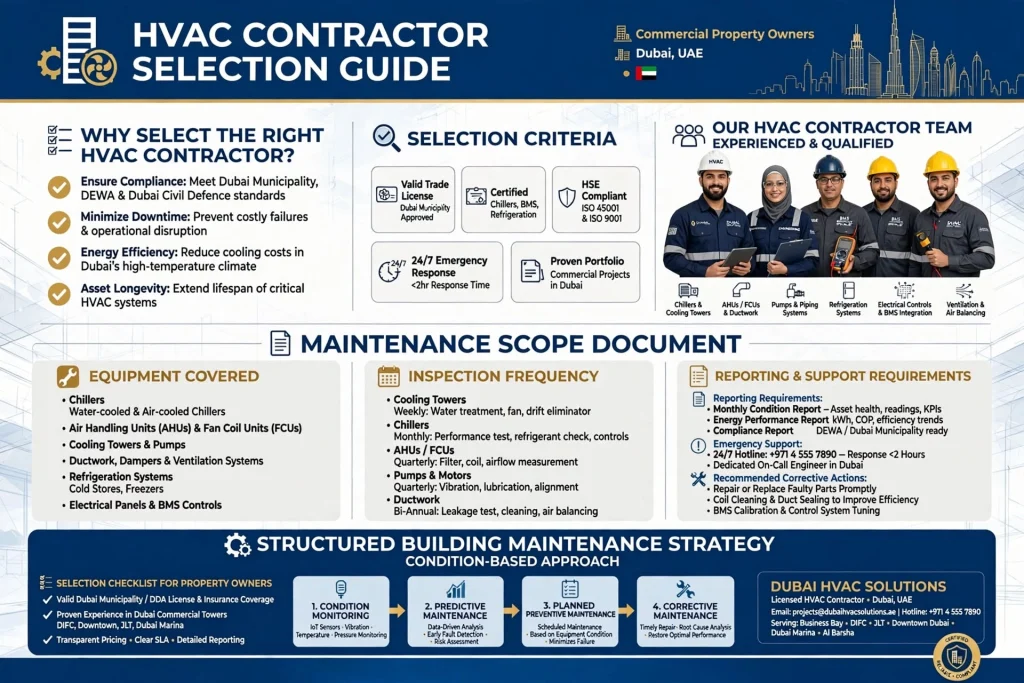
Commercial property owners should choose contractors with appropriate experience in the type of HVAC system installed at the property.
A suitable contractor should understand:
Chillers, AHUs, FCUs, pumps, cooling towers, ductwork, refrigeration systems, electrical controls, BMS integration, ventilation, and air balancing.
For businesses searching for professional support, Preventive HVAC Maintenance can form part of a structured building maintenance strategy designed around equipment condition, operating requirements, and the property’s cooling needs.
The maintenance scope should clearly identify the equipment covered, inspection frequency, reporting requirements, emergency support, and recommended corrective actions.
A Practical Preventive HVAC Maintenance Checklist
A commercial HVAC checklist can include:
Inspect and replace filters where required
Clean appropriate cooling coils
Inspect condenser coils
Check refrigerant-system performance
Inspect compressors
Check fans and motors
Inspect belts and bearings
Check pumps
Inspect valves
Verify chilled-water temperatures
Check airflow
Inspect ductwork
Check insulation
Clean condensate drains
Inspect drain pans
Test thermostats and sensors
Review BMS alarms
Inspect electrical connections
Check VFD operation
Record operating readings
Review recurring faults
Document completed work
The checklist should be adapted to the actual HVAC installation.
How Preventive Maintenance Supports ROI
Preventive maintenance should be viewed as an asset-management strategy rather than simply an expense.
The financial benefits can come from several areas:
Lower avoidable energy consumption
Fewer emergency repairs
Reduced downtime
Longer equipment service life
Better cooling performance
Reduced premature component replacement
Improved maintenance planning
Better visibility into asset condition
The actual return on investment varies depending on equipment age, building size, operating hours, energy prices, existing maintenance condition, and the quality of the maintenance program.
Final Thoughts
Preventive HVAC maintenance can play an important role in controlling operating costs for Dubai’s residential, commercial, hospitality, healthcare, retail, and industrial properties.
Because cooling systems operate under demanding conditions, small issues can gradually affect efficiency and reliability. Dirty filters, contaminated coils, restricted airflow, refrigerant problems, failing motors, blocked condensate drains, damaged insulation, inaccurate sensors, and control faults can all contribute to higher operating costs when left unresolved.
A structured maintenance strategy provides an opportunity to identify these conditions early.
The most effective approach combines regular inspection, equipment cleaning, performance testing, condition monitoring, planned component replacement, accurate documentation, BMS monitoring, and professional troubleshooting.
For larger properties, maintenance should cover the entire HVAC ecosystem rather than focusing on individual units. Chillers, cooling towers, pumps, AHUs, FCUs, ductwork, ventilation systems, controls, and electrical components all influence the building’s overall cooling performance.
Ultimately, preventive maintenance is not simply about avoiding breakdowns. It is about managing HVAC assets throughout their operating life, maintaining appropriate performance, and making maintenance costs more predictable.
For Dubai property owners and facility managers, investing in a well-planned HVAC maintenance program can help create more reliable cooling, support energy management, reduce unexpected interruptions, and protect valuable mechanical equipment over the long term.