Commercial HVAC systems are responsible for maintaining comfortable temperatures, controlling humidity, supporting indoor air quality, and providing reliable ventilation across offices, retail stores, hotels, restaurants, warehouses, healthcare facilities, schools, and other commercial properties. Because these systems often operate for long hours and under demanding conditions, regular servicing is essential for dependable performance.
Unlike a small residential air-conditioning unit, a commercial HVAC system can include multiple interconnected components such as chillers, air handling units, fan coil units, cooling towers, pumps, ductwork, filters, thermostats, variable frequency drives, dampers, ventilation equipment, and building automation controls. A problem with one component can affect the performance of the wider system.
For properties in Dubai and other parts of the UAE, regular maintenance is particularly important because cooling equipment can operate extensively during periods of high outdoor temperatures. A planned maintenance programme can help identify developing faults before they become major operational problems.
How Often Should a Commercial HVAC System Be Serviced?
For most commercial buildings, a professional HVAC inspection and preventive maintenance programme should be carried out at least twice a year, while systems operating continuously or under heavy loads may require more frequent attention.
However, there is no universal schedule that applies to every commercial property.
A small office with moderate operating hours may have different maintenance requirements from a hotel, shopping centre, hospital, restaurant, data centre, or industrial facility.
A practical maintenance programme may include:
- Routine visual inspections
- Filter inspection and replacement
- Coil cleaning
- Fan inspection
- Electrical checks
- Refrigerant system inspection
- Drain cleaning
- Ductwork inspection
- Thermostat and sensor checks
- Airflow testing
- Chilled-water system checks
- Pump inspection
- Cooling tower maintenance
- BMS monitoring
- Seasonal performance checks
The exact frequency should be determined according to equipment type, operating hours, manufacturer recommendations, building usage, environmental conditions, and previous maintenance history.
Why Commercial HVAC Maintenance Is Different
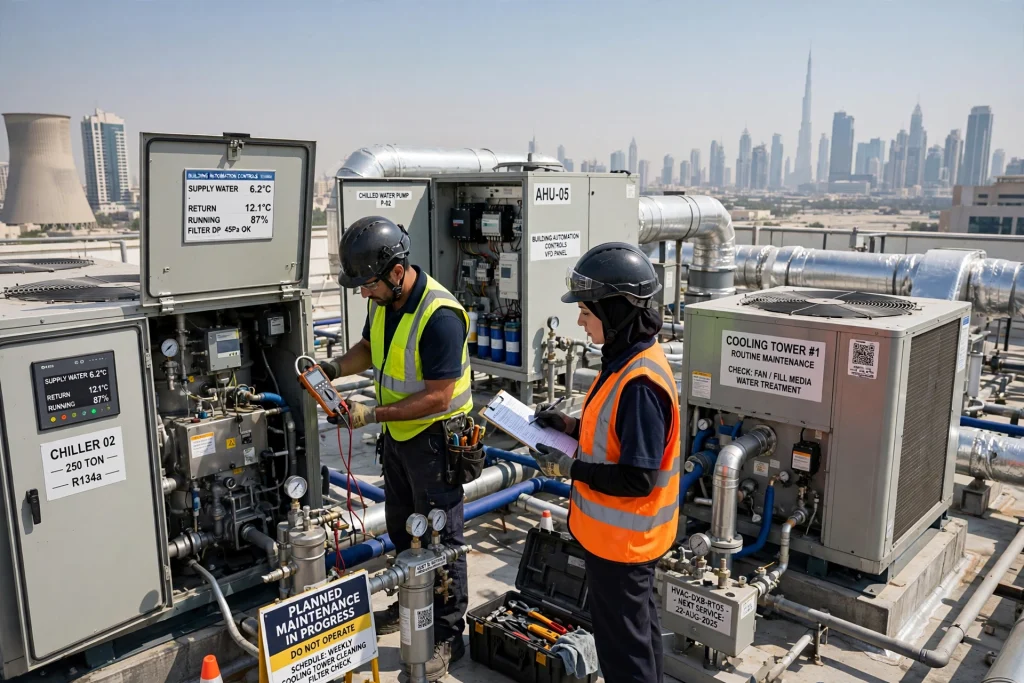
Commercial HVAC systems are often much more complicated than residential systems.
A commercial building may use several types of equipment simultaneously.
For example, a hotel may have:
- Chillers
- Cooling towers
- Chilled-water pumps
- AHUs
- FCUs
- Fresh-air units
- Exhaust fans
- Kitchen ventilation
- BMS controls
An office tower may have a central chilled-water plant connected to hundreds of FCUs or multiple AHUs.
A restaurant can have air-conditioning equipment operating alongside kitchen exhaust and make-up air systems.
Because these systems are interconnected, maintenance needs to consider the complete HVAC network rather than one individual unit.
Monthly Commercial HVAC Checks
Some maintenance tasks should be performed more frequently than a full professional service visit.
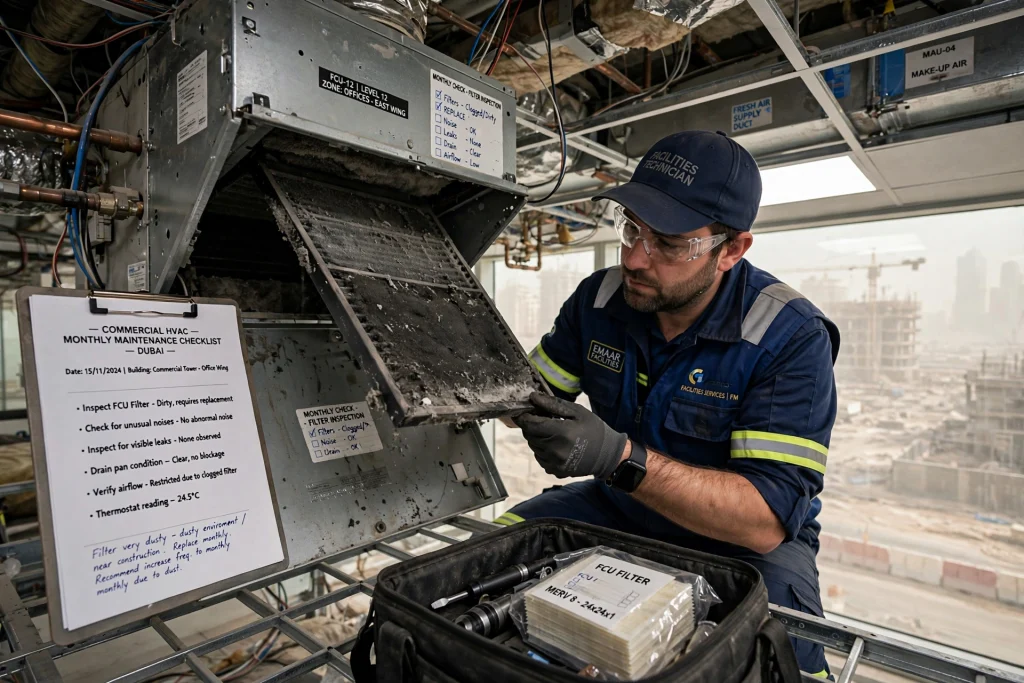
Depending on the building and equipment, monthly checks can include inspection of filters, unusual noises, visible leaks, thermostat readings, drain conditions, airflow, and general equipment operation.
Filters deserve particular attention because clogged filters restrict airflow.
Restricted airflow can increase the workload on fans and cooling equipment while reducing indoor comfort.
In dusty environments, filters may become dirty more quickly.
For commercial properties near busy roads, construction areas, industrial zones, or dusty outdoor environments, filter inspection may need to occur more frequently.
Quarterly HVAC Maintenance
Quarterly maintenance can be useful for commercial buildings with moderate to high HVAC usage.
A quarterly service may include more detailed inspection of mechanical and electrical components.
Technicians can check:
- Filters
- Coils
- Blowers
- Fans
- Belts
- Bearings
- Drain pans
- Condensate drains
- Electrical connections
- Sensors
- Thermostats
- Refrigerant circuits
- Airflow
- Operating temperatures
For larger systems, the service may also include pumps, valves, cooling-water systems, and control equipment.
Quarterly inspections can help identify developing issues before they become significant failures.
Six-Month Commercial HVAC Servicing
A six-month maintenance cycle is commonly appropriate for many commercial HVAC installations, particularly where the equipment operates regularly but is not subject to continuous heavy-duty use.
A detailed service at this interval can include cleaning, inspection, testing, and performance evaluation.
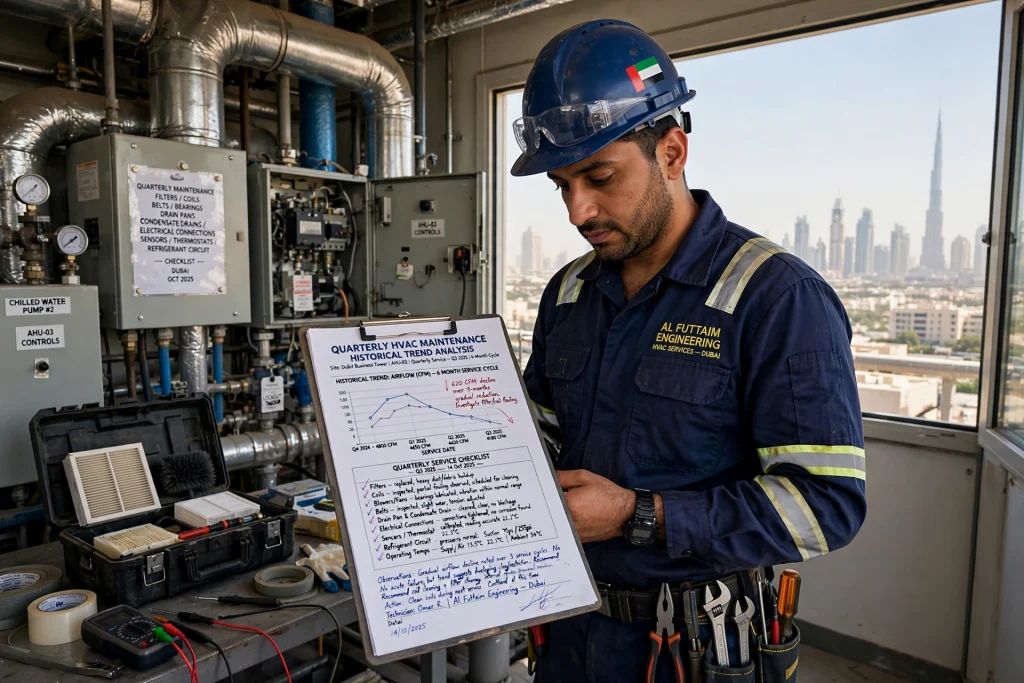
The technician should review the condition of major components and compare current operating conditions with previous service records.
This historical information is useful because gradual deterioration may not be obvious during a single inspection.
For example, a small reduction in airflow may not immediately indicate a serious problem, but repeated declines over several maintenance visits can reveal a developing issue.
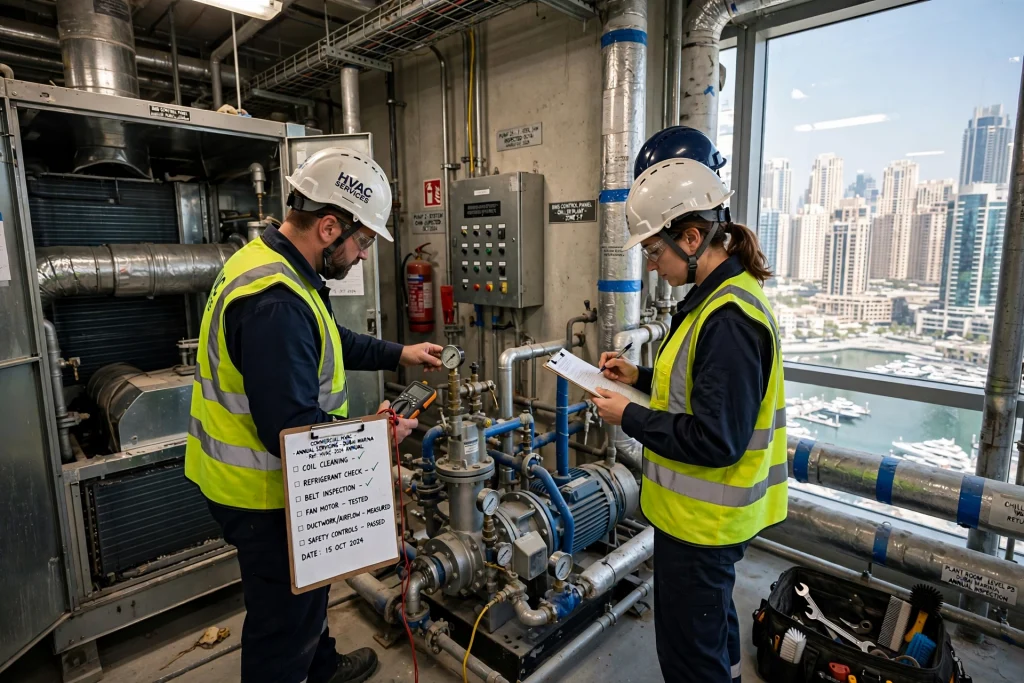
Annual Commercial HVAC Maintenance
At least once a year, commercial HVAC systems should receive a comprehensive inspection.
Annual servicing can provide an opportunity to evaluate the overall condition of the installation.
Depending on the system, the annual service may involve:
- Detailed equipment inspection
- Coil cleaning
- Electrical testing
- Refrigerant checks
- Drainage inspection
- Fan and motor inspection
- Belt inspection
- Bearing assessment
- Ductwork inspection
- Airflow measurements
- Control calibration
- BMS review
- Pump inspection
- Cooling tower inspection
- Safety control testing
For large central plants, additional testing may be required according to equipment type and manufacturer requirements.
Commercial HVAC Maintenance in Dubai
Dubai’s climate makes air-conditioning reliability especially important.
Commercial properties can experience prolonged periods of high ambient temperatures, meaning cooling systems may operate under significant demand.
Buildings in areas such as Dubai Marina, Downtown Dubai, Business Bay, Jumeirah, Palm Jumeirah, Dubai Hills Estate, Deira, Bur Dubai, Al Barsha, and Sheikh Zayed Road can contain a wide variety of commercial HVAC installations.
Offices, hotels, restaurants, retail centres, clinics, gyms, warehouses, and mixed-use buildings may each have different cooling and ventilation requirements.
Maintenance schedules should therefore reflect the building’s actual operating conditions rather than following a generic timetable.
Commercial HVAC Contractors in Dubai Marina
Buildings in Dubai Marina often include high-rise residential towers, hotels, restaurants, offices, retail spaces, and mixed-use developments.
These properties can have complex mechanical systems operating across multiple floors and zones.
Professional Commercial HVAC Contractors in Dubai Marina can assess equipment condition, identify developing faults, perform preventive maintenance, and support larger HVAC systems such as chillers, AHUs, FCUs, pumps, ventilation systems, and associated controls.
For high-rise properties, maintenance planning also needs to consider plant-room access, equipment shutdowns, tenant comfort, service elevators, and coordination with building management.
How Operating Hours Affect Maintenance Frequency
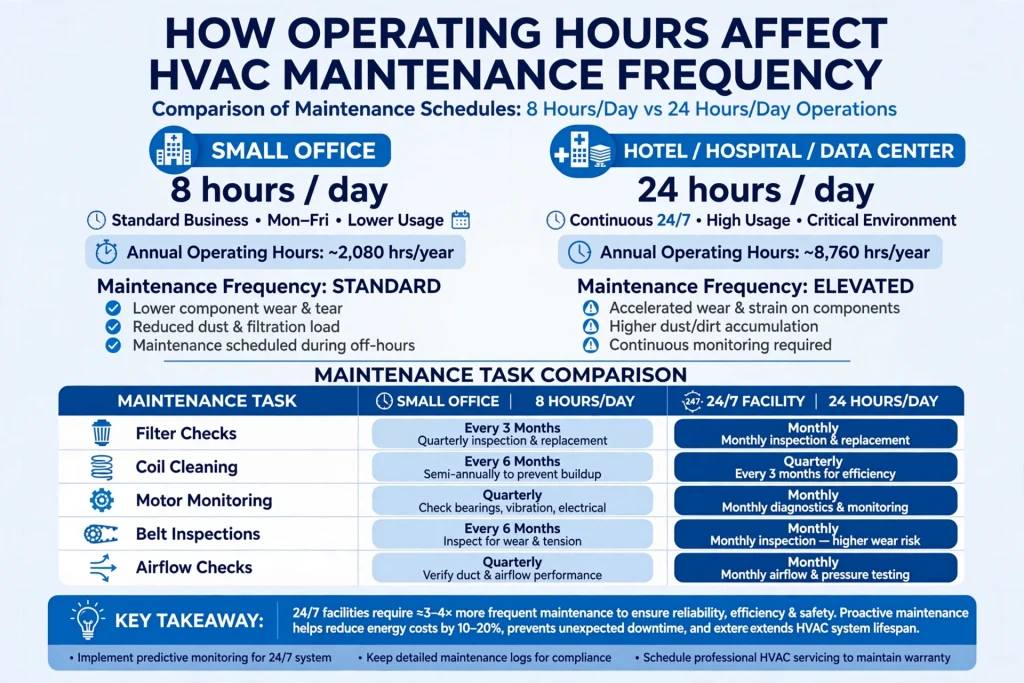
Operating hours have a direct influence on maintenance requirements.
A small office operating eight hours a day may place less demand on its HVAC equipment than a hotel operating continuously.
Similarly, a supermarket, shopping centre, hospital, or data facility may require cooling throughout the day and night.
Systems operating continuously may require:
- More frequent filter checks
- More frequent coil cleaning
- Closer monitoring of motors
- More frequent belt inspections
- More frequent airflow checks
- Detailed performance monitoring
The maintenance programme should reflect actual equipment runtime.
How Occupancy Affects HVAC Maintenance
The number of people using a commercial building can also influence HVAC performance.
Higher occupancy increases heat loads and can increase ventilation requirements.
A conference room with dozens of occupants can experience significantly different cooling requirements from an office containing only a few people.
Restaurants and hospitality spaces can have additional heat and ventilation loads from cooking equipment, lighting, kitchen appliances, and customer occupancy.
Maintenance should therefore consider how the building is actually being used.
Importance of Air Filters
Air filters are among the simplest HVAC components but can have a major effect on system performance.
Dirty filters restrict airflow and can allow dust to accumulate on internal components.
Restricted airflow can contribute to:
- Reduced cooling
- Higher fan workload
- Poor indoor air quality
- Increased energy consumption
- Coil contamination
- Uneven temperatures
The appropriate replacement frequency depends on the filter type and environmental conditions.
A maintenance technician can assess the filter condition and determine whether the current replacement interval is appropriate.
Cleaning Evaporator and Condenser Coils
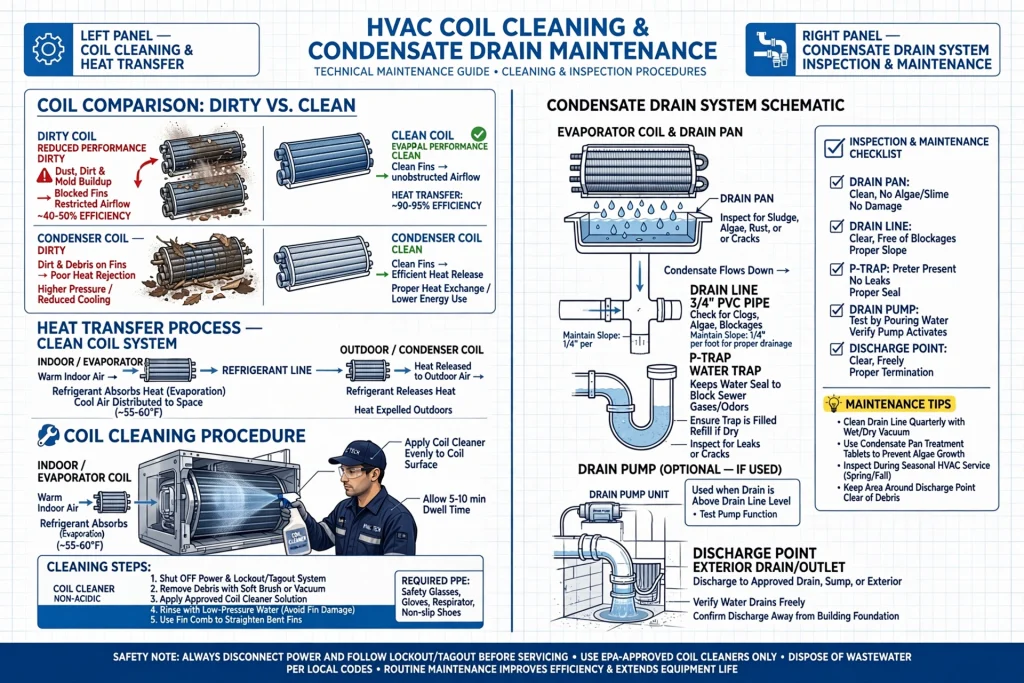
Coils transfer heat and therefore need to remain reasonably clean.
An evaporator coil transfers heat from indoor air into the refrigeration system.
A condenser coil rejects heat from the refrigerant.
When coils become contaminated, heat transfer can become less effective.
Outdoor condenser coils in dusty environments can accumulate dirt and debris.
Indoor evaporator coils can also collect dust if filtration is inadequate.
Regular inspection and appropriate cleaning can help maintain heat-transfer performance.
Condensate Drain Maintenance
Air-conditioning systems produce condensate during normal cooling operation.
This water needs to drain correctly.
Blocked condensate drains can result in water accumulation and potentially cause leakage around air-handling or fan-coil equipment.
A maintenance technician should inspect:
- Drain pans
- Drain lines
- Traps
- Drain pumps
- Discharge points
This is especially important in commercial buildings where water leakage can damage ceilings, flooring, walls, electrical systems, furniture, and equipment.
Refrigerant System Checks
Refrigerant-related problems can affect cooling performance.
A professional technician can check the system for signs of abnormal operating conditions, leaks, pressure problems, temperature differences, or component faults.
Refrigerant should not simply be added whenever cooling performance declines.
A drop in refrigerant level can indicate a leak or another underlying issue.
The cause should be investigated before additional refrigerant is introduced.
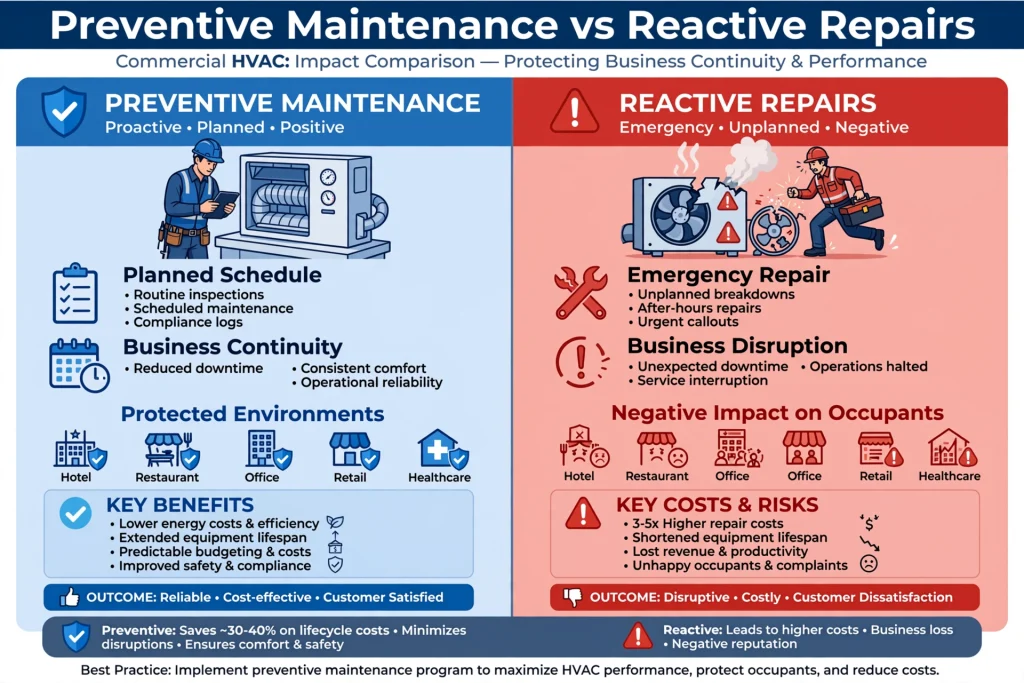
Electrical Inspection
Commercial HVAC equipment contains motors, compressors, contactors, relays, control boards, sensors, capacitors, and other electrical components.
Electrical connections should be inspected as part of planned maintenance.
Technicians can look for signs such as:
- Loose connections
- Overheating
- Damaged wiring
- Abnormal current
- Component deterioration
- Faulty controls
Electrical maintenance should always be performed by appropriately qualified personnel.
AHU and FCU Maintenance
Air handling units and fan coil units are common components of commercial chilled-water systems.
An AHU may condition and distribute air to larger areas, while an FCU typically serves a specific zone or room.
Maintenance can include inspection of:
- Filters
- Cooling coils
- Fans
- Motors
- Bearings
- Drain pans
- Valves
- Actuators
- Insulation
- Temperature sensors
Poorly maintained AHUs or FCUs can affect comfort even when the central chiller plant is functioning correctly.
Chiller Maintenance
Large commercial properties may depend on central chillers for cooling.
Chiller maintenance requirements vary according to equipment type.
Common types include:
- Water-cooled chillers
- Air-cooled chillers
- Centrifugal chillers
- Screw chillers
- Scroll chillers
Maintenance may include inspection of compressors, evaporators, condensers, refrigerant circuits, electrical components, controls, pumps, and associated water systems.
Water-cooled systems also require attention to condenser-water circuits and cooling towers.
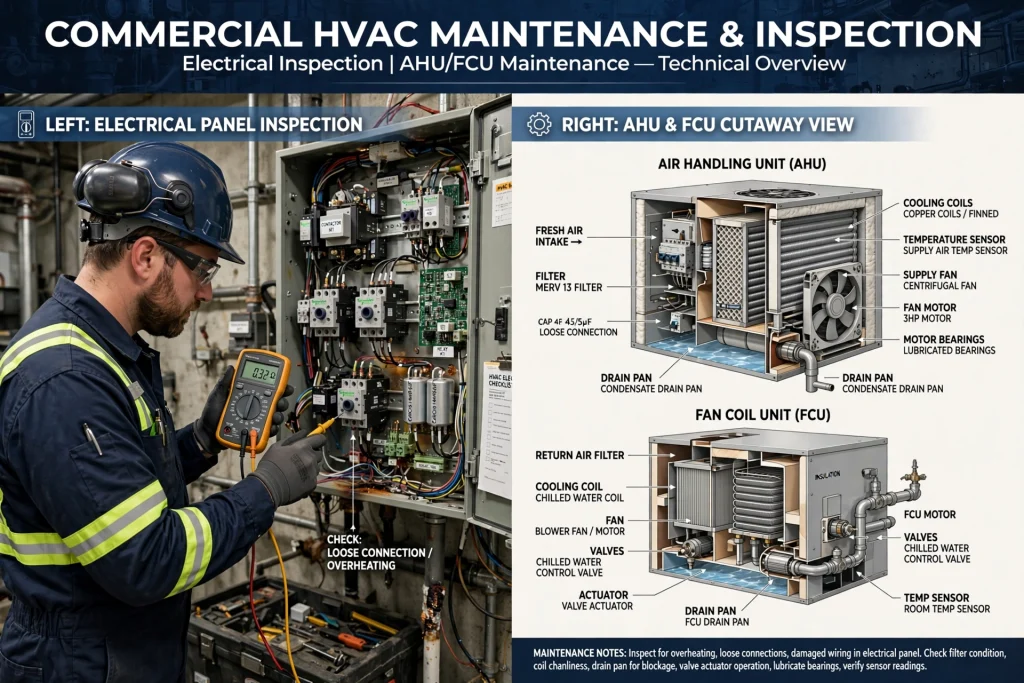
Cooling Tower Maintenance
Cooling towers are important components of many water-cooled chiller systems.
Because they operate outdoors, they can be exposed to dust, debris, biological contamination, and water-quality issues.
Maintenance can include:
- Basin inspection
- Fill inspection
- Fan inspection
- Drift eliminator inspection
- Water-quality checks
- Cleaning
- Pump inspection
- Corrosion assessment
Water treatment is also an important consideration for maintaining the condenser-water system.
HVAC Ductwork Inspection
Ductwork distributes conditioned air throughout a building.
Damaged or poorly sealed ducts can affect airflow and system efficiency.
During maintenance, technicians can look for:
- Visible damage
- Loose connections
- Insulation deterioration
- Air leakage
- Damaged flexible connections
- Blocked sections
- Dirty surfaces
Commercial kitchens require additional attention because grease and contaminants can accumulate within exhaust systems.
Ventilation and Indoor Air Quality
Commercial HVAC servicing should not focus only on temperature.
Ventilation plays an important role in maintaining indoor environmental conditions.
Fresh-air systems, exhaust fans, filters, dampers, and air-handling equipment should be inspected to ensure appropriate operation.
Poor ventilation can contribute to stuffy indoor environments and uncomfortable conditions.
Restaurants, healthcare facilities, gyms, educational buildings, and densely occupied offices may have particularly important ventilation requirements.
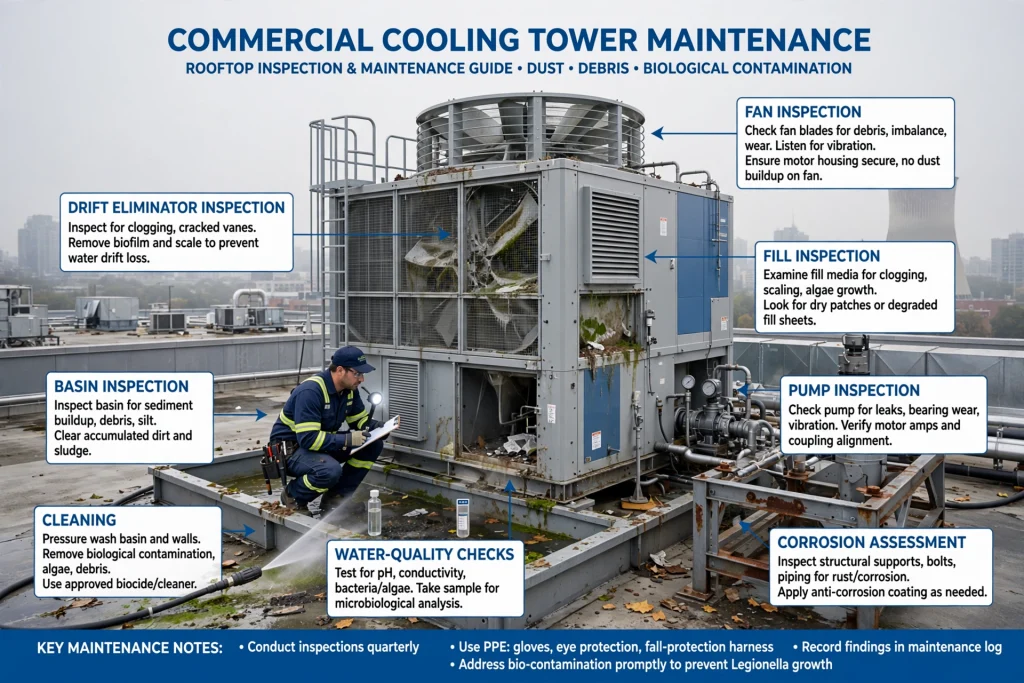
BMS and HVAC Controls
Many modern commercial buildings use a Building Management System to monitor and control HVAC equipment.
BMS can provide information about:
- Temperature
- Equipment status
- Alarms
- Operating schedules
- Pump operation
- Chiller operation
- Fan status
- Energy consumption
During HVAC maintenance, the control system should also be reviewed.
A mechanical component may be operating correctly while an incorrect sensor reading or control setting causes the system to operate inefficiently.
Warning Signs That Your HVAC Needs Immediate Attention
A commercial HVAC system may require service sooner than its scheduled maintenance date if unusual symptoms appear.
Warning signs include:
- Weak airflow
- Uneven temperatures
- Unusual noises
- Water leakage
- Frequent equipment shutdowns
- Unusual odours
- Rising energy consumption
- Repeated alarms
- Poor humidity control
- Slow cooling
- Excessive vibration
- Frequent compressor cycling
Ignoring these symptoms can allow a relatively small issue to develop into a larger repair.
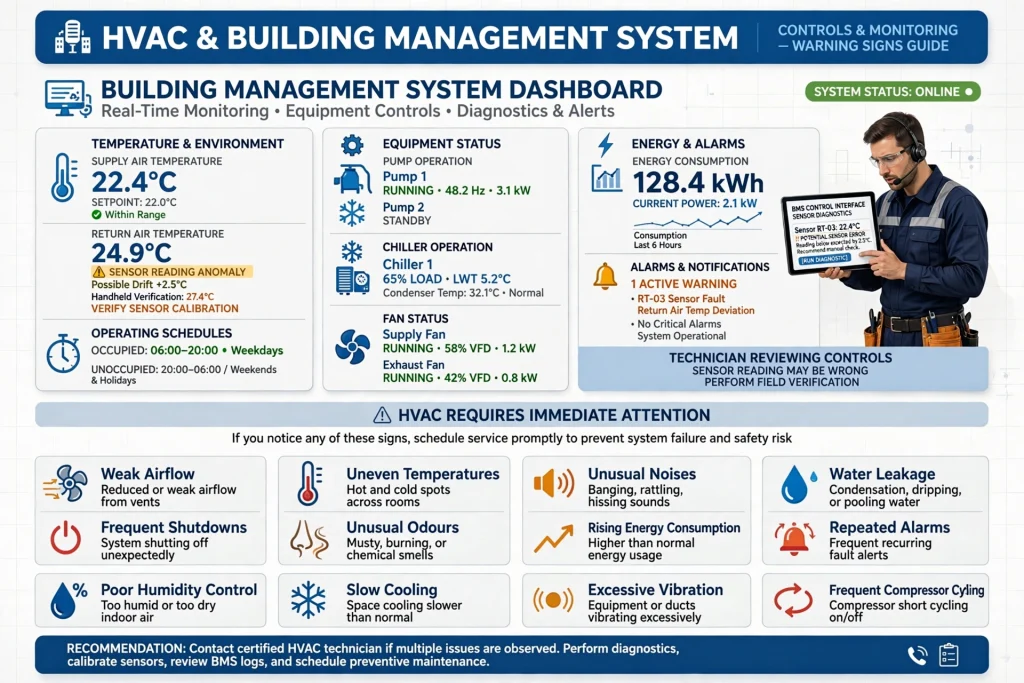
Preventive Maintenance vs Reactive Repairs
Preventive maintenance focuses on identifying and correcting developing problems before equipment fails.
Reactive maintenance occurs after a problem has already affected operation.
For commercial buildings, preventive maintenance can be particularly valuable because HVAC failure can disrupt business operations.
A failed cooling system in a hotel, restaurant, office, retail store, or healthcare facility can affect occupants, employees, customers, equipment, and business continuity.
A planned maintenance programme provides greater control over when equipment is inspected and serviced.
How Maintenance Can Reduce Unexpected Downtime
No maintenance programme can guarantee that equipment will never fail.
However, regular inspection can identify wear, contamination, abnormal temperatures, electrical problems, leaks, and other warning signs.
Replacing a worn belt during planned maintenance is generally easier than dealing with a failed belt during peak operating hours.
Similarly, identifying a blocked drain before it causes water damage can prevent a more disruptive incident.
The goal of preventive maintenance is therefore not simply to clean equipment but to identify potential failure points.
Keeping HVAC Maintenance Records
Commercial properties should maintain detailed service records.
Records can include:
- Service dates
- Equipment identification
- Filter changes
- Parts replaced
- Refrigerant work
- Cleaning
- Electrical readings
- Faults identified
- Repairs completed
- Recommendations
- Technician observations
Historical records make future maintenance easier.
They also help facility managers identify recurring problems and understand how equipment performance changes over time.
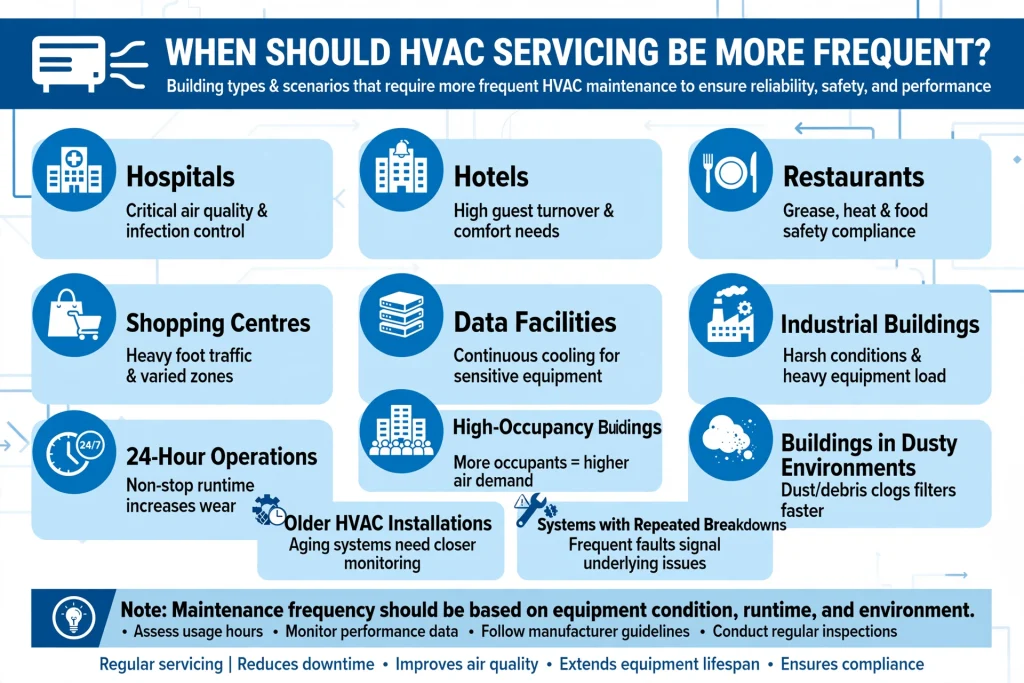
When Should HVAC Servicing Be More Frequent?
Some commercial systems require more frequent attention than twice-yearly maintenance.
More frequent servicing may be appropriate for:
- Hospitals
- Hotels
- Restaurants
- Shopping centres
- Data facilities
- Industrial buildings
- 24-hour operations
- High-occupancy buildings
- Buildings in dusty environments
- Older HVAC installations
- Systems with repeated breakdowns
The maintenance frequency should ultimately be based on equipment condition and operational requirements.
A Practical Commercial HVAC Maintenance Schedule
A practical programme could be structured around different levels of inspection.
Monthly: Visual checks, filters, leaks, unusual noises, temperatures, and basic operating conditions.
Quarterly: Detailed inspection of mechanical components, airflow, drainage, electrical connections, coils, and controls.
Every six months: Comprehensive preventive maintenance and performance assessment.
Annually: Detailed system review, equipment testing, deep cleaning where required, control checks, and maintenance planning for the following year.
As required: Emergency troubleshooting, repairs, component replacement, and investigation of abnormal operating conditions.
This schedule should be adapted to the equipment and building.
Frequently Asked Questions
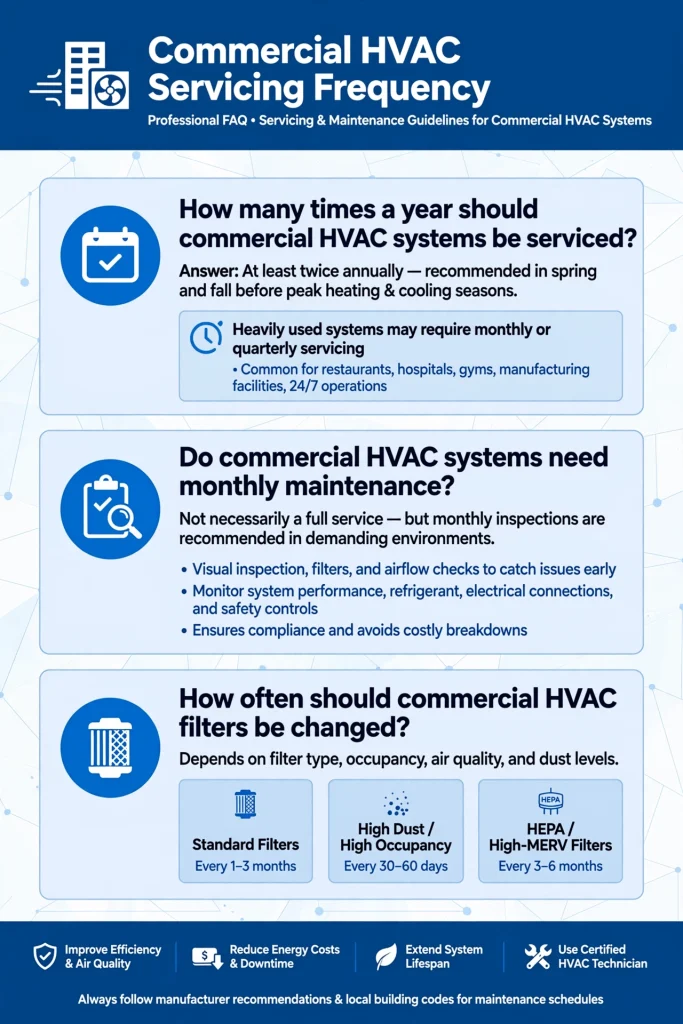
How many times a year should commercial HVAC systems be serviced?
Many commercial systems benefit from professional preventive maintenance at least twice annually, while heavily used or critical systems may require monthly, quarterly, or more frequent inspections.
Do commercial HVAC systems need monthly maintenance?
Not necessarily a full service every month. However, some systems benefit from monthly inspections and routine checks, particularly in demanding environments.
How often should commercial HVAC filters be changed?
There is no universal interval. Filter replacement depends on filter type, building occupancy, outdoor air quality, dust levels, and equipment requirements.
Should chillers be serviced separately?
Large chiller plants often require specialized maintenance in addition to general HVAC servicing. Chillers, pumps, cooling towers, and associated controls should be included in the maintenance programme.
Can regular HVAC maintenance reduce energy consumption?
Proper maintenance can help equipment operate closer to its intended condition. Dirty filters, contaminated coils, poor airflow, faulty controls, and other problems can contribute to inefficient operation.
When should a commercial HVAC contractor be called?
A contractor should be contacted when there is poor cooling, unusual noise, water leakage, repeated alarms, abnormal energy consumption, weak airflow, or frequent equipment shutdowns.
Conclusion
Commercial HVAC systems should not be maintained only when something breaks. A planned preventive maintenance programme helps building owners and facility managers monitor equipment condition, identify developing faults, maintain indoor comfort, and reduce the likelihood of unexpected failures.
For many commercial properties, professional servicing at least twice a year provides a useful baseline, while high-use and critical facilities may require substantially more frequent inspections.
The right schedule depends on the type of HVAC system, operating hours, building occupancy, equipment age, environmental conditions, manufacturer requirements, and previous maintenance history.
In Dubai and across the UAE, where commercial cooling systems can operate under demanding conditions, proactive maintenance is particularly important. Whether the property is an office in Business Bay, a hotel in Palm Jumeirah, a retail facility in Downtown Dubai, or a high-rise building in Dubai Marina, the maintenance programme should be designed around the actual cooling and ventilation infrastructure.
Regular attention to chillers, AHUs, FCUs, filters, coils, pumps, cooling towers, ductwork, ventilation equipment, electrical components, sensors, and BMS controls can help maintain the performance of the complete HVAC system rather than simply responding to individual breakdowns.
The most effective approach is to establish a documented maintenance schedule, monitor equipment performance throughout the year, and address warning signs before they become costly failures.