Chillers are essential for maintaining comfortable and controlled indoor temperatures across many commercial and industrial properties in Dubai. Shopping malls, hotels, office towers, hospitals, schools, residential communities, warehouses, factories, and mixed-use developments often depend on central chilled-water systems to provide reliable cooling.
Because Dubai experiences long periods of high temperatures, cooling equipment can operate under considerable demand. A chiller problem that might initially appear minor can develop into reduced cooling capacity, higher energy consumption, unstable operation, water leakage, repeated alarms, or an unexpected shutdown if it is not investigated properly.
Professional diagnosis is particularly important because a chiller is not a single mechanical component. It is a complete refrigeration and water-circulation system involving compressors, evaporators, condensers, pumps, valves, sensors, electrical controls, cooling towers, piping, and building management systems.
Understanding common chiller problems can help property owners and facility managers recognize warning signs early and arrange appropriate repairs before the issue affects the wider cooling system.
Why Chiller Problems Are Common in Dubai
Commercial chillers in Dubai can operate for long periods under demanding environmental conditions. High outdoor temperatures increase the heat-rejection requirements of cooling equipment, while dust and airborne contaminants can affect outdoor components such as cooling towers and condenser coils.
Water quality can also influence the condition of chilled-water and condenser-water systems. Scale, corrosion, fouling, and poor water treatment can gradually affect heat-transfer surfaces and system efficiency.
Building occupancy is another factor. A hotel, shopping centre, hospital, or large office tower may experience substantial changes in cooling demand throughout the day.
These conditions make regular inspection and professional troubleshooting important for maintaining reliable chiller operation.
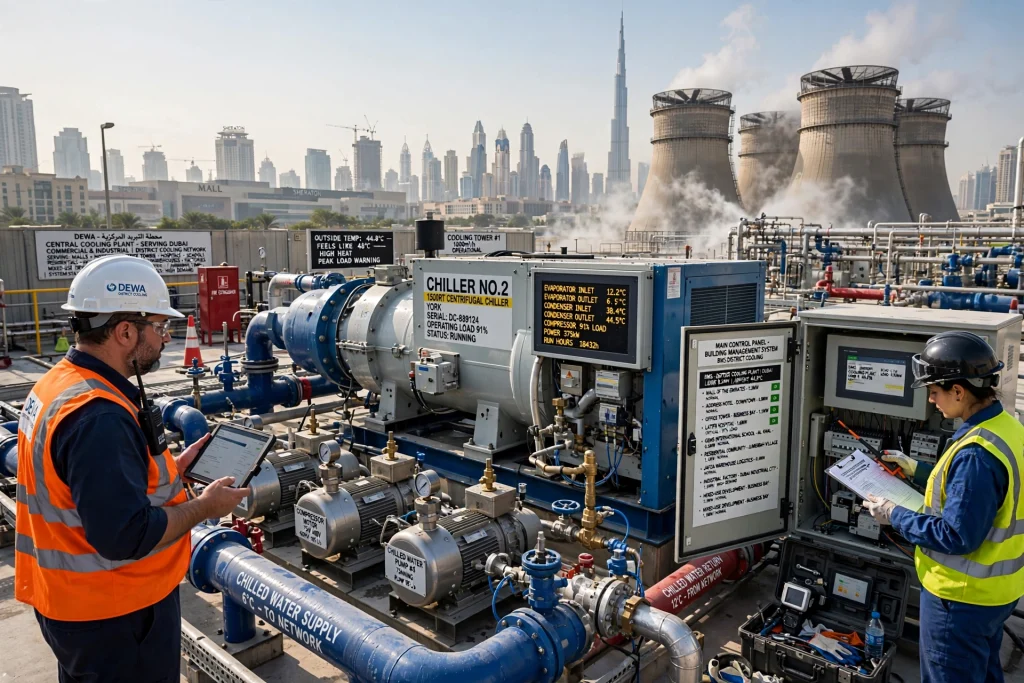
Reduced Cooling Capacity
One of the most noticeable signs of a chiller problem is reduced cooling performance.
A building may take longer to reach the required temperature, individual zones may remain uncomfortable, or the chilled-water supply temperature may not reach its expected level.
Reduced cooling capacity can have several causes, including:
- Dirty heat-transfer surfaces
- Poor chilled-water flow
- Condenser problems
- Refrigerant issues
- Compressor deterioration
- Faulty sensors
- Cooling-tower problems
- Incorrect control settings
A professional technician should diagnose the underlying cause rather than simply adjusting the system without identifying why performance has changed.
Chiller Not Reaching the Required Temperature
A chiller is designed to produce chilled water within a specified operating range.
If the leaving chilled-water temperature remains higher than expected, the problem may originate from the refrigeration circuit, water flow, heat-transfer surfaces, controls, or building load.
Technicians can compare supply and return temperatures and evaluate operating conditions to determine where the problem may exist.
A temperature issue should not automatically be attributed to insufficient refrigerant because several different faults can create similar symptoms.
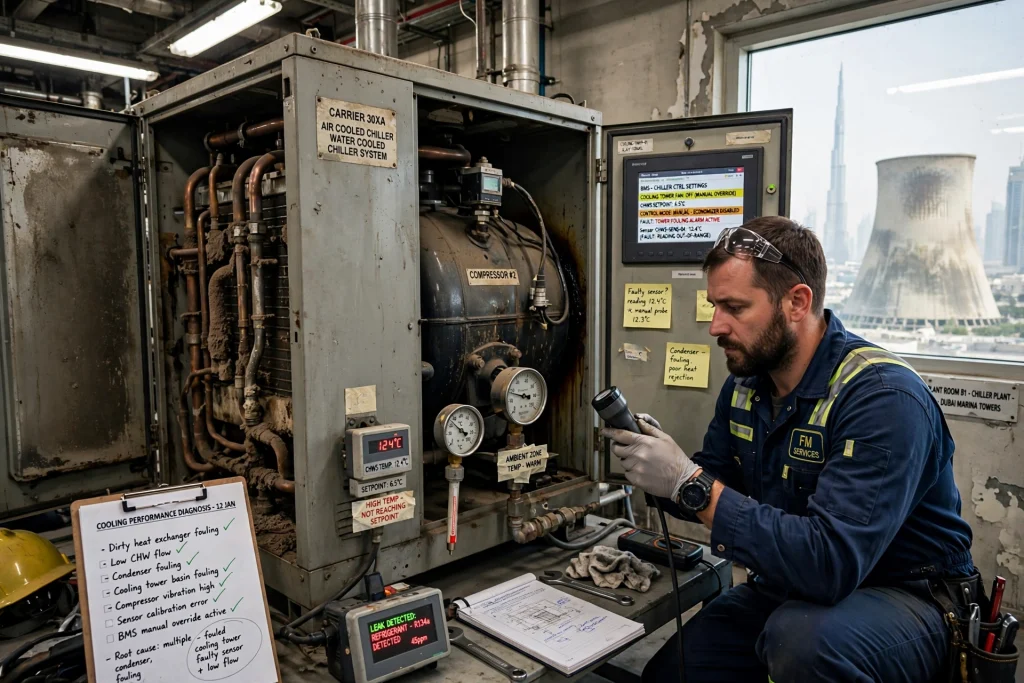
Refrigerant Leaks
Refrigerant problems can affect cooling performance and compressor operation.
A leak can gradually reduce refrigerant charge and change the operating conditions of the refrigeration circuit.
Possible signs include:
- Reduced cooling capacity
- Abnormal operating pressures
- Temperature changes
- Compressor performance issues
- Repeated system alarms
Professional technicians can use appropriate diagnostic procedures to determine whether a leak exists and where it may be located.
Simply adding refrigerant without repairing the underlying leak is not a long-term solution.
Compressor Problems
The compressor is one of the most important components in a chiller.
Commercial chillers may use centrifugal, screw, scroll, or reciprocating compressor technologies, depending on the equipment.
Compressor problems can involve:
- Excessive vibration
- Abnormal noise
- Electrical faults
- Oil-related problems
- High operating temperatures
- Bearing wear
- Motor problems
- Control faults
Because compressor failure can be expensive and disruptive, unusual operating conditions should be investigated promptly.
Early diagnosis can sometimes allow a component or control problem to be corrected before major compressor damage occurs.
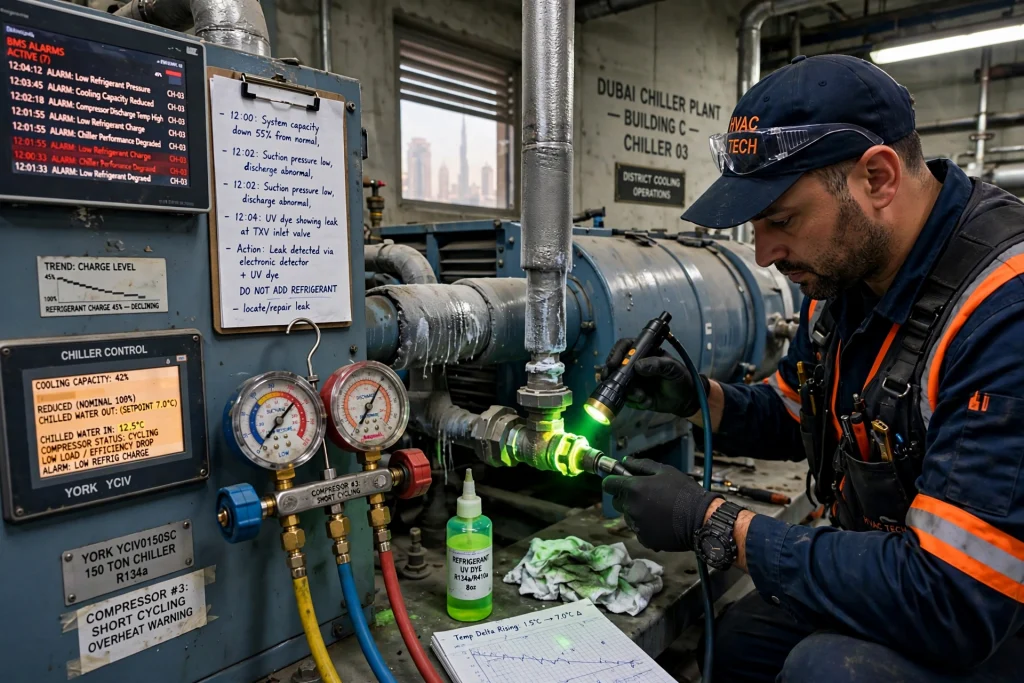
High Condenser Pressure
High condenser pressure is another common chiller problem.
In a water-cooled system, condenser pressure can be affected by the condition and performance of the cooling tower, condenser-water flow, heat-transfer surfaces, and water temperature.
Potential causes include:
- Dirty condenser tubes
- Poor cooling-tower performance
- Restricted condenser-water flow
- Pump problems
- High outdoor temperatures
- Fouling
- Water-treatment issues
A technician can inspect the condenser-water circuit and operating conditions to identify the underlying problem.
Dirty Condenser Tubes
Water-cooled chillers depend on efficient heat transfer through the condenser.
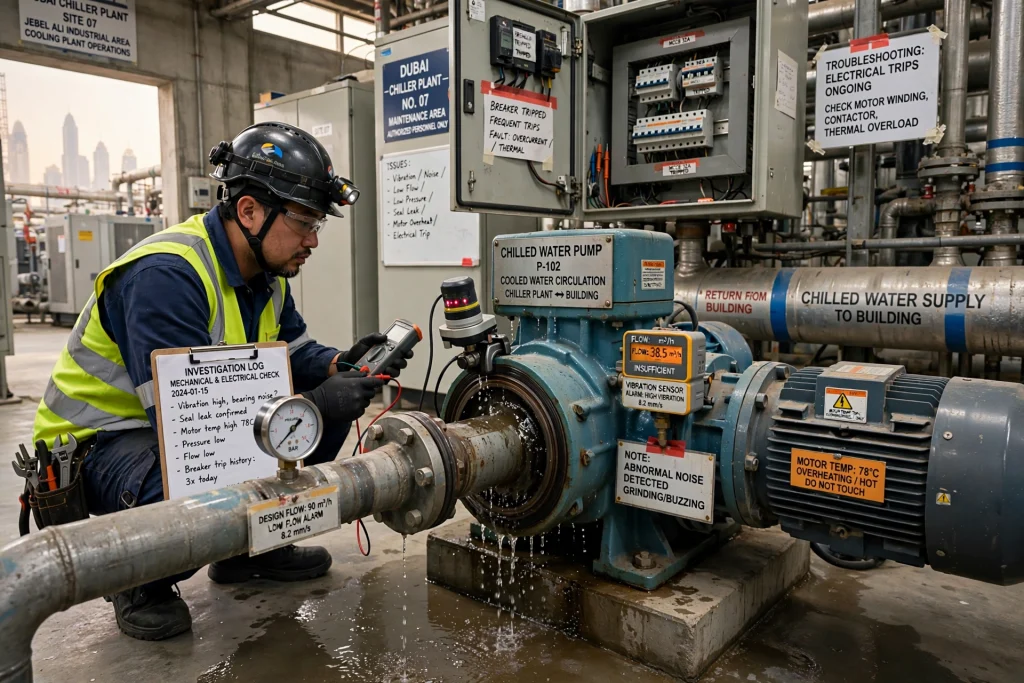
Over time, scale, deposits, corrosion products, and other contaminants can accumulate on condenser tubes.
This can reduce heat-transfer efficiency.
When the condenser cannot reject heat effectively, the chiller may operate under higher pressure and require greater effort to provide the desired cooling.
Professional tube inspection and cleaning can help restore appropriate heat-transfer conditions where fouling is responsible for the problem.
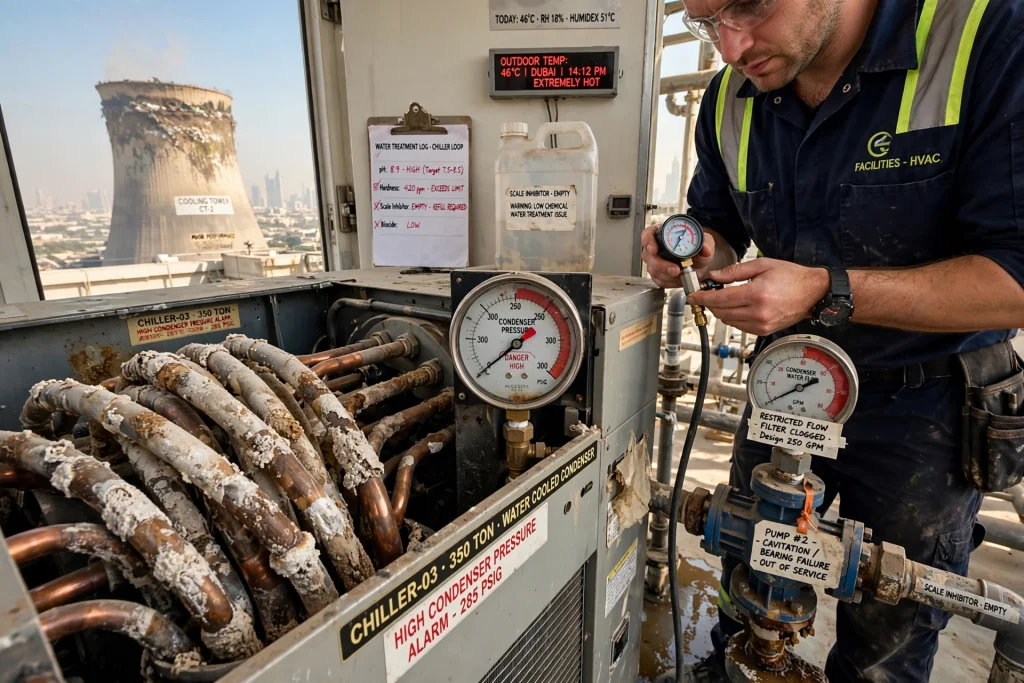
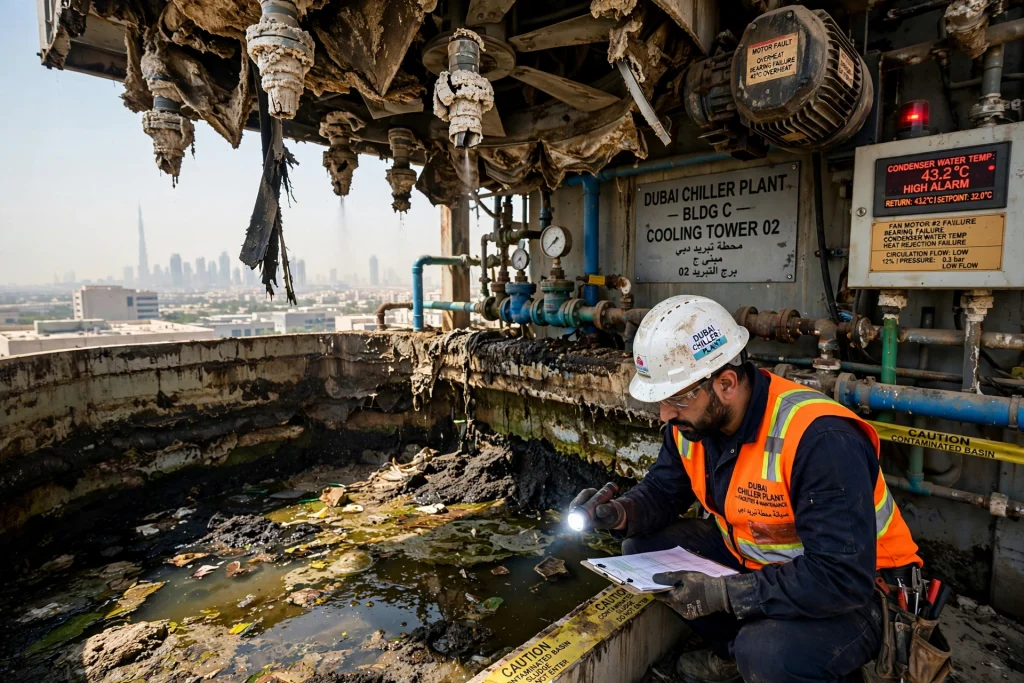
Cooling Tower Problems
Cooling towers are closely connected to the performance of water-cooled chillers.
A cooling tower that is not operating correctly may fail to reject heat effectively.
Common cooling-tower problems include:
- Dirty fill
- Blocked spray nozzles
- Fan problems
- Motor faults
- Damaged belts
- Poor water circulation
- Water-quality issues
- Basin contamination
- Drift eliminator problems
Because cooling-tower performance directly affects condenser-water temperature, it should be considered whenever a water-cooled chiller experiences abnormal condenser conditions.
Low Chilled-Water Flow
Correct chilled-water flow is essential for proper heat transfer.
Low flow can be caused by:
- Pump problems
- Blocked strainers
- Partially closed valves
- Air in the system
- Pipe restrictions
- Control-valve problems
- Incorrect pump operation
Low flow may result in unstable chiller operation or reduced cooling capacity.
A professional technician can inspect the pump, valves, strainers, pressure readings, and flow conditions to identify the source of the restriction.
Chilled-Water Pump Failure
Chilled-water pumps circulate cooled water between the chiller plant and building equipment.
A pump problem can affect the entire cooling system.
Warning signs can include:
- Unusual vibration
- Abnormal noise
- Reduced pressure
- Insufficient flow
- Seal leakage
- Motor overheating
- Frequent electrical trips
Pump maintenance and repair should consider the mechanical and electrical components together.
Replacing a pump without investigating why it failed may allow the underlying system problem to remain unresolved.
Condenser-Water Pump Problems
Water-cooled chiller systems also use condenser-water pumps.
These pumps circulate water between the chiller condenser and cooling tower.
A problem with condenser-water circulation can contribute to elevated condenser pressure and reduced chiller performance.
Technicians should inspect pump operation, pressure, flow, valves, strainers, motors, seals, and control signals when diagnosing condenser-side problems.
Evaporator Problems
The evaporator is where heat is transferred from the chilled water into the refrigeration system.
Poor evaporator performance can result from fouling, restricted water flow, refrigerant-side problems, or control issues.
Potential symptoms include abnormal chilled-water temperatures, reduced cooling capacity, and changes in pressure conditions.
Professional inspection is important because evaporator problems can have several possible causes.
Scale and Water-Side Fouling
Scale can develop when water chemistry is not properly controlled.
Deposits on heat-transfer surfaces create an insulating layer that reduces the effectiveness of heat exchange.
This can affect both the evaporator and condenser depending on the system and water circuit.
Regular water-quality monitoring, appropriate treatment, inspection, and cleaning can help control this type of problem.
Electrical Control Failures
Commercial chillers depend on electrical control systems to operate safely and efficiently.
Electrical components can include:
- Contactors
- Relays
- Circuit breakers
- Control boards
- Motor starters
- Sensors
- Wiring
- Variable frequency drives
- Protection devices
Loose connections, overheating, damaged wiring, or faulty components can cause intermittent operation or complete shutdown.
Electrical diagnosis should be carried out by qualified professionals using appropriate testing procedures.
Sensor and Thermostat Problems
Modern chiller systems depend heavily on sensors.
Sensors can monitor:
- Water temperature
- Refrigerant temperature
- Pressure
- Flow
- Ambient conditions
- Equipment status
If a sensor provides inaccurate information, the control system may respond incorrectly.
For example, an incorrect temperature reading can cause a chiller to operate longer than necessary or shut down unexpectedly.
Professional troubleshooting should include checking sensors and comparing their readings with actual system conditions.
VFD Problems
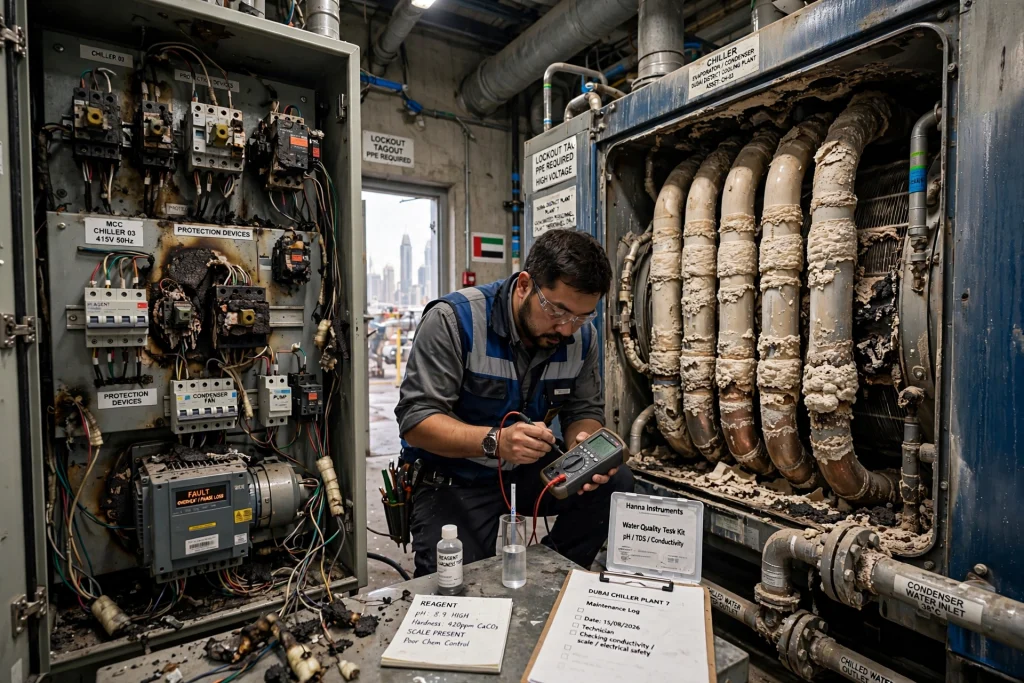
Variable frequency drives are commonly used to control the speed of pumps and fans.
VFDs allow equipment operation to adjust according to system demand.
A VFD fault can cause:
- Pump shutdown
- Fan shutdown
- Incorrect speed
- Electrical alarms
- Unstable flow
- Reduced system performance
VFD problems require careful electrical and control-system diagnosis.
Chiller Short Cycling
Short cycling occurs when the chiller starts and stops more frequently than intended.
This can be caused by:
- Incorrect control settings
- Low system load
- Sensor problems
- Flow issues
- Refrigeration faults
- Control-system problems
Frequent starting and stopping can place additional stress on equipment.
The cause should be identified rather than simply resetting the equipment repeatedly.
Unusual Chiller Noise
Unusual sounds can provide an early indication of mechanical problems.
Possible causes include:
- Bearing wear
- Pump problems
- Compressor issues
- Loose components
- Cavitation
- Vibration
- Fan problems
The type and location of the noise can provide useful diagnostic information.
Ignoring a new mechanical noise can allow a relatively manageable issue to develop into more extensive damage.
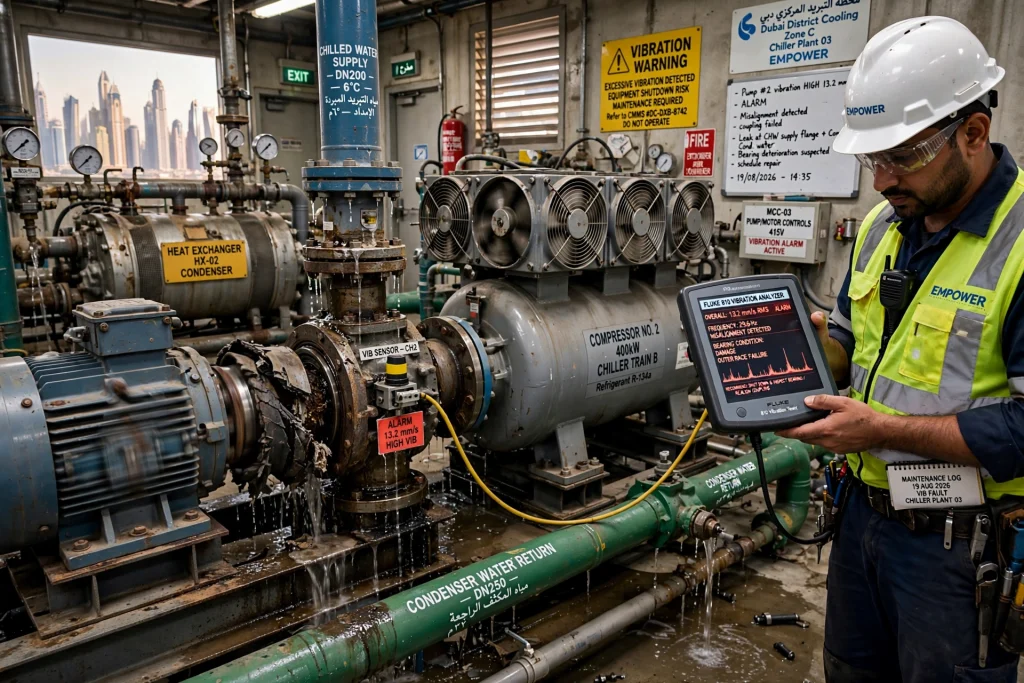
Excessive Vibration
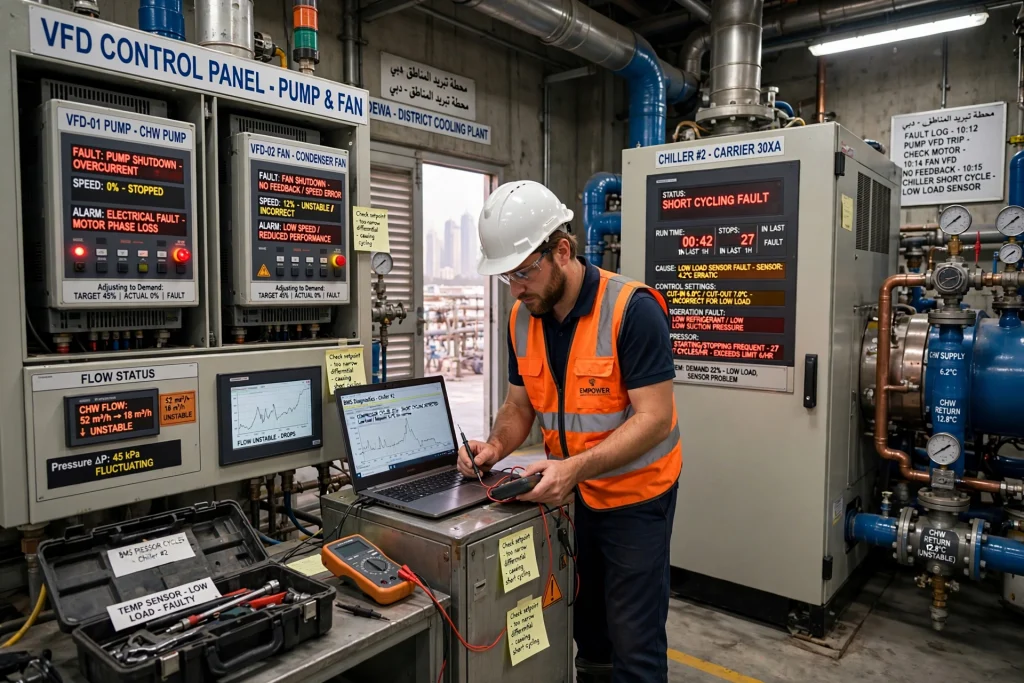
Vibration is another important warning sign.
Excessive vibration can originate from pumps, compressors, motors, fans, bearings, couplings, or mounting systems.
In rotating equipment, vibration can indicate imbalance, misalignment, bearing deterioration, or other mechanical problems.
Professional vibration assessment can help determine whether the issue requires adjustment, component replacement, or further investigation.
Water Leakage Around the Chiller Plant
Water leakage can occur around:
- Chilled-water pipes
- Condenser-water pipes
- Pump seals
- Valves
- Flanges
- Drain lines
- Heat exchangers
A leak should not be ignored.
Even a small leak can lead to water damage, insulation deterioration, corrosion, reduced system pressure, or equipment problems if it continues.
The source should be identified and repaired properly.
Air in the Chilled-Water System
Air trapped in a chilled-water system can affect circulation and heat transfer.
It can contribute to:
- Flow problems
- Noise
- Reduced cooling
- Pump issues
- Uneven system performance
Air separators, expansion systems, vents, and water pressure should be assessed where air-related problems are suspected.
Poor Insulation
Chilled-water pipes and components require suitable insulation to reduce unwanted heat gain and condensation.
Damaged or deteriorated insulation can result in:
- Condensation
- Water dripping
- Energy losses
- Moisture damage
- Corrosion under insulation
During maintenance, technicians should inspect visible insulation and identify areas requiring repair or replacement.
BMS Communication Problems
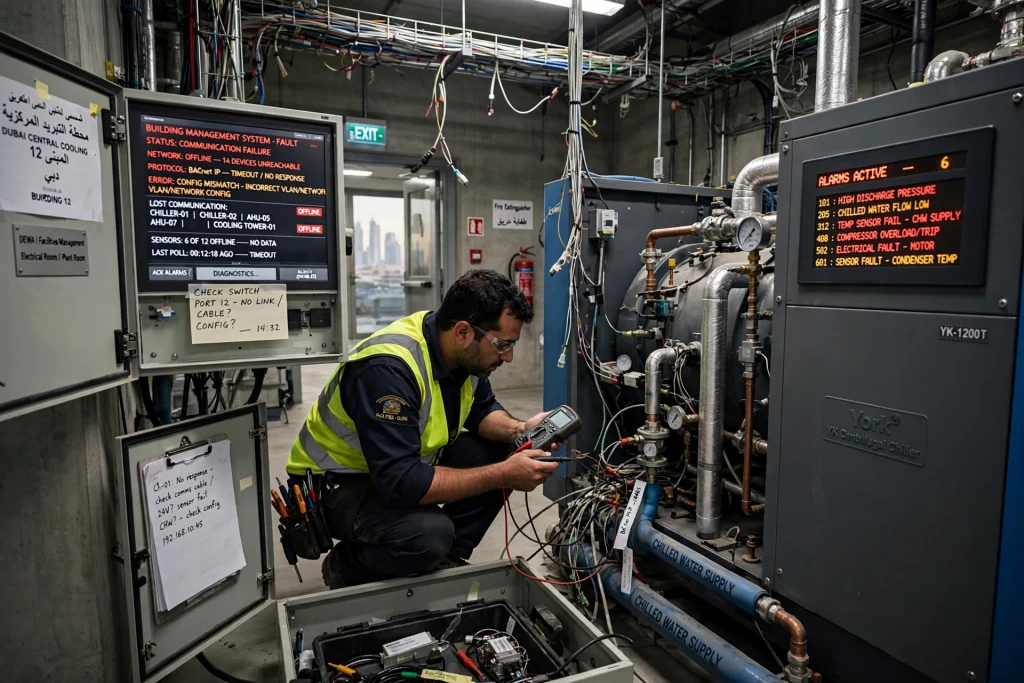
Large commercial buildings often connect chillers to a Building Management System (BMS).
If communication between the chiller and BMS is interrupted, facility managers may lose visibility of equipment status and alarms.
Possible causes include:
- Communication faults
- Sensor problems
- Network issues
- Control-panel faults
- Incorrect configuration
A chiller can sometimes operate mechanically while communication problems prevent the building management team from monitoring it properly.
Chiller Alarm and Fault Codes
Modern chillers often display alarm or fault codes when abnormal conditions occur.
These codes can provide useful information about the affected system.
However, resetting an alarm without investigating its cause is not a proper repair strategy.
Repeated alarms may indicate:
- Pressure problems
- Flow issues
- Electrical faults
- Temperature abnormalities
- Sensor failures
- Compressor problems
A technician should identify why the alarm occurs and address the underlying issue.
Reduced Energy Efficiency
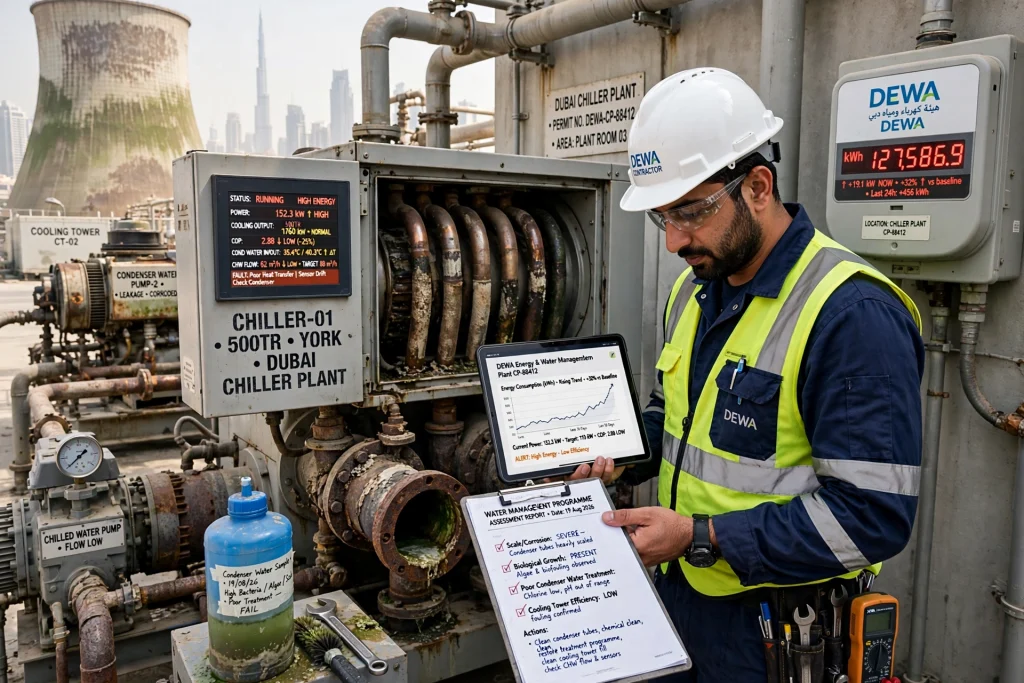
A chiller that consumes more energy while producing the same cooling output may have a developing problem.
Potential causes include:
- Dirty heat-transfer surfaces
- Poor condenser-water conditions
- Incorrect chilled-water flow
- Compressor problems
- Faulty sensors
- Control issues
- Cooling-tower inefficiency
Energy performance should be assessed alongside operating conditions rather than viewed as an isolated number.
Problems Caused by Poor Water Treatment
Water treatment is particularly important for water-cooled chiller systems.
Poor water chemistry can contribute to scale, corrosion, and biological growth.
These conditions can affect:
- Condenser tubes
- Cooling towers
- Pumps
- Piping
- Valves
- Heat-transfer performance
A suitable water-management programme can help protect the system and reduce the likelihood of water-related performance problems.
Chiller Problems in Dubai’s High-Rise Buildings
Dubai has a large number of high-rise developments, particularly around Dubai Marina, Downtown Dubai, Business Bay, Sheikh Zayed Road, Jumeirah, Palm Jumeirah, and Dubai Hills Estate.
Many of these buildings rely on centralized cooling infrastructure.
A chiller problem in a high-rise property can affect numerous floors and tenants.
This makes timely diagnosis especially important.
Facility teams should maintain detailed equipment records and establish clear procedures for responding to chiller alarms and performance issues.
Chiller Problems in Hotels and Hospitality Properties
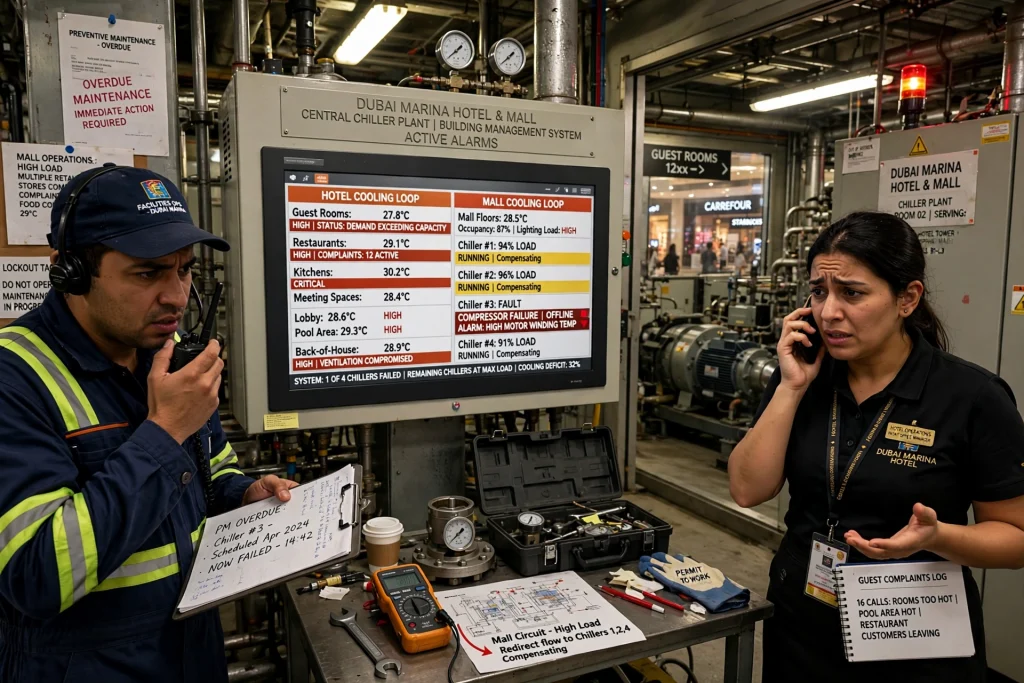
Hotels have particularly demanding cooling requirements because guests expect comfortable indoor temperatures throughout the day and night.
Cooling systems can serve guest rooms, restaurants, kitchens, meeting spaces, lobbies, pools, and back-of-house areas.
A chiller problem can therefore affect multiple operations simultaneously.
Preventive maintenance and rapid professional troubleshooting are particularly valuable for hospitality facilities.
Chiller Problems in Shopping Malls
Shopping centres can have extensive cooling requirements because of large floor areas, high occupancy, lighting loads, retail equipment, restaurants, and continuously changing customer traffic.
A chiller plant may operate with multiple chillers and pumps to accommodate varying loads.
If one chiller develops a problem, the remaining equipment may have to compensate.
A professional maintenance strategy can help identify faults early and support appropriate load management.
When Professional Chiller Repair Is Necessary
Professional intervention is recommended when the system experiences repeated alarms, reduced cooling, unusual noise, abnormal pressure, water leakage, compressor problems, electrical faults, or repeated shutdowns.
Complex refrigeration and electrical systems should not be repaired through trial-and-error adjustments.
A qualified technician can diagnose the equipment using appropriate instruments and system data.
This is particularly important for large commercial chillers where an incorrect repair can create additional problems.
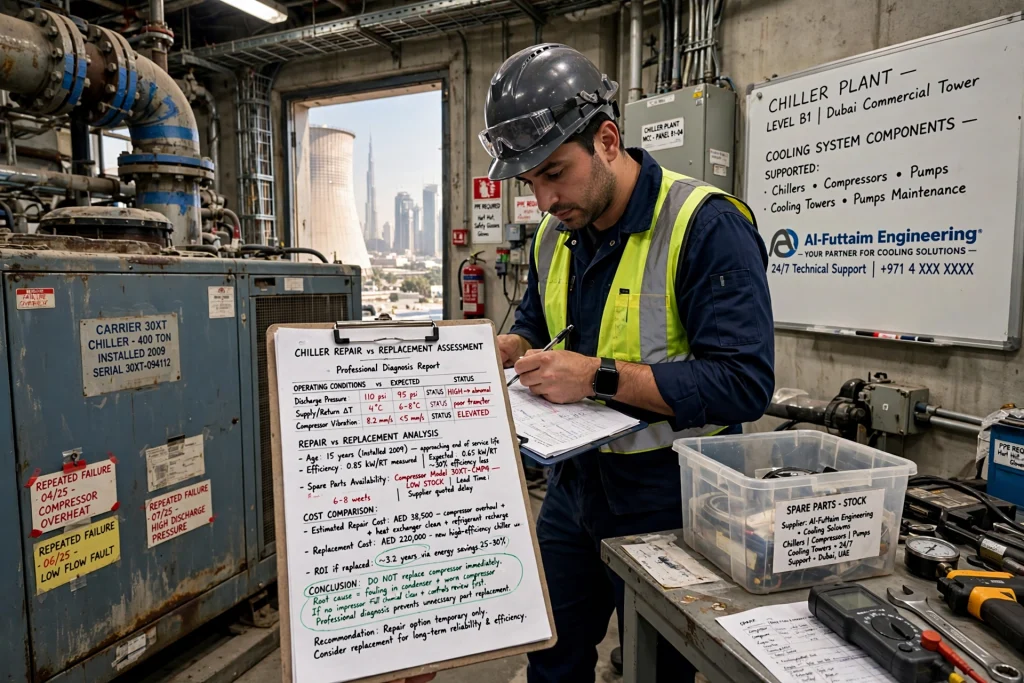
Repair vs Chiller Replacement
Not every chiller problem requires complete replacement.
Depending on the equipment’s age, condition, efficiency, availability of spare parts, and repair cost, a component-level repair may be appropriate.
For older systems experiencing repeated major failures, however, replacement may eventually become more practical.
A professional assessment can help property owners compare repair, refurbishment, and replacement options.
Why Professional Diagnosis Matters
Many chiller symptoms can have several possible causes.
For example, reduced cooling can result from a refrigerant problem, water-flow issue, condenser fouling, compressor deterioration, sensor error, or cooling-tower problem.
Replacing the first component that appears suspicious does not guarantee that the actual cause has been corrected.
Professional diagnosis involves looking at the complete system and comparing operating conditions against expected values.
How Chiller Problems Solutions Supplier Support Can Help
A reliable Chiller Problems Solutions Supplier can provide more than individual component replacement.
The right technical provider should be able to assess the complete cooling system, identify the source of the problem, recommend an appropriate repair, and help prevent the same issue from recurring.
Depending on the installation, this may involve support for chillers, compressors, pumps, cooling towers, controls, valves, sensors, heat exchangers, electrical components, and BMS integration.
A supplier with knowledge of commercial HVAC systems can also help identify suitable replacement components when repairs require new parts.
Preventing Recurring Chiller Problems
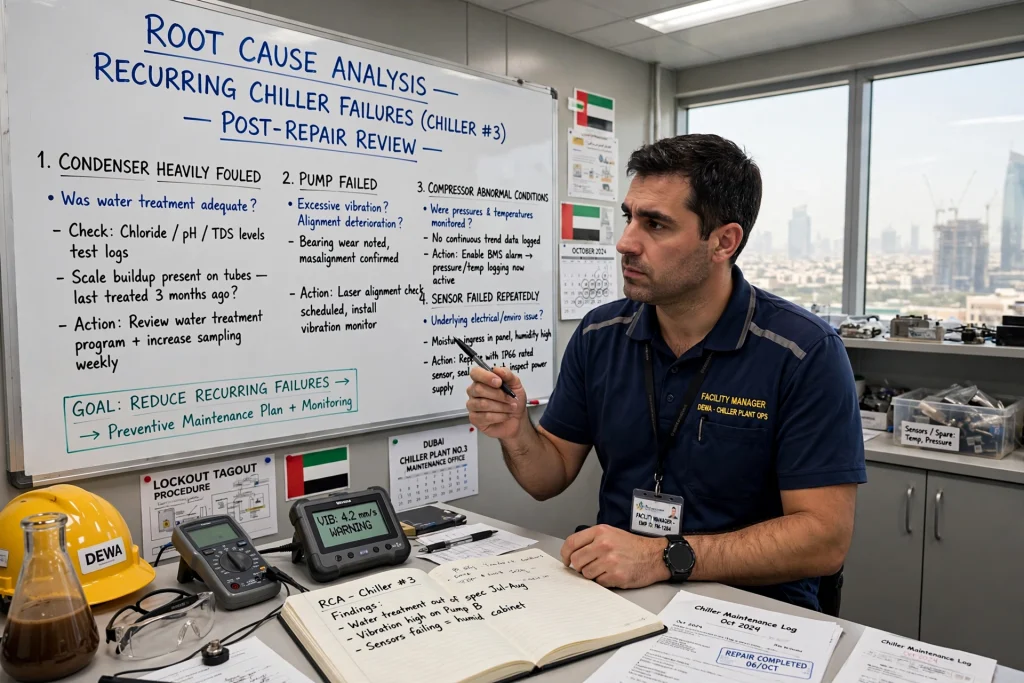
Repairing a fault is only part of maintaining a reliable cooling system.
After a problem is corrected, facility managers should consider why it occurred.
For example:
If a condenser became heavily fouled, was water treatment adequate?
If a pump failed, was there excessive vibration or alignment deterioration?
If a compressor experienced abnormal conditions, were operating pressures and temperatures monitored?
If a sensor failed repeatedly, is there an underlying electrical or environmental issue?
This approach can help reduce recurring failures.
A Practical Chiller Troubleshooting Approach
When a chiller develops a problem, the investigation should generally begin with the symptoms and operating data.
Technicians may review:
- Alarm history
- Chilled-water temperatures
- Condenser-water temperatures
- Flow conditions
- Pressure readings
- Compressor operation
- Pump performance
- Cooling-tower operation
- Electrical readings
- Sensor data
- BMS information
This creates a more complete picture of the equipment’s condition.
Frequently Asked Questions
What is the most common chiller problem?
Common problems include reduced cooling capacity, dirty heat-transfer surfaces, water-flow issues, refrigerant faults, compressor problems, cooling-tower issues, electrical faults, and sensor problems.
Why is my commercial chiller not cooling properly?
Possible causes include restricted water flow, dirty condenser or evaporator surfaces, refrigerant problems, compressor issues, cooling-tower performance, incorrect controls, or sensor faults. Professional diagnosis is recommended.
Can dirty condenser tubes affect chiller performance?
Yes. Deposits and fouling can reduce heat-transfer efficiency and increase the operating demand on a water-cooled chiller.
What causes chiller high-pressure alarms?
Possible causes include poor condenser-water flow, dirty condenser tubes, cooling-tower problems, high water temperatures, or other heat-rejection issues.
Should a chiller alarm simply be reset?
No. A repeated alarm should be investigated to determine the underlying cause before the system is returned to normal operation.
How often should commercial chillers be inspected?
The appropriate frequency depends on equipment type, operating hours, cooling load, age, water quality, manufacturer requirements, and operating conditions. High-demand facilities may require more frequent inspections.
Conclusion
Chiller problems can affect cooling capacity, energy performance, reliability, and the comfort of an entire commercial building. In Dubai, where cooling systems can operate under demanding conditions for long periods, early identification of problems is particularly important.
Common issues include refrigerant leaks, compressor faults, dirty condenser tubes, cooling-tower problems, restricted water flow, pump failures, sensor faults, electrical problems, BMS communication issues, vibration, water leakage, and heat-transfer deterioration.
The key is to treat the chiller as a complete cooling system rather than an isolated machine. Chillers, pumps, cooling towers, heat exchangers, valves, controls, sensors, piping, and BMS equipment all influence overall performance.
For commercial properties in Dubai Marina, Downtown Dubai, Business Bay, Jumeirah, Palm Jumeirah, Dubai Hills Estate, Deira, and surrounding areas, professional diagnosis and planned maintenance can help address developing problems before they cause major operational disruption.
When a chiller shows abnormal temperatures, repeated alarms, unusual noise, reduced cooling, excessive vibration, water leakage, or rising energy consumption, professional inspection should be arranged promptly. Correct diagnosis followed by the appropriate repair can restore system performance while helping facility managers make better long-term decisions about maintenance, refurbishment, and eventual equipment replacement.