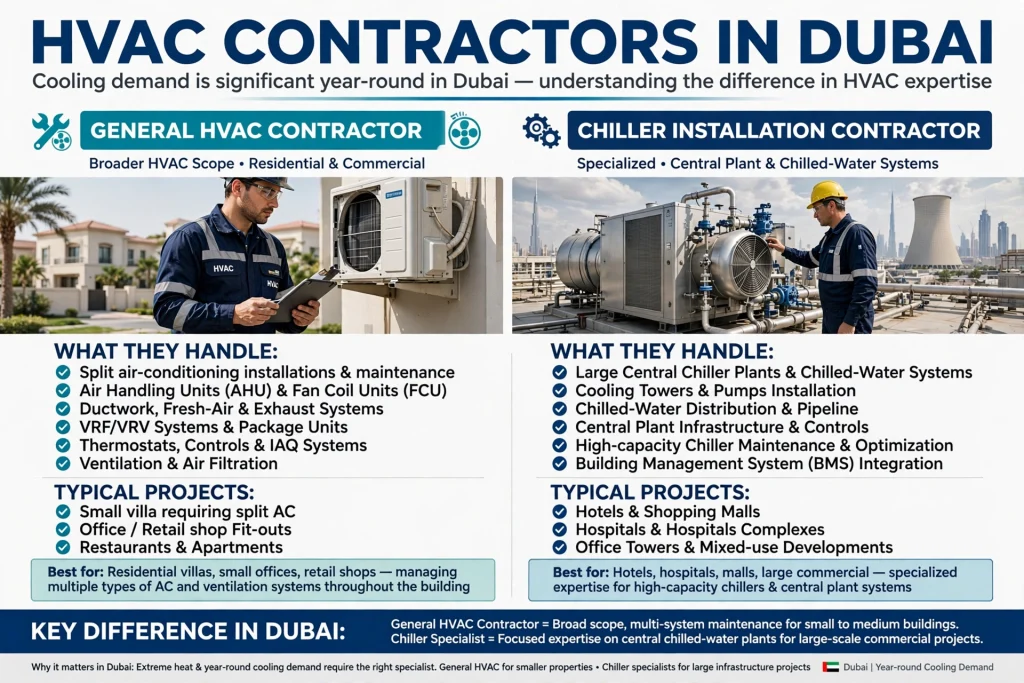
Choosing the right contractor for a cooling project is an important decision for commercial buildings, hotels, residential towers, offices, retail developments, hospitals, warehouses, and industrial facilities in Dubai. Although the terms chiller contractor and HVAC contractor are sometimes used interchangeably, they do not always describe the same scope of work.
A chiller installation contractor typically specializes in the central cooling equipment that produces chilled water, while an HVAC contractor may manage a much broader range of heating, ventilation, air-conditioning, ductwork, air distribution, controls, and indoor climate systems.
Understanding the difference helps property owners, developers, facility managers, consultants, and building operators select a contractor with the technical experience required for the project.
What Is a Chiller Installation Contractor?
A chiller installation contractor focuses on the design, installation, replacement, commissioning, maintenance, and associated mechanical works required for chilled-water cooling systems.
A chiller plant can contain considerably more than the chiller itself. Depending on the system, the installation may include chillers, chilled-water pumps, condenser-water pumps, cooling towers, expansion tanks, strainers, valves, heat exchangers, control systems, variable frequency drives, piping, insulation, and electrical connections.
The contractor therefore needs to understand how these components operate together as a complete cooling plant.
Common chiller technologies include water-cooled chillers, air-cooled chillers, centrifugal chillers, screw chillers, scroll chillers, and absorption chillers.
The appropriate equipment depends on building size, cooling load, available plant space, water availability, operating requirements, energy objectives, and project specifications.

What Is an HVAC Contractor?
An HVAC contractor generally handles a wider range of heating, ventilation, and air-conditioning systems.
In Dubai, where cooling demand is significant for much of the year, HVAC contractors may work on:
- Air-conditioning systems
- Air handling units
- Fan coil units
- Ductwork
- Fresh-air systems
- Exhaust systems
- Ventilation
- VRF and VRV systems
- Package units
- Split air-conditioning
- Chilled-water distribution
- Thermostats and controls
- Indoor air quality systems
An HVAC contractor may therefore be involved in everything from a small split air-conditioning installation to a large commercial mechanical system.
However, not every HVAC contractor has the same level of experience with large central chiller plants.
The Main Difference Between the Two
The simplest distinction is specialization versus broader HVAC scope.
A chiller installation contractor concentrates on chilled-water systems and the central plant infrastructure supporting them.
An HVAC contractor may manage multiple types of air-conditioning and ventilation systems throughout a building.
For a small villa requiring split air-conditioning, a general HVAC contractor may be entirely appropriate.
For a large hotel, shopping centre, hospital, office tower, or mixed-use development using multiple high-capacity chillers, specialized chiller expertise becomes much more important.
How a Chiller Plant Works
Understanding the basic cooling cycle makes the contractor distinction easier to understand.
A chiller removes heat from chilled water.
The chilled water is circulated through the building to cooling equipment such as AHUs and FCUs.
The air handling unit uses the chilled water through a cooling coil to reduce the temperature of air before distributing it through the building.
In a water-cooled system, heat removed from the building is transferred through the condenser-water circuit to a cooling tower, where heat is rejected to the atmosphere.
The major components can include:
Chiller: Produces chilled water by transferring heat from the chilled-water circuit to a refrigerant and ultimately rejecting that heat outside the conditioned space.
Chilled-water pumps: Circulate chilled water between the chiller plant and building cooling equipment.
Condenser-water pumps: Move condenser water between water-cooled chillers and cooling towers.
Cooling towers: Reject heat from condenser water to the surrounding atmosphere.
AHUs: Condition and distribute air using chilled-water cooling coils.
FCUs: Provide localized air-conditioning in individual rooms or zones.
VFDs: Adjust motor speed to help match equipment operation with changing demand.
BMS: Monitors and controls equipment operation, temperatures, alarms, schedules, and other building services.
Because these components are interconnected, installing a chiller is not simply a matter of placing equipment on a concrete base and connecting a few pipes.
When You Need a Chiller Installation Contractor
A specialized chiller contractor becomes particularly valuable when the project involves a central cooling plant.
Examples include:
- Commercial towers
- Hotels
- Hospitals
- Shopping malls
- Large villas
- Universities
- Schools
- Industrial facilities
- Data centres
- Mixed-use developments
- Large residential buildings
These buildings can have significant cooling loads and complicated mechanical infrastructure.
The contractor needs to understand equipment selection, hydraulic design, piping, pumps, controls, commissioning, balancing, and integration.
When an HVAC Contractor May Be Enough
A general HVAC contractor can be appropriate for projects involving simpler systems.
For example, a villa may use split air-conditioning units or a VRF system.
A small office may use packaged units or ducted air-conditioning.
A retail unit may use a combination of FCUs, ventilation, and existing building chilled water.
In such cases, the broader HVAC experience of the contractor may be sufficient.
However, if the project includes a central chiller plant, the contractor’s experience with chillers should be specifically verified rather than assumed from the term “HVAC contractor.”
Chiller Installation Requires Detailed Planning
Chiller installation starts long before the equipment arrives on site.
The contractor must understand the cooling requirement and the available infrastructure.
Important considerations can include:
- Cooling load
- Chiller capacity
- Number of chillers
- Equipment redundancy
- Plant-room dimensions
- Access routes
- Pump arrangement
- Pipe sizing
- Electrical requirements
- Water treatment
- Cooling tower requirements
- Controls
- BMS integration
- Maintenance access
- Future expansion
For large projects, these considerations need to be coordinated with mechanical consultants, electrical engineers, architects, structural engineers, facility managers, and other project stakeholders.

Selecting the Correct Chiller Capacity
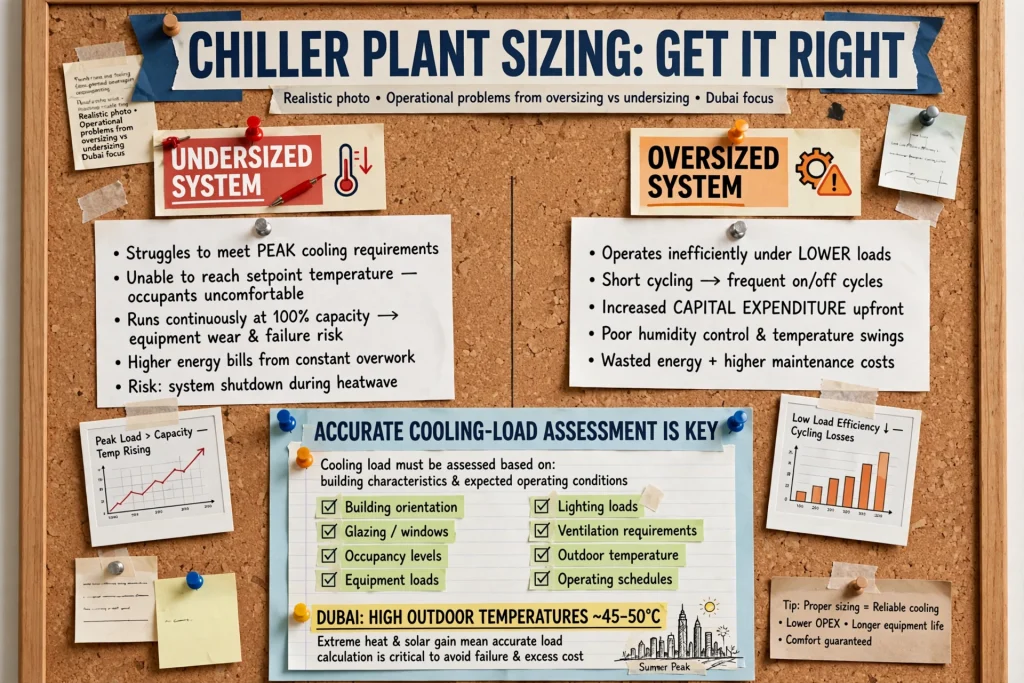
Oversizing or undersizing a chiller plant can create operational problems.
An undersized system may struggle to meet peak cooling requirements.
An oversized system may operate inefficiently under lower loads and increase capital expenditure.
The cooling load should therefore be assessed based on the building’s characteristics and expected operating conditions.
Factors can include building orientation, glazing, occupancy, equipment loads, lighting, ventilation requirements, outdoor temperature, and operating schedules.
In Dubai, high outdoor temperatures make accurate cooling-load assessment particularly important.
Water-Cooled vs Air-Cooled Chillers
The contractor should also understand the differences between water-cooled and air-cooled chillers.
Water-Cooled Chillers
Water-cooled chillers typically use cooling towers and condenser-water systems to reject heat.
They can be highly suitable for large commercial cooling plants where efficiency and high-capacity operation are priorities.
However, they require additional infrastructure, including cooling towers, condenser-water pumps, water treatment, and associated piping.
Air-Cooled Chillers
Air-cooled chillers reject heat directly through air-cooled condenser coils.
They generally do not require cooling towers or condenser-water circuits.
This can simplify installation and reduce water-related infrastructure.
The choice depends on the project requirements, available space, operating conditions, energy objectives, and lifecycle considerations.
Chiller Installation in Dubai’s Climate
Dubai’s hot climate places substantial demands on cooling infrastructure.
High ambient temperatures can influence chiller performance and system capacity.
The installation environment must therefore be considered carefully.
Plant-room ventilation, outdoor equipment placement, condenser conditions, cooling tower operation, insulation, controls, and maintenance access all contribute to reliable performance.
A contractor familiar with local conditions can help identify practical installation considerations for buildings across areas such as Dubai Marina, Downtown Dubai, Business Bay, Jumeirah, Palm Jumeirah, Dubai Hills Estate, Al Barsha, Deira, Bur Dubai, and Sheikh Zayed Road.
Chiller Installation Contractor in Dubai Marina
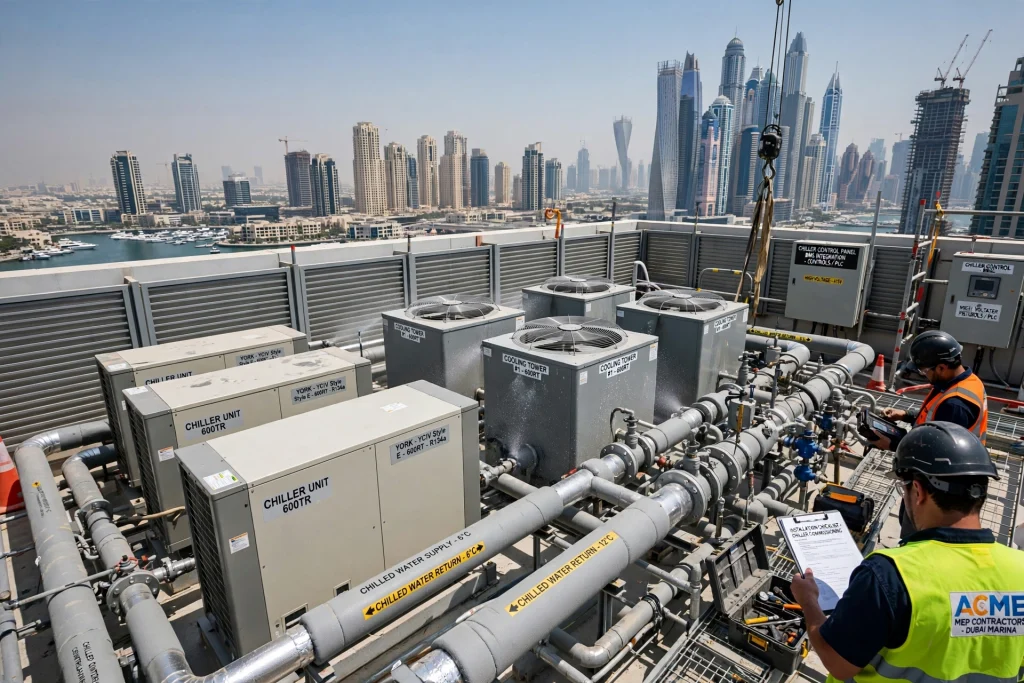
For buildings in Dubai Marina, the cooling system can involve additional logistical considerations because of high-rise construction, limited plant-room access, basement facilities, tower mechanical rooms, and dense surrounding development.
A specialized Chiller Installation Contractor in Dubai Marina can assess the specific requirements of the building, including equipment access, lifting arrangements, chilled-water connections, pump systems, controls, and commissioning.
This is especially relevant for hotels, residential towers, offices, restaurants, retail spaces, and mixed-use developments where reliable cooling is essential.
Installation Is Only One Part of the Project
A competent chiller contractor should consider the entire lifecycle of the equipment.
The installation stage may include:
- Site inspection
- Equipment delivery planning
- Equipment positioning
- Piping installation
- Pump installation
- Valve installation
- Electrical connections
- Insulation
- Controls installation
- Pressure testing
- Flushing
- Water treatment
- System balancing
- Commissioning
- Performance verification
Skipping or rushing any of these stages can affect long-term performance.
Chiller Commissioning
Commissioning is particularly important after installation.
The objective is to confirm that the system operates according to the project requirements.
Commissioning may include checking:
- Chilled-water temperatures
- Condenser-water temperatures
- Flow rates
- Pump operation
- Pressure differential
- Compressor operation
- Electrical parameters
- Safety controls
- Alarms
- VFD operation
- BMS communication
- Cooling capacity
The commissioning process provides an opportunity to identify problems before the system enters normal operation.
HVAC Contractor and Ductwork
One area where a general HVAC contractor may have a stronger focus is air distribution.
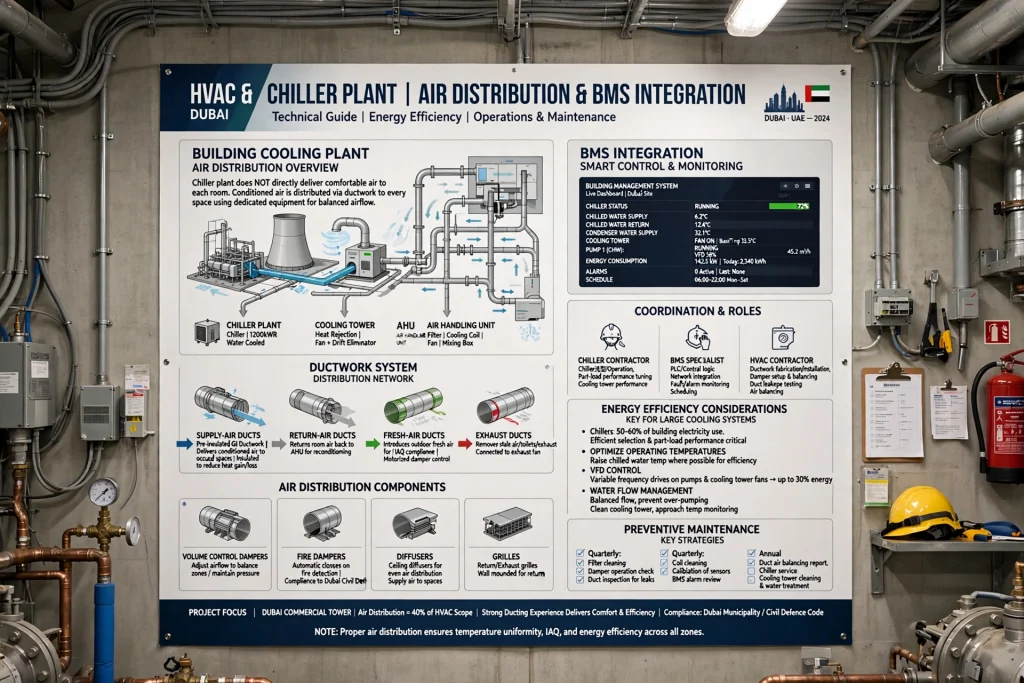
A building’s cooling plant does not directly deliver comfortable air to every room.
The conditioned air must be distributed through appropriate equipment and ductwork.
This can involve:
- GI ductwork
- Pre-insulated ductwork
- Supply-air ducts
- Return-air ducts
- Fresh-air ducts
- Exhaust ducts
- Volume control dampers
- Fire dampers
- Diffusers
- Grilles
An HVAC contractor with strong ducting experience can therefore be valuable for projects where air distribution represents a significant portion of the scope.
Chiller Contractor and BMS Integration
Modern buildings increasingly rely on automation.
A chiller plant can be connected to a Building Management System, allowing facility teams to monitor equipment and operating conditions.
BMS integration can provide information such as:
- Chiller status
- Supply-water temperature
- Return-water temperature
- Pump status
- Cooling tower status
- Energy consumption
- Alarm conditions
- Operating schedules
A chiller contractor should understand how the equipment communicates with the building’s control system.
For complex facilities, coordination between the chiller contractor, BMS specialist, electrical contractor, and HVAC contractor may be required.
Energy Efficiency Considerations
Energy consumption is a major consideration for large cooling systems.
Chillers can represent a significant portion of a commercial building’s electricity consumption.
Efficiency can be influenced by:
- Chiller selection
- Operating temperatures
- Part-load performance
- Pump efficiency
- Cooling tower performance
- VFD control
- Water flow
- Condenser conditions
- BMS strategies
- Preventive maintenance
A contractor with central plant experience can help ensure that equipment is installed and configured to operate effectively.
Maintenance Requirements
Chiller systems require regular maintenance to remain reliable.
Maintenance can include inspection and servicing of:
- Compressors
- Evaporators
- Condensers
- Pumps
- Cooling towers
- Strainers
- Valves
- Electrical components
- Sensors
- Controls
- Refrigerant circuits
- Water systems
The maintenance approach differs depending on the chiller type.
Centrifugal chillers, screw chillers, air-cooled chillers, and water-cooled chillers each have their own service requirements.
A contractor experienced with the specific equipment installed at the facility can provide more relevant support.
Chiller Repair vs General HVAC Repair
A general HVAC contractor may be experienced in repairing air-conditioning equipment, but major chiller repairs can require specialized knowledge.
Chiller troubleshooting may involve:
- Compressor faults
- Refrigerant issues
- Condenser problems
- Evaporator performance
- Oil systems
- Flow problems
- Electrical faults
- Sensor failures
- Control-system faults
- High-pressure trips
- Low-flow alarms
A specialized chiller technician can interpret operating data and fault codes while assessing the wider plant rather than focusing only on one component.
What About Existing Buildings?
Existing buildings often present more complicated challenges than new construction.
A replacement chiller may need to fit into an existing plant room.
The new equipment may have different dimensions, connections, electrical requirements, or control requirements from the original unit.
The contractor may need to coordinate:
- Existing piping
- Existing pumps
- Electrical infrastructure
- BMS
- Cooling towers
- Structural access
- Crane or lifting arrangements
- Shutdown periods
This is where experience with retrofit and replacement projects becomes particularly valuable.
Chiller Replacement in High-Rise Buildings
High-rise buildings can present unique logistical challenges.
Equipment may need to be transported through restricted access points or lifted using cranes.
Temporary shutdowns need to be planned carefully because tenants, hotel guests, retail operations, and other occupants may depend on continuous cooling.
A detailed replacement plan can reduce disruption.
The contractor should assess the existing system before removing equipment and establish how the new installation will connect to the building infrastructure.
How to Choose Between a Chiller Contractor and HVAC Contractor
The right choice depends on the scope.
If your project involves central chilled-water equipment, prioritize a contractor with demonstrated chiller experience.
If the project involves ductwork, ventilation, AHUs, FCUs, VRF, split systems, and general air-conditioning, a capable HVAC contractor may be appropriate.
For a large project, you may need both.
The important point is not simply what the contractor calls itself, but whether its technical experience matches the actual system being installed.
Questions to Ask Before Hiring a Contractor
Before appointing a contractor, ask about previous projects involving similar equipment and building types.
Important questions include:
- Have you installed this type of chiller before?
- What chiller brands do your technicians work with?
- Can you handle chilled-water piping?
- Do you provide commissioning?
- Can you integrate the chiller with BMS?
- Do you handle pump installation?
- Can you coordinate cooling tower works?
- Do you provide maintenance after installation?
- Can you support emergency repairs?
- Have you worked on high-rise buildings?
- Can you provide testing and commissioning documentation?
These questions can reveal whether a contractor has genuine project experience.
The Importance of Coordination
Large HVAC projects rarely involve one contractor working independently.
Chiller installation may need coordination with:
- Mechanical consultants
- Electrical contractors
- BMS contractors
- Plumbing contractors
- Civil contractors
- Fire protection contractors
- Facility management teams
- Building management
- Equipment manufacturers
Good coordination helps prevent conflicts between services.
For example, chilled-water piping needs to be coordinated with electrical cable trays, fire protection systems, structural elements, access routes, and other mechanical services.
Chiller Contractor vs HVAC Contractor: A Practical Comparison
A chiller installation contractor is generally more specialized in central cooling plants.
An HVAC contractor generally has a broader scope covering air-conditioning and ventilation systems.
For a large commercial development, specialization can be especially valuable.
For smaller air-conditioning projects, broad HVAC expertise may be sufficient.
The best contractor is therefore the one whose technical capabilities match the equipment, building type, cooling load, and project requirements.
Frequently Asked Questions
Is a chiller contractor the same as an HVAC contractor?
Not necessarily. Chiller contractors generally specialize in chilled-water cooling plants, while HVAC contractors can cover a broader range of air-conditioning, ventilation, and air-distribution systems.
Can an HVAC contractor install a chiller?
Some HVAC contractors have the required chiller expertise, while others focus mainly on conventional air-conditioning and ventilation. Always verify specific chiller installation experience.
When should I hire a specialized chiller contractor?
A specialized contractor is particularly useful for large central cooling plants, chiller replacements, water-cooled systems, centrifugal chillers, complex pump arrangements, and projects requiring detailed commissioning.
Are water-cooled chillers better than air-cooled chillers?
Neither is universally better. The appropriate option depends on capacity, space, water availability, efficiency requirements, operating conditions, and the building’s infrastructure.
Does chiller installation include piping?
It can, depending on the contractor’s scope. Chilled-water piping, condenser-water piping, valves, pumps, insulation, and controls should be clearly defined in the project contract.
Is BMS integration important for chillers?
Yes. BMS integration can help monitor and control chiller plant operation, temperatures, pumps, alarms, schedules, and energy-related parameters.
Do chillers require regular maintenance?
Yes. Preventive maintenance can help identify developing issues, maintain performance, and reduce the risk of unexpected shutdowns.
Conclusion
The difference between a chiller installation contractor and a general HVAC contractor largely comes down to scope and specialization.
A general HVAC contractor can handle many types of air-conditioning and ventilation systems, including ductwork, AHUs, FCUs, VRF systems, package units, and ventilation equipment.
A specialized chiller installation contractor focuses more heavily on central chilled-water systems, including chillers, pumps, cooling towers, piping, controls, commissioning, and plant optimization.
For a small residential or commercial air-conditioning project, a qualified HVAC contractor may be enough. For a high-capacity central cooling plant serving a hotel, shopping centre, hospital, office tower, residential development, or large mixed-use property, specialized chiller expertise can provide important advantages.
In Dubai’s demanding climate, selecting a contractor with the right technical knowledge is essential for reliable and efficient cooling. The most important factor is not the label used by the company, but its demonstrated experience with the exact type of cooling system, building, equipment, and installation scope required for your project.