Chillers are among the most important energy-consuming systems in large commercial and industrial buildings. They provide chilled water for air-conditioning and process cooling, supporting offices, hotels, shopping malls, hospitals, factories, data centres, airports, and other facilities. Because chillers can operate for long periods, even a relatively small improvement in efficiency can produce meaningful reductions in electricity consumption and operating costs.
Improving chiller efficiency is not simply about replacing an old machine with a newer model. Cooling energy consumption is influenced by chilled-water temperature, condenser-water temperature, cooling load, compressor performance, pumps, cooling towers, heat exchangers, controls, filters, water quality, and the condition of the wider HVAC system.
For buildings in Dubai and across the UAE, efficient chiller operation is particularly important because cooling demand can remain high for much of the year. A properly designed and maintained chilled-water system can provide reliable indoor comfort while reducing unnecessary energy consumption.
What Is Chiller Efficiency?
Chiller efficiency describes how effectively a chiller produces cooling compared with the amount of electrical energy it consumes. A more efficient chiller delivers the required cooling capacity while using less electricity.
Chiller performance can be evaluated using measurements such as coefficient of performance (COP), energy efficiency ratio (EER), kilowatts per ton of refrigeration (kW/ton), and integrated part-load value (IPLV), depending on the equipment and application.
For practical building operation, kW/ton is particularly useful because it relates electrical input to cooling output. A lower kW/ton generally indicates better efficiency.
However, the chiller itself is only one part of the overall cooling plant. Pumps, cooling towers, fans, air handling units, fan coil units, controls, and distribution systems also consume energy. Therefore, improving total plant efficiency requires a system-level approach.
Why Chillers Consume So Much Energy
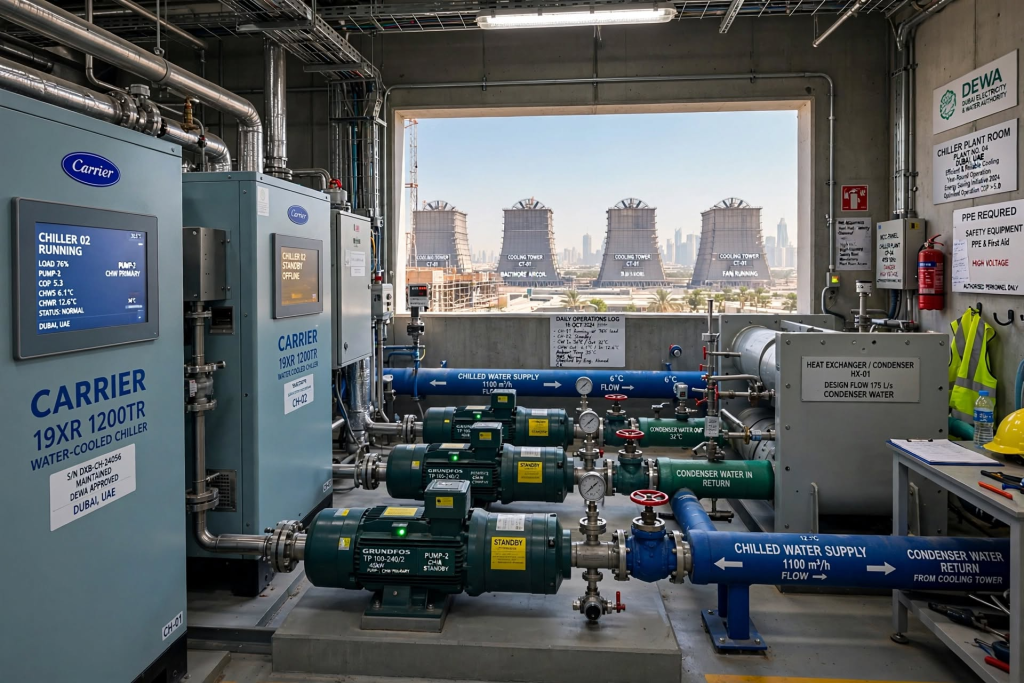
A chiller performs a continuous thermodynamic process to remove heat from chilled water and reject that heat to another medium, usually air or condenser water.
A typical water-cooled chiller contains components such as a compressor, evaporator, condenser, expansion device, refrigerant circuit, controls, and associated water systems. Air-cooled chillers use condenser fans to reject heat directly to outdoor air.
The compressor is usually one of the largest electrical loads in a refrigeration system. If operating conditions force the compressor to work harder than necessary, energy consumption increases.
High condensing temperatures, low chilled-water temperatures, dirty heat-transfer surfaces, refrigerant problems, excessive cooling demand, and poor control strategies can all reduce efficiency.
Chilled-Water Temperature and Energy Consumption
Chilled-water temperature has a direct relationship with chiller efficiency. Producing colder water generally requires the refrigeration system to operate at a greater lift between the evaporating and condensing conditions.
Where building comfort and equipment requirements allow, increasing the chilled-water supply temperature slightly can reduce compressor energy consumption.
For example, a chilled-water system operating at an unnecessarily low setpoint may consume more electricity than required to satisfy the actual building load.
The correct temperature depends on the building’s air-conditioning design, AHU requirements, FCU requirements, humidity control, indoor conditions, and equipment specifications.
Setpoints should therefore be optimised rather than changed arbitrarily.
Reduce Condenser Water Temperature Where Appropriate
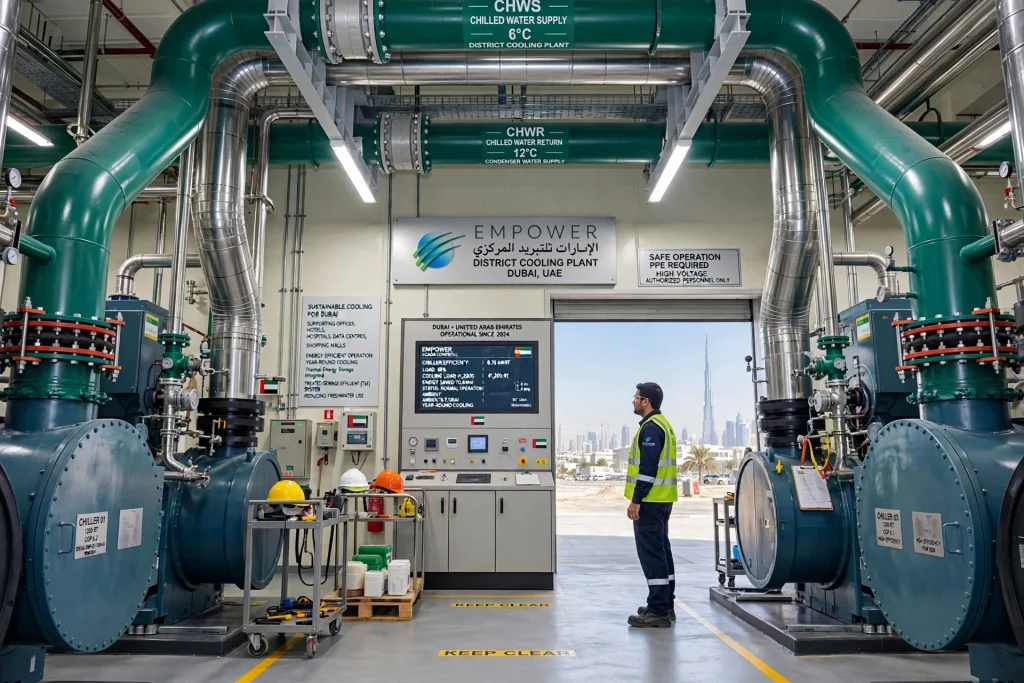
For water-cooled chillers, condenser-water temperature has a significant effect on compressor workload.
Cooling towers reject heat from the condenser-water loop to the outdoor environment. When the cooling tower can provide cooler condenser water, the chiller may operate with lower condensing pressure and reduced compressor lift.
Cooling tower performance depends on outdoor wet-bulb temperature, airflow, water flow, fill condition, fan operation, approach temperature, and cleanliness.
However, running cooling tower fans continuously at maximum speed is not necessarily efficient. The goal is to optimise the combined energy consumption of the chiller and cooling tower rather than minimise one component in isolation.
Maintain Clean Heat-Transfer Surfaces
Heat exchangers transfer thermal energy between fluids and refrigerant. In a chiller, the evaporator and condenser must remain sufficiently clean to operate effectively.
Scale, biological growth, corrosion products, sediment, and other deposits can reduce heat-transfer performance.
A dirty condenser can cause higher condensing temperatures, forcing the compressor to work harder. Fouling on the chilled-water side can also reduce heat-transfer efficiency.
Regular inspection, water treatment, tube cleaning where applicable, and appropriate maintenance can help maintain heat-transfer performance.
Water quality management is especially important for water-cooled chiller plants because cooling tower systems can be exposed to scaling and biological contamination.
Optimise Chiller Part-Load Operation
Chillers rarely operate at their full rated capacity all day. Building cooling demand changes according to occupancy, weather, solar gain, internal heat loads, equipment operation, and time of day.
Modern chillers can often achieve excellent efficiency at part load when operated within appropriate conditions.
Running multiple chillers at low loads can sometimes consume more energy than operating fewer machines at a more efficient loading level. Conversely, concentrating excessive load on one machine may reduce efficiency or create operational risks.
A central plant control strategy can sequence chillers according to actual cooling demand and equipment performance.
The objective is to maintain the required cooling capacity using the lowest practical total plant energy.
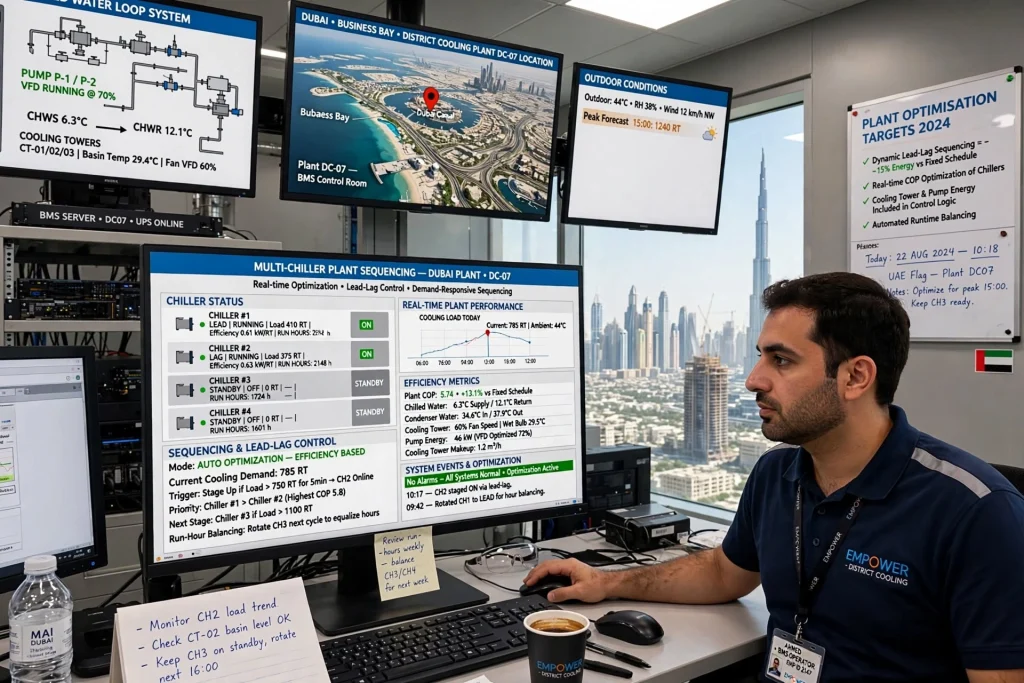
Chiller Sequencing and Lead-Lag Control
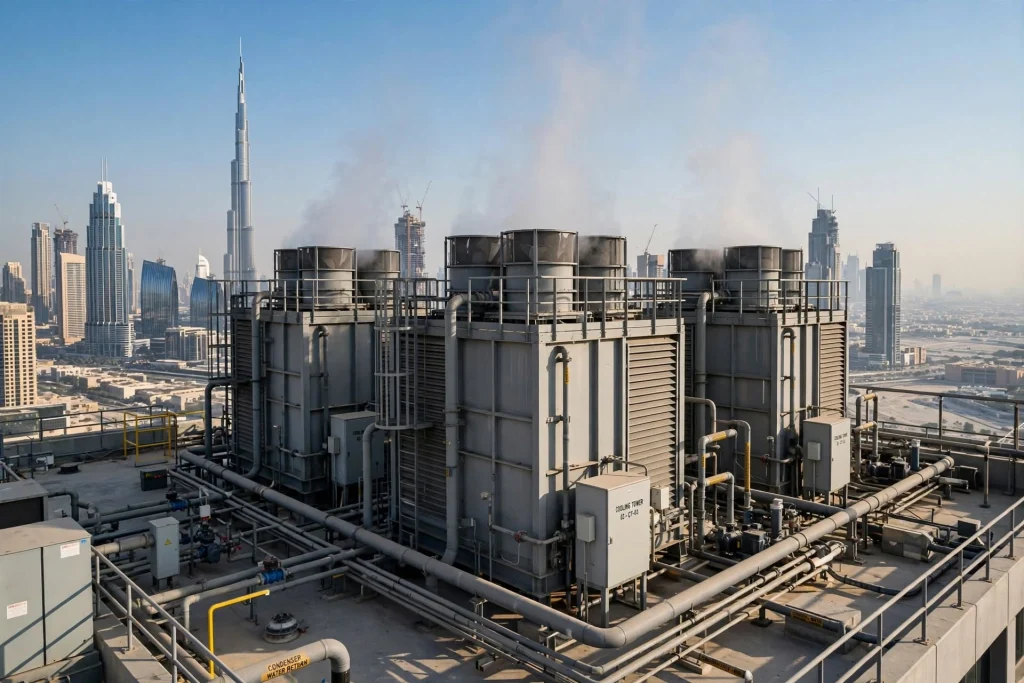
In a multi-chiller plant, sequencing determines when each chiller starts, stops, or changes operating priority.
Lead-lag control can distribute operating hours between machines while allowing the plant to respond to changes in demand.
Advanced sequencing can consider real-time cooling load, chiller efficiency curves, chilled-water temperatures, condenser-water conditions, pump energy, and cooling tower performance.
This approach can improve overall plant efficiency compared with operating chillers according to a fixed schedule.
For large facilities, building management system (BMS) integration can make this type of optimisation more practical.
Variable Frequency Drives for Chiller Plant Equipment
Variable frequency drives (VFDs) can adjust motor speed according to actual system requirements. They can be applied to chilled-water pumps, condenser-water pumps, and cooling tower fans where the equipment and control strategy support variable-speed operation.
Reducing motor speed can significantly reduce energy consumption in centrifugal fan and pump applications because power demand can change substantially with speed.
Instead of operating pumps or fans continuously at full speed, a variable-speed system can respond to pressure, flow, temperature, or load requirements.
VFD control should be properly commissioned because incorrect minimum speeds, unstable control loops, or excessive pressure setpoints can reduce the expected energy savings.
Improve Chilled-Water Pump Efficiency
Chilled-water pumps circulate water between the chiller plant and building cooling equipment such as AHUs and FCUs.
If pumps operate at unnecessarily high flow rates or pressure levels, the building consumes additional electricity without receiving proportional cooling benefits.
Variable primary flow systems and differential-pressure control can help match water flow with actual cooling demand.
Sensors can monitor differential pressure at critical points in the distribution network and allow pump speed to be adjusted accordingly.
Pump impeller condition, alignment, motor efficiency, valve positions, strainers, and piping configuration should also be considered when evaluating pump energy consumption.
Cooling Tower Optimisation
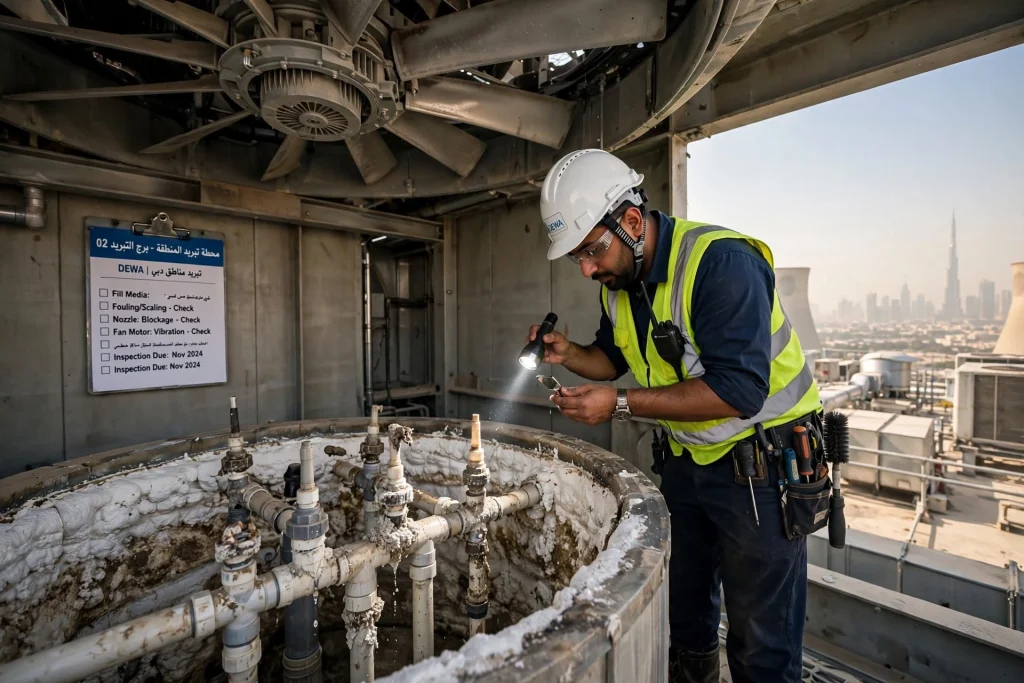
Cooling towers are a critical part of many water-cooled chiller plants. Their performance affects the temperature at which the chiller rejects heat.
Cooling tower efficiency can be affected by dirty fill material, poor water distribution, damaged nozzles, inadequate airflow, fan problems, scale, and incorrect control settings.
Regular cooling tower inspection and water treatment can maintain heat rejection performance.
Variable-speed tower fans can also adjust airflow according to condenser-water temperature requirements.
The best control strategy considers both chiller compressor energy and cooling tower fan energy to find the lowest total plant consumption.
Reduce Air-Side HVAC Energy Consumption
Chiller efficiency is connected to the performance of the air-side HVAC system.
Air handling units and fan coil units distribute conditioned air throughout the building. Dirty filters, blocked coils, poorly balanced air systems, leaking ductwork, incorrect temperature setpoints, and excessive fan speed can increase cooling demand.
If an AHU cannot transfer cooling effectively because its coil or filter is dirty, the system may need to operate longer or at lower supply-air temperatures.
Regular HVAC maintenance therefore supports chiller efficiency by reducing unnecessary cooling demand.
Improve Building Load Management
The most efficient chiller is still going to consume energy if the building has unnecessary cooling loads.
Solar heat gain through windows, poorly insulated roofs, heat-generating equipment, inefficient lighting, open doors, and uncontrolled ventilation can all increase cooling demand.
Building owners can reduce cooling requirements through improved insulation, solar-control glazing, shading, efficient lighting, occupancy controls, and appropriate building automation.
Reducing the building load allows the chilled-water plant to operate at lower capacity.
This is why chiller optimisation should be coordinated with building energy management rather than treated as an isolated mechanical issue.
Use Smart BMS Controls
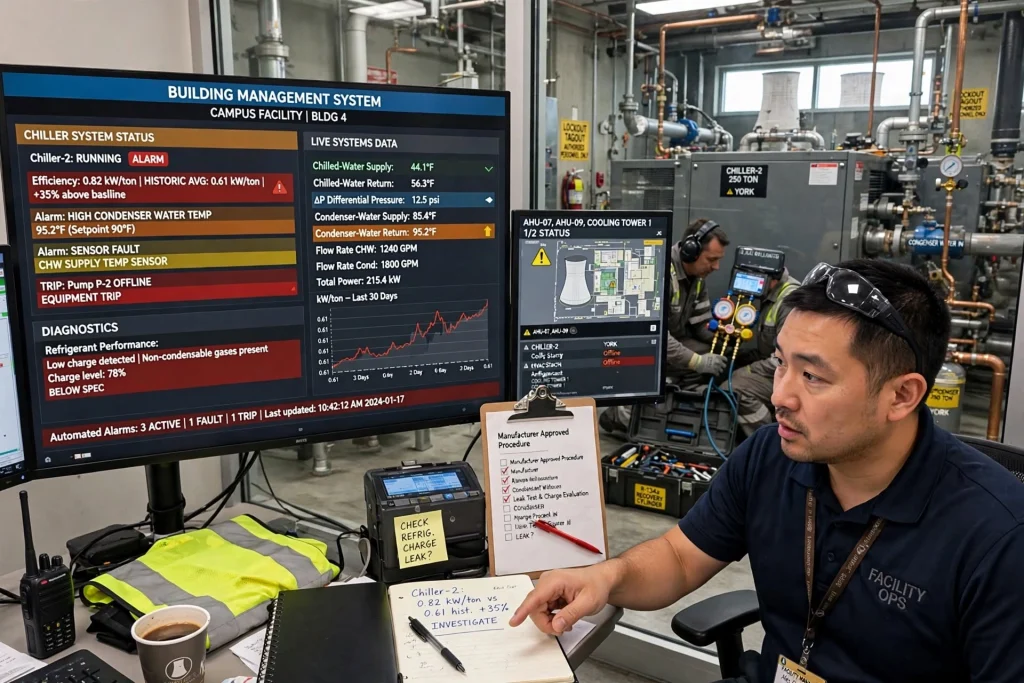
A building management system can collect and analyse information from chillers, pumps, cooling towers, AHUs, sensors, meters, and other mechanical equipment.
BMS controls can monitor chilled-water supply and return temperatures, differential pressure, condenser-water temperatures, flow rates, equipment status, and energy consumption.
This information can help facility managers identify abnormal operating conditions.
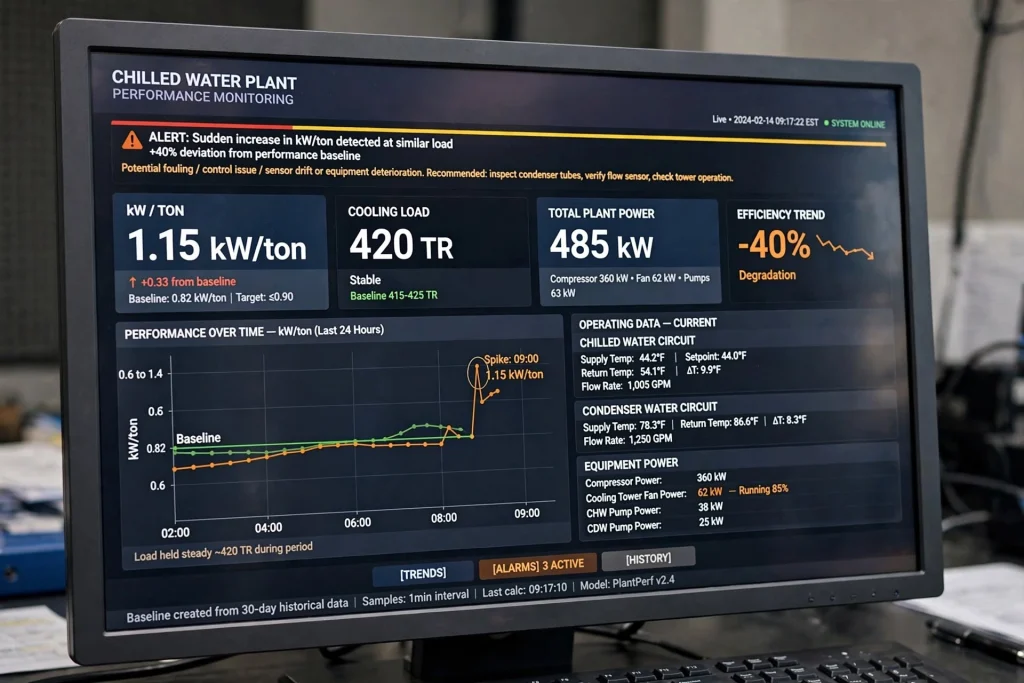
For example, if a chiller is consuming more kW/ton than its historical performance at a similar load, the system may require investigation.
Automated alarms can also identify sensor faults, high temperatures, equipment trips, and other conditions before they become major operational problems.
Refrigerant Charge and Chiller Performance
Refrigerant conditions can influence refrigeration system performance. Incorrect refrigerant charge, leaks, non-condensable gases, or other refrigeration-system issues can cause abnormal operating conditions.
Chiller technicians should use manufacturer-approved procedures and appropriate diagnostic equipment when evaluating refrigerant systems.
Refrigerant maintenance is not simply about adding refrigerant. If a leak exists, the underlying cause should be identified and repaired.
Maintaining the refrigeration circuit according to manufacturer requirements can help protect compressor performance and system reliability.
Electrical Efficiency and Motor Performance
Electrical systems also influence chiller operating costs. Motors, compressors, pumps, cooling tower fans, starters, VFDs, and electrical connections should operate within their intended conditions.
Poor electrical connections, voltage imbalance, motor deterioration, or incorrect VFD settings can affect equipment performance.
Power meters can help facility teams monitor actual electrical consumption rather than relying only on theoretical equipment ratings.
Comparing electrical consumption with cooling output provides a more useful picture of real-world chiller efficiency.
Regular Chiller Maintenance Improves Energy Performance
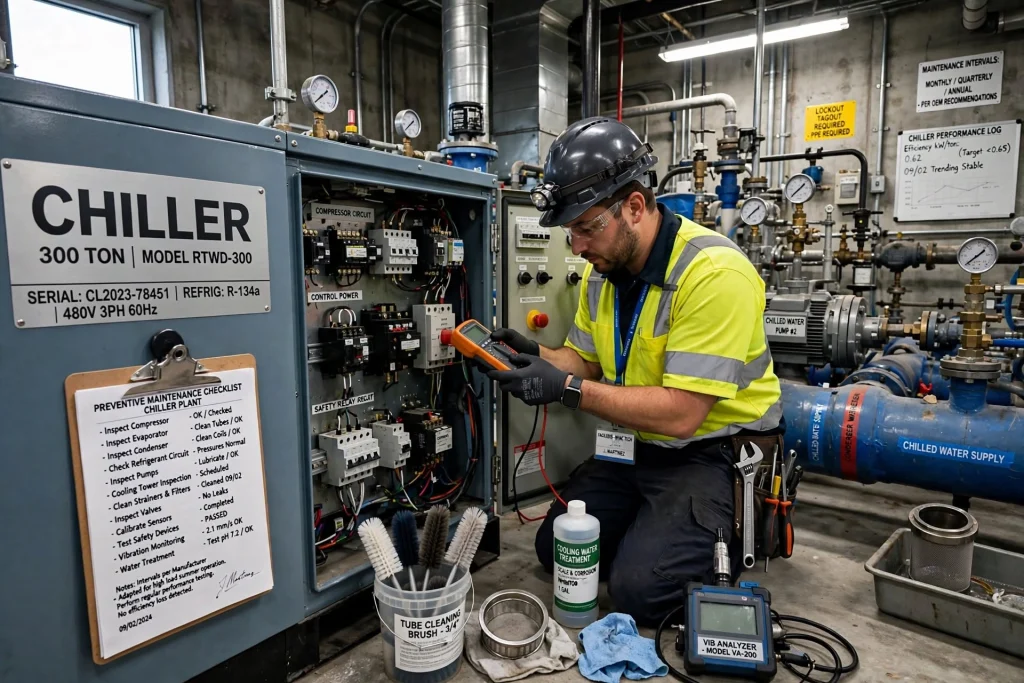
Preventive maintenance is fundamental to efficient chiller operation.
A maintenance program may include inspection of compressors, evaporators, condensers, refrigerant circuits, pumps, cooling towers, strainers, valves, sensors, electrical components, controls, and safety devices.
Tube cleaning, filter and strainer maintenance, water treatment, coil cleaning, vibration monitoring, and electrical testing may also be required depending on the equipment.
Maintenance intervals should follow manufacturer recommendations and be adapted to operating conditions.
For facilities with high cooling demand, regular performance testing can identify efficiency deterioration before it becomes a major operating expense.
Air-Cooled vs Water-Cooled Chiller Efficiency
Air-cooled and water-cooled chillers use different methods to reject heat, so their efficiency characteristics differ.
Water-cooled chillers typically use a cooling tower and condenser-water circuit. Under suitable operating conditions, they can achieve strong efficiency, particularly in larger central plants.
Air-cooled chillers reject heat directly to outdoor air through condenser coils and fans. They can offer simpler installation and avoid cooling tower water consumption, but their performance is strongly influenced by outdoor air temperature.
The appropriate technology depends on building size, climate, water availability, maintenance requirements, capital costs, and operational objectives.
Chiller Efficiency in Dubai and the UAE
Dubai, Abu Dhabi, Sharjah, and other UAE locations experience substantial cooling demand, making HVAC energy management an important consideration for commercial and industrial facilities.
Large buildings may operate chilled-water systems for extended periods to maintain indoor comfort. Hotels, shopping malls, hospitals, airports, offices, residential towers, and industrial facilities can therefore benefit from systematic chiller optimisation.
Local conditions such as high outdoor temperatures, dust, cooling tower water quality, and long operating hours can influence equipment performance.
Regular condenser and cooling tower maintenance is particularly important where dust and environmental conditions affect heat-transfer surfaces.
How to Measure Chiller Efficiency
Measuring efficiency is essential before implementing an optimisation strategy. Facility teams can monitor cooling output and electrical input to calculate performance indicators such as kW/ton.
Important operating data may include:
- Chilled-water supply temperature
- Chilled-water return temperature
- Chilled-water flow rate
- Condenser-water supply temperature
- Condenser-water return temperature
- Compressor power
- Total plant power
- Cooling load
- Cooling tower fan power
- Pump power
Monitoring these parameters over time creates a performance baseline.
A sudden change in kW/ton at a similar load may indicate fouling, control problems, sensor issues, equipment deterioration, or another operational problem requiring investigation.
Practical Ways to Reduce Chiller Energy Consumption
Reducing cooling energy does not always require major capital investment. Many improvements begin with operational optimisation.
Correcting temperature setpoints, improving chiller sequencing, cleaning heat-transfer surfaces, maintaining cooling towers, adjusting pump pressure, calibrating sensors, repairing leaking valves, improving BMS controls, and replacing heavily loaded filters can all contribute to better system performance.
Larger projects may involve high-efficiency chillers, variable-speed compressors, VFD pumps, advanced controls, heat recovery, thermal energy storage, or plant redesign.
The appropriate solution depends on the existing system and its measured performance.
Professional Chiller Efficiency Services
A professional chiller specialist can evaluate the complete cooling plant rather than looking at the chiller in isolation.
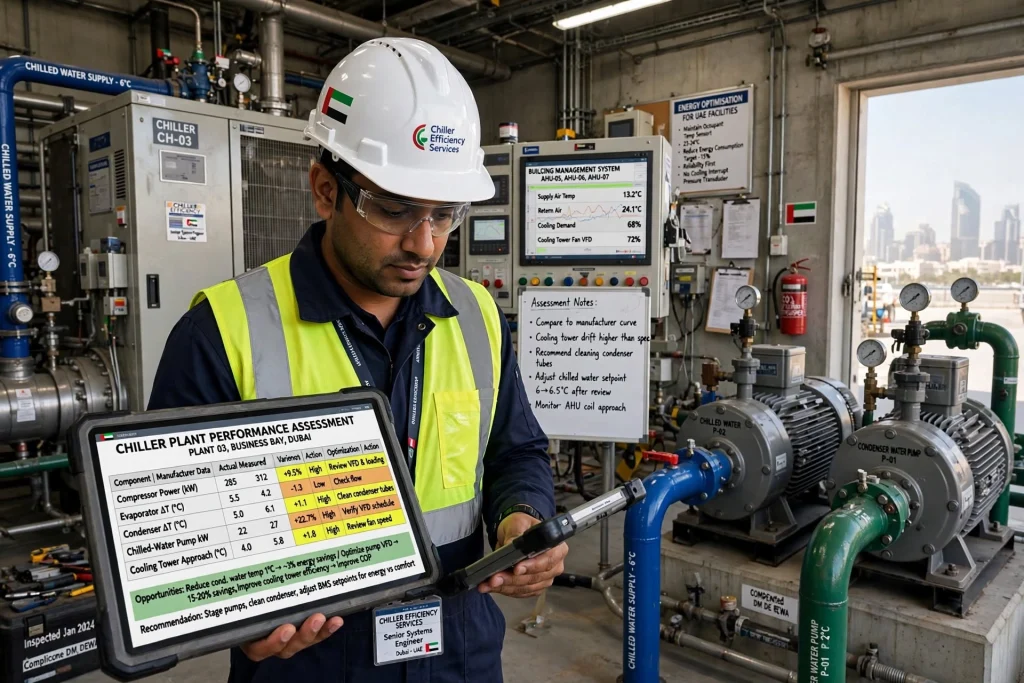
A performance assessment may examine the compressor, evaporator, condenser, chilled-water pumps, condenser-water pumps, cooling tower, AHUs, controls, sensors, and BMS.
Specialists can compare actual operating conditions against manufacturer data and identify opportunities for optimisation.
For large UAE facilities, professional Chiller Efficiency Services can help property owners and facility managers develop practical strategies for reducing energy consumption while maintaining cooling reliability and occupant comfort.
Why Chiller Efficiency Is a Long-Term Investment
Improving chiller efficiency can provide benefits beyond lower electricity bills. Efficient equipment operates under more appropriate conditions, which can support reliability and reduce unnecessary mechanical stress.
Better monitoring also makes it easier to detect performance deterioration early.
For property owners, lower energy consumption can improve operating costs. For facility managers, improved monitoring provides greater control over plant performance. For organisations focused on sustainability, reducing cooling energy can contribute to broader energy-management and environmental objectives.
The financial return depends on the building, equipment condition, operating hours, electricity tariffs, and optimisation measures selected.
Final Thoughts
Chiller efficiency is determined by the performance of the entire cooling system. Compressors, evaporators, condensers, cooling towers, pumps, AHUs, FCUs, VFDs, BMS controls, sensors, water quality, and building cooling loads all influence energy consumption.
The most effective strategy is to measure current performance, identify inefficiencies, optimise operating conditions, maintain heat-transfer equipment, improve controls, and monitor results over time.
For Dubai and UAE buildings with substantial cooling requirements, even incremental improvements can produce meaningful long-term savings. By combining preventive maintenance with intelligent controls, appropriate temperature setpoints, efficient pumping, cooling tower optimisation, and professional system assessment, facility managers can reduce cooling energy consumption while maintaining reliable indoor comfort.