High-Efficiency Particulate Air, commonly known as HEPA, filters are an important air filtration technology used in environments where controlling airborne particles is a priority. When correctly selected, installed, and maintained, HEPA filtration can help reduce very small airborne particles and support better indoor air quality.
Modern buildings rely on HVAC systems to maintain temperature, humidity, ventilation, and air movement. Because HVAC equipment continuously circulates or introduces air, filtration becomes an important part of the overall indoor environmental strategy.
The benefits of HEPA filtration can be particularly relevant in healthcare facilities, laboratories, cleanrooms, pharmaceutical environments, specialised commercial buildings, educational facilities, and other spaces where particulate control is important.
In the UAE, indoor air quality receives additional attention because buildings often remain mechanically conditioned for long periods due to the hot climate. Dust, fine particles, outdoor pollutants, construction activity, and high occupancy can all influence indoor environmental conditions.
However, installing a HEPA filter is not simply a matter of replacing an existing filter with a higher-efficiency model. HEPA filters can create significantly greater airflow resistance than standard filters, so the HVAC system must be evaluated for fan capacity, pressure drop, filter housing, sealing, airflow requirements, and maintenance.
What Is a HEPA Filter?
A HEPA filter is a high-efficiency mechanical air filter designed to capture very small airborne particles.
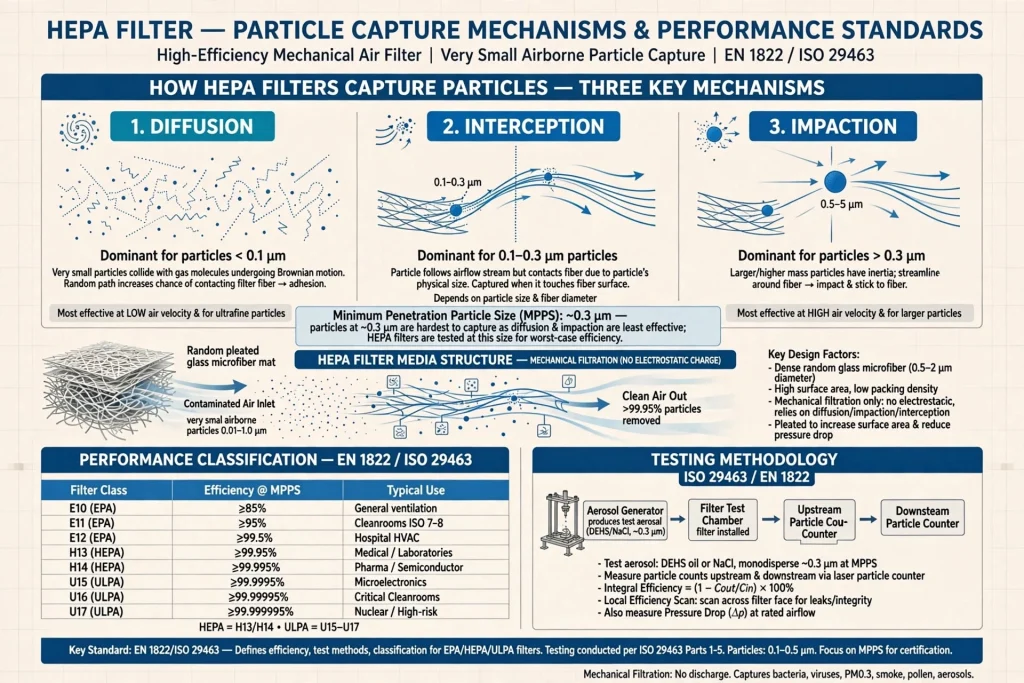
Unlike ordinary filters that primarily rely on larger particles being trapped in filter media, HEPA filtration uses several mechanisms, including interception, impaction, diffusion, and related particle-capture effects.
A properly manufactured HEPA filter can provide very high particle-removal efficiency under defined test conditions.
The term HEPA should therefore be associated with a specific performance classification rather than simply meaning “very good filtration.”
Different standards and classifications are used internationally, so the exact efficiency and testing methodology should be confirmed when specifying a system.
How HEPA Filtration Works
Air passes through a dense fibrous filter medium.
Particles travelling through the media can be captured through different mechanisms depending on their size and movement.
Larger particles may collide with filter fibres because of inertia.
Smaller particles can be intercepted as they move through the media.
Very small particles can also be influenced by Brownian motion, increasing the likelihood of interaction with the filter fibres.
The result is a filtration process capable of removing a very high percentage of particulate matter when the filter is correctly manufactured, installed, and operated.
HEPA Filters and Indoor Air Quality
One of the primary reasons for using HEPA filtration is to improve control of airborne particulate matter.
Indoor air can contain particles originating from:
Outdoor dust, construction activity, combustion, occupant movement, textiles, cleaning activities, biological material, and other indoor sources.
A suitable filtration system can reduce the concentration of many airborne particles circulating through an HVAC system.
However, filtration is only one part of indoor air quality management.
Ventilation, source control, humidity management, cleaning, building maintenance, and appropriate HVAC operation also influence indoor environmental conditions.
HEPA Filters and Fine Particles
Fine particulate matter can be more difficult to capture with basic filtration systems.
Particles can include dust fractions, smoke-related particles, aerosols, and other microscopic airborne material.
HEPA filtration is designed to achieve high particle-capture performance, making it useful where fine particulate control is a priority.
The actual indoor air quality result depends on the complete system, including filter efficiency, airflow rate, room characteristics, filter condition, leakage, and outside-air conditions.
HEPA Filters in Healthcare Facilities
Healthcare environments can have specialised filtration requirements.
Hospitals, clinics, laboratories, isolation areas, operating rooms, and other controlled environments may use high-efficiency filtration as part of their infection-control and environmental-management strategies.
HEPA filters can be incorporated into dedicated air-handling equipment, terminal units, portable filtration equipment, or specialised ventilation systems depending on the application.
Healthcare filtration design should always follow the applicable engineering, healthcare, and infection-control requirements rather than using HEPA filtration as a universal solution.
HEPA Filtration in Cleanrooms
Cleanrooms require tightly controlled environmental conditions.
Industries such as:
Pharmaceutical manufacturing, biotechnology, electronics, medical-device production, research, and specialised laboratories
may require high-efficiency filtration to control airborne particulate contamination.
HEPA filters are widely associated with cleanroom air-handling and terminal filtration applications.
In these environments, filter performance, airflow patterns, pressure relationships, leakage control, testing, and validation are particularly important.
HEPA Filters for Commercial Buildings
Some commercial buildings may benefit from high-efficiency filtration depending on occupancy, building use, external air quality, and indoor air quality objectives.
Potential applications include:
Offices, hotels, shopping centres, educational buildings, specialised retail environments, laboratories, and high-occupancy facilities.
Not every commercial HVAC system requires HEPA filtration.
A professional assessment should determine whether the existing air-handling system can accommodate the additional pressure drop and whether the expected air-quality benefit justifies the investment.
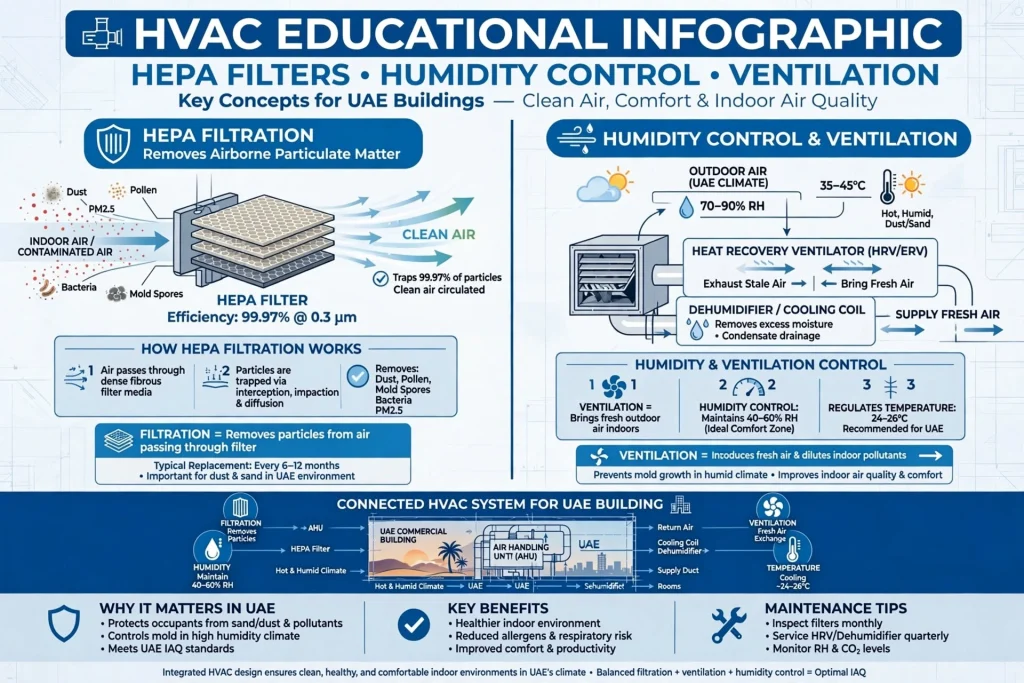
HEPA Filters in Dubai and the UAE
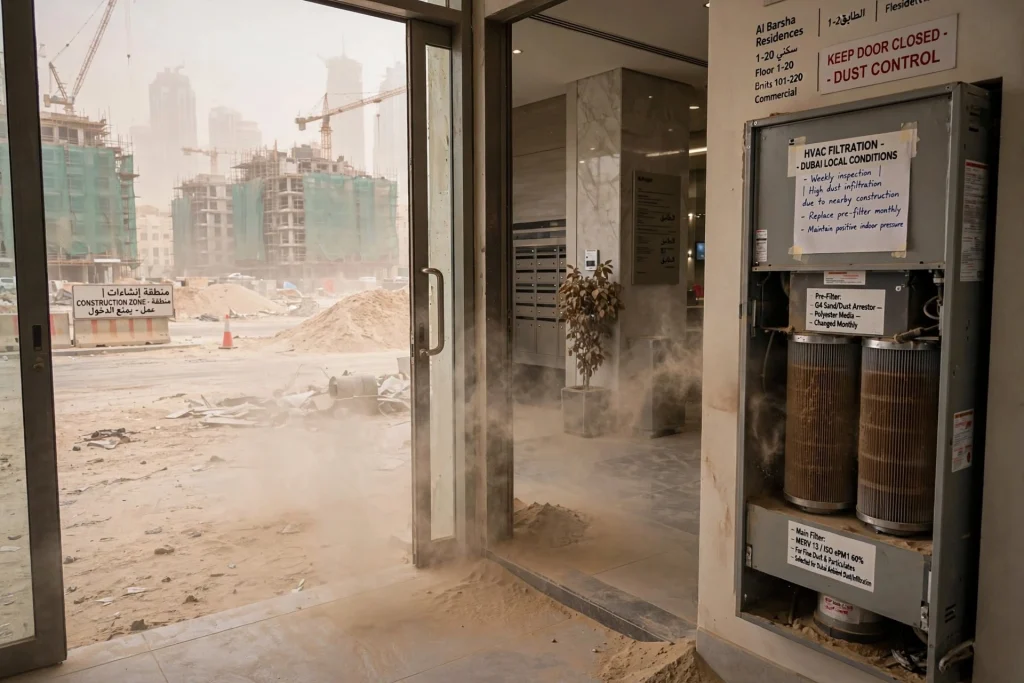
Dubai and other UAE cities experience environmental conditions that can place additional demands on building filtration systems.
Outdoor dust and particulate matter can enter buildings through doors, ventilation systems, infiltration, and other pathways.
During construction and development activities, airborne dust can also become a concern around commercial and residential areas.
HVAC filtration therefore needs to be selected with local environmental conditions in mind.
For facilities in Dubai, Abu Dhabi, Sharjah, Ajman, and other UAE locations, filtration design should consider outdoor air quality, building envelope performance, ventilation strategy, occupancy, and HVAC equipment characteristics.
HEPA Filters and Dust Control
Dust management is particularly important in the UAE.
While a HEPA filter can capture a large proportion of fine particles that reach the filter, it should not be treated as the only solution for building dust.
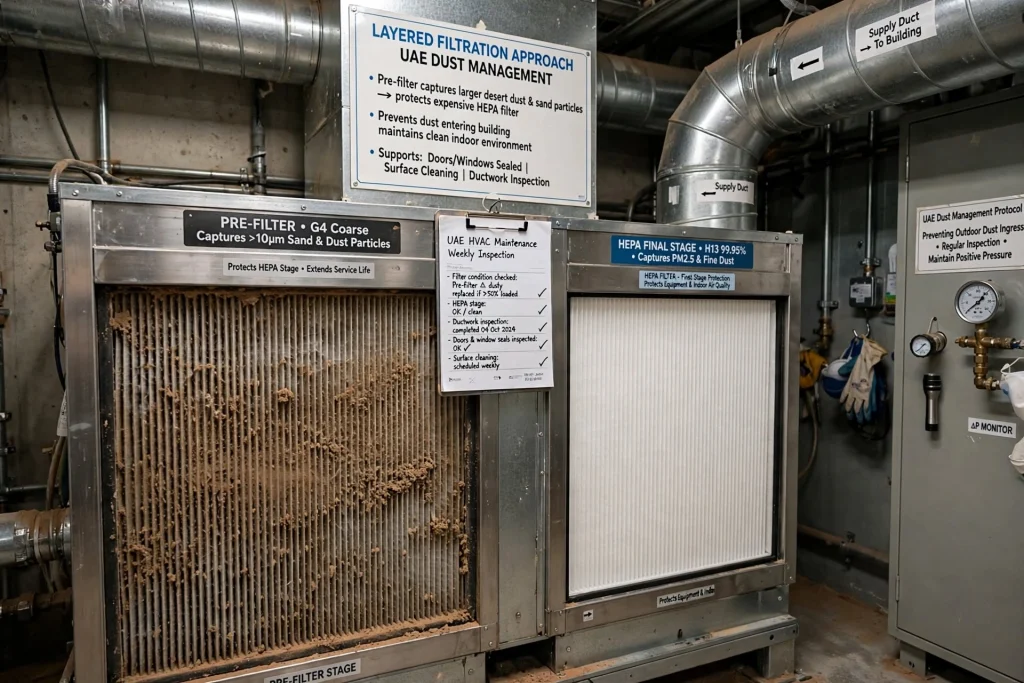
Preventing dust from entering the building, maintaining doors and windows, cleaning surfaces, inspecting ductwork, and maintaining pre-filters can reduce the particle load reaching the HEPA filter.
A layered filtration approach is often more practical.
A pre-filter can capture larger particles before air reaches the high-efficiency filter, helping protect the more expensive final-stage filter.
HEPA Filters and HVAC Airflow
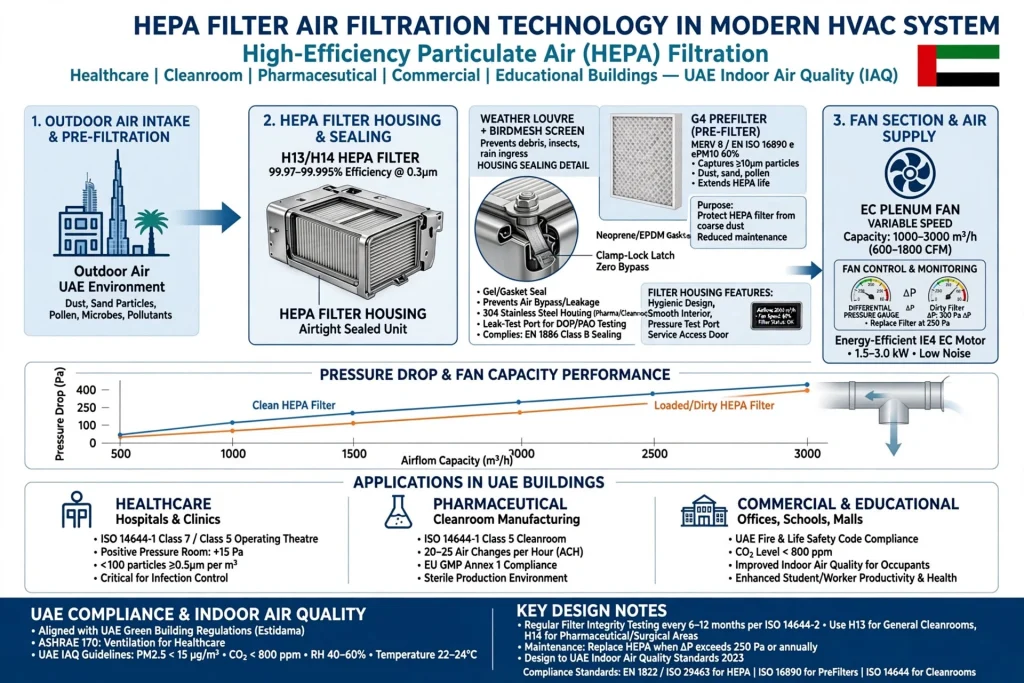
One of the most important technical considerations is pressure drop.
Because HEPA filters contain dense filtration media, air may encounter greater resistance compared with conventional filters.
If the HVAC fan cannot overcome this resistance, airflow can decrease.
Reduced airflow can affect:
Cooling performance, heating performance, ventilation rates, room pressure, occupant comfort, and equipment operation.
Therefore, a HEPA upgrade should be evaluated by an HVAC professional rather than treated as a simple filter replacement.
Fan Capacity and Static Pressure
HVAC systems are designed around specific airflow and static-pressure conditions.
Adding a high-efficiency filter can change the system’s pressure profile.
The design team should evaluate:
Fan capacity, external static pressure, filter pressure drop, duct resistance, coil resistance, damper positions, and required airflow.
If necessary, the system may require modifications to maintain the intended airflow.
This is particularly important for older air-handling units that were not designed for high-efficiency filtration.
Importance of Proper Filter Sealing
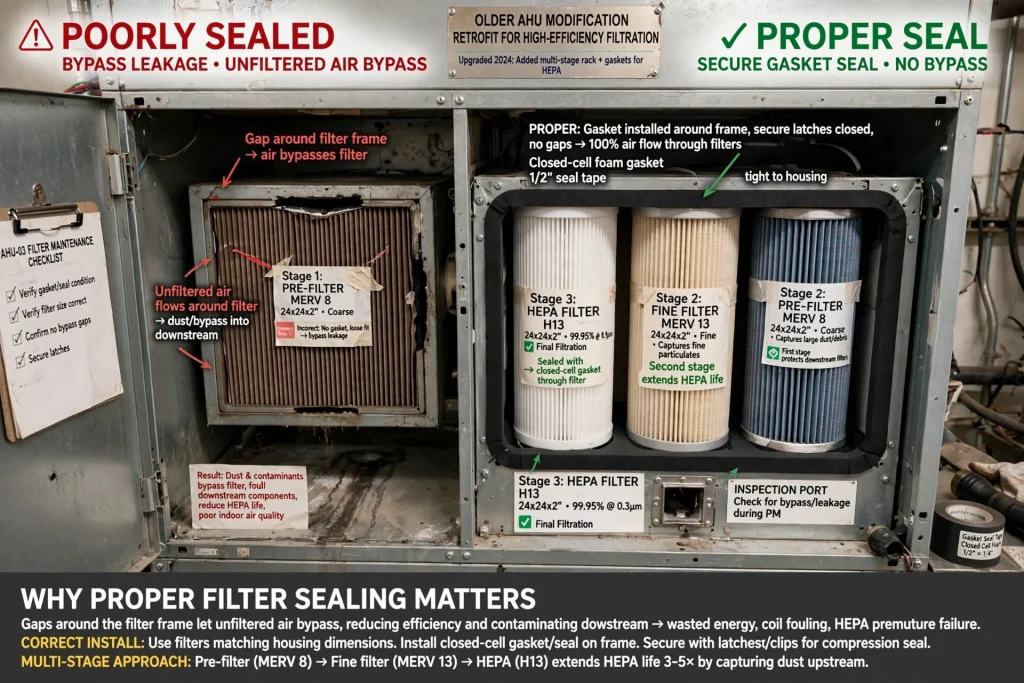
Even a highly efficient filter cannot perform as intended if air bypasses it.
Gaps around the filter frame or poorly sealed housings can allow unfiltered air to pass around the filtration media.
Proper installation should therefore include:
Correct filter dimensions, secure mounting, appropriate gaskets or seals, compatible housing, and inspection for bypass leakage.
For critical applications, more comprehensive integrity testing may be required.
Pre-Filtration Extends HEPA Filter Life
Using a pre-filter can be an effective way to protect a HEPA filter.
The pre-filter captures larger particles before they reach the high-efficiency media.
This can reduce the rate at which the HEPA filter loads with dust.
A multi-stage filtration arrangement might include:
Coarse filtration → fine filtration → HEPA filtration
with each stage serving a different purpose.
The exact configuration should be based on the application and HVAC system design.
Energy Efficiency Considerations
There is an important relationship between filtration efficiency and energy consumption.
As filters become more restrictive, fan energy requirements can increase.
A dirty filter can create an even greater pressure drop.
Therefore, energy-efficient filtration requires more than selecting the highest available filter efficiency.
The system should be designed to provide the required air quality while maintaining appropriate airflow and reasonable fan energy consumption.
Monitoring filter pressure drop can help identify when maintenance is required.
HEPA Filters and HVAC Maintenance
Maintenance is essential for maintaining filtration performance.
Over time, particles accumulate on filter media.
As loading increases, pressure drop can rise.
This can reduce airflow and increase fan energy consumption.
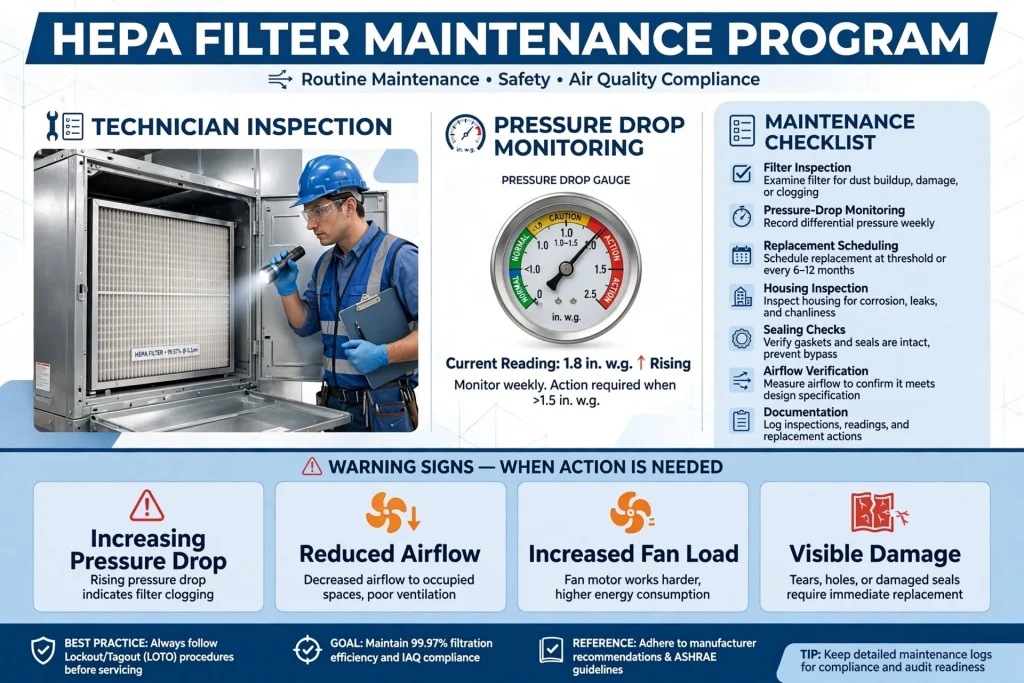
A planned maintenance programme should include:
Filter inspection, pressure-drop monitoring, replacement scheduling, housing inspection, sealing checks, airflow verification, and documentation.
The replacement interval should be based on actual operating conditions rather than an arbitrary calendar period alone.
Signs That a HEPA Filter May Need Attention
Facility teams should monitor the condition of high-efficiency filters.
Potential warning signs include:
Increasing pressure drop, reduced airflow, unusual HVAC performance, increased fan load, visible damage, damaged seals, or maintenance indicators showing that the filter has reached its service limit.
However, some filtration problems are not visible.
For critical systems, appropriate testing and measurement should be incorporated into the maintenance programme.
HEPA Filters and Building Automation
Modern buildings can integrate filtration monitoring with Building Management Systems.
Sensors can provide information about:
Filter pressure differential, fan operation, airflow, temperature, humidity, and system status.
Facility managers can use this information to identify abnormal operating conditions.
Instead of replacing filters purely according to time, maintenance teams can use system data to support condition-based maintenance where appropriate.
HEPA Filters and Humidity Control
Humidity management is another important component of indoor environmental quality.
HEPA filtration primarily addresses airborne particulate matter.
It does not replace humidity control.
In UAE buildings, air-conditioning systems often play an important role in controlling indoor moisture.
HVAC design should therefore address filtration, temperature, ventilation, and humidity as connected aspects of indoor environmental management.
HEPA Filtration and Ventilation
Filtration and ventilation perform different functions.
Filtration removes particles from air passing through the filter.
Ventilation introduces outdoor air and removes or dilutes indoor contaminants.
A building can therefore require both appropriate ventilation and suitable filtration.
Reducing outdoor-air ventilation simply because HEPA filtration is installed is not automatically appropriate.
The ventilation strategy should be based on building use, occupancy, applicable standards, and indoor air quality objectives.
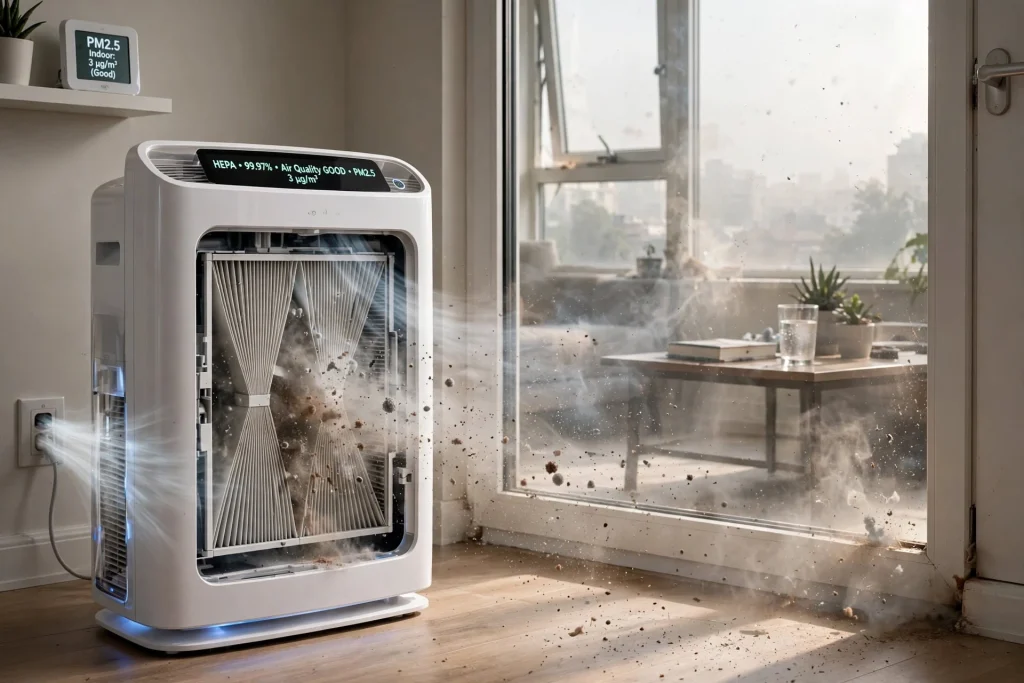
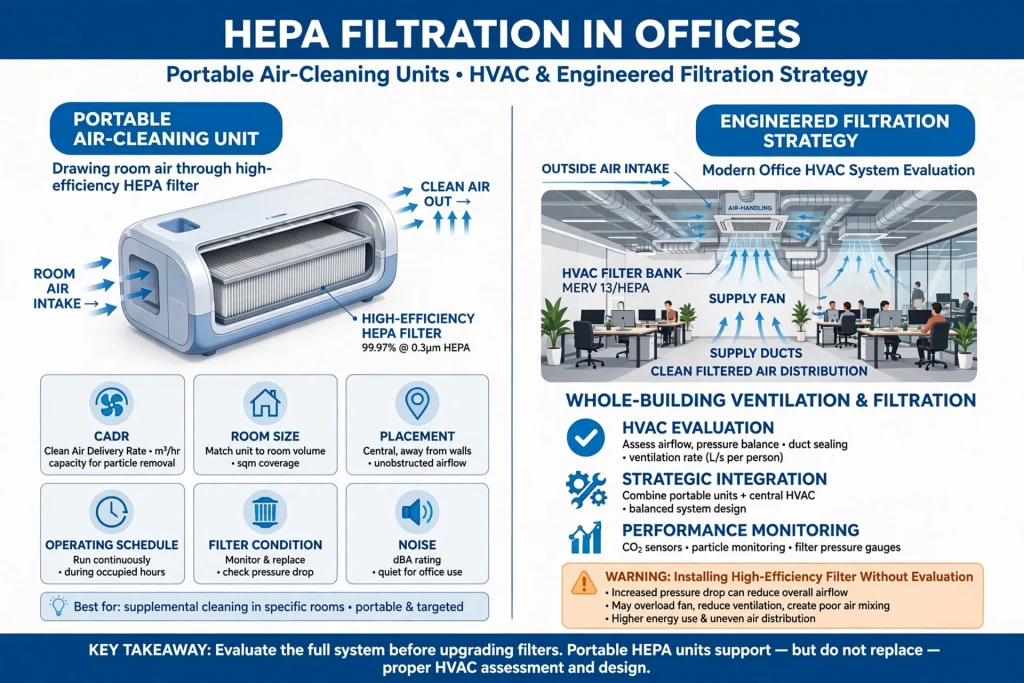
Portable HEPA Air Cleaners
Portable air-cleaning units can provide another approach to particulate control in selected environments.
These units use fans to draw room air through high-efficiency filters.
They can be useful where modifying the central HVAC system is difficult or where supplemental filtration is desired.
The effectiveness of a portable unit depends on its clean air delivery rate, room size, placement, operating schedule, filter condition, and noise characteristics.
HEPA Filtration in Offices
Modern offices can use high-efficiency filtration where appropriate, particularly in environments with specific indoor air quality objectives.
However, office HVAC systems must be evaluated before HEPA filters are installed.
If the system cannot maintain adequate airflow after the upgrade, the expected benefits may be compromised.
An engineered filtration strategy is therefore preferable to simply purchasing a high-efficiency filter and installing it into an existing air-handling unit.
HEPA Filters in Hotels
Hotels have variable occupancy and long operating hours.
Guest rooms, corridors, restaurants, meeting spaces, kitchens, back-of-house areas, and public zones have different HVAC requirements.
Filtration strategies should reflect the specific application.
Guest comfort, ventilation, noise, energy use, and maintenance access are all important considerations.
High-efficiency filtration may be appropriate for selected areas rather than the entire hotel.
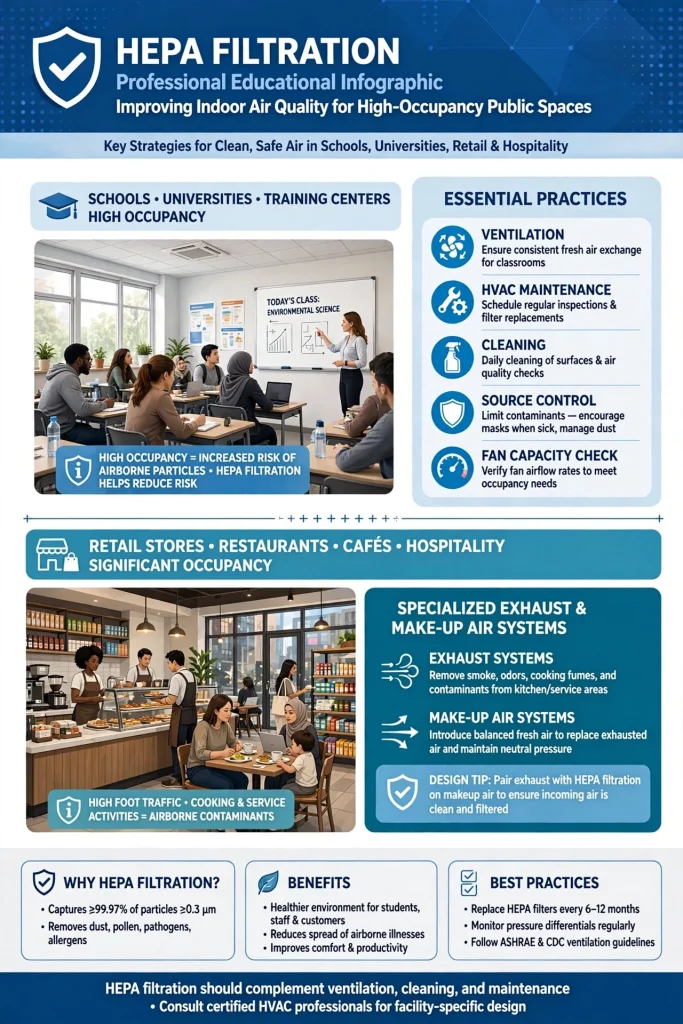
HEPA Filters in Schools and Educational Facilities
Schools, universities, and training centres have high occupancy during operating hours.
Indoor air quality is therefore an important facility-management consideration.
Filtration can be one component of an overall strategy that includes adequate ventilation, HVAC maintenance, cleaning, and source control.
Before upgrading filtration, facility operators should confirm that air-handling systems have sufficient fan capacity and that required ventilation rates can still be maintained.
HEPA Filters in Retail and Hospitality
Retail stores, restaurants, cafés, and hospitality environments may have significant occupancy and extended operating hours.
These spaces also contain varying sources of airborne particles.
Appropriate filtration can support indoor environmental quality, but systems should be designed according to the specific application.
Restaurants, for example, require specialised exhaust and make-up-air systems in addition to general comfort HVAC.
HEPA filtration in an air-conditioning system does not replace commercial kitchen exhaust requirements.
HEPA Filtration and Odour Control
HEPA filters are primarily designed for particulate filtration.
They should not be confused with activated carbon filters, which are commonly used for adsorption of certain gases and odours.
If a building has both particulate and odour concerns, a combination of technologies may be appropriate.
For example, a filtration system could use particulate filtration alongside activated carbon where technically justified.
The correct solution depends on the contaminants being addressed.
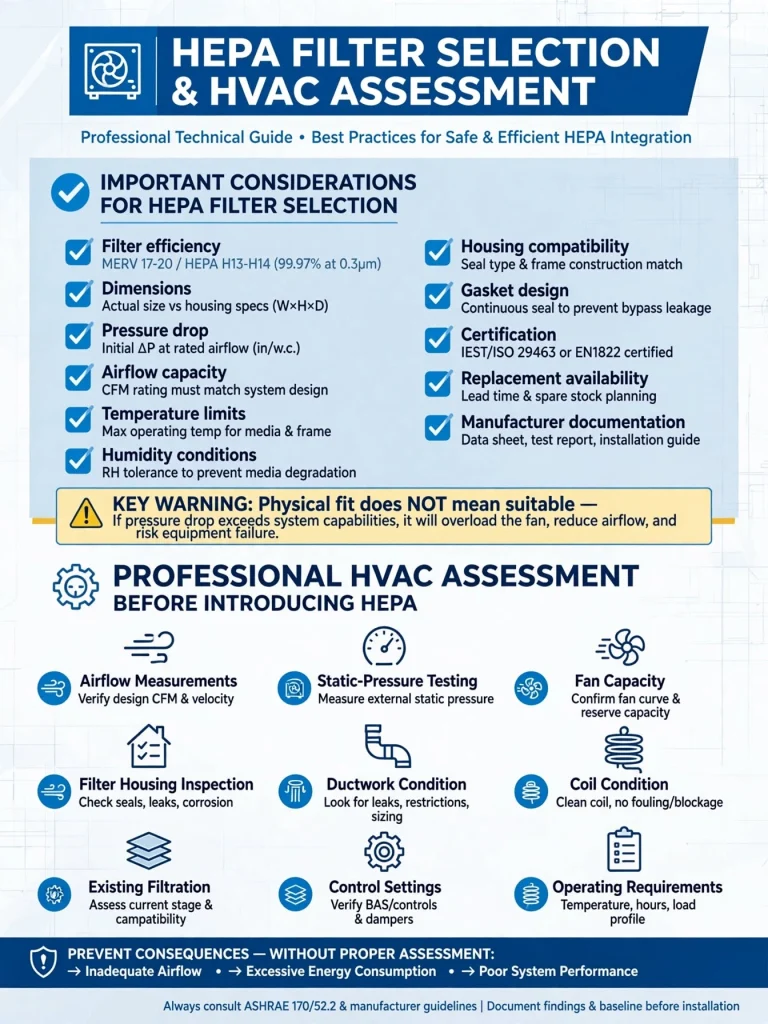
Choosing the Right HEPA Filter
Important considerations include:
Filter efficiency, dimensions, pressure drop, airflow capacity, temperature limits, humidity conditions, housing compatibility, gasket design, certification, replacement availability, and manufacturer documentation.
The filter should be compatible with the HVAC equipment.
A filter that physically fits inside the housing may still be unsuitable if its pressure drop exceeds the system’s capabilities.
Professional HVAC Assessment
Before introducing HEPA filtration into an existing HVAC system, a professional assessment can evaluate the complete system.
This may include:
Airflow measurements, static-pressure testing, fan capacity, filter housing inspection, ductwork condition, coil condition, existing filtration, control settings, and operating requirements.
The assessment can determine whether the system requires modifications.
This approach can prevent unintended consequences such as inadequate airflow, excessive energy consumption, or poor equipment performance.
The Role of HVAC Professional Services
Businesses and facility managers looking to improve filtration should consider working with an experienced provider offering HVAC Systems Professional Services.
Professional HVAC support can help evaluate equipment, filtration requirements, airflow, pressure drop, maintenance schedules, controls, and indoor environmental conditions.
An integrated approach ensures that filtration improvements work with the existing mechanical system rather than creating new operational problems.
Frequently Asked Questions About HEPA Filters
Are HEPA filters suitable for every HVAC system?
No. HEPA filters can create substantially higher pressure drops than standard filters. The HVAC fan, filter housing, airflow requirements, and system design should be evaluated before installation.
Do HEPA filters improve indoor air quality?
They can significantly reduce airborne particulate concentrations in air that passes through the filter. Overall indoor air quality also depends on ventilation, source control, humidity, cleaning, and HVAC maintenance.
Do HEPA filters remove dust?
HEPA filters can capture very small airborne particles, including many particles associated with dust. Larger dust particles are often better handled by pre-filters, which can also protect the HEPA filter from rapid loading.
How often should HEPA filters be replaced?
There is no universal replacement interval. Replacement should consider pressure drop, operating hours, particle loading, manufacturer recommendations, and the requirements of the specific facility.
Do HEPA filters remove odours?
Not primarily. HEPA filters target particulate matter. Activated carbon or other gas-phase filtration technologies may be required for specific odours and gaseous contaminants.
Can HEPA filtration reduce HVAC efficiency?
If a HEPA filter creates excessive pressure drop, fan energy consumption can increase and airflow can decrease. Proper system design and maintenance are therefore important.
Conclusion
HEPA filtration can provide significant benefits when high-efficiency particulate control is required. By capturing a very high proportion of small airborne particles under defined test conditions, HEPA filters can support indoor air quality strategies in healthcare, cleanrooms, laboratories, commercial buildings, educational facilities, hospitality environments, and specialised applications.
For UAE buildings, the technology can be particularly relevant where airborne dust and fine particulate control are important. However, the filter itself is only one part of an effective indoor environmental strategy.
The HVAC system must have sufficient fan capacity, appropriate filter housing, effective sealing, suitable airflow, and a practical maintenance plan. Pre-filtration, pressure-drop monitoring, smart controls, ventilation management, and regular HVAC servicing can further improve system performance.
The most effective solution is therefore not simply choosing the highest-efficiency filter available. It is selecting the right filtration level for the building, integrating it correctly with the HVAC system, monitoring performance, and maintaining the equipment throughout its operating life.