Air-cooled chillers are an important part of modern commercial and industrial cooling systems. They provide chilled water for air conditioning, process cooling, and temperature control without requiring a cooling tower or a continuous condenser-water circuit. This makes them a practical option for many buildings where space, water availability, installation complexity, or maintenance requirements need to be carefully considered.
In the UAE, chillers are particularly important because cooling demand remains high for much of the year. Commercial offices, hotels, shopping centres, healthcare facilities, educational buildings, warehouses, factories, data centres, and mixed-use developments all require dependable cooling solutions. Choosing between an air-cooled chiller and a water-cooled chiller depends on factors such as building size, cooling load, available space, ambient temperature, water consumption, energy efficiency, operating conditions, and lifecycle costs.
Understanding how air-cooled chillers work, where they are used, their advantages, limitations, and maintenance requirements can help property owners, facility managers, MEP consultants, and businesses make better HVAC decisions.
What Is an Air-Cooled Chiller?
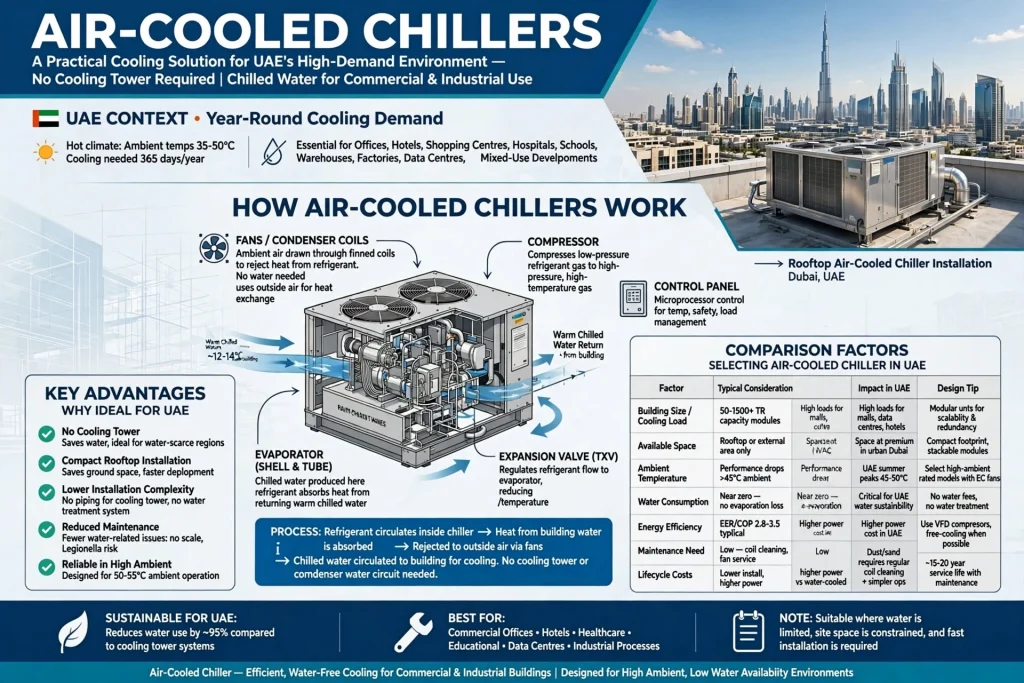
An air-cooled chiller is a refrigeration machine that removes heat from water or another chilled fluid and rejects that heat directly into the surrounding atmosphere.
Unlike a water-cooled chiller, which uses a cooling tower and condenser-water loop, an air-cooled system uses fans and air-cooled condenser coils to transfer heat to outdoor air.
A typical air-cooled chiller contains several important components:
Compressor, evaporator, condenser coil, condenser fans, expansion device, refrigerant circuit, chilled-water circuit, controls, sensors, and electrical components.
The chilled water produced by the evaporator can then circulate through the building to air handling units (AHUs), fan coil units (FCUs), chilled beams, process equipment, or other terminal systems.
How Does an Air-Cooled Chiller Work?
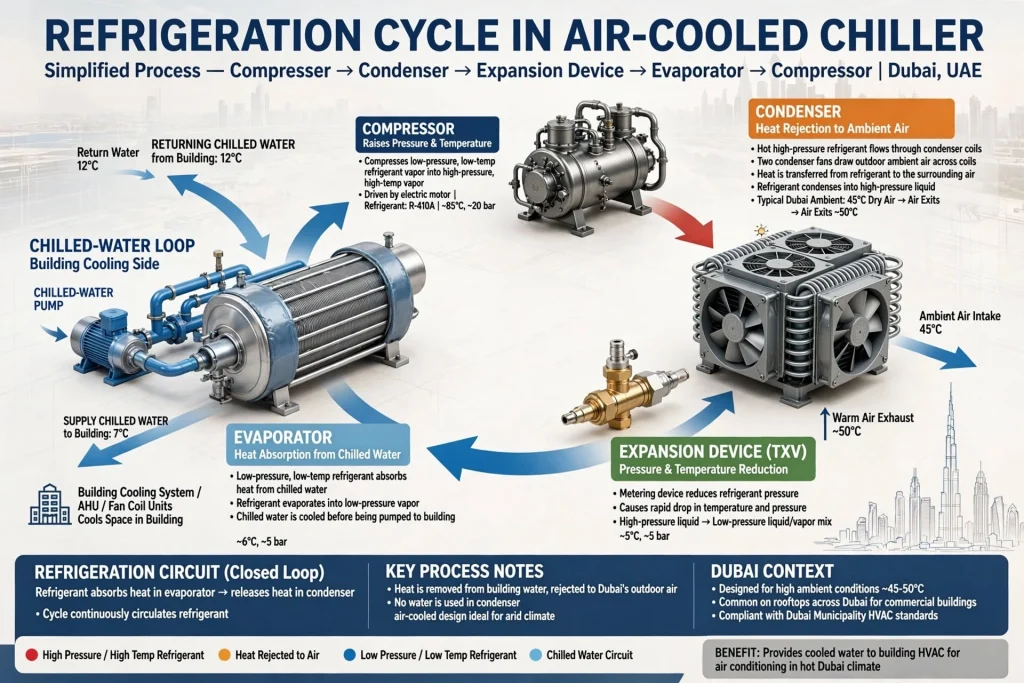
The refrigeration cycle begins when the compressor raises the pressure and temperature of the refrigerant.
The hot refrigerant then moves toward the condenser.
In an air-cooled chiller, condenser fans draw outdoor air across the condenser coils. Heat is transferred from the refrigerant to the surrounding air.
The refrigerant then passes through an expansion device, reducing its pressure and temperature.
Inside the evaporator, the colder refrigerant absorbs heat from the returning chilled water.
The cooled water is then pumped back into the building’s cooling system.
The simplified process is:
Compressor → Condenser → Expansion Device → Evaporator → Compressor
The chilled-water side operates alongside the refrigeration circuit to deliver cooling to the building.
Main Components of an Air-Cooled Chiller
Understanding the main components helps facility managers identify maintenance requirements.
Compressor
The compressor circulates refrigerant through the refrigeration circuit.
Depending on the chiller design and capacity, compressors may use technologies such as:
Scroll compressors, screw compressors, reciprocating compressors, or other configurations.
Compressor condition has a major influence on overall chiller performance.
Abnormal vibration, unusual noise, overheating, electrical problems, or changes in operating pressure can indicate a developing issue.
Air-Cooled Condenser
The condenser rejects heat from the refrigerant to outdoor air.
It normally consists of:
Condenser coils, fins, headers, refrigerant circuits, and condenser fans.
Because the condenser is exposed to outdoor conditions, dust and debris can accumulate on coil surfaces.
This is particularly relevant in dusty environments such as the UAE.
Condenser Fans
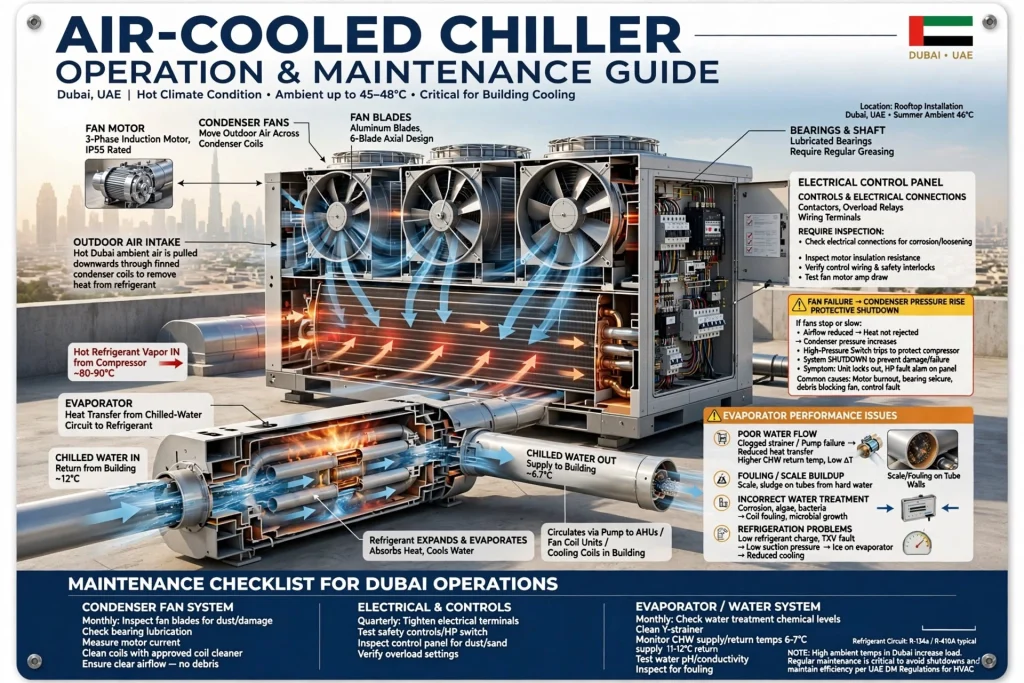
Condenser fans move outdoor air across the condenser coils.
Fan motors, blades, bearings, controls, and electrical connections require appropriate inspection.
A fan failure can cause condenser pressure to rise and may trigger a protective shutdown.
Evaporator
The evaporator transfers heat from the chilled-water circuit to the refrigerant.
The chilled water leaves the evaporator at the required supply temperature and circulates toward the building’s cooling equipment.
Poor water flow, fouling, incorrect water treatment, or refrigeration problems can affect evaporator performance.
Expansion Device
The expansion valve or other expansion device controls refrigerant flow into the evaporator.
Modern chillers may use electronic expansion valves that respond to system operating conditions.
Correct refrigerant control is important for stable and efficient operation.
Air-Cooled vs Water-Cooled Chillers
The biggest difference is how heat is rejected.
An air-cooled chiller rejects heat directly to outdoor air through condenser coils and fans.
A water-cooled chiller transfers heat into condenser water, which then carries the heat to a cooling tower.
This creates different operational requirements.
Water-cooled systems can achieve excellent efficiency under appropriate conditions but require cooling towers, condenser-water pumps, water treatment, and additional equipment.
Air-cooled systems generally have a simpler infrastructure because they do not require a cooling tower or condenser-water loop.
Why Air-Cooled Chillers Are Popular in the UAE
Air-cooled chillers can be attractive in UAE projects because they eliminate cooling-tower water consumption.
This can be beneficial for buildings where:
Water availability is limited, plant-room space is restricted, cooling-tower installation is undesirable, or a simpler HVAC infrastructure is preferred.
However, Dubai’s high outdoor temperatures can affect air-cooled chiller performance.
As ambient temperature rises, the condenser has to reject heat into hotter outdoor air.
This can increase condensing pressure and reduce efficiency.
Therefore, selecting a chiller designed for the local climate is extremely important.
Applications of Air-Cooled Chillers
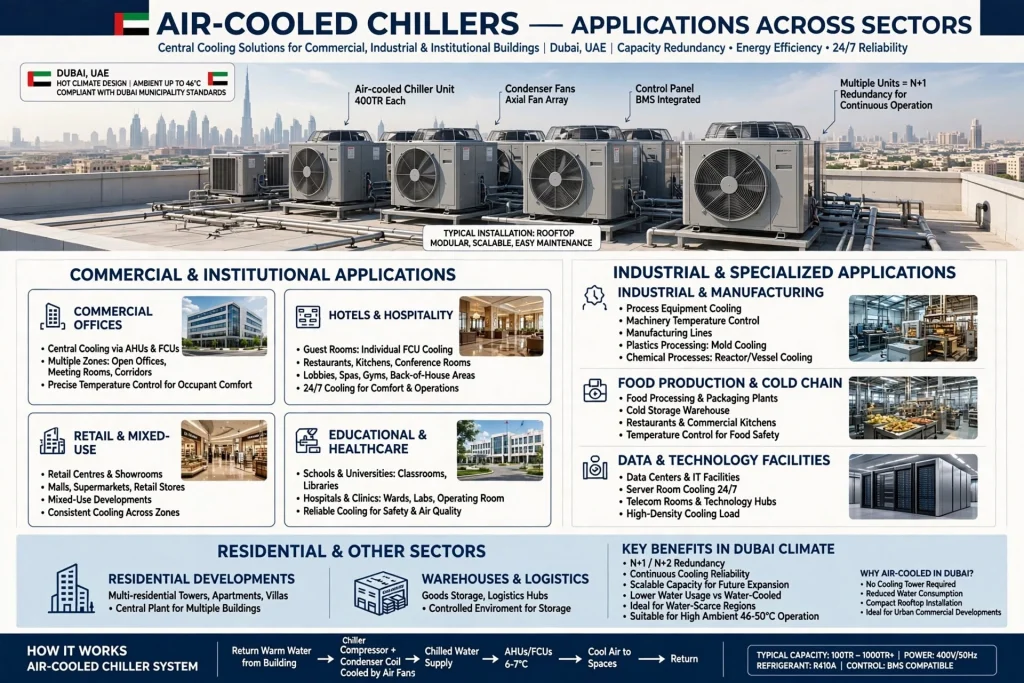
Air-cooled chillers can be used across many sectors.
Typical applications include:
Commercial offices
Hotels
Retail buildings
Schools
Healthcare facilities
Residential developments
Restaurants
Warehouses
Industrial facilities
Manufacturing plants
Process cooling
Data and technology facilities
The appropriate application depends on the required cooling capacity and operating conditions.
Air-Cooled Chillers for Commercial Buildings
Commercial buildings often require central cooling systems capable of serving multiple zones.
An air-cooled chiller can supply chilled water to AHUs and FCUs throughout a building.
This arrangement can be suitable for:
Office buildings, retail centres, showrooms, hotels, educational facilities, and mixed-use developments.
Multiple chillers can also be installed together to provide additional capacity and redundancy.
Air-Cooled Chillers for Hotels
Hotels require reliable cooling because guest comfort is directly related to room temperature and indoor environmental conditions.
A hotel may have cooling requirements across:
Guest rooms, restaurants, kitchens, conference rooms, lobbies, corridors, spas, gyms, offices, and back-of-house spaces.
Air-cooled chillers can provide chilled water to different HVAC zones through AHUs and FCUs.
Facility managers must account for changing occupancy and seasonal cooling loads.
Air-Cooled Chillers for Industrial Applications
Industrial facilities may require cooling for both comfort and manufacturing processes.
Applications can include:
Process equipment cooling, machinery temperature control, manufacturing lines, plastics processing, food production, chemical processes, and industrial HVAC.
Industrial applications can have very different temperature requirements from comfort air conditioning.
The chiller should therefore be selected according to the process load, required leaving-water temperature, operating hours, fluid requirements, and environmental conditions.
Air-Cooled Chillers for Data Centres
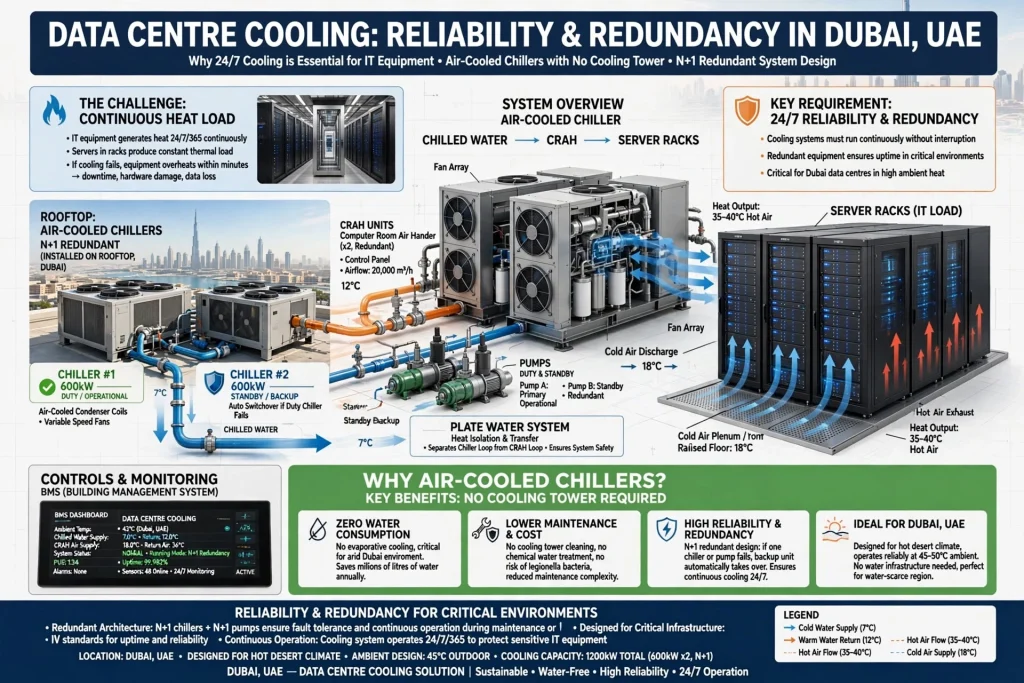
Data centres require highly reliable cooling because IT equipment generates continuous heat.
Cooling systems may need to operate around the clock.
Depending on the facility design, air-cooled chillers can be integrated with:
CRAH units, chilled-water systems, pumps, heat exchangers, controls, and redundant cooling equipment.
Reliability and redundancy are particularly important in critical environments.
Benefits of Air-Cooled Chillers
Air-cooled chillers provide several practical advantages.
No Cooling Tower
One of the biggest benefits is the absence of a cooling tower.
This eliminates the need for:
Cooling-tower fans, condenser-water pumps, cooling-tower basins, tower water treatment, and associated condenser-water piping.
This can simplify system architecture.
Lower Water Consumption
Air-cooled chillers do not require evaporative cooling-tower water.
This can reduce water consumption and eliminate many water-treatment requirements associated with condenser-water systems.
For water-conscious projects, this can be a significant consideration.
Simpler Installation
An air-cooled chiller generally requires fewer major components than a comparable water-cooled system.
The installation may therefore involve:
Chiller, chilled-water pumps, piping, controls, electrical supply, and terminal equipment.
The absence of a cooling tower can simplify plant layout.
Reduced Plant-Room Requirements
Water-cooled systems need space for cooling towers and condenser-water equipment.
Air-cooled systems can often be installed outdoors, subject to project design and manufacturer requirements.
This can free up valuable building space.
Easier Maintenance
Air-cooled chillers generally have fewer water-side components compared with water-cooled systems.
There is no condenser-water loop or cooling tower to maintain.
However, this does not mean air-cooled chillers are maintenance-free.
Condenser coils and fans require regular attention, particularly in dusty environments.
Limitations of Air-Cooled Chillers
Air-cooled chillers also have limitations.
Performance in High Ambient Temperatures
High outdoor temperatures can reduce air-cooled chiller efficiency.
This is particularly important in Dubai and other UAE locations.
Chiller selection should therefore consider:
Design ambient temperature, full-load performance, part-load efficiency, condenser design, controls, and manufacturer operating limits.
Outdoor Dust
Because the condenser coils are exposed to outdoor air, dust can accumulate on the coil surface.
Heavy contamination can reduce heat transfer and increase condensing pressure.
Regular inspection and appropriate coil cleaning are therefore important.
Potential Noise
Condenser fans and compressors can generate noise.
For installations near residential buildings, hotels, offices, or noise-sensitive areas, acoustic considerations should be included during system design.
Air-Cooled Chiller Efficiency
Chiller efficiency is influenced by multiple factors.
These include:
Outdoor temperature, chilled-water supply temperature, return-water temperature, part-load operation, condenser cleanliness, compressor efficiency, fan operation, water flow, controls, and system design.
Modern chillers can use variable-speed drives and sophisticated control strategies to adjust operation according to cooling demand.
Running a chiller at part load efficiently can be particularly valuable in buildings where demand changes throughout the day.
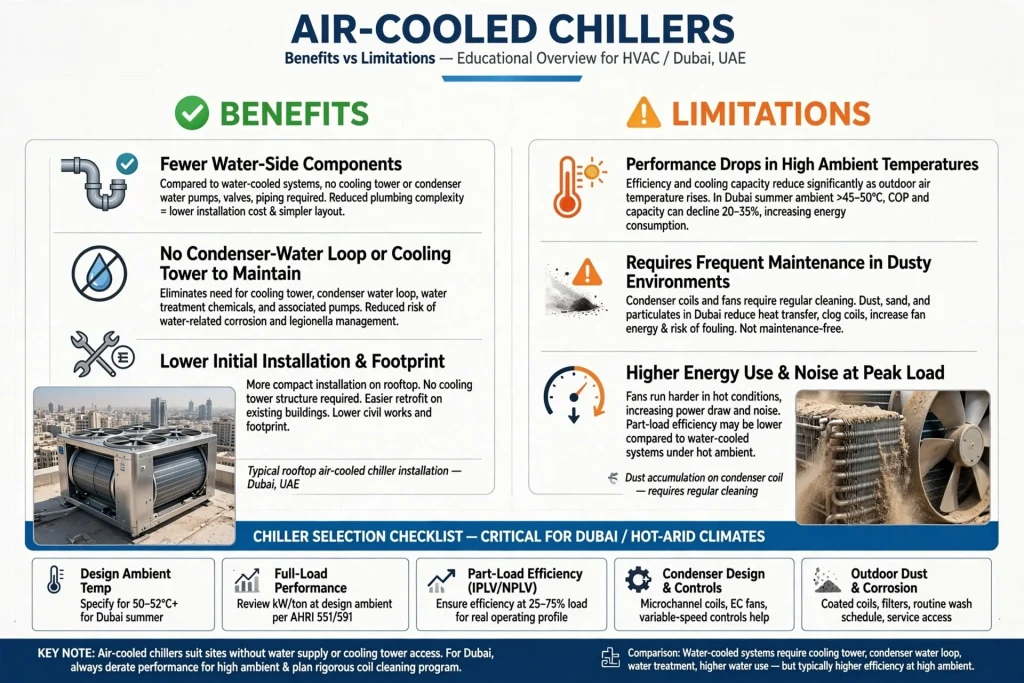
Variable-Speed Technology
Variable-speed compressors and condenser fans can adjust operating speed according to actual cooling requirements.
Instead of operating at full capacity continuously, the system can reduce output when the cooling load decreases.
This can improve part-load efficiency.
Variable-speed drives can also help reduce unnecessary fan and pump energy consumption when properly integrated into the system.
Importance of Correct Chiller Sizing
Oversizing and undersizing can both create problems.
An undersized chiller may struggle to meet peak cooling demand.
An oversized chiller may cycle inefficiently and operate outside its ideal range.
Chiller sizing should consider:
Building heat load, occupancy, solar gain, equipment loads, ventilation requirements, operating schedules, climate conditions, process loads, and future expansion.
A professional cooling-load calculation is preferable to selecting equipment based only on building floor area.
Maintenance Requirements for Air-Cooled Chillers
Preventive maintenance is essential for reliable operation.
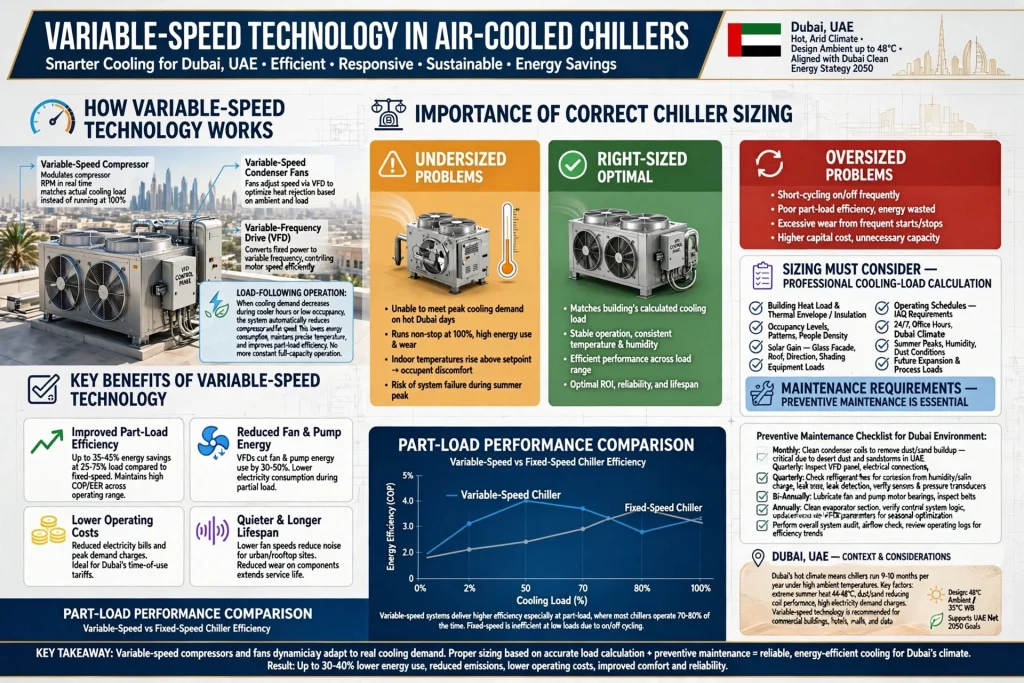
A maintenance program may include:
Condenser coil inspection
Condenser fan inspection
Compressor checks
Refrigerant circuit inspection
Electrical testing
Control-system checks
Chilled-water flow inspection
Filter and strainer inspection
Pump checks
Vibration monitoring
Temperature and pressure measurements
Leak inspection
The exact maintenance schedule should follow manufacturer recommendations and operating conditions.
Condenser Coil Cleaning
Condenser coils are particularly important in Dubai.
Dust and debris can restrict airflow and reduce heat-transfer efficiency.
Coil condition should be inspected regularly.
Cleaning methods should be appropriate for the coil design.
Excessive pressure or unsuitable cleaning chemicals can damage fins or coatings.
Professional technicians should use procedures suitable for the specific equipment.
Refrigerant Circuit Inspection
The refrigeration circuit should be monitored for abnormal pressure, temperature, superheat, subcooling, and other operating conditions according to the equipment design.
Refrigerant leaks should be investigated and repaired by qualified personnel.
Refrigerant handling should follow applicable environmental and safety requirements.
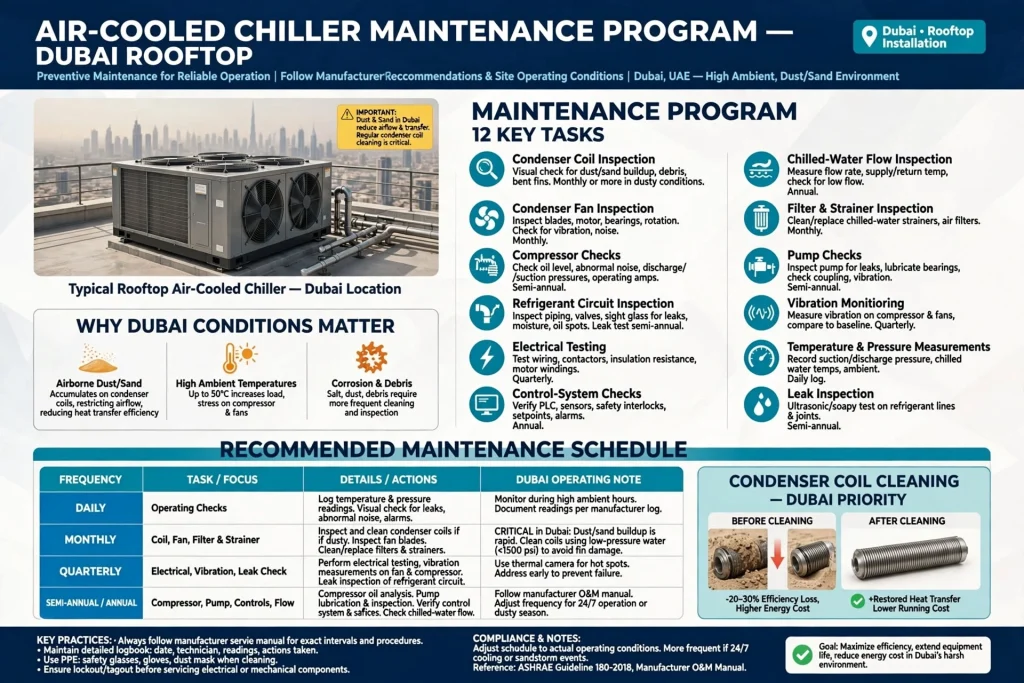
Compressor Maintenance
Compressors should be monitored for:
Abnormal noise, vibration, temperature, oil-related issues where applicable, electrical conditions, and operating pressures.
Early identification of compressor problems can help prevent major failures.
Electrical and Control-System Checks
Modern chillers depend heavily on electrical controls.
Maintenance can include inspection of:
Electrical terminals, contactors, protection devices, sensors, control boards, variable-frequency drives, communication systems, and safety controls.
A control fault can sometimes appear as a mechanical problem, which is why proper diagnostics are important.
Chilled-Water System Maintenance
Although the chiller itself is air-cooled, the chilled-water side still requires maintenance.
This may involve:
Pumps, valves, strainers, expansion tanks, piping, insulation, flow controls, water quality, and heat-transfer surfaces.
Poor chilled-water flow can reduce system capacity and affect chiller performance.
Water Treatment Still Matters
Air-cooled chillers eliminate the cooling tower, but they do not eliminate chilled-water quality considerations.
Closed-loop chilled-water systems can still experience:
Corrosion, scaling, biological growth, suspended solids, and other water-quality problems.
Appropriate water treatment and periodic testing can help protect system components.
Air-Cooled Chiller Commissioning
New chiller installations should be properly commissioned.
Commissioning can involve:
Equipment verification, flow checks, temperature measurements, control testing, safety-device checks, electrical verification, system balancing, and performance assessment.
The purpose is to confirm that the chiller operates according to its design intent.
Poor commissioning can result in operational problems that are difficult to diagnose later.
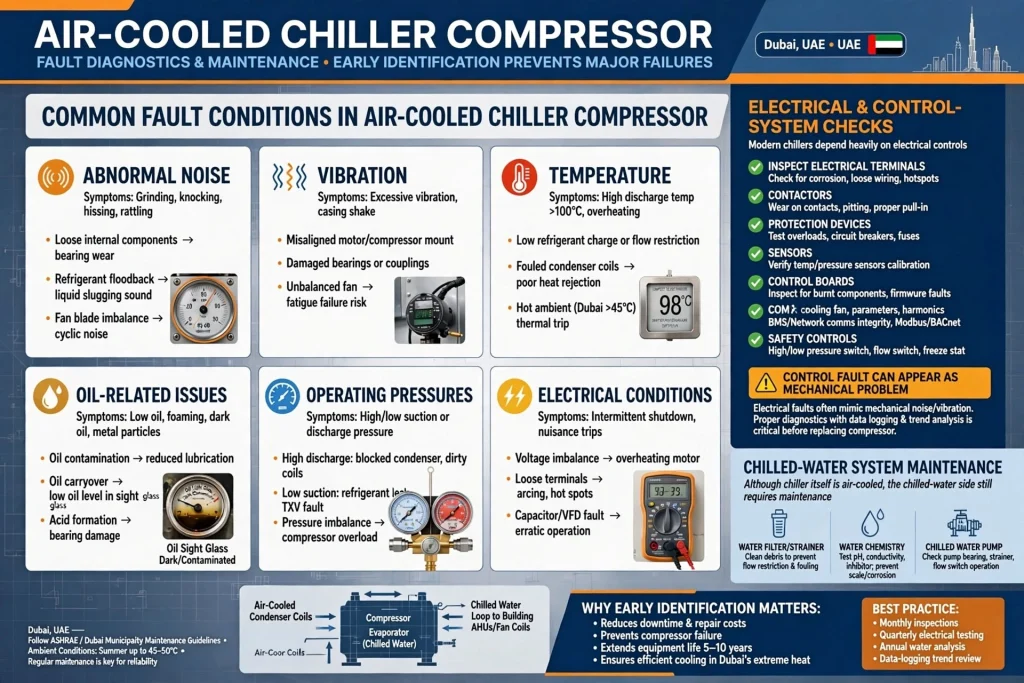
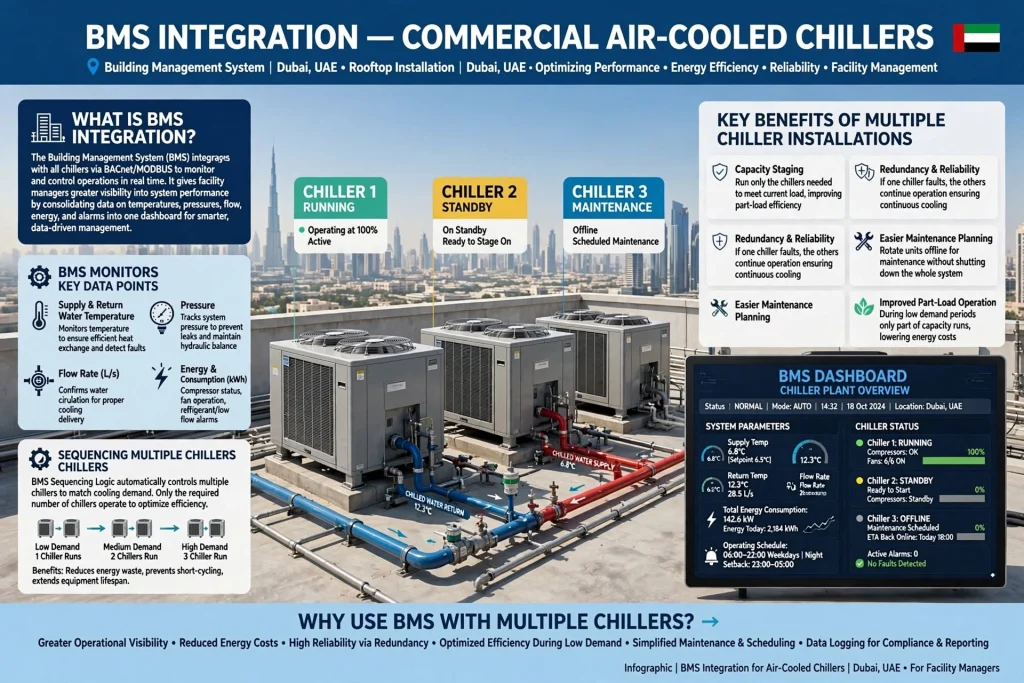
BMS Integration
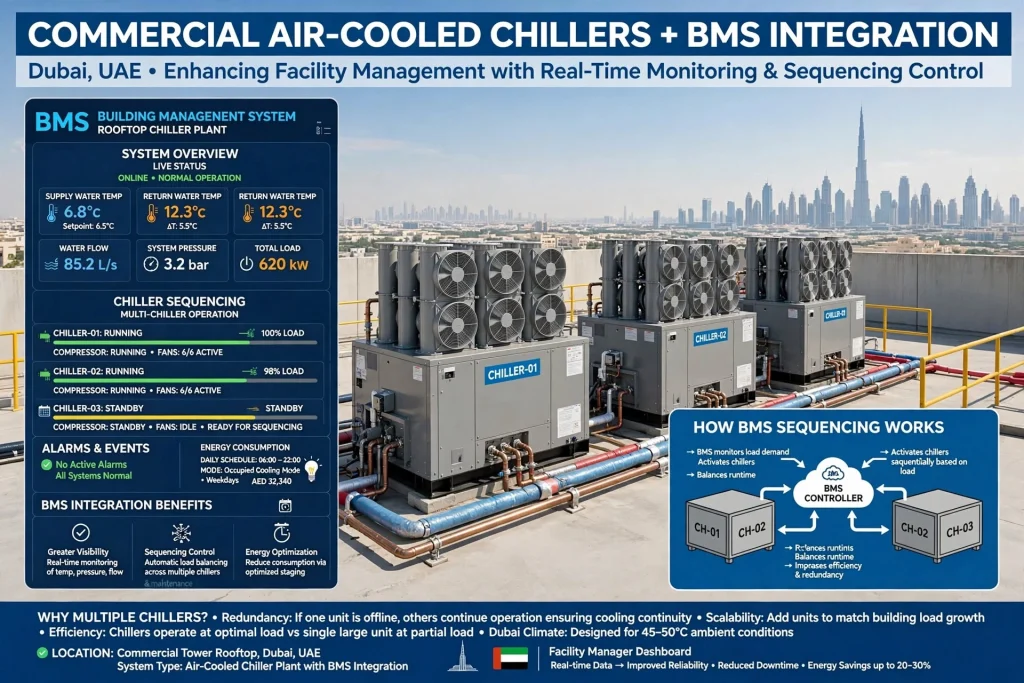
Commercial air-cooled chillers can be integrated with a Building Management System (BMS).
A BMS may monitor:
Supply and return water temperature, pressure, flow, compressor status, fan operation, alarms, energy consumption, and operating schedules.
This gives facility managers greater visibility into system performance.
BMS integration can also support sequencing when multiple chillers operate together.
Multiple Chiller Installations
Larger facilities may install several air-cooled chillers instead of relying on one large machine.
This can provide:
Capacity staging, redundancy, easier maintenance planning, and improved part-load operation.
For example, during periods of lower demand, only part of the installed chiller capacity may operate.
During peak conditions, additional units can start automatically.
Air-Cooled Chiller Maintenance in Dubai
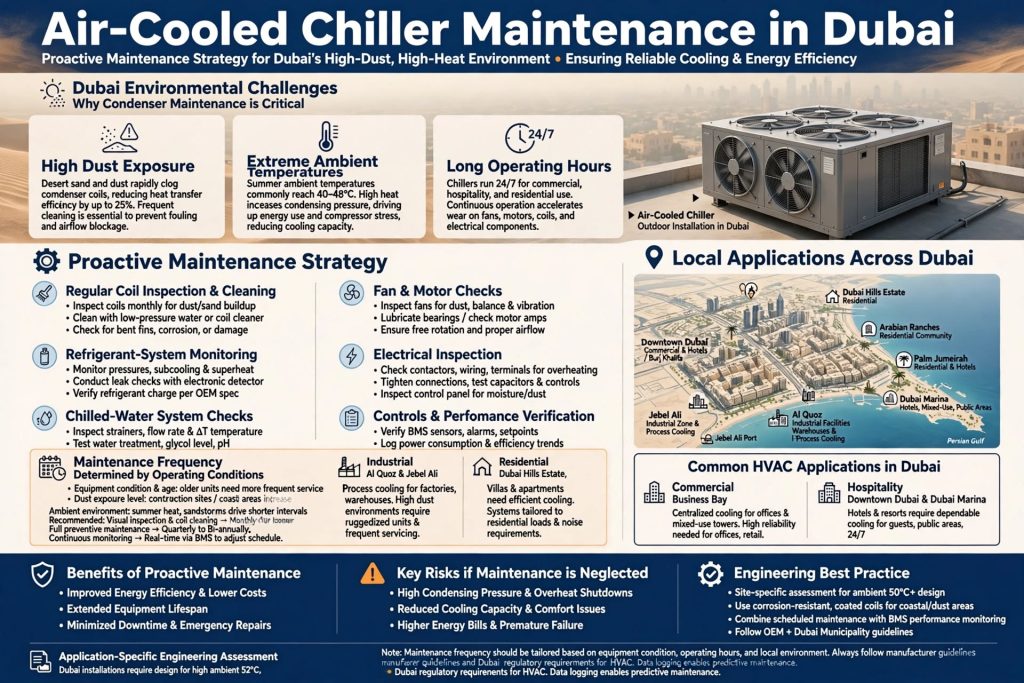
Dubai’s environment makes condenser maintenance particularly important.
Dust exposure, high ambient temperatures, long operating hours, and outdoor equipment installation can increase maintenance requirements.
A proactive maintenance strategy can include:
Regular coil inspection, fan checks, refrigerant-system monitoring, electrical inspection, chilled-water checks, control verification, and performance monitoring.
The actual frequency should be determined by the equipment condition and operating environment.
Local Applications Across Dubai
Air-cooled chillers can be found in many types of properties across Dubai.
Commercial developments in Business Bay may require centralized cooling for offices and mixed-use buildings.
Hotels around Downtown Dubai and Dubai Marina need dependable cooling for guest and public areas.
Industrial facilities in Al Quoz and Jebel Ali may require both comfort and process cooling.
Large residential developments in areas such as Dubai Hills Estate, Palm Jumeirah, and Arabian Ranches may use different HVAC configurations depending on the development.
Each project requires an application-specific engineering assessment.
Air-Cooled Chillers in Abu Dhabi and Sharjah
The same principles apply throughout the UAE.
In Abu Dhabi, commercial, hospitality, healthcare, and industrial developments require reliable cooling systems suited to local conditions.
Sharjah also contains a wide range of residential, commercial, educational, and industrial properties.
UAE-wide chiller selection should consider local ambient conditions, building use, maintenance access, available space, energy requirements, and project specifications.
How to Select an Air-Cooled Chiller
Before selecting a chiller, consider:
Required cooling capacity
Design ambient temperature
Chilled-water supply temperature
Return-water temperature
Part-load performance
Available installation space
Noise requirements
Electrical requirements
Refrigerant type
Maintenance access
BMS compatibility
Future capacity requirements
Manufacturer support
A lifecycle-cost approach is usually better than selecting equipment solely on initial purchase price.
Why Professional Chiller Expertise Matters
Chiller performance depends on more than the equipment itself.
System design, hydraulic configuration, controls, installation quality, commissioning, maintenance, and operating conditions all affect performance.
For UAE businesses looking for professional support, an experienced Air-Cooled Chillers Company can assist with chiller-related requirements such as system assessment, installation, servicing, maintenance, troubleshooting, and performance considerations, depending on project scope.
Air-Cooled Chiller Maintenance Checklist
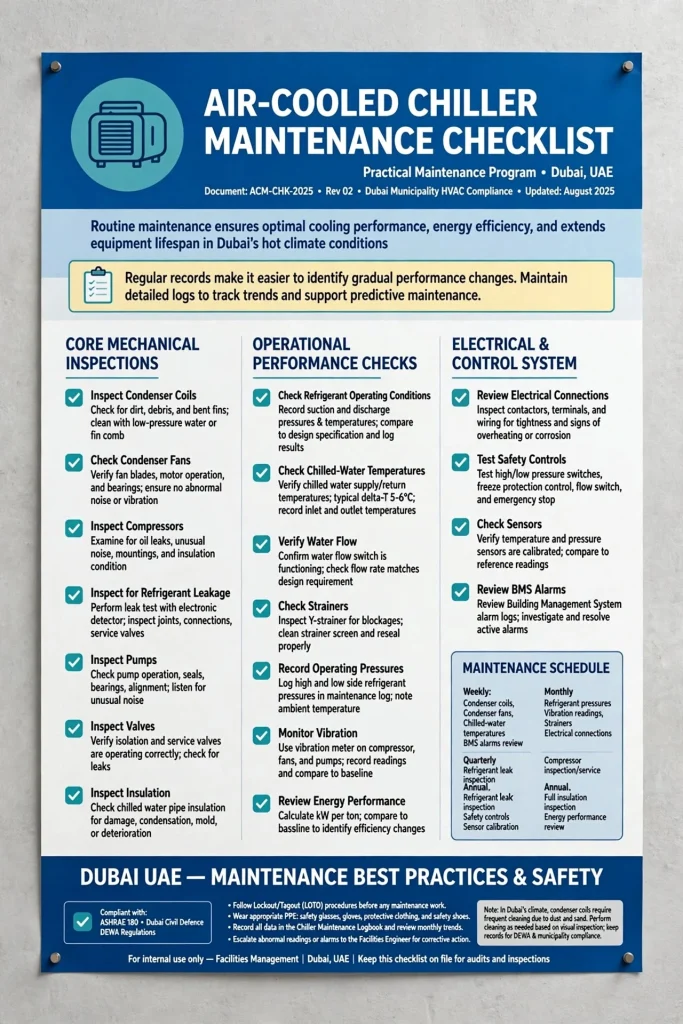
A practical maintenance program can include:
Inspect condenser coils
Check condenser fans
Inspect compressors
Check refrigerant operating conditions
Inspect for refrigerant leakage
Check chilled-water temperatures
Verify water flow
Inspect pumps
Check strainers
Inspect valves
Review electrical connections
Test safety controls
Check sensors
Review BMS alarms
Monitor vibration
Record operating pressures
Review energy performance
Inspect insulation
Regular records make it easier to identify gradual performance changes.
Final Thoughts
Air-cooled chillers provide an effective method of producing chilled water for commercial, residential, hospitality, healthcare, and industrial applications. Their biggest advantages include the absence of cooling towers, lower water consumption, relatively simple infrastructure, flexible installation options, and straightforward condenser-side maintenance.
However, they are not suitable for every project.
Dubai’s high ambient temperatures mean that air-cooled chiller performance can be strongly influenced by outdoor conditions. Condenser coil cleanliness, airflow, compressor operation, chilled-water flow, controls, and correct equipment sizing all contribute to reliable performance.
The best chiller solution should therefore be based on the actual building or process requirements rather than simply choosing a unit based on nominal capacity.
For UAE properties, a successful air-cooled chiller strategy combines proper load calculation, suitable equipment selection, professional installation, commissioning, BMS integration, preventive maintenance, condenser cleaning, chilled-water management, and performance monitoring.
When these elements are managed together, air-cooled chillers can provide dependable cooling while avoiding the cooling-tower infrastructure required by water-cooled systems. For facility managers and property owners in Dubai, understanding these operational factors can help improve HVAC reliability, control maintenance costs, and support efficient cooling throughout the demanding UAE climate.