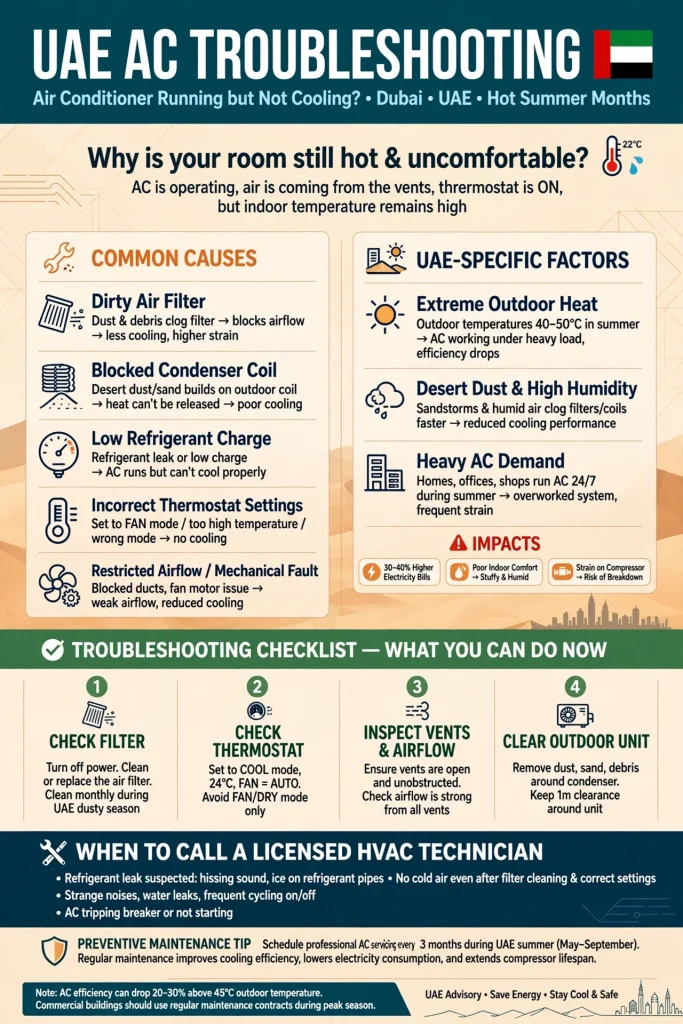
When an air conditioner is running but not cooling properly, it can make a Dubai home, office, shop, or commercial building uncomfortable, especially during the UAE’s hot summer months. You may hear the indoor unit operating, feel air coming from the vents, and notice that the thermostat is switched on, yet the room temperature remains high. This problem can result from a dirty air filter, blocked condenser coil, low refrigerant charge, incorrect thermostat settings, restricted airflow, or a more serious mechanical fault.
Dubai’s extreme outdoor temperatures, fine desert dust, high humidity, and heavy air-conditioning demand can place additional pressure on cooling equipment. Understanding why an AC is running without delivering sufficient cooling helps property owners identify simple problems, recognise warning signs, and arrange the right repair before the issue affects the entire building.
For residential and commercial properties, timely diagnosis is particularly important because an inefficient air-conditioning system can increase electricity consumption, affect indoor comfort, and put unnecessary strain on compressors and other components.
Why Is My AC Running but Not Cooling?
An air conditioner needs more than an operating fan to cool a room effectively. It must circulate sufficient indoor air, transfer heat through the evaporator and condenser coils, maintain the correct refrigerant conditions, and operate with suitable controls. If any part of this process is disrupted, the system may continue running without achieving the desired temperature.
In Dubai, one common reason is that the cooling system is working under a high heat load. Outdoor temperatures, direct sunlight through windows, poor insulation, crowded rooms, and heat-producing equipment can increase the amount of heat entering a building. However, extreme weather should not automatically be blamed for poor performance. A correctly designed and maintained system should still deliver appropriate cooling under its specified operating conditions.
Start by checking the thermostat setting, air filter, and visible airflow from the vents. If the AC continues running without cooling, produces unusual noises, leaks water, or repeatedly switches off, the problem may require professional inspection.
1. Dirty or Blocked AC Air Filters
A dirty air filter is one of the simplest problems to investigate when an air conditioner is running but not cooling. Dust, lint, and airborne particles accumulate on the filter over time, restricting the volume of air that can pass through the indoor unit.
When airflow decreases, the evaporator coil may not receive enough warm indoor air to transfer heat effectively. In some conditions, the coil can become excessively cold and develop ice. The system may continue operating, but cooling becomes weaker and energy consumption may increase.
Dubai properties can experience significant dust accumulation because of construction activity, open windows, outdoor air pollution, and sand carried by the wind. Apartments near busy roads and villas with frequent outdoor exposure may need closer attention to filter condition.
What to do: Switch off the AC before accessing the filter and follow the manufacturer’s instructions for cleaning or replacement. Washable filters should be cleaned and completely dried before reinstalling them. Disposable filters should be replaced with the specified type and size.
The required cleaning frequency depends on the equipment, filter type, indoor air quality, and operating hours. During periods of heavy use, checking filters every few weeks can help identify blockages early. If airflow remains weak after filter maintenance, inspect the system professionally rather than assuming the filter is the only cause.
2. Dirty Outdoor Condenser Coils
The outdoor condenser unit releases heat removed from the building into the surrounding air. If the condenser coil becomes covered with dust, debris, or other deposits, heat transfer can deteriorate. The compressor may then operate at higher pressure and temperature, reducing cooling performance or triggering protective shutdowns.
This is particularly relevant in Dubai, where outdoor equipment can be exposed to sand, construction dust, intense sunlight, and high ambient temperatures. Condenser units installed in poorly ventilated service areas may face additional difficulties because hot discharge air cannot escape efficiently.
Check whether the outdoor unit has an unobstructed area around it and whether leaves, packaging, or other objects are blocking the air intake or discharge. Do not dismantle the equipment or attempt to clean electrical components yourself.
Solution: Arrange professional condenser coil cleaning when dirt buildup is significant. A technician can also check fan operation, coil condition, refrigerant pressures, and signs of overheating. Cleaning should be performed using methods appropriate for the coil material and manufacturer recommendations to avoid damaging delicate fins.
Routine outdoor-unit maintenance helps the AC reject heat more effectively, particularly during periods when cooling demand remains high throughout the day.
3. Low Refrigerant or a Refrigerant Leak
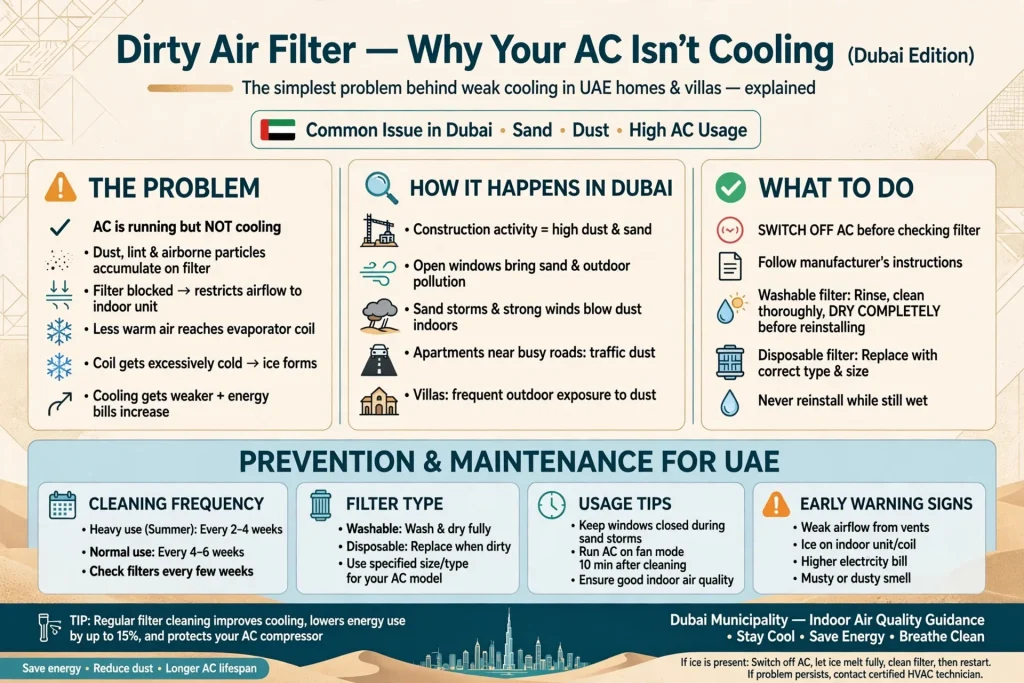
Refrigerant carries heat between the indoor evaporator coil and the outdoor condenser coil. If the refrigerant charge is below the required level, the system may struggle to absorb sufficient heat, resulting in weak cooling, longer operating cycles, or ice formation on the evaporator.
Low refrigerant is often associated with a leak rather than ordinary consumption. In a properly sealed air-conditioning system, refrigerant should not need routine topping up simply because the AC has been operating for several months.
Possible warning signs include reduced cooling, hissing sounds near refrigerant lines, oily residue around connections, and ice on the indoor coil or refrigerant pipework. However, these symptoms can also occur because of airflow restrictions or other faults, so they do not independently confirm a refrigerant leak.
Solution: A qualified HVAC technician should identify the cause, repair the leak where present, and charge the system according to the manufacturer’s specifications. The technician may use suitable leak-detection methods and verify operating conditions after the repair.
Adding refrigerant without investigating the underlying problem can lead to repeated failures, unnecessary costs, and environmental harm. Refrigerant handling should be carried out by appropriately qualified personnel using the correct equipment and procedures.
4. Incorrect Thermostat Settings or a Faulty Temperature Sensor
Sometimes the air conditioner is functioning, but the control system is not requesting the cooling required by the room. The thermostat may be set to Fan mode instead of Cool mode, the temperature setting may be too high, or the fan may be operating continuously without active refrigeration.
A faulty temperature sensor can also send inaccurate readings to the controller. For example, if a sensor detects a lower temperature than the room actually has, the system may reduce cooling prematurely. In other cases, poor thermostat placement near direct sunlight, warm appliances, or supply-air vents can distort temperature readings.
What to check: Confirm that the operating mode is set to Cool, the target temperature is below the current room temperature, and the fan setting is appropriate. Check whether the controller displays an error code or warning.
If the room remains warm despite correct settings, the thermostat, room sensor, control board, or communication wiring may need inspection. Commercial buildings with building management systems (BMS) may also experience control issues caused by incorrect schedules, sensor faults, or automation settings.
5. Frozen Evaporator Coils
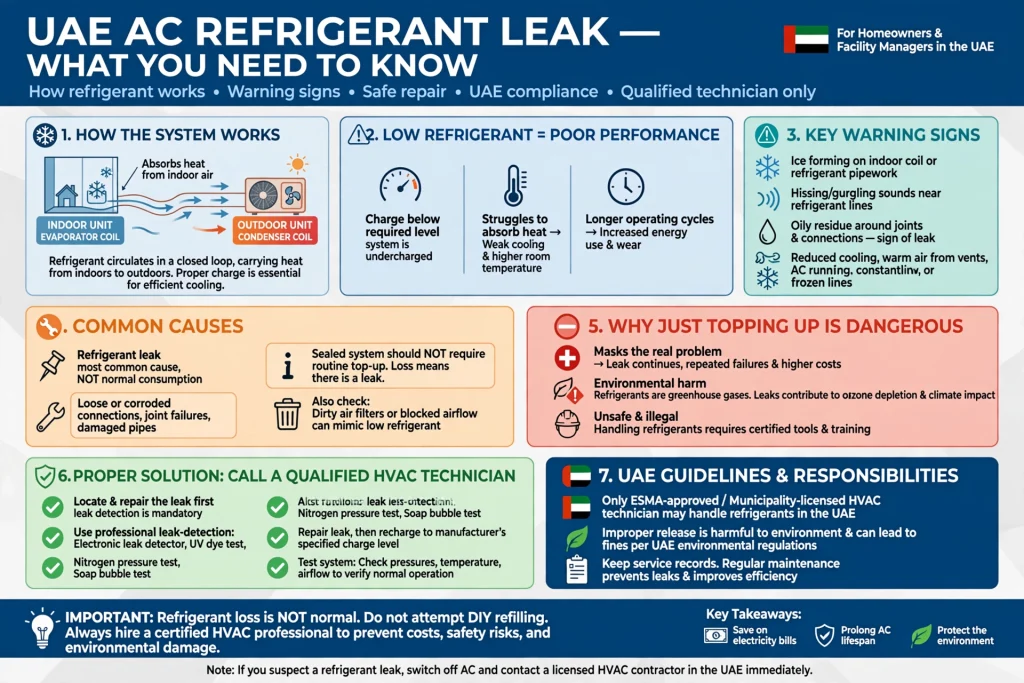
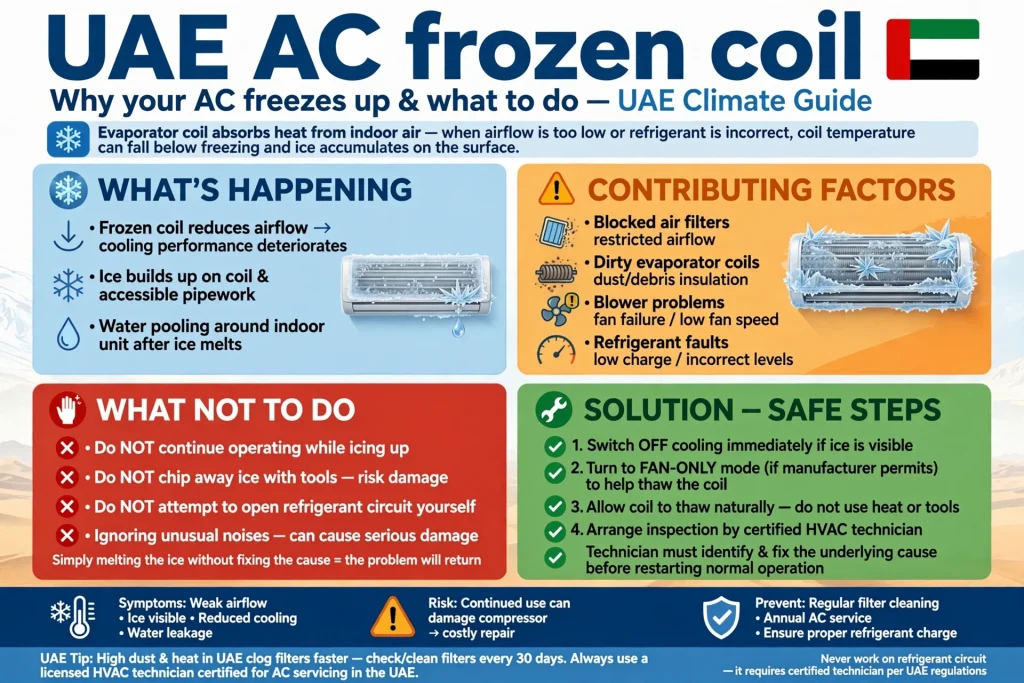
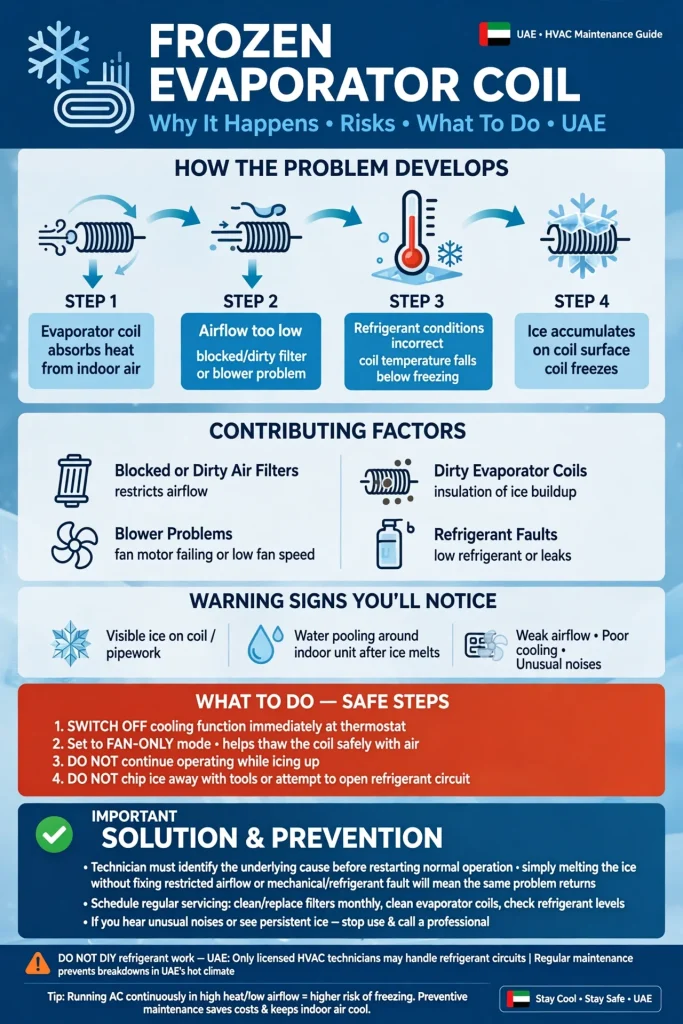
An evaporator coil absorbs heat from indoor air. When airflow is too low or refrigerant conditions are incorrect, the coil temperature can fall below freezing and ice may accumulate on its surface.
A frozen coil reduces airflow further, creating a cycle in which cooling performance deteriorates while the system continues running. You may notice weak airflow, visible ice on accessible pipework, or water around the indoor unit after the ice melts.
Common contributing factors include blocked filters, dirty evaporator coils, blower problems, and refrigerant-related faults.
Solution: Switch off the cooling function if ice is visible and arrange an inspection. If the manufacturer permits it, the fan-only mode may help thaw the coil, but do not continue operating a system that is icing up or producing unusual noises. Never chip ice away with tools or attempt to open the refrigerant circuit.
Once the coil has thawed, a technician should identify the underlying cause before restarting normal operation. Simply melting the ice without addressing restricted airflow or a mechanical fault can lead to the same problem returning.
6. Faulty Compressor or Outdoor Fan Motor
The compressor is central to the refrigeration cycle. It circulates refrigerant through the system so that heat can be transferred between the indoor and outdoor coils. If the compressor fails, overheats, or cannot operate correctly, the indoor fan may still blow air even though little or no cooling is produced.
A defective outdoor fan motor can also reduce heat rejection. In this situation, the compressor may overheat or operate under abnormal pressure conditions, potentially activating protective controls.
Warning signs may include clicking sounds, unusual vibration, a humming outdoor unit, repeated breaker trips, or an indoor fan that runs while the outdoor equipment remains inactive. These symptoms are not conclusive and should be assessed by a qualified technician.
Solution: Professional diagnosis may include checking electrical supply, capacitors where fitted, contactors, motor operation, compressor current, control signals, and safety devices. Electrical work should not be attempted while the unit is energised.
For older commercial systems, the technician should compare the cost of compressor repair or replacement with the condition and expected remaining service life of the entire unit.
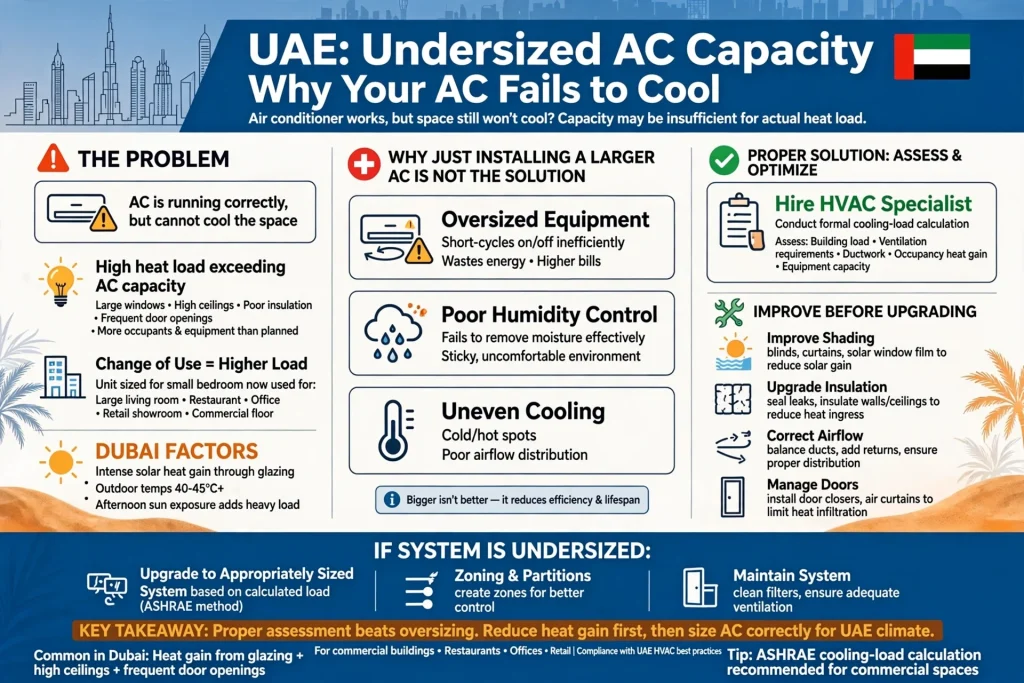
7. AC Capacity Is Too Small for the Room or Building
An air conditioner may be functioning correctly but still fail to cool a space because its capacity is insufficient for the actual heat load. This can happen when a room has large windows, high ceilings, significant afternoon sun exposure, poor insulation, frequent door openings, or more occupants and equipment than originally anticipated.
A unit selected for a small bedroom may not be appropriate for a large living room, restaurant, office, retail showroom, or commercial floor. Similarly, adding partitions or changing the use of a space can affect the cooling load even if the original system previously worked well.
In Dubai, solar heat gain through glazing and high outdoor temperatures can be significant design considerations. However, simply installing a larger AC is not always the correct solution. Oversized equipment can cycle inefficiently, create uneven temperature distribution, and fail to manage humidity effectively under certain conditions.
Solution: An HVAC specialist should assess the building’s cooling load, equipment capacity, ventilation requirements, ductwork, occupancy, and heat gain. For commercial buildings, this may require a formal cooling-load calculation and an assessment of the existing HVAC design.
If the system is undersized, options may include improving shading, reducing unwanted heat gain, correcting airflow distribution, or upgrading the equipment to an appropriately sized system.
8. Blocked or Leaking AC Ductwork
Ducted split AC systems and central air-conditioning systems rely on properly designed ductwork to distribute cooled air throughout a building. If ducts are obstructed, damaged, poorly insulated, or leaking, some rooms may receive insufficient airflow while others remain comfortable.
A disconnected duct can release cooled air into a ceiling void instead of the occupied room. Leaking supply ducts can also increase energy consumption, while blocked return-air paths may reduce the amount of air circulating through the cooling equipment.
These problems can occur in Dubai villas, offices, retail spaces, hotels, and commercial towers, particularly where ceiling modifications or building renovations have affected existing services.
Solution: A professional HVAC inspection can identify airflow restrictions, disconnected sections, damaged insulation, and leakage. Depending on the findings, the technician may recommend duct repairs, sealing, insulation replacement, balancing, or cleaning where contamination is present.
If one room remains warm while other rooms cool normally, duct distribution, balancing dampers, return-air pathways, and room-level controls deserve particular attention.
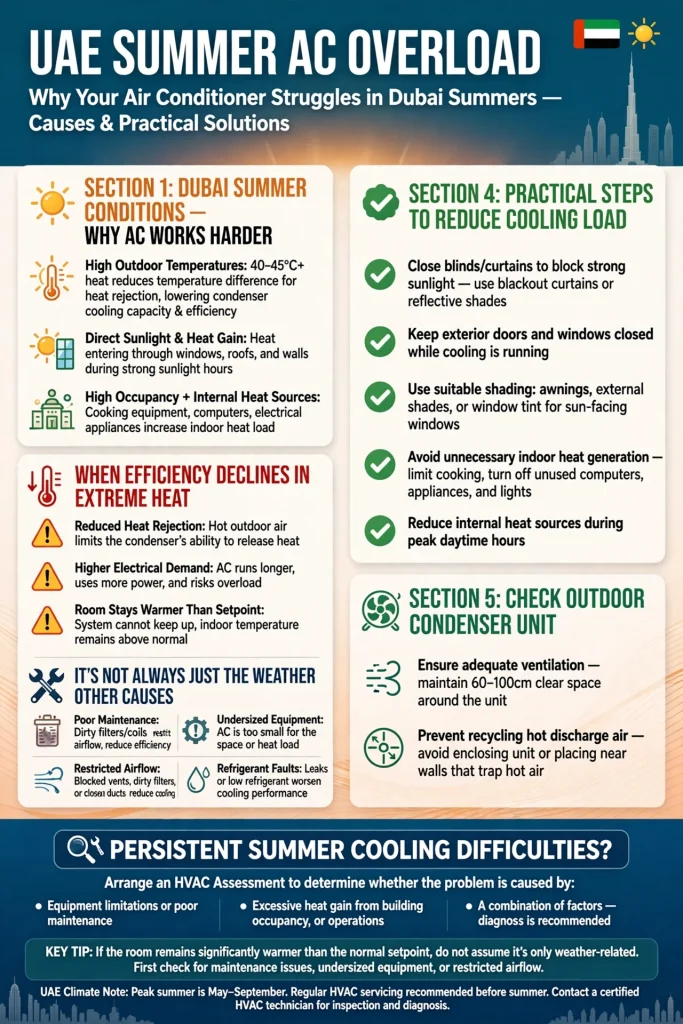
9. High Outdoor Temperatures and Excessive Indoor Heat Gain
Dubai’s summer conditions can make an air conditioner work much harder than it would during milder weather. Direct sunlight, heat entering through windows and roofs, high occupancy, cooking equipment, computers, and other electrical appliances can all increase the cooling load.
High outdoor temperatures also reduce the temperature difference available for heat rejection at the condenser. Depending on the equipment’s design and rated operating limits, cooling capacity and efficiency may decline under extreme conditions.
However, a room that remains significantly warmer than its normal setpoint should not automatically be considered a weather-related problem. Poor maintenance, undersized equipment, restricted airflow, and refrigerant faults can make the effects of hot weather considerably worse.
Practical steps: Close blinds or curtains during periods of strong sunlight, keep exterior doors and windows closed while cooling, use suitable shading, and avoid unnecessary indoor heat generation. Confirm that outdoor condenser units have adequate ventilation and are not recycling their own hot discharge air.
For buildings with persistent summer cooling difficulties, an HVAC assessment can determine whether the problem is caused by equipment limitations, excessive heat gain, or a combination of factors.
10. Poor AC Maintenance and Incorrect System Settings
Air-conditioning systems require periodic inspection to maintain reliable performance. Without suitable maintenance, filters and coils become dirty, condensate drains may clog, electrical connections can deteriorate, and components may develop faults that remain unnoticed until cooling performance declines.
Commercial buildings may also suffer from incorrect operating schedules, disabled equipment, faulty temperature sensors, or poorly configured BMS controls. A system that switches off too early or operates outside its intended schedule can leave occupied spaces uncomfortable even when the mechanical equipment is in reasonable condition.
Preventive maintenance should be based on manufacturer recommendations, equipment condition, operating hours, site conditions, and the criticality of the cooling system.
A suitable inspection may cover filters, evaporator and condenser coils, fan motors, refrigerant circuit performance, electrical components, condensate drainage, thermostat accuracy, safety controls, and airflow. Chilled-water systems may also require checks of water flow, control valves, strainers, and differential pressure.
For commercial properties, documented inspections and maintenance records help facility managers identify recurring issues and plan repairs before peak cooling demand.
How to Troubleshoot an AC That Is Not Cooling
Before arranging a service visit, property owners can perform a few basic checks without opening the equipment or handling electrical and refrigerant components.
First, verify that the thermostat is set to Cool and that the target temperature is below the actual room temperature. Check whether the controller displays an error code or indicates that the system is in Fan mode.
Next, inspect the accessible air filter and clean or replace it according to the manufacturer’s instructions. Check whether supply vents are open and whether furniture, curtains, or stored items are blocking airflow.
Observe the system for warning signs. Ice, unusual vibration, a burning smell, repeated electrical trips, or water leaking from the indoor unit may indicate a fault that requires professional attention. If the equipment appears to be overheating or presents an electrical hazard, switch it off if safe to do so and arrange an inspection.
If these basic checks do not restore cooling, avoid repeatedly restarting the unit or attempting repairs. A technician can test the refrigeration circuit, electrical components, airflow, controls, and overall operating performance.
When Should You Call an HVAC Technician in Dubai?
Professional assistance is appropriate when the AC continues running without sufficient cooling after basic checks, when airflow remains weak, or when the system repeatedly freezes, trips its electrical protection, or produces unusual sounds.
A service visit is also advisable when a refrigerant leak is suspected, the compressor or outdoor fan is not operating correctly, or several rooms experience uneven cooling. Commercial buildings may need a more detailed investigation if cooling problems affect multiple zones or coincide with BMS alarms.
When selecting a service provider, look for relevant experience with your specific equipment, including ducted split units, package units, VRF/VRV systems, air-cooled chillers, or water-cooled chillers, as applicable. Ask for a clear diagnosis, the proposed repair, and an explanation of any replacement parts or refrigerant work.
For property managers, hotels, offices, retail units, and other commercial facilities, an experienced Professional hvac Solution Supplier can help assess cooling problems, identify maintenance requirements, and recommend suitable HVAC repair or system optimisation work.
The correct solution depends on the actual fault. Replacing components without testing the system can lead to unnecessary expenses and may not resolve the original cause of poor cooling.
AC Not Cooling in Different Dubai Property Types
Dubai Apartments
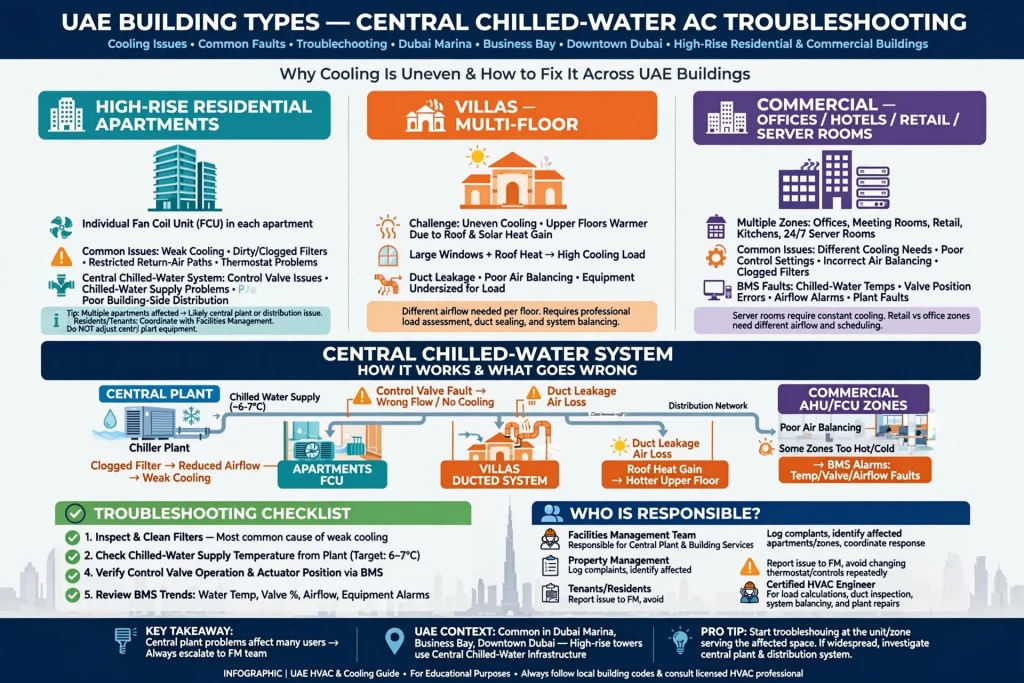
In apartments, weak cooling may be caused by dirty filters, restricted return-air paths, thermostat issues, or problems with the individual indoor unit. Where the property uses a central chilled-water system, the fault may also involve a control valve, fan coil unit, or building-side chilled-water supply.
If several apartments experience cooling problems at the same time, the building’s central plant or distribution system may require investigation through the property management team.
Dubai Villas
Villas can experience uneven cooling because of multiple floors, large windows, roof heat gain, duct leakage, poor balancing, or equipment that does not match the building’s cooling load. Upper floors may become warmer because they receive more solar heat through the roof and may have different airflow requirements.
A professional inspection should consider the entire system rather than focusing only on the room that feels warm.
Offices, Hotels, and Commercial Buildings
Commercial properties often operate air-conditioning systems for extended periods and may have different cooling requirements across offices, meeting rooms, retail areas, kitchens, and server rooms. Poor control settings, incorrect air balancing, clogged filters, or central plant faults can affect several occupied areas.
In these environments, checking BMS trends, chilled-water temperatures, valve positions, airflow, and equipment alarms can help identify whether the problem is isolated or affects the wider HVAC system.
Dubai Marina, Business Bay, and Downtown Dubai
High-rise residential and commercial buildings in areas such as Dubai Marina, Business Bay, and Downtown Dubai may use a mixture of ducted systems, fan coil units, and central chilled-water infrastructure. The appropriate troubleshooting approach depends on the building’s design and the equipment serving the affected space.
Where a fault appears to originate in shared plant or building services, residents and tenants should coordinate with the facilities management team instead of attempting to adjust central equipment themselves.
How to Prevent AC Cooling Problems During Dubai’s Summer
The best way to reduce unexpected cooling problems is to identify deterioration before it affects the system’s ability to meet the building’s cooling load. Maintenance should be scheduled according to the manufacturer’s recommendations and adjusted to reflect actual operating conditions.
Filters should be inspected regularly, coils should be kept clean, and condensate drains should be checked for blockages. Technicians should verify refrigerant performance, electrical connections, fan operation, safety controls, and thermostat accuracy during appropriate maintenance visits.
Outdoor condenser units need sufficient ventilation and protection from avoidable obstructions. Ducted systems should be inspected for leakage, insulation damage, and airflow imbalance where performance problems are suspected.
Property owners can also reduce heat entering the building by using suitable window shading, maintaining door seals, and improving insulation where appropriate. These measures help reduce unnecessary cooling demand but cannot compensate for major equipment faults.
For commercial facilities, preventive maintenance agreements can help organise inspections, document recurring problems, and plan repairs. A useful maintenance plan should clearly define the equipment covered, inspection frequency, emergency response arrangements, reporting requirements, and exclusions.
Frequently Asked Questions
Why is my AC blowing air but not cooling in Dubai?
The system may have a dirty filter, blocked condenser coil, refrigerant leak, frozen evaporator, faulty compressor, or incorrect thermostat setting. High outdoor temperatures and excessive heat gain can also contribute. Begin with safe basic checks and arrange professional diagnosis if the problem continues.
Why does my AC take so long to cool a room in Dubai?
Possible causes include an undersized AC, dirty coils, weak airflow, leaking ducts, poor insulation, direct sunlight, or a high indoor heat load. A technician can measure system performance and determine whether maintenance, airflow correction, or a capacity assessment is required.
Should I turn off my AC if it is running but not cooling?
If the system is icing up, repeatedly tripping, leaking significantly, producing a burning smell, or making unusual mechanical noises, switch it off if safe to do so and arrange professional inspection. Continuing to operate a faulty unit can worsen some problems.
Can a dirty AC filter increase electricity consumption?
Yes. A heavily restricted filter can reduce airflow and force the system to operate inefficiently. In some cases, the evaporator may freeze, further reducing cooling. Regular filter inspection helps maintain appropriate airflow.
How often should AC maintenance be performed in Dubai?
The appropriate frequency depends on the equipment, operating hours, environment, and manufacturer’s instructions. Systems operating continuously in dusty or high-demand conditions may require more frequent filter checks and inspections than lightly used residential units. Commercial systems should follow a documented maintenance plan.
Does low refrigerant mean my AC needs replacement?
Not necessarily. Low refrigerant may indicate a repairable leak, but the cause must be identified. A qualified technician can assess the condition of the equipment, repair the fault where possible, and determine whether further repairs are economically sensible.
Why is one room cold while another room remains hot?
Uneven cooling can result from duct leakage, airflow imbalance, blocked vents, faulty dampers, room sensors, insulation differences, or excessive heat gain. The cause should be assessed across the affected rooms and their associated HVAC components.
Can a BMS cause an AC system to stop cooling properly?
Yes. Incorrect schedules, faulty sensors, control communication problems, or inappropriate temperature setpoints can prevent an otherwise functional system from delivering the required cooling. A technician familiar with building automation can investigate controller settings and system data.
Conclusion
An air conditioner that runs without cooling properly can have several causes, ranging from a dirty air filter to a refrigerant leak, frozen evaporator coil, faulty compressor, blocked ductwork, or an undersized system. Dubai’s extreme summer temperatures and dusty outdoor conditions can increase cooling demand, but persistent poor performance should always be investigated rather than dismissed as normal.
Start with safe checks of the thermostat, filter, and visible airflow. If cooling does not improve or the system shows signs of a fault, arrange a professional inspection to identify the actual cause before replacing parts or adding refrigerant.
For Dubai apartments, villas, offices, hotels, and commercial buildings, regular maintenance, correct system design, effective airflow, and properly configured controls are essential for dependable cooling. Addressing problems early can improve comfort, reduce avoidable energy use, and help protect important HVAC components during the UAE’s hottest months.