The filtration system is one of the most important components of any HVAC system because it acts as the building’s first line of defense against airborne contaminants. Every day, large volumes of air circulate through offices, hotels, hospitals, schools, shopping malls, residential towers, pharmaceutical facilities, and industrial buildings. Without effective filtration, this air can carry dust, pollen, mold spores, bacteria, volatile organic compounds (VOCs), smoke particles, fibers, and other microscopic pollutants that negatively affect Indoor Air Quality (IAQ).
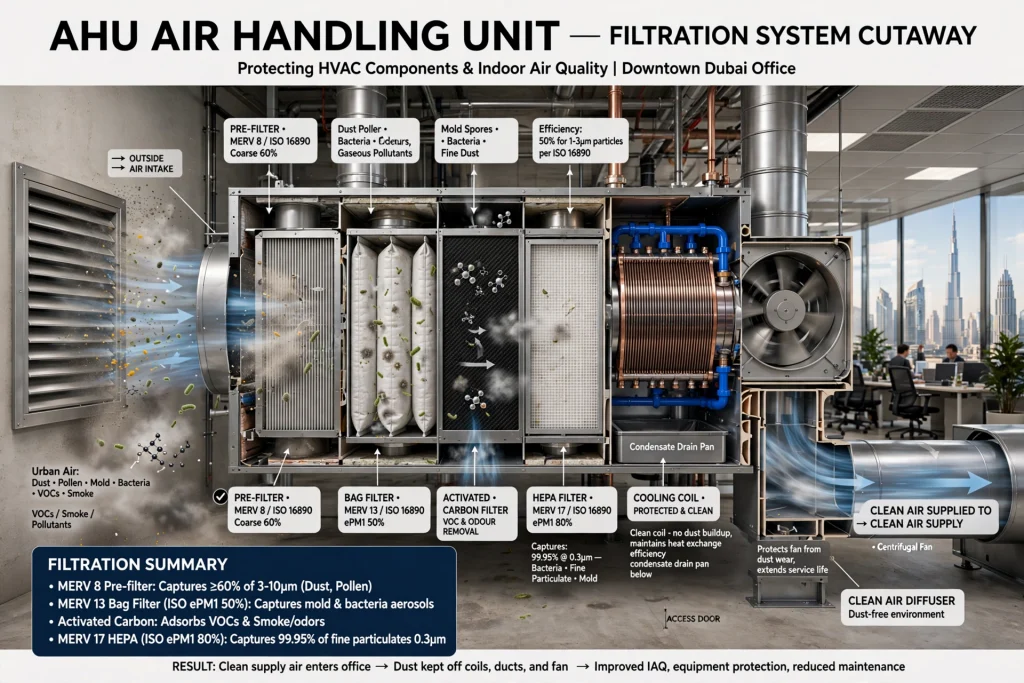
As air passes through an Air Handling Unit (AHU) or Fan Coil Unit (FCU), it moves through carefully selected filters designed to capture contaminants before the conditioned air returns to occupied spaces. Filter efficiency is measured using internationally recognized standards such as MERV (Minimum Efficiency Reporting Value) and ISO 16890, which classify filters based on their ability to remove particles of different sizes.
For commercial office buildings in Downtown Dubai, Dubai Marina, Business Bay, Palm Jumeirah, DIFC, Abu Dhabi, and Sharjah, selecting the correct filtration system is essential because outdoor air often contains construction dust, desert sand, vehicle emissions, and fine particulate matter. Buildings located near major highways or industrial zones require higher filtration efficiency than facilities operating in cleaner environments.
Proper filtration not only protects occupants but also prevents dust accumulation inside cooling coils, ductwork, fan assemblies, and heat exchangers, helping HVAC equipment maintain its designed performance.
Understanding Different Types of Airborne Contaminants
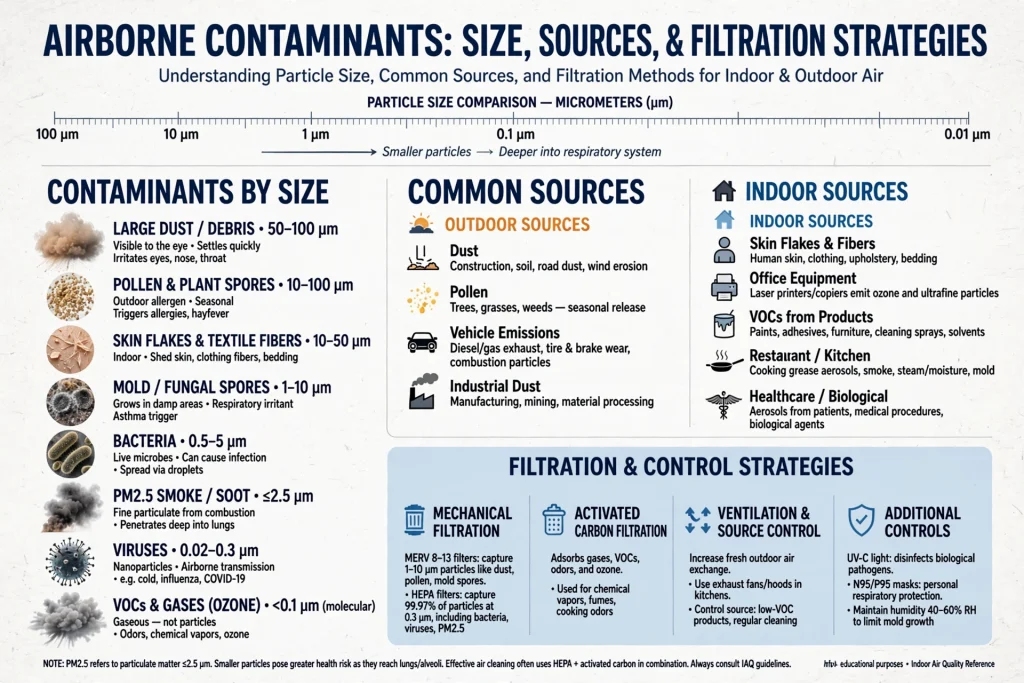
Not all airborne contaminants behave in the same way, and different pollutants require different control strategies. One of the most common misconceptions among building owners is believing that every HVAC filter removes every type of airborne contaminant equally. In reality, particle size, composition, moisture content, and airborne behavior determine how effectively contaminants can be controlled.
Large dust particles are relatively easy to capture using standard HVAC filters. However, much smaller pollutants such as PM2.5, smoke particles, combustion by-products, bacteria, fungal spores, allergens, and certain viruses require significantly higher filtration efficiency.
Indoor contaminants commonly originate from several sources. Outdoor air introduces dust, pollen, vehicle emissions, and fine sand particles. Building occupants generate skin flakes, textile fibers, respiratory aerosols, and carbon dioxide. Office equipment releases ozone and ultrafine particles, while furniture, paints, adhesives, flooring materials, and cleaning chemicals emit Volatile Organic Compounds (VOCs).
Restaurants introduce cooking grease, commercial kitchens generate airborne moisture, industrial facilities produce manufacturing dust, and healthcare buildings face additional biological contamination risks.
Professional HVAC engineers evaluate these contamination sources before selecting filtration systems capable of maintaining acceptable Indoor Environmental Quality (IEQ).
HEPA Filters Provide Superior Air Cleaning
High Efficiency Particulate Air (HEPA) filters represent one of the most effective filtration technologies available for controlling microscopic airborne contaminants. Unlike conventional HVAC filters, HEPA filters remove at least 99.97 percent of particles measuring 0.3 microns, including many bacteria, fungal spores, allergens, and fine particulate matter.
HEPA filtration is widely used in hospitals, pharmaceutical manufacturing facilities, biotechnology laboratories, operating theatres, cleanrooms, research laboratories, and healthcare environments where exceptional air cleanliness is required.
Although HEPA filters provide outstanding filtration performance, they also create higher airflow resistance than standard commercial filters. Engineers must therefore carefully design fan capacities, static pressure requirements, duct sizing, and air distribution systems before integrating HEPA filtration into an HVAC system.
In facilities such as Dubai Healthcare City, specialized medical centers in Abu Dhabi, pharmaceutical plants in Dubai Science Park, and advanced laboratories across the UAE, HEPA filtration plays a critical role in maintaining sterile indoor environments while supporting infection prevention and regulatory compliance.
Fresh Air Ventilation Dilutes Indoor Pollutants
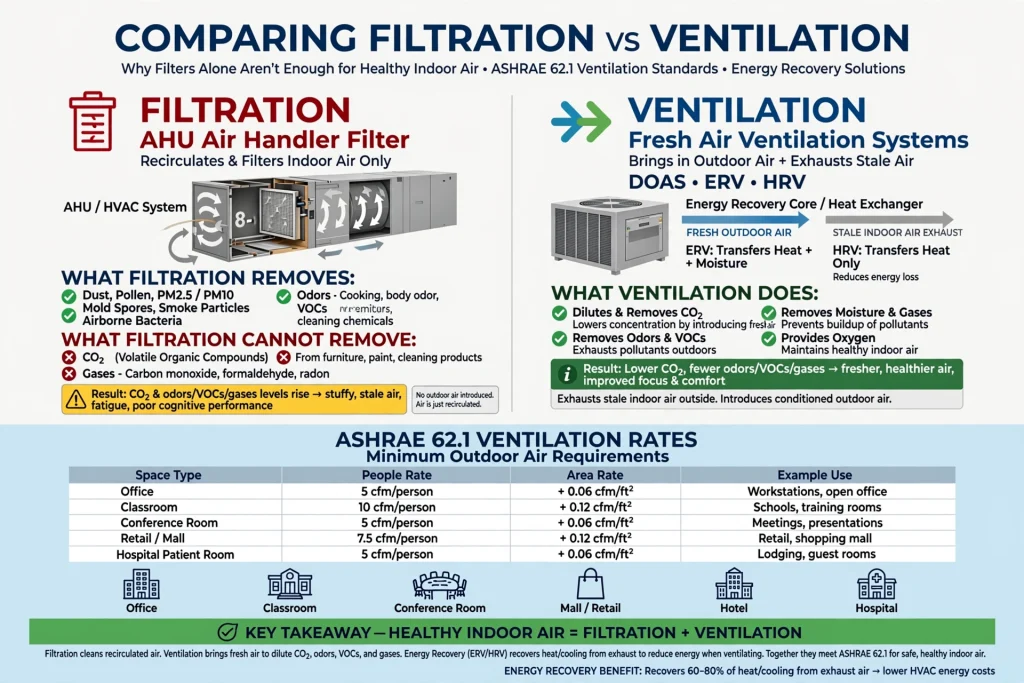
Filtration alone cannot maintain excellent indoor air quality because some contaminants cannot be effectively removed using mechanical filters. Carbon dioxide, odors, certain gases, and volatile organic compounds require proper ventilation rather than filtration.
Fresh air ventilation continuously introduces outdoor air while exhausting stale indoor air. This process dilutes contaminant concentrations and helps maintain healthier indoor environments.
Professional HVAC engineers calculate ventilation rates according to occupancy levels, building usage, and internationally recognized standards such as ASHRAE Standard 62.1. Conference rooms, classrooms, shopping malls, hotels, restaurants, healthcare facilities, and office buildings all require different outdoor air quantities depending on occupant density and operational activities.
Modern HVAC systems frequently utilize Dedicated Outdoor Air Systems (DOAS), Energy Recovery Ventilators (ERVs), and Heat Recovery Ventilators (HRVs) to introduce fresh air efficiently while minimizing energy losses associated with cooling hot outdoor air.
Proper ventilation reduces carbon dioxide accumulation, minimizes indoor odors, and creates a more comfortable environment for building occupants.
Humidity Control Helps Prevent Biological Growth
Maintaining appropriate indoor humidity is one of the most overlooked aspects of controlling airborne contaminants. While filtration removes particles already suspended in the air, humidity management helps prevent many biological contaminants from developing in the first place.
Excessive indoor moisture creates favorable conditions for mold growth, fungal spores, bacteria, and dust mites. These biological contaminants can spread through HVAC systems if moisture accumulates on cooling coils, drain pans, insulation materials, or inside ductwork.
Professional HVAC systems maintain indoor relative humidity within recommended ranges by combining sensible cooling with effective latent heat removal. Properly selected cooling coils, balanced airflow, condensate drainage systems, and accurate thermostat control all contribute to stable humidity conditions.
In coastal regions such as Dubai Marina, Palm Jumeirah, Jumeirah Beach Residence (JBR), Abu Dhabi Corniche, and other humid environments, effective dehumidification becomes especially important because outdoor moisture levels remain elevated for much of the year.
Stable humidity not only improves occupant comfort but also significantly reduces conditions that encourage biological contamination within buildings.
HVAC Ductwork Must Remain Clean to Protect Air Quality
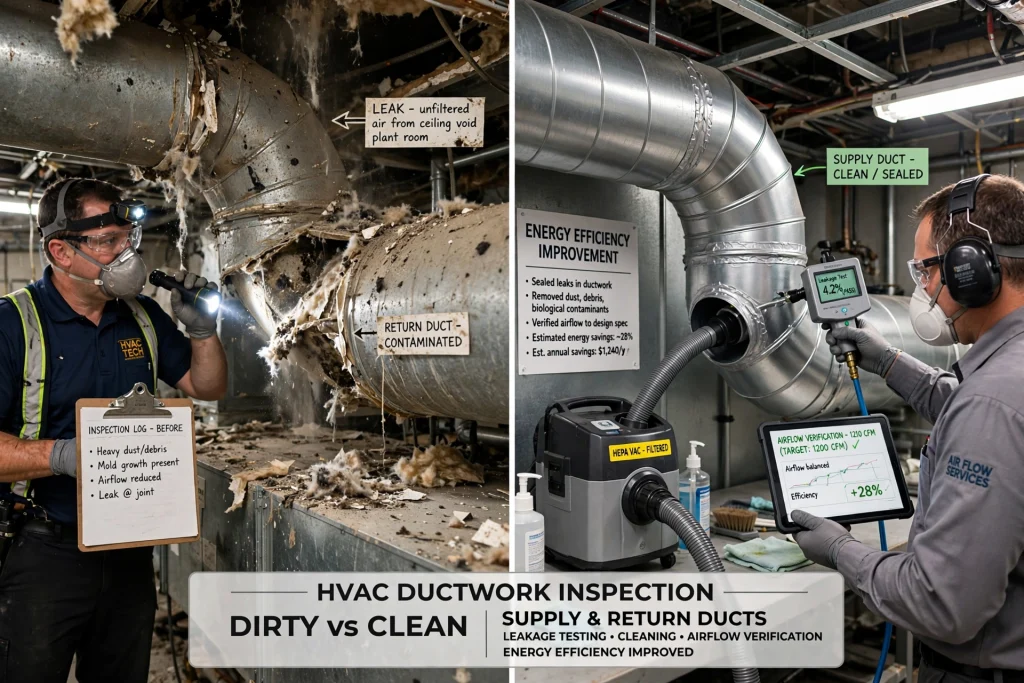
Even the most advanced filtration system cannot maintain healthy indoor air if contaminants accumulate inside poorly maintained ductwork. Supply ducts, return ducts, flexible duct connections, dampers, diffusers, and air distribution components gradually collect dust, fibers, construction debris, and biological contaminants when maintenance is neglected.
Leaks within duct systems create additional problems by allowing unfiltered air from ceiling voids, plant rooms, or service shafts to enter the conditioned air stream.
Professional HVAC maintenance programs include periodic duct inspections, leakage testing, cleaning procedures, and airflow verification to ensure contaminants are not redistributed throughout occupied spaces.
Proper duct sealing also improves energy efficiency by preventing conditioned air from escaping before reaching occupied areas.
Buildings that maintain clean duct systems generally experience better Indoor Air Quality, improved airflow, lower fan energy consumption, and fewer occupant complaints regarding dust accumulation.
HVAC Maintenance Is Essential for Long-Term Air Quality
Even the most sophisticated HVAC system gradually loses its ability to control airborne contaminants if preventive maintenance is ignored. Filters eventually become clogged, evaporator coils accumulate dust, condensate drains become blocked, fan assemblies collect debris, and sensors lose calibration.
These issues reduce filtration efficiency while increasing airflow resistance and energy consumption.
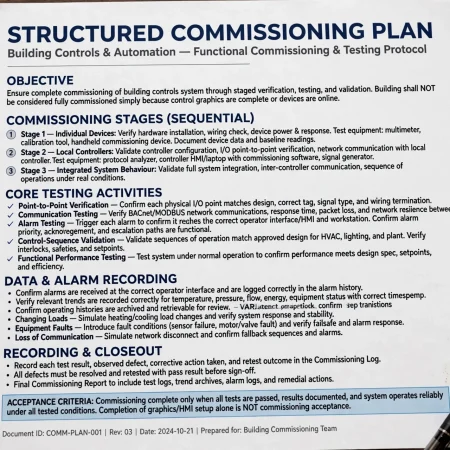
Routine preventive maintenance includes filter replacement, coil cleaning, drain flushing, airflow measurements, fan inspection, electrical testing, vibration analysis, refrigerant performance evaluation, and Building Management System calibration.
Rather than waiting for indoor air quality complaints, experienced facility managers schedule maintenance according to operating conditions, occupancy levels, and environmental exposure.
Consistent maintenance ensures HVAC systems continue protecting occupant health while maintaining reliable long-term building performance.
UV-C Technology Adds an Extra Layer of Air Purification
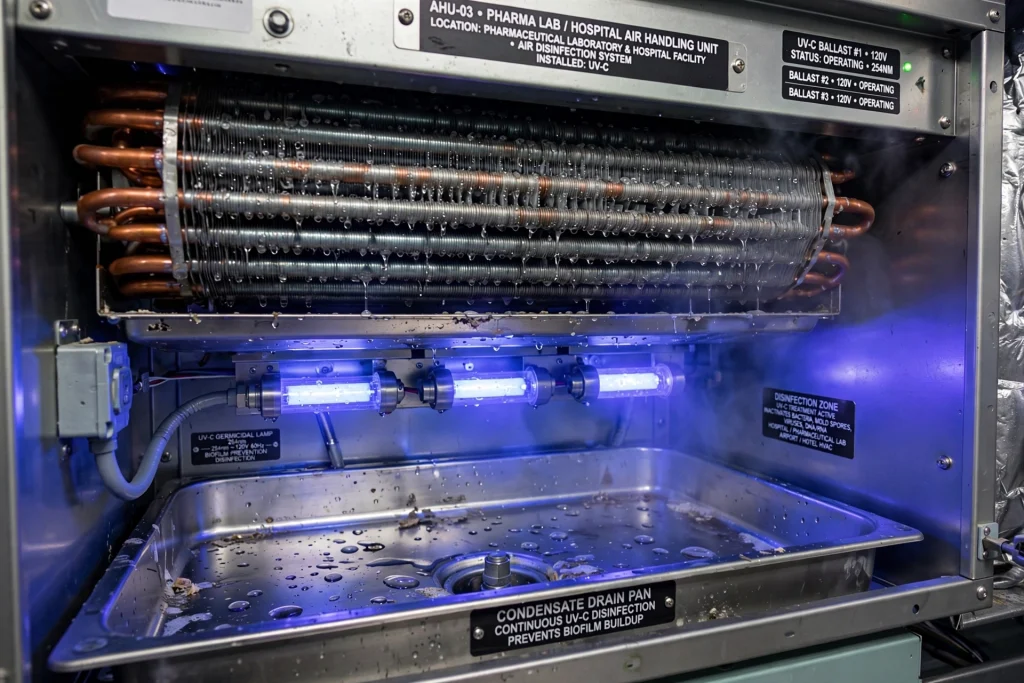
Modern HVAC systems can do much more than heat and cool indoor spaces. In buildings where indoor air quality is a priority, Ultraviolet Germicidal Irradiation (UVGI), commonly known as UV-C technology, provides an additional layer of protection against airborne biological contaminants. While mechanical filters capture particles suspended in the air, UV-C systems target microorganisms by disrupting their DNA and RNA, preventing them from reproducing.
UV-C lamps are commonly installed near evaporator coils, drain pans, inside Air Handling Units (AHUs), or within dedicated air purification chambers where air passes through controlled ultraviolet exposure. This technology helps reduce bacteria, mold spores, viruses, and microbial biofilm that may develop on moist HVAC components.
Hospitals, pharmaceutical manufacturing facilities, laboratories, airports, hotels, educational institutions, and commercial office buildings increasingly incorporate UV-C technology to improve Indoor Air Quality (IAQ). In high-occupancy developments across Downtown Dubai, Dubai Marina, Business Bay, Dubai Healthcare City, Abu Dhabi, and Sharjah, UV-C systems complement filtration and ventilation strategies while supporting healthier indoor environments.
Although UV-C technology should never replace proper filtration or ventilation, it significantly strengthens an HVAC system’s ability to control biological contaminants when professionally designed and maintained.
Smart HVAC Controls Continuously Monitor Indoor Air Quality
Today’s HVAC systems are no longer limited to thermostats that simply regulate temperature. Smart Building Management Systems (BMS) continuously monitor multiple environmental parameters to maintain healthier indoor conditions while optimizing energy efficiency.
Modern HVAC sensors measure temperature, relative humidity, carbon dioxide (CO₂), particulate matter (PM2.5 and PM10), airflow rates, pressure differentials, filter pressure drop, volatile organic compounds (VOCs), and occupancy levels. These sensors provide real-time information that allows the HVAC system to automatically adjust ventilation rates, filtration performance, fan speed, and outdoor air intake.
For example, when occupancy increases inside conference rooms or auditoriums, carbon dioxide levels rise rapidly. Demand-controlled ventilation automatically introduces additional fresh air to maintain acceptable indoor air quality without wasting energy during periods of lower occupancy.
Facility managers also receive alerts when filters become clogged, airflow decreases, or humidity exceeds recommended levels. This proactive monitoring prevents small maintenance issues from becoming major indoor air quality problems while reducing unnecessary energy consumption.
Smart HVAC technology creates buildings that continuously adapt to changing environmental conditions rather than relying on fixed operating schedules.
Indoor Air Quality Directly Influences Health and Productivity
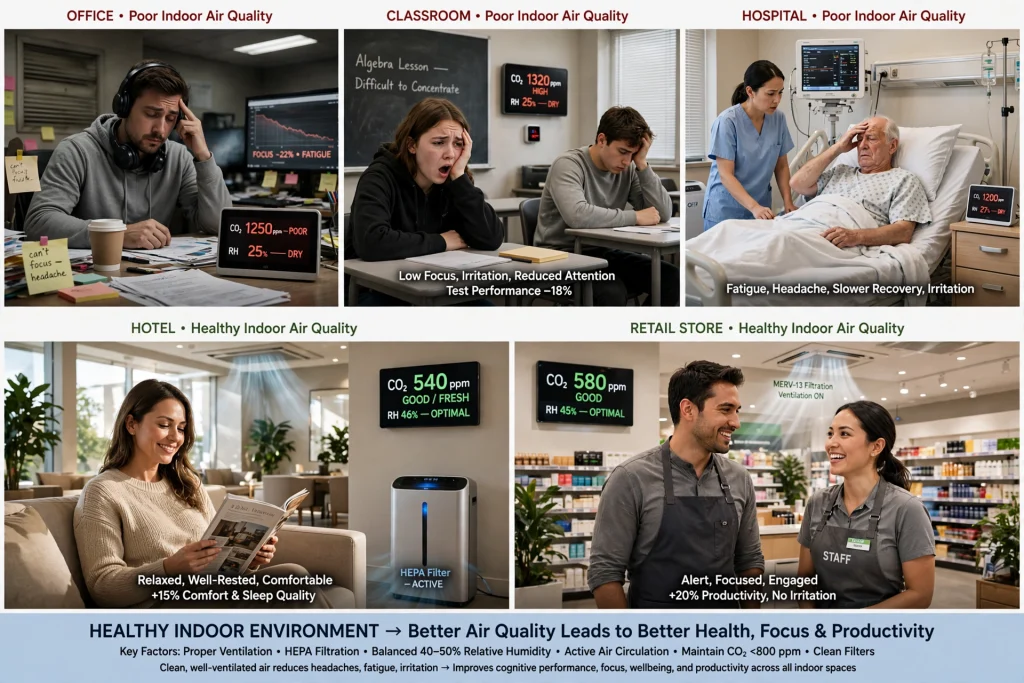
Airborne contaminants affect far more than occupant comfort. Numerous studies have demonstrated that Indoor Air Quality directly influences respiratory health, cognitive performance, workplace productivity, absenteeism, and overall wellbeing.
Poor indoor air quality may contribute to headaches, fatigue, eye irritation, dry throat, allergic reactions, asthma symptoms, respiratory discomfort, reduced concentration, and general occupant dissatisfaction. These symptoms are often associated with elevated particulate matter, excessive carbon dioxide, biological contaminants, volatile organic compounds, and inadequate ventilation.
In commercial offices, improved air quality has been linked to better employee performance and reduced sick leave. Educational institutions benefit from increased student concentration, while healthcare facilities rely on superior air quality to support infection prevention and patient safety. Hotels enhance guest comfort through cleaner indoor environments, and retail facilities create more pleasant shopping experiences.
By maintaining proper ventilation, effective filtration, balanced humidity, and continuous air circulation, professionally designed HVAC systems create indoor environments that support both health and productivity.
Common HVAC Problems That Allow Airborne Contaminants to Spread
Many indoor air quality problems are not caused by outdoor pollution but by deficiencies within the HVAC system itself. Poor maintenance, aging equipment, incorrect system design, and neglected components often allow contaminants to circulate throughout occupied spaces.
Clogged air filters reduce airflow while allowing smaller particles to bypass filtration media. Dirty evaporator coils become breeding grounds for microbial growth due to continuous moisture exposure. Blocked condensate drains create standing water that encourages mold development. Damaged duct insulation may release fibers into the air stream, while leaking ductwork introduces dust from ceiling voids and service areas.
Improperly balanced ventilation systems can create negative building pressure, allowing outdoor contaminants to infiltrate occupied spaces through doors, windows, and structural openings.
Buildings experiencing persistent dust accumulation, unpleasant odors, humidity problems, or uneven airflow should undergo a comprehensive HVAC inspection to identify the underlying causes before indoor air quality continues to deteriorate.
Professional HVAC Design Creates Cleaner Indoor Environments
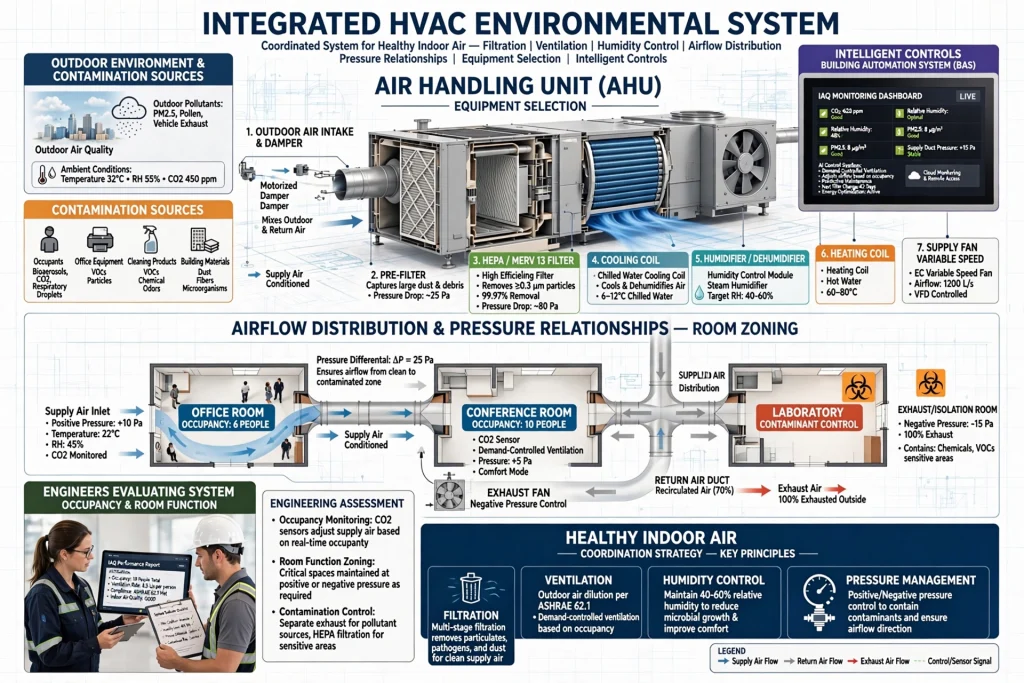
Maintaining healthy indoor air requires more than installing high-quality filters. Professional HVAC engineering integrates filtration, ventilation, humidity control, airflow distribution, pressure relationships, equipment selection, and intelligent controls into one coordinated environmental system.
Engineers evaluate building occupancy, room functions, contamination sources, airflow patterns, filtration requirements, fresh air quantities, energy efficiency, and maintenance accessibility before developing an HVAC solution. Every design decision influences how effectively airborne contaminants are controlled throughout the building.
Organizations seeking a Professional HVAC Service Provider benefit from engineering expertise that addresses both occupant comfort and indoor environmental quality. Properly designed HVAC systems reduce airborne pollutants while supporting long-term equipment reliability, energy efficiency, regulatory compliance, and healthier indoor spaces.
Conclusion
HVAC systems play a vital role in reducing airborne contaminants by combining advanced filtration, fresh air ventilation, humidity control, intelligent airflow management, and regular preventive maintenance. Rather than relying on a single technology, effective indoor air quality is achieved through an integrated engineering approach that continuously removes pollutants, dilutes contaminants, controls biological growth, and maintains balanced environmental conditions.
Across commercial offices, hospitals, hotels, schools, shopping malls, residential developments, pharmaceutical facilities, and industrial buildings in Dubai Marina, Downtown Dubai, Business Bay, Palm Jumeirah, Dubai Hills Estate, Jumeirah, Dubai Silicon Oasis, Jebel Ali, Dubai South, Abu Dhabi, Yas Island, Al Reem Island, and Sharjah, professionally designed HVAC systems are becoming increasingly important as building owners prioritize occupant health, sustainability, and operational efficiency.
As building technologies continue to evolve through smart sensors, Building Management Systems (BMS), predictive maintenance, artificial intelligence, UV-C disinfection, and advanced filtration technologies, HVAC systems will remain the foundation of healthy indoor environments. Investing in professional HVAC design, quality equipment, and routine maintenance not only improves Indoor Air Quality but also protects occupant wellbeing, enhances productivity, extends equipment life, and delivers long-term value for every type of building.