Concrete moisture testing is one of the most important steps before applying epoxy floor coatings. A concrete surface may look dry, clean and ready for installation, but moisture can remain trapped inside the slab. When an epoxy coating is applied over concrete with excessive moisture, it can lead to blistering, bubbling, peeling, poor adhesion and coating failure.
This problem is particularly important in Dubai, where buildings experience high temperatures, humidity variations, air-conditioning conditions and different construction environments. Industrial warehouses in Jebel Ali, commercial buildings in Business Bay, residential garages in Dubai Hills Estate and retail properties in Al Quoz may all have different concrete moisture conditions.
A professional moisture assessment helps determine whether a concrete floor is suitable for epoxy application. It also helps contractors select an appropriate primer, moisture mitigation system and coating specification.
Concrete moisture testing should not be treated as an optional installation procedure. It is an essential part of substrate inspection, especially when installing epoxy flooring in warehouses, factories, parking areas, workshops, commercial kitchens and residential properties.
Why Is Concrete Moisture Testing Important Before Epoxy Flooring?
Concrete is a porous building material that absorbs and retains water. Even after the surface appears dry, moisture may remain within the concrete structure.
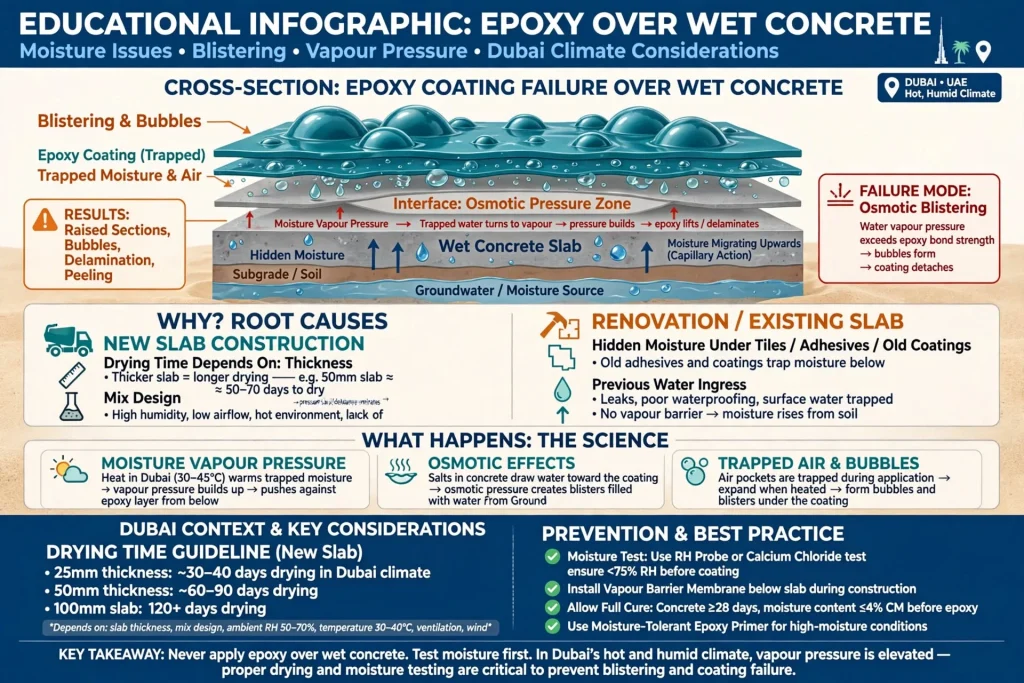
When epoxy resin is applied over a concrete slab containing excessive moisture, the coating can restrict moisture movement through the surface. Depending on the moisture conditions, vapour pressure, osmotic effects and the coating system, this can contribute to adhesion problems and visible surface defects.
Moisture-related epoxy flooring problems include:
- Blistering: Small or large bubbles develop beneath the epoxy coating.
- Delamination: The epoxy layer separates from the concrete substrate.
- Peeling: Sections of the coating lose adhesion and detach from the floor.
- Cloudy appearance: Moisture-related reactions or contamination affect the surface finish.
- White deposits: Salts may accumulate at the surface through moisture movement.
- Soft coating areas: Incompatible conditions or application problems may affect curing and coating performance.
These defects can increase repair costs, interrupt warehouse operations and create additional maintenance requirements.
For example, an industrial facility in Dubai Industrial City may require a large epoxy flooring installation. If concrete moisture is not properly assessed before application, coating failure may affect forklift routes, production areas and storage operations.
Testing the substrate before installation helps identify potential risks before expensive flooring materials are applied.
Understanding Moisture Inside Concrete Slabs
Concrete contains water from the original mixing process, construction activities and surrounding environmental conditions. Some water is consumed during cement hydration, while the remaining moisture gradually moves through the concrete and evaporates.
The drying process depends on several factors, including:
- Concrete thickness.
- Water-to-cement ratio.
- Concrete mix design.
- Ambient temperature.
- Relative humidity.
- Air circulation.
- Slab location.
- Ground moisture conditions.
- Presence of a vapour barrier beneath the slab.
A concrete slab installed directly on the ground may receive moisture from the underlying soil if an effective damp-proof membrane or vapour retarder is missing, damaged or improperly installed.
In basement parking areas, ground-floor warehouses and buildings with poor drainage, moisture migration can become a particular concern.
Another important factor is that surface dryness does not always indicate internal dryness. A concrete slab may have a dry upper layer while retaining significant moisture deeper inside.
This is why professional moisture testing should use appropriate methods rather than relying only on visual inspection or touching the concrete surface.
What Are the Main Methods for Testing Concrete Moisture?
There are several methods used to evaluate moisture conditions before epoxy floor coating installation. Each method measures a different aspect of moisture behaviour, so the correct choice depends on the project requirements and manufacturer’s specifications.
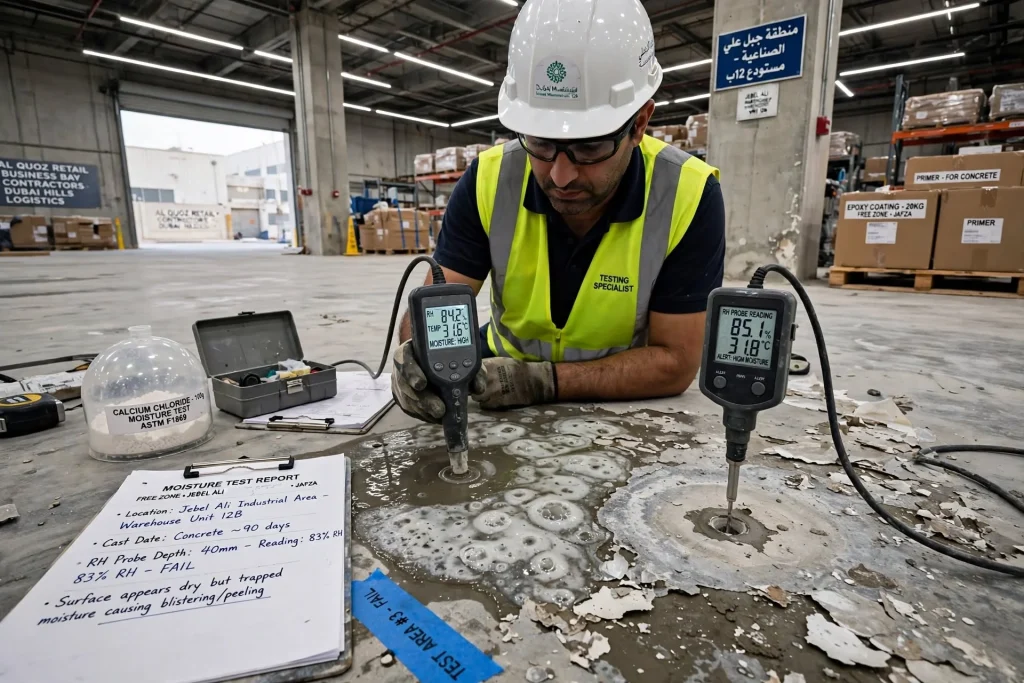
1. In-Situ Relative Humidity (RH) Testing
In-situ relative humidity testing is a widely recognised method for evaluating moisture conditions inside concrete slabs.
The test measures the relative humidity within a drilled hole at a specified depth. It provides information about the moisture condition inside the concrete rather than only measuring surface moisture.
ASTM F2170 is the recognised standard for determining relative humidity in concrete floor slabs using in-situ probes.
The general testing process involves drilling holes into the concrete, cleaning the test locations, installing measurement sleeves and allowing the sensors to equilibrate according to the standard before recording readings.
For slabs drying from one side, ASTM F2170 generally specifies a test depth of 40% of the slab thickness. For slabs drying from both sides, the specified depth is 20%.
The recorded relative humidity percentage helps contractors assess whether the concrete is suitable for the selected epoxy system.
For example, if an in-situ RH reading exceeds the coating manufacturer’s permitted limit, additional drying or moisture mitigation may be required before installation.
The acceptable limit must be taken from the specific product’s technical data sheet. There is no single universal RH percentage that guarantees suitability for every epoxy coating.

2. Calcium Chloride Moisture Vapour Emission Test
The calcium chloride test is another established method used to assess moisture vapour emission from concrete.
ASTM F1869 describes the anhydrous calcium chloride test for measuring the moisture vapour emission rate (MVER) of concrete floor slabs.
During the test, a measured quantity of anhydrous calcium chloride is placed inside a sealed test assembly on an exposed concrete surface.
The test assembly is left in position for the period specified by the standard, commonly 60–72 hours. The calcium chloride absorbs moisture released from the concrete, and the change in mass is used to calculate the moisture vapour emission rate.
Results are generally expressed in pounds of moisture per 1,000 square feet per 24 hours.
This method is useful for evaluating surface moisture emission, but it does not measure internal relative humidity in the same way as ASTM F2170.
Its results can be affected by environmental conditions, surface preparation and the testing procedure.
The manufacturer’s acceptance criteria should always be checked before applying epoxy coatings.
3. Electronic Concrete Moisture Meter
An electronic concrete moisture meter provides a convenient way to check moisture variations across a concrete surface.
These devices generally use electrical resistance or capacitance-based measurement principles to assess moisture-related changes in the material.
They can help contractors identify areas that may require additional investigation.
For example, a moisture meter can be used to compare readings around:
- Concrete floor joints.
- Basement walls and floor edges.
- Areas near plumbing installations.
- Previously repaired sections.
- Warehouse loading bays.
- Areas with visible damp patches.
However, electronic moisture meters do not necessarily provide the same measurement as an in-situ relative humidity test or calcium chloride test.
Many handheld devices provide comparative or indicative readings rather than a standardised moisture acceptance result.
They are useful for preliminary screening, but should not automatically replace the testing method required by the epoxy manufacturer or project specification.
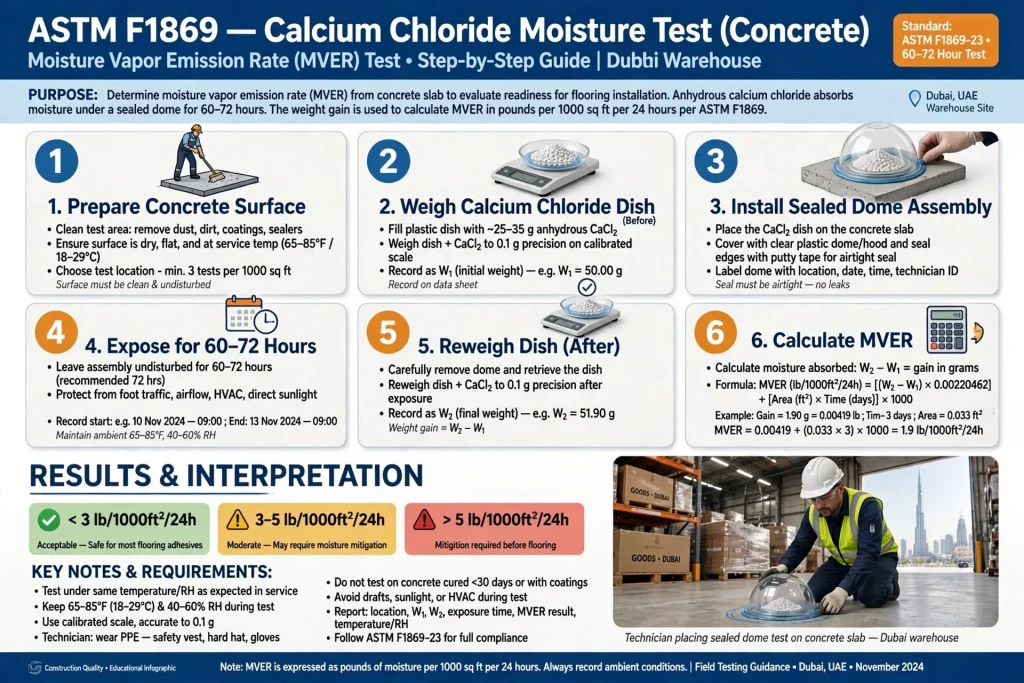
4. Plastic Sheet Test
The plastic sheet test is a simple preliminary method for identifying possible moisture movement through a concrete surface.
ASTM D4263 describes a qualitative test using a plastic sheet to indicate the presence of moisture in concrete.
A transparent plastic sheet is securely taped to a clean concrete surface. After the specified exposure period, the sheet and the concrete underneath are examined for condensation or visible darkening.
If moisture appears beneath the sheet, it may indicate moisture movement or moisture-related conditions within the concrete.
However, this test does not provide a quantitative moisture measurement. It cannot establish a precise RH percentage or moisture vapour emission rate.
The plastic sheet test should therefore be treated as an initial screening method rather than the final approval procedure for epoxy flooring.
Step-by-Step Process for Testing Concrete Moisture Before Epoxy Application
A systematic inspection helps contractors understand the moisture condition of the entire concrete floor rather than relying on a single reading.
Step 1: Inspect the Concrete Surface
Before using testing equipment, inspect the concrete floor for visible signs of moisture and deterioration.
Look for dark patches, water stains, efflorescence, damp areas, cracks, surface contamination and previous coating failures.
Pay particular attention to areas near external walls, plumbing systems, expansion joints, floor drains and basement sections.
In Dubai commercial buildings, loading bays and ground-floor storage areas may experience different moisture conditions from elevated floors.
Visual inspection helps identify potential problem areas, but it cannot confirm that the slab is sufficiently dry for epoxy application.
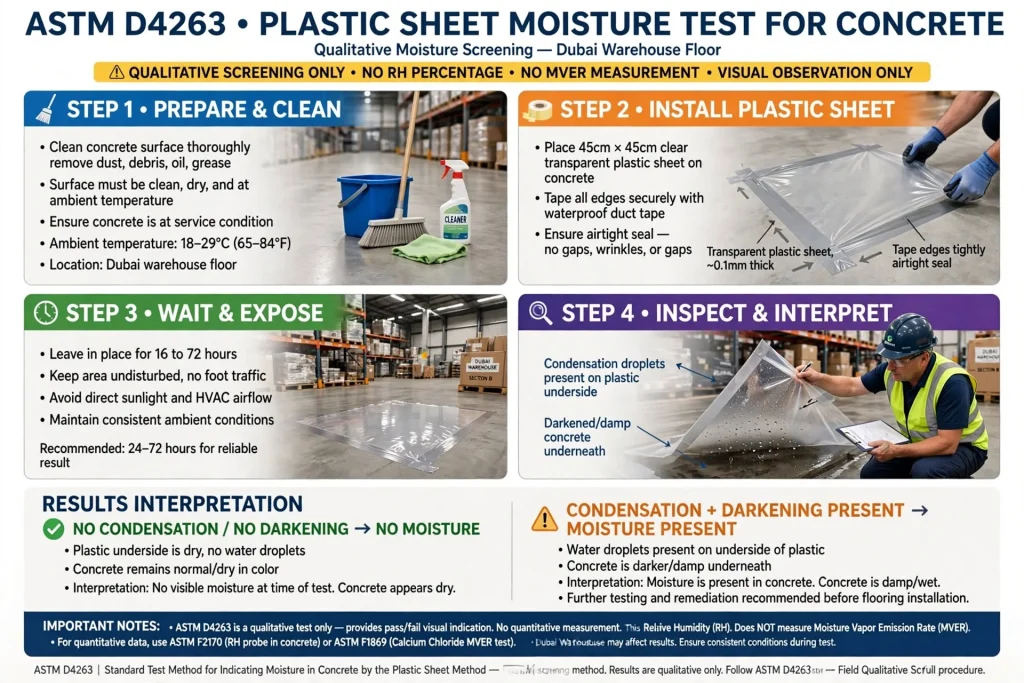
Step 2: Review the Concrete Slab History
The age and construction details of the concrete slab can influence moisture conditions.
Contractors should establish when the concrete was poured, whether it was exposed to rain or water during construction, and whether a damp-proof membrane was installed beneath ground-supported slabs.
Other useful information includes:
- Concrete thickness and construction type.
- Whether the slab dries from one or both sides.
- Previous waterproofing treatments.
- Existing floor coverings or coatings.
- History of water leakage.
- Previous moisture-related flooring failures.
For a warehouse in Jebel Ali or a commercial building in Business Bay, construction drawings and site records may help identify the presence of an under-slab vapour barrier.
Step 3: Select the Appropriate Moisture Testing Method
The testing method should match the flooring specification and project requirements.
ASTM F2170 is commonly used where in-situ concrete relative humidity measurements are required. ASTM F1869 may be specified where moisture vapour emission testing is needed.
Electronic moisture meters can help identify areas for further investigation, while the plastic sheet test provides a basic qualitative indication.
For larger flooring projects, using more than one assessment method may provide a better understanding of the substrate condition.
Step 4: Identify Representative Test Locations
Moisture readings should represent the actual floor conditions.
Testing only one convenient location may overlook areas with higher moisture levels.
Test locations should be distributed across the installation area and include locations that may have greater moisture exposure.
These can include:
- External wall perimeters.
- Areas near plumbing and drainage systems.
- Ground-supported concrete sections.
- Basement floor areas.
- Previous water leakage locations.
- Concrete sections with visible discolouration.
The number and distribution of test locations should follow the applicable testing standard and project requirements.
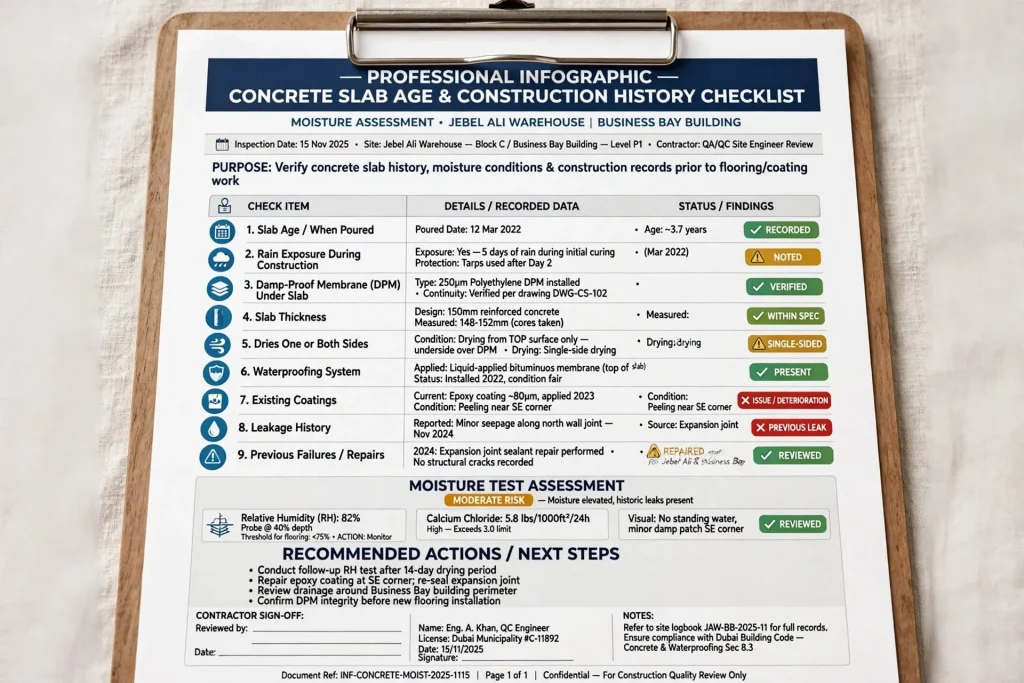
Step 5: Record and Evaluate the Readings
Once testing is completed, record the results, test locations, environmental conditions, equipment details and testing dates.
Compare the readings against the acceptance limits specified by the epoxy manufacturer.
For example, an epoxy coating may permit a particular in-situ RH level, while another system may require a different limit or a dedicated moisture mitigation primer.
The highest relevant reading should not be ignored simply because other parts of the floor show lower moisture levels.
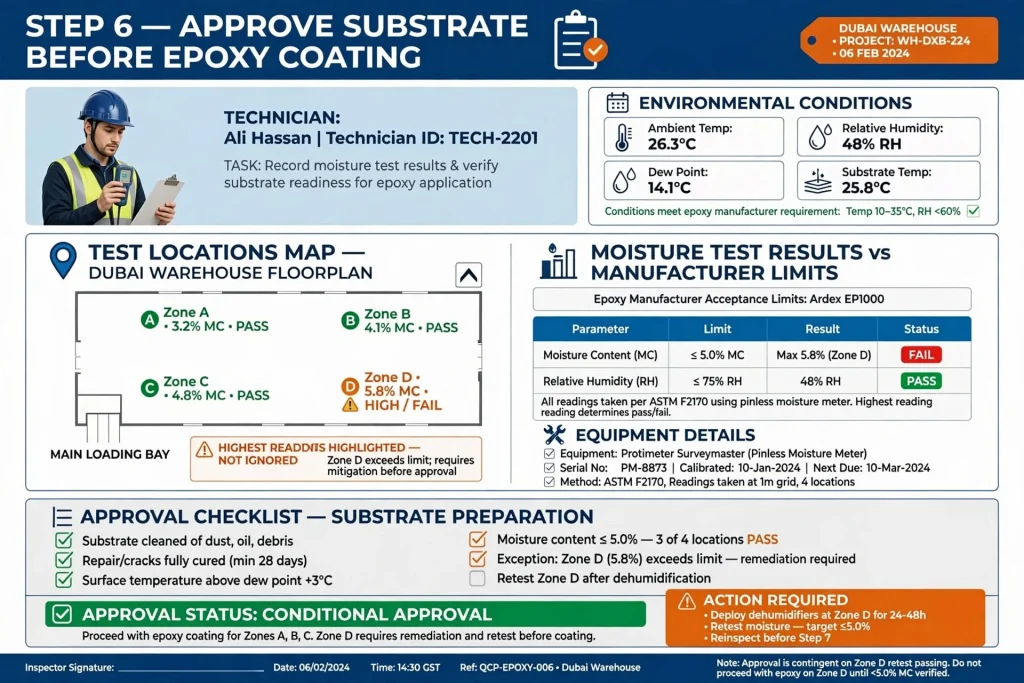
Step 6: Approve the Substrate Before Coating
After reviewing the moisture results, determine whether the concrete is ready for epoxy application.
If readings are within the manufacturer’s permitted limits and other substrate requirements are satisfied, the installation can proceed.
If moisture levels exceed the permitted limits, additional drying, moisture mitigation or investigation may be required.
Written approval of the substrate condition helps reduce misunderstandings between the flooring contractor, project consultant and building owner.
What Is the Acceptable Moisture Level for Epoxy Flooring?
There is no single acceptable moisture percentage for every epoxy flooring system.
Different epoxy products have different moisture tolerances, and the required limits depend on resin formulation, primer technology, coating thickness and the manufacturer’s testing requirements.
For example, one epoxy system may specify a maximum in-situ relative humidity of 75%, while a specially formulated moisture-tolerant system may permit a higher value under its documented conditions.
These figures are product-specific examples, not universal installation limits.
The following measurements should not be confused:
| Testing method | What it measures | Typical reporting |
|---|---|---|
| ASTM F2170 | Internal concrete relative humidity | RH percentage |
| ASTM F1869 | Surface moisture vapour emission | lb/1,000 sq. ft./24 hours |
| Electronic moisture meter | Electrical response related to moisture | Device-specific reading |
| ASTM D4263 | Qualitative indication of moisture | Visual observation |
A relative humidity reading of 80% does not mean the concrete contains 80% water. It indicates the relative humidity of the air within the concrete test cavity under the prescribed test conditions.
Similarly, a calcium chloride result is not interchangeable with an in-situ RH reading.
Important: Always use the measurement method and acceptance limit stated in the flooring manufacturer’s current technical data sheet. If the project specification requires a particular ASTM method, a different testing method should not be substituted without approval.
How Dubai’s Climate and Building Conditions Affect Concrete Moisture
Dubai’s climate creates specific challenges for concrete drying and moisture assessment.
Although outdoor temperatures can become extremely high, this does not mean that concrete slabs automatically become dry enough for epoxy application.
Moisture conditions are influenced by building design, ventilation, air-conditioning, slab construction and the surrounding ground conditions.
High Humidity and Air-Conditioned Buildings
Dubai experiences periods of high humidity, particularly during warmer months and coastal weather conditions.
Air-conditioned buildings may have significantly different indoor temperature and humidity conditions compared with outdoor environments.
If the concrete surface temperature approaches the dew point, condensation may develop on the slab. Applying epoxy over a surface affected by condensation can create adhesion and curing problems.
Contractors should check ambient temperature, concrete surface temperature and relative humidity before installation.
Ground Moisture in Warehouses and Industrial Buildings
Ground-supported concrete slabs may receive moisture from the underlying soil.
This can be particularly important in warehouses, manufacturing facilities and industrial properties where large concrete floor areas are installed over the ground.
Facilities in Jebel Ali, Dubai Industrial City and Dubai Investment Park should be assessed according to their actual slab construction and moisture protection details.
Basement and Underground Parking Areas
Basement parking facilities in Dubai Marina, Downtown Dubai and Business Bay may experience moisture-related issues caused by water ingress, drainage problems or groundwater conditions.
A concrete slab that appears dry may still have elevated internal moisture.
Before installing an epoxy parking floor system, contractors should investigate the moisture source and verify the substrate condition.

Construction and Renovation Projects
New concrete slabs require sufficient drying time before receiving moisture-sensitive coatings.
The time required depends on concrete thickness, mix design, environmental conditions and drying arrangements.
Renovation projects can also present hidden problems because existing tiles, adhesives or previous coatings may conceal moisture movement.
Removing the existing floor finish and carrying out proper substrate assessment helps reveal these conditions before applying a new epoxy system.
What Happens If Epoxy Flooring Is Applied Over Wet Concrete?
Applying epoxy over concrete with moisture levels exceeding the coating system’s permitted limits can result in several failures.
Epoxy Floor Blistering
Blistering occurs when bubbles or raised sections develop within or beneath the coating.
Moisture vapour pressure, osmotic effects, trapped air and application conditions can all contribute to blister formation.
The exact cause should be investigated rather than assuming that every blister is moisture-related.
Epoxy Coating Delamination
Delamination occurs when the coating loses adhesion to the concrete substrate.
Moisture, surface contamination, laitance, inadequate mechanical preparation and incompatible primers can all contribute to this problem.
Once adhesion is compromised, sections of the coating may separate from the floor.
Peeling and Flaking
When the coating system fails to bond properly, the epoxy layer may begin peeling or flaking.
This can expose the underlying concrete and require localised repairs or complete coating removal.
Efflorescence and White Deposits
Efflorescence is a deposit of soluble salts that can appear when moisture moves through concrete and carries dissolved minerals to the surface.
These deposits may indicate moisture movement and should be investigated before applying a new coating.
Premature Flooring Failure
Repeated moisture-related defects can shorten the useful service life of an epoxy flooring system.
For commercial properties, this can mean additional repair costs, operational interruptions and disruption to tenants or warehouse activities.
How to Reduce Concrete Moisture Before Applying Epoxy Coatings
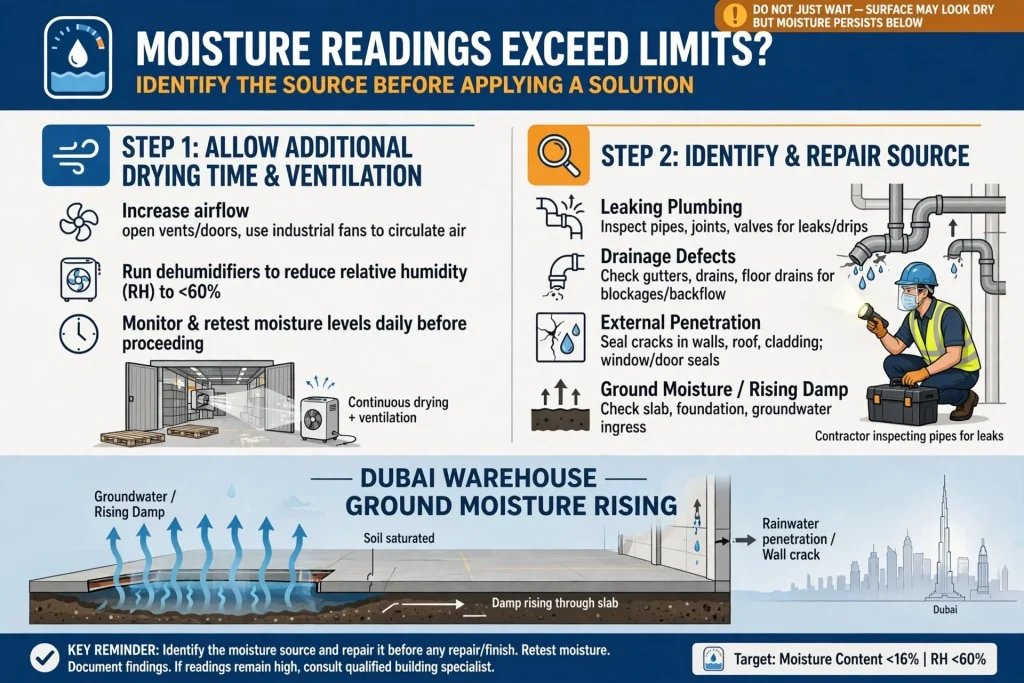
If moisture readings exceed the permitted limits, contractors should identify the source before choosing a solution.
Simply waiting for the concrete surface to look dry may not solve the problem, especially if moisture continues to enter from the ground or surrounding building elements.
1. Allow Additional Concrete Drying Time
New concrete slabs may need additional drying time before receiving epoxy coatings.
Proper ventilation and suitable environmental conditions can support moisture evaporation.
However, drying time should not be estimated only from the concrete’s age. Moisture testing should confirm whether the slab meets the flooring manufacturer’s requirements.
2. Identify and Repair Water Ingress
If moisture comes from leaking plumbing, drainage defects or external water penetration, the source should be corrected first.
Applying an epoxy coating over an unresolved water ingress problem may result in further coating failure.
3. Use a Moisture Mitigation System
Where the concrete cannot be dried sufficiently, a suitable moisture mitigation system may be considered.
Specialised epoxy moisture vapour barriers and moisture mitigation primers are designed to reduce moisture-related risks when installed according to their technical specifications.
These products are not interchangeable with ordinary epoxy primers.
The contractor should verify the system’s permitted substrate moisture conditions, surface preparation requirements, curing schedule and compatibility with the proposed topcoat.
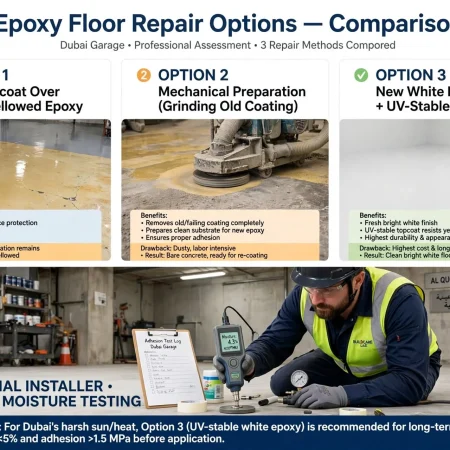
4. Prepare the Concrete Mechanically
Concrete surface preparation is important for achieving proper coating adhesion.
Mechanical grinding or shot blasting can remove weak surface layers, laitance, contaminants and previous coating residues.
However, mechanical preparation does not eliminate moisture inside the concrete slab.
Moisture testing should still be carried out after the appropriate preparation and before the epoxy system is installed.
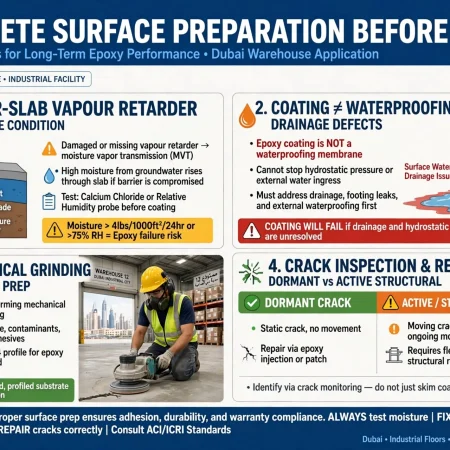
5. Check the Vapour Barrier
For ground-supported concrete slabs, the presence and condition of the under-slab vapour retarder can influence long-term moisture behaviour.
Where moisture migration continues through the slab, contractors may need to investigate the construction details and consider an engineered mitigation solution.
A surface coating alone should not be treated as a substitute for correcting serious underlying waterproofing or drainage defects.
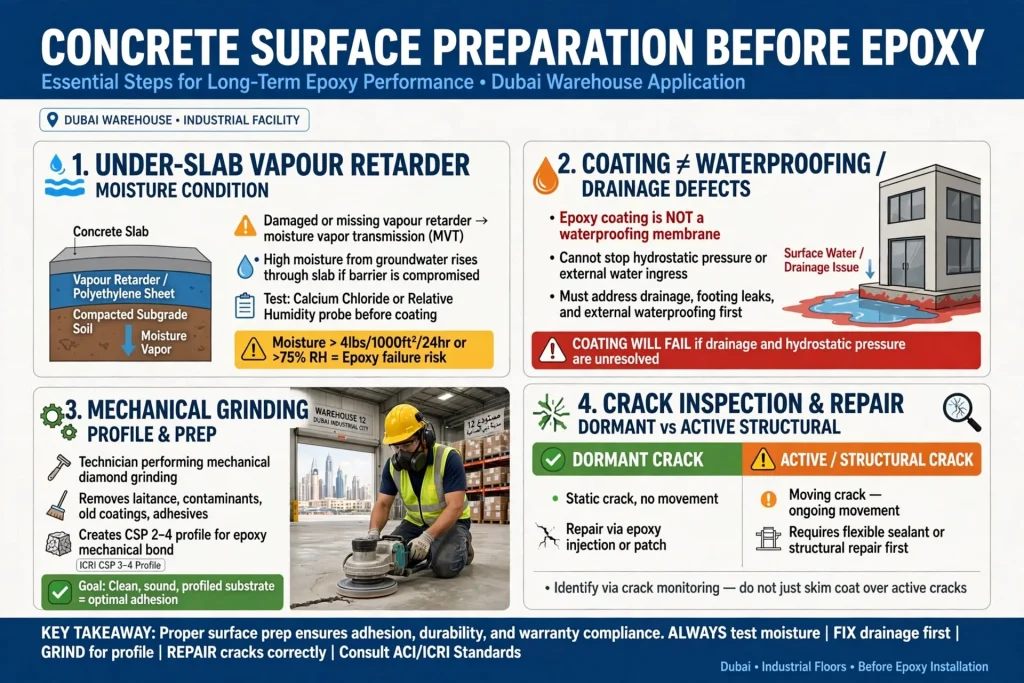
Concrete Surface Preparation Before Epoxy Floor Coating
Moisture testing is only one part of preparing a concrete floor for epoxy application. The surface must also have sufficient strength, cleanliness and profile to support the selected coating system.
A professional substrate preparation process generally includes the following activities.
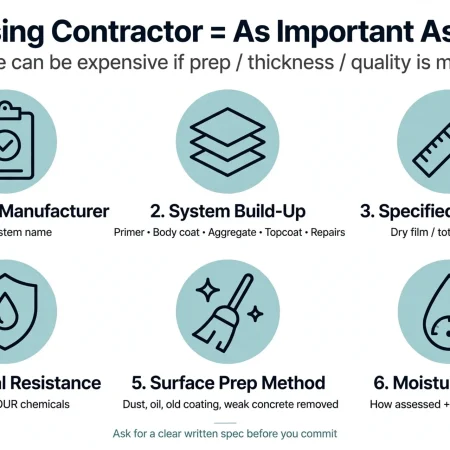
Concrete grinding: Mechanical grinding removes weak concrete layers, laitance and surface contaminants while creating an appropriate surface profile.
Crack inspection and repair: Cracks should be assessed to determine whether they are dormant, active or associated with structural movement. Suitable repair materials should be selected according to the condition.
Oil and grease removal: Automotive workshops, warehouses and industrial facilities may have oil or chemical contamination that can interfere with epoxy adhesion.
Dust removal: Industrial vacuum equipment should be used to remove loose dust and debris after mechanical preparation.
Surface profile assessment: The concrete profile should meet the coating manufacturer’s requirements. ICRI concrete surface profile (CSP) guidelines can help contractors identify the appropriate preparation level.
Final moisture assessment: Confirm that the prepared substrate meets the moisture acceptance criteria before applying the primer and epoxy coating.
Common Mistakes to Avoid During Concrete Moisture Testing
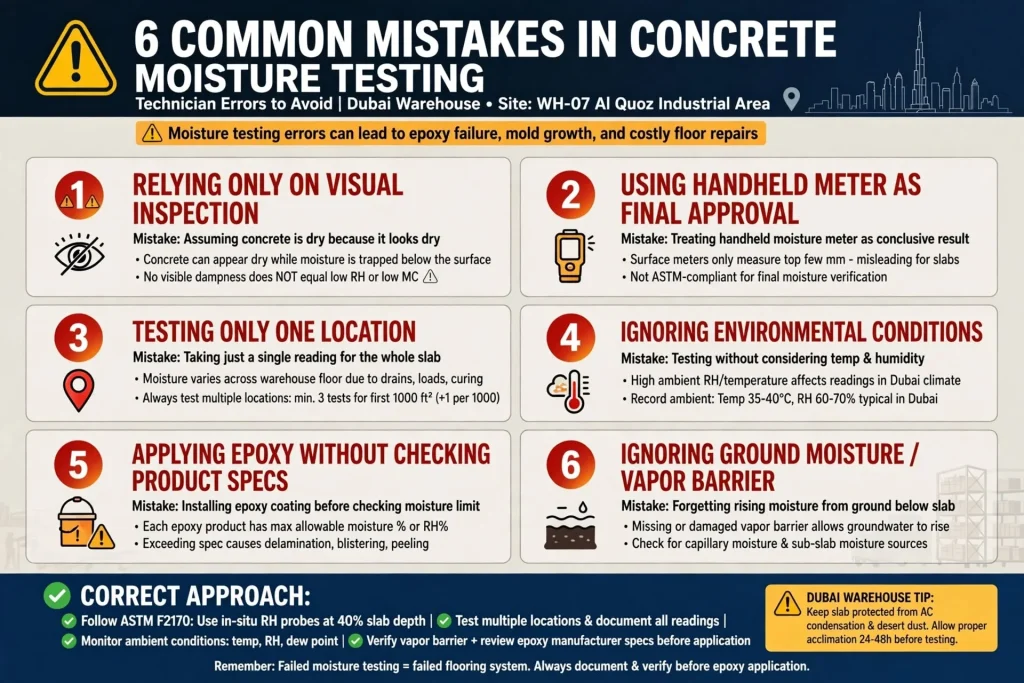
Incorrect testing procedures can produce misleading results and increase the risk of coating failure.
Some common mistakes include:
Relying only on visual inspection: A concrete floor may look dry while retaining significant moisture internally.
Using a handheld meter as final approval: Electronic meters are useful for preliminary assessment but may not provide the standardised results required by a project specification.
Testing only one location: Moisture conditions can vary across a large slab. Testing should represent the entire installation area.
Ignoring environmental conditions: Temperature, relative humidity and condensation can influence testing and application conditions.
Applying epoxy without checking product specifications: Every flooring system has its own moisture tolerance and installation requirements.
Ignoring ground moisture: A ground-supported slab may continue receiving moisture from below even after its upper surface has dried.
Applying ordinary primer over excessive moisture: A standard epoxy primer should not be assumed to function as a moisture mitigation barrier.
Avoiding these mistakes helps contractors improve installation quality and reduce unnecessary repair expenses.
Concrete Moisture Testing Checklist for Epoxy Flooring Projects
Before approving an epoxy flooring installation, contractors, facility managers and project consultants can use the following checklist.
| Inspection item | What needs to be checked |
|---|---|
| Concrete age | Date of concrete placement and drying history |
| Slab construction | Ground-supported or suspended concrete slab |
| Vapour barrier | Presence and condition where applicable |
| Visual inspection | Damp patches, staining and efflorescence |
| Moisture testing | Appropriate ASTM testing method |
| Test locations | Representative locations across the floor |
| RH and temperature | Ambient and concrete surface conditions |
| Surface preparation | Grinding, cleaning and removal of contamination |
| Moisture acceptance | Compliance with the manufacturer’s limits |
| Primer compatibility | Suitability for the selected moisture conditions |
| Final approval | Documented inspection and test results |
Maintaining a moisture testing report provides useful documentation for the contractor, client and project consultant.
For large industrial or commercial installations, test records should include the test location, date, equipment identification, calibration information where applicable, environmental conditions and recorded results.
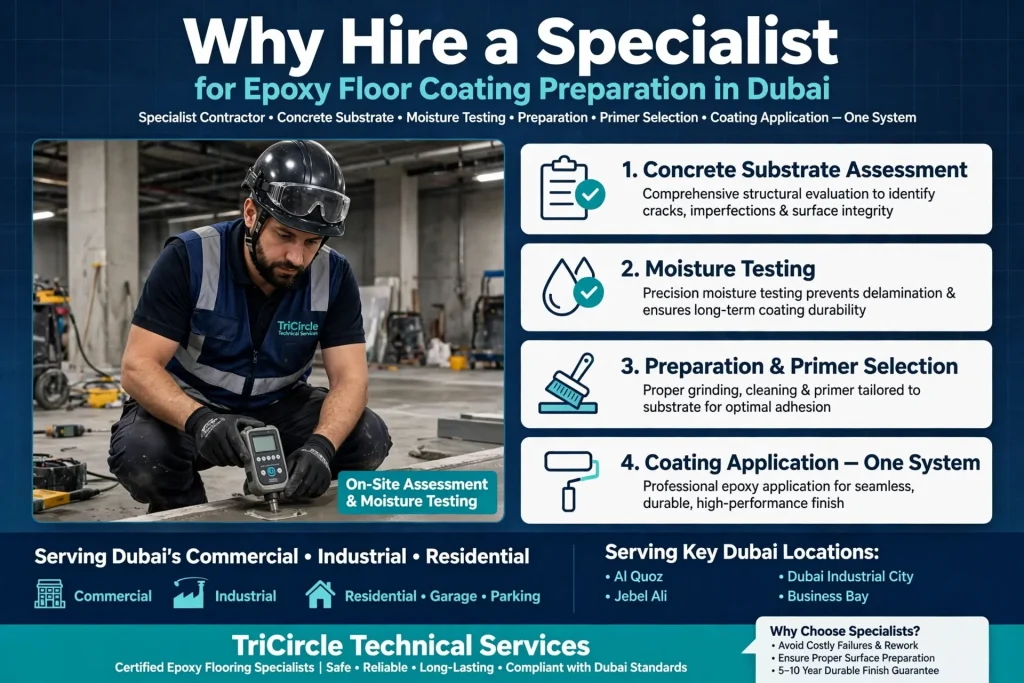
Why Hire a Specialist for Epoxy Floor Coating Preparation in Dubai?
Epoxy flooring performance depends on the condition of the concrete substrate as much as the quality of the resin itself.
A professional contractor understands that moisture testing, concrete preparation, primer selection and coating application must work together as one system.
For commercial buildings, industrial warehouses, residential garages and parking facilities, professional assessment helps identify potential substrate problems before installation begins.
TriCircle Technical Services provides flooring solutions for different residential, commercial and industrial requirements across Dubai.
Property owners and project managers planning new flooring installations should work with an experienced Epoxy Floor Coatings Specialist who can assess concrete conditions, review coating specifications and recommend an appropriate application system.
This is particularly important for projects in Al Quoz, Jebel Ali, Dubai Industrial City, Dubai Investment Park, Business Bay and other commercial areas where floor performance can directly affect daily operations.
A properly assessed concrete substrate provides a better foundation for a durable, well-bonded epoxy flooring system.
Building Reliable Epoxy Flooring Systems Through Proper Moisture Assessment
Concrete moisture testing is an essential part of preparing floors for epoxy coatings. A surface that appears dry may still contain internal moisture capable of affecting coating adhesion, curing and long-term performance.
Methods such as ASTM F2170 in-situ relative humidity testing and ASTM F1869 calcium chloride testing provide valuable information about concrete moisture conditions. Electronic moisture meters and plastic sheet testing can also support preliminary investigations when used appropriately.
For Dubai construction and renovation projects, contractors should consider slab construction, ground moisture, humidity, air-conditioning conditions and environmental exposure before selecting an epoxy flooring system.
If moisture readings exceed the manufacturer’s permitted limits, additional drying, investigation or a suitable moisture mitigation system may be required.
The most reliable approach combines accurate moisture testing, proper concrete surface preparation, compatible primers and professional epoxy application. These steps help reduce coating defects and support better flooring performance in residential, commercial and industrial buildings throughout the UAE.