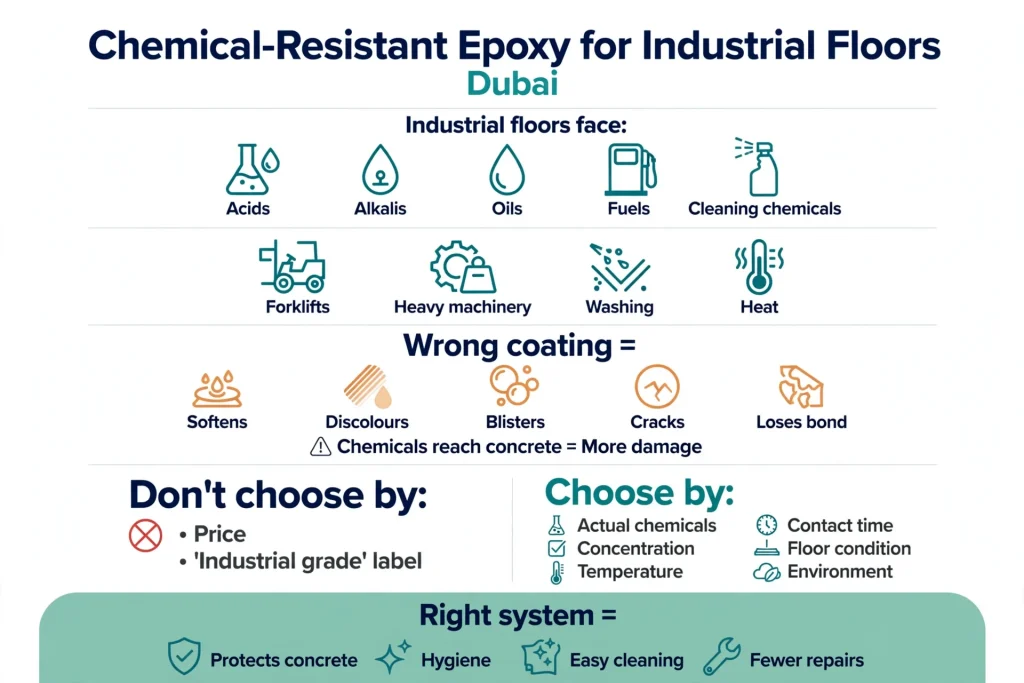
Industrial floors face much more than daily foot traffic. In factories, warehouses, workshops and processing plants, concrete floors can come into contact with acids, alkalis, oils, fuels, cleaning chemicals and other aggressive substances. Some areas may also experience forklift movement, heavy machinery, dropped equipment, regular washing and high temperatures.
A standard floor coating may look strong when first installed, but that does not mean it can handle every chemical used inside an industrial facility. The wrong coating can soften, discolour, blister, crack or lose its bond with the concrete. Once this happens, chemicals can reach the concrete below and cause further damage.
This is why choosing chemical-resistant epoxy flooring requires more than comparing product prices or selecting a coating described as industrial grade.
For facilities in Dubai, the decision should consider the actual chemicals used on site, their concentration, temperature, contact time, floor condition and operating environment. The local climate, building conditions and maintenance routine also need attention.
A properly selected epoxy flooring system can protect concrete, improve workplace hygiene, make cleaning easier and reduce the need for frequent floor repairs. However, the system must be suitable for the work carried out in each area.
This guide explains how to assess chemical exposure, compare epoxy flooring systems, prepare the concrete and select a finish that can handle the demands of an industrial facility in Dubai.
Why Chemical-Resistant Epoxy Flooring Is Important in Industrial Facilities
Concrete is strong, but it is not completely resistant to chemical attack. Its surface contains pores and can absorb certain liquids. When aggressive chemicals remain on untreated or poorly protected concrete, they may cause staining, surface deterioration and gradual loss of strength.
This can become a serious problem in areas where chemicals are used or stored every day.
For example, a manufacturing facility may use cleaning agents, lubricants, solvents and process chemicals in different sections. A vehicle maintenance workshop may deal with engine oil, fuel, battery fluids and degreasers. A chemical storage area may experience accidental spills from drums, containers or transfer equipment.
Without suitable floor protection, these substances can damage the concrete surface and make cleaning more difficult.
Chemical-resistant epoxy flooring creates a protective resin layer over the prepared concrete. When correctly selected and installed, the coating helps limit the movement of liquids into the substrate. Its seamless finish also reduces the number of joints where dirt, oil and spilled materials can collect.
Industrial epoxy flooring is commonly considered for manufacturing units, laboratories, workshops, warehouses, pharmaceutical facilities and processing areas. The actual suitability depends on the chemical resistance data of the proposed system.
A coating that performs well against oils may not provide the same protection against strong acids or certain solvents. Therefore, the chemical exposure must be understood before selecting the product.
Start by Identifying the Chemicals Used in Your Facility
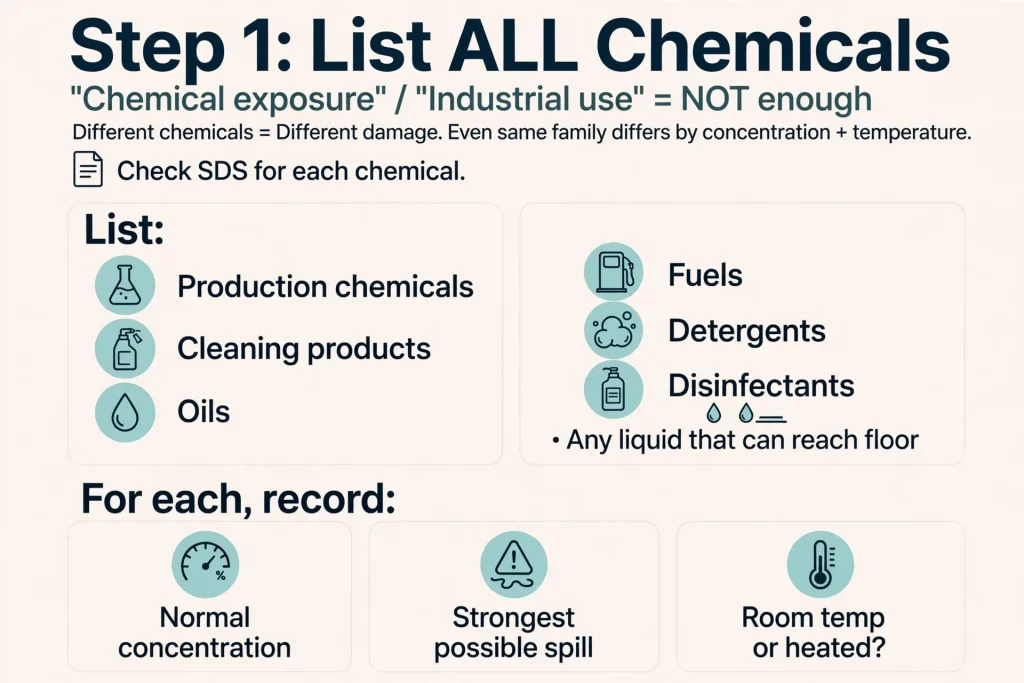
The first step is to prepare a clear list of chemicals that may come into contact with the floor.
Many flooring problems begin because the facility owner gives the contractor a general description such as chemical exposure or industrial use. These descriptions are not detailed enough to select the correct resin system.
Different chemicals can react with flooring materials in different ways. Even two products from the same chemical family may have different effects depending on their concentration and temperature.
Start by reviewing the safety data sheets (SDS) for the chemicals used in the facility. These documents help identify the chemical composition, concentration, handling requirements and potential hazards.
The list should include production chemicals, cleaning products, oils, fuels, detergents, disinfectants and any other liquids that may reach the floor.
For each substance, record its normal concentration and the strongest concentration that could realistically spill onto the surface. Also consider whether the chemical is used at room temperature or heated during the process.
A useful chemical exposure assessment should answer several questions.
- What is the exact name of the chemical?
- What is its concentration or dilution level?
- At what temperature can it reach the floor?
- Will the exposure be an occasional splash or a regular spill?
- How long could the liquid remain on the surface?
- Will the area be washed immediately after a spill?
- Which cleaning agents are used to remove the chemical?
- Could liquids collect around drains, equipment or floor joints?
These details help the flooring specialist compare the actual site conditions with the manufacturer’s chemical resistance chart.
For example, a floor may only experience small amounts of diluted cleaning chemicals during normal operations. Another area may have a risk of concentrated acid spills that remain on the surface for several hours. Both areas need chemical protection, but they may not need the same flooring specification.
Understand the Difference Between Chemical Splash and Continuous Exposure
Not every industrial floor faces the same level of chemical exposure. This is one of the most important points to understand before choosing a coating.
An epoxy system suitable for occasional chemical splashes may not be suitable for continuous contact or immersion.
Occasional chemical splashes
Some industrial areas only experience small splashes during normal work. A chemical container may leak briefly, or a worker may spill a small quantity while transferring liquids.
In these conditions, a suitable high-build epoxy coating may provide enough protection, provided the chemical resistance information confirms compatibility.
The cleaning procedure also matters. Even a resistant coating should not be expected to tolerate unlimited exposure if spills are left untreated.
Regular chemical spills
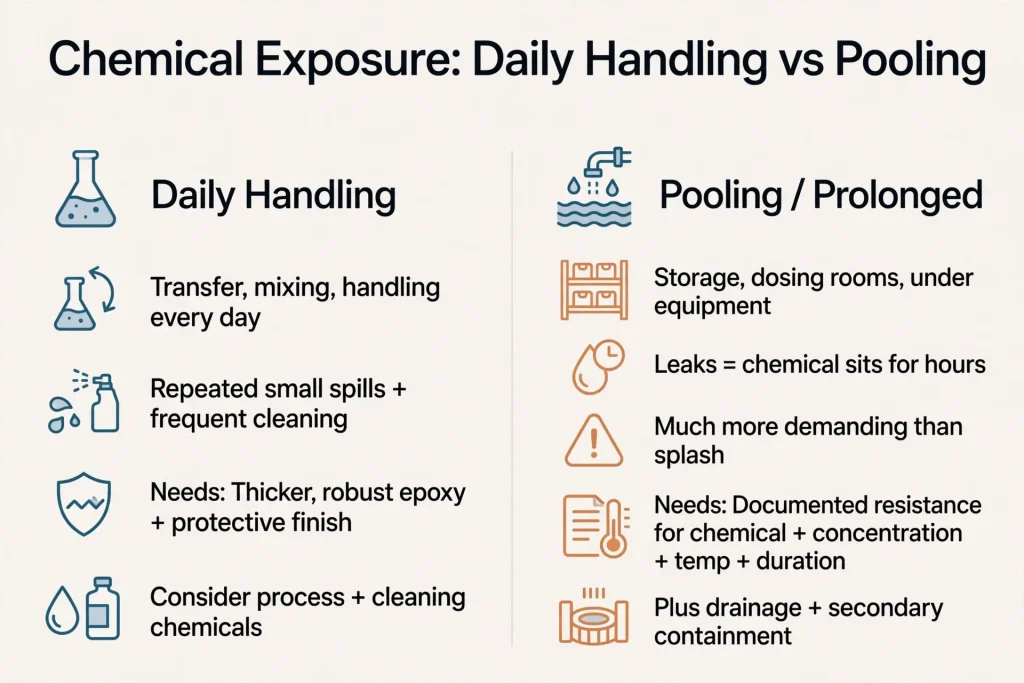
Areas where chemicals are transferred, mixed or handled every day face a greater risk. Small spills can happen repeatedly, and the floor may experience frequent cleaning.
These locations may need a thicker, more robust epoxy flooring system with a suitable protective finish.
The specification should consider both the process chemicals and the cleaning products used after each spill.
Prolonged contact and chemical pooling
Chemical storage areas, dosing rooms and locations beneath processing equipment may experience liquid pooling. A leaking container or damaged pipe can allow a chemical to remain on the floor for an extended period.
This exposure is more demanding than an occasional splash.
The proposed flooring system must have documented resistance for the actual chemical, concentration, temperature and expected contact duration. It may also be necessary to design the area with suitable drainage and secondary containment.
Continuous immersion
Continuous immersion is a specialist requirement. It should never be assumed that a standard industrial epoxy floor coating can handle it.
If a floor or concrete surface will remain in contact with a chemical for long periods, the designer must confirm that the complete system is suitable for that condition. A specialist chemical-resistant lining may be more appropriate than a conventional floor coating.
Choose the Right Epoxy Resin System
Epoxy flooring is available in different formulations and system builds. The resin, hardener, fillers, aggregate and protective topcoat all affect the final performance.
The correct choice depends on the facility’s chemical exposure and physical operating conditions.
Standard epoxy floor coating
A standard epoxy floor coating is commonly used to protect concrete in workshops, storage areas, plant rooms and general industrial spaces.
It creates a sealed surface that is easier to clean than untreated concrete. Depending on the product formulation, it may resist oils, lubricants, mild acids, alkalis and many common cleaning agents.
However, the term standard epoxy does not guarantee resistance to every chemical. Always check the product’s technical data sheet and chemical resistance information before approving it for a particular area.
High-build epoxy flooring
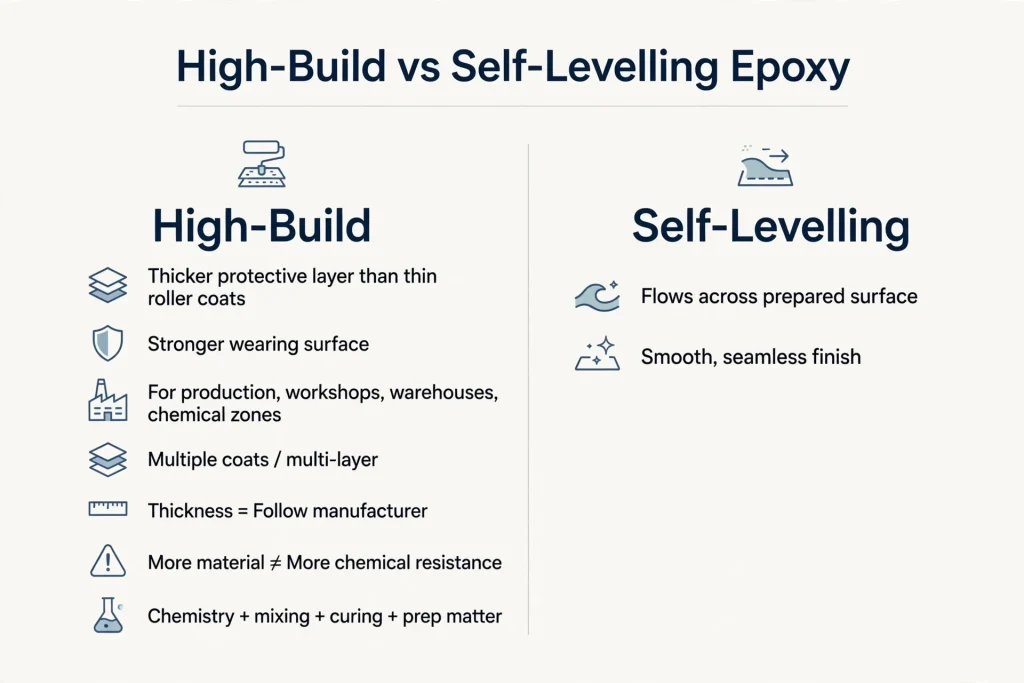
High-build epoxy systems create a thicker protective layer than thin roller-applied coatings.
They are often considered for industrial floors that need a stronger wearing surface and better protection against regular use. Depending on the system, they may be applied in multiple coats or as part of a multi-layer resin flooring build-up.
High-build epoxy can be useful in production areas, maintenance workshops, warehouses and selected chemical handling zones.
The specified thickness must come from the manufacturer’s system recommendation. Applying extra material does not automatically make a floor more chemical-resistant. Resin chemistry, correct mixing, curing and surface preparation remain important.
Self-levelling epoxy flooring
Self-levelling epoxy is a resin system that flows across a properly prepared surface to form a smooth, seamless finish.
It is often used in industrial and commercial facilities where an even floor is important for cleaning, movement and general hygiene.
A self-levelling system can be suitable for laboratories, pharmaceutical areas, manufacturing units and selected processing facilities.
However, a smooth surface may become slippery when oil, water or chemicals are present. If the area is exposed to spills or regular washing, the finish must be designed to provide suitable slip resistance.
Epoxy mortar flooring
Epoxy mortar flooring contains resin combined with graded aggregates. This creates a thicker and more robust flooring build-up than a thin coating.
It is often considered for floors exposed to heavy mechanical use, impact and demanding industrial traffic.
For example, a workshop with heavy equipment and regular trolley movement may need a stronger mortar system than a light-duty storage room.
Chemical resistance still needs to be confirmed separately. A strong mortar floor is not automatically suitable for every aggressive chemical.
Specialist chemical-resistant epoxy systems
Some facilities need a resin formulation designed for a particular chemical environment.
These systems may be suitable for selected acid handling areas, chemical processing rooms, electroplating facilities and industrial containment zones.
The exact product must be checked against the chemical exposure schedule. The complete flooring build-up should also be reviewed, including primer, body coat, topcoat, joint filler and any coving material.
A chemical-resistant topcoat cannot compensate for an incompatible layer underneath it.
Check the Chemical Resistance Chart Before Buying
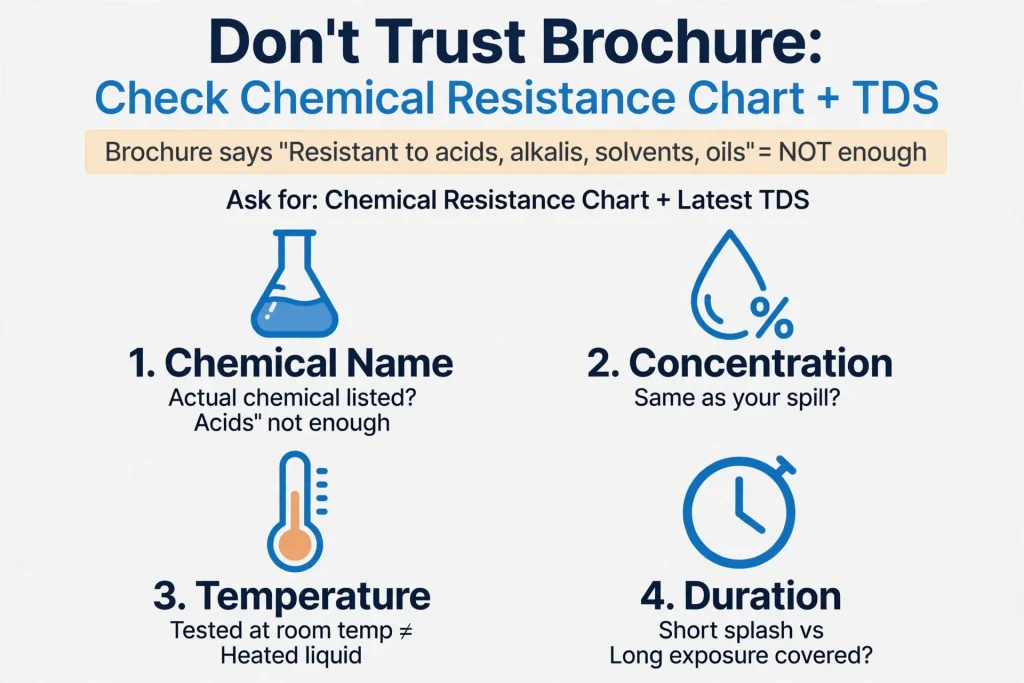
A product brochure may describe an epoxy coating as resistant to acids, alkalis, solvents and oils. This is useful as an introduction, but it is not enough to approve the material.
Ask the manufacturer or supplier for the chemical resistance chart and the latest technical data sheet (TDS).
The chart should identify which chemicals have been tested and the conditions under which the results were recorded.
Pay attention to the following details:
Chemical name: Confirm that the actual chemical is listed. A general reference to acids or solvents is not enough.
Concentration: Check whether the test was carried out using the same concentration that may reach the floor.
Temperature: Chemical resistance can change when the liquid is heated. A product tested at room temperature may not provide the same performance at higher temperatures.
Exposure duration: Some charts distinguish between short-term contact and longer exposure. Check whether the expected contact time is covered.
Curing period: Chemical resistance is normally assessed after the resin has reached the required cure. Do not assume that a newly installed floor is ready for chemical exposure.
Change in appearance: Some chemicals may cause staining or colour changes without immediately affecting the floor’s protective performance. Other reactions can cause softening, swelling or loss of adhesion.
The manufacturer should clarify the meaning of each rating. If the chemical or exposure condition is not covered, request written confirmation rather than making assumptions.
For example, the SpECtop ARE125 technical data sheet provides a chemical resistance chart for its high-performance epoxy coating and identifies industrial applications such as production areas, dairies, beverage facilities and electroplating shops. Its listed resistance results are product-specific and should not be treated as proof that all epoxy coatings provide the same performance.
The same principle applies to every product being considered for an industrial flooring project.
Consider Dubai’s Climate and Site Conditions
Dubai’s climate creates additional considerations when planning an epoxy flooring installation.
High outdoor temperatures, strong sunlight, humidity changes and air-conditioned indoor environments can affect construction planning. The actual conditions inside the facility are more important than the general weather forecast, but the local climate should still be considered.
Temperature during application
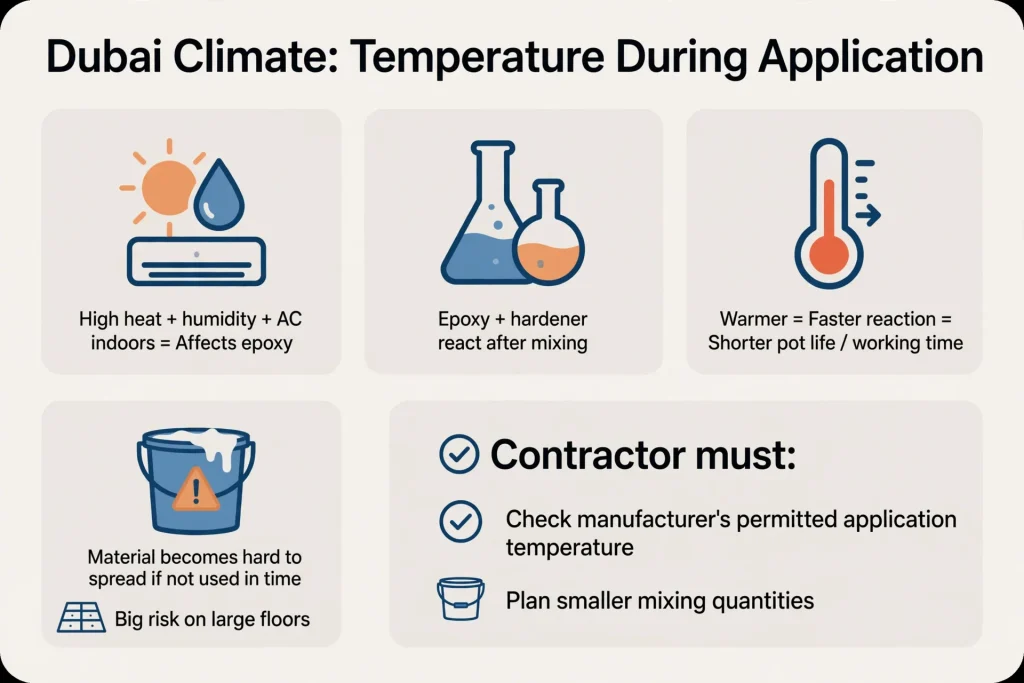
Epoxy resin and hardener react after mixing. Temperature affects the speed of this chemical reaction.
In warmer conditions, some products have a shorter working time, also known as pot life. The mixed material may become difficult to spread if the application team cannot use it within the recommended period.
This is especially important in large industrial facilities where several workers need to apply the material across wide floor areas.
The contractor should check the manufacturer’s permitted application temperature and plan mixing quantities accordingly.
Concrete temperature and direct sunlight
The temperature of the concrete surface can be higher than the surrounding air temperature, particularly in areas exposed to sunlight.
Applying epoxy to a surface outside the product’s recommended temperature range can affect working time, flow, adhesion and final appearance.
Outdoor loading bays and open industrial areas may also need a UV-resistant protective finish. Some epoxy coatings can change colour or become less attractive after prolonged sunlight exposure.
If the floor receives direct sunlight, ask whether the proposed system needs a UV-stable polyurethane topcoat or another suitable finish.
Humidity and moisture
Moisture is one of the common reasons epoxy flooring fails.
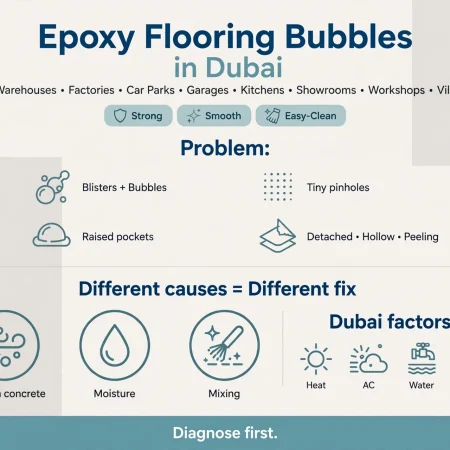
A concrete slab may appear dry while still containing moisture inside. If the moisture level is too high for the selected resin system, the coating may develop bubbles, blisters or adhesion problems.
Humidity can also affect the application and curing process, depending on the product.
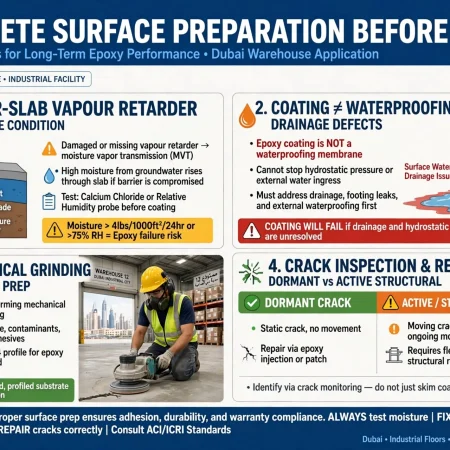
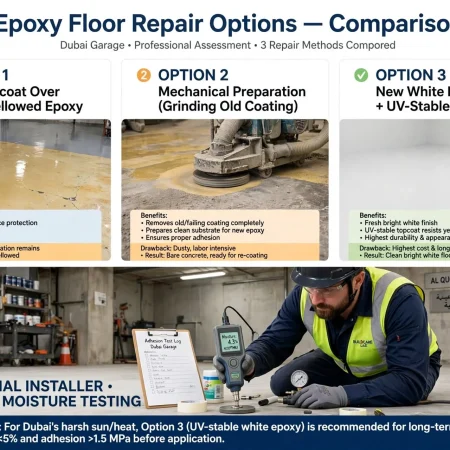
Before installation, the contractor should assess the substrate moisture using a suitable test method and compare the results with the manufacturer’s requirements.
A moisture-control primer or damp-proofing system may be required in some situations. It must be compatible with the proposed flooring build-up.
Indoor and outdoor flooring requirements
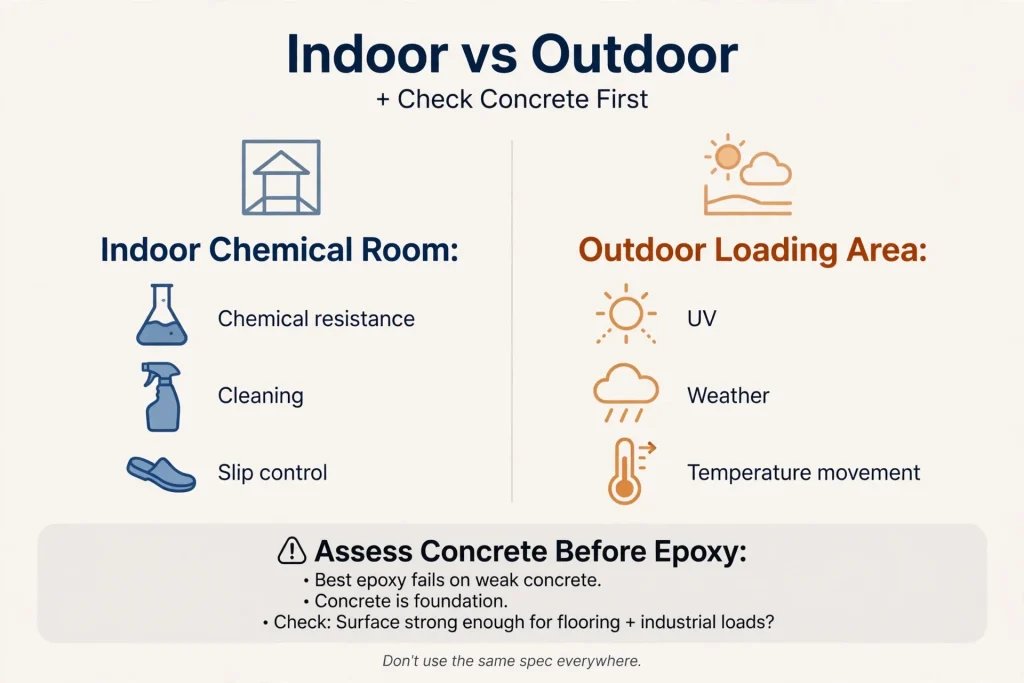
An indoor chemical processing room has different requirements from an exposed loading area.
Indoor floors may prioritise chemical resistance, cleaning and slip control. Outdoor surfaces may also need protection against UV exposure, weather changes and temperature movement.
Do not use the same specification across every area without checking its suitability.
Assess the Concrete Before Applying Epoxy Flooring
Even the best chemical-resistant epoxy system can fail if it is applied over weak or poorly prepared concrete.
The concrete slab is the foundation of the flooring system. Its condition must be checked before any primer or resin is applied.
Check the concrete strength
The surface should be strong enough to support the proposed flooring system and the expected industrial loads.
Weak concrete, loose material and surface laitance must be removed. If the slab is damaged, the affected sections should be repaired using suitable materials.
Applying epoxy over a weak surface can result in the coating separating from the concrete.
Identify cracks and damaged areas
Cracks should be inspected before installation.
Some cracks are non-moving and can be repaired using a suitable repair compound. Others may be active or structural and require further assessment.
Simply filling every crack with epoxy does not solve the underlying problem.
The contractor should identify the cause and decide whether the crack needs repair, flexible treatment or a properly detailed movement joint.
Remove oil and chemical contamination
Industrial concrete floors often contain oil, grease, fuel and chemical residues.
These contaminants can prevent the primer from bonding properly with the concrete.
The surface may need specialist cleaning and mechanical preparation. Depending on the condition, grinding, captive shot blasting or other suitable preparation methods may be required.
Chemical contamination should not be covered with a new resin layer without proper assessment.
Check moisture and rising damp
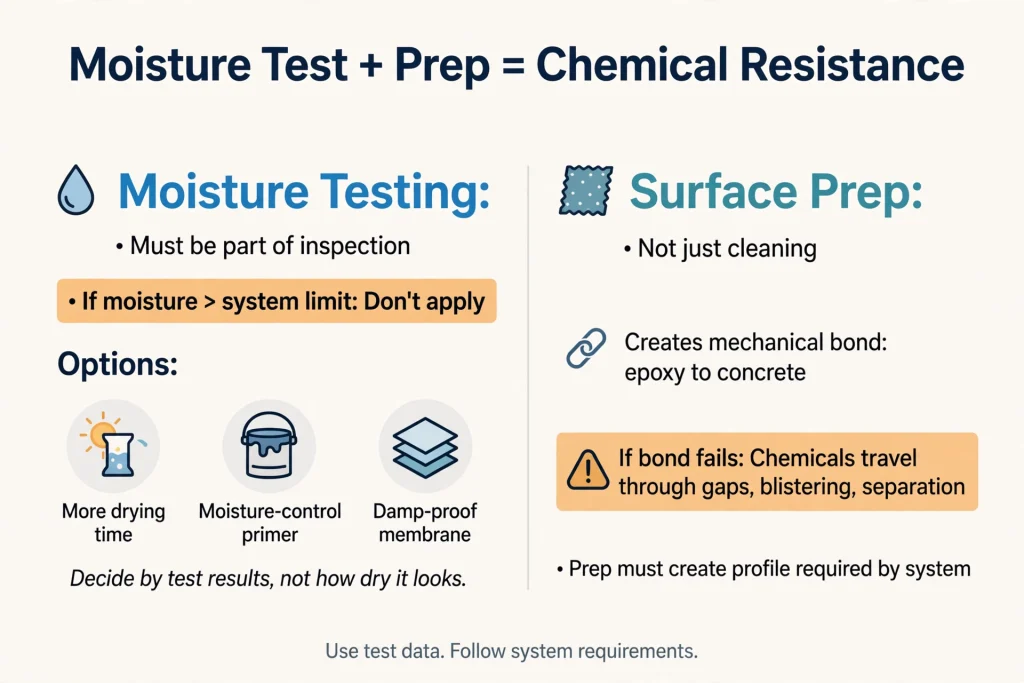
Moisture testing should form part of the site inspection.
If moisture levels exceed the selected system’s limits, the contractor must determine the correct solution before application.
Possible options include additional drying time, a compatible moisture-control primer or a suitable damp-proof membrane system.
The decision should be based on actual test results, not simply on how dry the floor looks.
Why Surface Preparation Has a Direct Effect on Chemical Resistance
Surface preparation is not just a step to make the floor look clean. It helps create the mechanical bond between the epoxy and the concrete.
If the coating loses adhesion, chemicals may travel through gaps and reach the substrate. This can cause local damage, blistering and further separation.
The preparation method should create the surface profile required by the selected epoxy system.
Mechanical grinding or shot blasting is commonly used to remove weak surface material, old coatings and contaminants. The method depends on the condition of the slab and the manufacturer’s requirements.
After preparation, the floor should be vacuumed using suitable industrial equipment. Dust and loose particles must be removed before the primer is applied.
Any repairs should be completed with compatible materials. The repaired areas should also be properly prepared before the next flooring layer is installed.
A contractor should not start applying epoxy simply because the surface looks clean. The preparation needs to be checked and approved.
Choose the Right Floor Finish for Slip Resistance
Chemical resistance is important, but workplace safety must also be considered.
An epoxy floor with a very smooth finish may be easy to clean, but it can become slippery when exposed to water, oil or chemical spills.
A textured or anti-slip finish can provide better grip under the right conditions.
The level of texture should match the work carried out in the area.
For example, a dry warehouse aisle may need a different finish from a chemical mixing room where workers regularly handle liquids. A wet processing area may require a more pronounced anti-slip surface.
The flooring specialist can incorporate suitable graded aggregates into the resin system to create the required texture.
However, there is a balance to maintain. A very rough floor can hold dirt and make cleaning difficult. This can be a problem in food production, pharmaceutical and hygiene-sensitive areas.
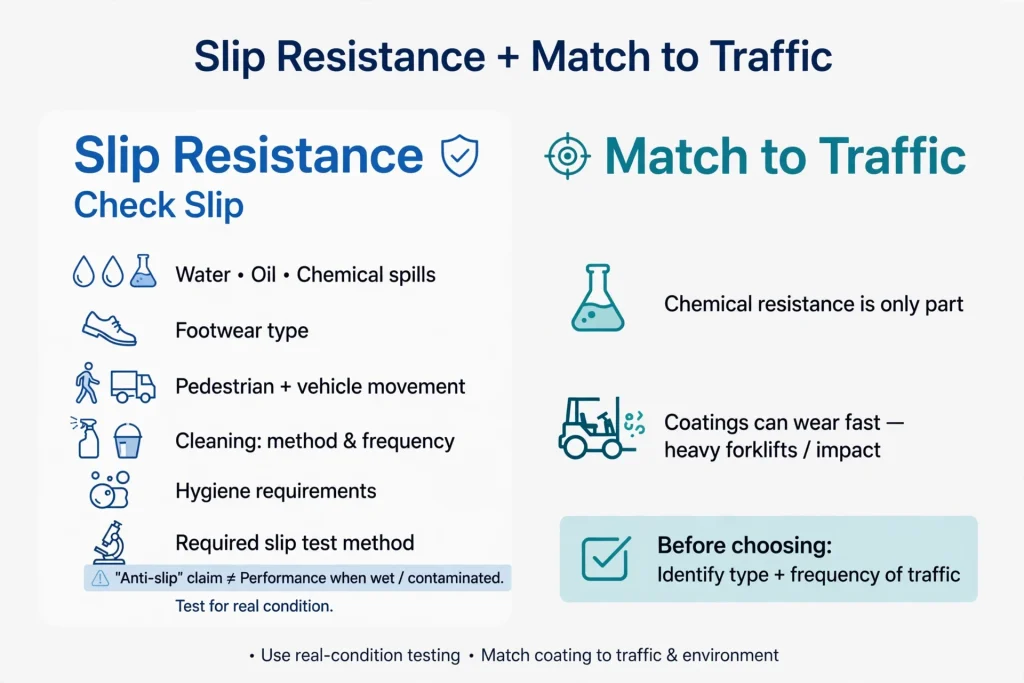
The selected finish should therefore consider:
- Expected water, oil and chemical spills.
- Type of footwear used by workers.
- Pedestrian and vehicle movement.
- Cleaning equipment and cleaning frequency.
- Hygiene requirements.
- Required slip-resistance test method.
Slip resistance should be assessed using an appropriate test for the actual floor condition. A general claim that a floor is anti-slip does not explain how it will perform when wet or contaminated.
Match the Flooring System to Industrial Traffic
Chemical exposure is only one part of the specification. Industrial floors must also withstand mechanical loads.
A chemical-resistant coating may still wear down quickly if it is installed in an area with heavy forklift movement or repeated impact.
Before choosing the system, identify the type and frequency of traffic.
Forklifts and pallet trucks
Forklift routes experience repeated wheel movement, turning forces and braking. These actions can wear the surface and place stress on the coating.
Turning points, loading zones and areas around storage racks may experience more wear than normal pedestrian routes.
A suitable high-build or epoxy mortar system may be considered where the mechanical demands require it.
Heavy machinery
Manufacturing plants often have heavy equipment that creates concentrated loads.
The contractor should consider machinery weight, support points, vibration and the condition of the concrete slab.
A resin coating cannot correct a structurally weak slab or compensate for an unsuitable foundation.
Dropped tools and equipment
Workshops and production areas may experience impact from tools, metal parts and other equipment.
If dropped objects are common, the floor needs sufficient impact resistance for the expected operating conditions.
Pedestrian areas
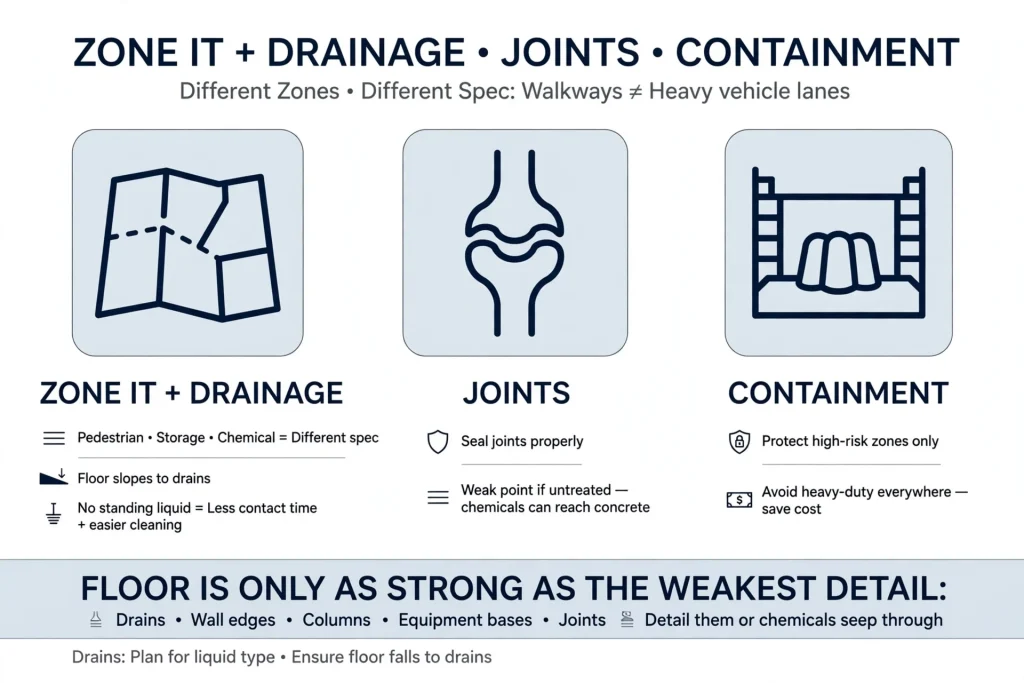
Walkways and staff access routes may not need the same thickness as heavy vehicle lanes. However, they still require a safe and durable finish.
Some facilities benefit from different floor specifications for pedestrian routes, storage aisles and chemical handling areas.
This approach avoids paying for the same heavy-duty build-up everywhere while ensuring that high-risk zones receive proper protection.
Consider Drainage, Floor Joints and Chemical Containment
A chemical-resistant floor is only as effective as its weakest detail.
Many problems begin around drains, wall edges, columns, equipment bases and floor joints. These areas can allow chemicals to reach the concrete if they are not correctly detailed.
Floor drains
Drainage should be planned according to the type of liquid handled in the facility.
The floor should have suitable falls towards the drainage points where required. Standing liquids can increase contact time and make cleaning more difficult.
Drain covers, channels and surrounding details must be compatible with the chemicals and cleaning methods used on site.
Wall-to-floor junctions
Chemical spills can collect along the edges of rooms and beneath equipment.
Epoxy coving can create a curved transition between the floor and wall. This helps reduce sharp corners where dirt and liquid can collect.
The coving material must be compatible with the main flooring system.
Expansion and movement joints
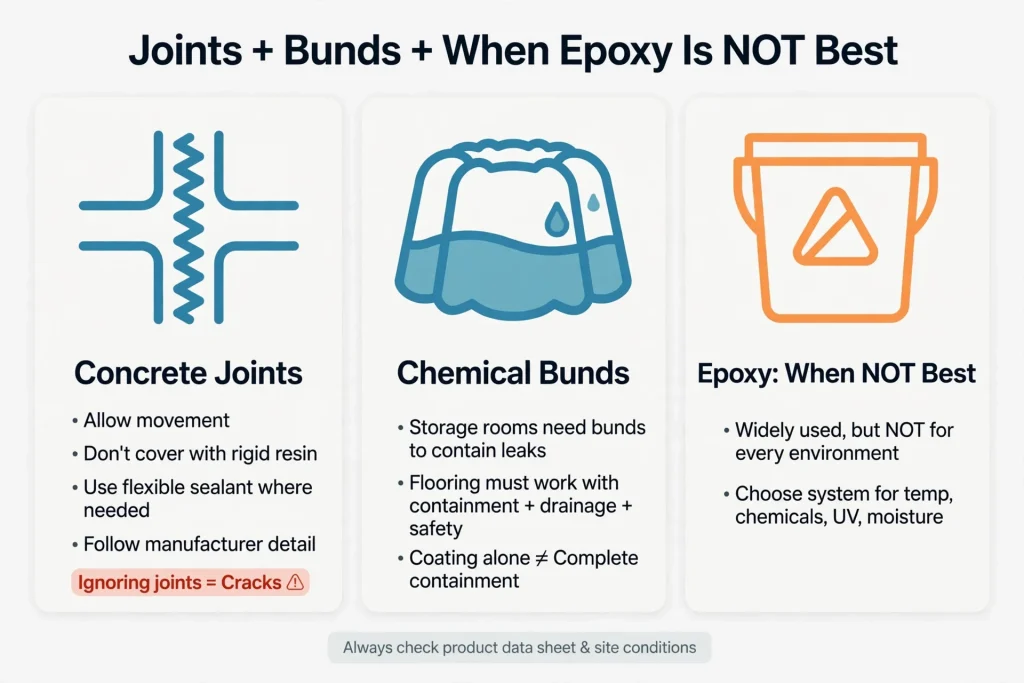
Concrete joints allow for movement and should not simply be covered with rigid resin.
The contractor needs to identify which joints require flexible sealants and which can be treated using the flooring manufacturer’s recommended detail.
Ignoring movement joints can lead to cracks in the finished coating.
Chemical bunds and containment areas
Chemical storage rooms may need bunded areas to help contain accidental leaks and spills.
The flooring specification should work alongside the facility’s containment design, drainage arrangements and safety requirements.
A floor coating alone should not be treated as a complete chemical containment solution.
Understand When Epoxy May Not Be the Best Option
Epoxy is a widely used industrial flooring material, but it is not suitable for every environment.
Some facilities have conditions that require a different resin chemistry.
For example, areas exposed to very hot wash water, repeated thermal shock or demanding wet processing may benefit from a specialist polyurethane-cement flooring system.
Polyurethane-cement systems are often considered in food production, commercial kitchens and certain industrial processing environments where temperature changes and aggressive cleaning are major concerns.
Methyl methacrylate (MMA) flooring may be considered when a project needs a faster return to service, subject to the system’s chemical and operating limits.
Specialist vinyl ester or other chemical-resistant resin systems may also be considered for particularly aggressive chemical exposure.
The right decision should come from comparing the actual performance requirements, not from assuming that one resin type is always better than another.
If epoxy meets the chemical, temperature, traffic and hygiene requirements, there may be no reason to select a more specialised system. If it does not, the specification should be changed before installation.
How to Compare Epoxy Flooring Suppliers in Dubai
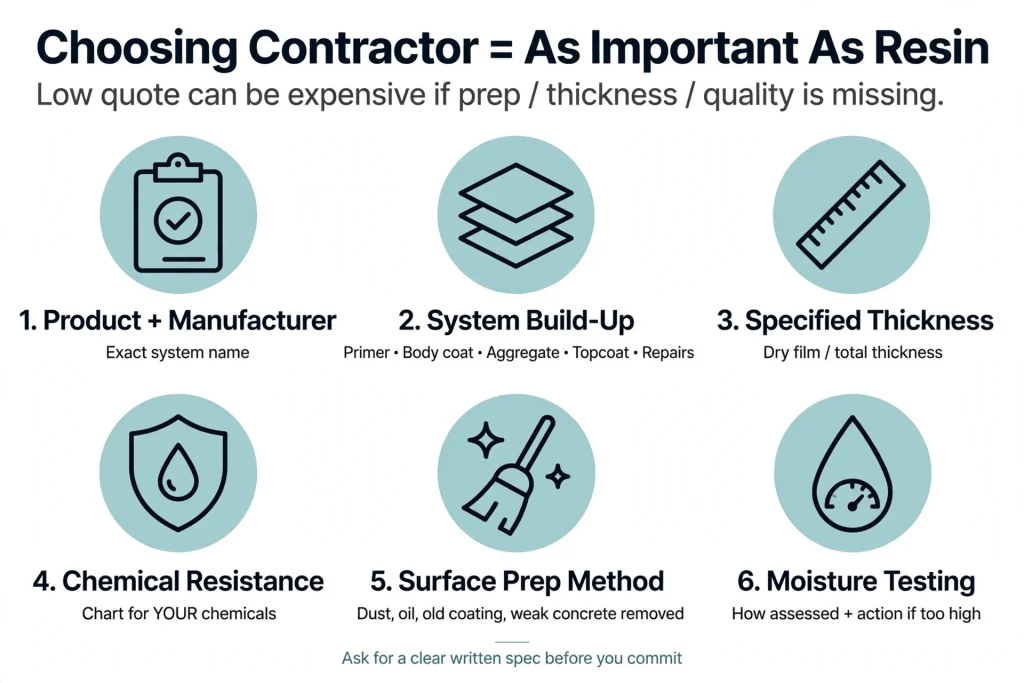
Choosing a suitable contractor is just as important as choosing the resin.
Two contractors may offer epoxy flooring at different prices, but their proposals may not include the same preparation, thickness, material quality or protective finish.
A low quotation can become expensive if important parts of the flooring system are missing.
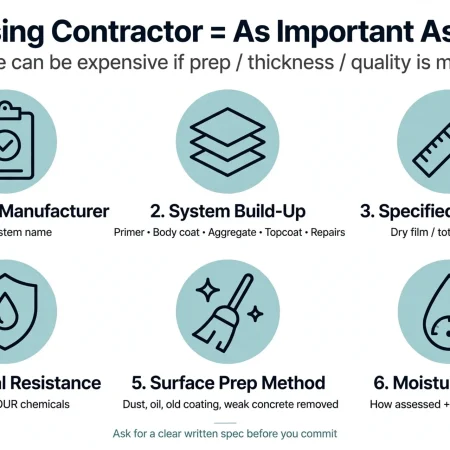
When comparing suppliers and contractors in Dubai, ask for a clear written specification.
It should identify the following:
Product name and manufacturer: The proposal should state exactly which epoxy system will be used.
System build-up: Check the primer, body coat, aggregate, topcoat and any repair materials included.
Specified thickness: The quotation should explain the required dry film thickness or total system thickness, as applicable.
Chemical resistance information: Request the relevant resistance chart for the actual chemicals used at the facility.
Surface preparation method: Confirm how existing coatings, dust, oil, weak concrete and other contaminants will be removed.
Moisture testing: Ask how the concrete will be assessed before installation and what happens if moisture levels are too high.
Slip resistance: Confirm the finish and how its suitability will be assessed for the working environment.
Curing and handover: The contractor should explain when the floor can accept foot traffic, vehicle traffic, cleaning and chemical exposure.
Warranty and maintenance: Ask what is covered and which cleaning methods are approved by the manufacturer.
A professional proposal should describe the complete flooring system rather than simply state that industrial epoxy will be applied.
It is also worth asking whether the contractor has experience with facilities that have similar chemical exposure and operating conditions.
What Does the Epoxy Flooring Installation Process Involve?
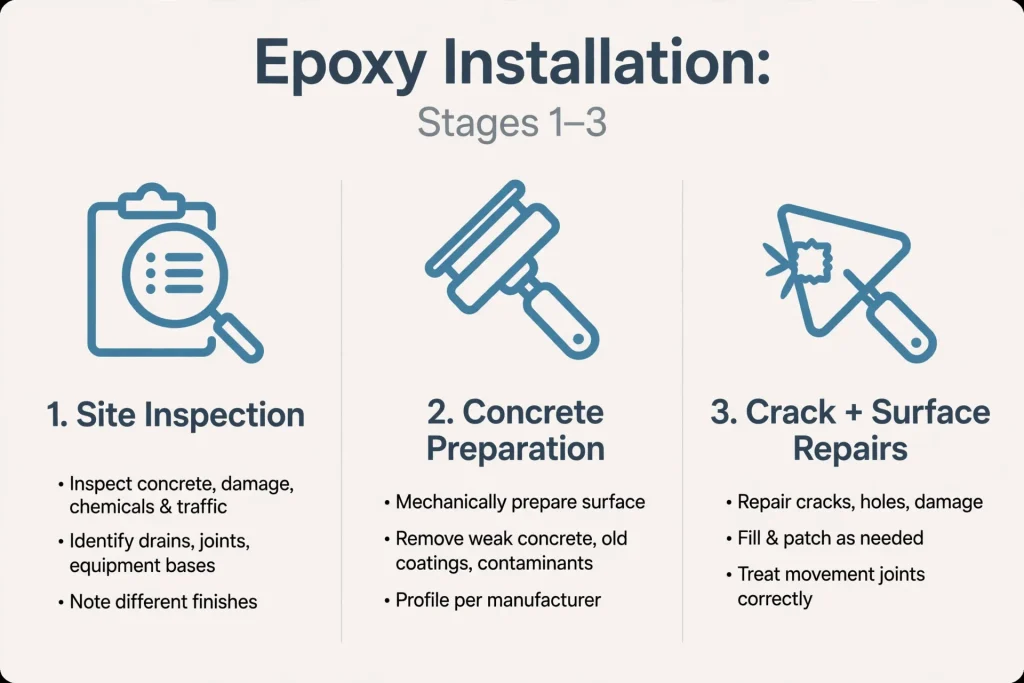
The installation process depends on the selected system, but a typical industrial epoxy project follows several important stages.
1. Site inspection and assessment
The contractor inspects the concrete, identifies damaged areas and reviews the chemicals and traffic expected in the facility.
This is also the time to identify drains, joints, equipment bases and any areas that need a different finish.
2. Concrete preparation
The surface is mechanically prepared to remove weak concrete, old coatings and contaminants.
The required surface profile depends on the manufacturer’s system instructions.
3. Crack and surface repairs
Cracks, holes and damaged areas are repaired using suitable materials.
The contractor should also check that movement joints and other structural details are treated correctly.
4. Moisture assessment and priming
Moisture test results are reviewed before applying the primer.
A suitable primer is then applied to help the flooring system bond with the prepared concrete. If moisture control is required, the specified compatible system should be installed at this stage.
5. Epoxy application
The resin and hardener are mixed in the correct ratio.
The material is applied according to the manufacturer’s instructions, including the specified thickness, coverage rate and recoat time.
Mixing errors, incorrect application thickness and poor working conditions can affect the final result.
6. Protective finish and texture
Where required, the contractor applies the specified topcoat or anti-slip finish.
The surface texture should be suitable for the area’s traffic, cleaning and safety requirements.
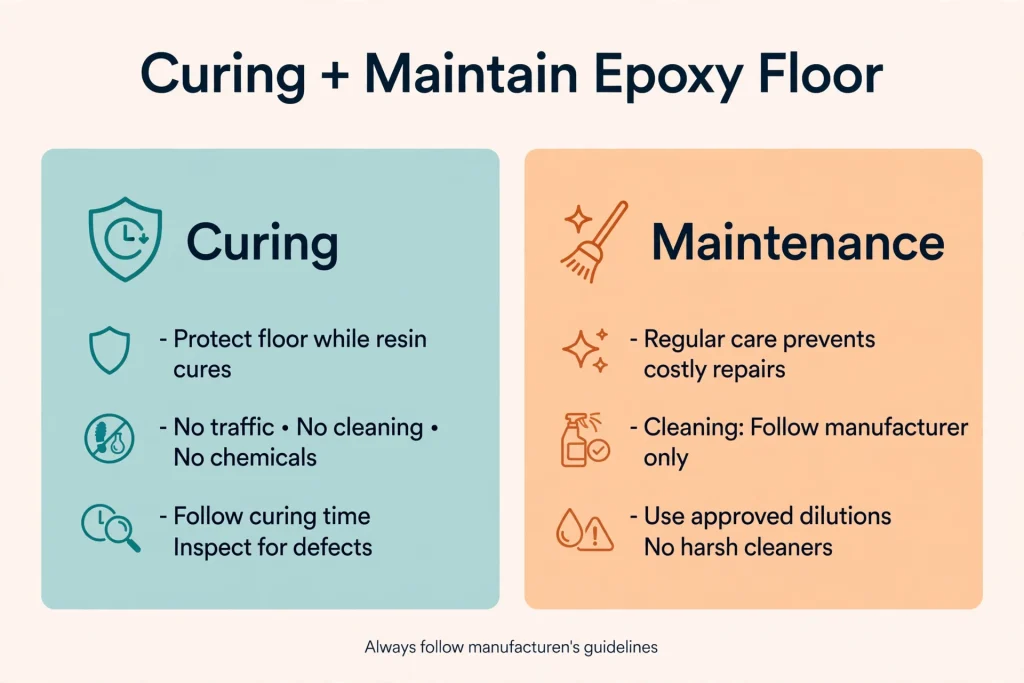
7. Curing and final inspection
The floor is protected while the resin cures.
The facility should not allow premature traffic, cleaning or chemical exposure. The handover should follow the manufacturer’s stated curing requirements for each type of use.
The completed floor should be inspected for defects, incomplete coverage, poor detailing and other visible problems.
How to Maintain Chemical-Resistant Epoxy Flooring
Even a well-installed industrial epoxy floor needs regular care.
Good maintenance helps protect the coating and makes it easier to identify small problems before they become expensive repairs.
The cleaning method should always follow the manufacturer’s recommendations.
Use approved cleaning agents at the correct dilution. Strong chemicals should not be introduced simply because they are commonly used in industrial cleaning. Some products may attack the floor or gradually damage its protective finish.
Chemical spills should be cleaned as soon as it is safe to do so. The facility should have a spill response procedure based on the chemical’s safety data sheet.
Avoid dragging heavy equipment or sharp metal objects across the floor where possible. Use suitable wheels, protective pads and handling methods.
Regular inspections should focus on:
- Areas around chemical storage containers.
- Floor joints and wall coving.
- Drains and channels.
- Forklift turning points.
- Equipment bases.
- Locations where spills happen frequently.
- Areas with visible scratches, cracks or coating separation.
If the coating becomes damaged, the affected area should be assessed and repaired using a compatible system. Applying a new layer over an unknown or poorly bonded coating may only hide the problem temporarily.
Common Mistakes to Avoid When Selecting Chemical-Resistant Epoxy Flooring
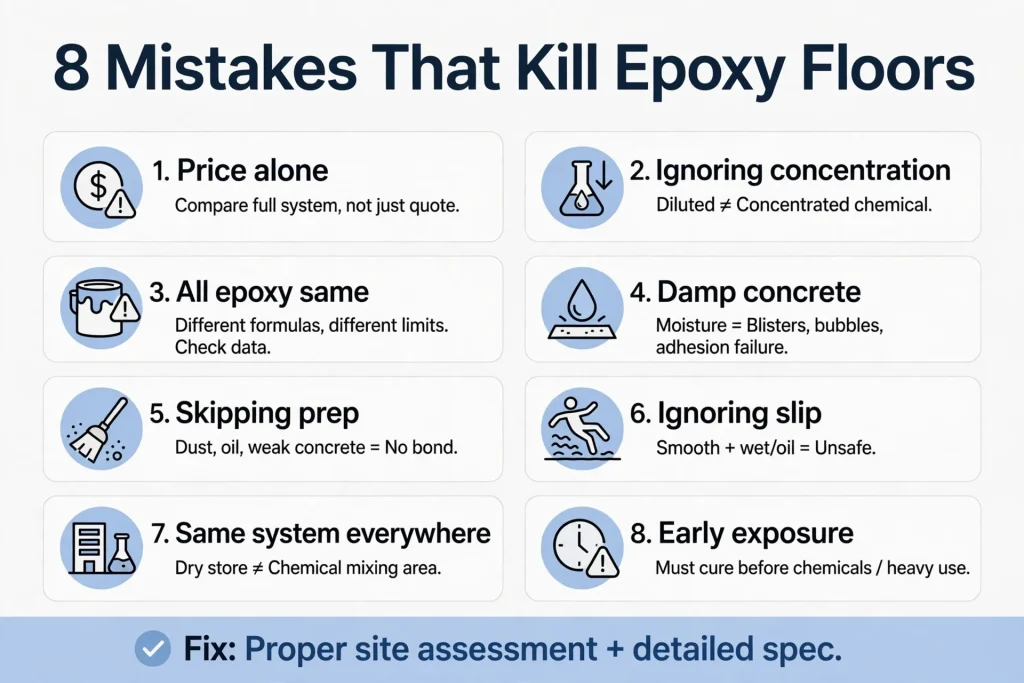
A few common mistakes can shorten the life of an industrial floor, even when the material itself is of good quality.
Choosing by price alone: A cheaper coating may have a lower thickness, different resin formulation or limited chemical resistance. Compare complete system specifications rather than only the total quotation.
Ignoring chemical concentration: A product that resists a diluted cleaning solution may not withstand the concentrated chemical stored in the same facility.
Assuming all epoxy products are the same: Different epoxy formulations have different performance limits. The product name and technical data matter.
Applying epoxy over damp concrete: Excessive moisture can lead to blistering, bubbles and adhesion failure. Always assess the substrate before installation.
Skipping mechanical preparation: Dust, oil, weak concrete and old coating residues can prevent proper bonding.
Ignoring slip resistance: A smooth floor may become unsafe when exposed to water, oils or cleaning chemicals.
Using the same system throughout the building: A dry storage room and a chemical mixing area do not necessarily need the same floor build-up.
Allowing early chemical exposure: The coating must reach the required cure before it is exposed to chemicals or heavy service conditions.
Avoiding these mistakes starts with a proper site assessment and a detailed flooring specification.
Where Is Chemical-Resistant Epoxy Flooring Used in Dubai?
Dubai has a wide range of industrial and commercial operations where floor protection is important.
The right flooring system will depend on the work carried out inside each facility.
In manufacturing plants, epoxy flooring can protect concrete in production areas where oils, process chemicals and regular equipment movement are present.
In warehouses and logistics facilities, suitable resin flooring can provide a sealed, easy-to-clean surface while supporting the movement of pallet trucks and other equipment.
In automotive workshops, the floor may need resistance to lubricants, oils, fuels and cleaning products. Mechanical wear and slip resistance should also be considered.
In laboratories and pharmaceutical facilities, the flooring specification may focus on chemical compatibility, hygiene, smooth finishes and controlled cleaning.
In food and beverage processing facilities, the floor must be suitable for the cleaning chemicals, washdown routine, hygiene needs and temperature conditions. A specialist polyurethane-cement system may be more appropriate in some areas.
In chemical storage and handling rooms, the most important requirements may include resistance to specific substances, spill management, drainage and containment details.
Industrial facilities in areas such as Jebel Ali, Al Quoz, Dubai Industrial City and other commercial and manufacturing zones may have very different operational needs. The location alone does not determine the flooring system. The processes inside the building do.
Final Checks Before Approving Your Industrial Epoxy Flooring System
Before approving a chemical-resistant epoxy floor for your Dubai facility, make sure the proposed system has been assessed against the actual working conditions.
The chemical list should be complete, including cleaning products and possible accidental spills. The manufacturer’s resistance data should cover the relevant chemical concentrations, temperatures and exposure periods.
The concrete should be inspected and tested, and the proposed preparation method should be suitable for its condition. The specification should also include the required thickness, slip-resistant finish, joint treatment and protective details.
Finally, check the curing schedule and make sure it fits the facility’s shutdown and operating plans.
The most suitable floor is not necessarily the thickest or most expensive option. It is the system that provides the required chemical protection while handling the traffic, cleaning routine, temperature and working conditions of the facility.
A proper site survey and product-specific specification can help avoid premature coating failure and unnecessary repair costs. For facilities that need a complete flooring solution, Epoxy Flooring for Industrial Facilities Services can be considered as part of a wider plan to protect concrete floors and support daily industrial operations.
Choosing the right system at the beginning helps create a floor that is safer to work on, easier to maintain and better prepared for the demands of an industrial environment.