What Is a Schneider Electric Building Management System?
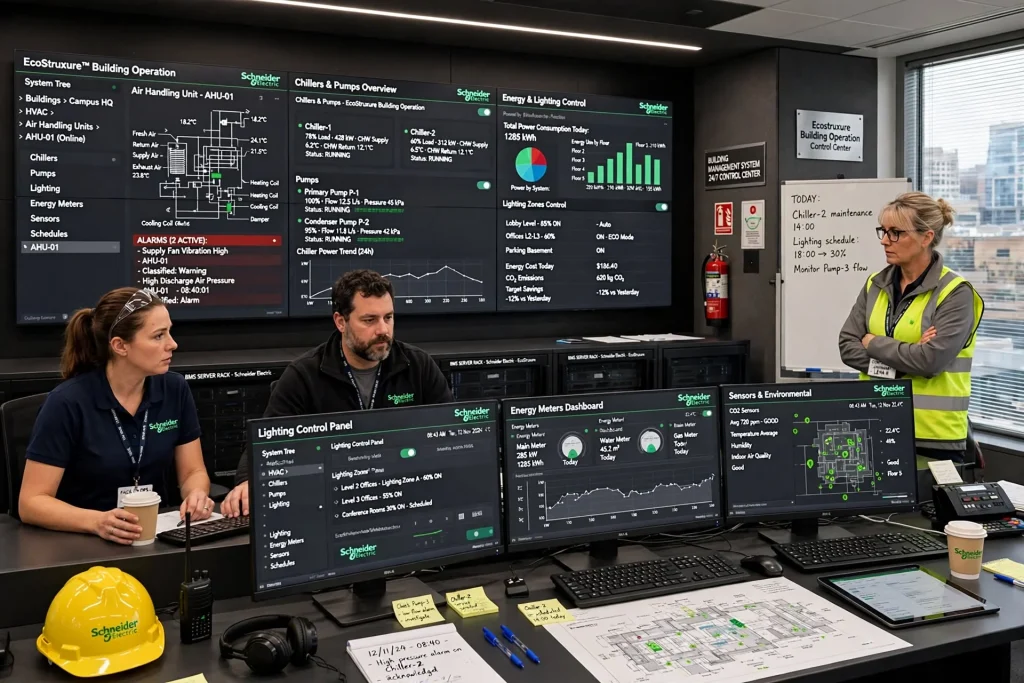
A Building Management System is a centralised platform that monitors and controls important mechanical and electrical services inside a building. It connects equipment such as air handling units, chillers, pumps, lighting controls, sensors and energy meters, allowing facility teams to manage building operations through a common interface.
Schneider Electric’s building automation portfolio includes EcoStruxure Building Operation, a platform designed to monitor, manage and optimise building systems. It brings data from HVAC, lighting, power, security and other connected systems into a central environment. This gives building operators a clearer picture of equipment performance, operating conditions and energy consumption.
Rather than treating each building service as an isolated installation, an integrated BMS helps different systems exchange information. For example, occupancy information from a room controller can support temperature and lighting adjustments, while energy meters can help facility managers identify unusual consumption patterns.
How Schneider Electric BMS Supports Building Automation
Building automation uses sensors, controllers, software and communication networks to manage building services according to defined operating conditions. A Schneider Electric BMS installation can be designed around the building’s size, equipment, operational requirements and integration needs.
The system collects information from field devices, processes control instructions and presents operating information through dashboards and graphical interfaces. Facility managers can use this information to review system status, adjust schedules, investigate alarms and understand how building equipment is performing.
For a commercial property, this may mean coordinating air conditioning schedules with working hours. In a hotel, it may involve managing room temperature, ventilation and lighting according to occupancy. In a hospital, building operators may need closer monitoring of ventilation conditions and critical mechanical equipment.
The objective is to create a more coordinated operating environment while keeping essential equipment under appropriate control.
Main Components of a Schneider Electric BMS
A building management system is not a single controller or software application. It is a combination of field devices, automation hardware, communication networks and supervisory software. Each component has a specific role in collecting information and controlling building services.
Sensors and Field Devices
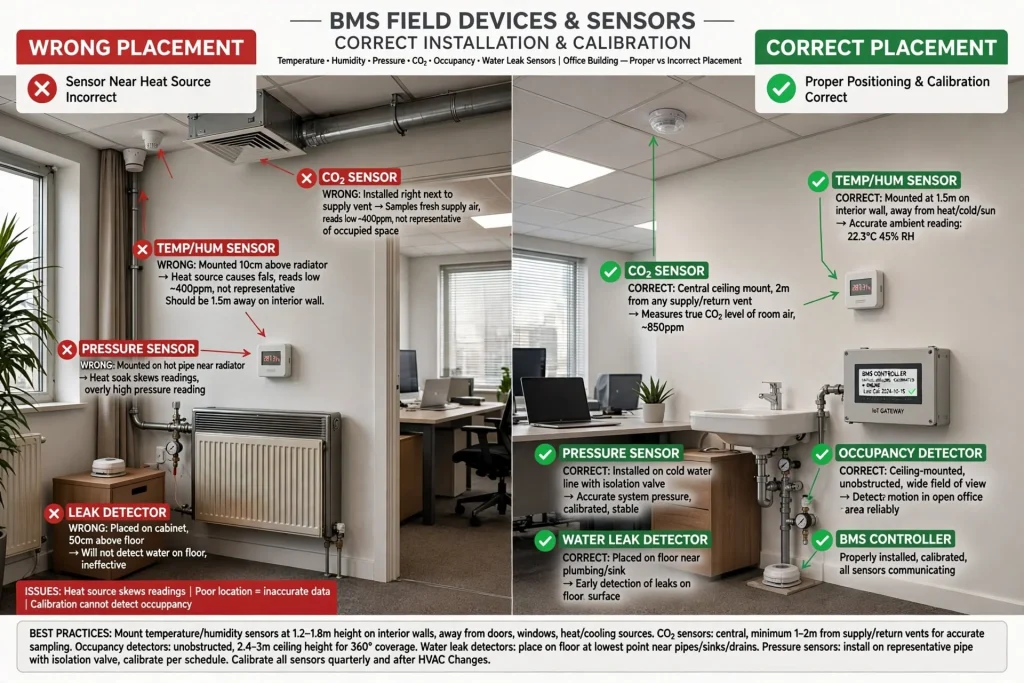
Sensors provide the information that a BMS needs to make control decisions. Common examples include temperature sensors, humidity sensors, pressure sensors, occupancy detectors, CO₂ sensors and water leak detectors.
In an office building, room temperature sensors can help maintain suitable indoor conditions. Differential pressure sensors can provide information about air filters or duct conditions, depending on the application. Occupancy sensors can help identify whether a room is being used.
Correct sensor positioning and calibration are important. A temperature sensor installed near a heat source, direct sunlight or an air supply diffuser may provide readings that do not represent the actual room conditions. Poor sensor placement can affect control accuracy even when the software and controllers are configured correctly.
Automation Servers and Controllers
Controllers receive information from sensors and connected equipment, then execute programmed control sequences. These sequences determine how equipment should respond to changing conditions.
Schneider Electric’s SpaceLogic range includes automation servers and controllers used within its building automation ecosystem. Depending on the selected architecture, these devices can support control logic, input and output connections, communication with field devices, alarm supervision and trend logging.
For example, a controller may operate an air handling unit according to a schedule, temperature demand and other configured conditions. It can also monitor feedback signals to help identify whether equipment is responding as expected.
BMS Software and Operator Interface
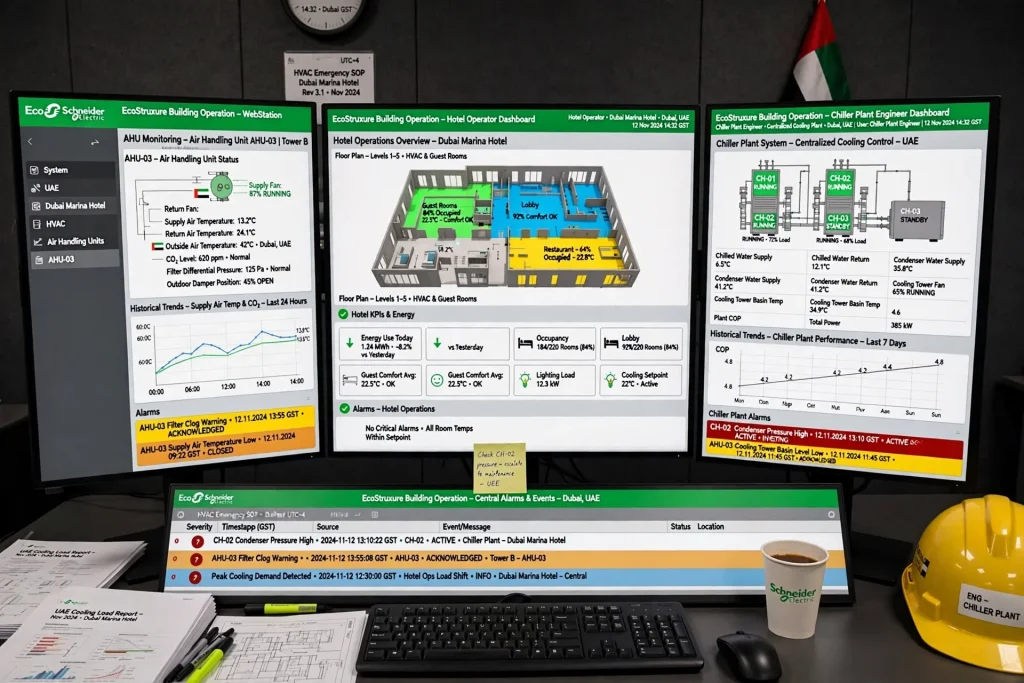
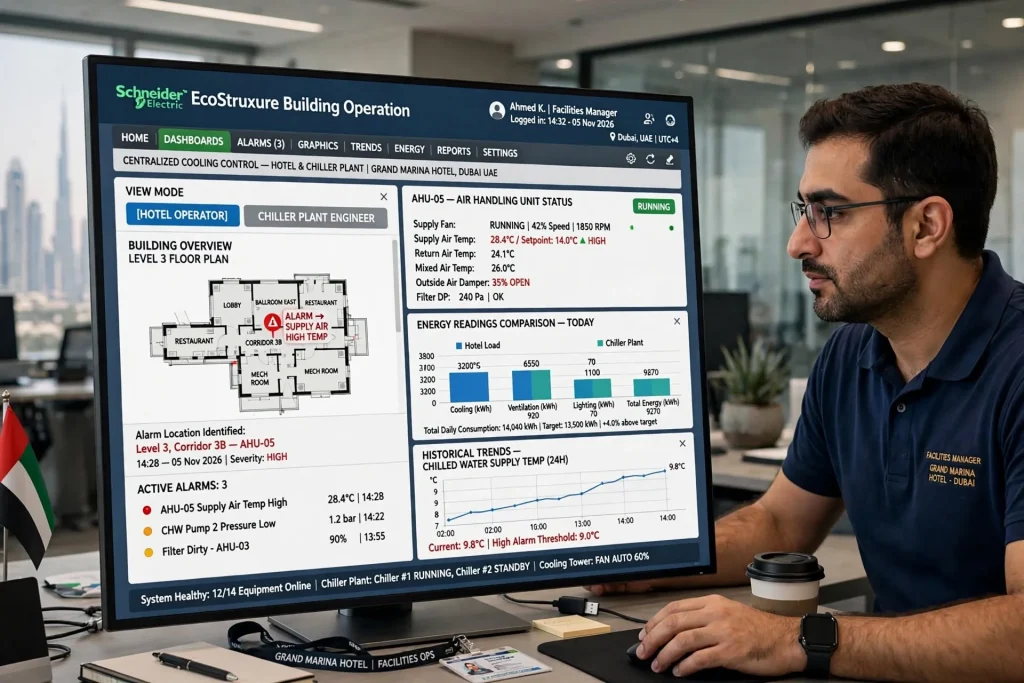
The software provides the central interface through which authorised users monitor and manage building operations. EcoStruxure Building Operation provides graphical views, dashboards, alarms, historical trends and system information.
A facility manager may use a floor plan to identify the location of an alarm, review the operating status of an air handling unit or compare energy readings over different periods. Clear graphics and organised equipment naming make it easier to understand the information presented by the system.
A well-designed interface should reflect how the building is operated. A hotel operator, for example, may need a different set of dashboards from an engineer responsible for a central chiller plant.
HVAC Automation and Centralised Cooling Control
Heating, ventilation and air conditioning are among the most important building services managed through a BMS. In the UAE, where cooling demand can remain high for much of the year, HVAC control has a direct influence on occupant comfort, equipment operation and electricity consumption.
A Schneider Electric BMS can be configured to monitor and control compatible HVAC equipment, depending on the selected controllers, interfaces and system architecture.
Chiller Plant Monitoring
Chiller plants serve offices, hotels, shopping centres, hospitals and large residential developments. A BMS can collect operating information from chillers, chilled water pumps, cooling tower equipment and associated sensors.
Typical monitoring points may include chilled water supply and return temperatures, pump status, flow-related information, equipment alarms and available operating data from connected chillers.
This information helps engineers understand how the cooling plant is performing. For example, if the chilled water supply temperature is not reaching its configured target, the operator can review the available readings and investigate the cause.
Chiller sequencing and staging can also be incorporated where the equipment interfaces, control design and manufacturer requirements permit it. The sequence should be engineered around actual cooling demand and plant limitations rather than relying on a generic control programme.
Air Handling Unit and Fresh Air Control
Air handling units distribute conditioned air throughout a building. Their operation may involve supply and return fans, cooling coils, dampers, filters, temperature sensors and pressure monitoring devices.
A BMS can manage operating schedules, monitor fan status, adjust compatible control valves and dampers, and generate alarms when readings move outside configured limits.
Fresh air control is also important in commercial buildings. Depending on the system design, outdoor air dampers and ventilation equipment can respond to schedules, occupancy signals or air quality measurements. CO₂ sensors may provide useful information about indoor occupancy-related ventilation demand, but they should be used as part of an appropriate ventilation strategy.
VAV and FCU Control
Variable Air Volume (VAV) systems regulate the amount of conditioned air delivered to different zones. Fan Coil Units (FCUs) provide local heating or cooling in individual rooms or areas.
Room controllers can help manage temperature setpoints, fan operation and compatible valve controls. In a large office, this allows different zones to operate according to their individual requirements instead of following one building-wide temperature setting.
In hotels and residential towers, room-level control can support guest or occupant comfort while helping facility teams monitor equipment status and operating schedules.
Energy Management and Building Performance
Energy management is more than checking a monthly electricity bill. Building operators need to understand when energy is being used, which equipment contributes to consumption and whether the building is operating according to its intended schedule.
An integrated BMS can bring together equipment status, operating schedules and energy meter information. EcoStruxure Building Operation supports the integration of metered energy and other building subsystem data, helping users review consumption and operational performance from a common platform.
Monitoring Electricity Consumption
Energy meters can provide information about electricity use at the main incomer, distribution board, floor, tenant area or individual equipment level, depending on the metering design.
When these readings are available through the BMS, facility teams can compare consumption across different periods and investigate unusual changes. For example, a commercial building may continue using significant energy after normal working hours because of equipment schedules, ventilation requirements or systems that have not been switched to their intended operating mode.
Sub-metering can make this investigation more useful by showing where consumption is occurring. However, the accuracy of the analysis depends on suitable meter selection, correct installation, reliable communication and appropriate data organisation.
Operating Schedules and Setpoint Management
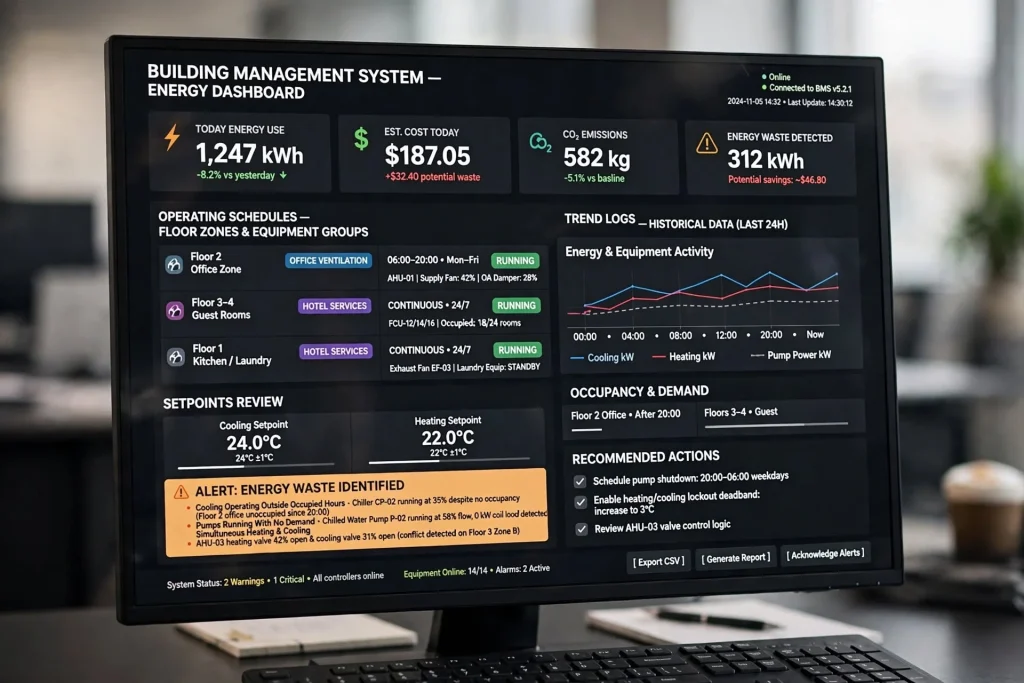
Operating schedules help ensure that equipment runs according to building use. Office ventilation may follow working hours, while hotel services may need to operate continuously in selected areas.
A BMS can support different schedules for different floors, zones and equipment groups. It can also help authorised operators review setpoints and identify equipment that is operating outside its intended schedule.
Schedules should always account for actual building requirements. Critical areas, server rooms, healthcare spaces and continuously occupied facilities may require different operating arrangements from standard office areas.
Identifying Energy Waste
A BMS can help identify operational patterns that deserve investigation. Examples include cooling equipment operating outside occupied hours, pumps running when there is no demand, simultaneous heating and cooling, or temperature setpoints that are not aligned with the building’s operating requirements.
Trend logs and historical data are particularly useful because they allow engineers to compare conditions over time. Instead of responding only to a complaint or equipment failure, facility teams can review changes in temperatures, operating hours, alarms and energy readings.
The BMS provides visibility and control tools, but energy savings are not automatic. Results depend on the quality of the original design, commissioning, operating strategy, equipment condition and ongoing maintenance.
Integration with Lighting, Power and Other Building Systems
Modern buildings contain many systems supplied by different manufacturers. A BMS becomes more useful when it can exchange relevant information with these systems through suitable interfaces and communication protocols.
Schneider Electric identifies support for common building automation protocols including BACnet, LonWorks, Modbus and web services. Its EcoStruxure Building Operation platform also supports MQTT connectivity for compatible IoT applications. Actual integration depends on device compatibility, firmware, licensing, network configuration and the available data points.
Lighting Control Integration
Lighting control can be integrated with building automation to support schedules, occupancy-based operation and centralised monitoring. In an office, lighting in meeting rooms and shared spaces may respond to occupancy or predefined operating hours.
Integration can also help facility teams review lighting system status from the BMS interface. The exact level of control depends on the lighting control system, gateways and supported communication method.
Electrical Power Monitoring
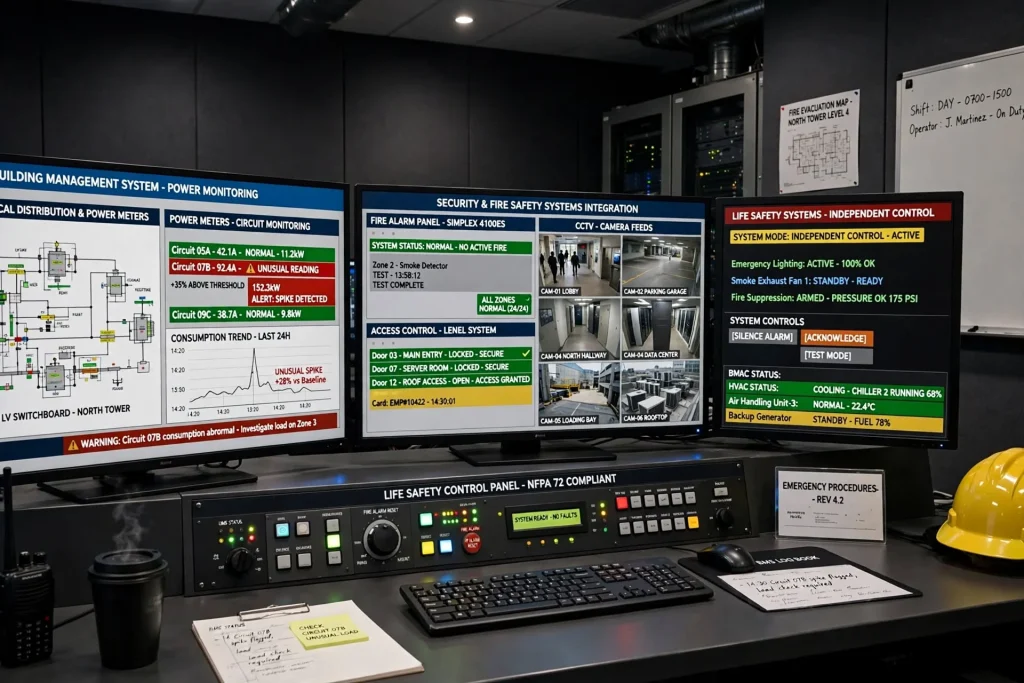
Power monitoring provides information about electrical distribution and connected loads. Depending on the project, a BMS may receive readings from compatible power meters, circuit monitoring devices and electrical equipment.
Facility managers can use this information to review consumption, identify unusual readings and understand the relationship between building operation and electrical demand. Detailed electrical analysis may require a dedicated power monitoring platform, with selected information shared with the BMS.
Fire and Security System Interfaces
Buildings may also require integration with fire alarm, access control, CCTV and other security systems. The purpose of integration should be clearly defined during design.
A BMS may display selected status information or alarms from compatible systems, allowing operators to view relevant events in one environment. However, life safety systems must retain their approved functions and independent control arrangements. BMS integration must not replace dedicated fire alarm or emergency control equipment, and any interface must follow the applicable authority requirements and approved design.
Communication Protocols: BACnet, Modbus, LonWorks and MQTT
Communication protocols determine how controllers, meters, sensors and other devices exchange information. They are an important consideration when selecting a BMS or upgrading an existing building automation installation.
BACnet is widely used in building automation for communication between HVAC controllers, plant equipment and supervisory systems. BACnet/IP can operate over IP networks, while BACnet MS/TP is commonly used over serial communication networks.
Modbus is frequently used for communication with energy meters, electrical equipment, plant controllers and other industrial devices. Modbus RTU and Modbus TCP are common versions, but the supported data points and register mapping must be checked for each device.
LonWorks is another building automation communication technology that may be found in existing installations and legacy systems.
MQTT is a messaging protocol used in connected-device and IoT applications. It can support the exchange of data between compatible devices, brokers and software platforms.
An open protocol does not guarantee that every connected device will work without engineering. Integrators still need to verify communication settings, object lists, register maps, network topology, data types, command permissions and device-specific limitations. These checks help avoid incomplete integration and unreliable control.
Schneider Electric BMS Applications Across UAE Buildings
Different building types have different operating requirements. A BMS should be configured around how a property is used, the equipment installed and the expectations of its facility management team.
Commercial Offices in Business Bay and DIFC
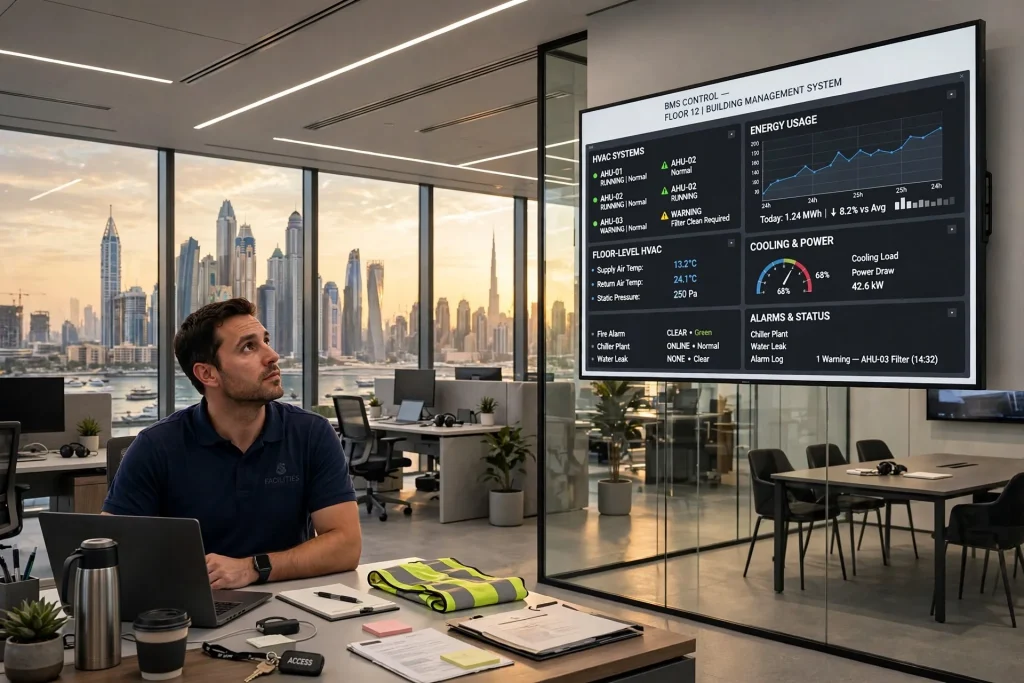
Commercial office buildings in Business Bay, DIFC and Downtown Dubai may contain multiple floors, tenant areas, meeting rooms and shared facilities. Their operating schedules can vary by floor and tenant.
A BMS can help coordinate HVAC schedules, monitor air handling units, manage compatible room controllers and collect energy information. Floor-level dashboards can make it easier for facility teams to identify alarms and review equipment performance.
For multi-tenant properties, access permissions and clearly defined operating responsibilities are also important. Tenants may need local comfort control, while central facility teams retain responsibility for plant operation and building-wide settings.
Hotels in Dubai Marina and Palm Jumeirah
Hotels have a combination of guest rooms, restaurants, kitchens, meeting facilities, back-of-house areas and central plant rooms. These areas do not all follow the same occupancy pattern.
Room-level temperature control, ventilation schedules and central HVAC monitoring can help hotel engineering teams manage different operating requirements. Integration with compatible room management systems may also support occupancy-related functions.
A hotel BMS should be designed with guest comfort, equipment reliability and maintenance access in mind. A room control strategy that works for a meeting room may not be suitable for a guest room or a commercial kitchen.
Hospitals and Healthcare Facilities
Hospitals require carefully managed ventilation and environmental conditions in selected areas. Operating theatres, isolation rooms, laboratories and general patient areas may have different requirements for temperature, humidity, pressure relationships and air changes.
A BMS can monitor compatible mechanical equipment and present operating information to authorised facility staff. However, critical healthcare ventilation requirements must be established by the project design and relevant healthcare standards. Monitoring through a BMS does not replace specialist validation, testing or dedicated safety controls.
Shopping Centres and Retail Developments
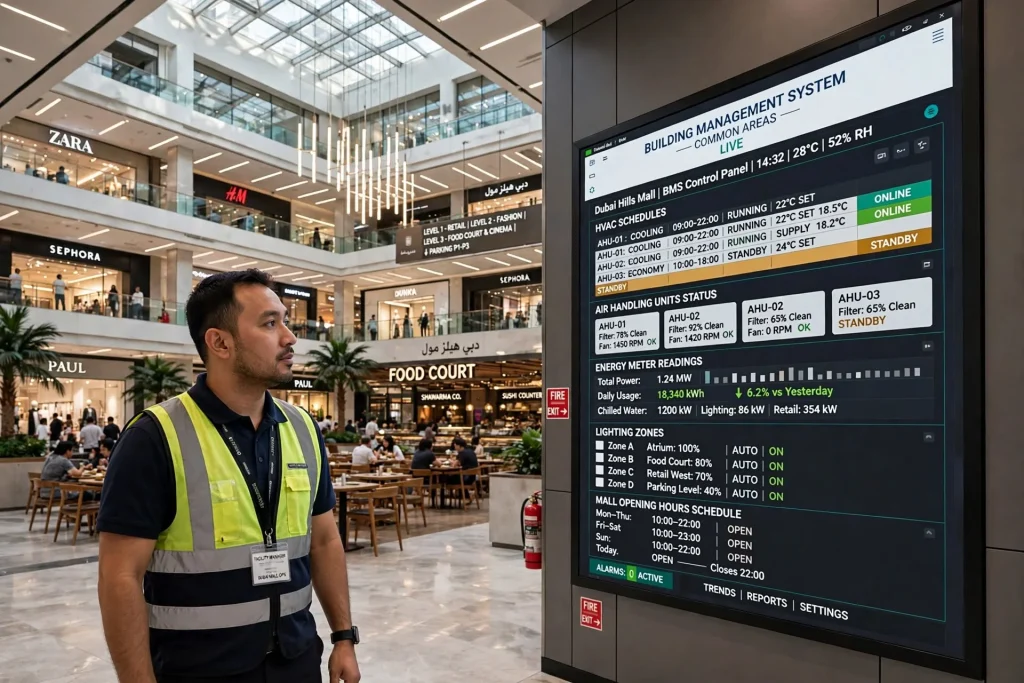
Shopping centres in Dubai and Abu Dhabi contain large conditioned spaces, retail units, food courts, service areas and extensive lighting installations.
A BMS can help manage common-area HVAC schedules, monitor air handling units, collect energy meter readings and coordinate selected lighting functions. Different zones can follow operating schedules based on tenant activity and mall opening hours.
Residential Towers and Mixed-Use Developments
Residential towers in areas such as Jumeirah Lake Towers, Dubai Silicon Oasis and Al Reem Island may contain central cooling, ventilation, water systems, common-area lighting and shared facilities.
Building automation can help monitor central plant equipment and common services. Where suitable room controllers and interfaces are installed, it can also support local temperature management and selected occupancy-related functions.
BMS and Dubai’s Building Sustainability Direction
Building automation can contribute to better operational visibility and energy management, which are relevant to sustainable building operation.
Dubai Municipality’s Al Sa’fat – Dubai Green Building System provides a framework for improving building performance, including energy and water consumption, electrical and mechanical system efficiency and environmental impact. It includes mandatory requirements for new buildings, with additional requirements for higher rating levels. A BMS can support the monitoring and management of building services, but installing one does not automatically mean that a property meets Al Sa’fat requirements. Compliance depends on the complete building design, documentation, implementation and assessment.
For developers and property owners in Dubai, this makes early coordination between mechanical, electrical, controls and sustainability teams important. BMS points, energy meters, equipment schedules and reporting requirements should be considered before installation rather than added as an afterthought.
Similar planning is valuable for projects in Abu Dhabi, Sharjah and other UAE locations, where project specifications and applicable authority requirements should be checked individually.
Common Problems in BMS Installation and Integration
Even a well-known automation platform can perform poorly if the system is not designed, installed and commissioned correctly. Many BMS issues are caused by incomplete engineering rather than the software alone.
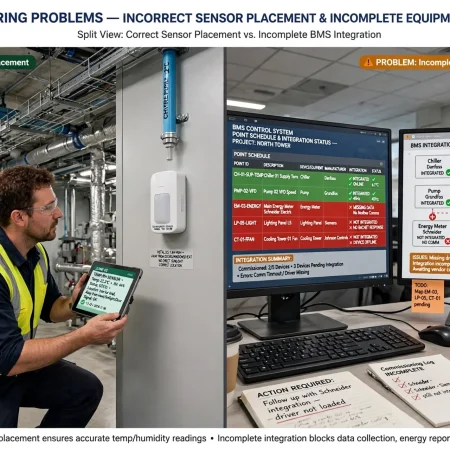
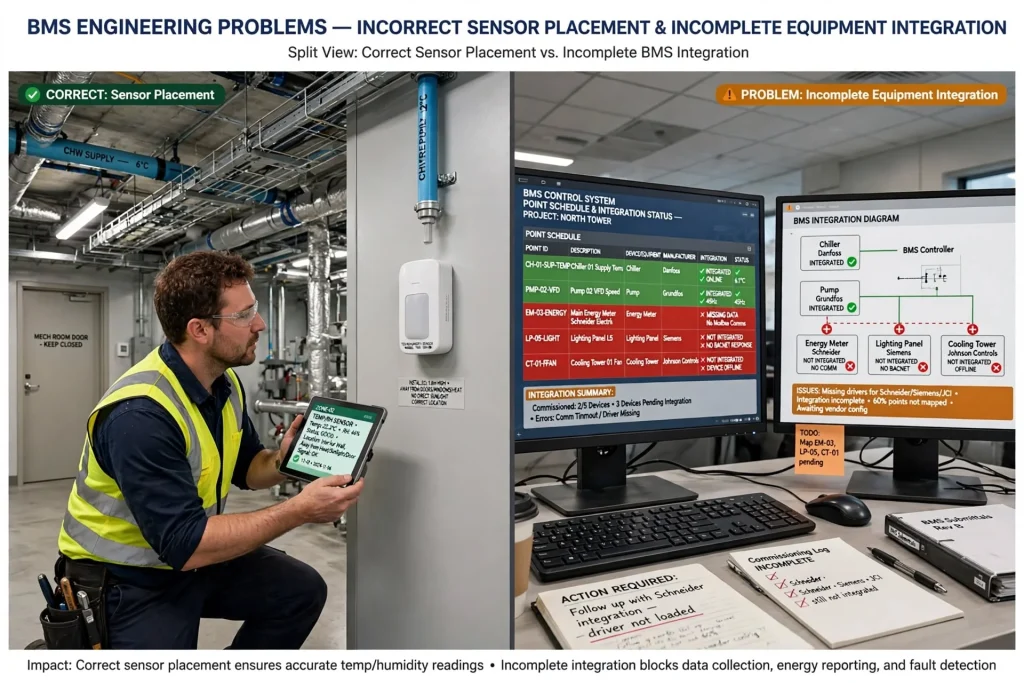
Incorrect Sensor Placement
A poorly positioned temperature or humidity sensor can send misleading information to the controller. This may cause unnecessary cooling, unstable temperature control or repeated occupant complaints.
Sensor locations should be selected according to the room layout, airflow, heat sources and equipment manufacturer’s recommendations.
Incomplete Equipment Integration
A project may include chillers, pumps, meters, lighting panels and other devices from different manufacturers. If the integration scope is not documented, some equipment may appear on the BMS graphics without providing all the information required for useful monitoring or control.
A point schedule should define each required data point, its source, communication method, description, alarm requirement and control responsibility.
Poor HVAC Control Sequences
Incorrect programming can lead to unnecessary equipment operation, unstable temperatures, simultaneous heating and cooling, or poor coordination between plant equipment.
Control sequences should be reviewed against mechanical design documents and actual equipment capabilities. Functional testing should confirm that each sequence responds correctly under normal and abnormal operating conditions.
Communication and Network Problems
Incorrect IP settings, duplicate device addresses, poor network design, wiring faults and unsupported communication settings can interrupt data exchange.
A structured network design, device addressing plan and communication test procedure help reduce these risks. BMS networks should also be coordinated with the building’s IT and cybersecurity teams.
Limited Operator Training
A technically complete BMS may still be underused if facility staff do not understand its dashboards, alarms, schedules and trend information.
Training should cover normal operation, alarm acknowledgement, authorised setpoint changes, report generation, backup procedures and escalation of faults. Operators should know which settings they can change and which require an authorised controls engineer.
BMS Commissioning, Testing and Preventive Maintenance
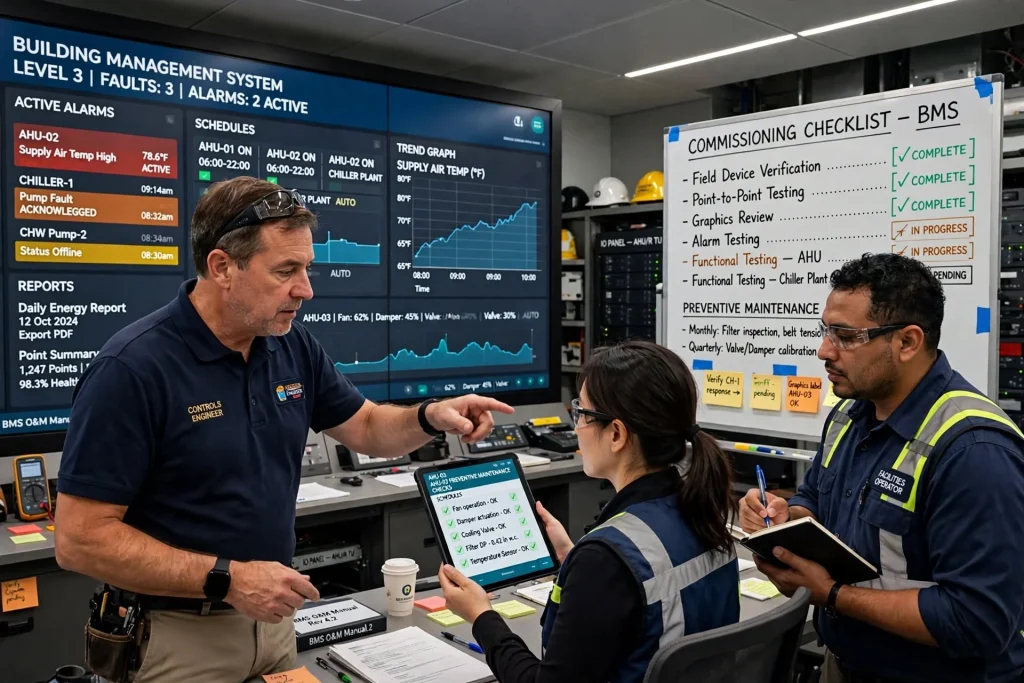
Commissioning confirms that the installed system works according to the approved design and control sequences. It should cover more than checking whether devices appear online.
The process normally includes field device verification, controller checks, network communication tests, point-to-point testing, graphics review, alarm testing and functional testing of equipment sequences.
For an air handling unit, for example, the commissioning team may verify temperature sensor readings, fan status, damper operation, valve response, schedule control and alarm conditions. For a chiller plant, the team may review available operating values, pump interlocks, equipment status and the approved sequencing strategy.
After handover, preventive maintenance helps keep the system reliable. This may include sensor calibration, controller inspection, communication checks, alarm review, trend analysis, software backup and documentation updates.
A building’s operation changes over time. New tenants, renovated floors, replaced equipment and modified operating hours can all affect the BMS. Keeping drawings, point schedules, control descriptions and software backups up to date makes future maintenance and troubleshooting easier.
Cybersecurity and Remote BMS Access
A connected building management system needs appropriate cybersecurity controls. BMS networks may communicate with corporate IT networks, remote service platforms and third-party devices, so access should be planned carefully.
Good practices include role-based user permissions, strong authentication, secure remote access, network segmentation, controlled software updates and regular backup procedures. Unused accounts and unnecessary network services should be reviewed, while access logs can help administrators investigate unusual activity.
Remote access can make it easier for authorised engineers to review alarms and operating conditions without being physically present in the plant room. However, remote access should be enabled only through approved security arrangements and should not expose controllers or automation servers directly to the public internet.
Cybersecurity responsibilities should be shared between the building owner, facility management team, IT department and BMS service provider.
Selecting the Right Schneider Electric BMS Design for a Project
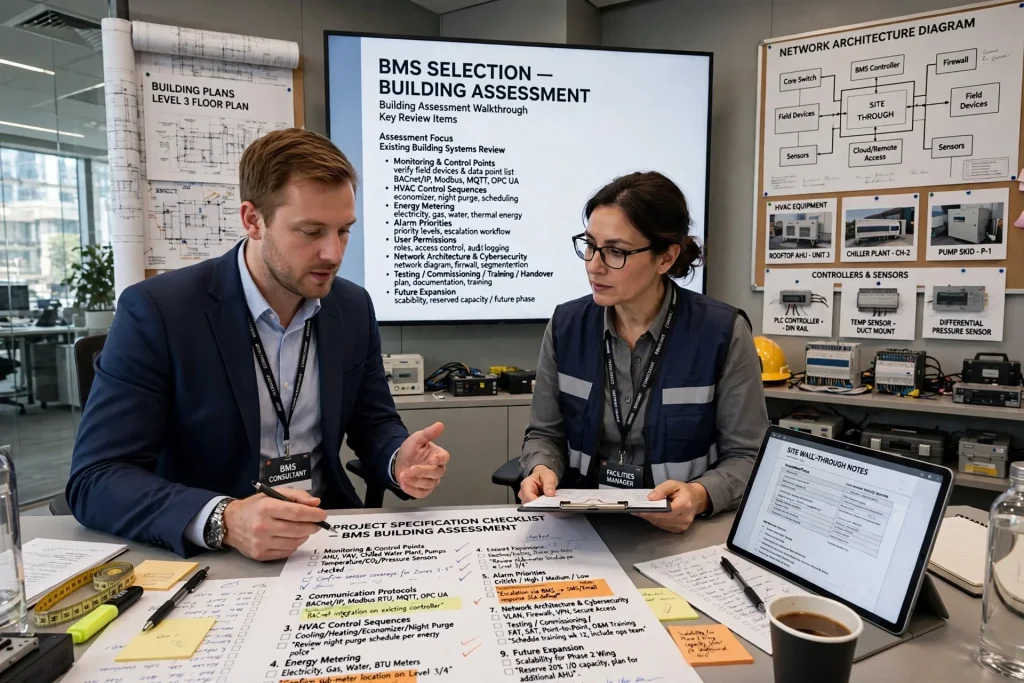
Choosing a BMS should begin with an assessment of the building rather than a product list. The required architecture depends on building size, number of control points, equipment types, existing infrastructure, future expansion plans and the level of integration required.
For a new commercial building, the design team should identify the HVAC equipment, room control requirements, electrical metering points, lighting interfaces and reporting needs. For an existing property, an initial audit should establish which controllers, sensors, communication networks and software components can be retained or integrated.
The project specification should also address:
- Required monitoring and control points.
- Supported communication protocols and device compatibility.
- HVAC control sequences and operating schedules.
- Energy metering and reporting requirements.
- Alarm priorities and escalation procedures.
- User permissions and remote access arrangements.
- Network architecture and cybersecurity responsibilities.
- Testing, commissioning, training and handover documents.
- Future expansion, software support and maintenance requirements.
An appropriately designed system can be easier to operate, maintain and expand. The most suitable solution is the one that meets the building’s actual operational needs and can be supported throughout its service life.
Building Automation Support for Commercial Properties in Dubai
Successful BMS operation depends on coordination between the controls platform and the building’s mechanical and electrical services. HVAC contractors, electrical engineers, controls specialists and facility managers need to work from a clear project scope.
For properties in Dubai, this may involve coordinating central chiller plants, air handling units, FCUs, VAV systems, ventilation equipment, energy meters and room controllers. Existing buildings may also require troubleshooting of communication faults, sensor problems, incorrect schedules or incomplete integration between different manufacturers’ equipment.
A structured BMS assessment can help identify what is working, what needs correction and which improvements are practical. It should include a review of the existing control architecture, equipment interfaces, point schedules, network condition and operator requirements.
Whether the project is a commercial office in Business Bay, a hotel in Dubai Marina, a residential tower in Jumeirah Lake Towers or a mixed-use development in Abu Dhabi, the objective remains the same: reliable building operation supported by accurate monitoring, suitable control strategies and maintainable automation infrastructure.
Making Buildings More Efficient Through Connected Control
Schneider Electric building automation technology provides a platform for connecting HVAC, lighting, energy monitoring and other compatible building systems. Through EcoStruxure Building Operation, building teams can access operating information, review trends, manage alarms and coordinate selected building services from a central interface.
However, the value of a BMS depends on more than the technology installed. Accurate sensors, suitable controllers, compatible integrations, properly engineered sequences, effective commissioning and trained operators all contribute to reliable performance.
For UAE property owners and facility managers, a well-planned building management system can improve visibility over energy use, support more consistent HVAC operation and make maintenance decisions more informed. The right design begins with the building’s operational requirements and continues through installation, testing and ongoing support.