Basement moisture is more than a minor maintenance issue. Water entering through foundation walls, floor slabs, cracks, joints, drainage systems, or plumbing can create the conditions necessary for mold growth while gradually contributing to deterioration of concrete and other building materials. Effective basement waterproofing addresses these moisture pathways before they develop into expensive building problems.
For property owners, developers, facility managers, and building maintenance professionals, professional Basement Waterproofing Services can provide an important layer of protection against water infiltration and moisture-related deterioration.
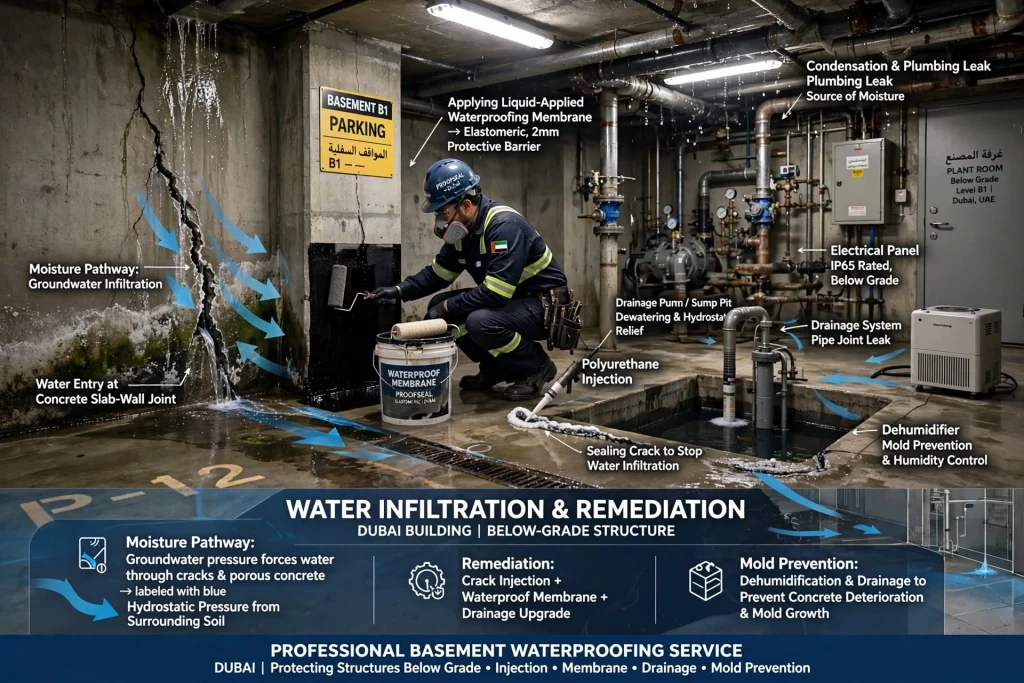
Although traditional basements are less common in some parts of the UAE than in colder or wetter regions, underground spaces, parking basements, plant rooms, storage areas, service rooms, and below-grade structures in Dubai, Abu Dhabi, and Sharjah can still face significant waterproofing requirements. Groundwater, hydrostatic pressure, plumbing leaks, condensation, poor drainage, and construction defects can all introduce unwanted moisture.
Understanding how waterproofing works helps property owners identify risks early and choose appropriate solutions.
Why Basement Moisture Creates Long-Term Building Problems
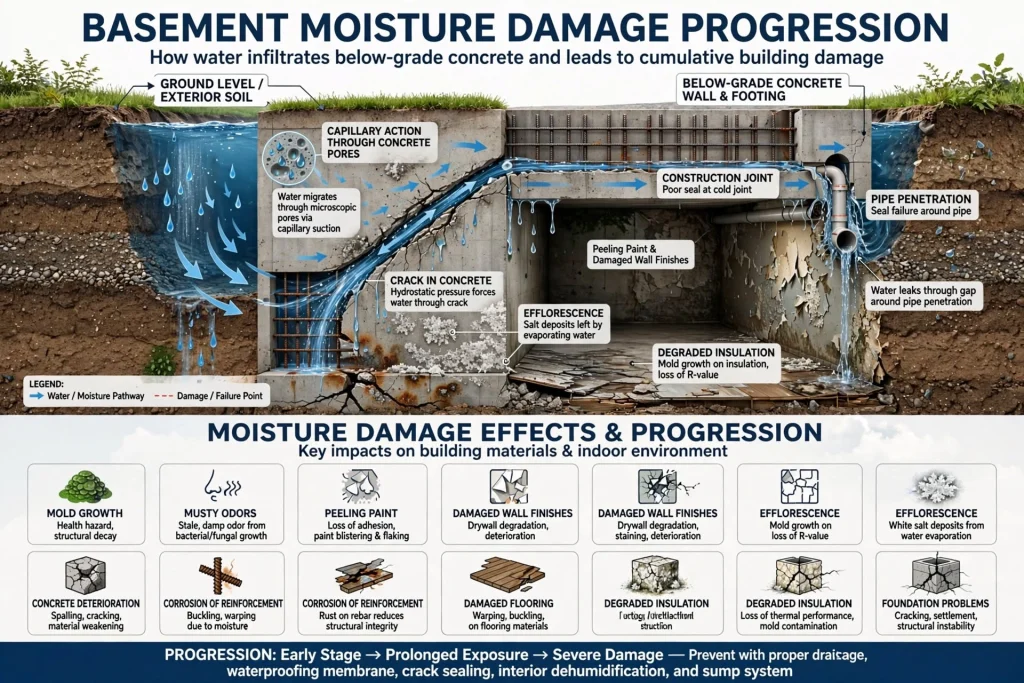
Water is one of the most damaging elements that a building envelope must control. When moisture reaches below-grade structures, it can migrate through concrete pores, cracks, construction joints, pipe penetrations, and poorly sealed interfaces.
A basement does not have to be visibly flooded to have a moisture problem. Small amounts of water vapor or intermittent seepage can increase humidity and create favorable conditions for biological growth. Repeated wetting and drying can also affect finishes, coatings, insulation, and other materials.
Over time, uncontrolled moisture may contribute to:
- Mold and microbial growth
- Musty odors
- Peeling paint
- Damaged wall finishes
- Efflorescence
- Concrete deterioration
- Corrosion of embedded reinforcement
- Damaged flooring
- Degraded insulation
- Foundation-related maintenance problems
Waterproofing aims to control the entry and movement of water before these secondary problems become extensive.
How Water Enters a Basement
Understanding the source of moisture is essential before selecting a waterproofing system. Different water-entry mechanisms require different solutions.
Groundwater can exert pressure against below-grade walls and floor slabs. This pressure, known as hydrostatic pressure, can push water through weaknesses in the building structure.
Rainwater can also become a problem when surface drainage is inadequate. If water collects around foundations rather than being directed away from the building, it can increase moisture exposure.
Other sources include leaking water supply or drainage pipes, failed expansion joints, defective construction joints, damaged waterproofing membranes, cracks in concrete, and condensation caused by high indoor humidity.
A professional waterproofing assessment should identify the source rather than simply treating the visible symptom.
Waterproofing and Mold Prevention
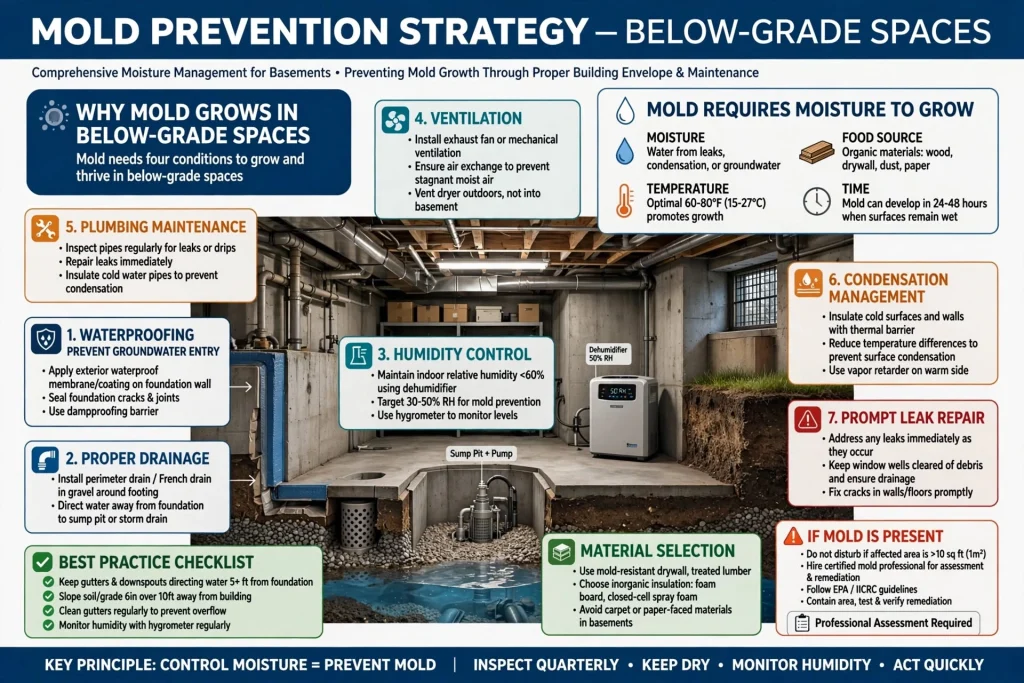
Mold requires moisture to grow. It can develop when building materials remain damp or when indoor humidity remains elevated for extended periods.
Basement waterproofing helps address one of the most important variables in mold prevention: unwanted water intrusion.
By preventing groundwater and rainwater from entering through foundation walls and slabs, a waterproofing system can reduce the moisture available to mold. However, waterproofing alone does not guarantee a mold-free environment.
Mold prevention requires a broader moisture-management strategy that can include:
- Waterproofing
- Proper drainage
- Ventilation
- Humidity control
- Plumbing maintenance
- Condensation management
- Prompt leak repair
- Appropriate material selection
If mold is already present, the contaminated materials may require professional assessment and remediation in addition to correcting the moisture source.
What Is Hydrostatic Pressure?
Hydrostatic pressure is the pressure exerted by water against a surface. For a basement or underground structure, groundwater surrounding the foundation can create pressure against walls and floor slabs.
When waterproofing is inadequate, this pressure can force water through cracks, joints, porous concrete, or poorly sealed penetrations.
Hydrostatic pressure is particularly important when designing waterproofing systems for deep basements, underground parking structures, retaining walls, and other below-grade construction.
A durable solution may involve a combination of waterproof membranes, drainage systems, sump pumps, joint treatments, crack repair, and appropriate structural detailing.
The specific system should be selected according to site conditions and the building’s construction.
Protecting Concrete Foundations From Moisture
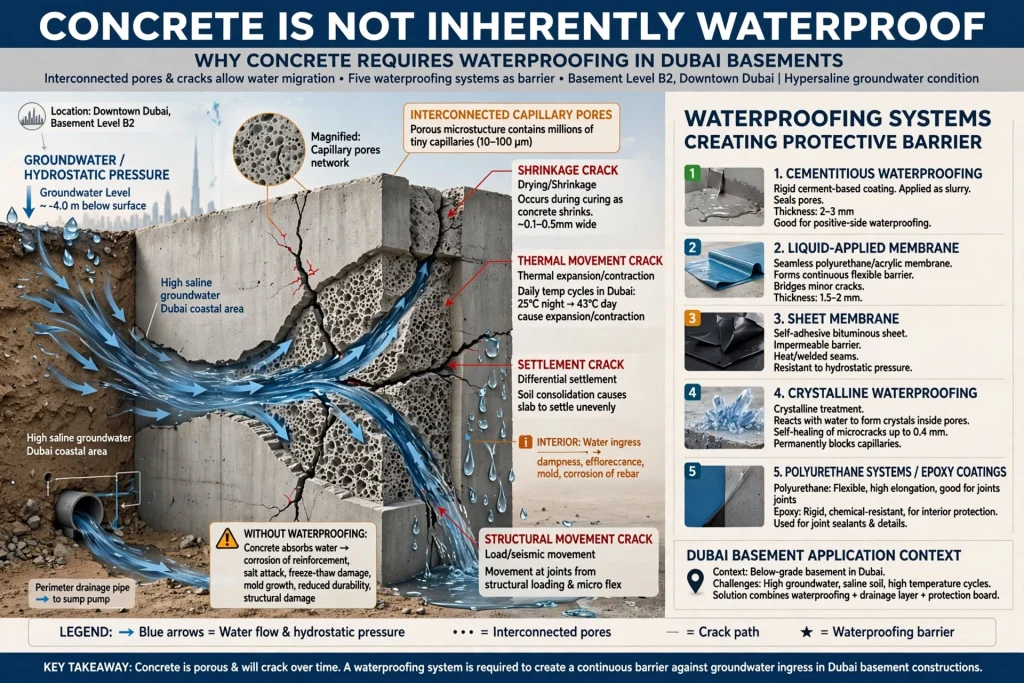
Concrete is strong and durable, but it is not inherently waterproof. Concrete contains interconnected pores and can develop cracks due to shrinkage, thermal movement, settlement, structural movement, or construction conditions.
When water continuously contacts concrete, moisture can migrate through these pathways.
Waterproofing systems create a barrier or controlled drainage route that limits this exposure. Depending on the project, solutions can include cementitious waterproofing, liquid-applied membranes, sheet membranes, crystalline waterproofing, polyurethane-based systems, epoxy coatings for suitable applications, and other specialized materials.
The correct solution depends on the substrate, water pressure, crack characteristics, accessibility, and intended use of the basement.
How Waterproofing Helps Prevent Structural Damage
Structural damage does not normally occur simply because a basement becomes damp once. The bigger concern is prolonged or repeated exposure to moisture.
Water can contribute to the deterioration of concrete and can reach reinforcing steel embedded within reinforced-concrete elements. If reinforcement corrodes, the resulting expansion can contribute to cracking and concrete spalling.
Water can also affect construction joints, sealants, protective coatings, finishes, and other components.
By reducing water penetration, waterproofing helps create a more controlled environment around below-grade structural elements.
This is particularly important for underground parking facilities, commercial basements, plant rooms, utility spaces, and buildings where below-grade areas contain important mechanical or electrical infrastructure.
Efflorescence and Basement Water Problems
One visible sign of moisture movement through masonry or concrete is efflorescence.
Efflorescence appears as a white or powdery deposit on a surface. It occurs when water moves through a porous material and carries dissolved mineral salts toward the surface. When the water evaporates, the salts can remain behind.
Efflorescence is not necessarily a structural emergency, but it is an important indication that moisture is moving through the building material.
If the underlying water source remains unresolved, repeated efflorescence can continue to appear.
Waterproofing and moisture management can help address the source rather than repeatedly cleaning the visible deposits.
Basement Waterproofing Systems
Different waterproofing technologies are suitable for different conditions. A professional contractor should assess the structure before recommending a system.
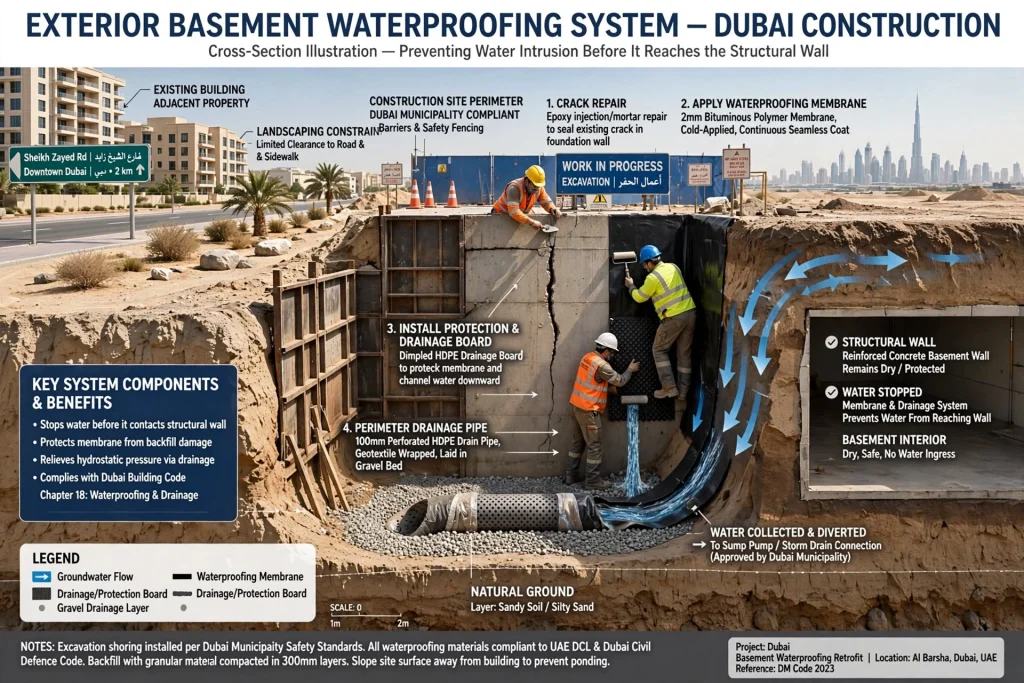
Exterior Waterproofing
Exterior waterproofing protects foundation walls from the outside. Excavation may be required to expose the foundation wall, allowing contractors to repair cracks, apply a waterproofing membrane, install protection boards, and improve drainage where necessary.
Exterior systems can be highly effective because they stop water before it reaches the structural wall.
However, excavation may not always be practical, particularly around existing buildings, roads, landscaping, neighboring structures, or underground utilities.
Interior Waterproofing
Interior waterproofing and moisture-management systems can be used when external excavation is impractical.
Solutions may include interior membranes, drainage channels, sump pump systems, crack injection, and specialized coatings.
The correct approach depends on the source and pressure of the water. Simply applying a coating to the inside of a wet wall may not solve a significant hydrostatic-pressure problem.
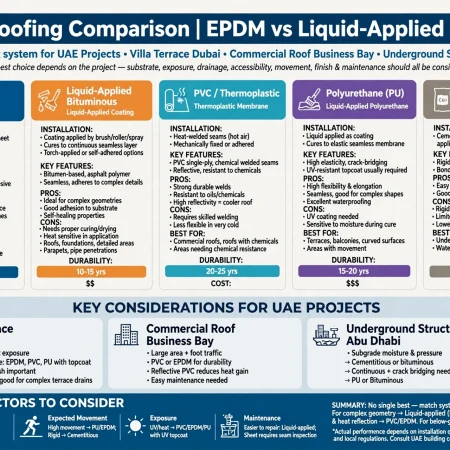
Cementitious Waterproofing
Cementitious waterproofing materials are commonly used on concrete and masonry substrates. They can create a water-resistant barrier when correctly prepared and applied.
These systems can be useful in certain basement walls, tanks, wet rooms, and below-grade structures.
Surface preparation is critical. Dust, loose material, contaminants, cracks, and unsuitable substrates can affect adhesion and performance.
Liquid-Applied Membranes
Liquid-applied waterproofing systems are installed as a liquid and cure to form a continuous membrane.
One advantage is their ability to cover complex geometries and details without requiring numerous sheet joints.
However, application thickness, substrate preparation, curing conditions, and compatibility with the existing surface must be carefully controlled.
Sheet Membrane Waterproofing
Sheet membranes are prefabricated waterproofing materials installed across foundation surfaces. Proper detailing is particularly important around joints, corners, penetrations, drains, and terminations.
A high-quality membrane installation depends not only on the membrane itself but also on correct detailing and workmanship.
Drainage Is Just as Important as Waterproofing
A waterproofing membrane should not be viewed in isolation. Effective water management often requires drainage.
Foundation drainage systems can help collect and redirect water away from below-grade walls. Depending on the structure, solutions can include perforated drainage pipes, drainage boards, channel drains, collection systems, and sump pumps.
A sump pump can remove collected water from a basement drainage system and discharge it to a suitable location.
For buildings in areas where underground water management is important, the drainage design should be considered together with the waterproofing strategy.
Basement Waterproofing in Dubai and the UAE


7
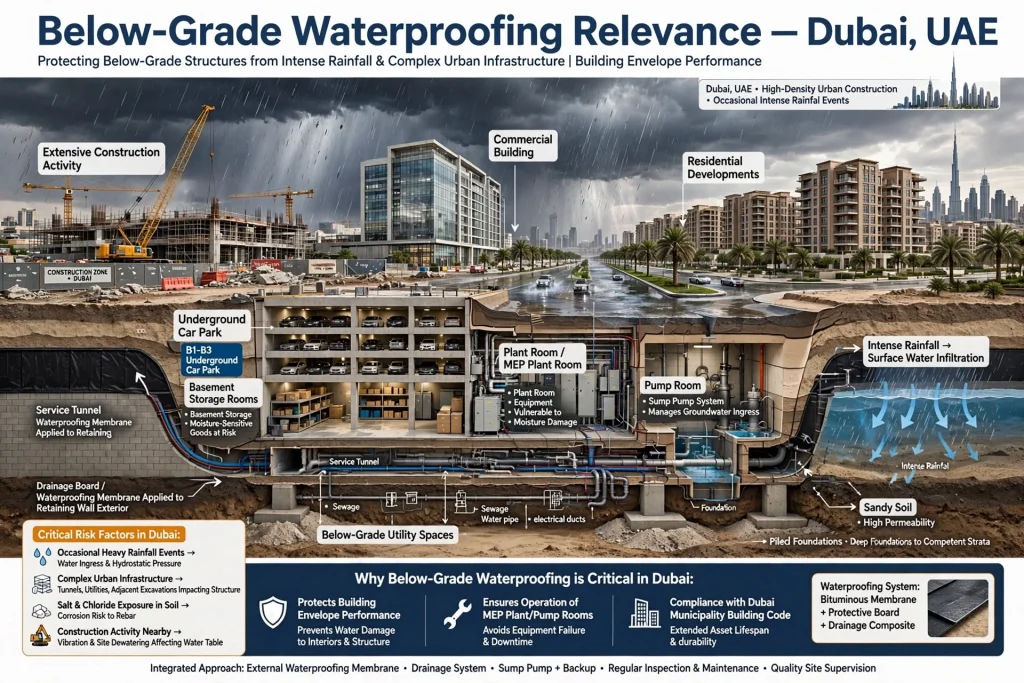
Dubai’s construction environment presents specific waterproofing considerations. High temperatures, occasional intense rainfall, underground structures, extensive construction activity, and complex urban infrastructure can all influence building-envelope performance.
Waterproofing is particularly relevant to:
- Underground car parks
- Basement storage rooms
- Plant rooms
- Pump rooms
- Commercial buildings
- Residential developments
- Retaining walls
- Foundation structures
- Service tunnels
- Below-grade utility spaces
In Dubai, Abu Dhabi, and Sharjah, waterproofing specifications should be developed according to the building design, soil conditions, groundwater conditions, construction details, and applicable project requirements.
Basement Waterproofing in Dubai Hills and Other Residential Areas
Residential developments such as Dubai Hills Estate, Arabian Ranches, Emirates Hills, Jumeirah, Palm Jumeirah, and DAMAC Hills contain properties where moisture protection may be required in underground or below-grade spaces.
Although the waterproofing requirements of each property differ, villa basements, underground garages, retaining structures, swimming-pool areas, service rooms, and utility spaces can all benefit from proper moisture protection.
Older properties may require inspection where waterproofing membranes have deteriorated, cracks have developed, or drainage systems have become blocked.
New construction requires equally careful attention because waterproofing defects can be significantly more expensive to correct after backfilling and completion.
Waterproofing Underground Parking Structures
Underground parking areas are particularly exposed to water-related challenges because they are below ground and often contain large concrete surfaces.
Water can enter through construction joints, expansion joints, wall-floor junctions, cracks, pipe penetrations, ramps, and drainage systems.
A comprehensive waterproofing strategy can incorporate:
Concrete crack treatment: Cracks should be evaluated to determine whether they are structural, shrinkage-related, or caused by other movement.
Joint waterproofing: Construction and expansion joints require specialized detailing because they can become pathways for water.
Drainage: Floor drains, channels, collection points, and sump systems should be maintained and kept free of obstruction.
Surface protection: Suitable protective coatings can help manage moisture and protect selected concrete surfaces.
Waterproofing Construction Joints and Cracks
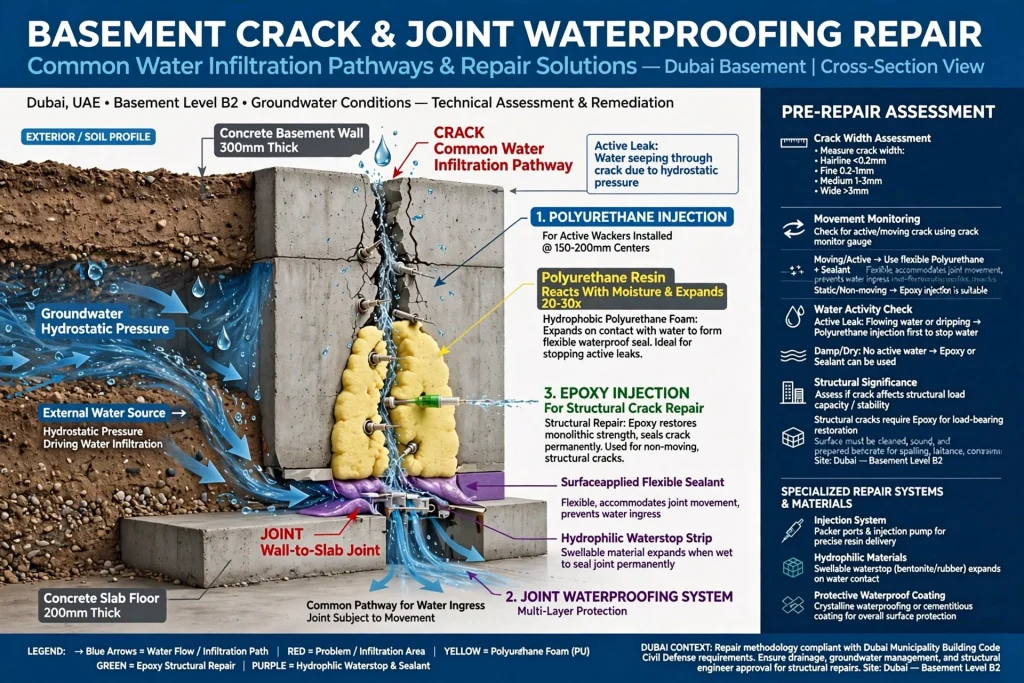
Cracks and joints are among the most common pathways for water infiltration.
Not every crack requires the same repair material. Depending on the circumstances, contractors may use polyurethane injection, epoxy injection, sealants, hydrophilic materials, waterstops, or other specialized repair systems.
Epoxy injection may be suitable for certain structural crack-repair applications, while polyurethane injection can be useful in some active water-leak situations because of its ability to react with moisture and expand.
The appropriate repair method should be selected after assessing crack width, movement, water activity, structural significance, and substrate condition.
Preventing Mold in Underground Rooms
Mold prevention begins with moisture prevention.
If an underground room has persistent dampness, waterproofing should be investigated before simply treating the visible mold. Otherwise, mold can return because the underlying moisture source remains.
After repairing water intrusion, affected areas should be dried appropriately. Damaged porous materials may require removal, depending on the extent of contamination.
Mechanical ventilation and dehumidification can also be important where humidity remains elevated.
For buildings with mechanical ventilation or HVAC systems, air-conditioning maintenance should be coordinated with the wider moisture-control strategy.
Waterproofing and Indoor Humidity
Even when there is no direct water leak, high humidity can create moisture-related problems.
Condensation can occur when warm, humid air comes into contact with cooler surfaces. In underground areas, poorly ventilated rooms may experience humidity accumulation, particularly when mechanical ventilation is inadequate.
This means basement moisture investigations should distinguish between:
Water infiltration: Liquid water entering from outside or plumbing systems.
Capillary moisture: Moisture moving through porous building materials.
Condensation: Water forming when humid air contacts sufficiently cool surfaces.
Water vapor: Moisture moving through materials in vapor form.
Correct diagnosis prevents contractors from applying the wrong solution.
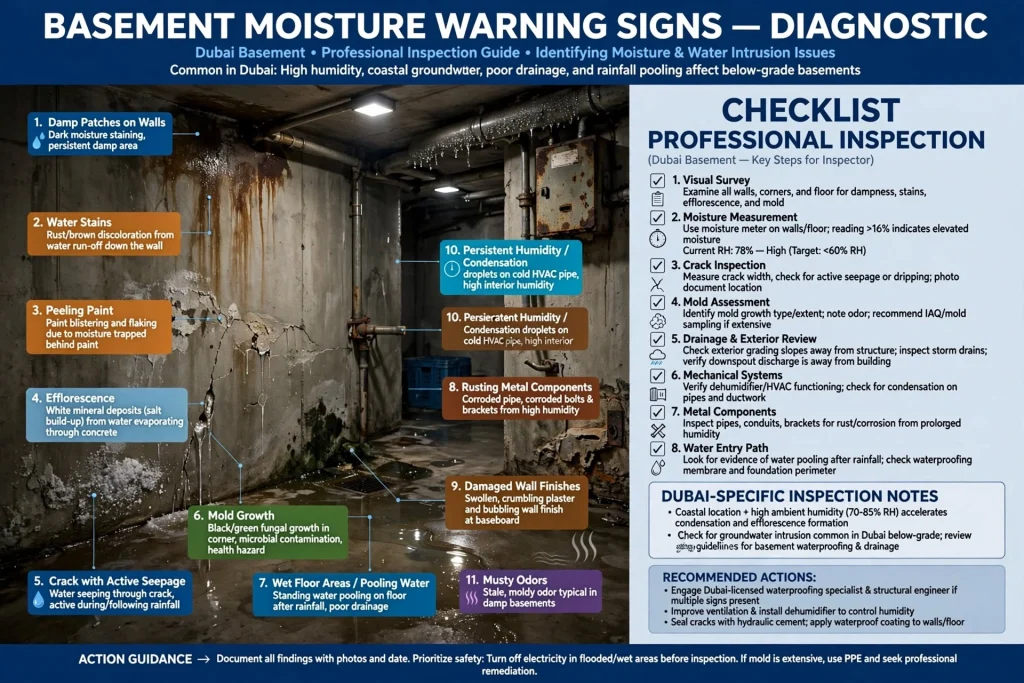
Early Warning Signs of Basement Waterproofing Problems
Property owners and facility managers should pay attention to visible indicators such as:
- Damp patches on basement walls
- Water stains
- Peeling paint
- Musty odors
- White mineral deposits
- Cracks with active seepage
- Mold growth
- Wet floor areas
- Rusting metal components
- Damaged wall finishes
- Persistent humidity
- Water pooling after rainfall
These signs should not automatically be interpreted as evidence of foundation failure. However, they justify a professional inspection to identify the underlying moisture source.
Why Waterproofing Should Be Addressed Early
Small water problems can become expensive when ignored.
A minor leak may initially appear as a small damp patch. Repeated water exposure can eventually damage finishes, flooring, insulation, equipment, and other building components.
If water reaches structural reinforcement, the long-term consequences can be more serious.
Early waterproofing repairs are often easier because access is available and damage is limited. Once moisture has spread behind finishes or into concealed building assemblies, investigation and repair can become more complicated.
Preventive maintenance is therefore usually preferable to emergency waterproofing.
Basement Waterproofing and Property Value
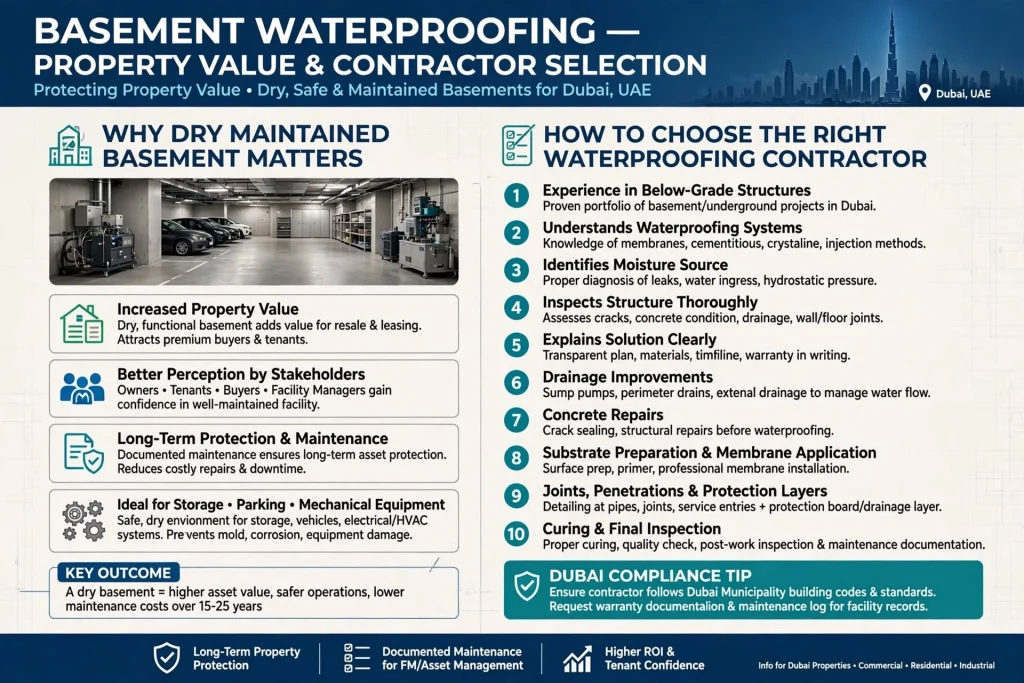
Water intrusion can negatively affect how a property is perceived by owners, tenants, buyers, and facility managers.
A dry and properly maintained basement provides a better environment for storage, parking, mechanical equipment, and other uses.
For commercial and residential developments, documented waterproofing maintenance can also contribute to better building management by demonstrating that moisture-related defects are being monitored and addressed.
Waterproofing is therefore not simply a repair expense. It can be considered part of long-term property protection.
How to Choose a Waterproofing Contractor in Dubai
Choosing the right contractor is important because waterproofing performance depends heavily on preparation and installation quality.
Property owners should look for a contractor with experience in below-grade structures and a clear understanding of different waterproofing systems.
Before work begins, the contractor should ideally identify the source of moisture, inspect the affected structure, explain the proposed solution, and clarify whether drainage improvements or concrete repairs are required.
A good waterproofing specification should address details such as substrate preparation, membrane application, joints, penetrations, drainage, protection layers, curing requirements, and final inspection.
The cheapest coating is not necessarily the most economical solution if the underlying water problem remains unresolved.
A Complete Moisture Protection Strategy
The most effective basement waterproofing strategy combines several layers of protection.
The first layer is water exclusion, which involves waterproof membranes, coatings, joint treatments, and properly sealed penetrations.
The second layer is water management, including drainage systems, channels, collection points, and sump pumps.
The third layer is building maintenance, including crack monitoring, drain cleaning, plumbing inspections, and periodic waterproofing assessments.
The fourth layer is indoor moisture control, including ventilation, dehumidification, and appropriate HVAC operation.
Together, these measures create a more resilient below-grade environment.
Frequently Asked Questions About Basement Waterproofing
Does waterproofing completely stop mold?
Waterproofing can reduce moisture entering through the building structure, which removes an important condition required for mold growth. However, mold can also result from condensation, plumbing leaks, ventilation problems, or high indoor humidity. These causes must also be addressed.
Can waterproofing prevent foundation damage?
Proper waterproofing can reduce prolonged water exposure to foundation walls and below-grade structures. It should be combined with appropriate drainage, crack repair, structural maintenance, and site water management.
Is basement waterproofing necessary for new buildings?
Yes. Waterproofing should be considered during the design and construction of any below-grade structure. Installing appropriate systems during construction is often easier than repairing concealed waterproofing defects after a building is completed.
What is the difference between waterproofing and damp-proofing?
Damp-proofing generally provides protection against moisture but may not be designed to resist significant hydrostatic water pressure. Waterproofing systems are designed for stronger water-resistance requirements and may incorporate membranes, drainage, joints, and other components.
Can basement waterproofing fix existing leaks?
In many cases, waterproofing and associated repair systems can address existing water intrusion, but the correct solution depends on where the water originates and how it enters the structure.
How long does basement waterproofing last?
Service life depends on the waterproofing material, installation quality, environmental exposure, structural movement, drainage conditions, and maintenance. Proper inspection and maintenance can help identify deterioration before major failure occurs.
Protect Your Building From Moisture and Structural Deterioration
Basement waterproofing plays an important role in protecting below-grade structures from water infiltration, excessive moisture, mold-friendly conditions, and long-term material deterioration. A successful waterproofing strategy is not simply about applying a coating to a wall. It involves understanding how water reaches the structure and creating a coordinated system of barriers, drainage, joint protection, crack treatment, and moisture control.
For properties across Dubai, Abu Dhabi, and Sharjah, professional assessment is particularly valuable for underground parking, basements, plant rooms, retaining walls, foundations, and other below-grade structures.
Whether the project involves a new development or an existing building experiencing water intrusion, addressing moisture at its source can help protect concrete, finishes, equipment, and the long-term performance of the property.
Ultimately, the best waterproofing strategy is proactive: identify moisture pathways early, repair defects correctly, maintain drainage systems, control indoor humidity, and inspect below-grade structures regularly. This approach helps reduce the risk of mold growth and protects the building from avoidable moisture-related deterioration.