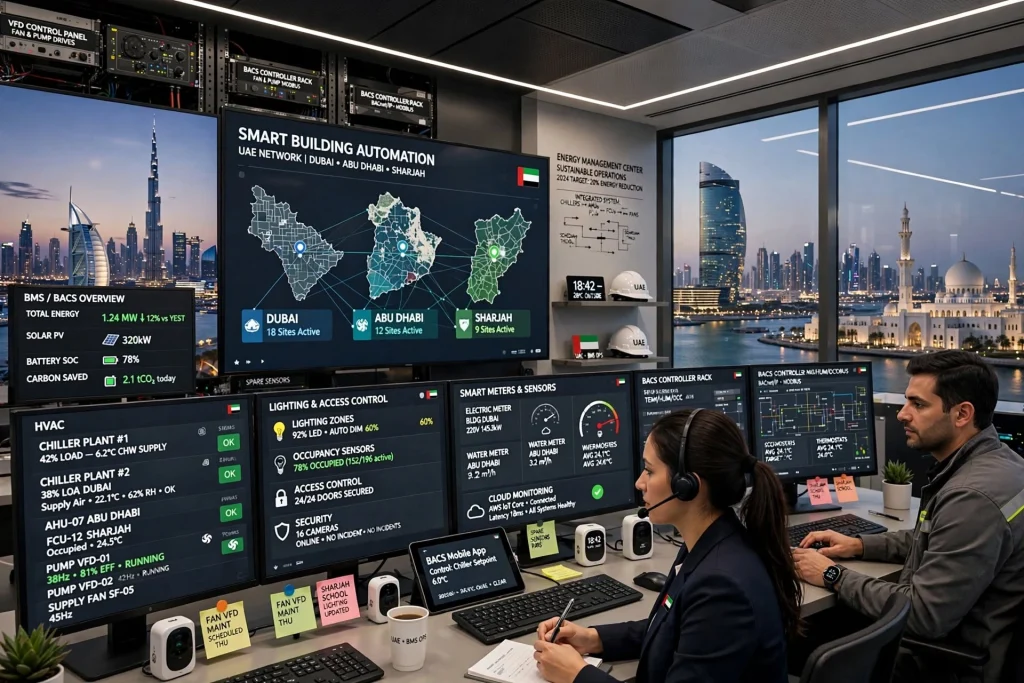
Smart building automation has become an important part of modern energy management, particularly in cities such as Dubai, Abu Dhabi, and Sharjah where commercial buildings, hotels, residential towers, hospitals, shopping centres, and industrial facilities depend heavily on air conditioning and electrical systems. Instead of operating building equipment continuously at fixed settings, automation allows different systems to respond to occupancy, temperature, schedules, energy demand, and real-time operating conditions.
A smart building can connect heating, ventilation and air conditioning (HVAC), lighting, access control, sensors, meters, security systems, elevators, and other building services through an integrated control environment. This creates a clearer picture of how energy is being consumed and provides opportunities to reduce unnecessary operation.
Building automation is closely associated with technologies such as Building Management Systems (BMS), Building Automation and Control Systems (BACS), Internet of Things (IoT) sensors, smart meters, programmable controllers, variable frequency drives (VFDs), occupancy sensors, thermostats, energy dashboards, and cloud-based monitoring platforms.
For UAE buildings, smart automation can be particularly valuable because cooling can represent a substantial part of building energy demand. Intelligent control of chillers, AHUs, FCUs, pumps, fans, and lighting can help facilities operate more efficiently while maintaining occupant comfort.
What Is Smart Building Automation?
Smart building automation is the use of connected hardware, software, sensors, controllers, and communication networks to monitor and control building systems automatically.
Traditional building systems often require individual equipment to be operated manually or according to simple schedules. A smart automation system introduces real-time information into the decision-making process. Sensors can detect room temperature, humidity, occupancy, carbon dioxide levels, light levels, pressure, and other conditions.
The control system then uses this information to adjust equipment operation.
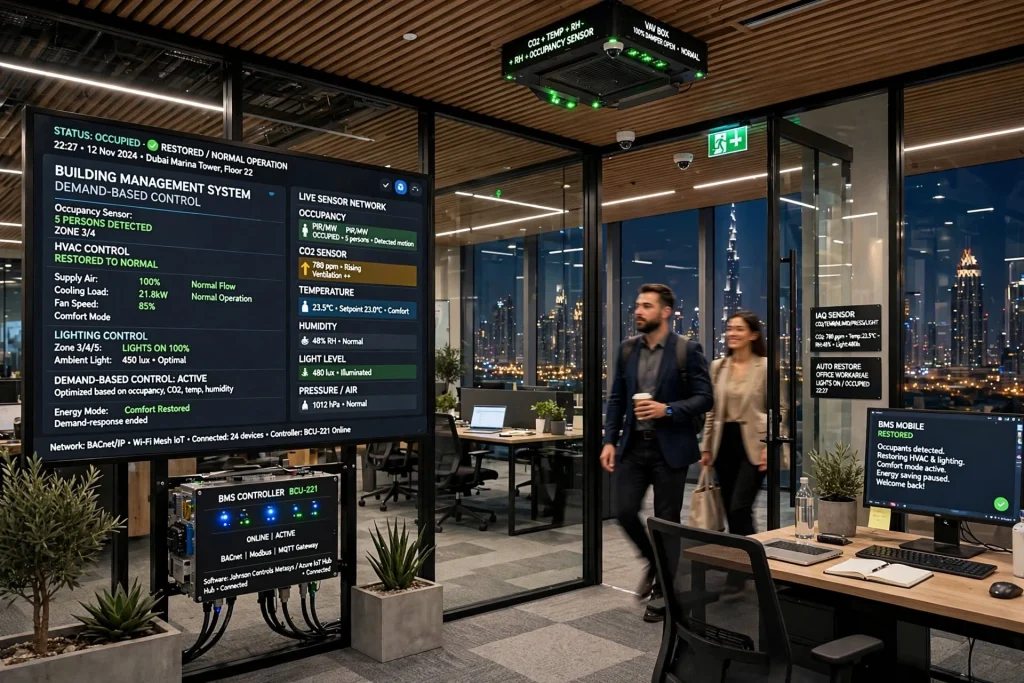
For example, if an office floor becomes unoccupied after working hours, the automation system can reduce HVAC operation and switch off unnecessary lighting. When occupants return, the system can restore the required conditions according to programmed parameters.
This approach moves building operation from fixed schedules toward demand-based control.
How Building Automation Connects Energy Management With HVAC
HVAC is one of the most important areas where smart building automation can support energy management. Air conditioning systems require fans, compressors, pumps, chillers, cooling towers, AHUs, FCUs, valves, and control devices to work together.
A BMS can collect operating information from these components and coordinate their operation.
For example, temperature sensors can provide room-level information while supply-air sensors monitor AHU performance. Chilled-water temperature sensors can provide information about the central plant. Differential pressure sensors can help control pump and fan speeds.
Variable frequency drives can then adjust motor speeds according to actual demand rather than operating equipment continuously at maximum output.
This can improve system control and reduce unnecessary energy use.
Real-Time Energy Monitoring and Smart Meters
One of the biggest advantages of building automation is visibility. Building owners and facility managers cannot effectively manage energy consumption if they do not know where and when energy is being used.
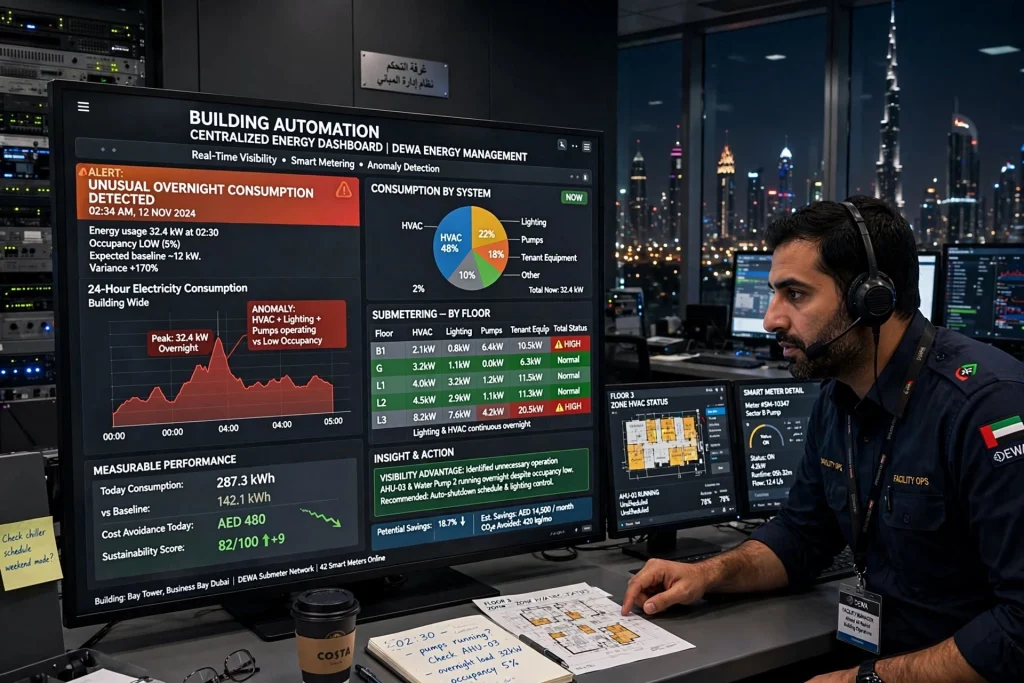
Smart meters and sub-metering systems provide detailed consumption information. Electricity usage can be monitored for entire buildings, individual floors, HVAC systems, lighting circuits, tenant areas, or specific equipment.
A centralized energy dashboard can display consumption patterns and identify unusual changes.
For example, if electricity consumption remains high overnight when occupancy is low, the facility team can investigate whether HVAC equipment, lighting, pumps, or other systems are operating unnecessarily.
Energy monitoring therefore transforms energy management from assumptions into measurable building performance.
Occupancy-Based HVAC Control
Occupancy is an important factor in determining building energy requirements. A meeting room designed for 20 people does not require the same level of ventilation and cooling when it is empty.
Occupancy sensors can provide information about whether spaces are being used. Smart automation can use this information to adjust HVAC and lighting according to demand.
In offices, conference rooms, classrooms, hotels, and commercial buildings, occupancy-based control can reduce the operation of systems in unused spaces.
More advanced systems can combine occupancy data with schedules, temperature sensors, indoor air quality information, and historical patterns.
This allows the building to respond dynamically rather than simply following a fixed timetable.
Smart Lighting and Energy Efficiency
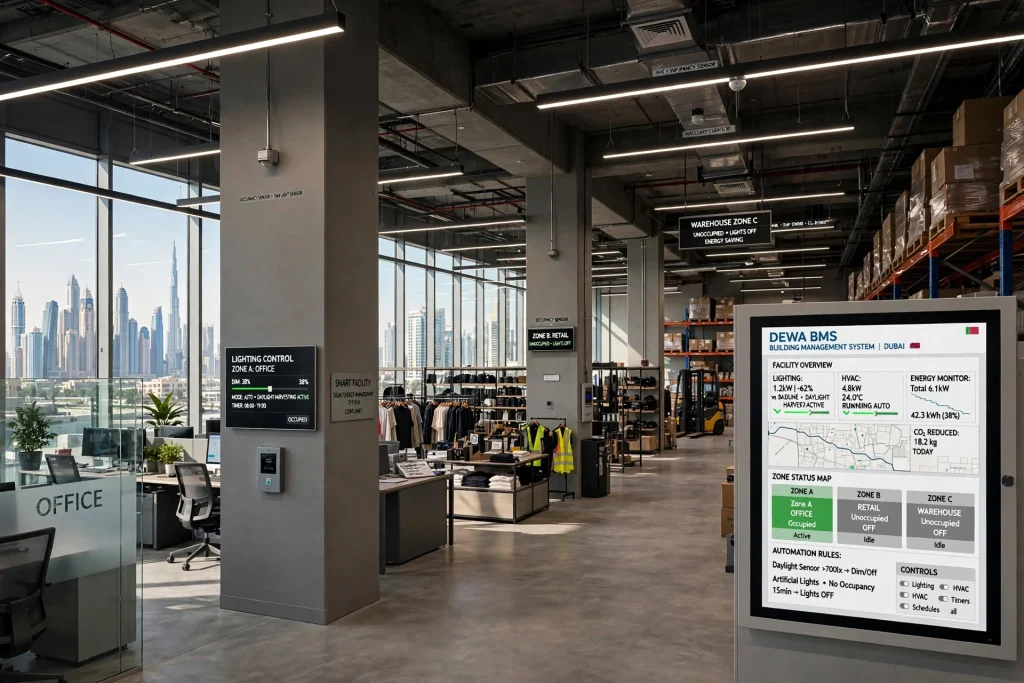
Lighting is another major area where automation can improve energy management. Smart lighting systems can combine LED fixtures with occupancy sensors, daylight sensors, dimming controls, timers, and centralized management.
When natural daylight is sufficient, automated controls can reduce artificial lighting levels. When an area becomes unoccupied, lighting can be switched off or reduced.
Modern commercial lighting systems can also be integrated with the BMS, allowing facility teams to monitor lighting status alongside HVAC and other building services.
In areas such as Dubai offices, retail spaces, hotels, warehouses, and industrial facilities, smart lighting can contribute to a broader energy-management strategy.
Daylight Harvesting and Automated Lighting Control
Daylight harvesting uses available natural light to reduce dependence on artificial illumination.
Sensors measure the amount of natural light entering a space and adjust artificial lighting accordingly. For buildings with large windows, atriums, skylights, or glazed façades, this approach can help balance visual comfort and electricity consumption.
The system does not simply turn lights off. Instead, lighting levels can be adjusted based on actual conditions.
When integrated with occupancy detection, the system can respond to both the presence of people and available daylight.
This creates more responsive lighting control while supporting energy efficiency.
Smart Chiller Plant Management
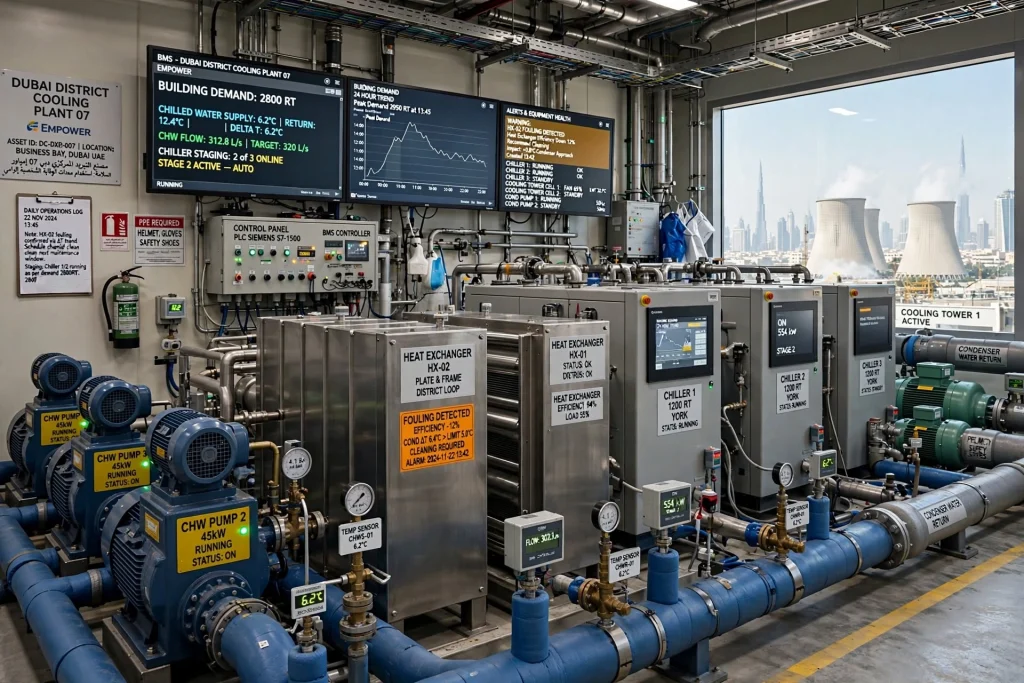
Large commercial buildings often depend on central chilled-water plants for air conditioning. A chiller plant can include chillers, cooling towers, chilled-water pumps, condenser-water pumps, heat exchangers, valves, sensors, and control systems.
Smart automation can coordinate these components based on actual cooling demand.
For example, the BMS can monitor chilled-water supply and return temperatures, flow rates, condenser temperatures, equipment status, and building demand.
Instead of running every chiller continuously, plant controls can stage equipment according to demand where the system design and operating strategy permit.
This can improve plant efficiency and reduce unnecessary equipment operation.
For large facilities, monitoring chiller performance can also help identify changes that may indicate fouled heat exchangers, inefficient operation, abnormal temperatures, or maintenance requirements.
Variable Frequency Drives and Demand-Based Operation
Variable frequency drives are important components in energy-efficient building automation.
Fans and pumps do not always need to operate at maximum speed. A VFD allows motor speed to be adjusted according to system demand.
For example, an AHU fan may operate at a lower speed when airflow requirements decrease. Similarly, a chilled-water pump can adjust its speed based on pressure or flow requirements.
Because motor power requirements can change significantly with speed, reducing unnecessary motor operation can contribute to energy savings.
VFDs can be integrated with BMS controllers and sensors so that equipment responds automatically to real-time conditions.
Indoor Air Quality and Energy Management
Energy management should not mean simply reducing HVAC operation. A well-designed smart building also needs to maintain appropriate indoor environmental conditions.
Sensors can monitor indoor air quality indicators such as carbon dioxide, temperature, and humidity. Depending on the building and system design, ventilation can then be adjusted according to occupancy and air-quality requirements.
This creates a balance between energy efficiency and occupant comfort.
For offices, schools, healthcare facilities, hotels, and other occupied environments, intelligent ventilation control can be particularly useful because ventilation requirements change throughout the day.
Predictive Maintenance Through Building Automation
Smart automation can also support predictive and condition-based maintenance.
Traditional maintenance often follows fixed schedules. While scheduled maintenance remains important, connected equipment can provide additional information about its operating condition.
A BMS can monitor equipment alarms, operating hours, temperatures, pressures, vibration data where sensors are available, valve positions, motor status, and other parameters.
Unusual changes may indicate developing problems.
For example, increasing pressure across a filter can indicate that it requires cleaning or replacement. Abnormal chilled-water temperatures may indicate a heat-transfer or flow problem. A fan operating outside expected parameters may indicate a mechanical or control issue.
Early detection can help facility teams investigate problems before they result in major equipment failure.
Fault Detection and Diagnostics
Fault Detection and Diagnostics (FDD) is becoming increasingly relevant to smart building management.
FDD software can compare actual equipment performance with expected operating patterns and identify unusual conditions.
A system might detect that a cooling valve is commanded to open but the temperature response does not match expectations. It may identify simultaneous heating and cooling, excessive HVAC operation during unoccupied periods, abnormal temperature differences, or equipment that is running when it should be off.
This provides facility managers with actionable information rather than requiring them to manually inspect every system continuously.
Energy Management Through Automated Scheduling
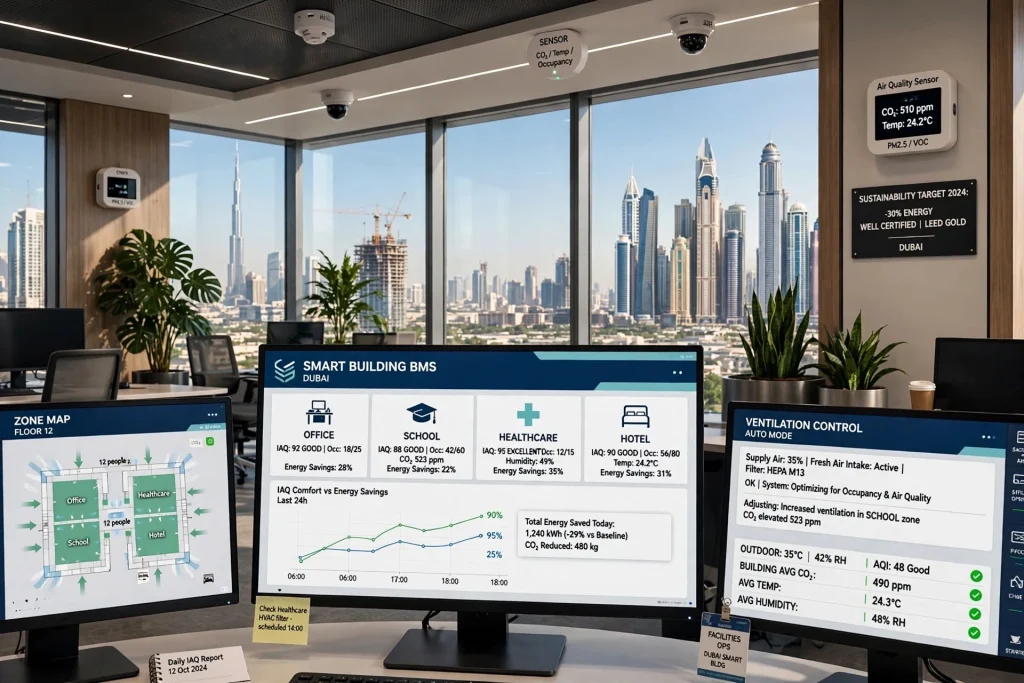
Building schedules are another simple but effective area of automation.
HVAC, lighting, ventilation, and other systems can be programmed according to occupancy schedules. However, smart automation can make these schedules more flexible.
For example, an office may normally operate from morning until evening. If an area remains unused during certain hours, automation can reduce HVAC and lighting operation.
Holiday schedules, weekend settings, seasonal schedules, and special events can also be incorporated.
This is especially useful for large buildings where manually controlling hundreds of devices would be inefficient.
Smart Building Automation in Dubai
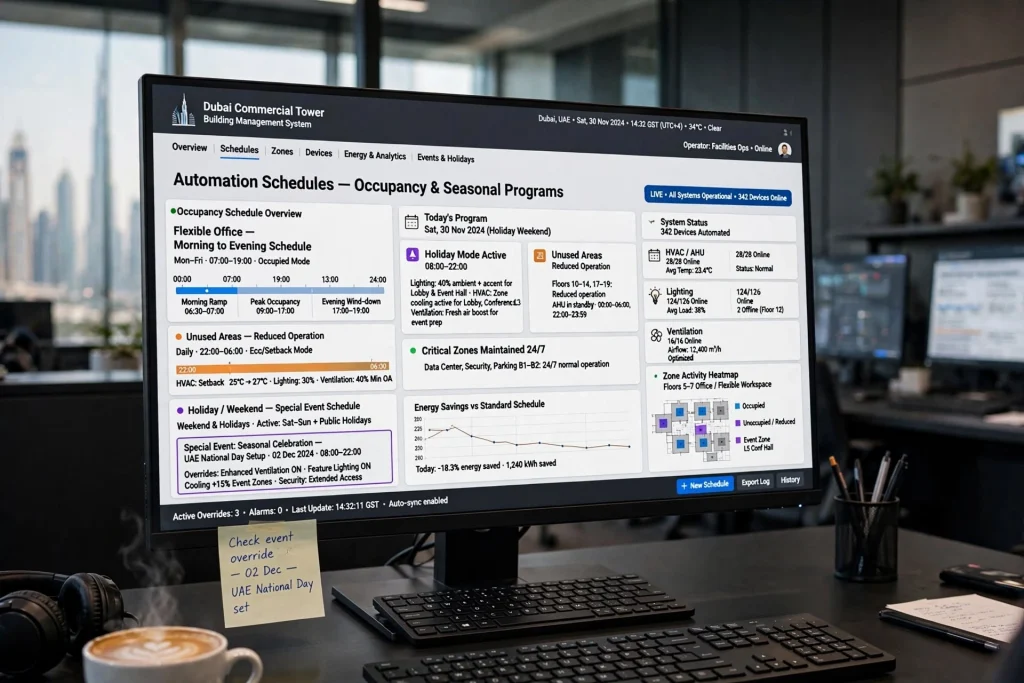
Dubai has a large concentration of high-rise buildings, luxury hotels, commercial towers, shopping destinations, residential communities, industrial facilities, and mixed-use developments.
Building automation can help these properties manage complex HVAC and electrical infrastructure.
Locations such as Downtown Dubai, Business Bay, Dubai Marina, Jumeirah Lake Towers, Dubai Hills Estate, Palm Jumeirah, Jumeirah, Al Barsha, Dubai South, Al Quoz, and Jebel Ali contain buildings with very different operating requirements.
A residential tower may prioritize centralized cooling and common-area lighting, while a hotel may require continuous HVAC operation across guest rooms, kitchens, restaurants, meeting spaces, and back-of-house areas.
Smart automation provides a common platform for monitoring and coordinating these systems.
Smart Buildings in Abu Dhabi and Sharjah
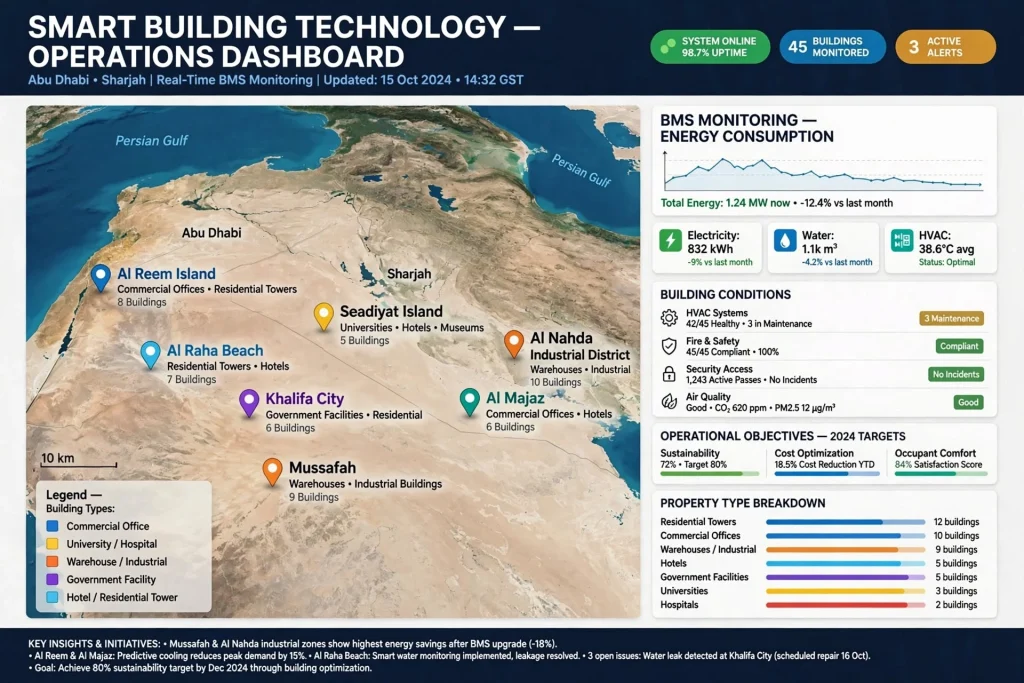
Smart building technology is also relevant to properties throughout Abu Dhabi and Sharjah.
Commercial offices, hospitals, universities, hotels, residential towers, government facilities, warehouses, and industrial buildings can use BMS technology to monitor energy consumption and building conditions.
Areas such as Al Reem Island, Saadiyat Island, Al Raha Beach, Khalifa City, Mussafah, Al Majaz, Al Nahda Sharjah, and industrial districts contain properties with different energy profiles.
A successful automation strategy should therefore be based on actual building requirements rather than simply installing technology without a clear operational objective.
Integration With Building Management Systems
The Building Management System acts as a central platform for monitoring and controlling many building services.
A modern BMS may communicate with HVAC controllers, lighting systems, energy meters, VFDs, pumps, sensors, access-control systems, fire-related monitoring interfaces, and other building equipment.
Common communication technologies and protocols can include BACnet, Modbus, KNX, LonWorks, and other integration methods depending on the equipment and system architecture.
The objective is to create a coordinated environment in which building data can be collected and used for better operational decisions.
For properties requiring professional installation, integration, optimization, or maintenance, a specialized Building Managment System Service can help align automation technology with the building’s HVAC and energy-management requirements.
Cloud-Based Building Monitoring
Cloud-connected building platforms can make building information accessible through web dashboards and mobile interfaces.
Facility managers can review equipment status, energy consumption, alarms, temperature trends, and other information without being physically present in a plant room.
Remote monitoring can be useful for organizations managing multiple properties.
A facility team may compare energy consumption between buildings, identify abnormal operating patterns, review alarms, and prioritize maintenance activities.
Cybersecurity and appropriate access controls are important considerations when connecting building systems to external networks or cloud platforms.
Artificial Intelligence and Smart Energy Management
Artificial intelligence and machine learning are increasingly being explored for building energy optimization.
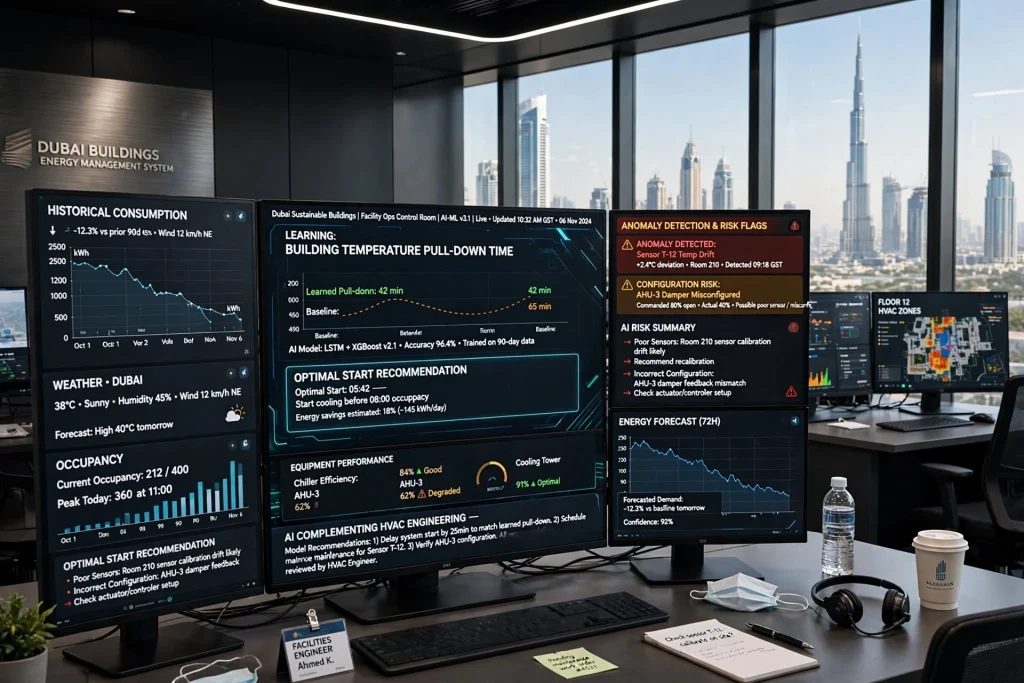
AI-based systems can analyze historical consumption, weather conditions, occupancy patterns, equipment performance, and other data to identify opportunities for optimization.
For example, an intelligent system may learn how quickly a building reaches its required temperature under different outdoor conditions. It can then help determine when equipment should start operating before occupancy.
AI can also assist with anomaly detection and energy forecasting.
However, AI should complement sound HVAC engineering rather than replace it. Poor sensors, incorrect system configuration, inadequate commissioning, or unreliable data can reduce the effectiveness of automated optimization.
Digital Twins and Building Performance
Digital twins provide another emerging technology for smart buildings. A digital twin represents physical building systems within a digital environment and can combine information from building models, sensors, equipment, and operational data.
Building Information Modeling (BIM) can provide valuable information about physical assets, while live sensor data can show how those assets are operating.
This combination can support facility management, maintenance planning, energy analysis, and operational optimization.
For large UAE developments, digital building information can become increasingly valuable throughout the lifecycle of a property.
Smart Automation and UAE Sustainability Goals
Energy-efficient building operation is closely connected to broader sustainability objectives.
The UAE has invested heavily in sustainable development, smart cities, efficient infrastructure, renewable energy, and improved building performance. Dubai’s smart-city initiatives and sustainability programs have encouraged the adoption of technologies that can improve resource efficiency.
Smart automation supports these objectives by providing better control over energy-consuming systems.
Automation does not automatically make a building efficient. The greatest value comes when sensors, controls, equipment, commissioning, maintenance, and operational strategies work together.
Why Commissioning Is Important
Even advanced automation systems can perform poorly if they are not correctly commissioned.
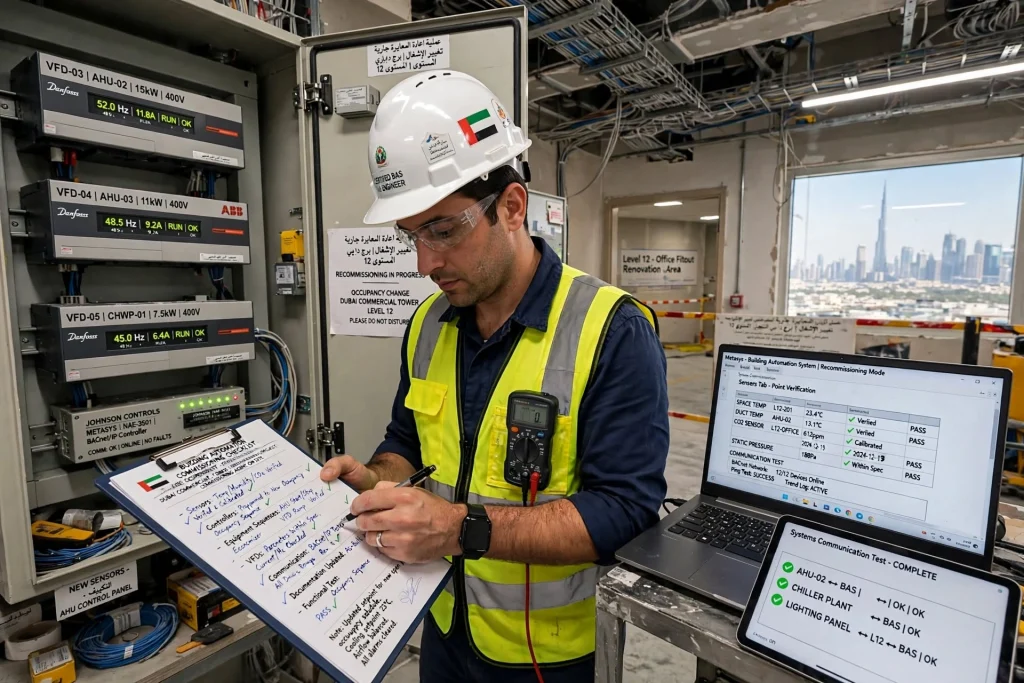
Sensors need to provide accurate information. Controllers must be programmed correctly. Equipment sequences need to reflect actual building requirements. VFDs must operate within appropriate parameters. Communication between systems needs to be tested.
Commissioning verifies that the automation system behaves as intended.
Recommissioning can also be useful when a building changes occupancy, undergoes renovation, adds equipment, or experiences significant changes in energy consumption.
Measuring the Results of Energy Management
Smart building automation should be measured using actual performance indicators.
Useful metrics can include total electricity consumption, HVAC energy consumption, energy use intensity, peak demand, equipment operating hours, chilled-water temperatures, indoor temperature stability, lighting consumption, and equipment efficiency.
Comparing current performance with historical data can help determine whether automation strategies are producing meaningful improvements.
Facility teams can also establish energy baselines and monitor performance over time.
The objective should not simply be to collect large amounts of data. Data should lead to better decisions and measurable operational improvements.
Common Challenges With Smart Building Automation
Smart building projects can face challenges such as outdated equipment, incompatible communication protocols, inaccurate sensors, poor documentation, inadequate commissioning, cybersecurity concerns, and limited staff training.
Legacy HVAC equipment may also require gateways or additional controllers before it can communicate with a modern BMS.
Another common challenge is installing technology without establishing clear objectives. A building may have many sensors and dashboards but still operate inefficiently if control sequences are poorly designed.
Successful projects therefore require proper planning, engineering, integration, commissioning, training, and ongoing maintenance.
The Future of Smart Energy Management
The future of building energy management is moving toward greater automation, interoperability, predictive analytics, and data-driven decision-making.
IoT sensors will provide more detailed information about buildings. AI-based analytics can identify patterns in energy consumption. Digital twins can improve asset visibility. Smart meters can provide more granular energy data. Automated controls can adjust systems dynamically according to real-time conditions.
The long-term objective is a building that can respond intelligently to changing conditions while maintaining comfort, reliability, safety, and energy performance.
Frequently Asked Questions About Smart Building Automation
How does smart building automation save energy?
Smart automation saves energy by controlling equipment according to actual demand. Occupancy sensors, schedules, temperature sensors, smart meters, VFDs, and automated controls can reduce unnecessary HVAC, lighting, ventilation, and equipment operation.
What is the role of BMS in energy management?
A Building Management System collects data from building equipment and provides centralized monitoring and control. It can help manage HVAC, lighting, pumps, fans, meters, alarms, sensors, and other systems while providing information for energy optimization.
Can smart automation reduce HVAC energy consumption?
Yes. Demand-based HVAC control, optimized chiller sequencing, variable-speed fans and pumps, occupancy-based temperature control, and improved scheduling can reduce unnecessary HVAC operation when properly engineered and commissioned.
Is smart building automation suitable for older buildings?
Yes. Existing buildings can often be upgraded through sensors, controllers, gateways, smart meters, VFDs, and integration with legacy equipment. The exact solution depends on the age, condition, controls architecture, and compatibility of existing systems.
What technologies are used in smart buildings?
Common technologies include BMS, IoT sensors, smart meters, occupancy sensors, VFDs, HVAC controllers, lighting controls, energy dashboards, cloud platforms, BACnet, Modbus, KNX, analytics software, and increasingly AI-based optimization tools.
Conclusion
Smart building automation provides a practical way to connect energy management with the everyday operation of HVAC, lighting, ventilation, pumps, and other building systems. Instead of relying entirely on fixed schedules or manual adjustments, smart buildings use real-time information to make equipment operation more responsive to actual conditions.
For UAE properties, this approach can be particularly valuable because air conditioning and centralized cooling systems play a major role in building operations. Automated control of chillers, cooling towers, AHUs, FCUs, pumps, fans, VFDs, thermostats, and lighting can improve visibility and help reduce unnecessary energy use.
The most successful smart-building strategies combine reliable sensors, properly engineered controls, accurate energy monitoring, effective commissioning, preventive maintenance, and trained facility teams.
As Dubai, Abu Dhabi, and Sharjah continue to develop smart infrastructure and modern commercial and residential buildings, building automation will increasingly become an important part of energy-efficient facility management. When technology is correctly integrated with building engineering, it can support lower operating costs, better occupant comfort, improved equipment performance, and more sustainable building operation.