Choosing the right plumbing pipe is an important engineering decision for residential buildings, villas, commercial properties, hotels, offices, restaurants, and industrial facilities. Copper, PPR, and PEX are three widely used piping materials, but they are not interchangeable in every application.
Each material has different characteristics relating to temperature resistance, pressure performance, corrosion resistance, flexibility, installation method, service life, water quality, maintenance, cost, and suitability for hot and cold water systems.
For projects in the UAE, material selection also needs to account for the local environment. High ambient temperatures, water quality, building design, installation practices, and maintenance requirements can all influence long-term plumbing performance.
The right question is therefore not simply, “Which pipe is the best?” Instead, the better question is:
Which pipe material is best suited to the building, water system, operating conditions, installation method, and expected service life?
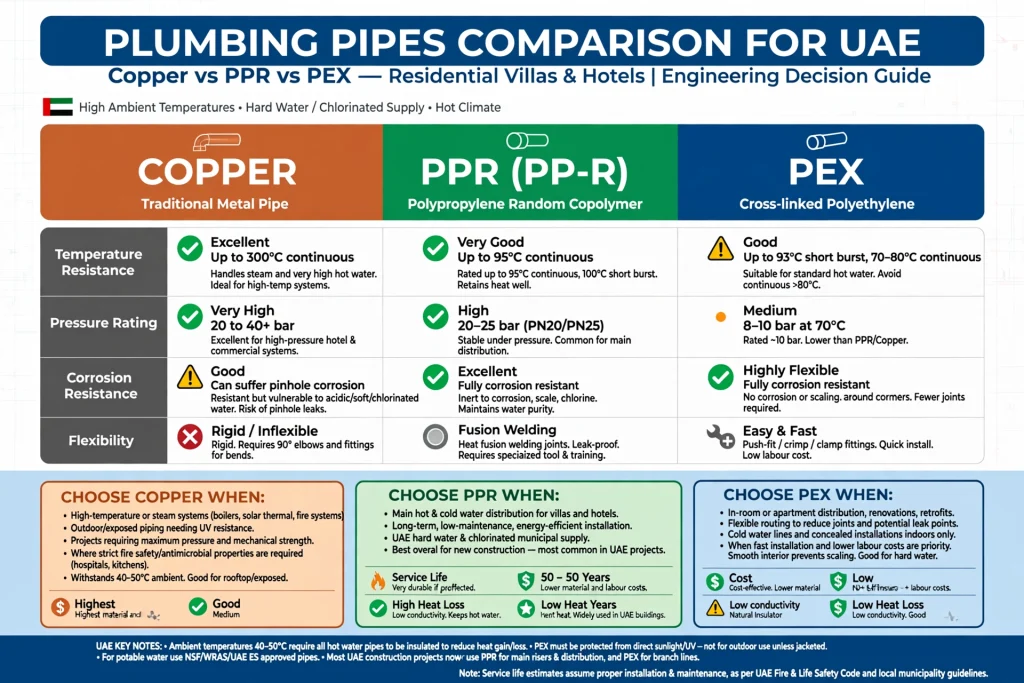
Copper vs PPR vs PEX: Quick Comparison
| Feature | Copper | PPR | PEX |
|---|---|---|---|
| Material | Metal | Polypropylene | Cross-linked polyethylene |
| Hot water suitability | Excellent | Excellent with correct grade | Excellent with correct grade |
| Cold water | Excellent | Excellent | Excellent |
| Flexibility | Low | Low to moderate | Excellent |
| Corrosion resistance | Good, application dependent | Excellent | Excellent |
| Installation | Soldering/brazing or mechanical fittings | Heat fusion | Crimp/press/expansion fittings |
| Joint reliability | High when correctly installed | Very high with proper fusion | High with correct fittings |
| Noise | Can transmit water noise | Relatively quiet | Relatively quiet |
| Thermal expansion | Relatively low | Higher | Higher |
| UV resistance | Excellent | Limited unless protected | Limited unless protected |
| Outdoor exposure | Excellent | Requires protection | Requires protection |
| Initial cost | Generally higher | Generally economical | Generally economical |
| Complex routing | Difficult | Moderate | Excellent |
| Common application | Premium/commercial/industrial | Hot and cold water | Residential/hot/cold water |
| Maintenance | Generally low | Low | Low |
These are general characteristics. Actual performance depends on the pipe grade, manufacturer, installation method, fittings, water chemistry, temperature, pressure, and applicable standards.
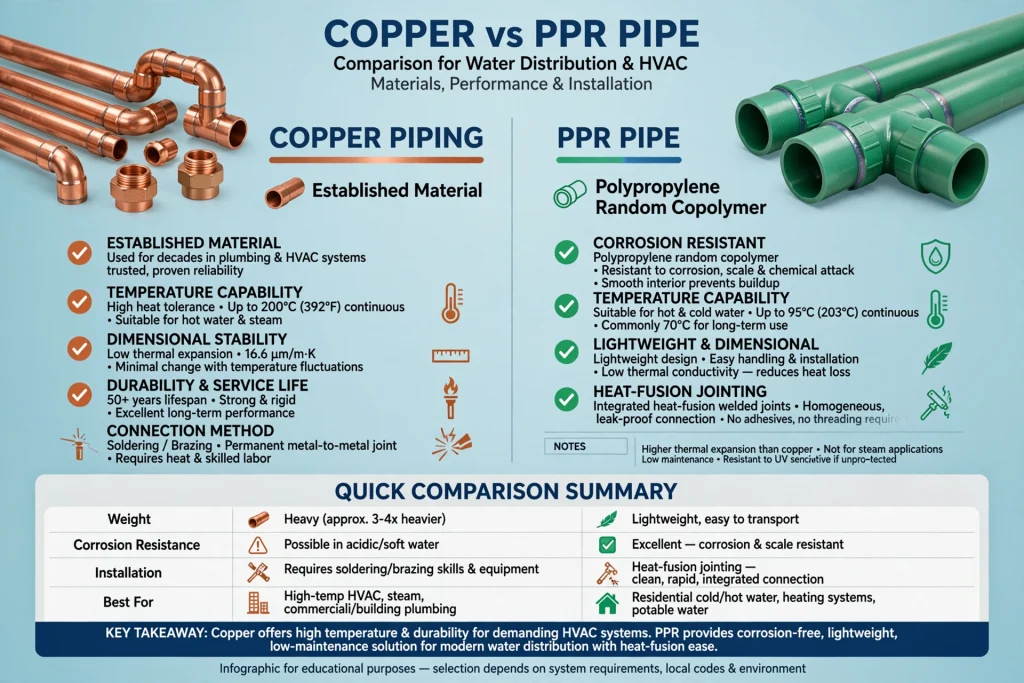
What Is Copper Piping?
Copper has been used in plumbing systems for decades and remains an established material for water distribution, HVAC applications, refrigeration, and specialized mechanical systems.
Copper pipe is available in different grades and wall thicknesses, with selection depending on pressure, temperature, installation method, and application.
One of copper’s biggest advantages is its temperature capability and dimensional stability. It does not soften in the same way as many thermoplastics when exposed to elevated temperatures within its intended operating range.
Copper also has relatively low thermal expansion compared with PPR and PEX.
For technically demanding applications, copper can provide a long service life when correctly specified and installed.
However, copper is not automatically the best choice for every plumbing project.
What Is PPR Pipe?
PPR stands for polypropylene random copolymer. PPR piping has become widely used for hot and cold water distribution because of its corrosion resistance, relatively low weight, and heat-fusion jointing method.
Unlike traditional threaded or soldered systems, PPR pipes are typically joined by heating the pipe and fitting ends and fusing them together.
When performed correctly, the resulting joint becomes an integrated connection rather than relying on a separate threaded joint.
PPR is commonly used in villas, residential buildings, hotels, commercial buildings, domestic water systems, and mechanical installations.
Its performance depends heavily on the pipe’s pressure class, wall thickness, temperature, manufacturer specifications, and installation quality.
What Is PEX Pipe?
PEX stands for cross-linked polyethylene.
PEX is a flexible thermoplastic pipe widely used for potable water distribution, hot-water systems, radiant heating, and other plumbing applications depending on the specific product.
Its major advantage is flexibility.
Unlike rigid copper and PPR, PEX can often be routed through walls, ceilings, floors, and around obstacles with fewer joints.
This can reduce the number of connection points in certain installations and make complex layouts easier to execute.
PEX systems use different connection technologies, including crimp, clamp, press, and expansion systems depending on the PEX type and manufacturer.
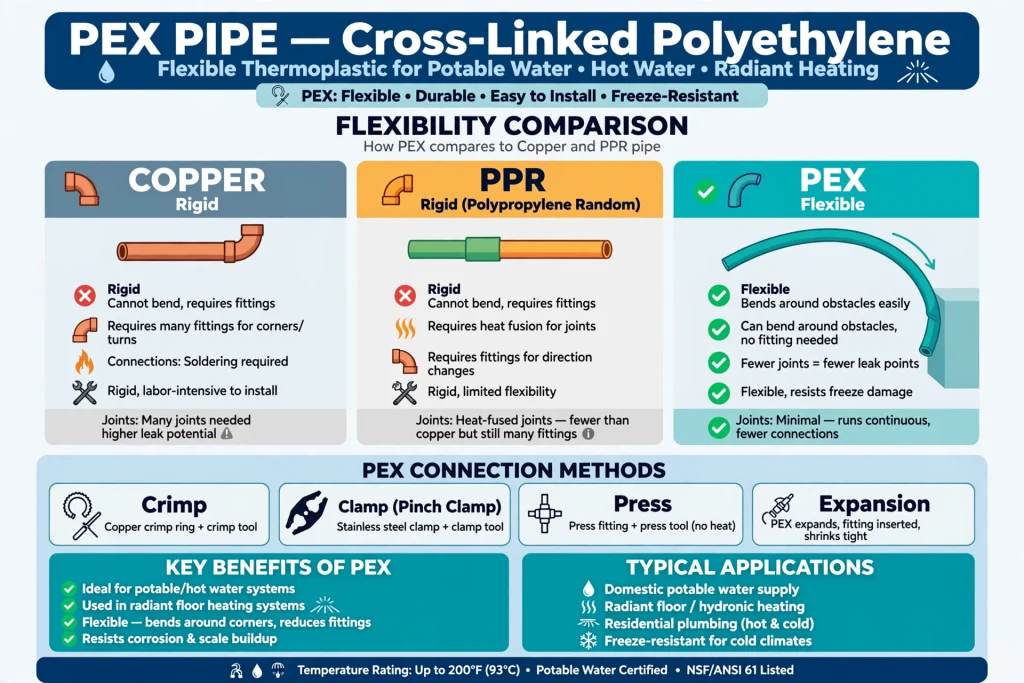
Difference in Flexibility
One of the biggest differences between the three materials is flexibility.
Copper is rigid and requires fittings when the pipe changes direction.
PPR is also relatively rigid, although it can accommodate some routing changes depending on the installation method.
PEX is significantly more flexible and can be bent around many obstacles.
This makes PEX attractive for residential plumbing layouts, retrofit projects, and installations where minimizing joints is beneficial.
For example, routing a flexible PEX line around structural obstacles can sometimes be easier than installing multiple elbows in a rigid piping system.
However, flexibility does not mean the pipe can be installed without planning. Bending radius, support spacing, protection, and manufacturer requirements must still be followed.
Difference in Corrosion Resistance
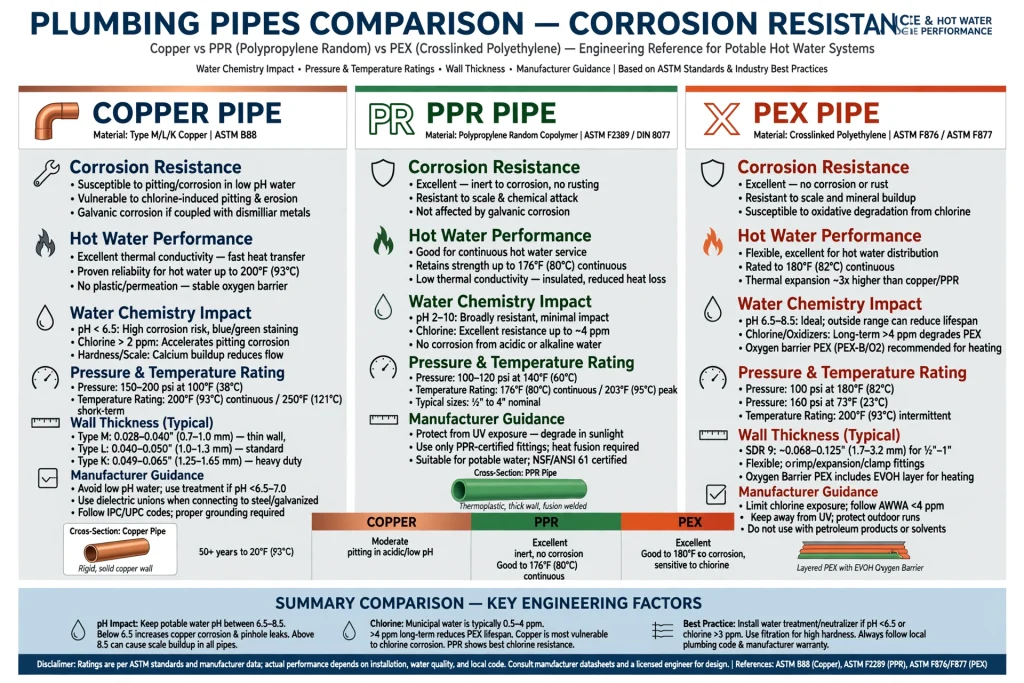
Corrosion is an important concern in plumbing systems because internal pipe degradation can eventually affect water quality, flow, and service life.
Copper has good corrosion resistance under many normal water conditions, but its performance can be affected by water chemistry. Aggressive water conditions can contribute to copper corrosion.
PPR and PEX are polymeric materials and do not experience metallic corrosion in the same way.
This makes them attractive for many domestic and commercial water-distribution systems.
However, “plastic does not rust” does not mean every plastic pipe is suitable for every chemical or temperature environment. Chemical compatibility, temperature, pressure, and product certification still matter.
Difference in Hot Water Performance
Hot-water performance is one of the most important considerations when comparing these materials.
Copper has long been used for hot-water distribution because of its ability to handle elevated temperatures within appropriate design limits.
PPR is also widely used for hot-water systems when the correct pressure and temperature-rated pipe is selected.
PEX can also be used for hot water, provided the specific PEX product is approved for the required temperature, pressure, and application.
A common mistake is to choose a pipe based on the material name alone.
For example, saying “PPR is suitable for hot water” is incomplete. The engineer should verify the specific PPR classification, pressure rating, temperature rating, wall thickness, and manufacturer’s design guidance.
The same principle applies to PEX and copper.
Difference in Thermal Expansion
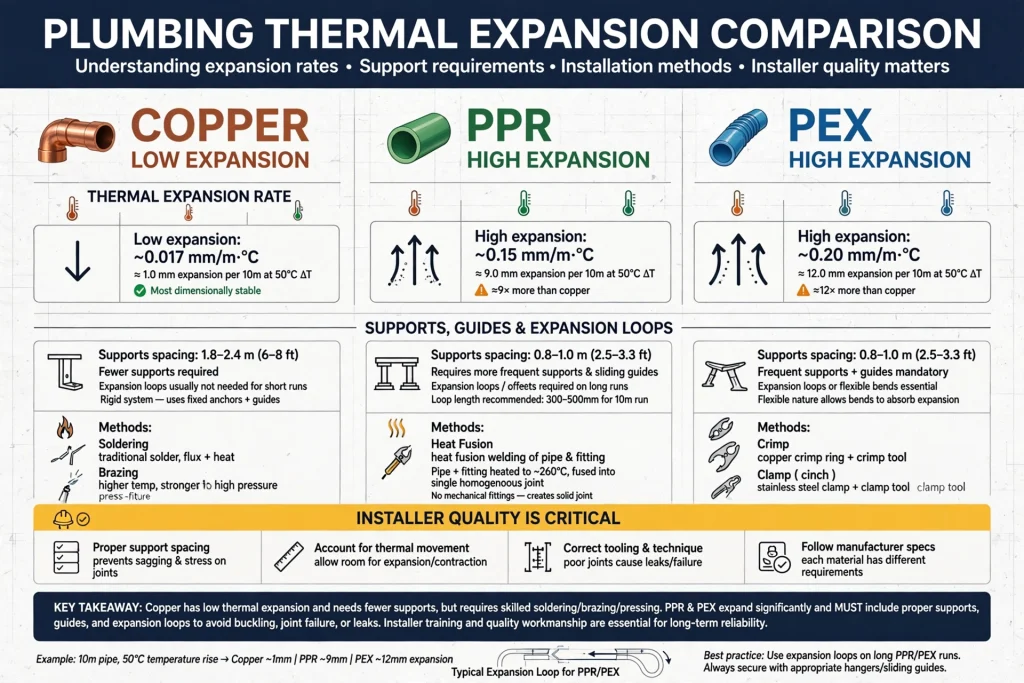
Thermal expansion is particularly important in hot-water systems.
Copper expands less than PPR and PEX when temperature changes occur.
Thermoplastic pipes therefore require appropriate design allowances for expansion and contraction.
Long PPR or PEX runs may need suitable supports, guides, expansion loops, or other installation measures depending on the system design.
If thermal movement is ignored, piping can experience stress, movement, noise, or excessive loading on fittings.
Experienced plumbing engineers therefore consider temperature changes during system design rather than treating thermal expansion as an installation afterthought.
Difference in Installation Methods
Copper commonly uses soldered, brazed, press-fit, or mechanical connections depending on the application.
PPR generally uses heat fusion.
PEX uses mechanical connection systems such as crimp, clamp, press, or expansion fittings depending on the product.
Each method requires specific tools and technician skills.
A theoretically excellent pipe can still fail if installation quality is poor.
For PPR, incorrect heating time, insufficient insertion, excessive heating, or contamination can compromise a joint.
For PEX, incorrect fitting installation, poor crimping, unsuitable components, or improper support can cause leaks.
For copper, poor soldering, contamination, overheating, or inadequate joint preparation can create problems.
The quality of the installer is therefore just as important as the material selection.
Difference in Water Flow and Internal Surface
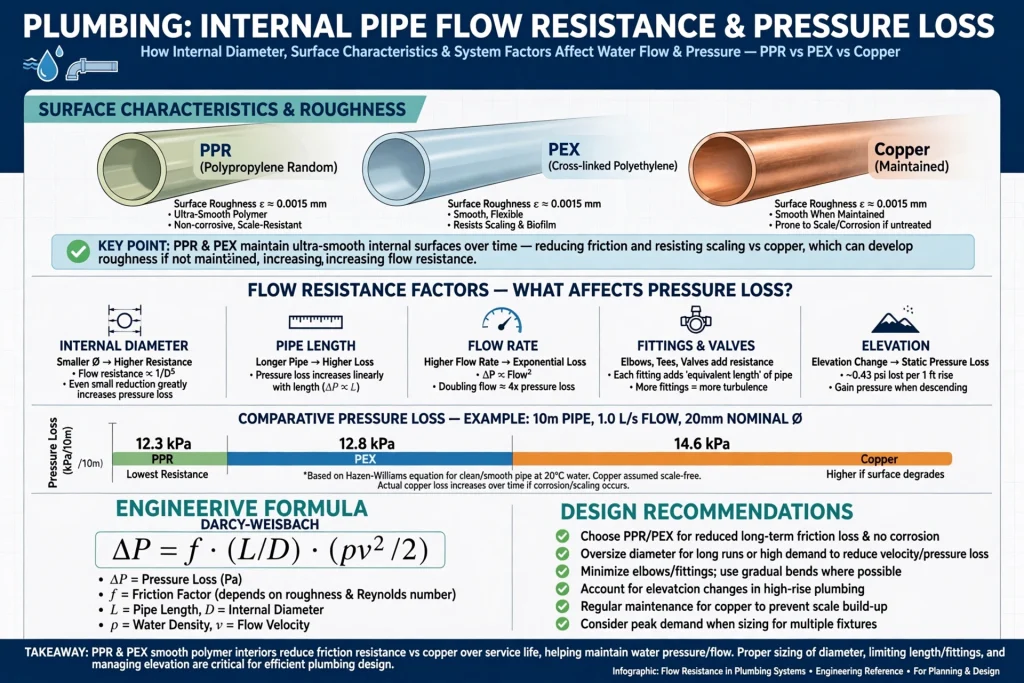
Internal pipe diameter and surface characteristics influence water flow.
PPR and PEX have smooth internal surfaces that can reduce certain types of flow resistance compared with rougher or deteriorated piping systems.
Copper also provides a relatively smooth internal surface when properly maintained.
However, water pressure and flow cannot be determined simply by comparing pipe materials.
Engineers consider internal diameter, pipe length, flow rate, pressure loss, fittings, valves, elevation changes, and simultaneous demand.
A properly designed plumbing system should deliver adequate pressure at fixtures while maintaining acceptable velocity and minimizing unnecessary pressure loss.
Difference in Noise
Plastic piping systems can provide a relatively quiet solution because thermoplastic materials behave differently from metal piping when water moves through the system.
Copper can transmit water hammer and flow noise through building structures if the system is poorly supported or inadequately designed.
PEX’s flexibility can help reduce some transmission of vibration and noise.
However, noise problems are not caused solely by the pipe material. Water velocity, pressure, pipe supports, valves, water hammer, pump operation, and building construction all contribute.
A well-designed copper system can be quiet, while a poorly installed PEX system can still create noise.
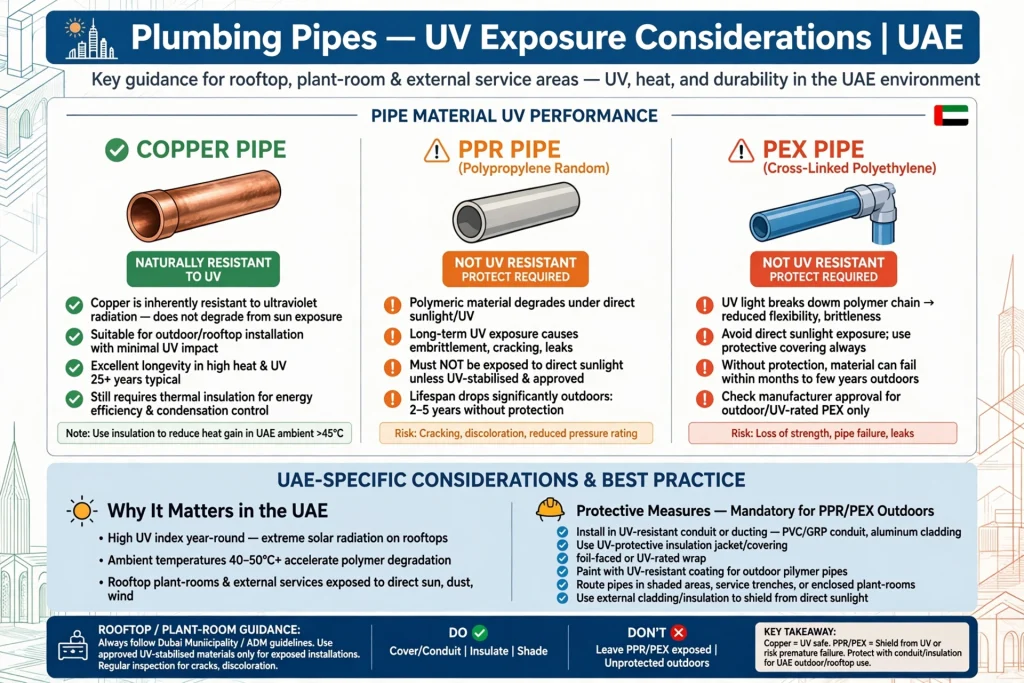
Difference in UV Resistance
This consideration is particularly relevant to the UAE.
Copper is naturally resistant to ultraviolet exposure.
PPR and PEX should generally not be left exposed to direct sunlight unless the specific product is designed and approved for such conditions.
Long-term UV exposure can degrade polymeric materials.
Therefore, exposed plastic piping may require insulation, protective covering, suitable conduit, or another approved protection method according to the manufacturer’s requirements.
This is particularly important during rooftop installations, plant-room work, external service areas, and construction projects where pipes may remain exposed before final enclosure.
Copper vs PPR vs PEX for Dubai Buildings
In Dubai, the appropriate choice depends heavily on the building type and application.
A villa in Arabian Ranches, Dubai Hills, Jumeirah, Emirates Hills, or Palm Jumeirah may use PPR or PEX for domestic water distribution depending on the plumbing design.
A commercial building in Business Bay, Downtown Dubai, or Dubai Marina may require a combination of piping materials depending on domestic water, HVAC, fire protection, drainage, and mechanical services.
Industrial facilities in Jebel Ali, Al Quoz, or Dubai Investment Park may have much more specialized requirements involving temperature, pressure, chemicals, and process water.
There is therefore no universal “Dubai pipe.”
The building’s engineering requirements should determine the material.
Copper vs PPR vs PEX for Commercial Buildings
Commercial plumbing systems typically experience higher demand and greater operational complexity than small residential systems.
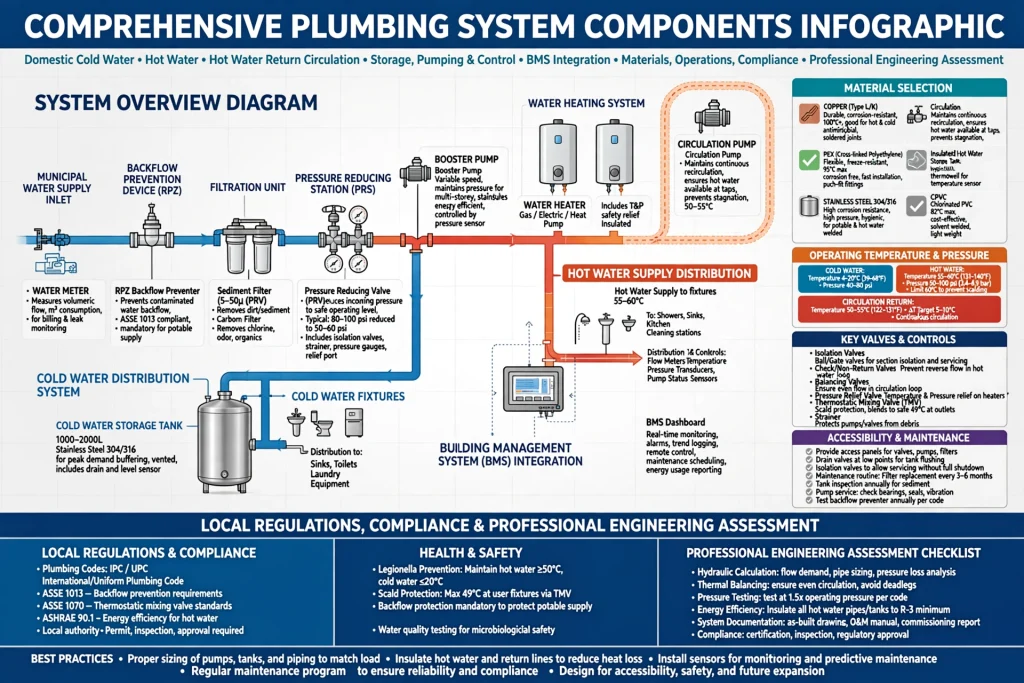
Hotels, hospitals, restaurants, shopping centers, office towers, schools, and mixed-use buildings may have extensive domestic water distribution networks.
The system may include:
- Domestic cold water
- Domestic hot water
- Hot-water return circulation
- Storage tanks
- Booster pumps
- Water heaters
- Valves
- Pressure-reducing stations
- Water meters
- Filtration systems
- Backflow protection
- Building management integration
Material selection should account for operating temperature, pressure, accessibility, maintenance requirements, and local regulations.
For complex projects, Professional Commercial level Plumbing service should begin with engineering assessment rather than material selection based only on initial price.
Difference in Maintenance Requirements
All three systems can provide long service when properly designed and installed.
Copper systems may require inspection for corrosion, joint problems, leaks, and mechanical damage.
PPR systems generally have low routine maintenance requirements, but joints and exposed sections should still be inspected.
PEX systems also require relatively little routine maintenance, but accessible fittings and connection points should be checked during building maintenance.
The most important maintenance principle is early leak detection.
A small concealed leak can cause significant damage to walls, ceilings, cabinets, electrical systems, and finishes before it becomes visible.
Regular inspection is especially important in commercial properties, hotels, restaurants, and multi-unit buildings.
Which Pipe Is Best for Hot and Cold Water?
There is no single answer.
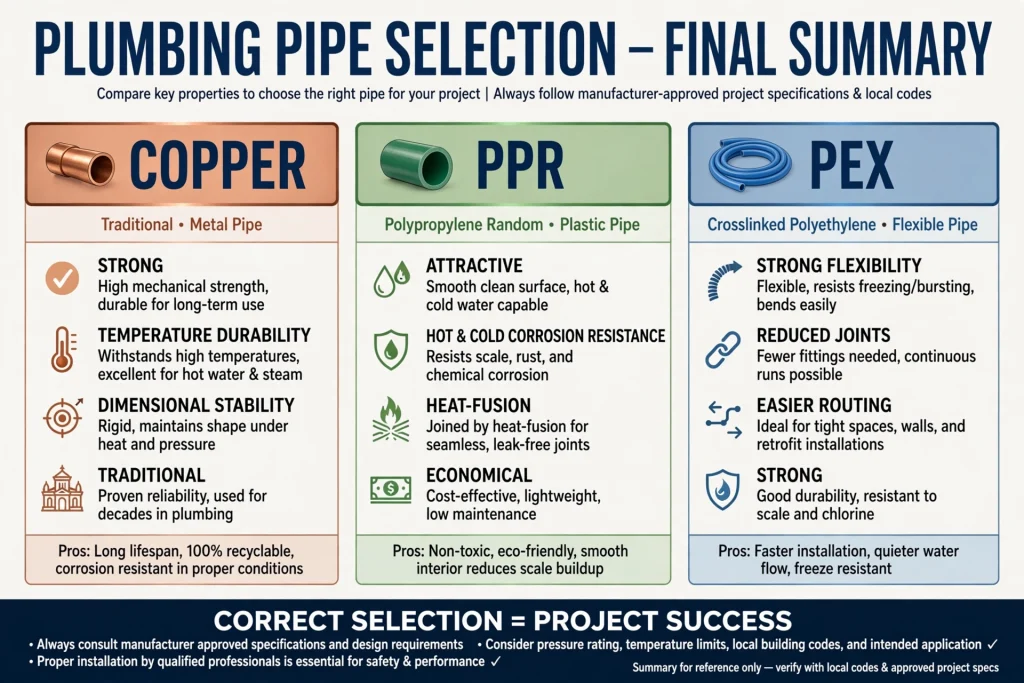
Copper
A strong choice when temperature capability, durability, dimensional stability, and traditional engineering practices are priorities.
PPR
An attractive choice for many hot- and cold-water distribution systems because of corrosion resistance, heat-fusion joints, and relatively economical installation.
PEX
A strong choice where flexibility, reduced joint count, and easier routing are important.
The correct selection should always be based on the manufacturer’s approved application and project specifications.
Which Pipe Is Most Cost-Effective?
Initial material cost is only one component of plumbing economics.
A better calculation includes:
Material + fittings + labor + installation time + tools + insulation + maintenance + repair + expected service life.
PPR can be economical for larger hot- and cold-water distribution networks.
PEX can reduce labor in certain installations because its flexibility allows simpler routing.
Copper may have a higher initial material and installation cost but can be attractive where its performance characteristics justify the investment.
For large commercial projects, lifecycle cost analysis is more meaningful than comparing the price of one meter of pipe.
Common Plumbing Mistakes When Choosing Pipe Materials
One common mistake is selecting pipe purely because it is inexpensive.
Another is mixing components from incompatible systems or manufacturers without confirming compatibility.
Other problems include:
Using non-rated pipe for hot water.
Leaving PPR or PEX exposed to unsuitable UV conditions.
Ignoring thermal expansion.
Using incorrect fittings.
Failing to support long pipe runs correctly.
Installing piping without considering future maintenance access.
Choosing pipe diameter without proper hydraulic calculations.
Ignoring water chemistry.
Assuming every plastic pipe has the same temperature and pressure performance.
These mistakes can reduce system reliability regardless of whether copper, PPR, or PEX is selected.
How to Choose the Right Pipe for Your Project
Start with the operating conditions.
Determine:
What temperature will the water reach?
What pressure will the pipe experience?
Is the water potable?
Will the pipe be exposed to sunlight?
Is flexibility required?
What is the expected service life?
How accessible will the pipe be for maintenance?
What installation system does the contractor support?
Are replacement fittings readily available?
What standards and approvals apply to the project?
Once these factors are known, the material decision becomes much easier.
Final Verdict: Copper vs PPR vs PEX
Copper, PPR, and PEX can all be excellent plumbing materials when correctly specified.
Copper is particularly strong where durability, temperature performance, rigidity, and proven metal-pipe technology are required.
PPR offers an excellent combination of corrosion resistance, heat-fusion joints, durability, and cost efficiency for many hot- and cold-water applications.
PEX stands out for flexibility, simplified routing, and reduced joint requirements, making it particularly attractive for many residential and selected commercial plumbing systems.
For UAE projects, the decision should also consider Dubai’s climate, UV exposure, water temperature, pressure conditions, building type, installation environment, and maintenance strategy.
The most reliable plumbing system is not necessarily the one using the most expensive material. It is the system where the pipe, fittings, installation technique, hydraulic design, insulation, supports, valves, and maintenance plan are all correctly matched to the building’s requirements.
For homeowners, facility managers, developers, and contractors, this approach provides a much better basis for selecting between copper, PPR, and PEX than simply asking which material is “best.”
In short: choose copper for specific high-performance requirements, PPR for economical and robust hot/cold water distribution, and PEX when flexibility and simplified routing provide a genuine installation advantage.