
Tile installation is not simply about choosing an attractive tile and fixing it to the floor or wall. The space between individual tiles plays an important role in the finished appearance, durability, cleaning requirements, and long-term performance of a tiled surface. This space is known as the grout joint, and choosing the right tile spacing can make a significant difference to the quality of an installation.
For homeowners in Dubai and across the UAE, grout joints also need to be considered in relation to temperature changes, humidity, moisture exposure, building movement, and the type of property. A bathroom, kitchen, balcony, villa entrance, apartment living room, and outdoor terrace may all require different installation considerations.
Understanding tile spacing helps homeowners communicate more effectively with tile installers, identify potential installation problems, and make better decisions when selecting tiles, grout, and joint sizes.
What Is Tile Spacing?
Tile spacing is the intentional gap left between two adjacent tiles during installation. This gap creates the grout joint that is later filled with a suitable grout material. Tile spacers, levelling systems, or other installation tools are commonly used to maintain consistent spacing across the surface.
The correct joint width depends on several factors, including tile dimensions, tile type, edge finish, installation location, substrate condition, and the desired appearance. There is no single grout-joint size that works for every project.
For example, rectified porcelain tiles can often be installed with relatively narrow joints because their edges are manufactured to precise dimensions. Traditional ceramic tiles or handmade-look tiles may require wider joints because of natural variations in size and shape.

Why Are Grout Joints Necessary?
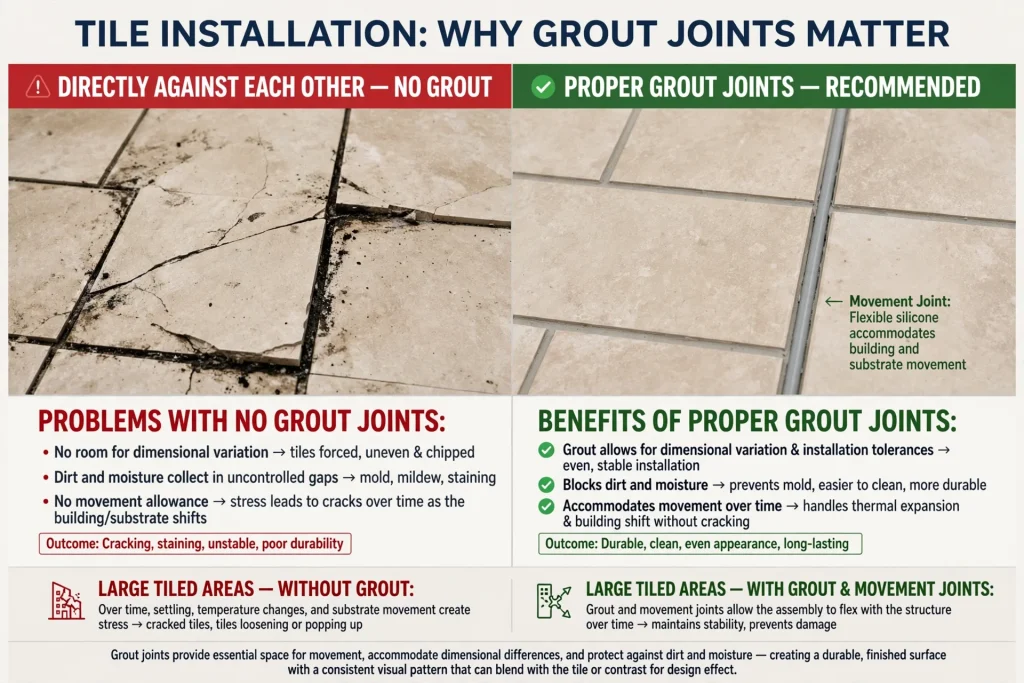
Homeowners sometimes assume that tiles should be installed directly against each other to create a seamless appearance. In most installations, this is not recommended. Grout joints provide space that helps accommodate dimensional variations, installation tolerances, and movement within the tiled surface.
A properly designed joint also provides a finished surface between tiles and helps prevent dirt and moisture from collecting in uncontrolled gaps. Grout contributes to the overall appearance of the floor or wall by creating a visual pattern that can either blend with the tile or provide contrast.
In larger tiled areas, additional movement considerations are also necessary because the building, substrate, and tile assembly can experience changes over time.
How Tile Size Affects Grout Joint Width
Tile dimensions are one of the most important factors when determining grout spacing. Small-format tiles often use more visible grout because of the number of individual joints across the surface. Large-format tiles have fewer joints, making the spacing more noticeable.
For instance, a large 1200 × 600 mm porcelain tile can create a very contemporary appearance with a relatively narrow joint, while smaller ceramic tiles may look more appropriate with a wider joint.
However, the smallest possible joint is not automatically the best option. The tile manufacturer’s recommendations, actual tile tolerances, substrate condition, and installation requirements should always be considered.
Large-format tiles also require careful substrate preparation because uneven surfaces can create lippage, where one tile edge sits higher than the adjacent tile.
Rectified vs Non-Rectified Tiles
The edge of a tile has a major influence on the possible grout-joint size.
Rectified tiles are mechanically finished after firing, producing relatively precise and consistent dimensions. This makes them suitable for contemporary installations where homeowners want a cleaner and more uniform joint pattern.
Non-rectified tiles, sometimes called pressed or cushion-edge tiles, can have greater dimensional variation. These tiles generally require a more visible grout joint to accommodate differences between individual pieces.
This distinction is particularly important when selecting large-format porcelain tiles for modern Dubai apartments, villas, offices, and retail interiors.
Choosing the Right Grout Joint for Different Rooms
Different rooms have different practical requirements. A grout joint that looks suitable in a dry living room may not be the most appropriate choice for a shower or kitchen.
Living rooms and bedrooms often focus heavily on visual consistency and easy maintenance. Bathrooms require additional attention to moisture, cleaning, waterproofing, and grout performance. Kitchens may experience food spills, grease, and frequent cleaning.
Balconies, terraces, and outdoor areas require consideration of temperature changes, water drainage, substrate movement, and exposure to weather conditions.
The joint should therefore be selected as part of the complete tile installation system rather than as an isolated design decision.
Tile Spacing in Bathrooms
Bathrooms are among the most important areas where correct grout joints matter. Water regularly reaches tiled walls and floors, particularly around showers, bathtubs, washbasins, and wet-room areas.
A consistent grout joint helps create a uniform surface and allows the installer to properly fill the spaces between tiles. However, grout itself should not be treated as a substitute for waterproofing.
The substrate behind bathroom tiles should have an appropriate waterproofing system where required. Corners, changes of plane, penetrations, and transitions need particular attention because these areas can experience movement and moisture exposure.
In Dubai villas and apartments, bathroom installations should also be coordinated with plumbing fixtures, floor gradients, shower drains, niches, and sanitaryware.
Tile Spacing in Kitchens
Kitchen floors and backsplashes are exposed to spills, cooking residues, cleaning chemicals, and frequent foot traffic. The grout joint therefore needs to balance appearance with practicality.
A very complex tile pattern with numerous joints may require more cleaning than a larger-format tile installation. On the other hand, wider joints can become visually prominent and may require more frequent maintenance.
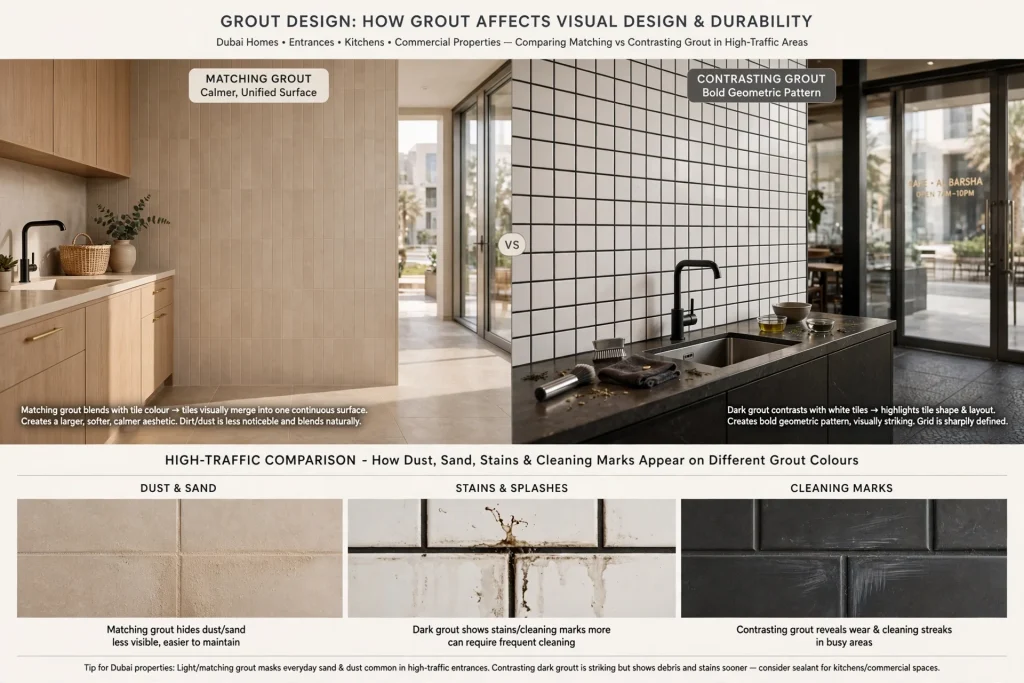
Homeowners should consider the colour of both the tile and grout. A grout colour that closely matches the tile can create a more continuous appearance, while contrasting grout can emphasize the tile pattern.

Grout Joint Colour Matters
Grout is not only a technical component; it also affects the visual design of a room.
Matching grout with the tile colour can make individual tiles appear less separated and can create a larger, calmer visual surface. Contrasting grout highlights the shape and layout of every tile.
For example, dark grout with white subway tiles creates a strong geometric pattern, while light grout produces a softer appearance.
In high-traffic areas, homeowners should also consider how quickly different grout colours may show dust, sand, stains, or cleaning marks. This can be particularly relevant in busy Dubai homes, entrances, kitchens, and commercial properties.
Narrow Grout Joints: Benefits and Limitations
Narrow grout joints can provide a clean and modern appearance, particularly when used with accurately manufactured rectified porcelain tiles.
They can make a tiled surface appear more continuous and reduce the visual dominance of grout lines. However, narrow joints leave less room to accommodate dimensional differences between tiles.
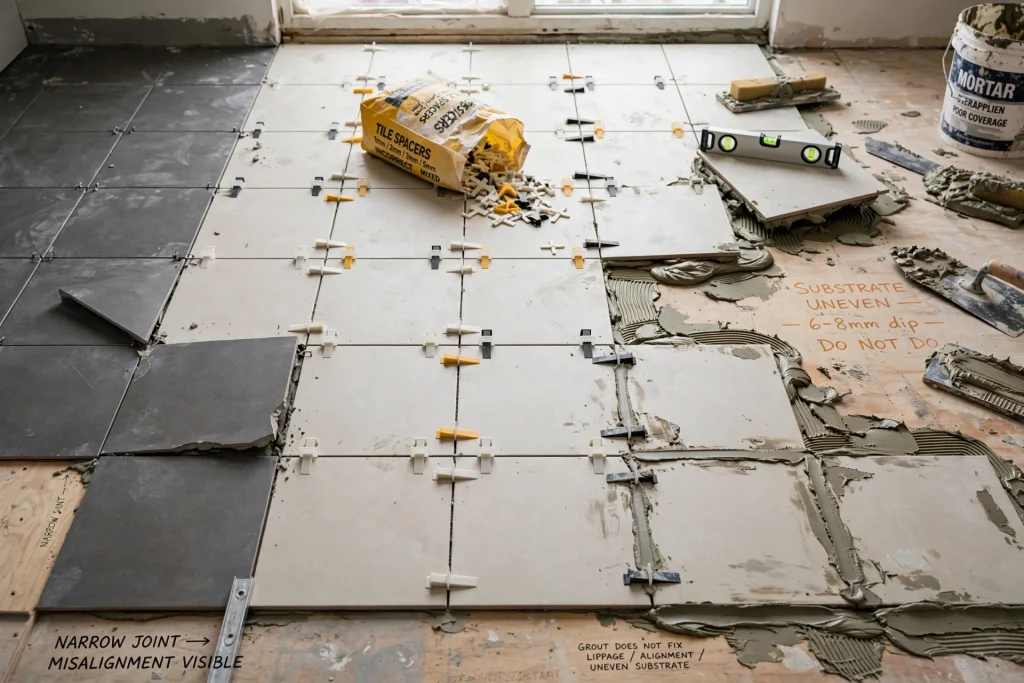
If the tiles are not sufficiently consistent or the substrate is uneven, attempting to use an extremely narrow joint can make installation problems more visible.
Homeowners should therefore avoid choosing joint width based solely on photographs or design trends. The actual tile specification and installation conditions should determine what is practical.
Wider Grout Joints: When Are They Useful?
Wider grout joints can be appropriate for tiles with dimensional variation, rustic finishes, handmade appearances, certain traditional patterns, and some outdoor applications.
They can also help accommodate differences between individual tiles and create a deliberate design feature.
However, wider joints contain more grout and may require additional cleaning and maintenance. The grout type and installation quality become particularly important in wet or high-use environments.
The correct width should always be determined according to the tile manufacturer’s instructions and the conditions of the project.
What Is Tile Lippage?
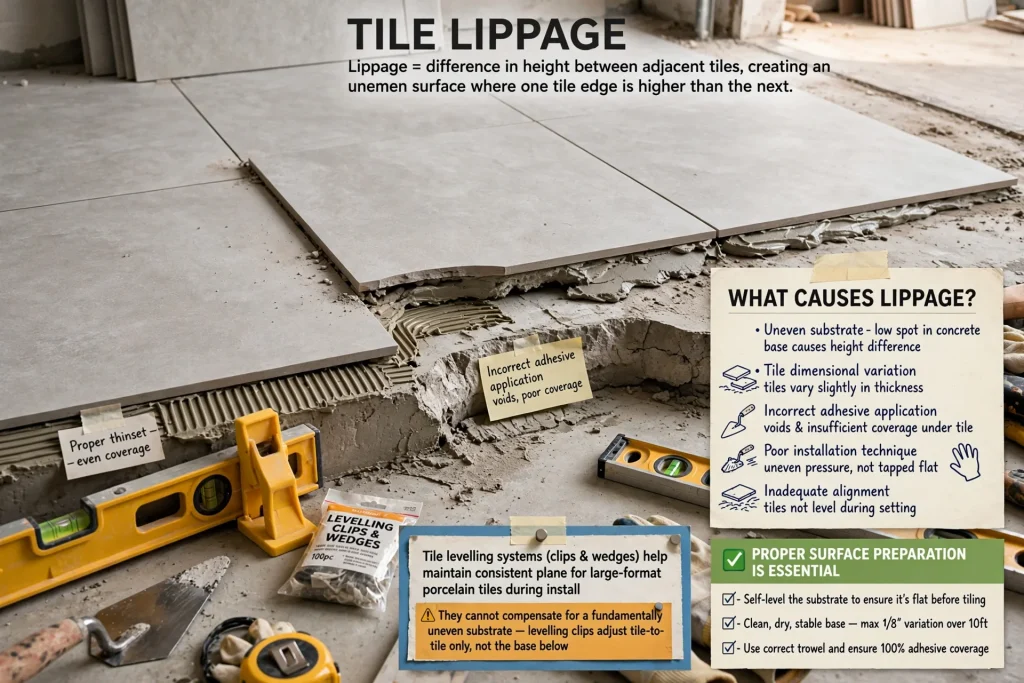
Tile lippage refers to a difference in height between adjacent tiles. It can create an uneven surface where one tile edge is higher than the next.
Lippage can result from an uneven substrate, tile dimensional variation, incorrect adhesive application, poor installation technique, or inadequate alignment.
Tile levelling systems can help installers maintain a more consistent plane during installation, particularly with large-format porcelain tiles. However, levelling clips and wedges cannot compensate for a fundamentally uneven substrate.
Proper surface preparation remains essential.
Tile Spacers and Levelling Systems
Tile spacers are simple tools used to maintain consistent gaps between tiles. They are available in different sizes and shapes depending on the installation system.
Levelling systems typically use clips and wedges or similar components to help control tile height differences during installation. They can be particularly useful when working with large-format tiles.
The choice of installation tools depends on the tile format, layout, substrate, and installation method. Professional installers may use different systems for floors, walls, natural stone, porcelain, ceramic tiles, and complex patterns.
The Importance of a Level Substrate
Even the best tile spacing cannot correct a poorly prepared substrate.
Before tiles are installed, the surface should be checked for flatness, strength, cleanliness, moisture-related problems, and compatibility with the selected adhesive system.
Uneven concrete, damaged screed, old adhesive residue, cracks, or movement can affect the finished tile surface.
In Dubai properties, renovation projects may involve existing concrete slabs, screeds, old tiles, gypsum walls, cement boards, or other substrates. Each situation requires an appropriate preparation method.
A professional assessment before installation can prevent many problems that become expensive to correct later.
Grout Joints and Movement
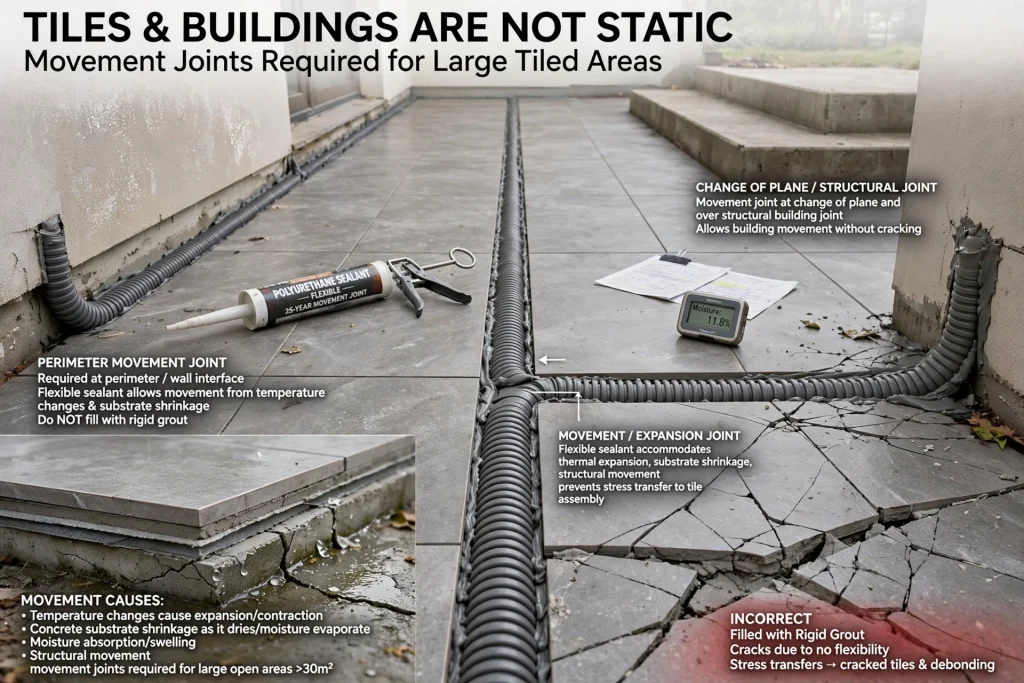
Tiles and buildings are not completely static. Floors and walls can experience movement caused by temperature changes, structural movement, substrate shrinkage, moisture, and other factors.
For this reason, large tiled areas may require movement or expansion joints in addition to ordinary grout joints.
Movement joints are designed to accommodate movement without transferring excessive stress to the tile assembly. They may be required around perimeters, structural joints, changes in plane, large open areas, and other locations depending on the installation system.
Importantly, movement joints should not simply be filled with ordinary rigid grout when a flexible joint is required.
Grout vs Movement Joints
A grout joint is the space between individual tiles that is normally filled with grout. A movement joint serves a different purpose.
Movement joints allow controlled movement within the tile installation. They may use flexible sealants or specialized profiles rather than conventional cementitious grout.
Confusing these two types of joints can lead to cracking or other installation problems.
Homeowners should ask their installer where movement joints are required, particularly for large areas, balconies, terraces, heated floors, exterior installations, and surfaces exposed to significant temperature changes.
Epoxy Grout vs Cement-Based Grout
The choice of grout also affects the performance of a tiled surface.
Cement-based grout is widely used in residential tile installations and is available in many colours. It is relatively straightforward to install but can require sealing or additional maintenance depending on the product.
Epoxy grout uses resin and hardener components and can provide strong resistance to staining, moisture, and chemicals when correctly installed. It is often considered for kitchens, bathrooms, commercial areas, and locations where enhanced resistance is required.
However, epoxy grout has different application requirements and should be installed according to the manufacturer’s instructions.
Homeowners considering resin-based or epoxy flooring and tile solutions can also explore a Home Epoxy Tiling Service when planning suitable residential applications.
Common Tile Spacing Mistakes
One common mistake is choosing the narrowest possible joint simply because it looks modern. A joint that is too narrow for the tile can make dimensional variations more obvious and complicate installation.
Another mistake is using inconsistent spacers. Small differences repeated across an entire room can become highly visible, especially with large-format tiles.
Installing tiles over an uneven substrate is another major problem. The installer may compensate temporarily with adhesive, but excessive adhesive variation can create poor coverage and height differences.
Homeowners should also avoid assuming that grout will hide poor workmanship. Grout can improve the finished appearance, but it cannot correct significant alignment, lippage, or substrate defects.
How to Check Grout Joints After Installation
Homeowners do not need to be professional tile installers to identify obvious spacing problems.
Look across several rows of tiles and check whether the joints remain visually consistent. Pay particular attention to corners, doorways, transitions, walls, and areas where different tile layouts meet.
The grout should be properly filled without obvious voids, pinholes, cracking, or significant shrinkage. The tile surface should also be checked for lippage and uneven transitions.
In bathrooms and kitchens, inspect corners and changes of plane carefully. These locations may require flexible sealant rather than rigid grout.
Tile Spacing for Large-Format Porcelain
Large-format porcelain tiles are increasingly common in modern UAE interiors because they can create a spacious and contemporary appearance.
However, their size makes installation tolerances more important. A small deviation can become noticeable across a long tile edge.
Large-format tiles require careful substrate preparation, appropriate adhesive coverage, correct handling, accurate alignment, and suitable joint planning.
In luxury villas around Palm Jumeirah, Emirates Hills, Dubai Hills Estate, and Jumeirah, large-format porcelain and natural stone surfaces are frequently incorporated into living rooms, bathrooms, kitchens, entrances, and feature walls.
Tile Spacing in Dubai Apartments
Apartments in areas such as Downtown Dubai, Dubai Marina, Business Bay, Jumeirah Lake Towers, and Al Barsha often have different floor plans and substrate conditions.
Renovation work may also need to coordinate with existing skirting, doors, kitchen cabinets, bathroom fixtures, and building management requirements.
For apartment projects, homeowners should confirm tile thickness, finished floor height, transition details, and door clearances before installation begins.
A change in tile thickness combined with adhesive and levelling requirements can affect the final floor height.
Outdoor Tile Spacing in the UAE
Outdoor tiled areas require additional consideration because UAE temperatures can vary significantly between direct sunlight and shaded conditions.
Balconies, terraces, pool surrounds, rooftops, and outdoor entertainment areas also need proper drainage and appropriate movement accommodation.
The tile itself should be suitable for the intended environment, while the adhesive, grout, substrate, and joints should form a compatible installation system.
For outdoor applications in Dubai, material selection should consider heat, UV exposure, moisture, thermal movement, cleaning, and expected foot traffic.
How to Maintain Grout Joints
Good maintenance starts with regular cleaning. Dust and loose debris should be removed before they become embedded in textured grout or tile surfaces.
Use cleaning products compatible with the specific grout and tile. Harsh chemicals or aggressive scrubbing can damage some finishes.
Bathrooms should receive particular attention because soap residue, moisture, and mineral deposits can accumulate around grout joints.
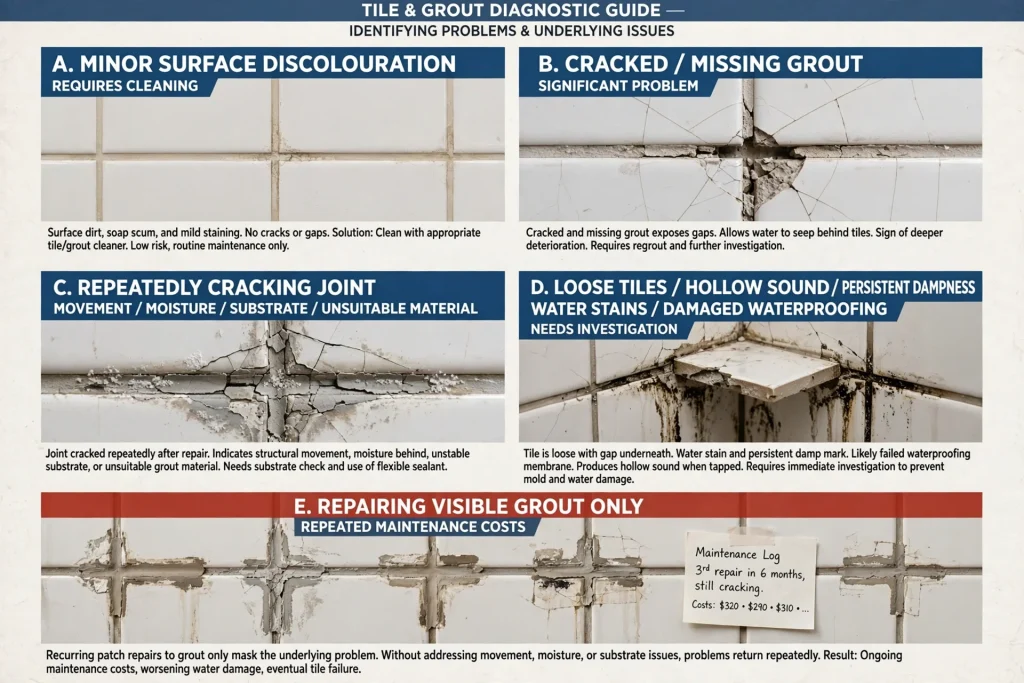
If grout begins to crack, crumble, become permanently discoloured, or separate from the tile edges, the cause should be investigated rather than simply applying new grout over the affected area.

When Should Grout Be Repaired?
Minor surface discolouration may only require appropriate cleaning. However, cracked or missing grout can indicate a more significant problem.
If the same joint repeatedly cracks after repair, there may be movement, moisture, substrate problems, or an unsuitable joint material.
Loose tiles, hollow sounds, persistent dampness, water stains, or damaged waterproofing should also be investigated.
Repairing the visible grout without addressing the underlying problem can result in repeated maintenance costs.
Why Professional Installation Matters
Professional tile installation involves much more than placing tiles in straight rows. Installers need to understand substrate preparation, adhesive selection, tile alignment, joint dimensions, cutting, movement joints, grout application, transitions, and finishing details.
The correct sequence is especially important in bathrooms and renovation projects where waterproofing, plumbing, electrical work, cabinetry, and flooring may all interact.
A professional approach also helps homeowners identify potential problems before tiles are installed, when corrections are generally easier and less expensive.
Questions Homeowners Should Ask Their Tile Installer
Before approving a tile installation, homeowners can ask what grout-joint width is recommended for their specific tile.
They can also ask whether the tile is rectified or non-rectified, whether the substrate requires levelling, what adhesive will be used, whether movement joints are required, and which grout is appropriate for the room.
For bathrooms and balconies, ask how waterproofing and drainage will be handled. For large-format tiles, ask how flatness, adhesive coverage, alignment, and lippage will be controlled.
These questions can make the installation process clearer and help prevent misunderstandings.
Frequently Asked Questions About Tile Spacing and Grout Joints
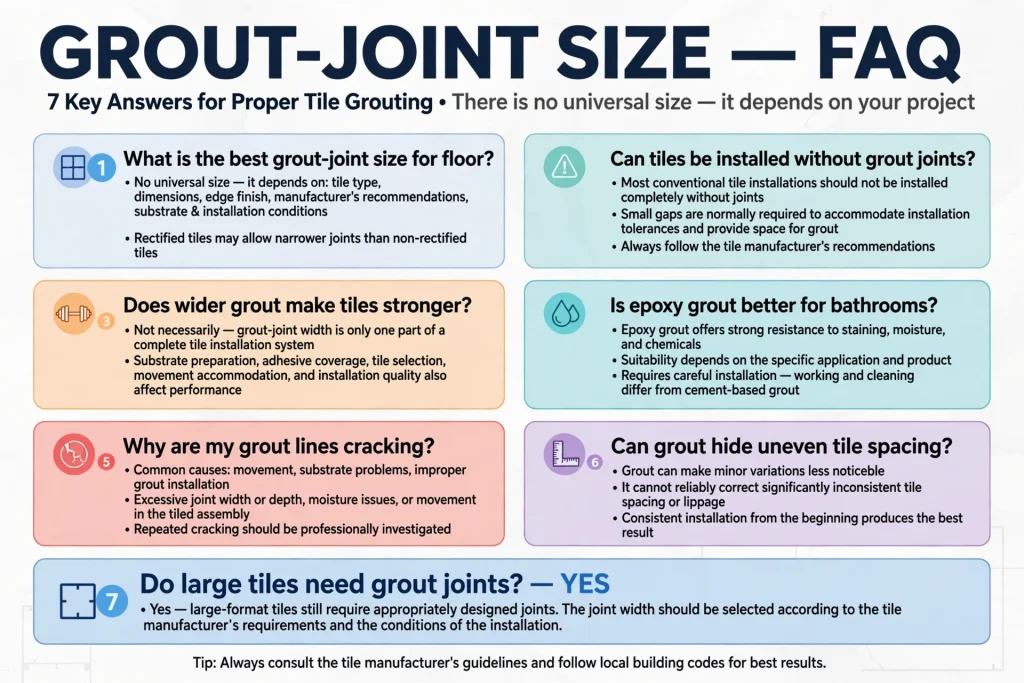
What is the best grout-joint size for floor tiles?
There is no universal joint size. The appropriate width depends on the tile type, dimensions, edge finish, manufacturer’s recommendations, substrate, and installation conditions. Rectified tiles may allow narrower joints than non-rectified tiles.
Can tiles be installed without grout joints?
Most conventional tile installations should not be installed completely without joints. Small gaps are normally required to accommodate installation tolerances and provide space for grout. The tile manufacturer’s recommendations should always be followed.
Does wider grout make tiles stronger?
Not necessarily. Grout-joint width is only one part of a complete tile installation system. Substrate preparation, adhesive coverage, tile selection, movement accommodation, and installation quality also affect performance.
Is epoxy grout better for bathrooms?
Epoxy grout can offer strong resistance to staining, moisture, and chemicals, but suitability depends on the specific application and product. It also requires careful installation because its working and cleaning characteristics differ from cement-based grout.
Why are my grout lines cracking?
Cracking can be associated with movement, substrate problems, improper grout installation, excessive joint width or depth, moisture issues, or movement in the tiled assembly. Repeated cracking should be professionally investigated.
Can grout hide uneven tile spacing?
Grout can make minor variations less noticeable, but it cannot reliably correct significantly inconsistent tile spacing or lippage. Consistent installation from the beginning produces a better result.
Do large tiles need grout joints?
Yes. Large-format tiles still require appropriately designed joints. The joint width should be selected according to the tile manufacturer’s requirements and the conditions of the installation.
Final Thoughts
Tile spacing and grout joints may seem like small details, but they have a major influence on the appearance and performance of a tiled surface. The right joint width helps create consistent alignment while allowing the installation to accommodate normal tolerances and movement.
Homeowners should consider tile dimensions, rectification, substrate flatness, room conditions, grout type, movement joints, cleaning requirements, and the intended appearance before installation begins.
For Dubai homes and properties across the UAE, these decisions are particularly important in bathrooms, kitchens, balconies, terraces, large living areas, villas, and apartments. Working with suitable materials and experienced installers can help create a tiled surface that looks balanced, performs reliably, and remains easier to maintain over time.