Commercial buildings are becoming more connected, automated, and energy-conscious, and heating, ventilation, and air conditioning systems are at the centre of this transformation. Traditional HVAC equipment can provide reliable heating and cooling, but modern commercial buildings increasingly require systems that can respond to occupancy, weather conditions, indoor air quality, energy demand, and changing operating conditions.
Smart HVAC systems combine heating and cooling equipment with sensors, controls, building management systems, Internet of Things technology, automation, data analytics, and increasingly artificial intelligence. Instead of operating equipment according to fixed schedules alone, these systems can continuously monitor building conditions and adjust HVAC performance accordingly.
This shift is particularly important in the UAE, Saudi Arabia, and other Gulf markets, where cooling represents a major part of commercial building energy consumption. Offices, hotels, shopping centres, hospitals, schools, warehouses, and mixed-use developments require reliable cooling for long periods of the year. Smart HVAC technology can help building operators improve comfort, energy management, maintenance planning, and operational visibility.
What Are Smart HVAC Systems?
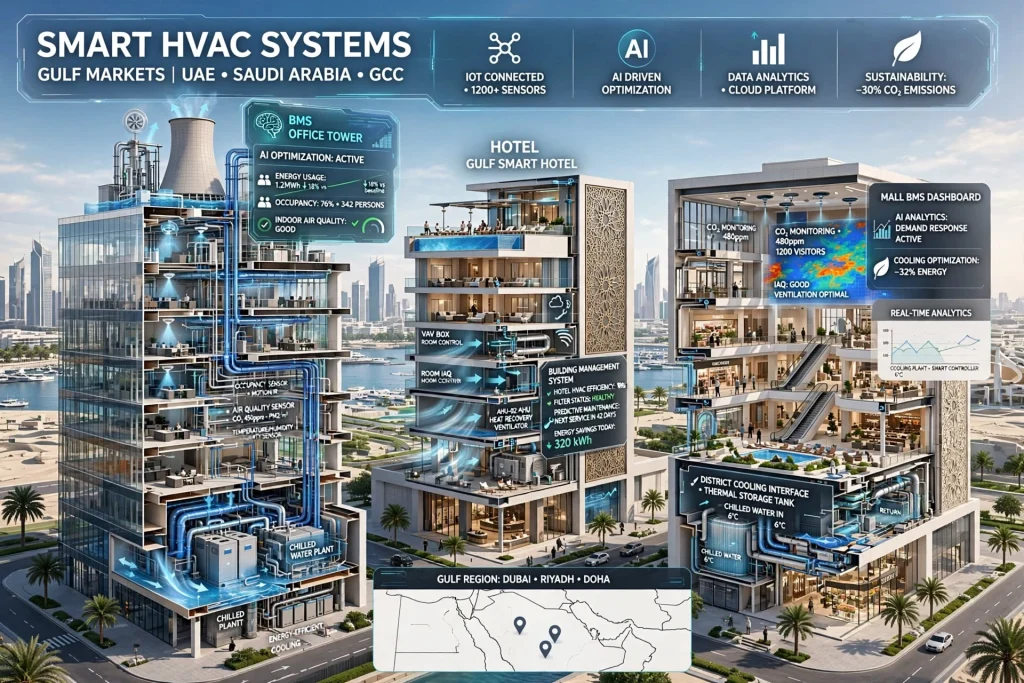
A smart HVAC system is an integrated heating, ventilation, and air conditioning solution capable of collecting building data and using that information to make or support operational decisions. Sensors measure conditions such as temperature, humidity, occupancy, carbon dioxide concentration, pressure, airflow, and equipment status.
This information can be transmitted to controllers, a Building Management System (BMS), cloud platform, or energy management software. Based on programmed control logic and available data, the system can adjust equipment such as chillers, air handling units, fan coil units, pumps, variable air volume systems, fans, dampers, and control valves.
The main difference between conventional and smart HVAC is the level of communication and responsiveness. A conventional system may follow a fixed operating schedule, while a smart system can respond to actual building conditions.
Why Smart HVAC Is Becoming Important
Energy costs, sustainability targets, occupant expectations, and building complexity are driving greater demand for intelligent HVAC controls. A commercial building does not have the same cooling requirement throughout the day. Occupancy varies between rooms, floors, meeting areas, retail zones, and common spaces.
Smart controls allow HVAC operation to become more responsive. Areas with low occupancy can potentially operate differently from heavily occupied zones. Equipment can also be coordinated rather than operating independently.
For building owners, this can provide greater visibility into energy consumption and equipment performance. Facility managers can identify abnormal operating conditions, investigate alarms, and analyse trends without relying entirely on manual inspection.
The Role of IoT Sensors in Smart HVAC
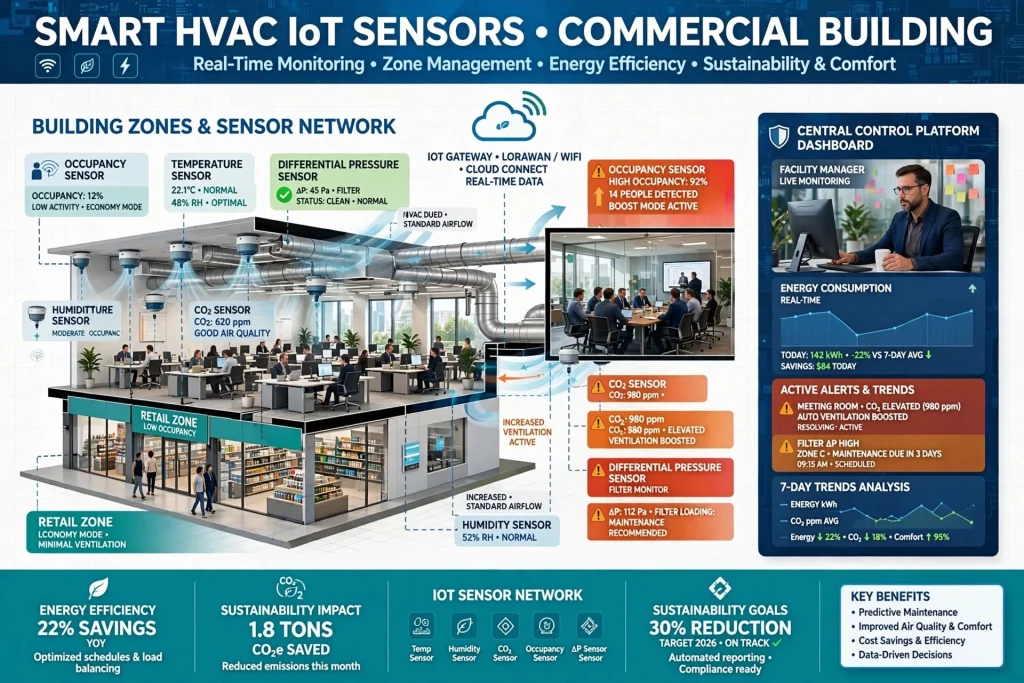
Internet of Things technology is one of the foundations of intelligent HVAC systems. Connected sensors can continuously provide information about the building environment and mechanical equipment.
Temperature sensors can identify variations between zones. Humidity sensors can support indoor environmental control. CO2 sensors can provide information related to occupancy and ventilation demand. Differential pressure sensors can monitor filters, ducts, pumps, and air systems.
When this information is connected to a central control platform, the building can respond dynamically. For example, ventilation requirements can be adjusted according to occupancy or indoor air quality rather than operating at the same level regardless of how many people are present.
Artificial Intelligence and HVAC Optimisation
Artificial intelligence is expected to play a larger role in commercial HVAC management. AI-based platforms can analyse large quantities of historical and real-time building data to identify patterns that may not be obvious through manual monitoring.
An intelligent system could analyse weather conditions, occupancy patterns, equipment performance, chilled-water temperatures, energy consumption, and building load. It can then help determine how equipment should operate under different circumstances.
AI does not necessarily replace the building engineer or facility manager. Instead, it can provide recommendations, automate repetitive optimisation tasks, identify unusual behaviour, and help operators make better decisions.
The quality of the results depends heavily on sensor accuracy, system integration, historical data, control strategy, commissioning, and the quality of the underlying HVAC equipment.
Predictive Maintenance for HVAC Equipment
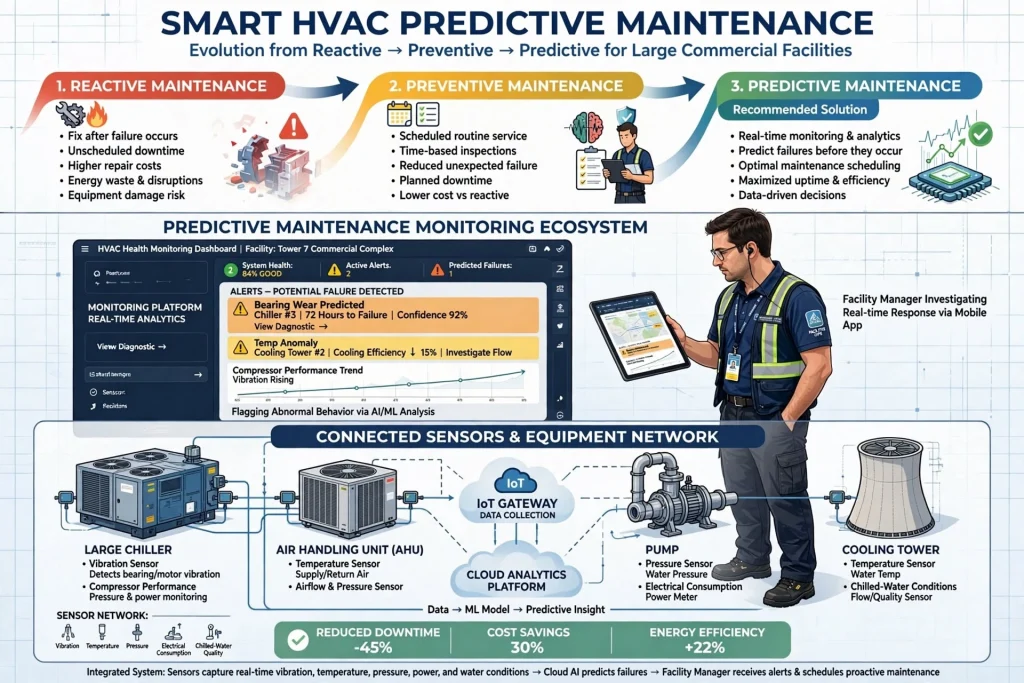
One of the most valuable developments in smart HVAC is the move from reactive maintenance toward predictive maintenance.
Traditional reactive maintenance often means repairing equipment after a fault occurs. Preventive maintenance improves this approach by servicing equipment according to a planned schedule. Predictive maintenance goes further by using equipment data and performance trends to identify potential problems before a major failure.
For example, changes in vibration, temperature, pressure, electrical consumption, compressor performance, or chilled-water conditions may indicate developing equipment issues. A monitoring platform can flag abnormal behaviour for investigation.
This can be particularly valuable for large commercial facilities where an unexpected chiller, AHU, pump, or cooling tower failure can disrupt building operations.
Smart Chiller Plant Management
Chillers are often among the most important HVAC assets in large commercial buildings. Smart controls can coordinate chillers, chilled-water pumps, condenser-water pumps, cooling towers, and associated equipment.
Instead of operating every available chiller continuously, a plant optimisation strategy can determine how many machines are needed based on cooling demand and equipment efficiency.
The system can also monitor chilled-water supply and return temperatures, flow rates, condenser conditions, approach temperatures, and equipment status. This information can support more efficient plant sequencing.
In large Dubai commercial buildings, hotels, hospitals, shopping centres, and industrial facilities, intelligent chiller plant management can provide valuable energy and operational benefits when properly designed and commissioned.
Integration with Building Management Systems
A modern smart HVAC system rarely operates in isolation. Integration with a Building Management System allows HVAC equipment to communicate with other building systems and provides facility managers with a central operational interface.
A BMS can monitor chillers, AHUs, FCUs, pumps, cooling towers, ventilation equipment, sensors, alarms, and control devices. It can also interact with lighting, access control, energy meters, fire systems, and other building services where appropriate.
Common communication protocols such as BACnet and Modbus can support interoperability between different equipment and control platforms, although compatibility should always be verified at the project design stage.
Occupancy-Based HVAC Control
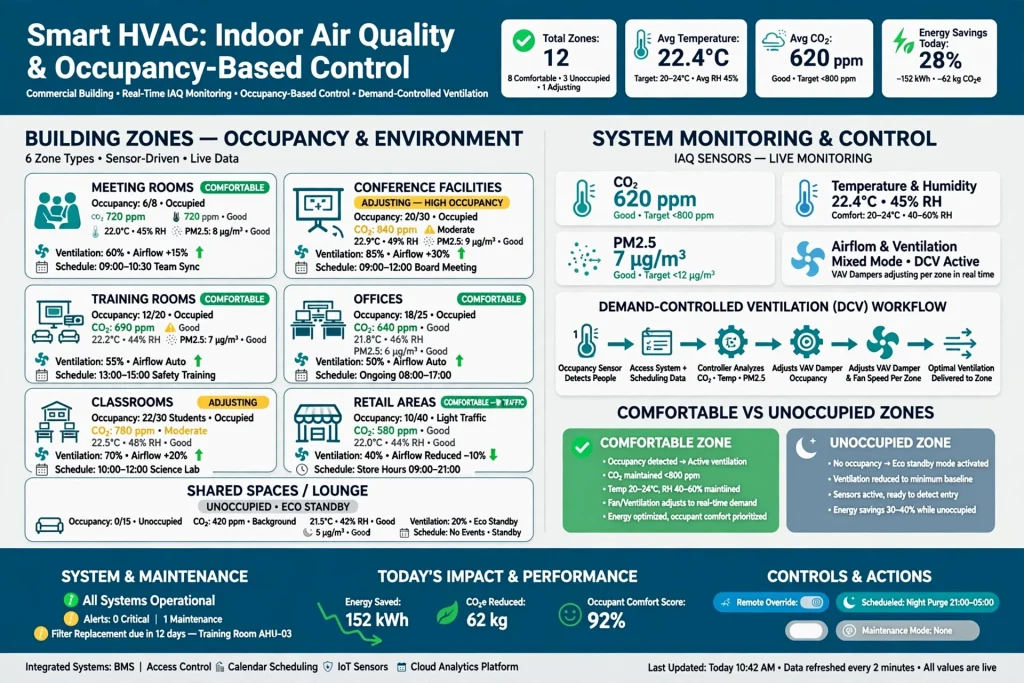
One of the practical applications of smart HVAC is occupancy-based control. Commercial buildings frequently contain areas that are not occupied continuously.
Meeting rooms, conference facilities, training rooms, offices, classrooms, retail areas, and shared spaces may have significantly different occupancy patterns.
Occupancy sensors, access systems, scheduling information, or other building data can help HVAC controls understand whether an area requires full conditioning. The system can adjust temperature, airflow, or ventilation according to the programmed control strategy.
This approach can reduce unnecessary operation while maintaining suitable comfort when spaces are occupied.
Indoor Air Quality Monitoring
Future HVAC systems will increasingly focus on indoor environmental quality rather than temperature alone. Indoor air quality can affect occupant comfort, productivity, and the usability of commercial spaces.
Smart systems can monitor parameters such as carbon dioxide, humidity, temperature, particulate matter, and other air-quality indicators when suitable sensors are installed.
For offices, schools, healthcare facilities, hotels, and retail buildings, this information can help facility teams identify ventilation problems and understand environmental conditions across different zones.
In densely occupied commercial spaces, demand-controlled ventilation can potentially adjust outside-air delivery based on actual requirements rather than relying exclusively on fixed schedules.
Weather-Based HVAC Control
Outdoor weather has a significant influence on HVAC demand. Smart systems can incorporate external temperature, humidity, solar conditions, and weather forecasts into operational strategies where the platform supports these functions.
For example, a building automation system can anticipate increased cooling demand during periods of high outdoor temperature. In suitable systems, this information can influence equipment scheduling, temperature setpoints, chilled-water strategies, or pre-cooling.
Weather-responsive control can be particularly relevant to Gulf cities such as Dubai, Abu Dhabi, Riyadh, Jeddah, and Doha, where outdoor conditions can have a substantial impact on cooling loads.
Smart HVAC and Energy Management
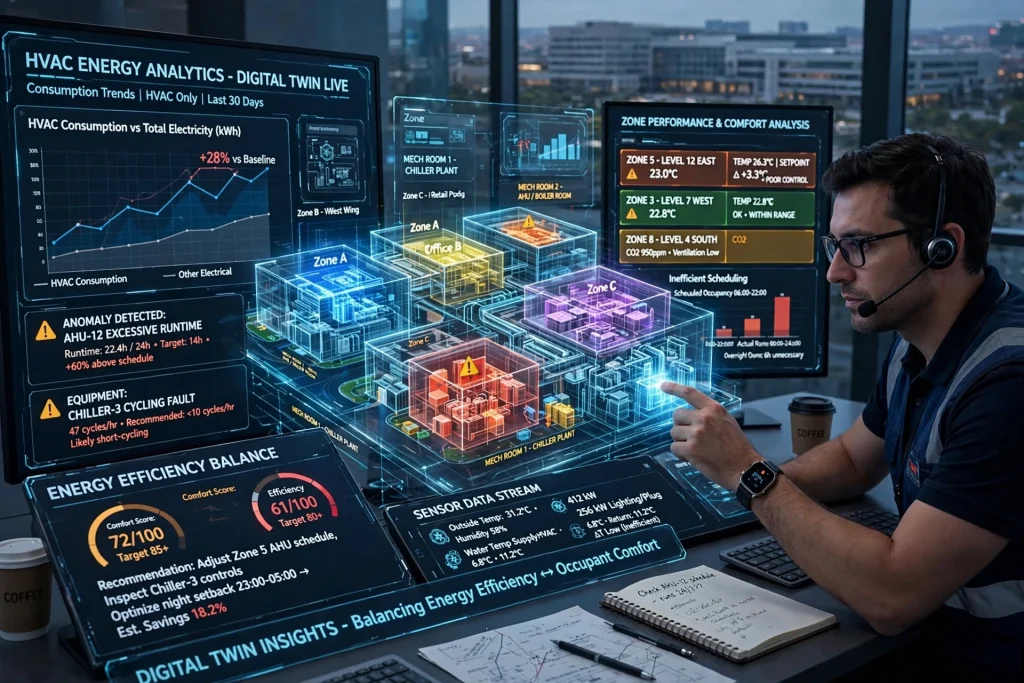
Smart HVAC technology is closely connected to commercial energy management. Energy meters and equipment sensors can provide detailed information about where electricity is being consumed.
Instead of looking only at a building’s total electricity bill, facility managers can analyse HVAC-related consumption and identify trends.
Energy analytics can reveal unusual equipment operation, excessive runtime, simultaneous heating and cooling where applicable, inefficient schedules, poor temperature control, or other operational issues.
The objective is not simply to reduce HVAC runtime. Excessive reduction can negatively affect comfort, ventilation, equipment operation, or indoor environmental quality. Effective optimisation balances energy efficiency with building requirements.
Digital Twins for HVAC Systems
Digital twin technology is another emerging development. A digital twin creates a digital representation of a physical building or system and can combine equipment information, sensor data, operational conditions, and building models.
For HVAC management, this can help facility teams understand how different components interact. Engineers can use digital models to investigate operating scenarios and identify potential optimisation opportunities.
Digital twins are particularly relevant to large and complex developments where numerous HVAC systems operate across multiple zones and mechanical rooms.
Cloud-Based HVAC Monitoring
Cloud connectivity is changing how facility managers access HVAC information. Instead of depending exclusively on a local workstation, authorised users can potentially monitor building systems through web-based dashboards and connected applications.
Cloud platforms can provide equipment trends, alarms, energy information, maintenance notifications, and performance reports.
However, connected HVAC systems also require appropriate cybersecurity, user authentication, network segmentation, software updates, access controls, and data-management practices. Building automation should therefore be treated as part of the wider digital infrastructure of a commercial property.
Smart HVAC for Hotels
Hotels present a particularly strong application for intelligent HVAC because occupancy can change constantly. Guest rooms, restaurants, conference facilities, ballrooms, kitchens, corridors, and public areas all have different operating patterns.
Smart controls can help coordinate these zones. Guest-room HVAC can respond to occupancy and room status, while meeting rooms can operate according to scheduled events.
For hotels in Dubai, Abu Dhabi, Riyadh, Jeddah, and Sharjah, smart HVAC can also support facility teams managing large properties with extensive cooling infrastructure.
Smart HVAC in Offices
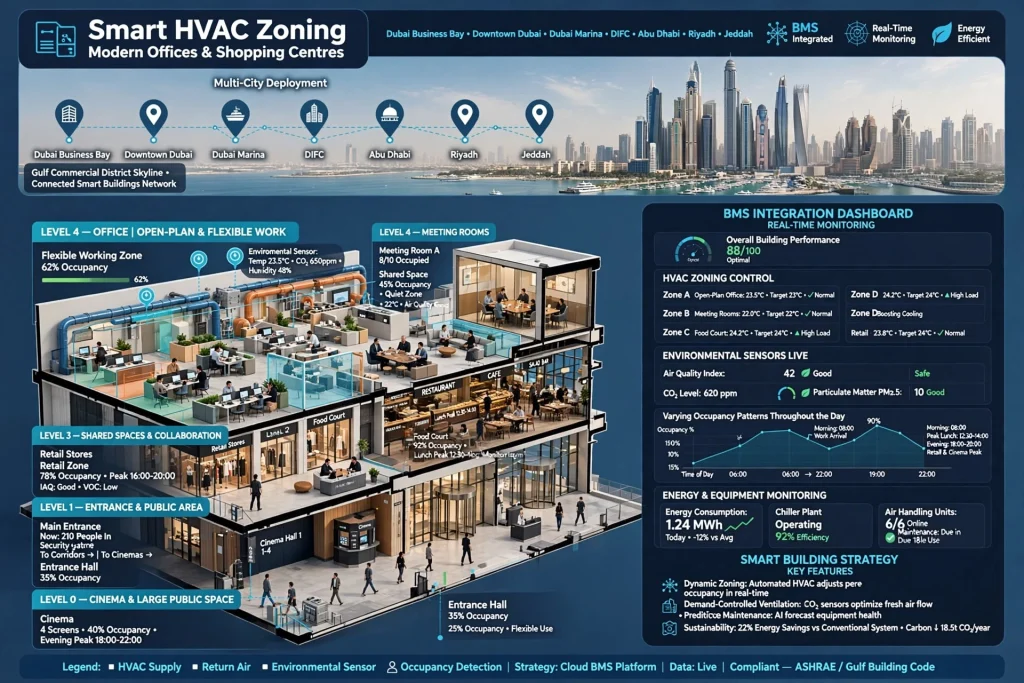
Modern offices increasingly use flexible working arrangements, shared spaces, meeting rooms, and open-plan layouts. Fixed HVAC schedules may not always match actual occupancy.
Smart zoning can help buildings respond to changing space utilisation. Occupancy information and environmental sensors can provide better visibility into which areas require conditioning.
For commercial districts such as Business Bay, Downtown Dubai, Dubai Marina, DIFC, Abu Dhabi’s business districts, Riyadh, and Jeddah, intelligent HVAC can form part of broader smart-building strategies.
Smart HVAC in Shopping Centres
Shopping centres have complex HVAC requirements because they contain retail stores, restaurants, food courts, corridors, entrances, cinemas, storage areas, and large public spaces.
Occupancy patterns can vary significantly throughout the day and between different zones. Smart HVAC controls can help operators monitor temperatures, air quality, equipment status, and energy consumption across the property.
Integration with a central BMS can make it easier for facility teams to identify problems and coordinate equipment operation.
Smart HVAC for Hospitals and Healthcare Buildings
Healthcare buildings require careful environmental control. HVAC systems may support patient comfort, ventilation, pressure relationships, filtration, and specialised clinical environments.
Smart monitoring can provide facility teams with greater visibility into HVAC performance and environmental conditions. However, healthcare applications require appropriate engineering, regulatory compliance, infection-control considerations, redundancy, and professional commissioning.
Automation should support the healthcare building’s operational requirements rather than compromising critical environmental conditions for the purpose of energy reduction.
Smart HVAC and Sustainability
Smart HVAC systems can contribute to broader building sustainability strategies by helping operators understand and optimise energy use.
Efficient equipment, variable-speed drives, intelligent controls, heat recovery where applicable, efficient pumps and fans, proper insulation, and well-designed building envelopes can work together to reduce unnecessary energy demand.
Smart technology should not be viewed as a replacement for efficient mechanical design. The strongest results generally come from combining efficient equipment with appropriate controls, commissioning, maintenance, and continuous performance monitoring.
Retrofitting Smart HVAC into Existing Buildings
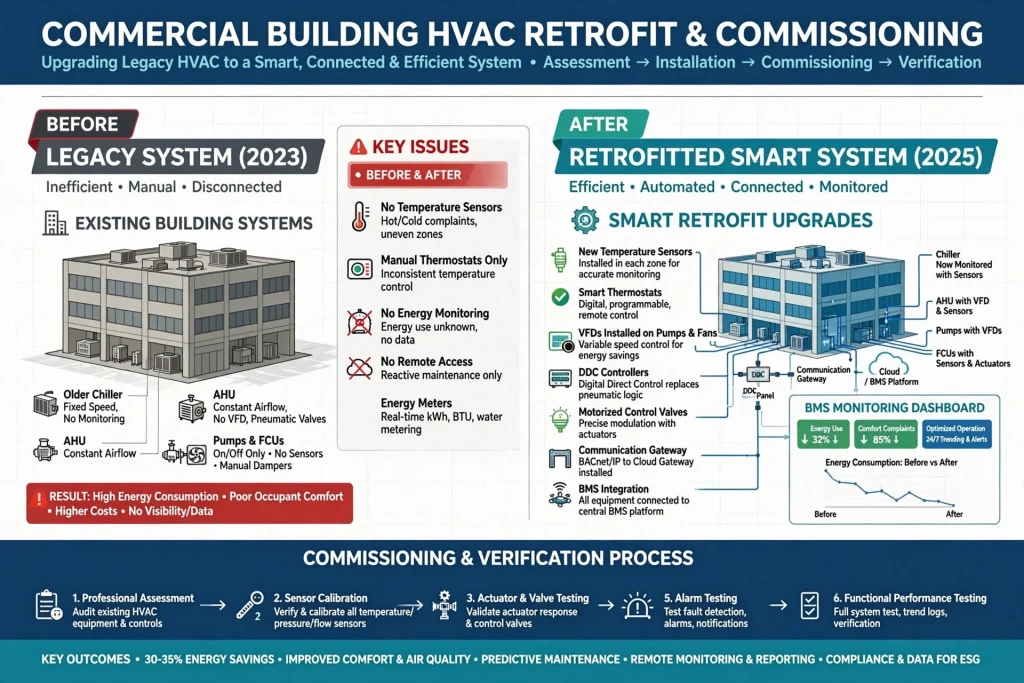
Not every commercial building requires a complete HVAC replacement to benefit from smart technology. Existing buildings can often be upgraded progressively, depending on the age and compatibility of their equipment and control systems.
A retrofit may include new temperature sensors, smart thermostats, VFDs, DDC controllers, energy meters, communication gateways, control valves, or BMS integration.
Older chillers, AHUs, pumps, and FCUs can sometimes be connected to modern monitoring systems through appropriate interfaces. A professional assessment should determine which components can be integrated and which may need replacement.
The Importance of Commissioning
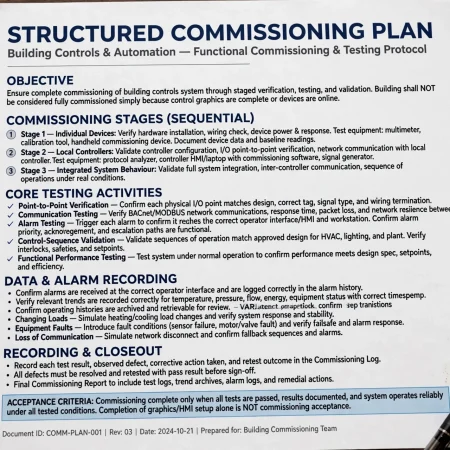
Smart HVAC systems are only as effective as their configuration. Incorrect sensor calibration, poorly tuned control loops, incorrect setpoints, communication problems, incomplete points lists, and inadequate commissioning can undermine the expected benefits.
Commissioning should verify that sensors provide reliable information, actuators respond correctly, equipment sequences operate as intended, alarms function properly, and control logic reflects the building’s actual requirements.
Functional testing is particularly important after integrating multiple HVAC systems through a BMS.
Cybersecurity in Smart HVAC
As HVAC systems become connected to networks and cloud platforms, cybersecurity becomes increasingly important. A building automation system can control critical mechanical equipment, making unauthorised access a potential operational risk.
Commercial buildings should use appropriate authentication, network security, access permissions, software maintenance, backups, monitoring, and segmentation strategies.
Cybersecurity requirements should be considered during the initial design rather than added only after the HVAC system has been connected to the internet.
The Role of Smart HVAC Professionals
Technology alone does not create an efficient smart building. Successful projects require appropriate HVAC engineering, controls knowledge, BMS integration, commissioning, and ongoing maintenance.
Building owners should work with an experienced Smart HVAC Systems Company that understands both mechanical HVAC equipment and digital building controls. The ideal project approach considers the existing HVAC infrastructure, building requirements, control philosophy, communication protocols, energy objectives, maintenance strategy, and future expansion.
Professional expertise is especially important for large commercial developments where HVAC equipment from multiple manufacturers needs to operate as one coordinated system.
The Future of Smart HVAC in the UAE and GCC
The future of commercial HVAC is moving toward greater automation, connected equipment, predictive analytics, AI-assisted optimisation, and integrated building management. As commercial developments in the UAE and Saudi Arabia become more technologically advanced, HVAC systems will increasingly form part of wider smart-building ecosystems.
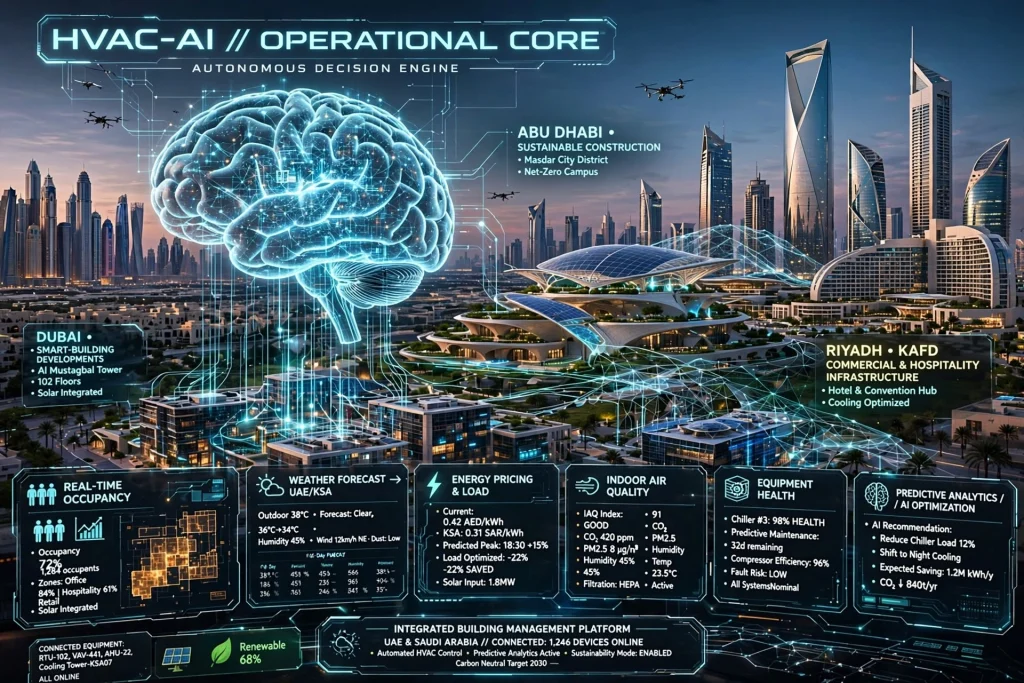
Dubai’s smart-building developments, Abu Dhabi’s sustainable construction initiatives, and Saudi Arabia’s rapidly expanding commercial and hospitality infrastructure create opportunities for advanced HVAC controls and energy management.
Future systems may increasingly combine real-time occupancy information, weather forecasting, energy pricing, equipment health, indoor air quality, and artificial intelligence to make more informed operational decisions.
Frequently Asked Questions
What is the future of HVAC in commercial buildings?
The future of HVAC is moving toward connected sensors, automation, BMS integration, predictive maintenance, AI-assisted optimisation, occupancy-based controls, energy analytics, and improved indoor environmental monitoring.
Can smart HVAC reduce commercial building energy consumption?
It can help reduce unnecessary HVAC operation when properly designed and commissioned. Energy performance depends on equipment efficiency, building design, controls, occupancy, maintenance, weather, and operating practices.
Can existing HVAC systems become smart?
Many existing systems can be upgraded with sensors, controllers, gateways, VFDs, meters, and BMS integration. The feasibility depends on the age, condition, controls architecture, and compatibility of the existing equipment.
What is the role of BMS in smart HVAC?
A BMS can provide central monitoring and control of HVAC equipment. It can collect sensor information, manage operating schedules, display alarms, coordinate equipment, and provide performance data to facility teams.
Is AI replacing HVAC engineers?
No. AI can assist with optimisation, diagnostics, forecasting, and data analysis, but professional HVAC engineers and controls specialists remain essential for system design, commissioning, troubleshooting, safety, and decision-making.
Conclusion
The future of smart HVAC systems in commercial buildings is centred on connectivity, automation, data, efficiency, and intelligent decision-making. HVAC equipment is evolving from independently operated mechanical systems into connected building infrastructure capable of responding to changing conditions.
IoT sensors, BMS platforms, AI analytics, predictive maintenance, occupancy-based controls, smart chiller plants, indoor air-quality monitoring, and cloud-based dashboards can provide building owners and facility managers with greater control over their mechanical systems.
For commercial properties across Dubai, Abu Dhabi, Sharjah, Riyadh, Jeddah, and the wider GCC, this evolution is particularly relevant because of the region’s demanding cooling requirements and rapidly developing commercial infrastructure.
The most successful smart HVAC projects will not rely on technology alone. They will combine efficient mechanical equipment, accurate sensors, intelligent controls, proper commissioning, professional maintenance, cybersecurity, and experienced engineering teams. When these elements work together, smart HVAC can become an important part of creating more comfortable, efficient, resilient, and future-ready commercial buildings.