Dubai’s climate places significant demands on roofs and building envelopes. High temperatures, intense sunlight, humidity, dust, occasional heavy rainfall and rapid temperature changes can gradually affect concrete roofs, roof membranes, joints, parapets and drainage systems. Although rainfall in Dubai is generally limited compared with many other regions, a poorly protected roof can still develop serious water ingress problems when heavy rain occurs.
Effective waterproofing is therefore an important part of building maintenance for villas, apartments, commercial properties, warehouses, offices, retail buildings and industrial facilities across the UAE. A properly designed waterproofing system helps prevent moisture penetration, concrete deterioration, mould growth, damaged interiors and expensive structural repairs.
For property owners searching for Roof Waterproofing Dubai, the right solution depends on the building type, existing roof condition, substrate, drainage arrangement, exposure to sunlight and whether the project involves new construction, maintenance or repair.
Why Roof Waterproofing Is Important in Dubai
A roof is continuously exposed to environmental conditions. In Dubai, strong ultraviolet radiation and high surface temperatures can accelerate the ageing of certain waterproofing materials, while humidity and occasional rainfall can expose weaknesses in joints, cracks and drainage points.
Water that enters through a roof does not always create an immediate visible leak. Moisture can travel through concrete slabs, insulation layers and ceiling voids before appearing inside a building. By the time a water stain becomes visible, the underlying waterproofing problem may already have existed for some time.
Professional roof waterproofing creates a protective barrier between the building structure and external moisture. Depending on the application, this barrier may be formed using a liquid-applied membrane, bituminous membrane, polyurethane coating, cementitious waterproofing system or another compatible solution.
Waterproofing should also work together with proper roof drainage. Even a high-quality membrane can be placed under unnecessary stress if rainwater remains ponded on the roof because drains are blocked or incorrectly positioned.
Common Roof Waterproofing Problems in Dubai
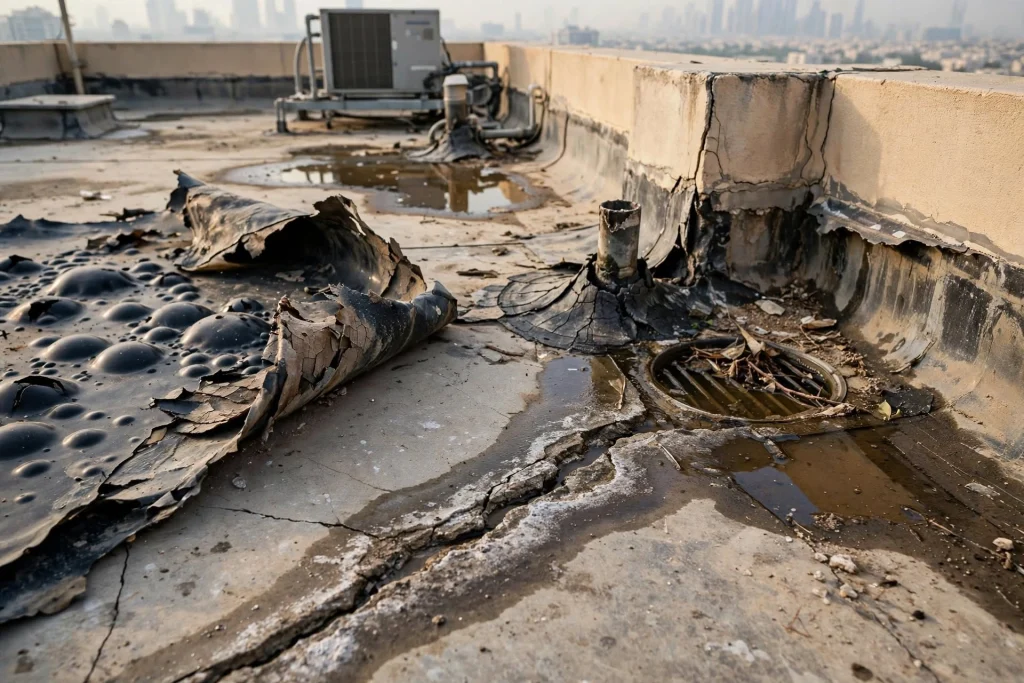
Roof problems can develop for several reasons. Cracks in concrete slabs are one common source of water ingress, particularly where movement occurs because of thermal expansion and contraction. Construction joints, pipe penetrations, parapet-wall junctions and roof edges can also become vulnerable areas.
Another common issue is deterioration of an existing waterproofing membrane. Older membranes can become brittle, detached, blistered or damaged by maintenance activities. Mechanical equipment installed on roofs may also create penetration points that require proper sealing.
Blocked or inadequate roof drains can increase the amount of water standing on a roof after rainfall. Over time, ponding can expose weak areas in the waterproofing system and increase the likelihood of leakage.
For this reason, waterproofing inspection should look beyond the visible leak. The source may be several metres away from the point where moisture appears inside the property.
Roof Waterproofing for Villas and Residential Buildings
Residential waterproofing requirements can vary significantly depending on the property. Dubai villas may have flat concrete roofs, terraces, balconies, rooftop rooms, water tanks, service areas and external mechanical equipment.
A residential roof waterproofing system should protect vulnerable areas while remaining compatible with the existing structure. Before installation, contractors generally inspect the concrete surface, identify cracks, check drainage and determine whether the existing waterproofing needs repair or complete replacement.
For villa owners in areas such as Jumeirah, Arabian Ranches, Dubai Hills Estate, Emirates Hills and Palm Jumeirah, waterproofing can be particularly important because many properties contain extensive outdoor areas exposed to the UAE climate.
Roof waterproofing should also consider adjacent areas such as parapets, terraces, balconies and rooftop service zones rather than treating the main roof slab as an isolated surface.
Commercial Roof Waterproofing Requirements
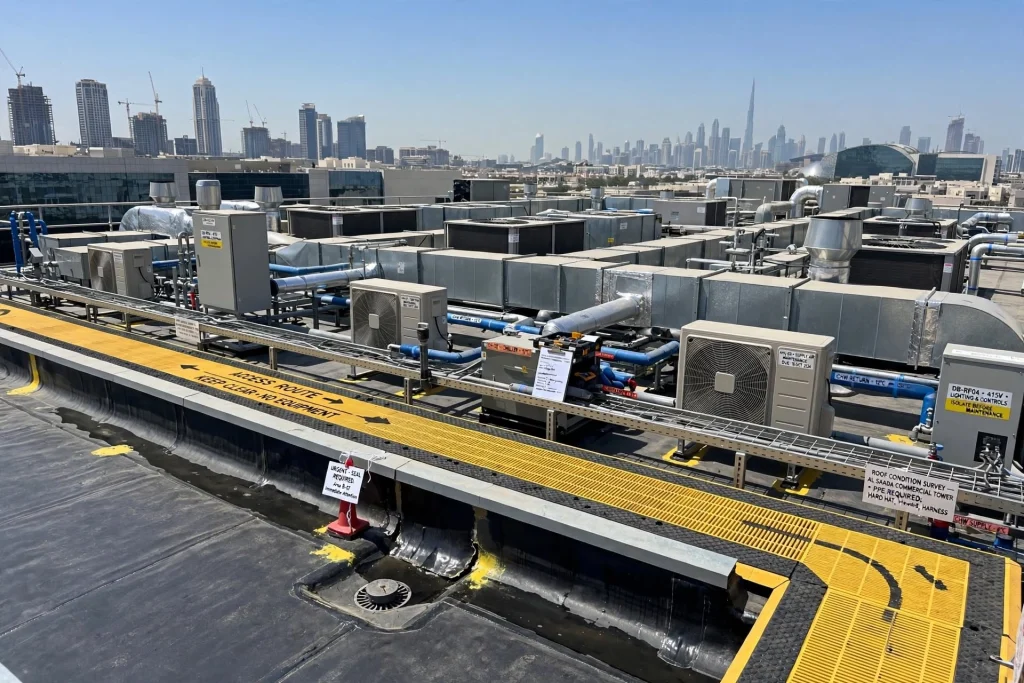
Commercial buildings generally have more complex roofing environments than residential properties. Offices, retail centres, warehouses, hotels and industrial buildings may contain HVAC equipment, ducts, electrical installations, ventilation systems, access walkways and multiple drainage points.
This means waterproofing work must be carefully coordinated with building operations.
For example, a commercial roof may contain air-conditioning equipment that requires regular maintenance. Waterproofing materials must therefore be protected from unnecessary mechanical damage and access routes should be planned appropriately.
In larger properties, roof condition surveys can help identify areas requiring immediate attention and those that can be monitored as part of planned preventive maintenance.
Choosing the Right Waterproofing System
There is no single waterproofing product that is suitable for every roof. The appropriate system depends on the substrate, exposure, movement, existing materials, accessibility and intended use of the roof.
Bituminous Waterproofing Membranes
Bituminous membranes are widely used for flat roof applications. They are typically manufactured with reinforcement and can provide a durable waterproof barrier when correctly installed.
Torch-applied and self-adhesive systems are available, although installation requirements differ. In occupied buildings, the choice of application method should take safety and site conditions into consideration.
The membrane must be properly detailed at corners, joints, penetrations, upstands and drainage outlets. A high-quality material cannot compensate for poor detailing.
Liquid-Applied Waterproofing
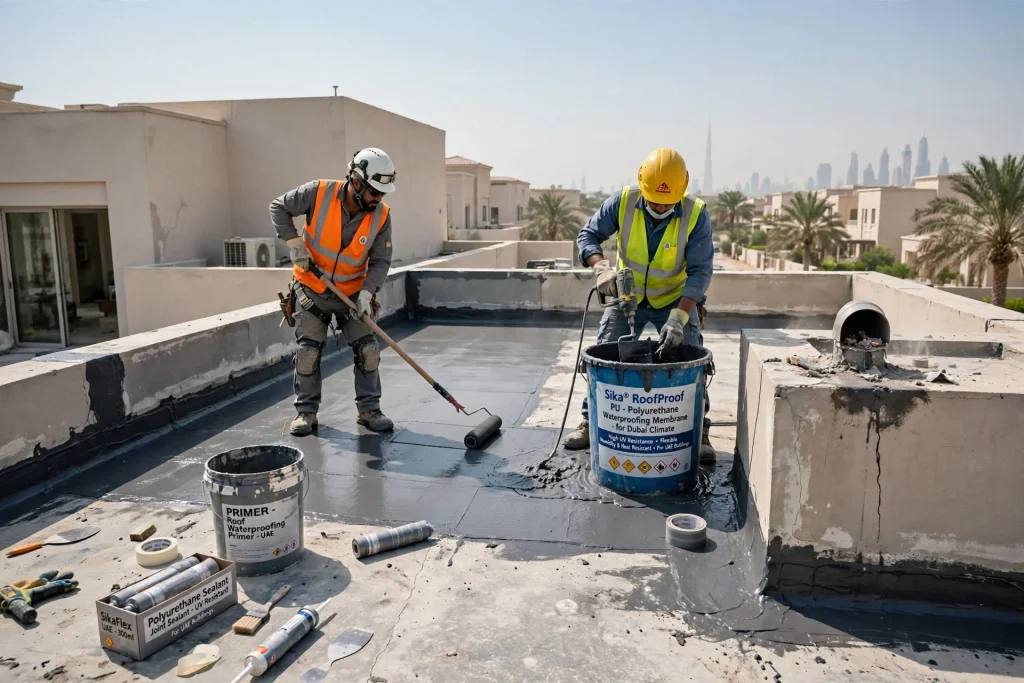
Liquid waterproofing systems are applied directly to the prepared surface and cure to form a continuous membrane. They can be useful around complicated roof geometry because the material can follow contours and reduce the number of joints.
Polyurethane and acrylic-based systems are among the products used for different applications. The selected coating should be appropriate for the substrate and expected exposure.
Surface preparation is critical. Dust, oil, loose concrete, moisture and other contaminants can interfere with adhesion and reduce system performance.
Cementitious Waterproofing
Cementitious waterproofing products can be suitable for certain concrete and masonry applications. They are generally mixed and applied as a coating or slurry.
Their suitability depends on the specific roof environment and movement characteristics. Where substantial thermal or structural movement is expected, a flexible system may be more appropriate.
Polyurethane Waterproofing
Polyurethane membranes can provide a seamless waterproofing layer and are used in various building applications. Their flexibility can make them useful where movement and detailed roof geometry need to be accommodated.
However, product selection should consider UV exposure, substrate moisture, application conditions and compatibility with primers and protective layers.
Roof Inspection Before Waterproofing
A professional waterproofing project should begin with an inspection rather than immediately applying a coating.
The inspection can assess concrete cracks, existing membranes, drainage outlets, parapet walls, expansion joints, pipe penetrations, surface contamination and areas of ponding water.
Moisture investigation may also be required when the leak source is difficult to identify. In some cases, the visible ceiling stain is not directly below the point of roof penetration.
The contractor should document the condition of the roof and identify whether the project requires localised repair, membrane refurbishment or complete waterproofing replacement.
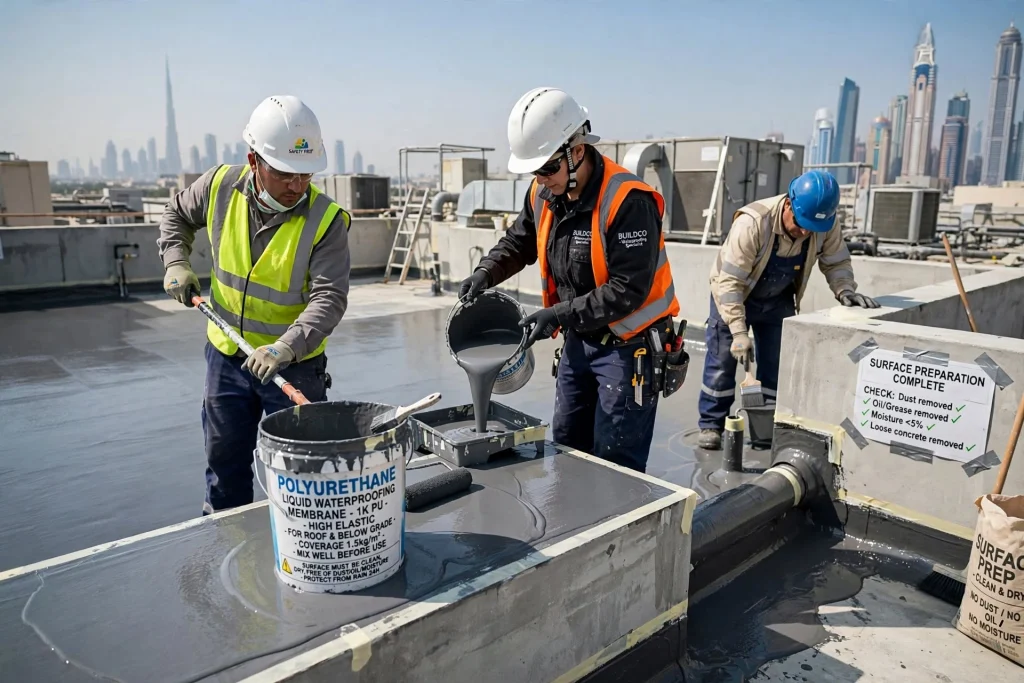
Surface Preparation Is Critical
Surface preparation is one of the most important stages of roof waterproofing. A waterproofing membrane needs a suitable substrate to achieve proper adhesion and long-term performance.
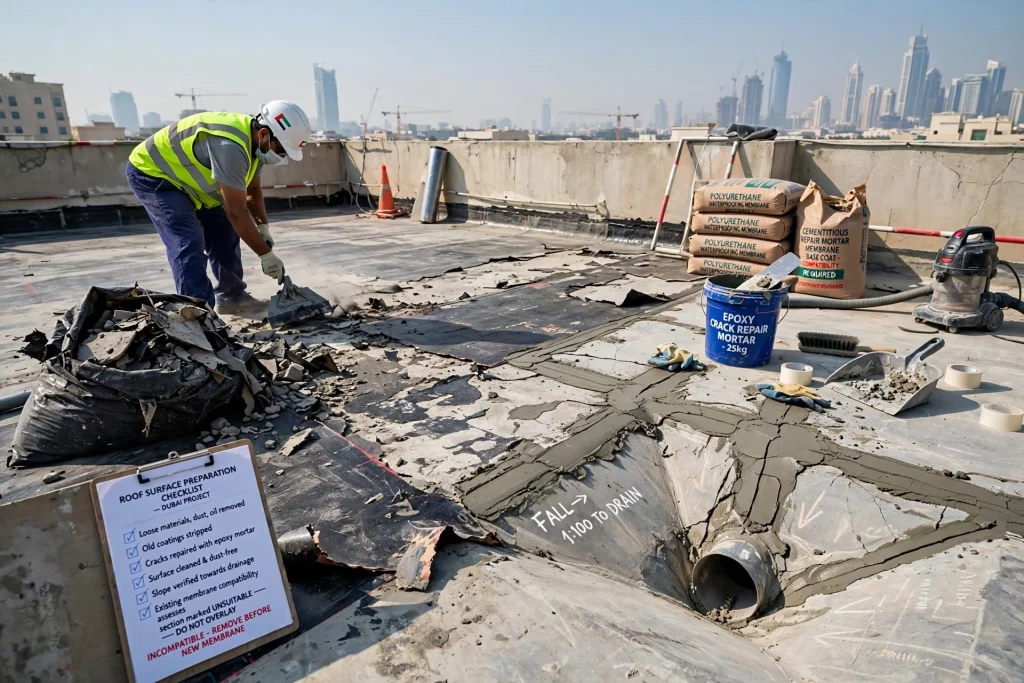
Loose materials, dust, oil, old coatings and deteriorated concrete may need to be removed. Cracks and damaged areas should be repaired using appropriate materials before the main waterproofing system is applied.
The roof surface should also be checked for adequate falls towards drainage points. Waterproofing is not a substitute for poor drainage design.
Where an existing membrane is being overlaid, compatibility must be assessed first. Applying a new material over an unsuitable or unstable old membrane can result in adhesion problems and premature failure.
Waterproofing Roof Cracks and Joints
Cracks require careful assessment because they can have different causes. Some may be superficial shrinkage cracks, while others may be associated with structural movement or thermal changes.
Joints and penetrations are particularly important because they interrupt the continuity of the waterproofing layer. Pipes, ducts, drains, equipment supports and other penetrations should receive appropriate detailing.
Expansion joints require flexible waterproofing solutions that can accommodate movement. Simply covering an active joint with a rigid coating may lead to cracking and leakage.
The objective is to create a continuous waterproofing system rather than treating every visible problem with the same product.
Roof Drainage and Waterproofing Work Together
Drainage should be considered an essential component of roof protection.
Rainwater needs to move efficiently towards drains or outlets. Blocked drains, damaged grates, insufficient falls and poorly designed outlets can result in standing water.
During waterproofing maintenance, drainage outlets should be inspected and cleaned. Areas around drains require careful membrane detailing because they are common points of water accumulation.
For commercial properties, drainage inspections should form part of routine roof maintenance, particularly before and after periods of heavy rainfall.
Waterproofing and Dubai’s Extreme Heat
Dubai’s roof surfaces can become extremely hot under direct sunlight. Repeated heating and cooling can contribute to expansion and contraction of construction materials.
A waterproofing system therefore needs to be selected with the local environment in mind. UV resistance, temperature tolerance, flexibility and adhesion can all influence service life.
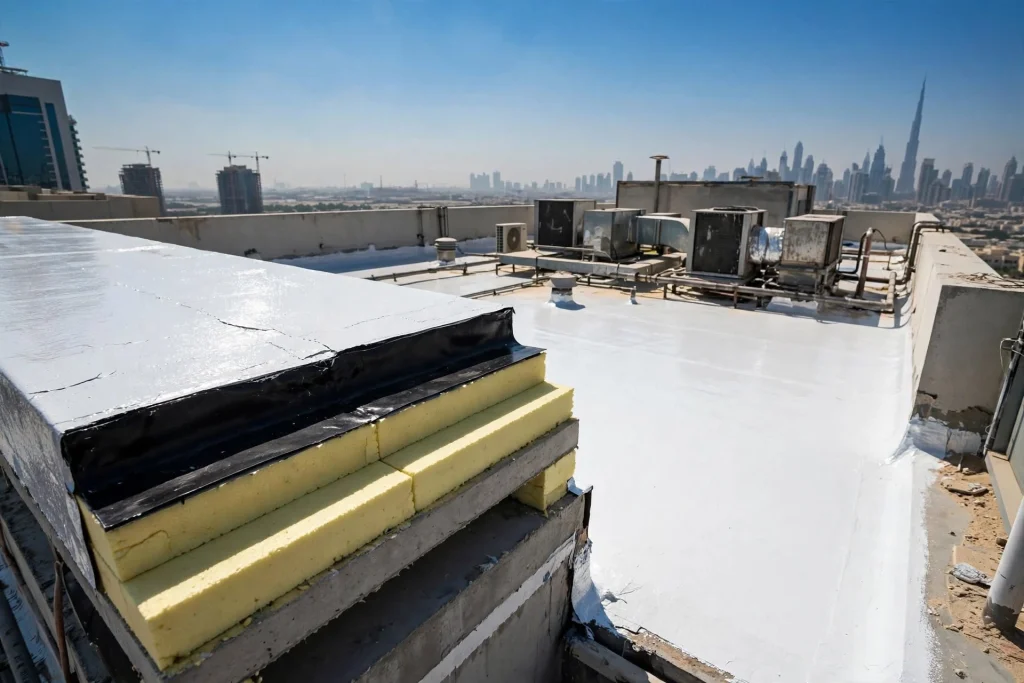
Reflective or light-coloured roof coatings may also be considered in suitable applications because they can reduce solar heat absorption. However, the primary waterproofing function should always remain the priority.
For occupied buildings, the wider roof build-up may also include thermal insulation to improve energy performance and reduce heat transfer into the building.
Signs That Your Roof Needs Waterproofing Repair
Property owners should not wait for major internal damage before inspecting a roof. Warning signs can include:
- Water stains on ceilings or walls
- Damp patches after rainfall
- Peeling paint
- Musty smells
- Cracks around roof structures
- Damaged or blistered waterproofing
- Standing water
- Deteriorated sealant around penetrations
- Water entering near roof drains
- Visible membrane separation
A small leak can become more expensive when water reaches insulation, ceilings, electrical installations or interior finishes.
Early inspection allows property owners to determine whether a local repair is sufficient or whether the existing waterproofing system has reached the end of its useful service life.
Roof Waterproofing for Warehouses and Industrial Buildings
Industrial roofs often cover large areas and may contain mechanical systems, service penetrations and maintenance access routes. A failure in a large roof can affect stored materials, equipment and daily operations.
Industrial roof waterproofing should therefore consider both water protection and maintainability. Walkways may be required around frequently serviced equipment to reduce accidental membrane damage.
Large facilities may also benefit from scheduled roof inspections, drainage cleaning and preventive maintenance rather than waiting for leaks to occur.
For warehouses in industrial locations such as Al Quoz, Ras Al Khor and Jebel Ali, roof maintenance can be particularly important because operational equipment and stored inventory may be directly affected by water ingress.
Waterproofing for Roofs With HVAC Equipment
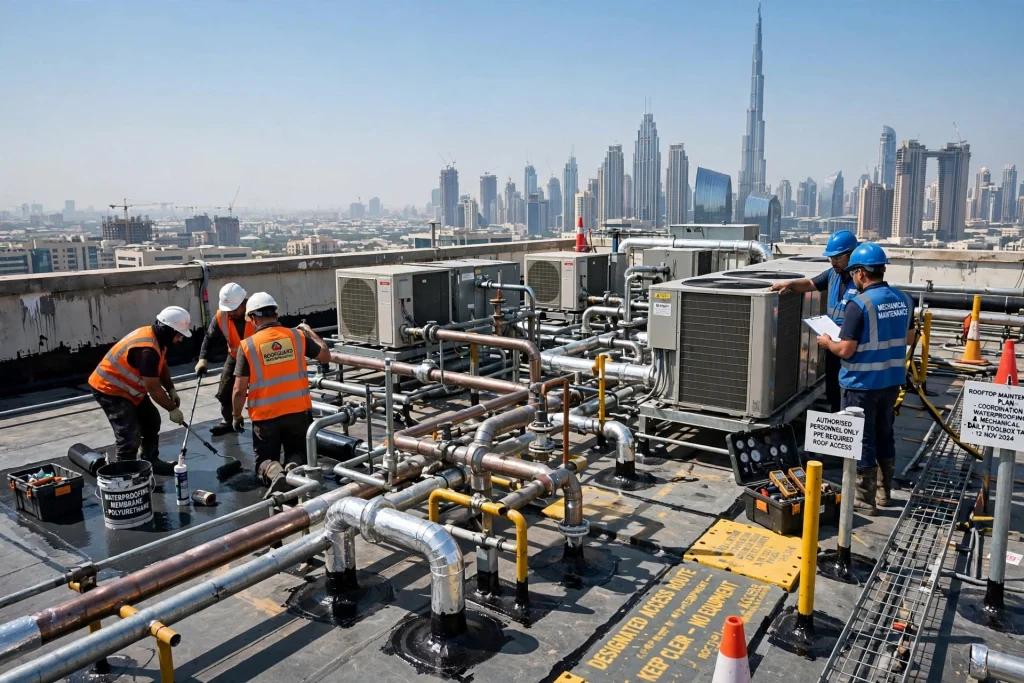
Dubai buildings commonly have substantial HVAC infrastructure installed on rooftops. Air-conditioning units, chillers, ducts, pipes and supports can create multiple waterproofing penetrations.
When waterproofing work is carried out around HVAC equipment, contractors should avoid damaging existing services and ensure that equipment supports and pipe penetrations are properly sealed.
Future maintenance should also be considered. If technicians regularly walk across the roof to service HVAC equipment, designated access routes can help protect the waterproofing membrane.
Coordination between waterproofing and mechanical maintenance teams can therefore improve the long-term performance of the roof.
Preventive Roof Waterproofing Maintenance
Waterproofing should not be considered a one-time project. Regular inspections can identify deterioration before it becomes a major leak.
A maintenance programme can include visual inspections, drain cleaning, checking membrane edges and joints, inspecting sealants, repairing minor cracks and monitoring areas where water tends to collect.
After significant rainfall, property managers should inspect vulnerable roof areas and check internal spaces for signs of water penetration.
Commercial property owners can incorporate roof inspections into a broader building maintenance programme that also covers HVAC systems, plumbing, electrical installations, façades and drainage.
How Long Does Roof Waterproofing Last?
The service life of a waterproofing system depends on several factors, including material quality, installation standards, substrate condition, UV exposure, drainage, roof traffic and maintenance.
A well-designed system can provide long-term protection, but no waterproofing material should be expected to remain unaffected indefinitely.
Regular inspection helps extend service life because small defects can be repaired before they develop into larger failures. Maintenance is particularly important around joints, penetrations, drains and areas exposed to frequent foot traffic.
Property owners should follow the manufacturer’s maintenance recommendations for the selected system.
Professional Roof Waterproofing in Dubai
Choosing a waterproofing contractor should involve more than comparing the lowest quotation. Property owners should consider the contractor’s experience with the relevant building type, proposed waterproofing system, surface preparation procedures, warranty conditions and maintenance recommendations.
A professional contractor should be able to explain why a particular system is suitable for the roof rather than simply recommending a generic coating.
For a Dubai property, the contractor should also understand the challenges created by high temperatures, UV exposure, concrete construction, roof drainage and the presence of rooftop mechanical equipment.
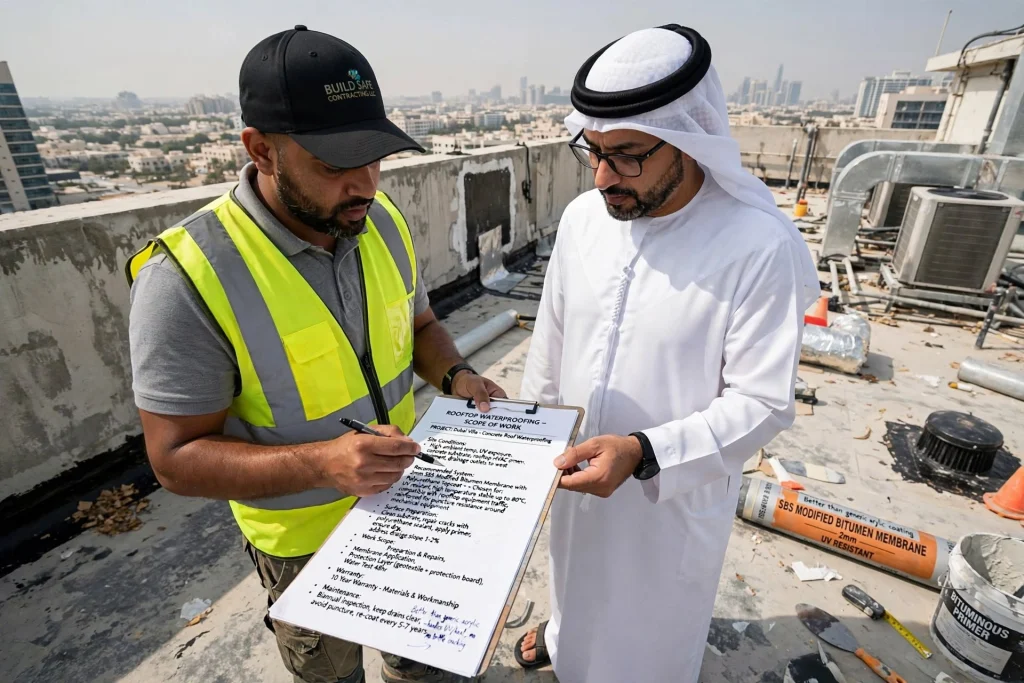
A detailed inspection and written scope of work can help avoid misunderstandings about preparation, repairs, membrane application, protection layers and testing.
Roof Waterproofing Across Dubai Areas
Waterproofing requirements can arise throughout Dubai, from villas and residential communities to commercial districts and industrial zones.
Properties in Jumeirah, Umm Suqeim, Al Barsha, Dubai Hills Estate, Arabian Ranches, Emirates Hills and Palm Jumeirah may require waterproofing for villa roofs, terraces and outdoor structures.
Commercial and mixed-use buildings in Business Bay, Downtown Dubai, Dubai Marina, Jumeirah Lake Towers (JLT) and Dubai International City may have more complex roof environments involving HVAC equipment, service areas and multiple drainage systems.
Industrial properties around Al Quoz, Ras Al Khor Industrial Area and Jebel Ali can also require specialised solutions for large warehouse and facility roofs.
Local conditions and building design should always be assessed individually rather than assuming that one waterproofing specification is suitable for every property.
Frequently Asked Questions About Roof Waterproofing Dubai
What is the best waterproofing system for a Dubai roof?
There is no universal best system. Bituminous membranes, polyurethane, liquid-applied membranes and cementitious systems can all be appropriate for different applications. The correct choice depends on the roof substrate, movement, exposure, drainage, existing waterproofing and intended use.
How can I identify a roof leak?
Look for ceiling stains, damp patches, peeling paint and moisture after rainfall. However, the visible location of a leak may not be the actual entry point. Professional inspection may be necessary to identify hidden water paths.
Can waterproofing be applied over existing waterproofing?
Sometimes, but the existing system must first be assessed for stability, adhesion and compatibility. If the old membrane is damaged or detached, simply covering it with another layer may not provide a reliable solution.
Does roof waterproofing prevent all water leakage?
A properly designed and installed waterproofing system can significantly reduce the risk of water ingress, but performance also depends on drainage, building movement, penetrations, maintenance and workmanship.
How often should a roof be inspected?
Inspection frequency depends on the building and roof condition. Commercial and industrial properties may benefit from scheduled inspections as part of preventive maintenance, while residential owners should inspect roofs periodically and after significant rainfall.
Conclusion
Roof waterproofing is an important investment for protecting Dubai properties against water ingress, concrete deterioration and costly internal damage. The most effective approach combines the correct waterproofing material with thorough surface preparation, proper detailing, effective drainage and ongoing maintenance.
For villas, apartments, offices, warehouses and commercial buildings, a roof should be assessed as a complete system rather than simply treating visible leaks. Cracks, joints, drains, parapets, penetrations, HVAC equipment and existing membranes can all influence waterproofing performance.
Businesses and property owners looking for Roof Waterproofing Dubai should therefore prioritise a professional inspection, appropriate material selection and quality installation. With preventive maintenance and timely repairs, a properly designed waterproofing system can provide durable protection while helping preserve the building’s structure, interiors and long-term value.