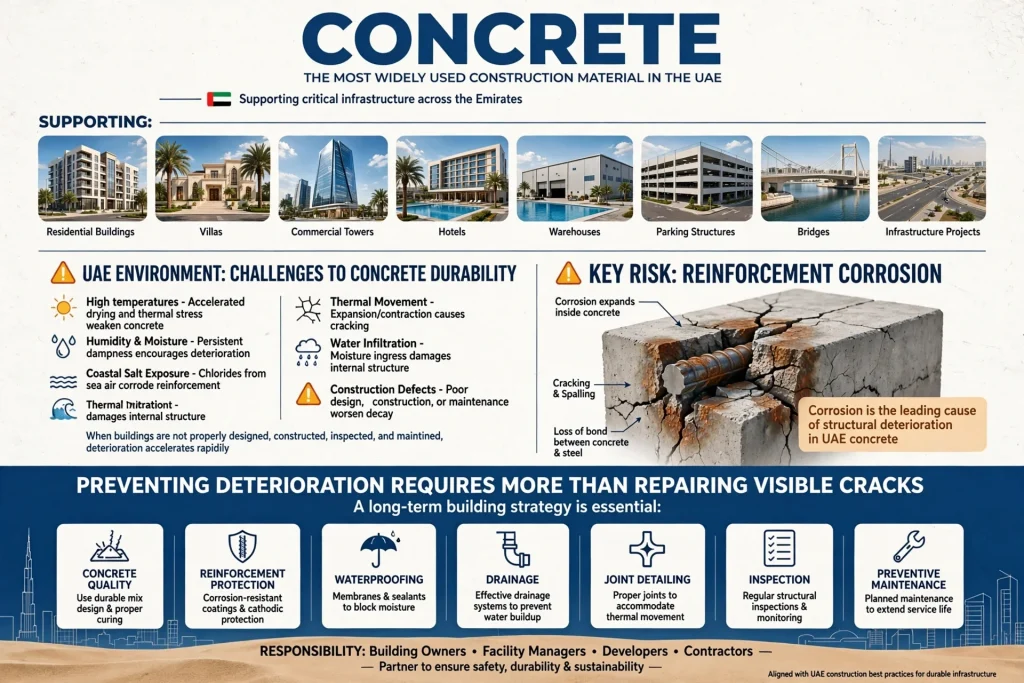
Concrete is one of the most widely used construction materials in the UAE, supporting residential buildings, villas, commercial towers, hotels, warehouses, parking structures, bridges and infrastructure projects. Although reinforced concrete is durable, the UAE environment can create conditions that accelerate deterioration when buildings are not properly designed, constructed, inspected and maintained.
High temperatures, humidity, coastal salt exposure, moisture, thermal movement, water infiltration and construction defects can all affect concrete durability. Reinforcement corrosion is particularly important because corrosion can expand inside concrete, causing cracking, spalling and loss of bond between concrete and steel.
Preventing concrete deterioration therefore requires more than repairing visible cracks. Building owners, facility managers, developers and contractors should consider concrete quality, reinforcement protection, waterproofing, drainage, joint detailing, inspection and preventive maintenance as part of a long-term building strategy.
Why Concrete Deterioration Is a Concern in UAE Buildings
Concrete deterioration occurs when the physical or chemical properties of concrete gradually become compromised. The damage may begin internally before becoming visible on the surface.
In UAE buildings, deterioration can be associated with moisture penetration, chloride exposure, carbonation, reinforcement corrosion, thermal expansion, shrinkage, poor workmanship and repeated wetting and drying cycles. Coastal locations such as Dubai Marina, Palm Jumeirah, Jumeirah and Abu Dhabi can experience additional exposure to salt-laden air.
Concrete deterioration can affect façades, balconies, roofs, podiums, basement structures, parking areas, retaining walls, swimming-pool structures and external slabs. Early detection is important because a relatively small defect can become a larger structural maintenance issue if water reaches reinforcement.
How the UAE Climate Affects Concrete Durability
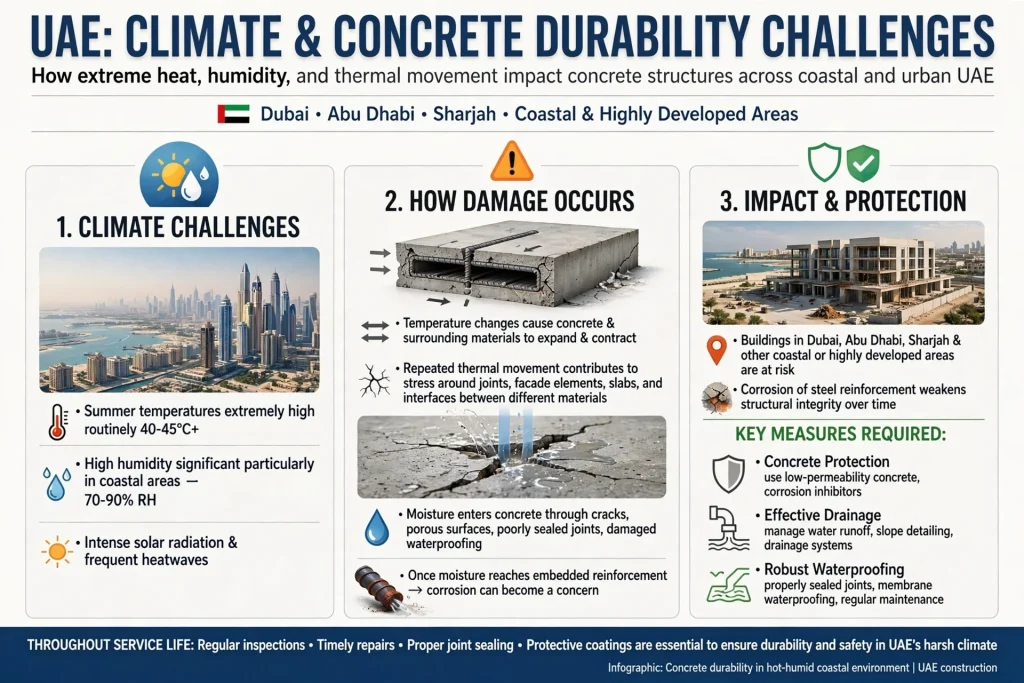
The UAE climate presents several durability challenges. Summer temperatures can become extremely high, while humidity can also be significant, particularly in coastal areas.
Temperature changes can cause concrete and surrounding construction materials to expand and contract. Repeated thermal movement can contribute to stress around joints, façade elements, slabs and interfaces between different materials.
Humidity and water are also important because moisture can enter concrete through cracks, porous surfaces, poorly sealed joints and damaged waterproofing. Once moisture reaches embedded reinforcement, corrosion can become a concern.
Buildings in Dubai, Abu Dhabi, Sharjah and other coastal or highly developed areas may therefore require careful attention to concrete protection, drainage and waterproofing throughout their service life.
Use High-Quality Concrete Materials
Concrete durability begins during construction. The mix design should be appropriate for the building’s structural requirements and environmental exposure.
Important considerations can include cementitious materials, water-cement ratio, aggregate quality, concrete strength, permeability, curing requirements and exposure conditions. A lower-permeability concrete can help reduce the movement of water and aggressive substances through the concrete matrix.
For reinforced concrete exposed to moisture or marine conditions, engineers may specify concrete mixes and durability measures appropriate for the expected exposure environment.
Simply choosing a high-strength concrete does not automatically eliminate deterioration. Workmanship, placement, compaction, curing and reinforcement detailing are equally important.
Maintain the Correct Concrete Cover
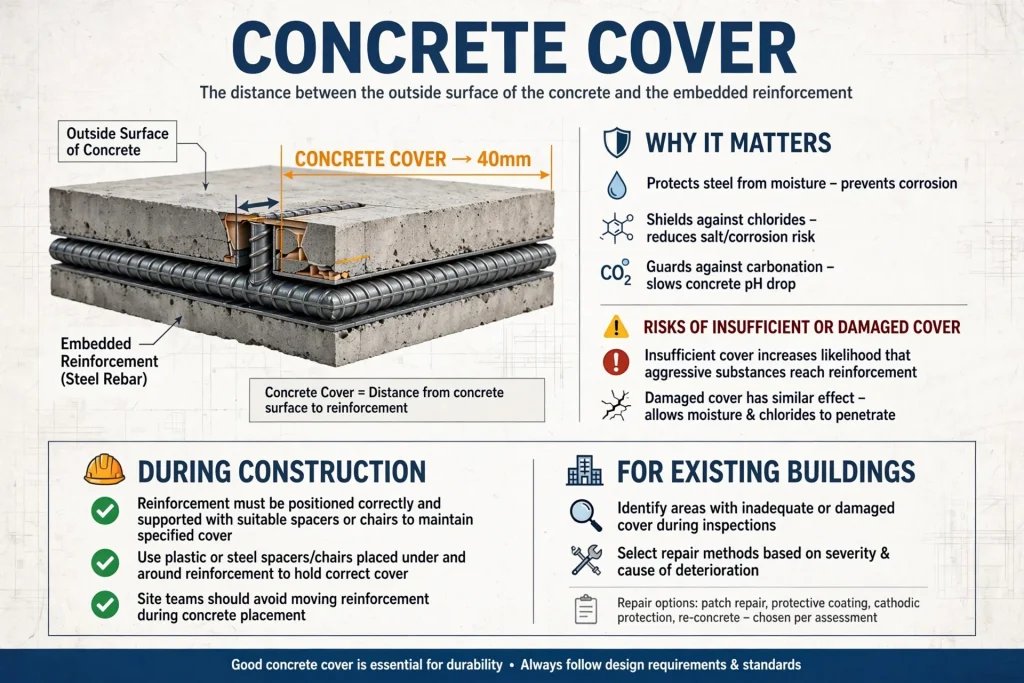
Concrete cover is the distance between the outside surface of the concrete and the embedded reinforcement. It plays an important role in protecting steel reinforcement from moisture, chlorides and carbonation.
Insufficient cover can increase the likelihood that aggressive substances reach reinforcement. Damaged cover can have a similar effect.
During construction, reinforcement should be positioned correctly and supported with suitable spacers or chairs so that the specified cover is maintained. Site teams should also avoid moving reinforcement during concrete placement.
For existing buildings, areas with inadequate or damaged cover should be identified during inspections. Repair methods can then be selected according to the severity and cause of deterioration.
Prevent Water Infiltration
Water is one of the most important factors in concrete deterioration. Preventing uncontrolled water penetration can significantly improve the durability of concrete structures.
Waterproofing is particularly important for roofs, terraces, balconies, basements, bathrooms, podiums, swimming-pool areas and other wet environments.
A waterproofing system should be designed for the specific location and substrate. Depending on the application, solutions may include cementitious waterproofing, liquid-applied membranes, bituminous membranes, polyurethane systems or other approved waterproofing technologies.
Waterproofing should not be viewed as a one-time installation with no maintenance requirement. Membranes, sealants, drainage points and joints should be inspected periodically, especially after heavy maintenance work or building alterations.
Control Cracks Before They Become Larger Problems
Not every concrete crack indicates structural failure, but every significant crack should be understood before it is repaired.
Concrete can crack because of drying shrinkage, thermal movement, settlement, structural loading, restraint, poor curing or movement at joints. Cracks can create pathways through which water enters the concrete.
Small non-structural cracks may sometimes be repaired using suitable crack injection, sealants, repair mortars or surface treatments. Larger or recurring cracks require investigation to identify the underlying cause.
Simply filling a crack without understanding why it formed may result in repeated failure.
Protect Reinforcement From Corrosion
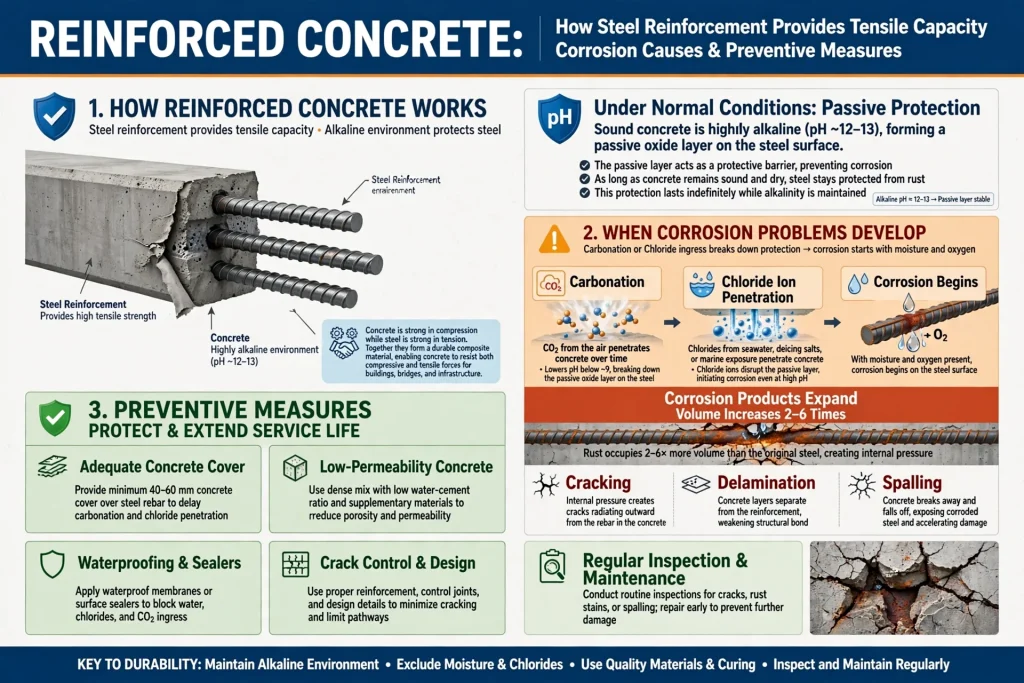
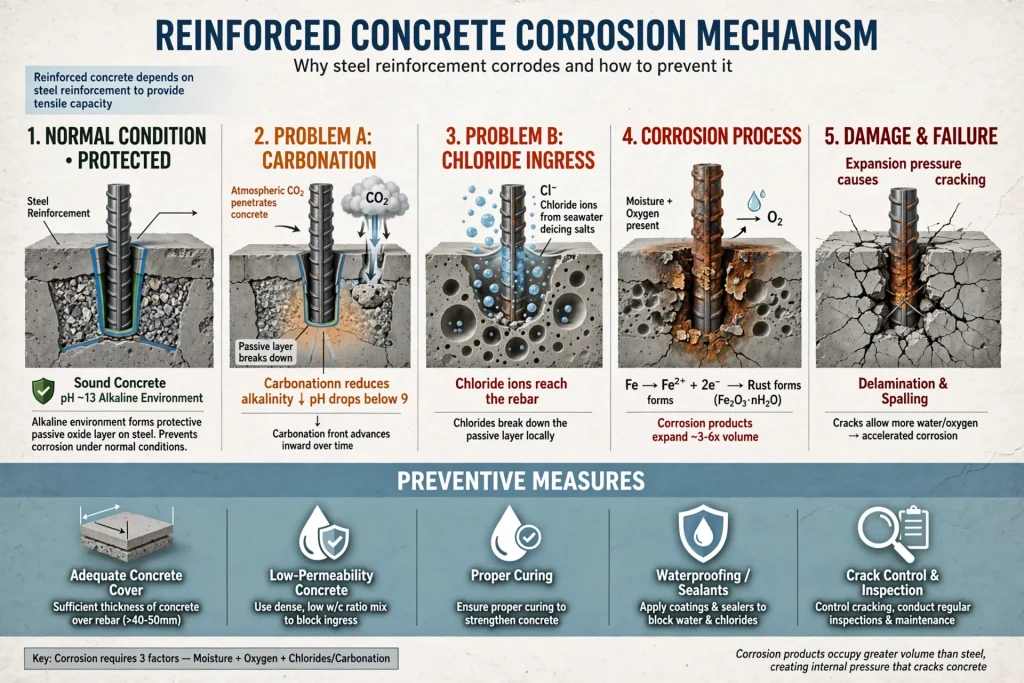
Reinforced concrete depends on steel reinforcement to provide tensile capacity. Under normal conditions, the alkaline environment of sound concrete helps protect reinforcing steel.
Problems can develop when carbonation reduces alkalinity around reinforcement or when chloride ions penetrate the concrete. Corrosion can then begin under suitable moisture and oxygen conditions.
As reinforcement corrodes, corrosion products occupy more volume than the original steel. This can create internal pressure, leading to cracking, delamination and concrete spalling.
Preventive measures include adequate concrete cover, low-permeability concrete, proper curing, waterproofing, crack control and regular inspection.
Pay Attention to Concrete Spalling
Concrete spalling occurs when sections of concrete break away from the surface. It can expose reinforcement and accelerate further deterioration.
Spalling is often visible around balconies, façades, beams, columns, parking structures and external slabs. Rust staining near cracks or exposed reinforcement can be an important warning sign.
Repair normally involves more than applying a cosmetic patch. Loose concrete should be safely removed, reinforcement condition assessed, corrosion addressed where appropriate, and a compatible repair material selected.
The repaired area should also be protected from the moisture source that contributed to the original deterioration.
Waterproof Roofs, Balconies and Terraces
Roof slabs, terraces and balconies are exposed to temperature changes and, depending on their design, significant moisture.
Poor drainage can leave water standing on concrete surfaces. Damaged waterproofing can allow moisture to migrate into the slab, while failed movement joints can create additional entry points.
Regular inspections should check membrane condition, drainage outlets, parapet junctions, expansion joints, sealants and areas around penetrations.
In Dubai villas and residential developments such as Arabian Ranches, Dubai Hills Estate, Emirates Hills and Palm Jumeirah, maintaining external concrete and waterproofing systems is particularly important because repairs can become more complicated when deterioration affects finished surfaces.
Maintain Expansion and Movement Joints
Concrete structures need to accommodate movement. Expansion joints, control joints and construction joints must be properly designed and maintained.
Sealants can deteriorate because of UV exposure, temperature changes, movement and ageing. Once a joint loses its ability to prevent water penetration, moisture can reach adjacent concrete.
Facility teams should inspect joints for cracking, separation, loss of adhesion and weathering. Damaged sealants should be replaced using products suitable for the joint movement and environmental exposure.
Joint maintenance is a relatively small part of building maintenance but can prevent significant moisture-related problems.
Ensure Proper Concrete Curing
Curing is essential for concrete strength development and durability. It allows cement hydration to continue and helps reduce premature moisture loss.
Poor curing can contribute to surface weakness, shrinkage cracking and increased permeability. These issues can make concrete more vulnerable to environmental exposure.
During new construction, curing procedures should follow the project specifications and applicable engineering requirements. Contractors should also protect newly placed concrete from excessive drying and temperature-related stresses.
Good curing is especially important in hot climates because high temperatures and rapid evaporation can affect fresh concrete if appropriate measures are not taken.
Use Suitable Concrete Repair Materials
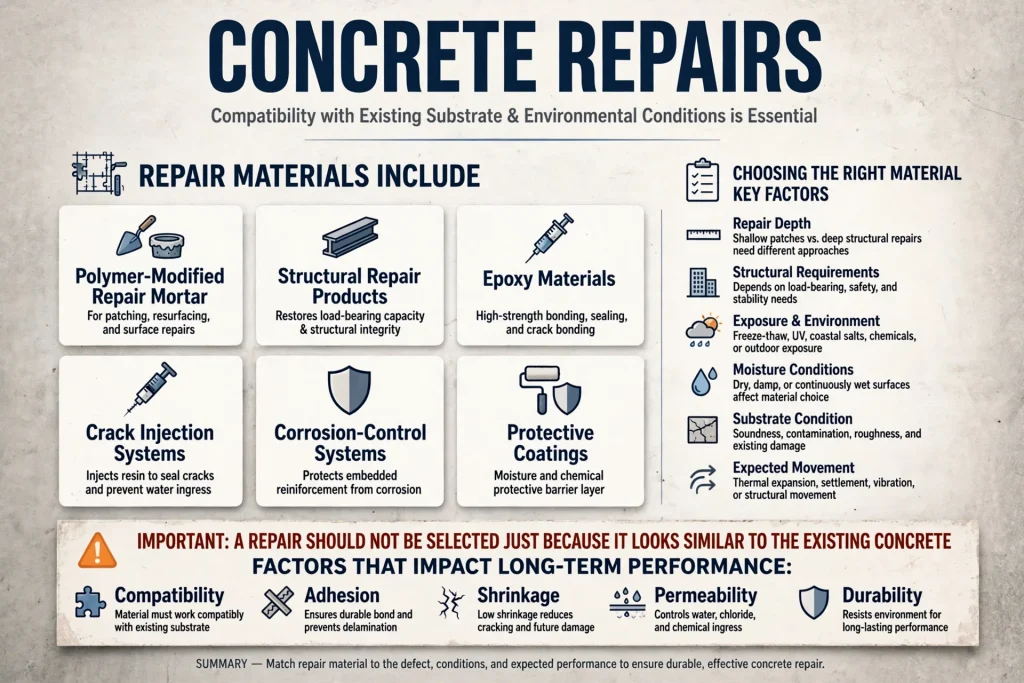
Concrete repairs should be compatible with the existing substrate and the environmental conditions.
Depending on the defect, repair materials may include polymer-modified repair mortar, structural repair products, corrosion-control systems, epoxy materials, crack injection systems or protective coatings.
The correct material depends on factors such as repair depth, structural requirements, exposure, moisture conditions, substrate condition and expected movement.
A repair should not be selected simply because it looks similar to the existing concrete. Compatibility, adhesion, shrinkage, permeability and durability can all affect long-term performance.
Protect Concrete From Chlorides in Coastal Areas
Chloride exposure is a significant durability consideration for reinforced concrete near marine environments.
Salt-laden air can contribute to chloride deposition on exposed surfaces. Over time, chlorides may penetrate concrete and reach reinforcement.
Buildings and structures close to the Arabian Gulf may therefore require appropriate durability design, concrete cover, surface protection and inspection.
This is relevant to coastal areas of Dubai and Abu Dhabi as well as waterfront developments around Dubai Marina, Jumeirah and Palm Jumeirah.
Regular washing of suitable exposed surfaces, maintaining protective coatings and repairing cracks can help reduce pathways for moisture and contaminants.
Manage Drainage Around Concrete Structures
Poor drainage can create persistent moisture exposure.
Water should be directed away from foundations, basement walls, podium slabs and other sensitive areas. Roof drains, balconies, planter boxes, parking decks and external paved areas should be checked for blocked outlets and standing water.
Landscape irrigation can also contribute to unwanted moisture around building elements when drainage or waterproofing is inadequate.
Building maintenance teams should therefore consider drainage as part of concrete preservation rather than treating it as a separate issue.
Inspect Concrete Parking Structures
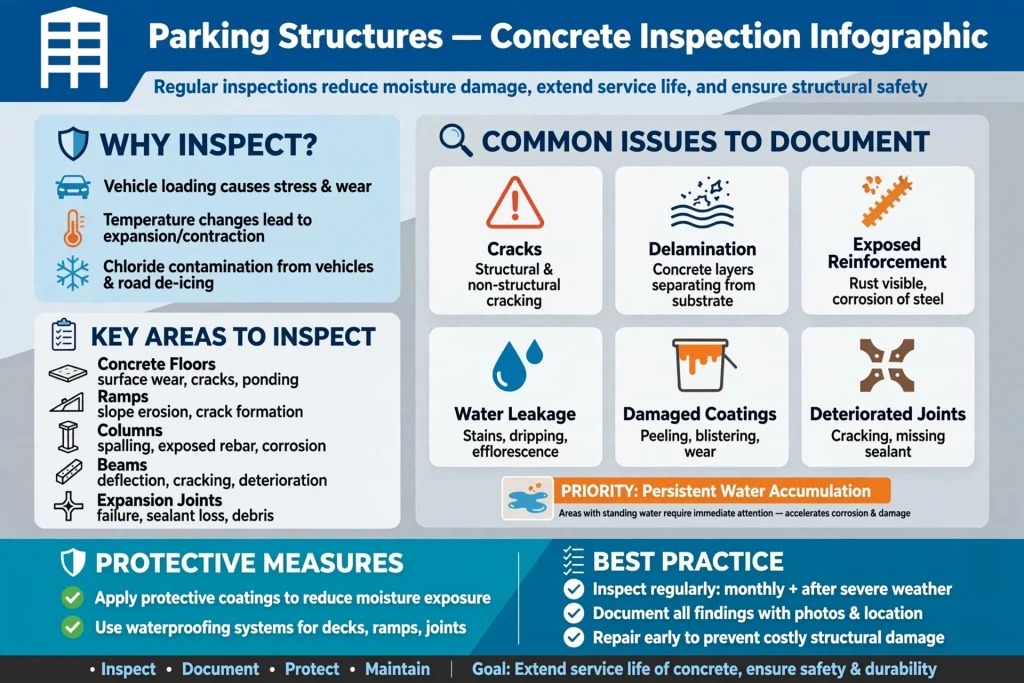
Parking structures experience a combination of vehicle loading, water, temperature changes and potentially chloride contamination from vehicles and road environments.
Concrete floors, ramps, columns, beams and expansion joints should be inspected regularly.
Cracks, delamination, exposed reinforcement, water leakage, damaged coatings and deteriorated joints should be documented. Parking areas with persistent water accumulation deserve particular attention.
Protective coatings and waterproofing systems may be used where appropriate to reduce moisture exposure and extend the service life of concrete surfaces.
Monitor Façades and External Concrete
Building façades can develop cracks, spalling, staining and joint failures over time. External concrete elements are exposed to UV radiation, temperature variation, humidity and wind-driven moisture.
High-rise buildings in Downtown Dubai, Business Bay and Dubai Marina require planned façade inspection because access can be difficult and defects may occur at considerable height.
A façade inspection can identify deteriorated concrete, failed sealants, cracks, corrosion indicators and water-entry points before they become larger maintenance problems.
Maintain Swimming Pool and Wet-Area Structures
Swimming pools and surrounding concrete structures require careful waterproofing and detailing because they are continuously or periodically exposed to water.
Pool shells, plant rooms, surrounding decks and wet areas should be checked for cracks, leakage, damaged waterproofing and failed sealants.
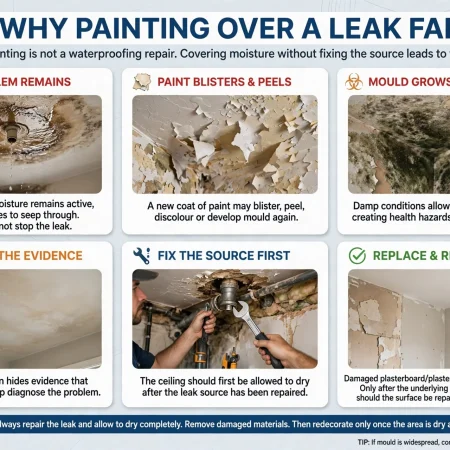
Pool maintenance should include inspection of construction joints and penetrations. If leakage is suspected, identifying the source is important before applying a surface repair.
A cosmetic coating may hide symptoms temporarily without solving the underlying water-management problem.
Prevent Concrete Deterioration During Renovation
Renovation work can unintentionally damage existing concrete. Drilling, chasing, demolition, waterproofing replacement and installation of new services can affect reinforcement or protective concrete cover.
Before major renovation work, existing structural elements should be identified and reviewed. Contractors should avoid cutting reinforcement unless specifically designed and approved by the responsible structural engineer.
This is particularly important in commercial properties, hotels, offices and residential towers where multiple services may pass through structural and non-structural elements.
Using an experienced Contruction Service Company can help property owners coordinate construction, repair and maintenance requirements while considering the existing condition of the building.
Schedule Regular Concrete Inspections
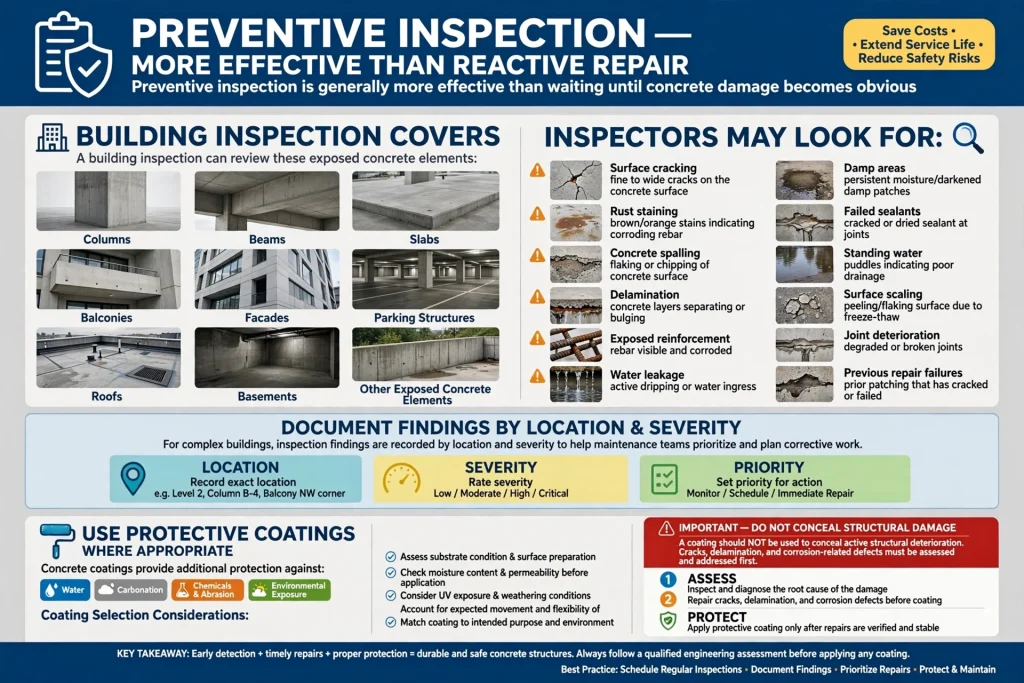
Preventive inspection is generally more effective than waiting until concrete damage becomes obvious.
A building inspection can review columns, beams, slabs, balconies, façades, parking structures, roofs, basements and other exposed concrete elements.
Inspectors may look for:
- Surface cracking
- Rust staining
- Concrete spalling
- Delamination
- Exposed reinforcement
- Water leakage
- Damp areas
- Failed sealants
- Standing water
- Surface scaling
- Joint deterioration
- Previous repair failures
For more complex buildings, inspection findings can be documented by location and severity so maintenance teams can prioritize corrective work.
Use Protective Coatings Where Appropriate
Concrete coatings can provide additional protection against water, carbonation, chemicals, abrasion and environmental exposure depending on the selected system.
However, coating selection should consider substrate condition, moisture content, permeability, UV exposure, expected movement and the purpose of the coating.
A coating should not be used to conceal active structural deterioration. Cracks, delamination and corrosion-related defects should be assessed and addressed before protective systems are applied.
Keep Concrete Surfaces Clean
Regular cleaning can help maintenance teams identify problems earlier. Dirt, oil deposits and biological growth can hide cracks, staining and surface deterioration.
Parking areas, service zones, external walkways and other concrete surfaces should be cleaned using methods suitable for the substrate and coating.
Aggressive cleaning methods should be avoided where they can damage concrete, joints, protective coatings or adjacent finishes.
Create a Preventive Concrete Maintenance Plan
A preventive maintenance plan should identify important concrete elements, their exposure conditions, inspection frequency and repair history.
For a commercial building, the plan may cover façades, podiums, parking decks, roofs, balconies, plant rooms and external structures.
For villas, attention may focus on terraces, balconies, boundary structures, pools, roofs, wet areas and external slabs.
Maintenance records should document the location of defects, inspection dates, photographs, repair materials and subsequent monitoring. This makes it easier to identify recurring deterioration.
Common Signs of Concrete Deterioration
Property owners should not ignore visible changes in concrete. Warning signs can include cracks that increase in width or length, rust-coloured staining, hollow-sounding areas, pieces of concrete breaking away, exposed reinforcement and persistent dampness.
Water leakage around concrete slabs, basements or roofs can also indicate a waterproofing or drainage problem.
If deterioration is recurring after repair, the underlying cause should be investigated rather than repeatedly applying surface patches.
When Should UAE Building Owners Repair Concrete?
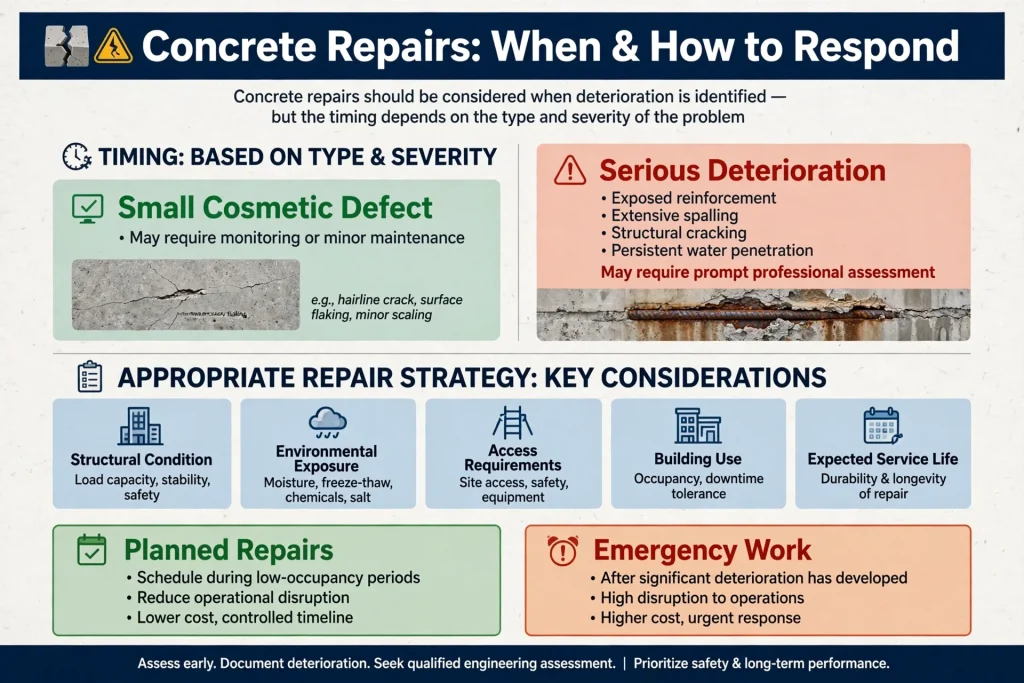
Concrete repairs should be considered when deterioration is identified, but the timing depends on the type and severity of the problem.
A small cosmetic defect may require monitoring or minor maintenance, while exposed reinforcement, extensive spalling, structural cracking or persistent water penetration may require prompt professional assessment.
The appropriate repair strategy should consider structural condition, environmental exposure, access requirements, building use and the expected service life of the repair.
For commercial properties, planned repairs can also reduce disruption compared with emergency work after significant deterioration has developed.
Concrete Durability for Dubai and Abu Dhabi Properties
Concrete maintenance requirements vary according to location and exposure. A waterfront property may face different durability challenges from an inland warehouse, while a basement may have different moisture risks from an exposed rooftop.
In Dubai, areas such as Downtown Dubai, Business Bay, DIFC, Dubai Marina, Jumeirah, Dubai Hills Estate and Palm Jumeirah contain a wide range of high-rise, residential, hospitality and commercial properties where concrete maintenance forms part of broader property management.
In Abu Dhabi, buildings across Abu Dhabi Island, Al Reem Island, Yas Island, Saadiyat Island and surrounding developments can also require planned concrete inspection, waterproofing and repair.
Sharjah and Ajman properties can similarly benefit from regular inspections, particularly where buildings are exposed to coastal humidity or persistent moisture.
How to Choose a Concrete Maintenance Contractor
When selecting a contractor, property owners should look beyond the price of a repair. The contractor should understand the cause of deterioration and provide a clear scope of work.
Ask whether the inspection includes identifying moisture sources, corrosion, cracking, damaged concrete cover and drainage problems.
A professional proposal should explain the repair method, materials, preparation, access requirements, curing or drying requirements, protective treatment and expected maintenance.
For structural concerns, appropriate engineering assessment should be included rather than relying solely on cosmetic repair.
Final Thoughts
Preventing concrete deterioration in UAE buildings requires a combination of good construction practices, appropriate materials, waterproofing, drainage, crack management, reinforcement protection and regular inspection. The UAE’s heat, humidity and coastal exposure make preventive maintenance particularly important for exposed and moisture-sensitive concrete elements.
The most effective approach is to identify deterioration early and address its underlying cause. Repairing a crack, for example, is only part of the solution if water continues to enter through the same location.
From villas and residential towers to hotels, commercial buildings, parking structures and high-rise developments, a planned concrete maintenance strategy can help protect structural elements, reduce unexpected repair costs and support the long-term service life of UAE buildings.