Heating, ventilation and air conditioning (HVAC) systems are among the most important building services in modern commercial and residential properties. In a climate such as Dubai’s, where cooling demand can remain high for much of the year, HVAC performance directly affects indoor comfort, energy consumption, equipment life, and operating costs. A Building Management System (BMS) provides a centralized way to monitor, control, and optimize these systems according to actual building conditions.
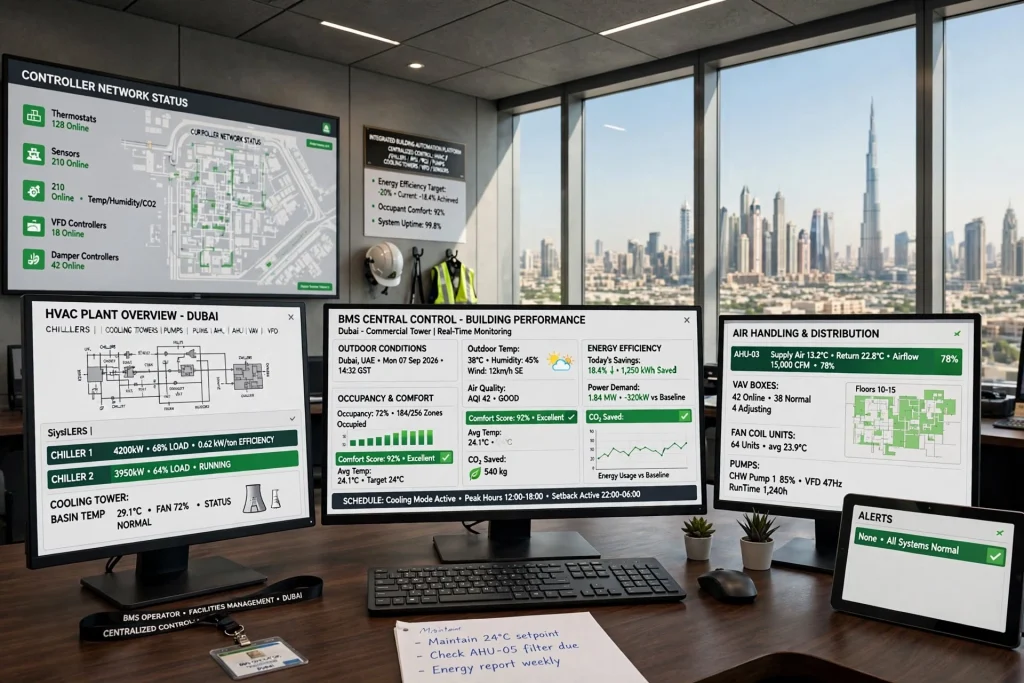
A BMS connects HVAC equipment, sensors, controllers, meters, and software into an integrated building automation platform. Instead of operating air conditioning equipment independently, facility teams can use real-time information to adjust temperature, airflow, operating schedules, and equipment performance. This allows the HVAC system to respond more intelligently to occupancy, outdoor conditions, and cooling demand.
For businesses searching to understand How Building Management Systems (BMS) improve building performance, the key is to look beyond simple temperature control. Modern BMS technology can coordinate chillers, air handling units, fan coil units, pumps, cooling towers, variable air volume systems, variable frequency drives, thermostats, and other mechanical equipment to improve efficiency while maintaining occupant comfort.
What Is a Building Management System?
A Building Management System is an automated platform used to monitor and control different building services from a centralized interface. It is also commonly referred to as a Building Automation System (BAS) or Building Management and Control System, depending on the application and technology provider.
A BMS typically integrates mechanical, electrical, and environmental systems through sensors, controllers, communication networks, and supervisory software. In HVAC applications, it can collect information such as room temperature, supply-air temperature, return-air temperature, humidity, pressure, airflow, valve position, fan speed, and equipment operating status.
The collected data allows facility managers and building operators to understand how HVAC equipment is performing. Instead of waiting for occupants to report uncomfortable temperatures or equipment failures, operators can identify abnormal conditions through alarms, trends, dashboards, and performance data.
Common BMS platforms can integrate technologies and equipment from manufacturers such as Siemens, Honeywell, Schneider Electric, Johnson Controls, and other automation and HVAC control providers. The exact capabilities depend on the system architecture, controllers, communication protocols, sensors, and software installed in the building.
Why BMS Optimization Is Important for HVAC Systems
HVAC equipment can consume a significant amount of energy, particularly in large offices, hotels, shopping centres, hospitals, warehouses, and high-rise buildings. Running chillers, pumps, fans, AHUs, and FCUs continuously at maximum capacity can result in unnecessary energy consumption and increased mechanical wear.
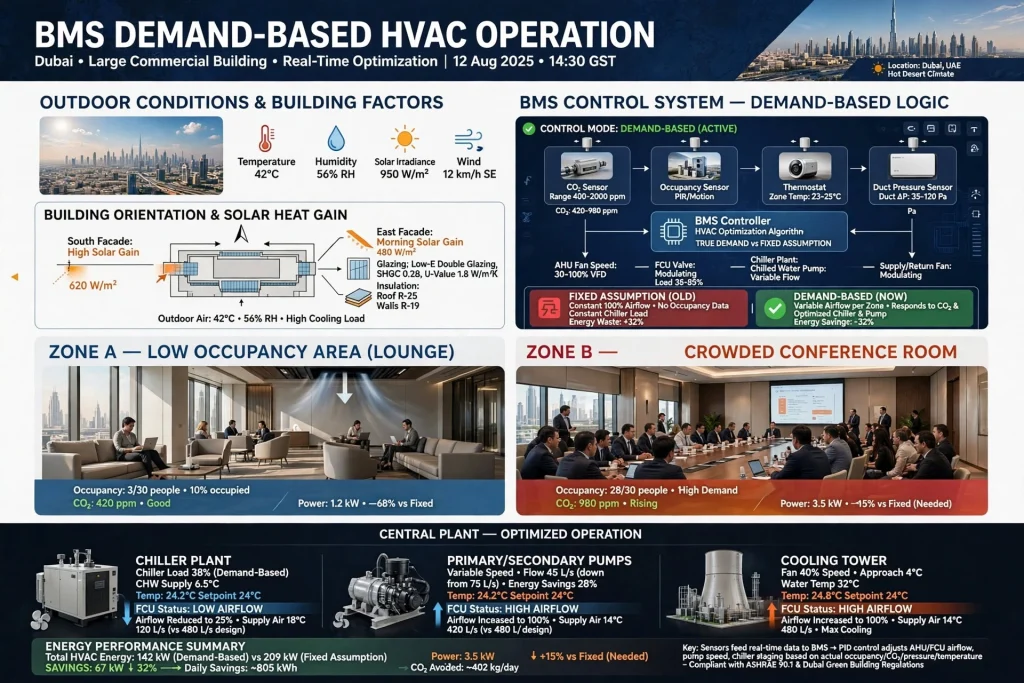
A BMS helps overcome this problem by allowing equipment to operate according to actual demand rather than fixed assumptions. For example, an air handling unit serving an area with low occupancy may not need to operate at the same airflow level as one serving a crowded conference room.
The BMS can receive information from occupancy sensors, thermostats, CO2 sensors, pressure sensors, and other field devices. It then uses programmed control logic to adjust HVAC operation. This demand-based approach can reduce unnecessary runtime while maintaining suitable indoor environmental conditions.
In Dubai and other parts of the UAE, this is particularly valuable because cooling loads can be substantial. Building orientation, solar heat gain, outdoor temperature, humidity, occupancy, glazing, insulation, and equipment loads all influence HVAC demand.
Real-Time Temperature Monitoring Improves Comfort
One of the simplest but most valuable functions of a BMS is continuous temperature monitoring. Sensors installed throughout a building provide real-time information about indoor conditions.
Without centralized monitoring, facility teams may need to investigate complaints individually. A BMS provides a broader picture by showing temperature conditions across multiple zones from one interface.
If a particular office area consistently becomes warmer than the surrounding zones, operators can investigate possible causes such as inadequate airflow, a dirty filter, incorrect damper position, faulty sensors, blocked ducts, or an issue with the FCU or AHU serving the space.
The system can also maintain temperature setpoints within programmed limits. This helps prevent unnecessary overcooling, which is particularly important in energy-intensive buildings.
Automated HVAC Scheduling Reduces Unnecessary Runtime
A major source of HVAC energy waste is operating equipment when a building or zone does not require cooling. Offices, for example, may have significantly different cooling requirements during working hours compared with evenings, weekends, and holidays.
A BMS can use programmed schedules to automatically start and stop equipment. Different schedules can be established for offices, retail areas, meeting rooms, common areas, parking facilities, and other zones.
Advanced systems can also incorporate holiday calendars, occupancy information, and building usage patterns. This means HVAC equipment does not have to operate according to a simple 24-hour schedule.
For a commercial property in Business Bay, Downtown Dubai, Dubai Marina, or another busy business district, automated scheduling can help align HVAC operation with actual occupancy patterns.
Chiller Plant Optimization
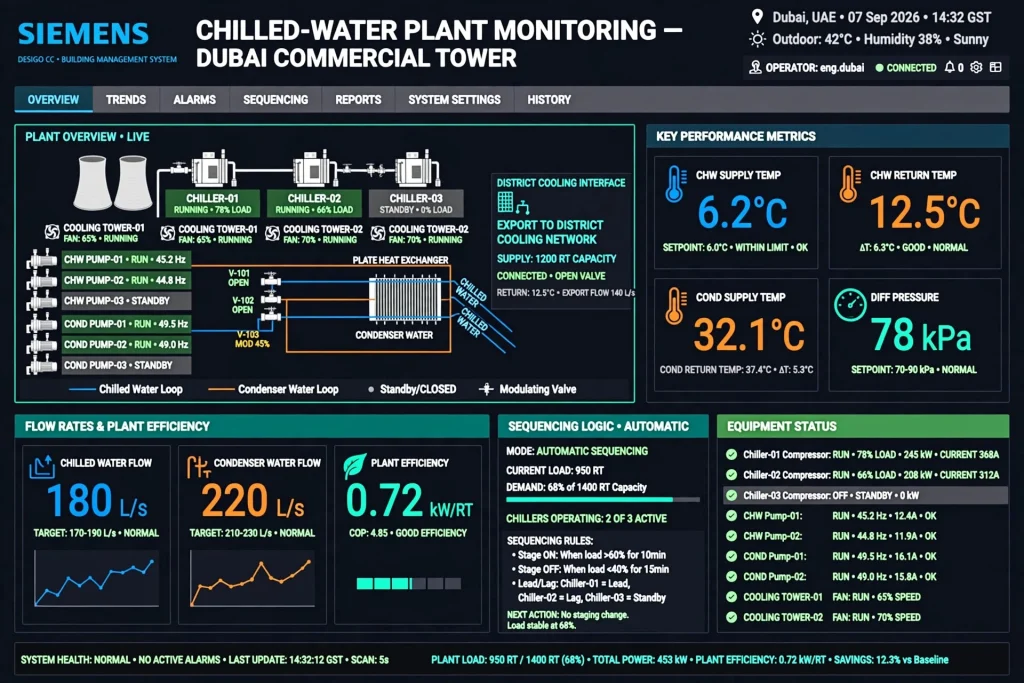
Chillers are critical components in many large HVAC installations. A chilled-water system can include chillers, chilled-water pumps, condenser-water pumps, cooling towers, heat exchangers, valves, sensors, and associated controls.
A BMS can monitor the operating condition of the complete chilled-water plant rather than treating each component as an isolated machine.
The system can track parameters such as chilled-water supply temperature, chilled-water return temperature, condenser-water temperature, differential pressure, flow rates, pump status, compressor loading, and chiller efficiency.
Based on programmed sequences, the BMS can determine how many chillers should operate at a particular time. During periods of lower demand, unnecessary chillers can remain offline rather than operating inefficiently at low loads.
This type of sequencing is particularly important in large commercial buildings and district cooling interfaces where HVAC loads can vary considerably throughout the day.
Improving AHU and FCU Performance
Air Handling Units (AHUs) and Fan Coil Units (FCUs) distribute conditioned air throughout buildings. Their performance directly affects indoor comfort and air quality.
A BMS can monitor fan operation, supply-air temperature, return-air temperature, filter status, valve position, damper position, and other operating parameters. Where variable-speed equipment is installed, the BMS can adjust fan speed according to demand.
For example, if a zone requires less cooling, the control system can reduce airflow or adjust the chilled-water valve instead of operating the fan continuously at full capacity.
This can improve energy efficiency while reducing unnecessary equipment stress.
Variable Frequency Drives and Demand-Based Control
Variable Frequency Drives (VFDs) are commonly used with HVAC motors, including fans and pumps. They allow motor speed to be adjusted instead of forcing equipment to run at a constant speed.
A BMS can communicate with VFDs and adjust motor speed based on demand.
For example, an AHU fan does not always need to operate at 100% speed. If the building requires less airflow, reducing fan speed can lower energy consumption while maintaining appropriate pressure and ventilation.
Similarly, chilled-water pumps can operate according to differential pressure or flow requirements. This allows the HVAC system to respond dynamically instead of wasting energy by maintaining excessive flow.
The combination of BMS controls and VFD technology is therefore an important part of modern HVAC optimization.
Demand-Controlled Ventilation and Indoor Air Quality
HVAC performance is not only about temperature. Ventilation and indoor air quality are equally important in commercial and public buildings.
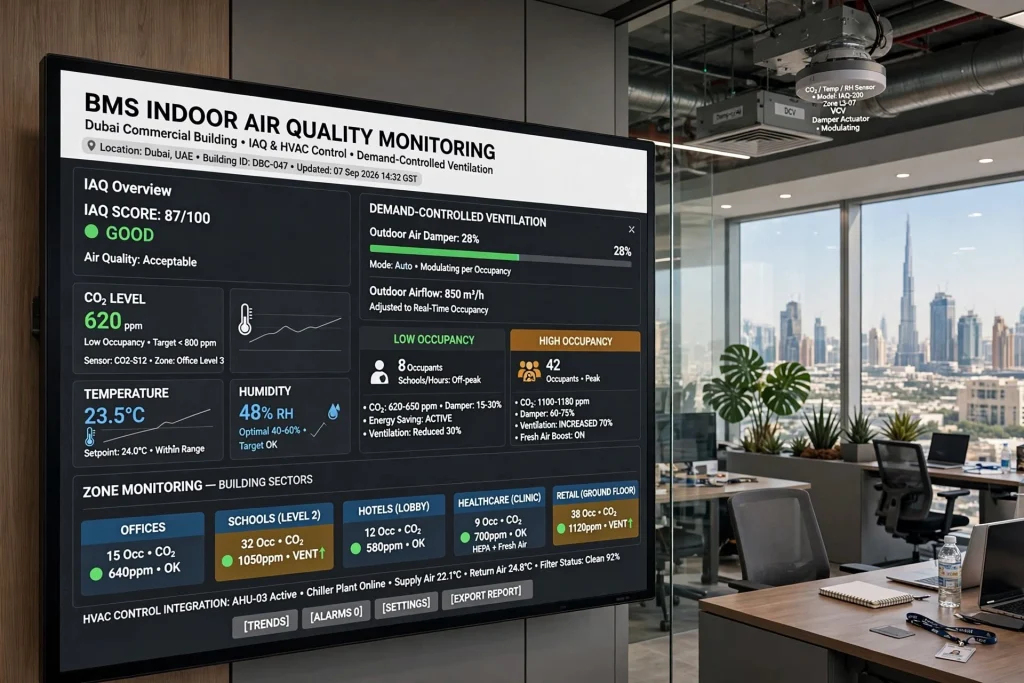
BMS technology can integrate sensors that measure carbon dioxide (CO2), temperature, humidity, and other environmental parameters. CO2 levels can provide useful information about occupancy and ventilation requirements.
In suitable applications, demand-controlled ventilation can adjust outdoor-air quantities according to occupancy conditions. This can prevent the HVAC system from supplying excessive amounts of conditioned outdoor air when spaces are lightly occupied.
At the same time, ventilation can be increased when occupancy rises, supporting a healthier and more comfortable indoor environment.
For offices, schools, hotels, healthcare environments, retail spaces, and other occupied buildings, integrating indoor air quality monitoring with HVAC control can provide significant operational value.
Humidity Control in the UAE Climate
Dubai’s environmental conditions make humidity management an important HVAC consideration. Excessive indoor humidity can affect comfort, materials, and indoor environmental quality.
A BMS can monitor relative humidity and coordinate HVAC equipment to maintain programmed humidity levels where the system has suitable dehumidification capabilities.
Monitoring humidity can also help operators identify unusual conditions. For example, an unexpected rise in humidity may indicate inadequate cooling, excessive outdoor-air infiltration, a control problem, or an equipment issue.
By tracking temperature and humidity together, facility teams can gain a more complete understanding of indoor environmental performance.
Predictive Maintenance and Early Fault Detection
Traditional HVAC maintenance often relies on scheduled inspections. Preventive maintenance remains important, but BMS data can provide an additional layer of intelligence.
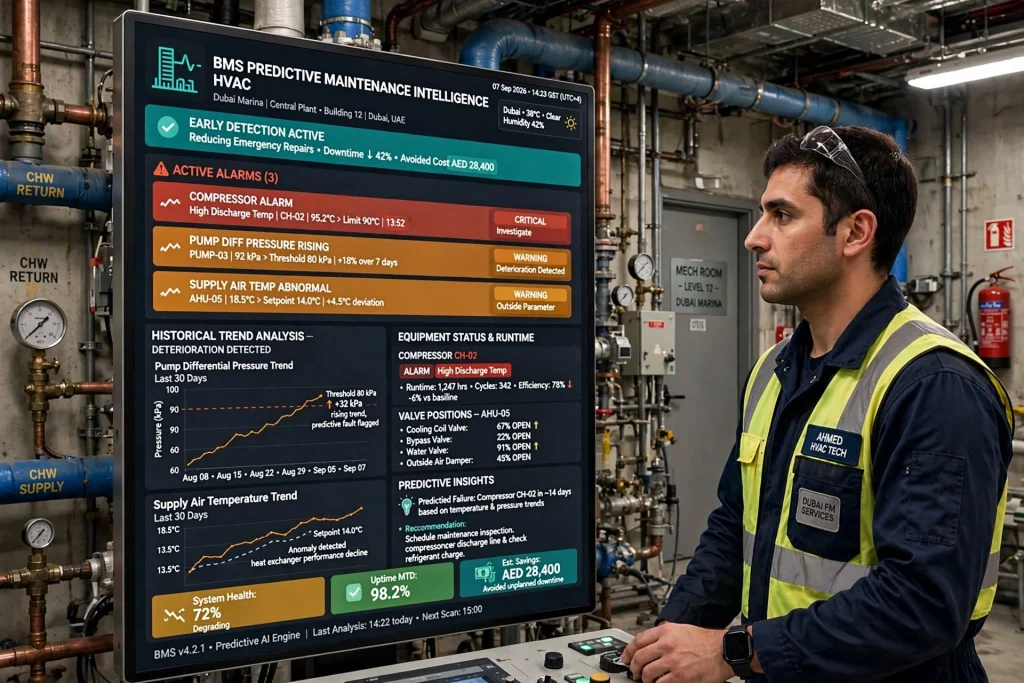
A BMS can generate alarms when equipment operates outside predefined parameters. It can also record historical trends that help technicians identify gradual deterioration.
For example, increasing pump differential pressure, abnormal supply-air temperatures, repeated compressor alarms, unusual valve positions, or prolonged equipment runtime may indicate a developing problem.
Early detection allows maintenance teams to investigate issues before they become major failures.
This can reduce emergency repairs, unexpected downtime, and disruption to building occupants.
Energy Monitoring and HVAC Performance Analysis
A modern BMS can integrate energy meters and provide information about electricity consumption. When combined with HVAC operating data, this creates a much stronger basis for energy management.
Facility managers can compare energy consumption against operating hours, occupancy, outdoor conditions, and equipment performance.
For example, if a building’s energy consumption increases while occupancy remains stable, the BMS data can help identify possible causes. These could include incorrect schedules, equipment degradation, excessive cooling, simultaneous heating and cooling, or control-system issues.
Energy dashboards can also help identify high-consumption periods and establish benchmarks for future improvements.
Alarm Management Makes HVAC Problems Easier to Identify
Large buildings can contain hundreds or thousands of HVAC components. Monitoring everything manually is difficult.
A BMS can generate alarms when specific operating conditions occur. Examples include high temperature, low temperature, high pressure, low pressure, fan failure, pump failure, communication loss, filter alarms, sensor faults, and chiller faults.
Effective alarm management is important because an excessive number of poorly configured alarms can overwhelm operators. The goal should be to prioritize meaningful events and provide enough information for technicians to respond efficiently.
A well-configured BMS therefore supports both automation and human decision-making.
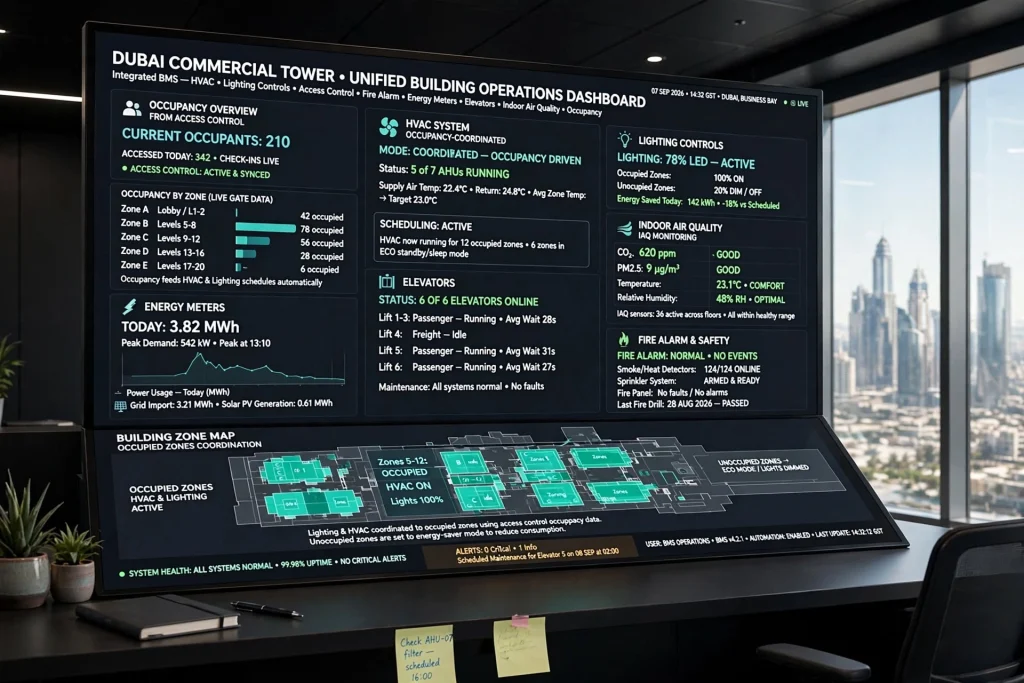
Integrating HVAC With Other Building Services
The value of BMS technology increases when HVAC controls are integrated with other building systems.
Depending on the project, a BMS may communicate with lighting controls, access control, fire alarm interfaces, energy meters, elevators, indoor air quality systems, and other building services.
For example, occupancy information from an access control system can potentially support HVAC scheduling. Lighting and HVAC systems can also be coordinated around occupied zones.
This creates a more integrated approach to building operation instead of managing each service independently.
BMS and Smart Buildings in Dubai
Dubai has a large and diverse building environment ranging from luxury villas and residential towers to hotels, shopping centres, hospitals, corporate offices, and industrial facilities.
Many modern developments incorporate automation and centralized building controls as part of their mechanical and electrical infrastructure.
Areas such as Downtown Dubai, Business Bay, Dubai Marina, Jumeirah Lakes Towers, Dubai Internet City, Dubai Media City, Dubai Design District, and Al Quoz contain properties with varying HVAC requirements and operational profiles.
A BMS can help building operators adapt HVAC performance to the specific characteristics of each property.
In larger facilities, centralized monitoring is particularly valuable because operators may need to manage numerous AHUs, FCUs, pumps, chillers, ventilation systems, and mechanical rooms simultaneously.
BMS for Hotels, Offices and Commercial Buildings
Hotels have continuously changing occupancy levels, making HVAC optimization particularly valuable. Guest rooms, restaurants, meeting spaces, kitchens, corridors, and back-of-house areas can have different schedules and cooling requirements.
Office buildings also benefit from zone-based control. Meeting rooms may experience sudden occupancy increases, while private offices may remain lightly occupied.
Retail environments can have different requirements depending on opening hours, customer traffic, store layout, and equipment loads.
A properly configured BMS allows each area to operate according to its requirements rather than applying the same HVAC strategy throughout the entire building.
BMS Applications in Residential Properties
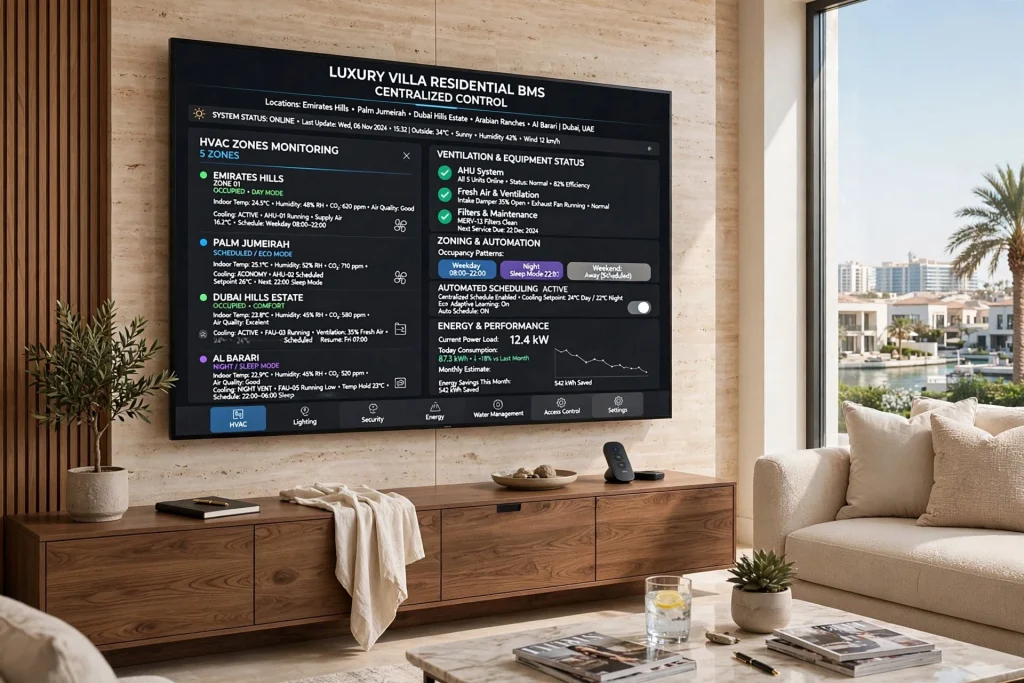
Although BMS technology is commonly associated with commercial buildings, advanced automation can also be used in large villas, residential compounds, and luxury properties.
A residential automation system can monitor HVAC zones, indoor temperatures, humidity, ventilation, and equipment status.
For large villas in Emirates Hills, Palm Jumeirah, Dubai Hills Estate, Arabian Ranches, and Al Barari, zoning can be particularly useful because different areas of the property may have different occupancy patterns.
Residents can also benefit from centralized control and automated scheduling, provided the system is designed appropriately for the property’s HVAC configuration.
How BMS Reduces HVAC Operating Costs
The primary financial benefit of HVAC automation comes from operating equipment more intelligently.
A BMS can reduce unnecessary runtime, prevent excessive cooling, optimize equipment sequencing, identify abnormal operating conditions, and support preventive maintenance.
However, actual savings depend on the building’s existing HVAC system, control strategy, equipment efficiency, occupancy profile, operating schedule, maintenance condition, and quality of commissioning.
Installing a BMS alone does not automatically guarantee energy savings. The system needs to be correctly designed, programmed, commissioned, monitored, and maintained.
This distinction is important when evaluating building automation projects.
The Importance of Sensors and Control Logic
The quality of a BMS depends heavily on its field devices and control logic. Sensors provide the information that the system uses to make decisions.
Common HVAC sensors include temperature sensors, humidity sensors, pressure sensors, differential pressure sensors, CO2 sensors, flow meters, occupancy sensors, and air-quality sensors.
Controllers process this information according to programmed sequences. The control logic determines when equipment starts, stops, modulates, or changes operating conditions.
Incorrect sensor calibration or poorly designed control sequences can lead to inefficient operation. Regular testing and calibration are therefore essential for maintaining reliable BMS performance.
BMS Commissioning and Continuous Optimization
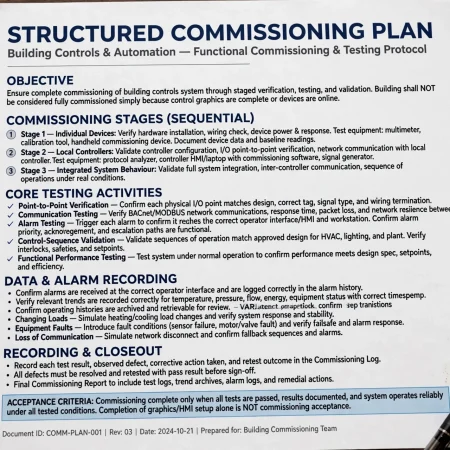
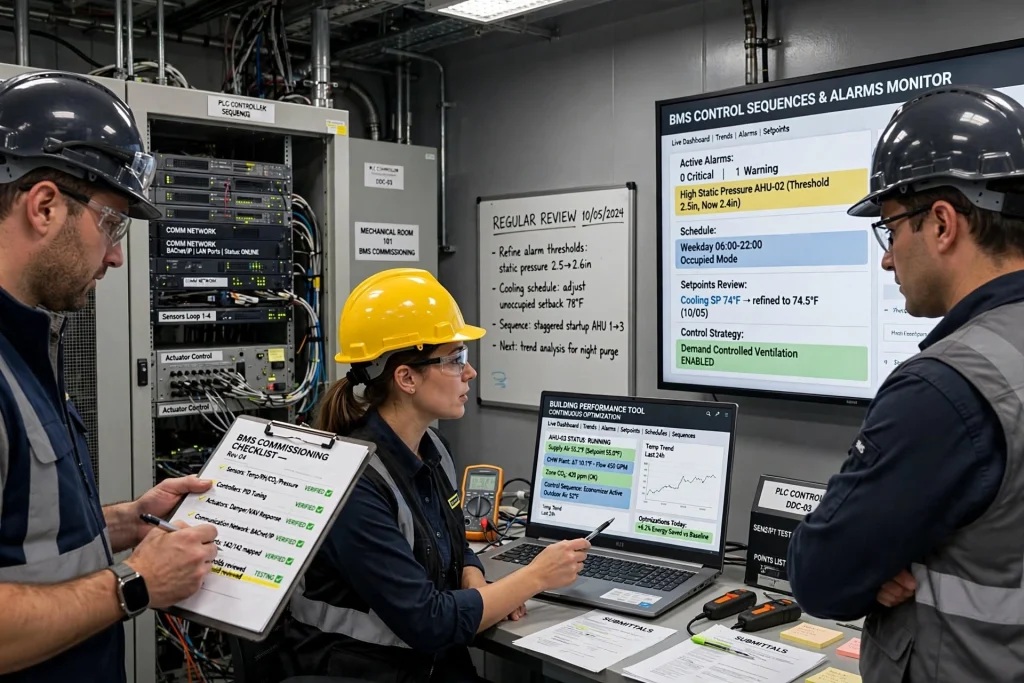
Commissioning is an important stage of BMS implementation. During commissioning, engineers verify that sensors, controllers, actuators, communication networks, software points, alarms, and control sequences operate as intended.
The process should also confirm that equipment responds correctly to different operating conditions.
After commissioning, continuous optimization can further improve performance. Building usage changes over time, equipment ages, tenants move in and out, and operating schedules evolve.
Regular BMS reviews can identify opportunities to refine setpoints, schedules, sequencing, alarm thresholds, and control strategies.
This turns the BMS from a one-time installation into an ongoing building performance tool.
BMS Communication Protocols and Integration
Modern building automation systems rely on communication protocols to exchange information between controllers, sensors, HVAC equipment, and supervisory software.
Common building automation protocols and technologies include BACnet, Modbus, LonWorks, KNX, and IP-based communication architectures.
BACnet is widely associated with building automation and HVAC integration because it is designed for communication between building control devices and systems.
The choice of protocol depends on the equipment, project requirements, existing infrastructure, interoperability requirements, cybersecurity considerations, and integration strategy.
Professional BMS design should consider these factors before equipment and controls are selected.
Cybersecurity and Reliable Building Automation
As BMS platforms increasingly use IP networks and remote monitoring, cybersecurity becomes an important consideration.
Building operators should ensure that access permissions, user authentication, network segmentation, software updates, remote access controls, and other security measures are appropriately managed.
A BMS should provide convenient operational access without unnecessarily exposing critical building infrastructure.
For large commercial properties, cybersecurity should be considered during system design rather than treated as an afterthought.
Choosing the Right BMS Strategy for a Dubai Property
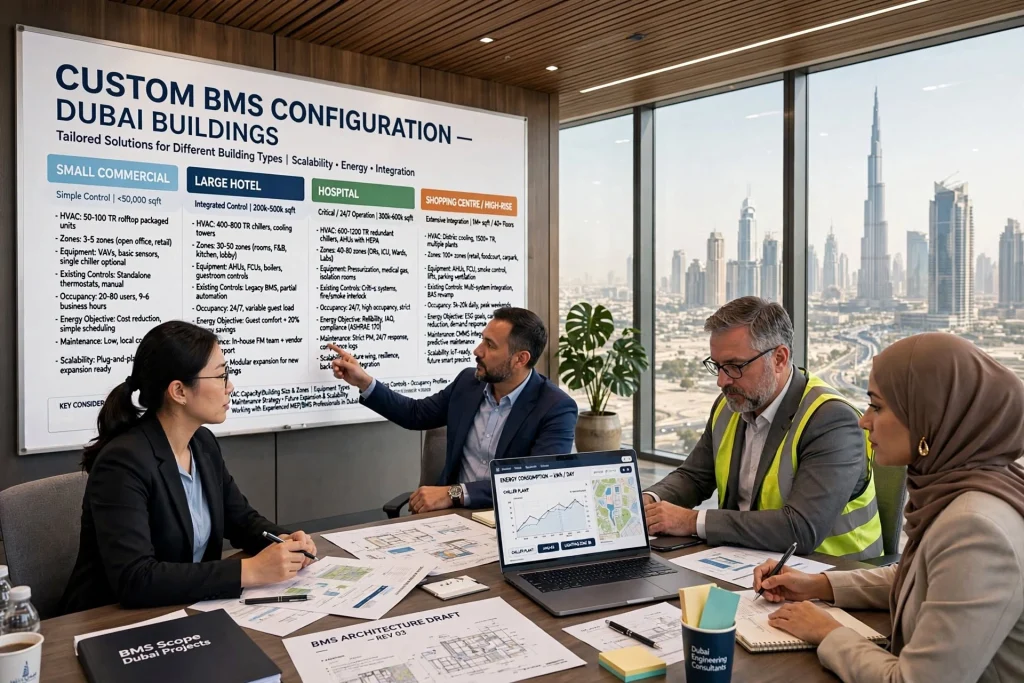
There is no single BMS configuration suitable for every building. A small commercial property may require a relatively simple control system, while a large hotel, hospital, shopping centre, or high-rise tower may require extensive integration.
The right solution should consider HVAC capacity, building size, number of zones, equipment types, existing controls, occupancy patterns, energy objectives, maintenance capabilities, and future expansion.
The system should also be scalable. A property may add new equipment or modify its internal layout in the future, so the BMS architecture should accommodate reasonable changes.
Working with experienced BMS and HVAC professionals can help ensure that the control strategy matches the building’s actual operational needs.
Key Benefits of BMS-Based HVAC Optimization
The most important advantage of BMS technology is that it transforms HVAC management from reactive operation into data-driven control.
By combining sensors, automation, equipment controls, energy monitoring, alarms, scheduling, and analytics, a BMS can help improve several aspects of building performance.
These benefits can include better temperature stability, optimized equipment runtime, improved energy management, early fault detection, better maintenance planning, centralized monitoring, improved ventilation control, and greater visibility into HVAC performance.
The actual results depend on the quality of the installation, programming, commissioning, equipment condition, and ongoing operation.
Frequently Asked Questions About BMS and HVAC
How does a BMS control HVAC systems?
A BMS uses sensors, controllers, software, and communication networks to monitor HVAC conditions and automatically adjust equipment according to programmed control strategies. It can control temperature, airflow, schedules, pumps, fans, valves, chillers, and other connected equipment.
Can BMS reduce HVAC energy consumption?
Yes, a properly designed and commissioned BMS can help reduce unnecessary HVAC energy consumption by optimizing schedules, equipment sequencing, temperature setpoints, airflow, pump and fan speeds, and operation according to demand. Actual savings vary by building and system.
Can a BMS monitor chillers?
Yes. A BMS can monitor and control many aspects of chiller plant operation, including temperatures, equipment status, alarms, operating hours, chilled-water systems, pumps, cooling towers, and other connected components.
Is BMS suitable for existing buildings?
Yes. BMS technology can often be integrated into existing buildings, although the extent of integration depends on existing HVAC equipment, controllers, sensors, communication protocols, and system compatibility. A site survey is normally required before planning an upgrade.
Does BMS improve indoor comfort?
A properly configured BMS can improve temperature consistency and support ventilation and humidity management. It can also identify abnormal conditions that may affect occupant comfort.
Why is BMS important in Dubai?
Dubai’s high cooling demand makes efficient HVAC operation particularly important. BMS technology can help commercial and residential properties monitor cooling systems, optimize schedules, manage zones, identify faults, and improve operational visibility.
Conclusion
Building Management Systems have become an important technology for optimizing HVAC performance in modern buildings. Rather than simply turning air conditioning equipment on and off, a BMS provides centralized monitoring, automated control, data analysis, scheduling, alarm management, and equipment coordination.
For Dubai properties, the benefits can be particularly relevant because HVAC systems often operate under demanding cooling conditions. Chillers, AHUs, FCUs, pumps, cooling towers, VFDs, ventilation systems, and other equipment can work together more efficiently when they are managed through a properly designed control strategy.
The most effective BMS installations combine reliable sensors, accurate controllers, suitable communication protocols, well-developed control sequences, professional commissioning, and ongoing maintenance. When these elements work together, building owners and facility managers gain greater visibility over HVAC performance and can make more informed operational decisions.
Ultimately, How Building Management Systems (BMS) optimize HVAC performance comes down to one principle: using real-time building information to operate equipment according to actual requirements. With the right design and management, BMS technology can support comfort, energy efficiency, equipment reliability, maintenance planning, and smarter building operations across Dubai and the wider UAE.