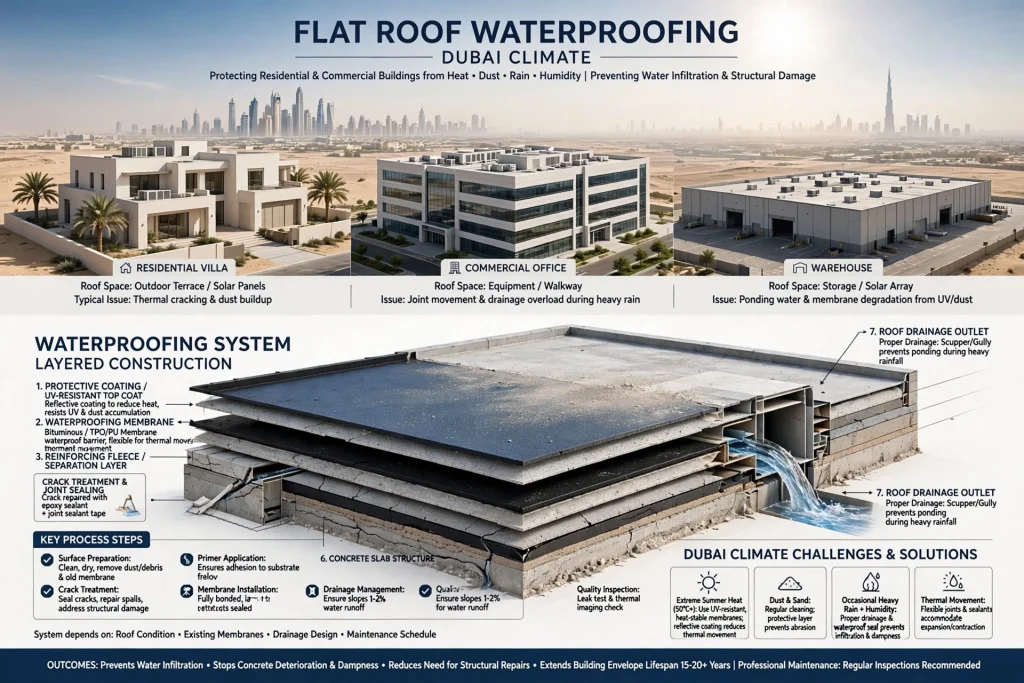
Flat roofs are common across Dubai villas, residential buildings, commercial properties, warehouses, offices, and other structures. Their clean architectural appearance and practical use of roof space make them popular, but flat roof systems require careful waterproofing to prevent water infiltration, concrete deterioration, dampness, and costly structural repairs.
Dubai’s climate creates specific challenges for roof waterproofing. Extreme summer temperatures, intense solar exposure, occasional heavy rainfall, humidity, thermal movement, and dust can gradually affect waterproofing membranes and roof surfaces. A waterproofing system that is suitable for one building may not be the right choice for another, which is why roof condition, construction type, drainage, existing membranes, and future maintenance requirements should all be considered.
Professional flat roof waterproofing involves more than simply applying a waterproof coating. A reliable system typically combines surface preparation, crack treatment, joint sealing, waterproofing membranes or coatings, drainage management, protective layers, and quality inspections. When these components are correctly selected and installed, they can help protect the roof structure and improve the long-term performance of the building envelope.
Why Flat Roof Waterproofing Is Important in Dubai
A flat roof may appear solid and durable, but concrete itself is not completely waterproof. Small cracks, construction joints, penetrations, poorly sealed edges, damaged membranes, and blocked drainage outlets can provide pathways for water to enter the building.
Once moisture reaches the roof slab, it can travel through concrete and appear inside rooms far from the original point of entry. Water stains on ceilings, peeling paint, damp patches, mould growth, unpleasant odours, and damaged insulation can all indicate that moisture has penetrated the building envelope.
For villas and buildings in Dubai, effective waterproofing also helps protect reinforcement steel embedded within reinforced concrete. Persistent moisture can contribute to corrosion when water reaches the reinforcement, potentially causing concrete cracking and spalling over time.
A properly designed waterproofing system therefore serves several purposes. It helps control water penetration, protects the roof structure, reduces maintenance requirements, supports indoor comfort, and helps preserve the property’s long-term value.
How Dubai’s Climate Affects Flat Roofs
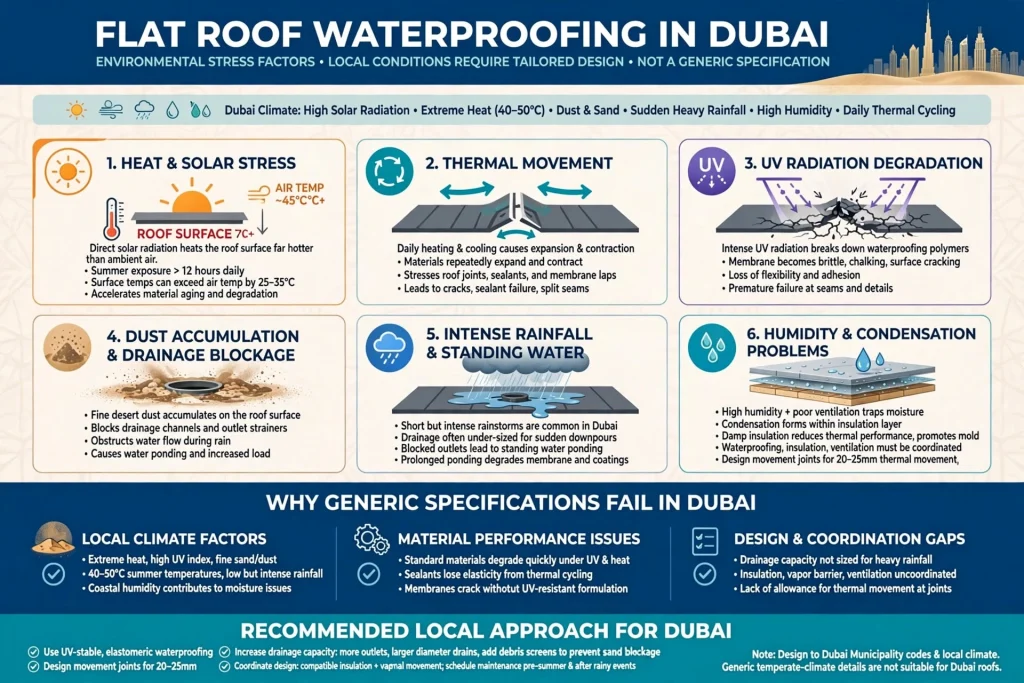
Dubai’s environment places considerable stress on exposed roof surfaces. During summer, roof temperatures can become significantly higher than the surrounding air temperature because of direct solar radiation. Repeated heating and cooling cause materials to expand and contract, creating thermal movement that can gradually affect joints, sealants, coatings, and membranes.
Ultraviolet radiation is another important consideration. Continuous exposure to sunlight can degrade certain waterproofing materials if they are not formulated or protected for outdoor conditions. Dust accumulation can also affect drainage channels and outlets, increasing the risk of standing water after rainfall.
Although Dubai has a predominantly dry climate, rainfall events can be intense. A roof that has been designed only around average dry conditions may still experience problems if drainage capacity is inadequate or outlets are obstructed.
Humidity and condensation can also contribute to moisture-related problems, particularly when roof construction, insulation, ventilation, and waterproofing are not properly coordinated.
For these reasons, flat roof waterproofing in Dubai should be selected with the local environment in mind rather than relying solely on a generic waterproofing specification.
Common Flat Roof Waterproofing Problems
Many roof leaks begin as relatively small defects. A minor crack around a pipe penetration or a deteriorated sealant joint may not initially appear serious, but repeated exposure to water and heat can enlarge the problem.
Common signs of flat roof waterproofing failure include ceiling water stains, damp concrete, peeling interior paint, cracked waterproofing layers, blistering coatings, damaged membrane seams, standing water, deteriorated expansion joints, and water accumulation near roof penetrations.
Drainage problems are another major cause of roof deterioration. A flat roof should have suitable falls or slopes that direct water toward drains. When outlets become blocked by leaves, dust, construction debris, or other material, water may remain on the roof for extended periods.
Ponding water can place additional stress on waterproofing layers. Over time, repeated wetting and drying can accelerate deterioration, especially when an existing waterproofing system is already damaged.
Early inspection is therefore important. Addressing a small defect is generally more straightforward than repairing a roof after moisture has reached insulation, ceilings, electrical components, or structural concrete.
Choosing the Right Waterproofing System
There is no single waterproofing product that is ideal for every flat roof. The appropriate system depends on the roof’s construction, existing surface, expected movement, accessibility, exposure, drainage, and intended use.
Common solutions include bituminous membranes, liquid-applied waterproofing, polyurethane systems, acrylic coatings, cementitious waterproofing, and other specialist membrane technologies.
Bituminous Waterproofing Membranes
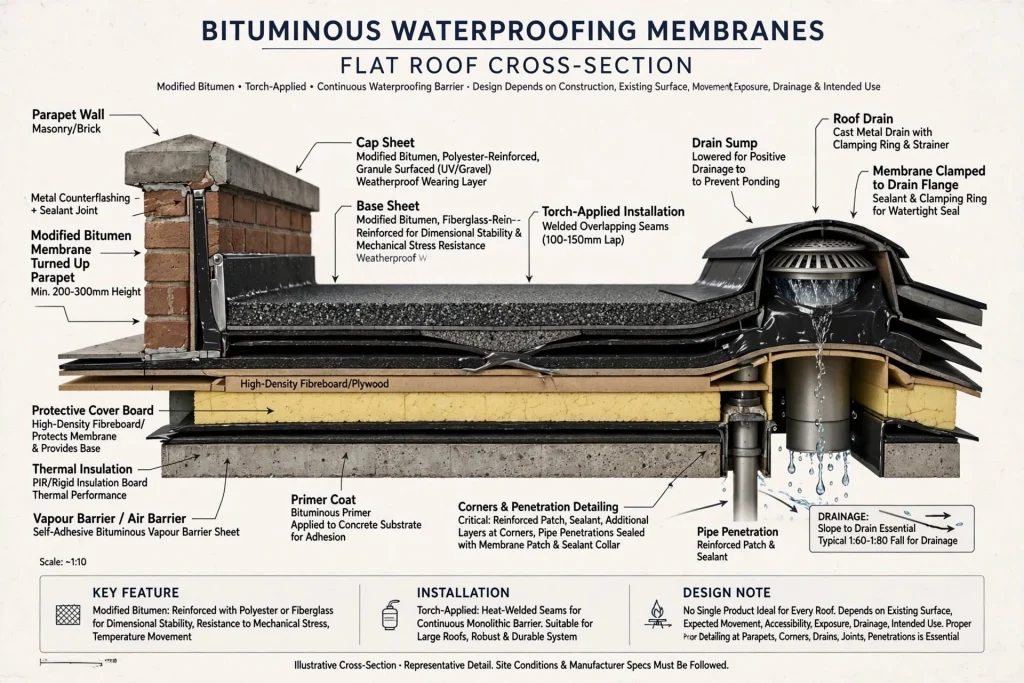
Bituminous membranes are widely used for building waterproofing because they can provide a continuous barrier against water when properly installed. Modified bitumen membranes can be reinforced with materials such as polyester or fiberglass to improve dimensional stability and resistance to mechanical stress.
Torch-applied systems are one traditional installation method, although the exact installation technique should be selected according to the project specification and safety requirements.
Bituminous systems can be particularly useful for larger roofs where a robust membrane system is required. Correct detailing at parapet walls, corners, drains, joints, and penetrations remains essential.
Liquid-Applied Waterproofing
Liquid waterproofing systems are applied directly to the prepared roof surface and cure to form a seamless protective layer. This approach can be useful around complicated roof geometry, penetrations, upstands, and areas where achieving continuous membrane coverage is difficult.
Polyurethane and acrylic-based systems are examples of liquid-applied technologies used in different waterproofing applications. Their suitability depends on the specific product formulation, substrate condition, UV exposure, traffic requirements, and project specification.
A major advantage of a properly applied liquid system is the reduction of conventional membrane joints. However, surface preparation and application thickness are critical to performance.
Cementitious Waterproofing
Cementitious waterproofing materials can be used on suitable concrete and masonry surfaces. They are often selected for specific applications where compatibility with a mineral substrate is important.
However, flat exposed roofs experience thermal movement, so the flexibility and movement capability of any cement-based waterproofing system should be carefully evaluated before use. A product that works well in a protected wet area may not necessarily be suitable for a fully exposed roof.
Roof Surface Preparation Before Waterproofing
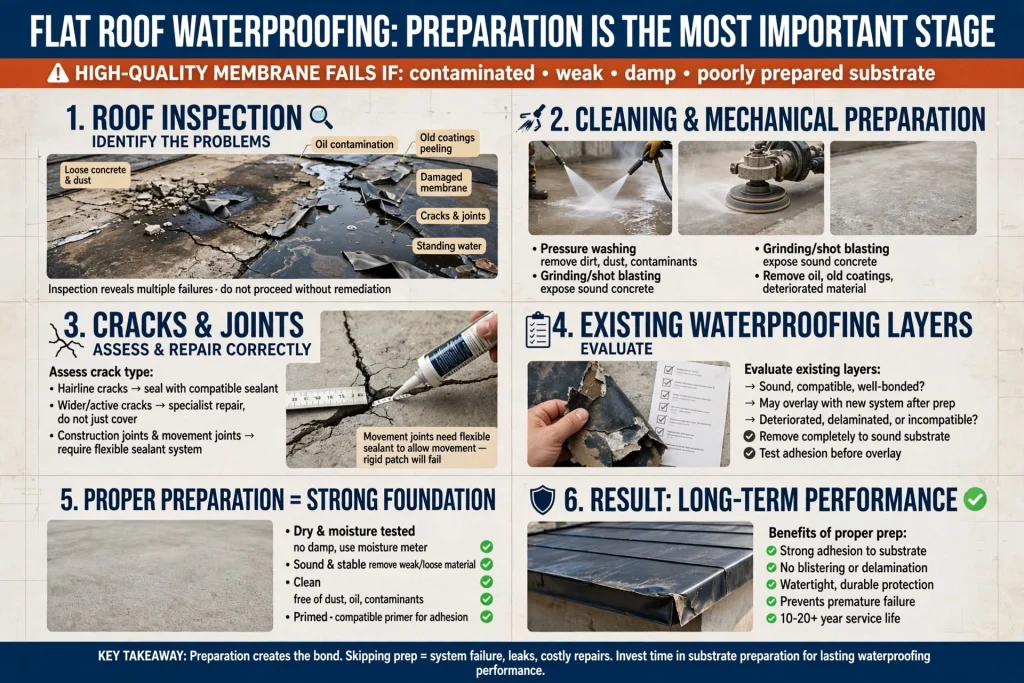
One of the most important stages of flat roof waterproofing is preparation. Even a high-quality waterproofing membrane can fail prematurely if it is installed over a contaminated, weak, damp, or poorly prepared substrate.
The roof should generally be inspected for loose concrete, dust, oil, old coatings, damaged membranes, cracks, joints, and areas of standing water. Depending on the existing surface, cleaning may involve mechanical preparation, pressure washing, grinding, or other suitable methods.
Cracks should be assessed rather than simply covered. Wider or active cracks may require specialist treatment, while construction joints and movement joints need compatible sealants or detailing systems.
Existing waterproofing layers should also be evaluated. In some cases, a compatible new system can be installed over the existing layer after appropriate preparation. In other situations, deteriorated material may need to be removed before a new system is installed.
Proper preparation creates the foundation for adhesion and long-term waterproofing performance.
Treating Cracks, Joints, and Roof Penetrations
Roof waterproofing systems commonly fail at changes in direction and points where different building components meet. These areas require careful detailing.
Typical vulnerable locations include parapet-wall junctions, drainage outlets, expansion joints, construction joints, pipe penetrations, HVAC supports, service ducts, roof access points, and equipment bases.
Crack repair may involve suitable repair mortars, injection systems, sealants, reinforcement fabrics, or other techniques depending on the cause and size of the crack.
Movement joints should not simply be filled with rigid material. They need a detailing approach that accommodates expected movement while maintaining water resistance.
Pipe penetrations also require special attention. Waterproofing should be properly dressed and sealed around the penetration, while mechanical fixtures should avoid creating unnecessary holes in the membrane.
These details are especially important on villas and buildings with rooftop air-conditioning equipment, water tanks, solar equipment, ducts, pipes, and other services.
Drainage and Slope Design for Flat Roofs
A flat roof is not necessarily completely level. Effective roof design normally incorporates falls or slopes that guide water toward drainage points.
Drainage is one of the most important parts of waterproofing because even a highly effective membrane can be placed under unnecessary stress when water remains on the surface for long periods.
Roof drains, outlets, gutters, scuppers, and downpipes should be correctly positioned and maintained. Drain covers should prevent debris from entering the drainage system while allowing water to flow freely.
During waterproofing inspections, contractors should look for low spots where water collects. If ponding is caused by inadequate falls, simply applying another waterproofing coating may not solve the underlying problem.
In some projects, corrective screeding or localized slope formation may be required before the waterproofing layer is installed.
Waterproofing Parapet Walls and Roof Edges
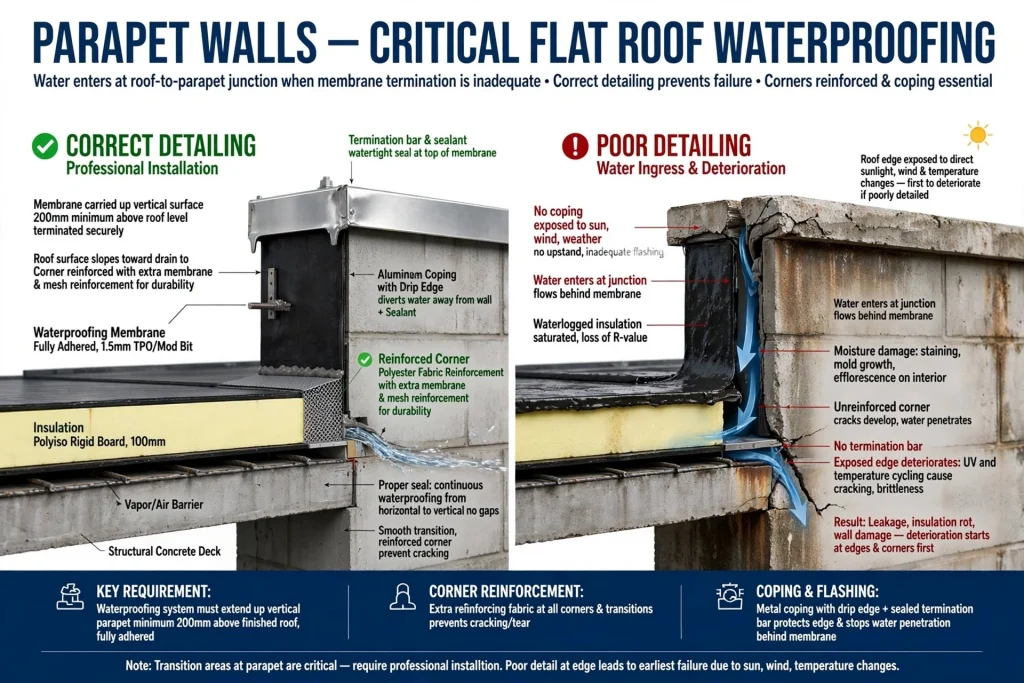
Parapet walls are a critical part of flat roof waterproofing. Water can enter at the junction between the horizontal roof surface and vertical parapet if the membrane termination and flashing details are inadequate.
A waterproofing system should be taken up the appropriate vertical surface and terminated using a suitable detailing method. Corners should be reinforced where required, and coping or edge protection should be designed to limit water penetration behind the waterproofing layer.
The roof edge is also exposed to direct sunlight, wind, and temperature changes. Poorly detailed edges can therefore become one of the first locations where waterproofing deterioration becomes visible.
Professional installation should pay particular attention to these transition areas rather than treating the main roof surface as the only waterproofing zone.
Waterproofing Villas and Residential Buildings in Dubai
Dubai villas often have complex roof layouts with multiple levels, terraces, parapets, skylights, AC units, service rooms, water tanks, and other penetrations. These features increase the number of areas that require detailed waterproofing.
Properties in areas such as Dubai Hills Estate, Arabian Ranches, Jumeirah, Emirates Hills, Palm Jumeirah, Al Barari, and DAMAC Hills can have different architectural designs and construction details, so waterproofing should be assessed on a property-by-property basis.
For villa owners planning renovation, roof maintenance, or refurbishment, combining waterproofing inspections with other building maintenance work can be useful. Drainage, insulation, roof tiles, sealants, concrete condition, and service penetrations can be reviewed at the same time.
If you are specifically looking for villa-focused protection, Roof Waterproofing Solutions for Dubai Villas can help address the particular requirements of exposed villa roofs, terraces, roof slabs, parapets, and associated waterproofing details.
Waterproofing Commercial and High-Rise Buildings
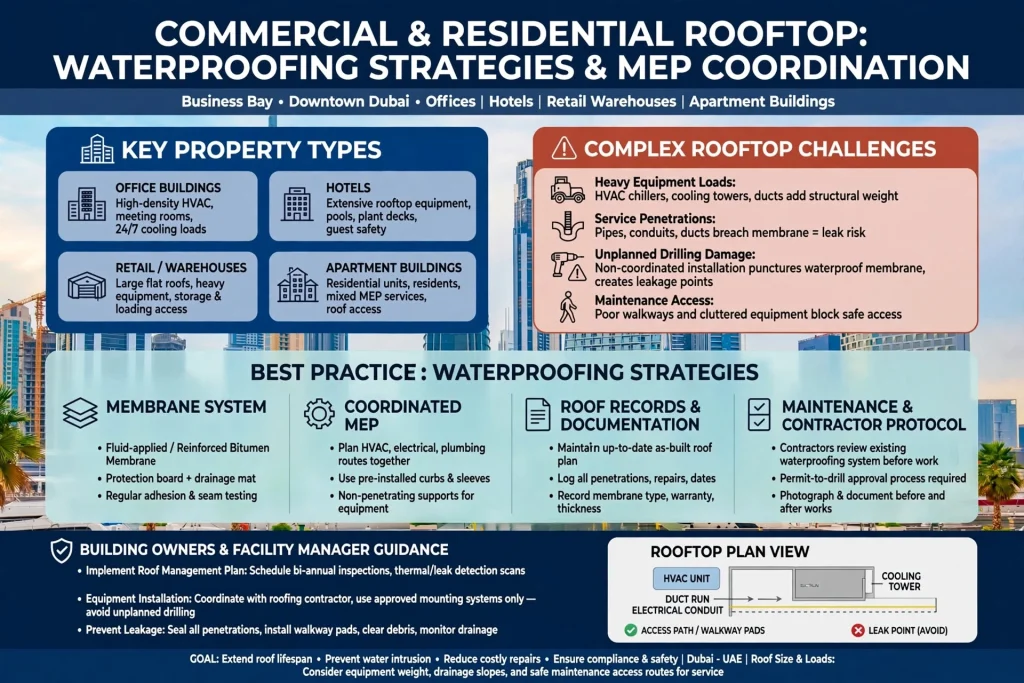
Commercial buildings and larger residential properties can require more complex waterproofing strategies because of their roof size, equipment loads, maintenance access, and mechanical services.
Office buildings in Business Bay and Downtown Dubai, hotels, retail properties, warehouses, and apartment buildings may contain extensive rooftop HVAC systems, cooling equipment, ducts, electrical installations, access structures, and service penetrations.
For these properties, waterproofing should be coordinated with mechanical and electrical systems. Unplanned drilling or equipment installation can damage an existing membrane and create new leakage points.
Building owners and facility managers should therefore maintain accurate roof records and ensure that contractors understand the existing waterproofing system before performing maintenance or modification work.
Protecting Waterproofing From UV and Mechanical Damage
A waterproofing membrane is not always intended to remain exposed to constant foot traffic or mechanical activity. Depending on the system, additional protection may be required.
Protective screeds, tiles, pavers, protective boards, reflective coatings, or other approved finishes can be used where appropriate. The correct solution depends on the waterproofing manufacturer and project design.
Roofs containing frequently serviced HVAC equipment may require designated walkways so technicians do not repeatedly walk directly over vulnerable membrane areas.
Similarly, maintenance activities should avoid dragging equipment, tools, or materials across waterproofed surfaces.
Protecting the waterproofing layer after installation is just as important as selecting the initial system.
Roof Insulation and Waterproofing
Waterproofing and thermal insulation are related but serve different functions. Waterproofing protects against moisture penetration, while insulation helps control heat transfer through the building envelope.
Dubai’s intense heat makes roof insulation particularly relevant to building energy performance and indoor comfort. Depending on the roof design, insulation may be positioned above or below the waterproofing layer.
Materials such as extruded polystyrene and other insulation products may be used in suitable roof assemblies, subject to the project’s thermal, fire, structural, and moisture requirements.
A well-designed roof assembly should consider waterproofing, insulation, drainage, vapour control, structural loading, and surface protection as connected components rather than independent layers.
Waterproofing Inspection and Leak Detection
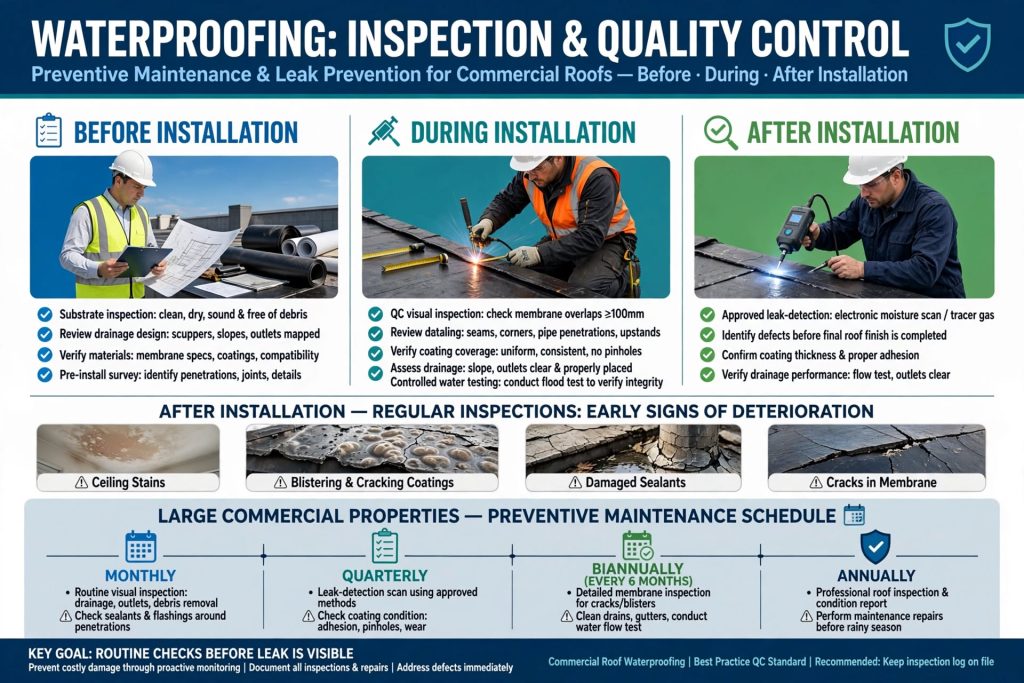
Waterproofing should be inspected before, during, and after installation. Quality control can include visual inspections, checking membrane overlaps, reviewing detailing, verifying coating coverage, and assessing drainage.
Where appropriate, controlled water testing or other approved leak-detection methods may be used to identify defects before the roof finish is completed.
After installation, regular inspections can identify early signs of deterioration. Building owners should pay attention to new ceiling stains, cracks, blistering coatings, damaged sealants, blocked drains, and standing water.
For large commercial properties, preventive maintenance schedules can be particularly valuable. A roof should not only be inspected after a leak becomes visible; routine checks can help identify problems before they become disruptive.
How Professional Roof Waterproofing Adds Long-Term Value
Professional waterproofing is ultimately about reducing risk. Water damage can affect ceilings, paint, insulation, flooring, electrical installations, interior finishes, and structural elements.
A properly planned waterproofing project considers the entire roof system rather than applying material only where water is currently visible.
Experienced waterproofing professionals can assess the substrate, identify probable water-entry points, select compatible materials, address drainage problems, detail vulnerable areas, and establish an appropriate maintenance approach.
This is particularly valuable for property owners who want to avoid repeated temporary repairs. Applying a small amount of sealant to a visible crack may provide short-term relief, but if the underlying waterproofing layer or drainage system is defective, the leak may return.
Maintenance After Flat Roof Waterproofing
Even a professionally waterproofed roof requires maintenance. Dubai’s dusty environment means drains and roof outlets should be checked regularly. Debris should be removed before it blocks drainage pathways.
Property owners should also monitor waterproofing around AC units, water tanks, pipe penetrations, parapets, expansion joints, and other rooftop installations.
Any new contractor working on the roof should be informed about the waterproofing system. Drilling through membranes, installing supports, or making unplanned penetrations can compromise the water barrier.
Routine inspections are especially important before and after periods of heavy rainfall. Early detection can prevent a minor waterproofing defect from becoming a major interior or structural problem.
How to Choose a Flat Roof Waterproofing Contractor in Dubai
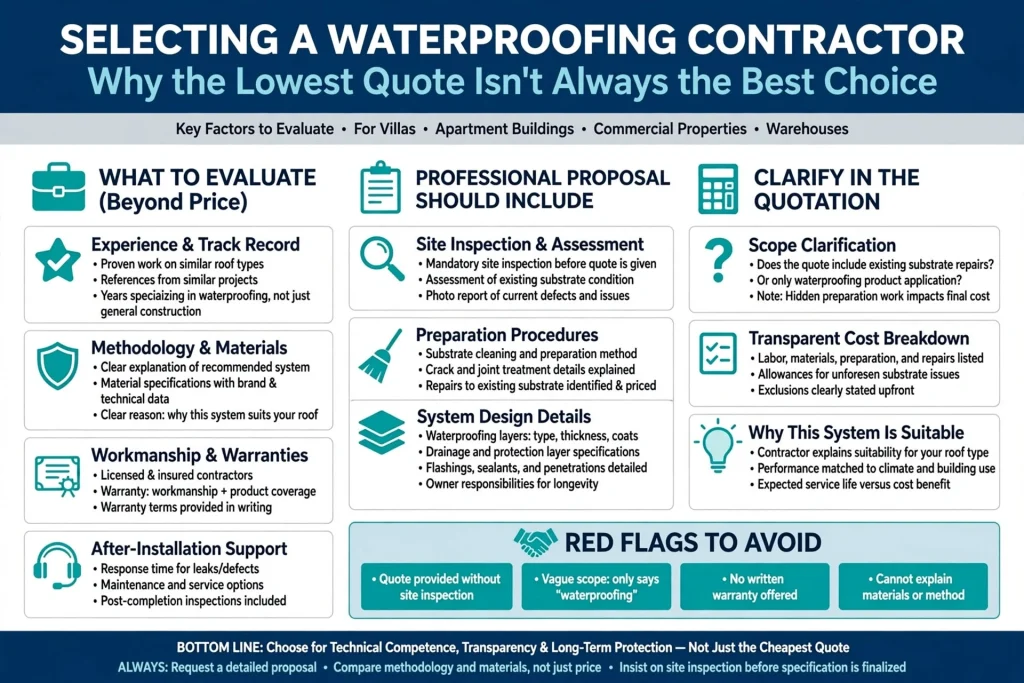
Selecting a waterproofing contractor should involve more than comparing the lowest quotation. Property owners should consider experience with similar roof types, waterproofing methodology, material specifications, preparation procedures, workmanship, warranties, and after-installation support.
Ask the contractor to explain why a particular system is suitable for the roof. A professional proposal should identify the existing substrate, preparation requirements, crack and joint treatment, waterproofing layers, drainage considerations, protection system, and expected maintenance.
It is also useful to clarify whether the quotation covers repairs to the existing substrate or only the application of a waterproofing product. Hidden preparation requirements can significantly affect the actual project cost.
For villas, apartment buildings, commercial properties, and warehouses, a site inspection should ideally take place before the waterproofing specification is finalized.
Cost Factors for Flat Roof Waterproofing in Dubai
The cost of roof waterproofing depends on several factors rather than being determined by roof area alone.
Important considerations include the size and condition of the roof, existing membrane removal, concrete repairs, crack treatment, surface preparation, drainage modifications, waterproofing material, number of layers, parapet detailing, accessibility, protection requirements, and the complexity of rooftop equipment.
A roof with severe deterioration may require considerably more preparation than a relatively new roof requiring preventive waterproofing.
Property owners should therefore compare quotations based on the complete scope of work rather than simply comparing the price per square metre.
A detailed specification can make it easier to understand what is included and reduce the risk of incomplete waterproofing work.
Frequently Asked Questions About Flat Roof Waterproofing
What is the best waterproofing for a flat roof in Dubai?
There is no universal best system. Bituminous membranes, polyurethane systems, liquid-applied membranes, and other technologies can be suitable depending on the roof construction, exposure, movement, drainage, and intended use. A site assessment should determine which system is compatible with the existing substrate and project requirements.
How long does flat roof waterproofing last?
Service life varies according to the waterproofing technology, installation quality, exposure, maintenance, substrate movement, and protection. A properly specified and maintained system can provide long-term protection, but regular inspections are still necessary.
Why does a waterproofed roof still leak?
Leaks can occur because of damaged membranes, failed joints, blocked drains, roof penetrations, cracks, poor installation, inadequate detailing, or water entering through another location and travelling beneath the waterproofing layer.
Can waterproofing be applied over an existing membrane?
Sometimes. The existing membrane must first be assessed for adhesion, condition, compatibility, moisture, and deterioration. If it is severely damaged or unsuitable, removal may be necessary before installing a new waterproofing system.
Does flat roof waterproofing help prevent concrete damage?
Yes. A properly functioning waterproofing system helps limit water penetration into the roof structure. This can reduce moisture-related deterioration and help protect reinforced concrete, although structural defects should always be assessed separately.
Final Thoughts
Flat roof waterproofing is an important part of protecting villas, residential buildings, offices, commercial properties, and other structures in Dubai. The combination of high temperatures, strong UV exposure, thermal movement, dust, rooftop equipment, and occasional intense rainfall means that waterproofing needs to be carefully selected and professionally detailed.
A successful solution begins with inspection and preparation. Cracks, joints, penetrations, parapets, drainage outlets, and low points should be addressed before the main waterproofing system is installed. The selected membrane or coating should be compatible with the substrate and appropriate for the roof’s exposure and intended use.
Long-term performance also depends on maintenance. Keeping drainage systems clear, inspecting vulnerable details, protecting membranes from unnecessary mechanical damage, and responding quickly to early signs of leakage can significantly improve roof service life.
For Dubai villas and buildings, professional flat roof waterproofing should therefore be viewed as a complete roof protection strategy rather than simply a coating applied to the surface. When waterproofing, drainage, insulation, structural condition, detailing, and maintenance are considered together, property owners can achieve a more durable and reliable building envelope.