Cooling capacity loss is one of the most common problems affecting air conditioning systems, chillers, and large HVAC installations. When an air conditioning system no longer delivers the cooling performance it was designed to provide, indoor temperatures can rise, energy consumption can increase, equipment can run for longer periods, and operating costs can become difficult to control.
In Dubai and other parts of the UAE, maintaining the expected cooling capacity of HVAC equipment is particularly important because systems operate under demanding outdoor conditions for much of the year. High ambient temperatures, humidity, airborne dust, sand particles, building occupancy, and continuous cooling demand can all influence system performance.
Understanding the causes of cooling capacity loss helps property owners, facility managers, building operators, and maintenance teams identify problems before they develop into major equipment failures. Whether the system uses a split air conditioner, packaged unit, AHU, FCU, VRF system, air cooled chiller, or water cooled chiller, the underlying causes often involve airflow, refrigerant, heat transfer, mechanical components, electrical controls, or inadequate maintenance.
What Is Cooling Capacity Loss?
Cooling capacity loss occurs when an HVAC or refrigeration system produces less cooling than its rated or expected capacity. A system may still operate and produce cold air, but it cannot remove heat from the building as efficiently as it previously did.
For example, an air conditioning unit designed to maintain a comfortable indoor temperature may continuously operate without reaching the thermostat setting. Similarly, a chiller plant may operate for extended periods while chilled water temperature, supply air temperature, or building cooling conditions remain below the required performance level.
Cooling capacity is influenced by several interconnected factors, including refrigerant pressure, evaporator performance, condenser heat rejection, airflow, water flow, compressor efficiency, heat exchanger cleanliness, ambient temperature, and control settings.
A reduction in any of these areas can reduce the overall efficiency of the cooling cycle. This is why diagnosing cooling loss requires more than simply checking whether an air conditioner is producing cold air.
Why HVAC Systems Lose Cooling Capacity
HVAC equipment works through a combination of thermodynamic, mechanical, electrical, and control processes. The refrigeration cycle typically involves the compressor, condenser, expansion device, and evaporator. In larger systems, chilled water pumps, cooling towers, heat exchangers, AHUs, FCUs, valves, sensors, and building management systems are also involved.
If one component becomes dirty, restricted, incorrectly adjusted, worn, or damaged, the impact can extend throughout the entire system.
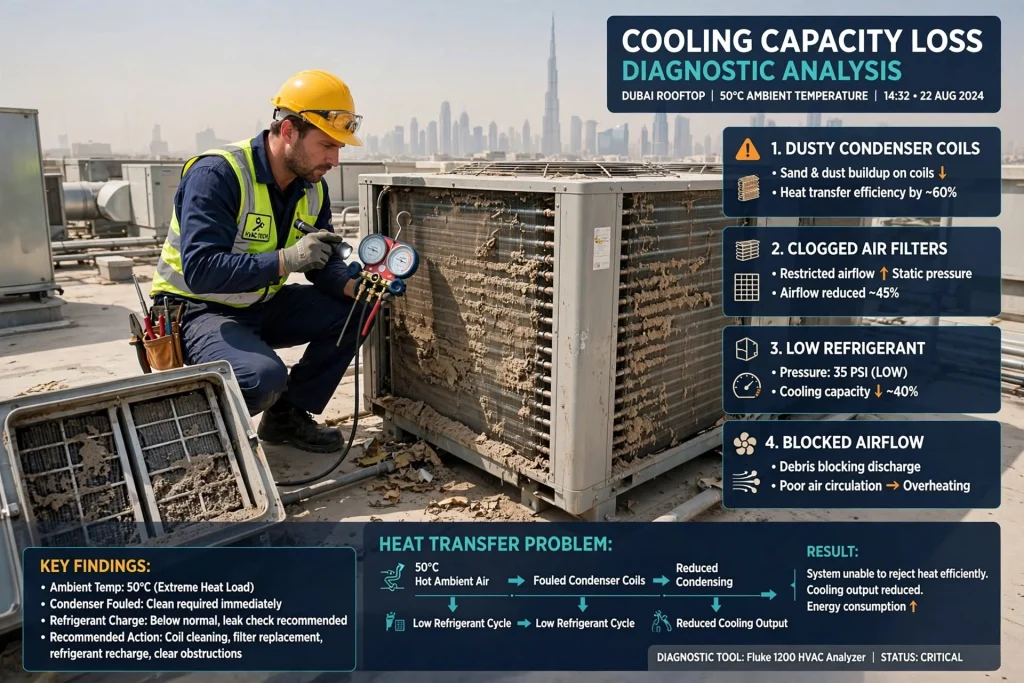
Common causes of cooling capacity loss include dirty air filters, blocked coils, insufficient airflow, refrigerant leakage, incorrect refrigerant charge, high condenser temperature, fouled heat exchangers, poor chilled water circulation, compressor problems, faulty expansion valves, duct leakage, thermostat problems, and inadequate preventive maintenance.
In commercial buildings, the problem can also result from changes in occupancy, increased internal heat loads, building extensions, poor insulation, or HVAC equipment that has become undersized for the current cooling demand.
Dirty Air Filters and Restricted Airflow
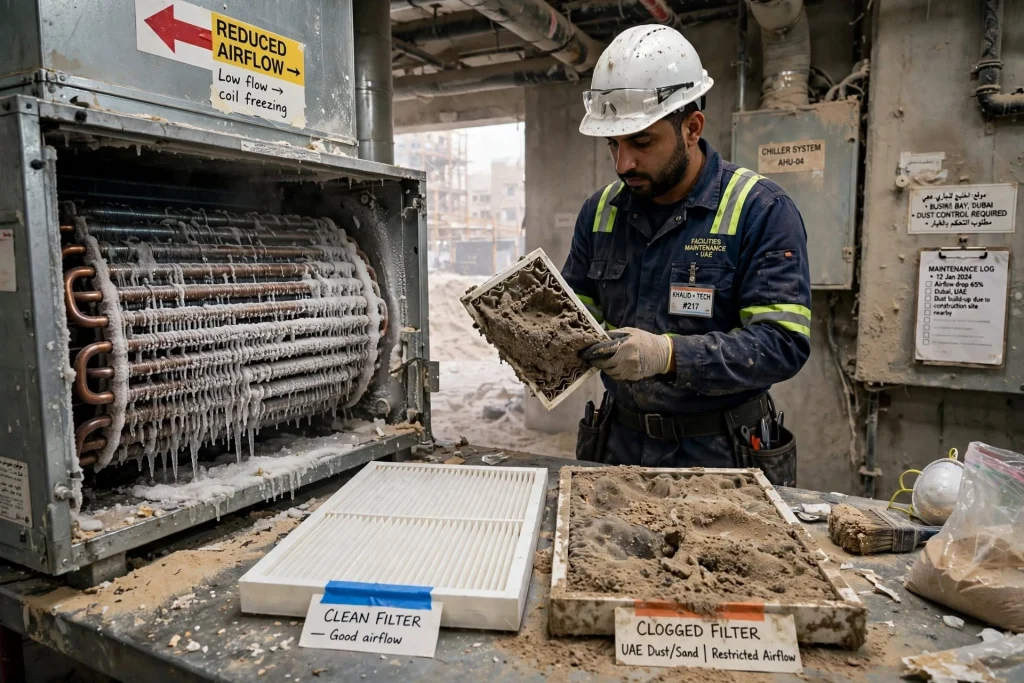
One of the simplest causes of reduced cooling performance is restricted airflow. Air conditioning systems depend on adequate air movement across the evaporator or cooling coil. When filters become heavily loaded with dust, the volume of air passing through the system decreases.
The UAE’s dusty environment can accelerate filter contamination, especially in areas exposed to construction activity, road dust, sand, or outdoor pollutants.
Restricted airflow can cause several problems. The cooling coil may become excessively cold, potentially leading to ice formation. The compressor may operate for longer periods, while the conditioned space receives less effective cooling.
Regular filter inspection and replacement should therefore be part of an HVAC preventive maintenance program. Commercial properties with high occupancy or continuous operation may require more frequent inspection than lightly used residential systems.
Dirty Evaporator and Condenser Coils
Heat transfer is essential to the refrigeration cycle. When evaporator or condenser coils become covered with dust, dirt, grease, or other contaminants, the system cannot exchange heat as effectively.
The evaporator absorbs heat from indoor air or chilled water, depending on the system configuration. If its surface is contaminated, cooling efficiency can decline.
The condenser has an equally important role because it rejects heat from the refrigerant. A dirty condenser coil restricts heat rejection and can cause condensing pressure and compressor operating temperature to increase.
In Dubai, outdoor condenser coils can accumulate dust relatively quickly. Regular coil cleaning, inspection, and proper fin maintenance can help preserve heat-transfer performance.
Refrigerant Leakage and Incorrect Refrigerant Charge
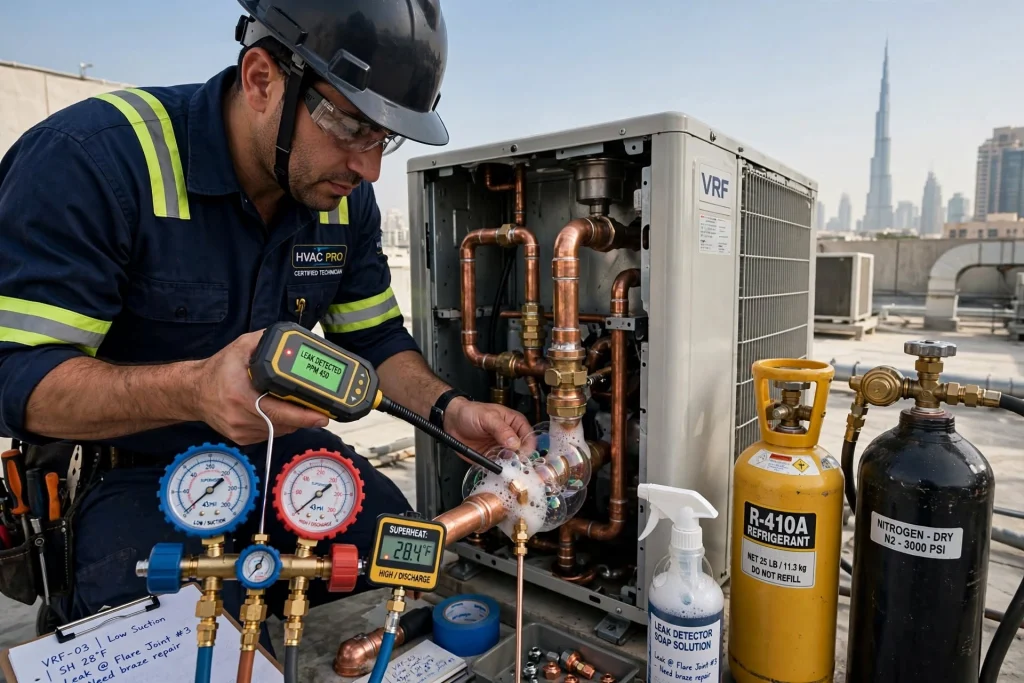
Refrigerant is essential for transferring heat through the refrigeration cycle. A leak can gradually reduce the amount of refrigerant circulating through the system.
Low refrigerant levels can cause reduced cooling, abnormal suction and discharge pressures, increased compressor operating time, and poor temperature control.
However, simply adding refrigerant is not always the correct solution. If a leak exists, the underlying problem needs to be identified and repaired. Refrigerant should also be charged according to the equipment manufacturer’s specifications and the appropriate operating conditions.
Common leakage points include pipe connections, flare joints, valves, coils, brazed joints, and damaged refrigerant lines.
Professional technicians may use pressure testing, electronic leak detection, temperature measurements, and other diagnostic methods to identify refrigerant problems.
High Outdoor Temperature and Condenser Performance
Outdoor temperature has a significant influence on air conditioning performance. When ambient temperatures rise, the condenser has to reject heat against a higher outdoor temperature.
This becomes especially important in Dubai, Abu Dhabi, Sharjah, and other UAE locations during the hottest months. If the condenser is dirty, airflow is restricted, fans are malfunctioning, or the equipment is operating close to its design limits, cooling capacity can decline further.
High condensing temperature can increase compressor workload and electrical consumption while reducing refrigeration efficiency.
Adequate condenser airflow, clean coils, properly functioning fans, and correct refrigerant conditions are therefore important for maintaining performance during extreme weather.
Problems with the Compressor
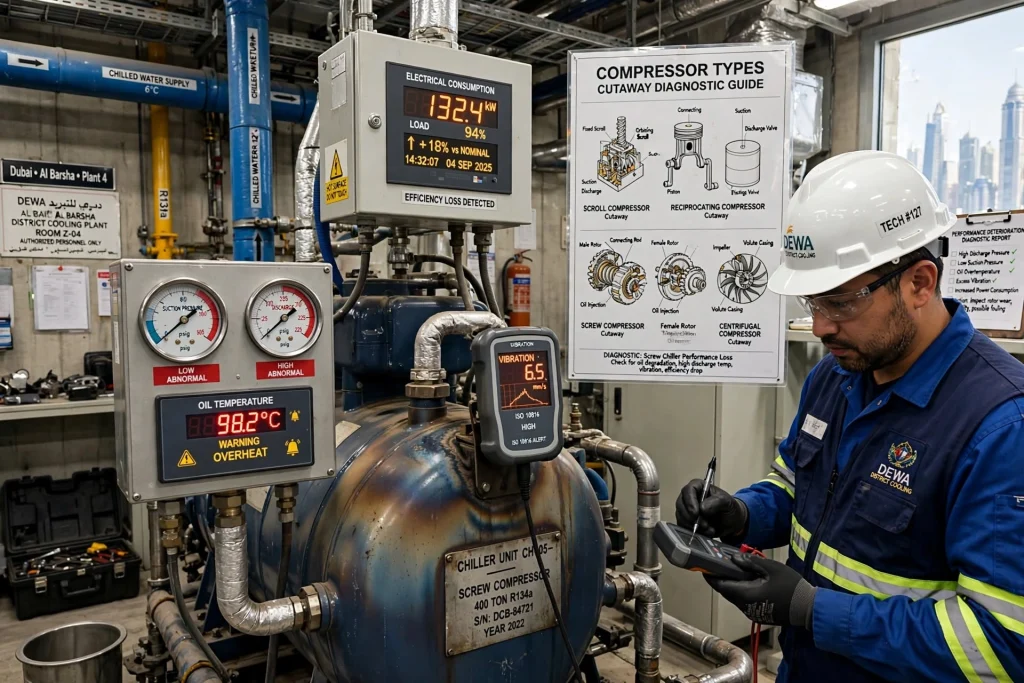
The compressor is one of the most important components in a refrigeration system. It circulates refrigerant between the evaporator and condenser while creating the pressure difference required for the refrigeration cycle.
Compressor wear, overheating, electrical faults, lubrication problems, valve damage, or incorrect operating conditions can reduce system capacity.
In larger HVAC installations, compressors may be scroll, reciprocating, screw, or centrifugal types. Each technology has different operating characteristics and maintenance requirements.
For example, a screw chiller experiencing compressor performance deterioration may show changes in suction pressure, discharge pressure, oil temperature, vibration, or electrical consumption.
A compressor should not automatically be replaced whenever cooling capacity declines. Proper diagnosis can determine whether the issue originates from the compressor itself or another part of the refrigeration system.
Expansion Valve and Refrigerant Flow Problems
The expansion device controls refrigerant flow into the evaporator while reducing refrigerant pressure. Depending on the system, this component may be a thermostatic expansion valve, electronic expansion valve, capillary device, or another metering arrangement.
If the expansion valve is restricted, incorrectly adjusted, contaminated, or malfunctioning, the evaporator may receive an incorrect amount of refrigerant.
This can lead to poor cooling performance, unstable suction pressure, coil freezing, overheating, or inefficient compressor operation.
Electronic expansion valves in modern VRF and variable-capacity systems may also interact with sensors and control boards. A sensor fault or communication problem can therefore create symptoms that appear to be mechanical refrigeration issues.
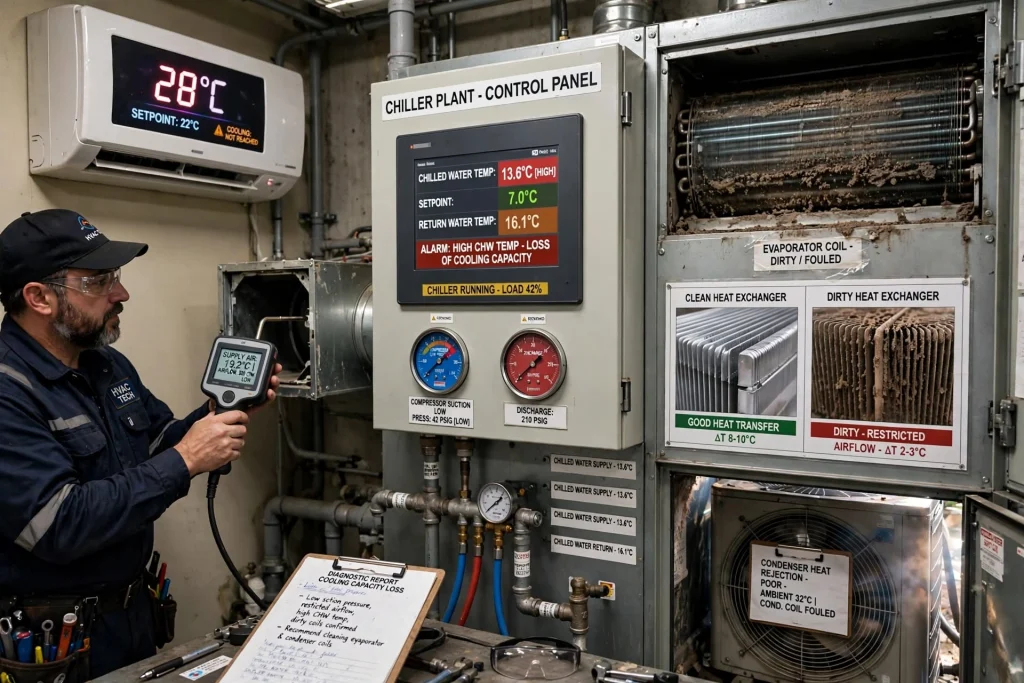
Chilled Water Flow Restrictions
In water cooled and chilled-water HVAC systems, cooling capacity depends not only on refrigerant performance but also on proper water circulation.
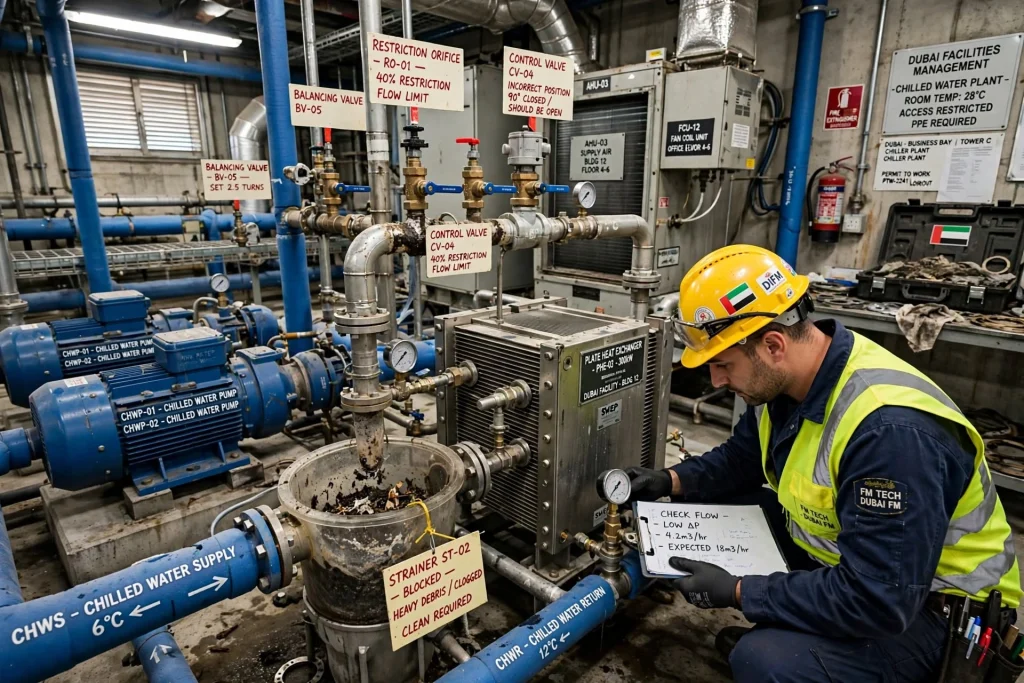
Chilled water pumps move cooled water between the chiller and air-side equipment such as AHUs and FCUs. If a pump is underperforming, a valve is incorrectly positioned, a strainer is blocked, or piping contains excessive restrictions, chilled water flow can decrease.
Low flow through an evaporator or AHU coil can reduce heat transfer and result in insufficient cooling.
Facility managers should therefore consider the entire chilled water circuit when investigating capacity problems. Important components can include pumps, control valves, strainers, balancing devices, plate heat exchangers, chilled water pipes, AHUs, and FCUs.
Cooling Tower Problems in Water Cooled Chillers
Water cooled chillers depend on cooling towers to reject heat from the condenser water circuit. Cooling tower performance therefore has a direct relationship with chiller efficiency.
Poor tower performance can result from dirty fill material, blocked nozzles, inadequate airflow, fan problems, incorrect water levels, scaling, poor water treatment, or high outdoor temperatures.
When condenser water temperature becomes too high, the chiller compressor may work harder to reject heat. This can reduce efficiency and contribute to capacity loss.
Regular cooling tower inspection, water treatment, cleaning, fan maintenance, and condenser-water monitoring are essential parts of maintaining a water cooled chiller plant.
Fouled Heat Exchangers and Scaling
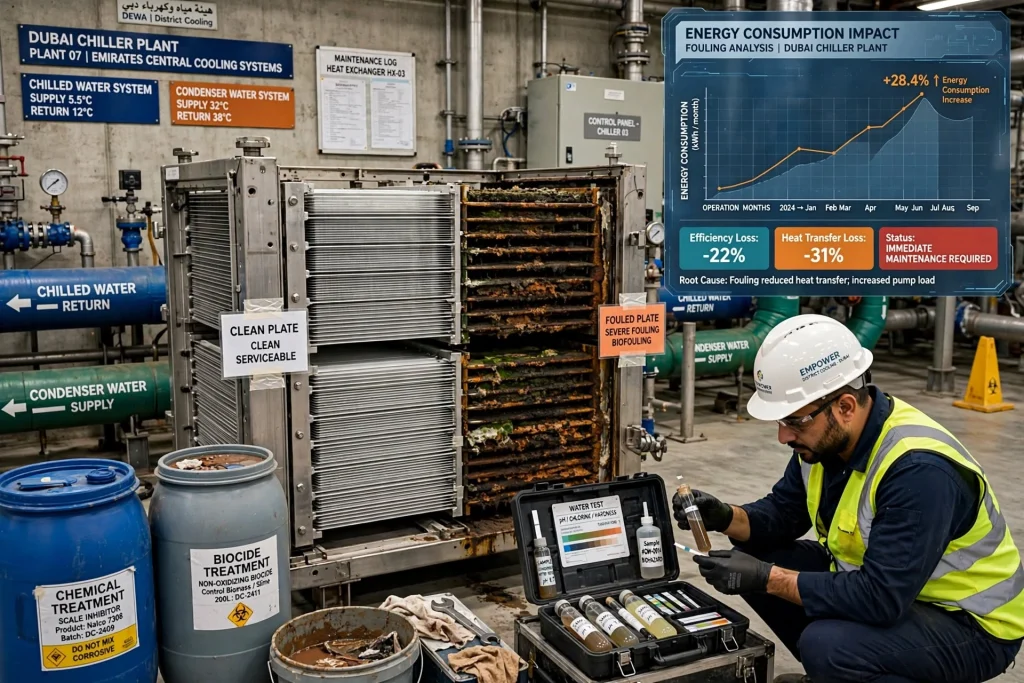
Heat exchangers are designed to transfer thermal energy between fluids efficiently. Over time, scale, corrosion products, biological growth, dirt, and other deposits can accumulate on heat-transfer surfaces.
This is particularly relevant to chilled water and condenser water systems.
A fouled heat exchanger creates additional thermal resistance, meaning more energy is required to transfer the same amount of heat. The result can be reduced cooling capacity and higher energy consumption.
Water quality management, filtration, chemical treatment where appropriate, inspection, and periodic cleaning can help prevent excessive fouling.
Ductwork Problems and Poor Air Distribution
Cooling capacity loss is not always caused by the refrigeration equipment itself. A building may experience poor cooling because conditioned air is not reaching occupied spaces effectively.
Leaking, damaged, poorly insulated, or incorrectly sized ductwork can reduce air delivery. In large buildings, poorly balanced air distribution can cause some rooms to remain warm while others receive excessive cooling.
AHU fans, dampers, VAV boxes, grilles, diffusers, flexible connections, and return-air pathways should be evaluated when investigating uneven cooling.
Duct insulation is also important in hot climates. If chilled air travels through poorly insulated ductwork in a hot ceiling void, heat gain can reduce the effective cooling delivered to the occupied area.
Inadequate HVAC Maintenance
Preventive maintenance is one of the most effective ways to reduce cooling capacity loss. HVAC equipment gradually accumulates wear and contamination even when it appears to be functioning normally.
A maintenance program should consider filters, coils, fans, belts, motors, electrical connections, refrigerant conditions, condensate drainage, thermostats, sensors, compressors, pumps, valves, insulation, and control systems.
For larger facilities, maintenance should also cover chillers, cooling towers, chilled water pumps, condenser water pumps, AHUs, FCUs, VFDs, BMS controls, water treatment, and heat exchangers.
Regular inspections allow technicians to identify developing problems before they become major failures.
Electrical and Control System Issues
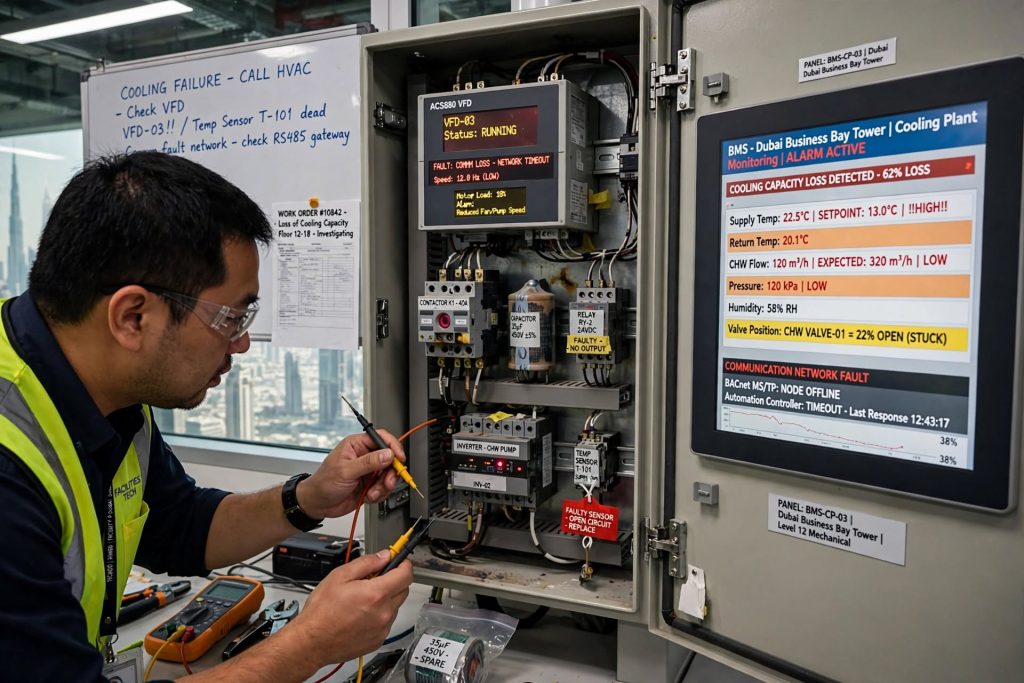
Modern HVAC systems depend heavily on electrical controls and automation. A cooling problem may therefore originate from a faulty sensor, contactor, capacitor, relay, inverter, variable frequency drive, controller, or communication network.
Incorrect temperature sensors can cause a system to cycle at the wrong time. A malfunctioning VFD can reduce fan or pump speed. A BMS programming problem can alter operating schedules or setpoints.
In commercial buildings, building automation systems can monitor supply temperature, return temperature, pressure, flow, humidity, valve positions, and equipment status.
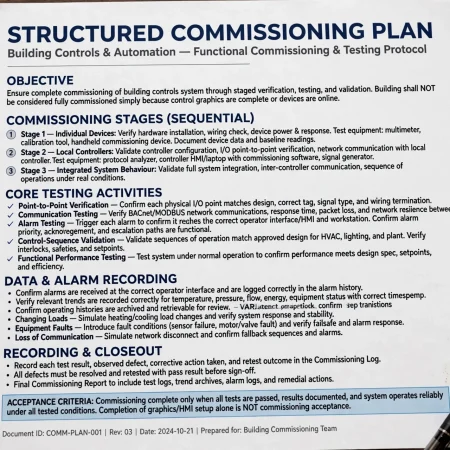
Proper commissioning and calibration of these controls can help ensure that HVAC equipment operates according to the building’s actual cooling requirements.
Building Heat Load Can Also Cause Cooling Problems
Sometimes the HVAC equipment is operating correctly, but the building’s cooling demand has increased.
Additional computers, lighting, appliances, occupants, equipment, glass surfaces, solar exposure, or changes in room usage can increase internal and external heat loads.
For example, a commercial office in Business Bay may have substantially different cooling requirements after a change in occupancy or equipment density. Similarly, a villa in Dubai Hills Estate or Palm Jumeirah may experience different heat loads following renovations, additional glazing, or changes to internal spaces.
If cooling demand has increased significantly, maintenance alone may not restore comfort. A professional load assessment can determine whether the installed HVAC capacity remains appropriate.
How to Diagnose Cooling Capacity Loss
Effective diagnosis should begin with symptoms rather than immediately replacing components.
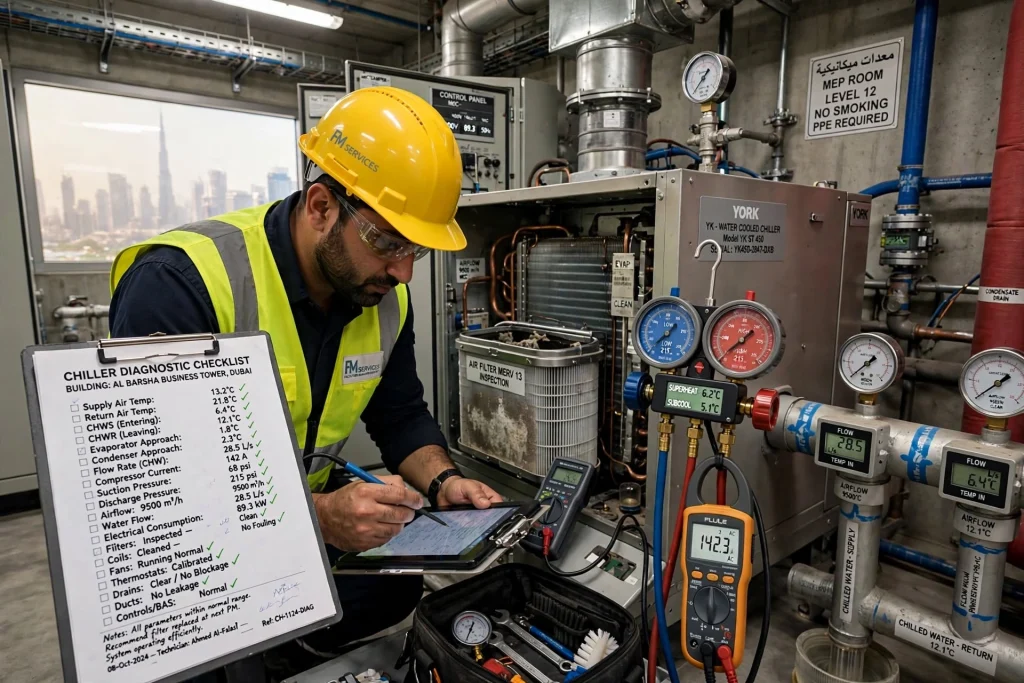
Technicians can evaluate supply-air and return-air temperatures, chilled water temperatures, refrigerant pressures, compressor operation, airflow, water flow, electrical consumption, condenser performance, and equipment operating conditions.
For chillers, important parameters may include chilled water entering and leaving temperatures, condenser water temperatures, evaporator approach, condenser approach, flow rate, compressor current, pressure readings, and operating efficiency.
For air conditioning systems, technicians may inspect filters, coils, fans, refrigerant conditions, thermostats, drain systems, ducts, and electrical controls.
A complete diagnosis helps distinguish between refrigeration problems, airflow problems, water-side problems, control issues, and increased building load.
Practical Solutions for Restoring Cooling Capacity
The appropriate solution depends on the underlying cause. Basic maintenance may restore performance when filters or coils are dirty, while more complex problems may require component repair or replacement.
Solutions can include filter replacement, evaporator and condenser coil cleaning, refrigerant leak repair, correct refrigerant charging, condenser fan repair, compressor diagnostics, expansion valve servicing, chilled water pump maintenance, cooling tower cleaning, heat exchanger descaling, duct sealing, insulation repair, sensor calibration, VFD troubleshooting, and BMS optimization.
For older HVAC equipment, an efficiency assessment may also determine whether upgrading a component or replacing the system provides a better long-term solution.
Professional Cooling Capacity Loss Services can help identify the source of reduced performance and develop a repair or maintenance strategy based on actual operating conditions.
Cooling Capacity Loss in Dubai Buildings
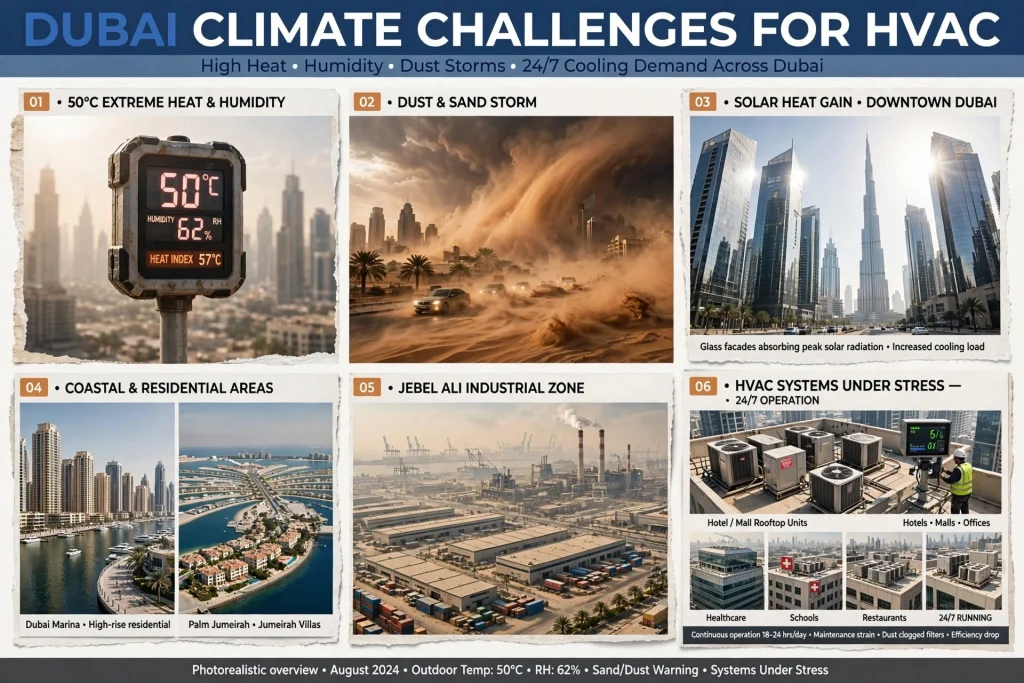
Dubai’s climate creates specific challenges for HVAC equipment. Buildings must deal with high outdoor temperatures, humidity, dust, solar heat gain, and long operating hours.
These conditions affect residential villas, apartments, hotels, shopping centres, offices, warehouses, restaurants, healthcare facilities, schools, factories, and industrial buildings.
Areas such as Downtown Dubai, Dubai Marina, Jumeirah, Business Bay, Al Barsha, Jumeirah Lake Towers, Dubai Hills Estate, Arabian Ranches, Palm Jumeirah, Emirates Hills, Al Quoz, Ras Al Khor, and Jebel Ali contain different building types with different HVAC requirements.
A reliable maintenance strategy should therefore consider building use, equipment age, operating hours, indoor occupancy, environmental exposure, and cooling demand.
Cooling Performance in Abu Dhabi and Sharjah
Cooling capacity management is equally important across Abu Dhabi and Sharjah. Large villas, commercial buildings, hotels, industrial facilities, retail spaces, and offices depend on reliable air conditioning throughout the year.
In Abu Dhabi areas such as Al Reem Island, Al Raha Beach, Khalifa City, Saadiyat Island, and Mussafah, HVAC systems can vary considerably in size and application.
Sharjah’s residential, commercial, and industrial properties also use a wide range of split systems, packaged units, VRF systems, and centralized chilled-water systems.
Local environmental conditions and building characteristics should be considered when creating HVAC maintenance schedules.
How Preventive Maintenance Protects Cooling Capacity
Preventive maintenance should focus on maintaining heat transfer, airflow, refrigerant circulation, water flow, mechanical reliability, and control accuracy.
A good maintenance program does not simply respond after a room becomes warm. Instead, it monitors equipment performance and identifies gradual changes.
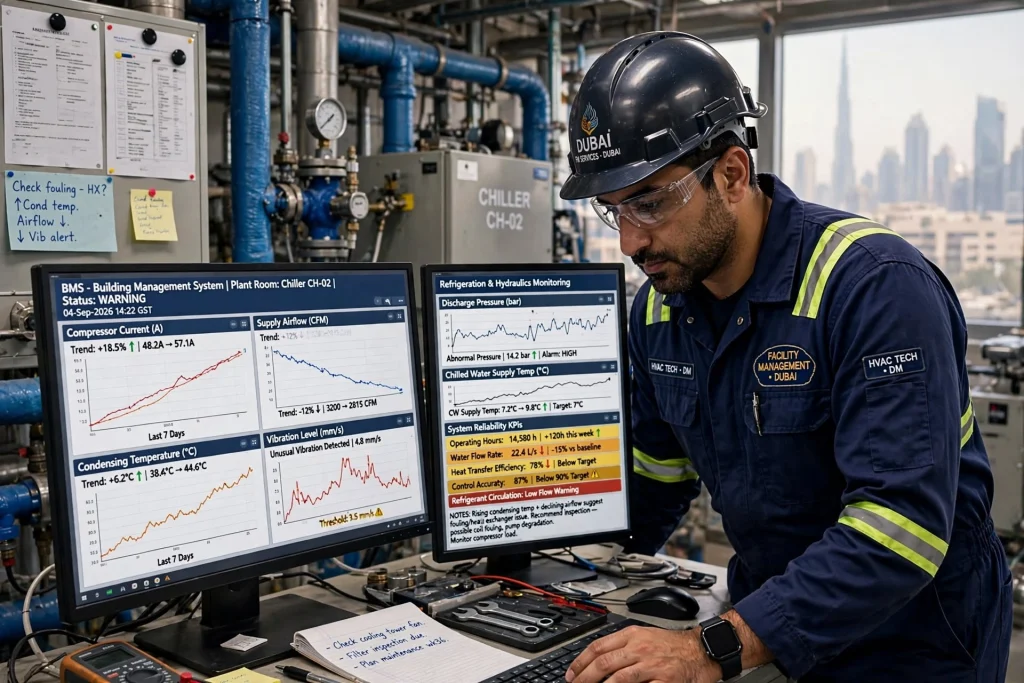
Increasing compressor current, rising condensing temperature, declining airflow, unusual vibration, abnormal pressure readings, increased operating hours, or changes in chilled water temperature can provide early indications of deterioration.
Trend monitoring can be particularly valuable for large facilities. BMS data can help facility teams identify changes in performance before occupants experience noticeable comfort problems.
When Should You Call an HVAC Professional?
Professional assistance is recommended when cooling performance continues to decline despite basic maintenance, when refrigerant problems are suspected, when compressors repeatedly trip, when chillers operate outside normal conditions, or when the building cannot maintain the required indoor temperature.
Immediate attention is also important when unusual noises, burning smells, water leaks, electrical faults, repeated alarms, or excessive vibration are present.
Attempting to adjust refrigerant, electrical components, compressor controls, or high-pressure refrigeration equipment without appropriate technical knowledge can create safety and equipment risks.
A qualified HVAC technician can use proper diagnostic instruments and manufacturer information to identify the actual cause.
Frequently Asked Questions About Cooling Capacity Loss
What are the most common causes of cooling capacity loss?
The most common causes include dirty filters, blocked coils, restricted airflow, refrigerant leakage, incorrect refrigerant charge, high condenser temperature, compressor problems, expansion valve faults, poor chilled water flow, dirty heat exchangers, duct leakage, electrical faults, and inadequate maintenance.
Can dirty filters reduce cooling capacity?
Yes. Dirty filters restrict airflow across the cooling coil. Reduced airflow can lower heat transfer, increase system operating time, cause coil freezing in some circumstances, and reduce indoor comfort.
Does low refrigerant always mean there is a leak?
Low refrigerant can indicate a leak, although diagnosis is necessary. Refrigerant does not normally disappear through routine operation. If the charge is repeatedly low, the system should be inspected for leakage and the underlying cause corrected.
Why does an air conditioner lose cooling during very hot weather?
High outdoor temperatures increase the condenser’s heat-rejection challenge. If the system is dirty, poorly maintained, undersized, or already operating near its limits, extreme ambient temperatures can make the loss of cooling more noticeable.
Can a water cooled chiller lose capacity because of the cooling tower?
Yes. Poor cooling tower performance can increase condenser water temperature, making it more difficult for the chiller to reject heat. This can reduce efficiency and potentially reduce available cooling capacity.
How can cooling capacity be restored?
The solution depends on the cause. Cleaning coils, replacing filters, repairing refrigerant leaks, correcting refrigerant charge, improving airflow, servicing pumps, cleaning cooling towers, repairing controls, maintaining compressors, and correcting water-flow restrictions are common solutions.
Conclusion
Cooling capacity loss should not be treated simply as an inconvenience. Reduced cooling performance can indicate problems with airflow, refrigeration, heat transfer, water circulation, electrical controls, mechanical components, or building cooling demand.
In the UAE, where air conditioning is essential for residential, commercial, hospitality, retail, and industrial buildings, maintaining HVAC performance is particularly important. Regular preventive maintenance, performance monitoring, proper cleaning, refrigerant management, water treatment, coil inspection, and control-system checks can help protect cooling capacity and reduce unexpected breakdowns.
Whether a property uses a split AC system, VRF installation, packaged unit, AHU and FCU network, air cooled chiller, or water cooled chiller plant, early diagnosis can prevent a relatively small performance issue from becoming an expensive repair.
A structured HVAC maintenance strategy also improves energy efficiency, equipment reliability, indoor comfort, and operational continuity. When cooling performance begins to decline, identifying the root cause rather than repeatedly treating the symptoms is the most effective long-term approach.