Building Management Systems (BMS) have become an important part of modern commercial and residential building operations across the United Arab Emirates. As buildings become larger, more connected, and more dependent on mechanical and electrical systems, facility teams need better ways to monitor equipment, control energy consumption, identify faults, and maintain indoor comfort.
A BMS, also called a Building Automation System (BAS), connects different building services to a central monitoring and control platform. Depending on the project, it can manage HVAC equipment, air handling units, chilled-water systems, lighting, pumps, ventilation, electrical monitoring, alarms, and other building services.
In the UAE, BMS solutions are particularly relevant because air conditioning represents a major operational requirement. Buildings in Dubai, Abu Dhabi, Sharjah, Ajman, and other Emirates can benefit from automated HVAC control, scheduling, temperature monitoring, and energy management. However, successful installation requires more than installing software and connecting sensors. The system must be properly designed, integrated, installed, programmed, tested, commissioned, and handed over.
What Is a Building Management System?
A Building Management System is a centralised platform used to monitor and control building services. It collects information from field devices and controllers and presents operational data through a graphical user interface.
A typical BMS installation may monitor room temperatures, chilled-water supply and return temperatures, fan status, pump operation, valve positions, air pressure, humidity, equipment alarms, and energy meters. Depending on the building, the system may also send commands to equipment according to schedules or predefined control strategies.
Modern BMS platforms can support both automatic and manual control. Facility managers can view equipment status from a central workstation and, where the system design permits, make approved adjustments to operating parameters.
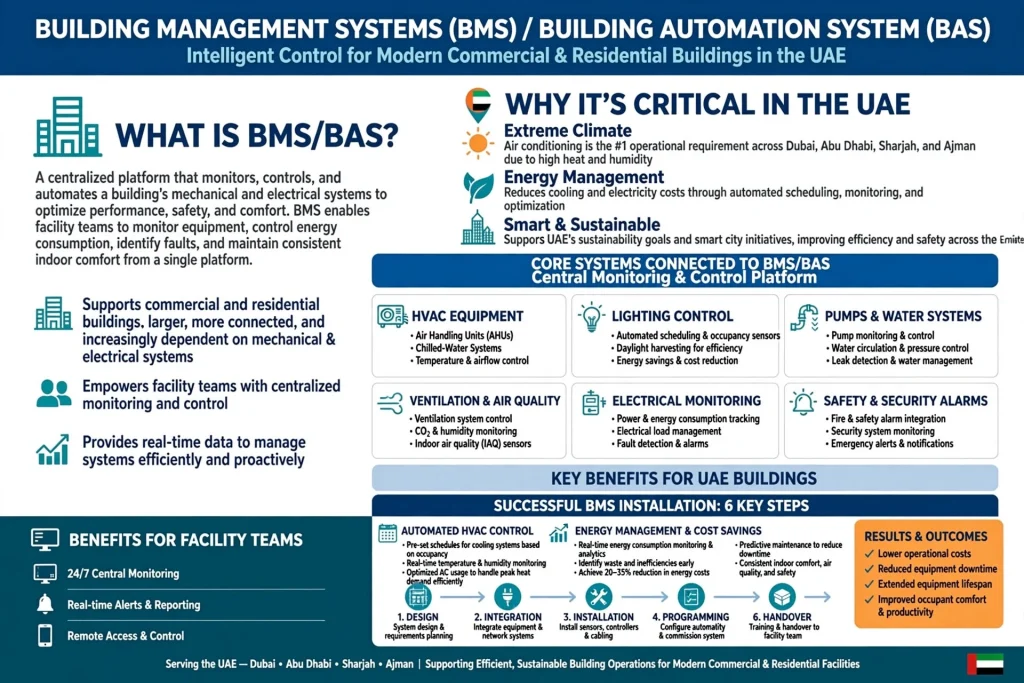
Why BMS Is Important for UAE Buildings
The UAE has a large number of air-conditioned commercial buildings, hotels, hospitals, shopping centres, offices, residential towers, educational facilities, and industrial properties. HVAC systems often operate for long periods, particularly during the hotter months.
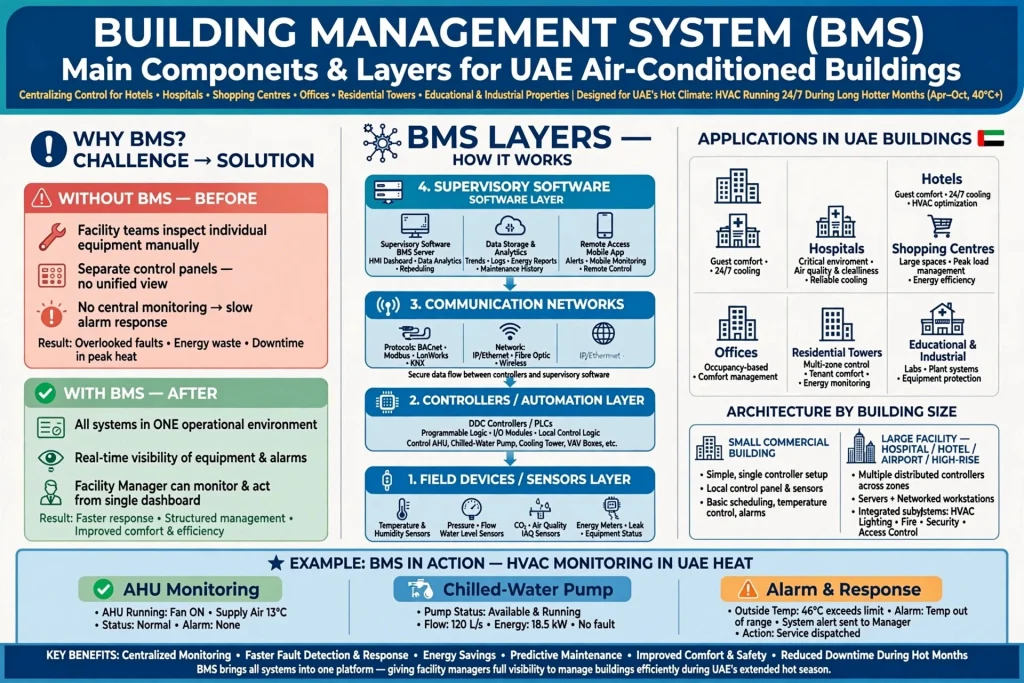
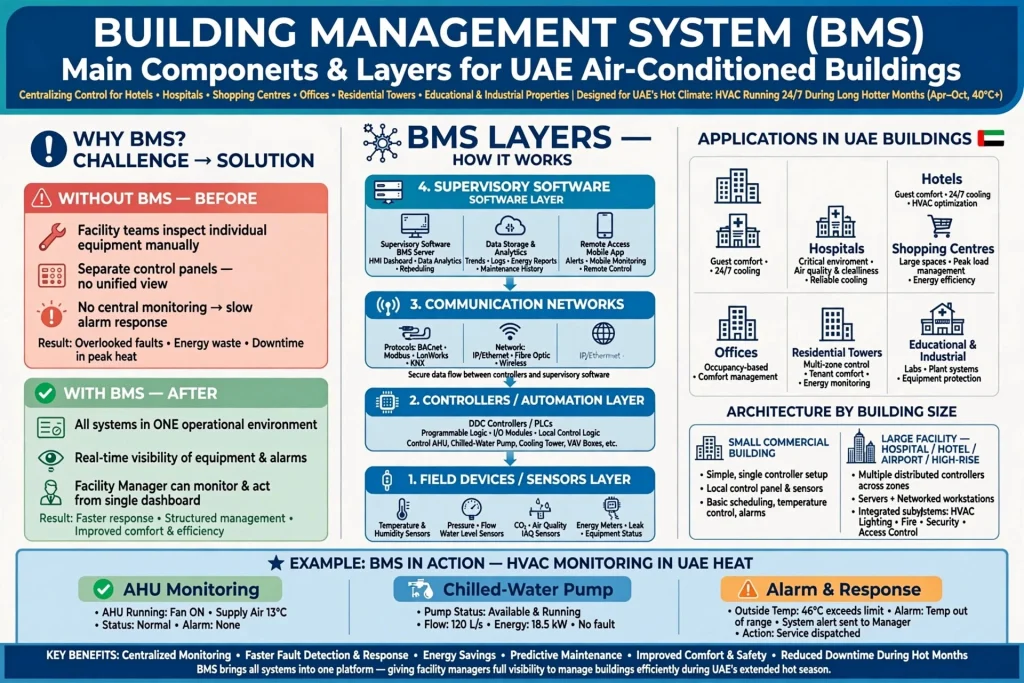
Without centralised monitoring, facility teams may need to inspect individual equipment or rely on separate control panels. A BMS brings relevant information into one operational environment.
For example, a facility manager can identify whether an AHU is running, whether a chilled-water pump is available, whether a temperature is outside its expected range, or whether an equipment alarm has occurred. This visibility can improve response times and support more structured facility management.
Main Components of a BMS
A BMS consists of several layers rather than one single device. Field sensors collect information, controllers process inputs and outputs, communication networks transfer data, and supervisory software allows operators to monitor the building.
The exact architecture depends on the building size and project requirements. A small commercial property may have a relatively simple control system, while a large hospital, hotel, airport facility, or high-rise development may require multiple controllers, servers, networks, workstations, and integrated subsystems.
Sensors and Field Devices
Sensors are the starting point for many BMS control functions. They measure physical conditions and send information to controllers.
Common devices include temperature sensors, humidity sensors, pressure sensors, differential pressure sensors, flow sensors, occupancy sensors, CO2 sensors, and equipment status contacts.
For HVAC applications, sensors may monitor supply-air temperature, return-air temperature, chilled-water temperature, duct pressure, room conditions, and other parameters.
Sensor selection and installation location are important. An incorrectly positioned temperature sensor can provide inaccurate information and cause the control system to operate unnecessarily.
DDC Controllers
Direct Digital Controllers (DDC) process information received from field devices and execute programmed control sequences.
A DDC controller may receive a temperature signal from a sensor and determine whether a valve, fan, pump, or other component should operate. Controllers can also generate alarms when measured values fall outside predefined limits.
The number and type of controllers depend on the equipment being controlled. AHUs, chilled-water systems, fan coil units, pumps, ventilation systems, and other mechanical services may each require different control arrangements.
Actuators and Control Valves
Actuators convert electrical control signals into physical movement. They are commonly used with dampers and control valves.
For example, an actuator can adjust an AHU air damper or modulating chilled-water valve based on the BMS control sequence. Proper sizing and commissioning are essential because an incorrectly selected actuator or valve can prevent the system from achieving stable control.
BMS Network and Communication
Communication networks connect controllers and other devices to the supervisory system. Common building automation protocols include BACnet and Modbus, while other communication technologies may be used depending on the equipment and project design.
BACnet is widely associated with building automation and HVAC integration. Modbus is also commonly used for equipment and meter communication.
The protocol itself is only one part of successful integration. Engineers must confirm that the connected equipment provides the required points, communication parameters, addressing, and documentation.
BMS Server and Operator Workstation
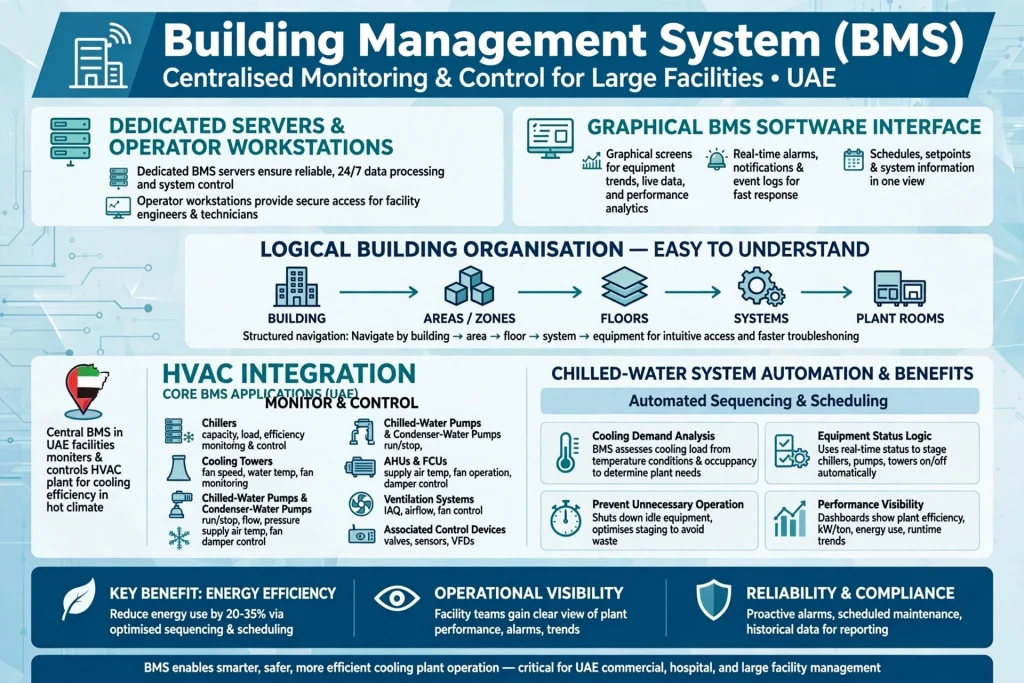
Larger systems may use dedicated servers and operator workstations. The BMS software provides graphical screens where facility teams can view equipment, trends, alarms, schedules, and system information.
A well-designed graphical interface should make the building easy to understand. Equipment should be logically organised according to building areas, floors, systems, or plant rooms.
HVAC Integration With BMS
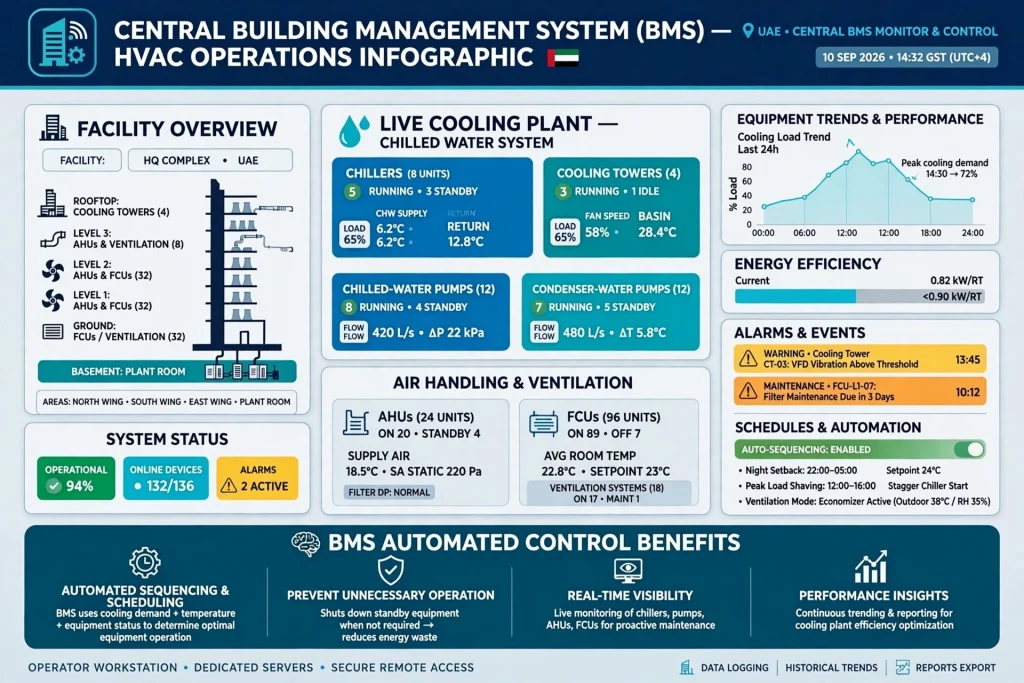
HVAC integration is one of the most important BMS applications in the UAE. A central BMS can monitor and control chillers, cooling towers, chilled-water pumps, condenser-water pumps, AHUs, FCUs, ventilation systems, and associated control devices.
Chilled-water systems can benefit from automated sequencing and scheduling. The BMS can use cooling demand, temperature conditions, equipment status, and other available information to determine how equipment should operate.
This can help prevent unnecessary operation and provide facility teams with better visibility into cooling plant performance.
Chiller Plant Control
Chiller plants can contain multiple interconnected components, including chillers, pumps, cooling towers, valves, sensors, and water circuits. Operating these components independently can result in inefficient system performance.
A BMS can coordinate plant equipment through programmed sequences. Depending on the project, this may include chiller enable and disable commands, pump sequencing, cooling tower fan control, chilled-water temperature monitoring, differential pressure control, and alarm management.
The control sequence should always be developed around the actual chiller manufacturer’s requirements and the project’s mechanical design.
AHU and FCU Automation
Air handling units are commonly connected to BMS systems in commercial buildings. The system can monitor supply-air temperature, return-air temperature, fan status, filter alarms, damper positions, valve positions, and other operating parameters.
An AHU control sequence can be designed to maintain required temperature and airflow conditions while responding to occupancy schedules.
Fan coil units may also be integrated into a BMS depending on the building design. In large developments, central monitoring can make it easier for facility teams to identify faults and manage multiple zones.
Energy Management Through BMS
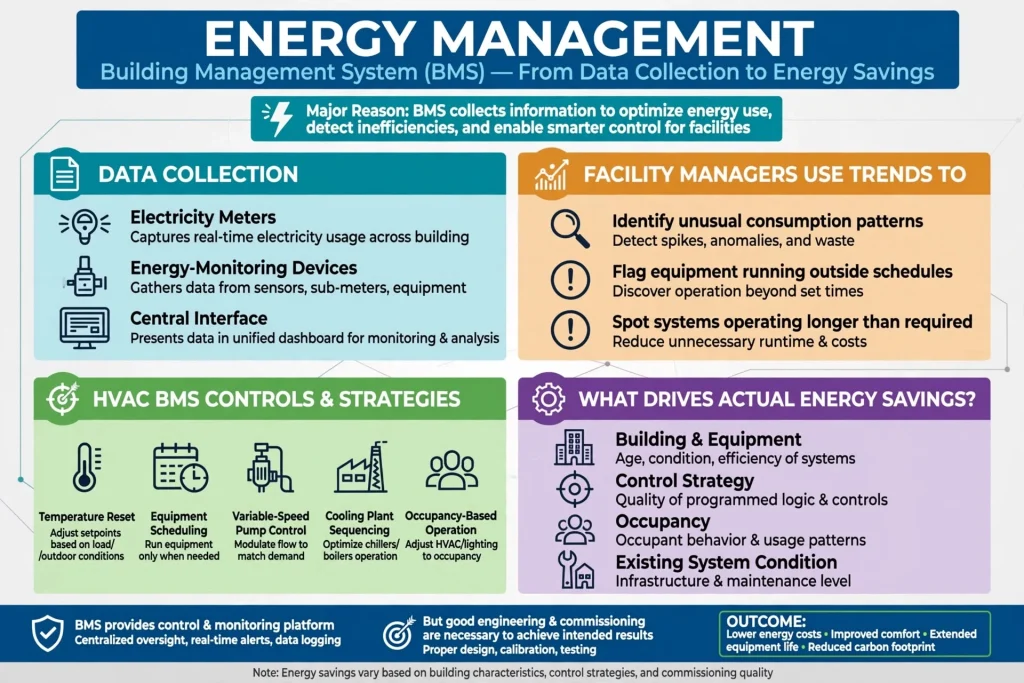
Energy management is another major reason for installing a BMS. The system can collect information from electricity meters and other energy-monitoring devices and present the data in a central interface.
Facility managers can use trends to identify unusual consumption patterns, equipment running outside schedules, or systems that are operating longer than required.
For HVAC systems, BMS controls can support strategies such as temperature reset, equipment scheduling, variable-speed pump control, cooling plant sequencing, and occupancy-based operation.
Actual energy savings depend on the building, equipment, control strategy, occupancy, and existing system condition. A BMS provides the control and monitoring platform, but good engineering and commissioning are necessary to achieve the intended results.
Lighting Control Integration
Depending on project requirements, a BMS can also communicate with lighting control systems. This can allow facility teams to monitor lighting status or coordinate lighting schedules with occupancy and building operating hours.
More advanced projects may use occupancy sensors, daylight-based controls, timers, and centralised lighting management.
Lighting integration can be particularly useful in offices, hotels, retail developments, parking facilities, educational buildings, and large commercial properties where lighting represents a significant operational load.
Indoor Air Quality Monitoring
Modern building automation projects increasingly consider indoor environmental quality. Sensors can monitor parameters such as temperature, humidity, and carbon dioxide.
CO2 monitoring can provide useful information about ventilation conditions in occupied spaces. Where the mechanical design supports automated control, ventilation rates can potentially be adjusted according to occupancy or air-quality requirements.
This should be implemented according to the building’s engineering design and applicable ventilation requirements rather than using sensor readings in isolation.
BMS and IoT Integration
The development of connected building technologies has expanded the capabilities of traditional BMS platforms. Internet of Things (IoT) devices can provide additional data from equipment and occupied spaces.
IoT sensors may be used for temperature monitoring, equipment condition monitoring, occupancy information, energy measurement, and other applications.
However, adding more connected devices does not automatically create a better building. Data should have a clear operational purpose. Facility teams need useful dashboards, meaningful alarms, appropriate data storage, cybersecurity controls, and clear procedures for responding to identified issues.
BMS Installation Process in the UAE
A successful BMS project generally starts with understanding the building’s mechanical, electrical, and operational requirements.
During the design stage, engineers identify the equipment that needs monitoring or control and develop a points list. The points list defines the inputs, outputs, statuses, alarms, commands, and values required for each system.
The control philosophy is then developed around the mechanical design. This may include operating schedules, temperature control, equipment sequencing, interlocks, alarm conditions, and safety-related logic.
After design approval, field devices, controllers, panels, communication networks, and associated wiring can be installed. Software programming and graphics are then configured before testing and commissioning.
BMS Points List and Control Philosophy
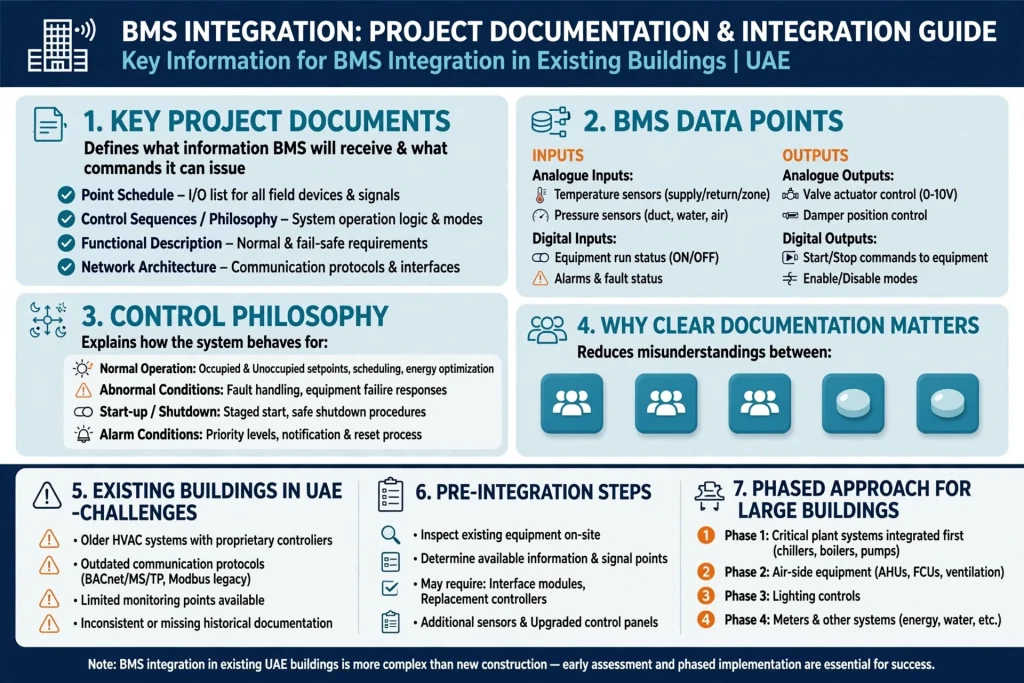
The points list is one of the most important project documents because it defines what information the BMS will receive and what commands it can issue.
Points may include analogue inputs, digital inputs, analogue outputs, and digital outputs. For example, a temperature sensor may provide an analogue input, while an equipment run status may be represented as a digital input.
The control philosophy explains how the system should behave under normal, abnormal, occupied, unoccupied, start-up, shutdown, and alarm conditions.
Clear documentation reduces misunderstandings between mechanical contractors, electrical contractors, BMS specialists, consultants, and facility management teams.
BMS Integration With Existing Buildings
Installing BMS in an existing UAE building can be more complex than installing it during new construction. Older HVAC equipment may use proprietary controllers, outdated communication protocols, or limited monitoring points.
Before integration, engineers should inspect existing equipment and determine what information is available. Some equipment may require interface modules, replacement controllers, additional sensors, or upgraded control panels.
A phased approach can be useful for large buildings. Critical plant systems can be integrated first, followed by air-side equipment, lighting, meters, and other systems.
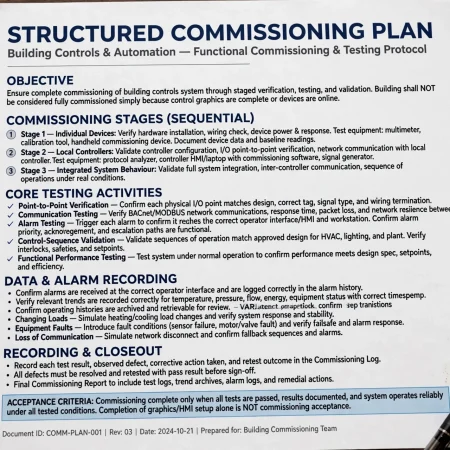
Commissioning and Functional Testing
Commissioning is essential because a BMS that has been physically installed is not necessarily a correctly operating BMS.
Functional testing verifies that sensors provide accurate information, commands reach the correct equipment, alarms operate correctly, and control sequences behave as intended.
For example, if an AHU is commanded to start, the commissioning team should verify the actual fan response, status feedback, valve operation, damper position, temperature response, and relevant alarms.
Chiller plant sequences should similarly be tested under appropriate operating conditions.
BMS Alarms and Fault Detection
A useful BMS should provide meaningful alarms rather than generating excessive notifications. Too many poorly configured alarms can cause alarm fatigue, making it harder for operators to identify genuine problems.
Alarm priorities should be established according to the potential impact of each condition. Critical equipment failures may require immediate attention, while minor deviations can be logged for routine investigation.
Alarm descriptions should also be clear enough for facility staff to understand what happened and what system is affected.
Cybersecurity and Remote BMS Access
Connected building systems introduce cybersecurity considerations. BMS networks should be designed with appropriate access controls, network segmentation, user permissions, password policies, software updates, and remote-access procedures.
Remote access can provide operational benefits, particularly for facility management teams responsible for multiple properties. However, remote connectivity should be implemented according to the organisation’s cybersecurity policies and IT requirements.
The BMS should not be treated as an isolated mechanical system when it is connected to a wider corporate or building network.
BMS Requirements for UAE Construction Projects
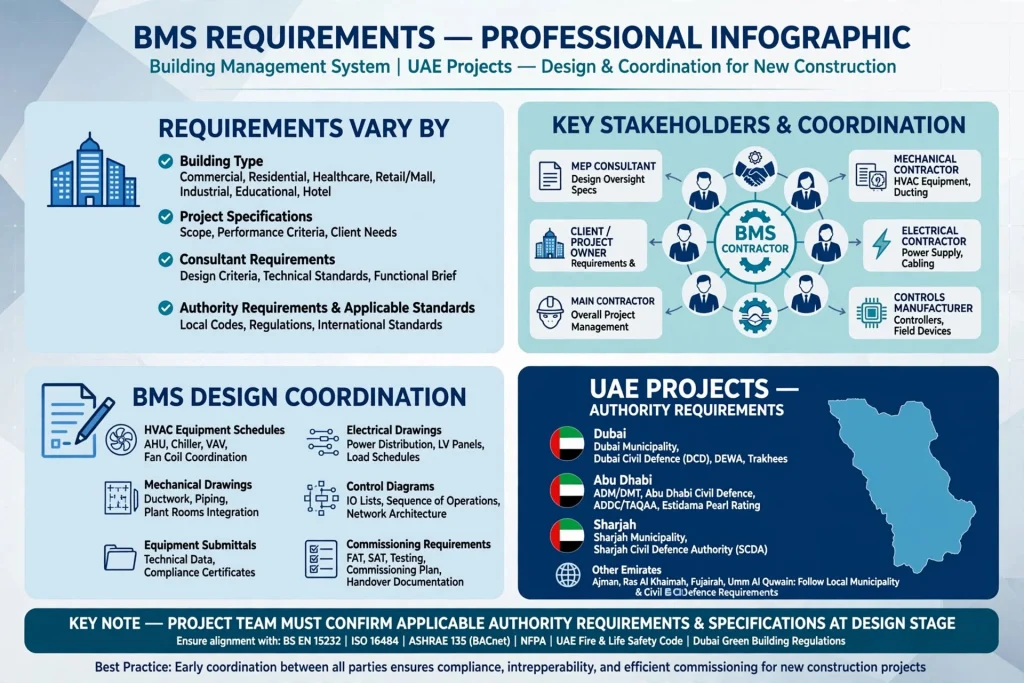
BMS requirements can vary according to the building type, project specifications, consultant requirements, authority requirements, and applicable standards.
New construction projects typically involve coordination between the BMS contractor, MEP consultant, mechanical contractor, electrical contractor, controls manufacturer, and main contractor.
The BMS design should be coordinated with HVAC equipment schedules, mechanical drawings, electrical drawings, control diagrams, equipment submittals, and commissioning requirements.
For projects in Dubai, Abu Dhabi, Sharjah, and other Emirates, the project team should confirm the applicable authority requirements and specifications at the design stage.
BMS for Hotels in Dubai
Hotels can benefit from BMS monitoring because they contain multiple HVAC zones, guest rooms, kitchens, restaurants, meeting spaces, public areas, pumps, ventilation systems, and other equipment.
Centralised monitoring can help hotel engineering teams identify equipment alarms and manage operating schedules. Integration with room controls and other hotel systems may also improve operational coordination, subject to the project’s design.
In busy hospitality environments such as Downtown Dubai, Dubai Marina, Palm Jumeirah, and Business Bay, reliable building automation can support consistent operation while reducing the need for manual intervention.
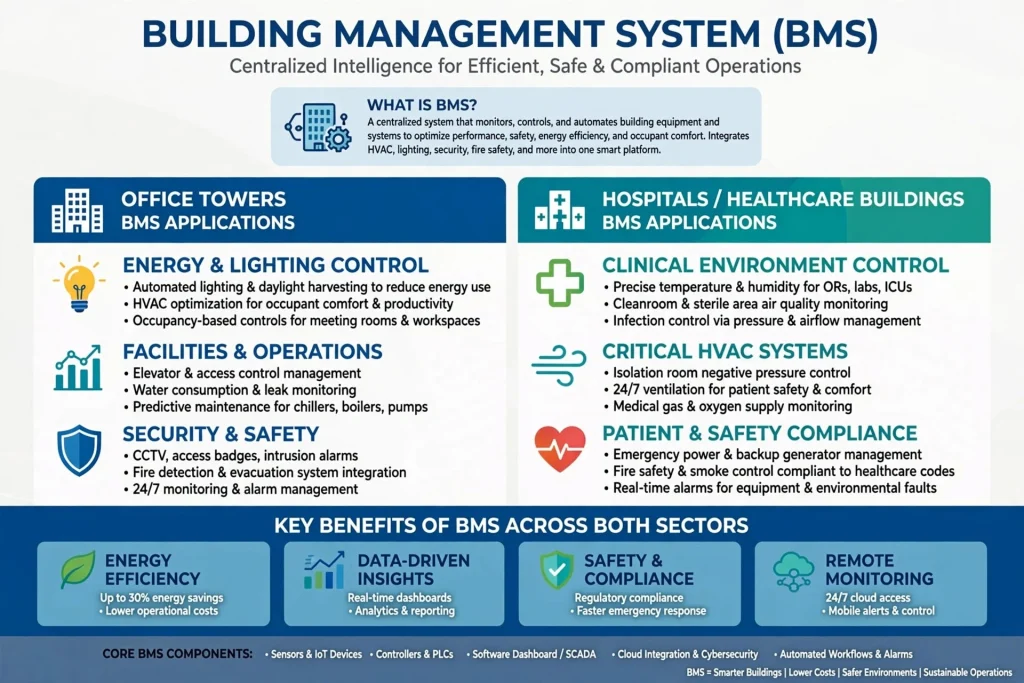
BMS for Offices and Commercial Buildings
Office towers have changing occupancy patterns and varying cooling demand throughout the day. BMS scheduling can help align HVAC operation with actual building use.
For example, air handling systems can operate according to working hours, while meeting rooms and other high-occupancy spaces can be managed according to their operational requirements.
Energy meters, HVAC controls, alarms, and equipment status can be displayed centrally, helping facility managers understand building performance.
BMS for Hospitals and Healthcare Buildings
Healthcare buildings require carefully coordinated mechanical and electrical systems. HVAC operation can be particularly important for temperature, ventilation, pressure relationships, and indoor environmental conditions.
BMS implementation in hospitals should follow the project’s engineering requirements and operational procedures. Critical systems may require redundancy, carefully defined alarms, and detailed commissioning.
The BMS should support the facility rather than compromise essential clinical or safety functions.
Choosing a BMS Installation Company
Selecting the right BMS installation company is important because the quality of programming and commissioning can have a major impact on long-term system performance.
Building owners should consider the contractor’s experience with HVAC controls, chiller plants, AHUs, pumps, cooling towers, communication protocols, BMS software, commissioning, troubleshooting, and integration with existing equipment.
Documentation and after-sales support are equally important. A good handover should provide updated drawings, points lists, control sequences, software backups, passwords or access procedures as appropriate, commissioning records, and operator training.
Common BMS Installation Problems
Poor BMS performance can result from incorrect sensor placement, incomplete points lists, inadequate network design, poor control logic, missing equipment interfaces, incorrect addressing, weak commissioning, or insufficient operator training.
Another common problem is designing a system with too many unnecessary points while failing to provide the information facility teams actually need.
A successful BMS should be practical. It should provide meaningful information, reliable control, useful alarms, understandable graphics, and a clear operating structure.
How Much Does BMS Installation Cost in the UAE?
BMS installation costs vary significantly depending on building size, number of control points, HVAC equipment, integration requirements, communication protocols, software platform, network architecture, existing infrastructure, and commissioning scope.
A small commercial building may require a relatively simple system, while a large hotel, hospital, shopping centre, or high-rise development can require thousands of monitoring and control points.
The most reliable way to estimate cost is through a site survey and detailed scope of work. The quotation should clearly identify hardware, controllers, sensors, panels, cabling, software, programming, graphics, integration, testing, commissioning, training, and maintenance requirements.
Frequently Asked Questions About BMS Installation
What does a BMS control?
A BMS can monitor and control building services such as HVAC equipment, AHUs, FCUs, chillers, pumps, cooling towers, ventilation systems, lighting, energy meters, and other connected systems, depending on the project scope.
Is BMS only useful for large buildings?
No. Although large commercial properties can gain substantial benefits from centralised automation, smaller buildings can also use BMS technology for HVAC scheduling, monitoring, energy management, and equipment control.
What is BACnet in BMS?
BACnet is a communication protocol designed for building automation and control networks. It allows compatible building systems and devices to exchange information.
Can an existing HVAC system be connected to a BMS?
Often, yes. The feasibility depends on the existing equipment, controllers, available communication interfaces, wiring, sensors, and manufacturer support. Some systems may require additional hardware or controller upgrades.
Does BMS reduce energy consumption?
A BMS can support energy efficiency by automating schedules, controlling equipment according to demand, monitoring consumption, and coordinating HVAC systems. The actual reduction depends on the building and the quality of the control strategy.
How important is BMS commissioning?
Commissioning is extremely important. It verifies that sensors, controllers, communication, alarms, equipment commands, graphics, and control sequences operate correctly under actual building conditions.
Conclusion
BMS installation has become an important part of modern building management across the UAE. From HVAC automation and chiller plant control to energy monitoring, lighting integration, alarms, and indoor environmental monitoring, a properly designed system can give facility teams much greater visibility and control.
The success of a BMS depends on the complete project process. Accurate design, suitable sensors, reliable controllers, compatible communication protocols, properly programmed control sequences, coordinated installation, functional testing, commissioning, documentation, and operator training all contribute to long-term performance.
For Dubai, Abu Dhabi, Sharjah, and other UAE locations, BMS solutions should be designed around the actual building, HVAC system, occupancy pattern, operational requirements, and project specifications. When these factors are considered from the beginning, BMS Installation in the UAE can become more than a monitoring platform—it can provide a practical foundation for smarter building operation, energy management, preventive maintenance, and long-term facility performance.