Epoxy flooring is widely used in residential, commercial and industrial buildings because it provides a seamless finish, good mechanical strength, chemical resistance and an attractive appearance. However, one issue that property owners sometimes experience after installation is yellowing. A floor that originally looked bright white, light grey or professionally finished may gradually develop a yellow, amber or uneven appearance.
In Dubai, this issue deserves particular attention because buildings experience intense sunlight, high outdoor temperatures and significant UV exposure. These environmental conditions can affect the long-term appearance of resin-based flooring, especially when the wrong epoxy formulation is selected for an exposed area.
Epoxy yellowing is not always a sign of poor installation. It can result from the natural chemical behaviour of certain epoxy resins, prolonged ultraviolet radiation, excessive heat, incorrect material mixing, unsuitable curing conditions or exposure to chemicals. Understanding these factors helps property owners, facility managers, contractors and building maintenance teams make better flooring decisions.
Whether the project involves a residential garage in Arabian Ranches, a commercial showroom in Business Bay, a villa in Palm Jumeirah or an industrial facility in Al Quoz, selecting an appropriate resin system and protective finish is important for maintaining the original floor appearance.
What Is Epoxy Flooring Yellowing?
Epoxy flooring yellowing is a colour change that occurs when the original surface gradually develops a yellowish or amber tone. It can affect the entire floor or appear in particular sections, depending on the material, environmental exposure and installation conditions.
The change may be difficult to notice during the early stages. A white or light-coloured epoxy floor might initially appear slightly warmer before developing more visible yellow patches over time. In some cases, the change occurs unevenly, particularly in areas exposed to sunlight through windows, glass doors or skylights.
Epoxy resin is generally produced through a chemical reaction between an epoxy resin component and a hardener. During curing, these materials form a cross-linked polymer structure that creates a hard, protective surface.
However, not every epoxy formulation has the same resistance to ultraviolet radiation. Certain epoxy systems contain chemical structures that are more susceptible to UV-related degradation. Exposure to sunlight can trigger chemical changes within the resin, affecting its original colour and clarity.
This is why two epoxy floors installed in different locations can experience different levels of yellowing, even when they initially have a similar appearance.
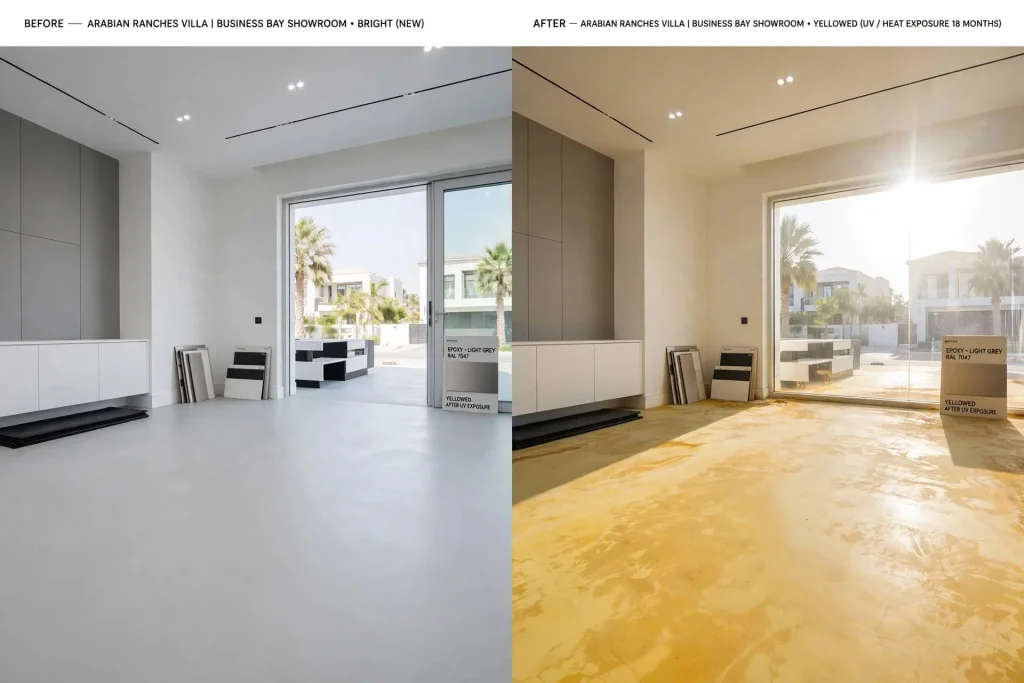
1. Ultraviolet Radiation from Direct Sunlight
One of the main reasons epoxy flooring turns yellow is prolonged exposure to ultraviolet radiation. Sunlight contains UVA and UVB radiation, which can contribute to chemical degradation in materials that are not designed for extended UV exposure.
Many conventional epoxy resins are not naturally UV-stable. When exposed to sunlight over an extended period, chemical reactions within the resin can produce colour changes, resulting in yellowing or amber discolouration.
This issue is particularly relevant to Dubai properties with large glass windows, sliding doors, skylights and open garage entrances.
For example, a villa in Emirates Hills or Dubai Hills Estate may have a garage or interior space receiving direct afternoon sunlight. If the floor has a conventional epoxy coating without suitable UV protection, the exposed section may gradually become more yellow than the shaded areas.
Commercial showrooms in Downtown Dubai, retail spaces in Dubai Marina and offices in Business Bay may experience similar problems where sunlight enters through extensive glazing.
It is important to understand that UV exposure does not affect every epoxy product equally. The degree of colour change depends on the resin formulation, pigments, protective layers, exposure duration and intensity of sunlight.
2. High Temperatures and Heat Exposure in Dubai
Temperature is another important factor affecting the appearance and performance of epoxy flooring.
Dubai experiences extremely hot summers, and outdoor surfaces can become considerably hotter than the surrounding air. Although epoxy flooring is generally installed indoors, garages, loading areas, industrial facilities and spaces near external entrances can still experience elevated temperatures.
Heat can accelerate certain chemical reactions responsible for resin ageing and discolouration. When combined with UV radiation, prolonged thermal exposure may contribute to more noticeable colour changes.
Consider a commercial garage in Al Quoz or an industrial workshop in Jebel Ali. Vehicle engines, equipment, machinery and limited ventilation can increase the temperature around the flooring surface.
If the selected epoxy system is not suitable for those operating conditions, the floor may experience premature ageing, colour changes or other performance problems.
Property owners should distinguish between normal environmental heat exposure and direct contact with hot equipment. These are different conditions and may require different material specifications.
Selecting a flooring system according to the expected operating temperature is important for maintaining both appearance and durability.
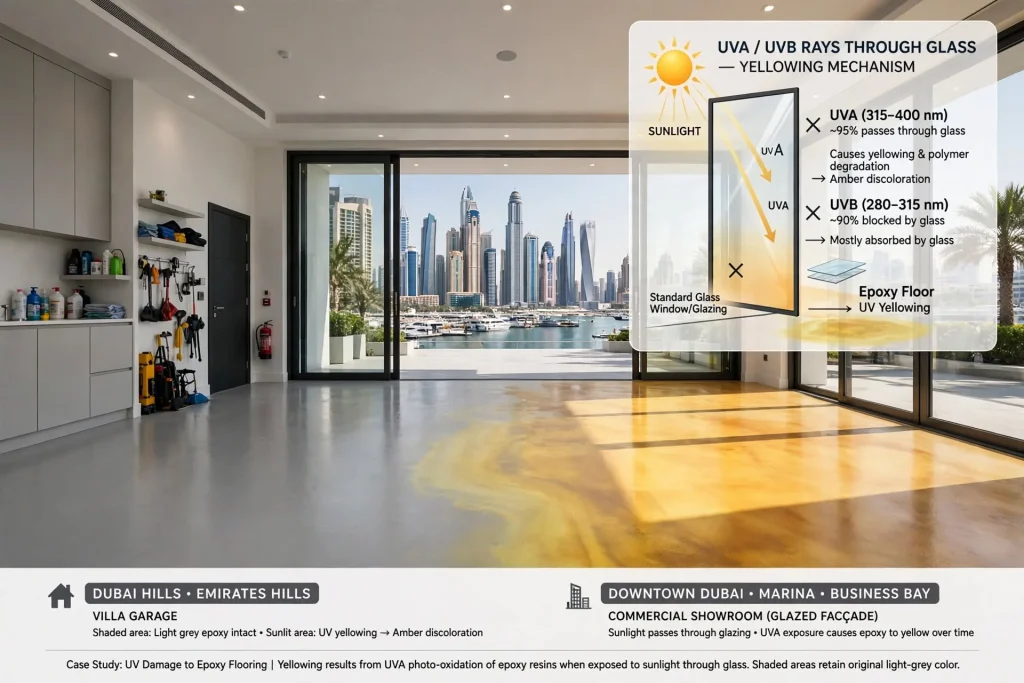
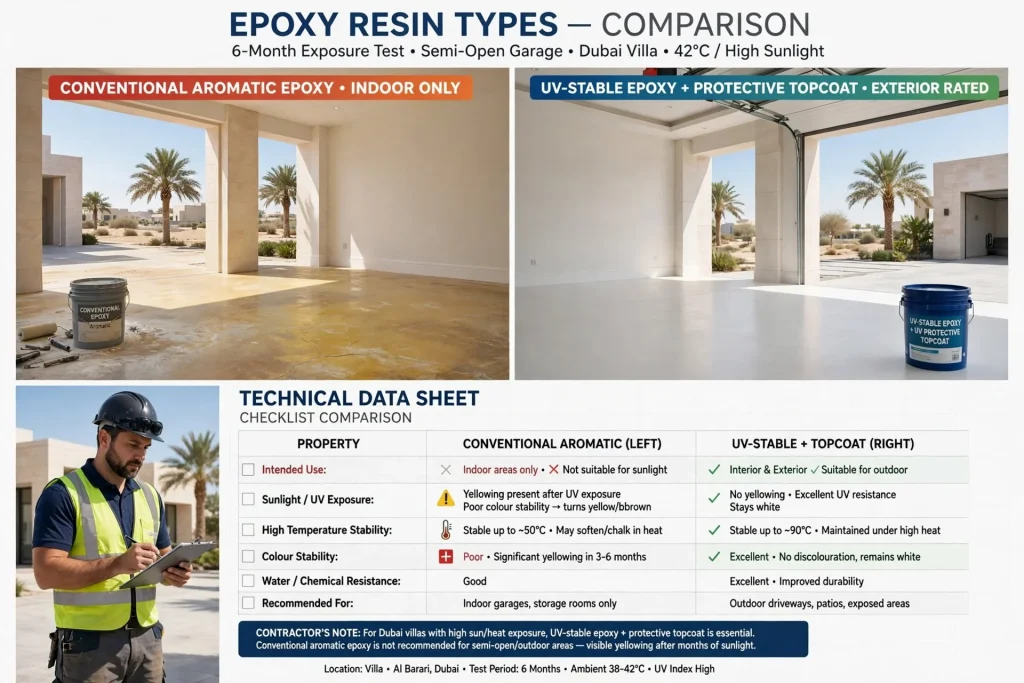
3. Using Conventional Epoxy Resin in Sunlight-Exposed Areas
Not all epoxy flooring products are manufactured for the same applications.
Some epoxy formulations are primarily designed for interior environments where direct sunlight exposure is limited. Others are developed for specialised applications requiring particular levels of chemical resistance, mechanical strength or decorative appearance.
A conventional aromatic epoxy resin may develop a yellow or amber appearance when exposed to UV radiation. This does not necessarily mean the product is defective. It can be an inherent characteristic of the resin chemistry.
The problem often occurs when a material designed for indoor applications is installed in a location that receives regular sunlight.
For example, a property owner may select a bright white epoxy finish for a semi-open garage because of its clean appearance. However, if the material is not suitable for UV exposure, the floor may gradually lose its original colour consistency.
Before installation, contractors should review the manufacturer’s technical data sheet and identify whether the product is recommended for:
- Interior or exterior applications.
- Direct or indirect sunlight exposure.
- High-temperature environments.
- Decorative flooring systems.
- Commercial and industrial traffic.
- Areas requiring long-term colour stability.
The correct product specification should always be based on the actual environmental conditions rather than appearance alone.
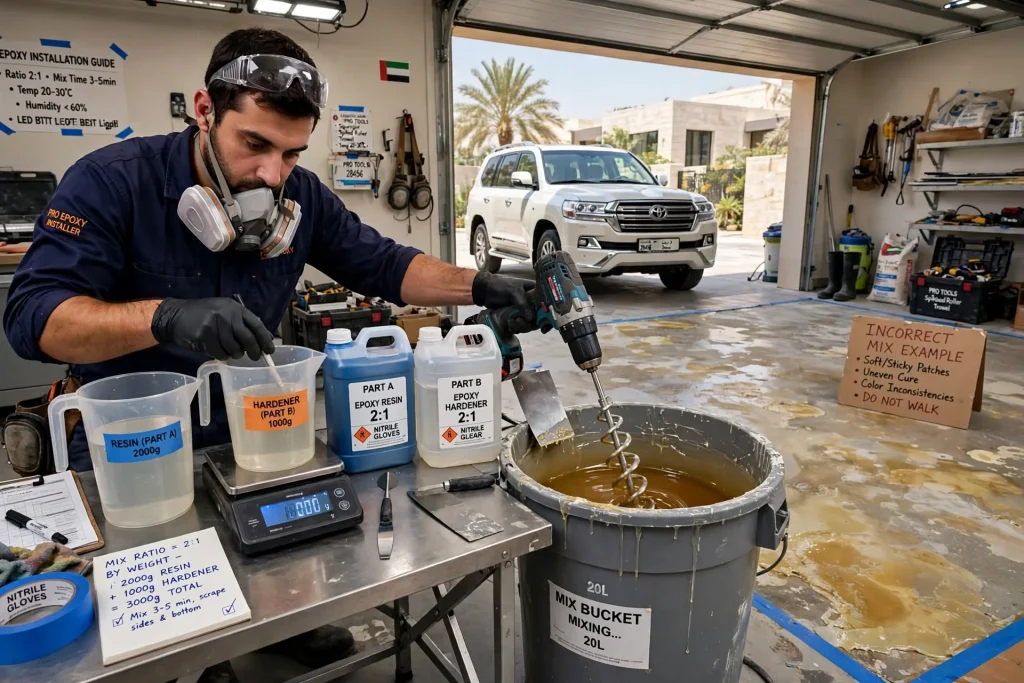
4. Poor Mixing of Epoxy Resin and Hardener
Epoxy flooring requires accurate mixing of two main components: resin and hardener.
These materials must be combined according to the manufacturer’s specified mixing ratio. Incorrect proportions can affect the curing reaction and result in incomplete or inconsistent polymer formation.
Poor mixing can cause several problems, including:
- Uneven curing across the floor.
- Soft or sticky sections.
- Colour inconsistencies.
- Reduced mechanical performance.
- Surface defects.
- Premature deterioration.
In light-coloured or transparent epoxy systems, incorrect mixing may also contribute to an uneven appearance.
For example, adding too much hardener does not necessarily make epoxy flooring stronger or more resistant to yellowing. Instead, it can interfere with the intended chemical reaction.
Professional installers should use accurate measuring equipment, appropriate mixing tools and the recommended mixing procedure. The sides and bottom of the mixing container should also be scraped where required to ensure that both components are properly combined.
Correct proportioning is particularly important for large commercial projects where several batches of epoxy material may be prepared during one installation.
5. Incorrect Curing Conditions
Curing is the chemical process through which epoxy resin and hardener react to form a solid polymer coating.
The curing process depends on several factors, including temperature, humidity, material formulation, application thickness and ventilation.
If the environmental conditions fall outside the manufacturer’s recommended limits, the coating may not develop its intended properties.
Dubai’s hot climate makes temperature management especially important during flooring installation. Materials stored in excessively hot conditions or applied to very warm concrete may behave differently from materials used under controlled conditions.
Incorrect curing conditions can contribute to:
- Uneven surface appearance.
- Inconsistent gloss levels.
- Surface defects.
- Reduced adhesion.
- Incomplete curing.
- Premature coating deterioration.
It is also important not to confuse epoxy yellowing with amine blush. Amine blush is a surface deposit that can sometimes develop during epoxy curing under unsuitable temperature and humidity conditions. It may appear as a waxy, greasy or cloudy film.
Amine blush is generally a surface contamination issue rather than the same chemical process as UV-related yellowing. Correct identification is necessary before selecting a cleaning or repair method.
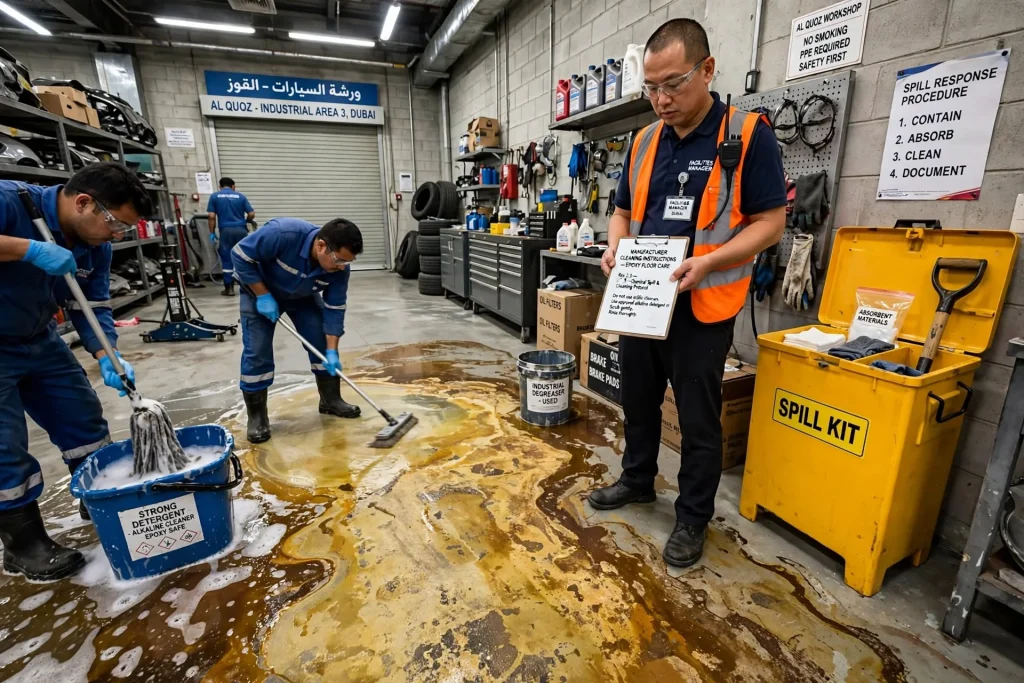
6. Chemical Exposure and Cleaning Products
Epoxy flooring is often selected for its resistance to chemicals, oils and stains. However, chemical resistance varies depending on the resin formulation, protective topcoat, concentration of the chemical and duration of contact.
Some aggressive cleaning agents, solvents, industrial chemicals and incorrectly selected maintenance products can affect the floor’s surface appearance.
For example, a workshop floor exposed to automotive fluids, industrial cleaners or chemical spills may develop localised discolouration if the coating is not compatible with those substances.
In commercial buildings, cleaning teams sometimes use strong detergents or unsuitable chemical solutions to remove stubborn stains. Repeated use of incompatible products can affect the finish, gloss level and colour consistency.
Facility managers should follow the cleaning instructions provided by the flooring manufacturer. Chemical spills should be removed using an appropriate cleaning procedure rather than allowing them to remain on the surface for extended periods.
7. Poor Quality Pigments and Decorative Materials
The colour stability of epoxy flooring depends on more than the resin itself. Pigments, decorative flakes, metallic additives and other materials can also influence the final appearance.
Light-coloured epoxy systems require particular attention because yellowing is easier to notice on white, cream and pale grey surfaces.
Some decorative systems use metallic pigments to create marble-like patterns, flowing effects or reflective finishes. If the selected pigments or additives are unsuitable for the intended environment, the decorative appearance may change over time.
The quality and compatibility of the complete flooring system should therefore be evaluated before installation.
For projects in Dubai villas, luxury apartments, retail showrooms and hospitality properties, contractors should consider the following:
- Colour stability of the epoxy resin.
- UV resistance of decorative pigments.
- Compatibility between primer, basecoat and topcoat.
- Suitability of metallic pigments.
- Manufacturer’s recommended application conditions.
- Expected exposure to sunlight and artificial lighting.
Using compatible materials from a properly specified system can reduce the risk of inconsistent finishes.
8. Inadequate UV-Protective Topcoat
One of the most important considerations when installing epoxy flooring in sunlight-exposed environments is the protective topcoat.
A conventional epoxy coating may provide excellent adhesion and mechanical performance but still have limited resistance to UV-related colour changes.
An appropriate UV-resistant protective layer can help reduce this problem.
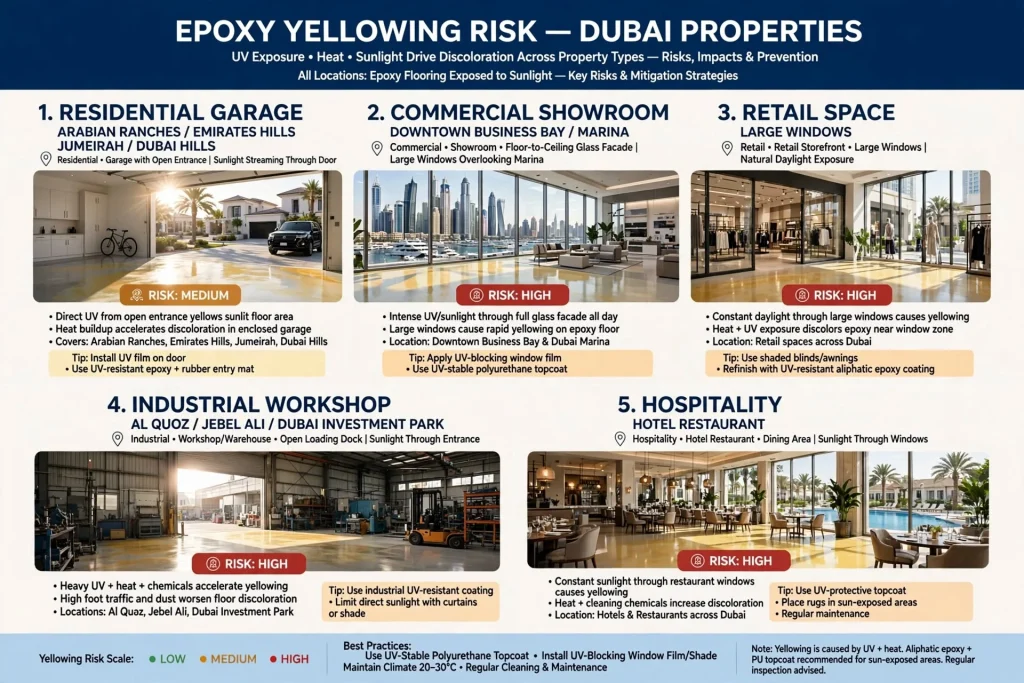
Aliphatic polyurethane and polyaspartic coatings are commonly considered as protective finishing options because suitable formulations offer better UV colour stability than many conventional epoxy systems.
These coatings can provide an additional protective layer over an epoxy basecoat, helping maintain the floor’s appearance under suitable exposure conditions.
However, not every polyurethane or polyaspartic product offers identical performance. The specific formulation, thickness, preparation requirements and manufacturer’s technical specifications must be checked.
For Dubai garages, commercial entrances, showrooms and semi-exposed flooring areas, selecting the correct protective system can make a significant difference to long-term appearance.
How Dubai’s Climate Affects Epoxy Flooring Colour Stability
Dubai’s environmental conditions create several considerations for resin-based flooring systems.
The combination of strong sunlight, elevated temperatures, dust, humidity and temperature variations can influence the performance of coatings, depending on their chemical composition and installation environment.
| Environmental factor | Possible effect on epoxy flooring |
|---|---|
| Direct sunlight | UV-related yellowing and colour changes |
| High surface temperatures | Faster ageing of susceptible coating formulations |
| Humidity during application | Potential curing and surface-quality problems |
| Dust contamination | Poor adhesion or visible surface defects |
| Chemical exposure | Staining, discolouration or coating damage |
| Temperature variation | Movement and stress in the coating system |
For example, a residential garage in Palm Jumeirah may receive direct sunlight through a wide entrance, while a warehouse in Dubai Industrial City may experience heat generated by machinery and vehicle operations.
These environments have different requirements, which is why one generic epoxy specification should not be used for every project.
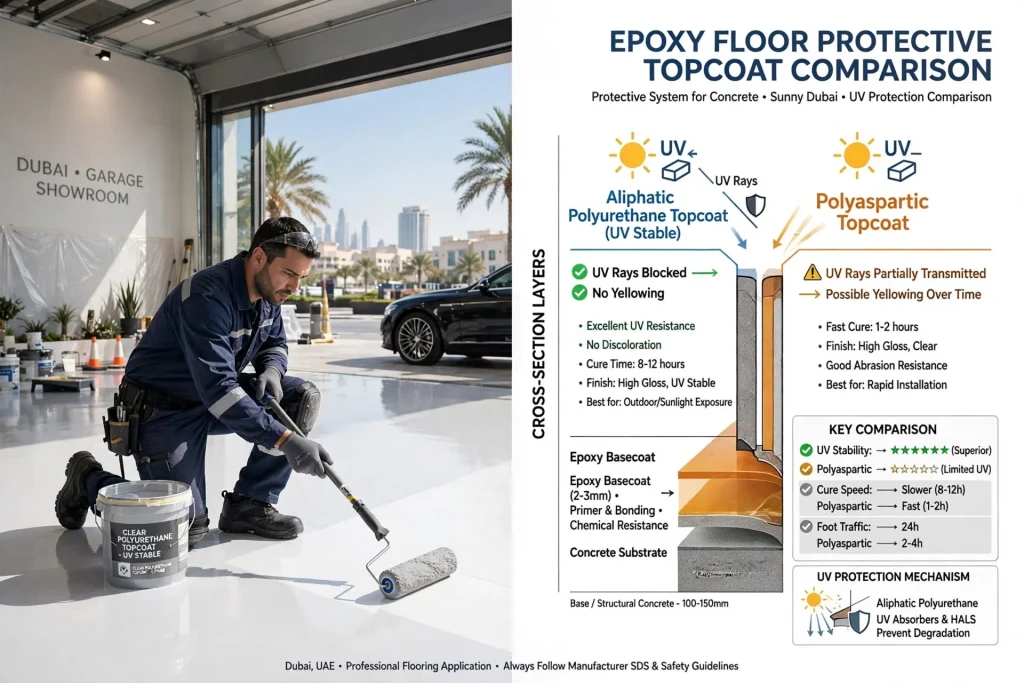
Which Dubai Properties Are More Likely to Experience Epoxy Yellowing?
Certain building layouts and applications deserve additional attention when selecting epoxy flooring.
Residential garages: Garages in Arabian Ranches, Emirates Hills, Jumeirah and Dubai Hills Estate may receive direct sunlight through open entrances or glazed doors.
Commercial showrooms: Properties in Downtown Dubai, Business Bay and Dubai Marina may have extensive glass façades that allow sunlight to reach decorative flooring.
Retail spaces: Shopping and retail environments with large windows may require UV-stable finishing systems, particularly when light-coloured flooring is selected.
Industrial facilities: Workshops and warehouses in Al Quoz, Jebel Ali and Dubai Investment Park may require coatings designed for both environmental exposure and operational conditions.
Hospitality properties: Hotels, restaurants and other hospitality spaces may prioritise consistent colour, cleaning performance and decorative appearance.
The most suitable flooring system depends on actual exposure rather than the property’s location alone.
How to Prevent Epoxy Flooring from Turning Yellow
Preventing epoxy yellowing begins before the installation process. Material selection, substrate preparation, application quality and protective finishing all contribute to the final result.
1. Select a UV-Resistant Flooring System
The first step is to choose a resin system that matches the expected sunlight exposure.
For indoor areas with limited UV exposure, a conventional epoxy system may be suitable depending on the manufacturer’s specifications.
For areas receiving direct sunlight, consider a UV-stable flooring specification. This may involve an epoxy basecoat combined with an appropriate aliphatic polyurethane or polyaspartic protective finish.
It is important to understand that a UV-resistant topcoat does not necessarily prevent all colour changes within the underlying epoxy. The complete system should be specified for the intended exposure.
2. Use a Suitable Aliphatic Polyurethane Topcoat
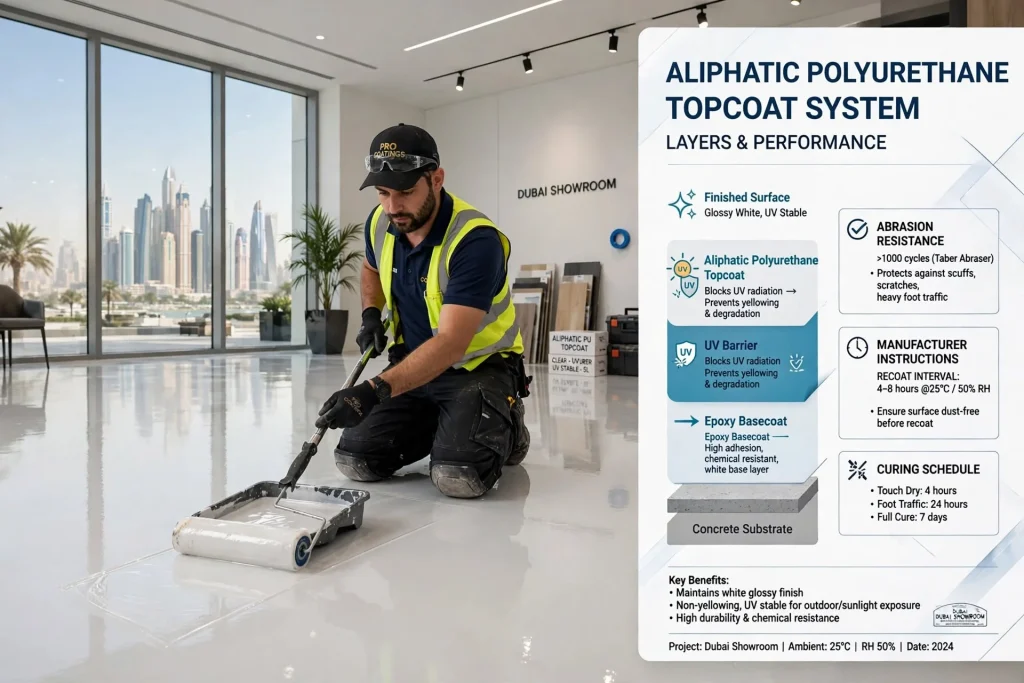
Aliphatic polyurethane is commonly used as a protective finish for resin flooring because suitable formulations offer improved resistance to UV-related yellowing and weathering.
It can help protect decorative epoxy finishes from environmental exposure while providing additional resistance to abrasion and everyday wear.
A suitable topcoat can also help maintain the desired gloss level and colour appearance.
However, the product should be compatible with the epoxy basecoat. Surface preparation, recoat intervals, curing conditions and application thickness must follow the manufacturer’s instructions.
3. Consider Polyaspartic Protective Coatings
Polyaspartic coatings are another option for projects where colour stability, rapid curing and surface protection are important.
Depending on the selected formulation, they can provide good UV stability, abrasion resistance and chemical resistance.
They are sometimes used in garages, commercial facilities and decorative flooring applications.
However, polyaspartic products can have specific application requirements, including pot life, temperature limits and curing windows. Installation should be handled by contractors familiar with the system.
4. Reduce Direct Sunlight Exposure
Where practical, reducing direct sunlight exposure can help protect conventional epoxy finishes.
Building owners can consider suitable window treatments, blinds, UV-filtering glazing and shading solutions to limit sunlight entering sensitive areas.
In residential garages, shaded entrances or suitable door systems may also reduce direct exposure.
These measures do not replace the need for appropriate coating selection, but they can support long-term colour stability.
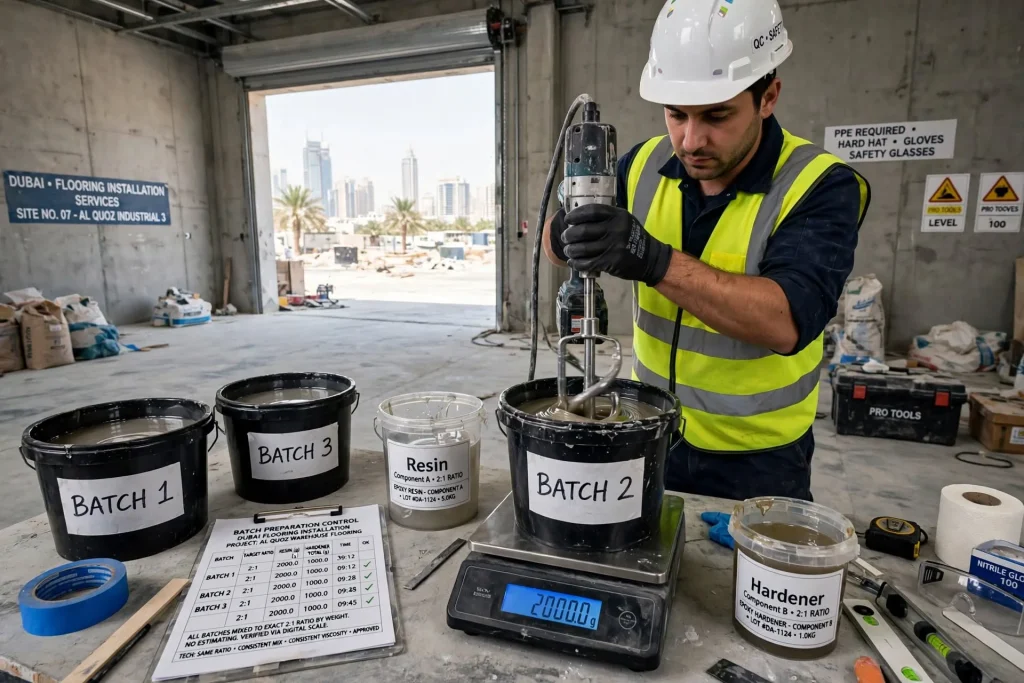
5. Follow the Correct Mixing Ratio
Accurate mixing is essential for achieving the intended coating performance.
Installers should follow the manufacturer’s specified resin-to-hardener ratio rather than estimating quantities.
Mechanical mixing equipment should be used where required, and materials should be combined thoroughly to achieve a consistent mixture.
For larger projects, batch preparation should be controlled so that the same application conditions and material proportions are maintained throughout the installation.
6. Control Installation Temperature and Humidity
Epoxy materials should be stored, mixed and applied within their recommended environmental limits.
Before installation, contractors should check:
- Ambient air temperature.
- Concrete surface temperature.
- Relative humidity.
- Concrete moisture conditions.
- Dew point and condensation risk.
- Ventilation and site conditions.
These checks are particularly important in Dubai, where outdoor temperatures can be extremely high during summer.
Where necessary, installation should be scheduled during suitable working conditions rather than applying materials when the concrete surface is excessively hot.
7. Use High-Quality Pigments and Compatible Materials
For decorative flooring, pigment quality and compatibility should be checked before installation.
This is especially important when using white, cream, light grey, metallic or transparent finishes.
A flooring contractor should confirm that the selected pigments are compatible with the resin and suitable for the expected exposure.
A complete system from compatible products can help reduce unexpected variations in appearance.
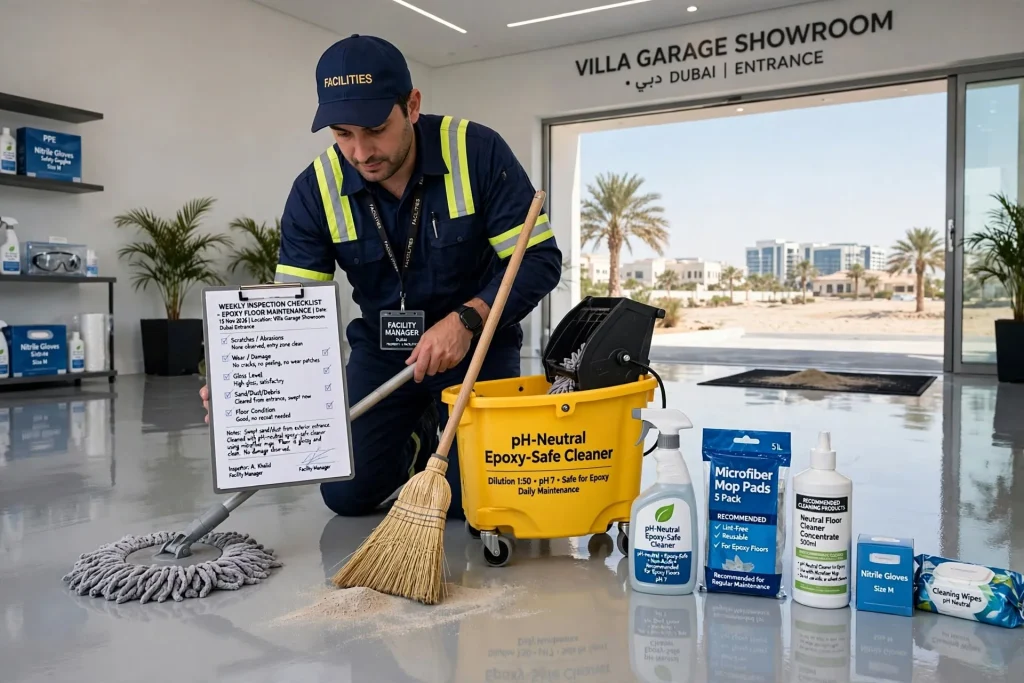
8. Follow a Suitable Floor Maintenance Schedule
Regular cleaning can help preserve the appearance of epoxy flooring.
Property owners and facility managers should remove dust, sand and abrasive particles before they accumulate. This is particularly useful in Dubai, where fine dust and sand can enter buildings through entrances and vehicle access points.
Use cleaning products recommended for the installed coating system. Avoid harsh chemicals unless their compatibility has been confirmed.
Periodic inspections can also help identify scratches, surface wear and coating damage before more extensive repairs become necessary.
Epoxy Flooring vs UV-Resistant Polyurethane: What Is the Difference?
Understanding the difference between epoxy and polyurethane is important when choosing a flooring system for Dubai buildings.
Although both materials are used in protective coating applications, their properties and purposes are different.
| Feature | Epoxy flooring | Aliphatic polyurethane |
|---|---|---|
| Main application | Basecoat and resin flooring system | Protective finishing coat |
| Adhesion | Strong adhesion to properly prepared substrates | Generally applied over compatible prepared coatings |
| UV stability | Many conventional systems have limited UV stability | Suitable formulations offer better UV stability |
| Chemical resistance | Depends on formulation | Depends on formulation |
| Surface appearance | Available in different colours and finishes | Available in different gloss levels |
| Abrasion resistance | Depends on system specification | Can provide additional surface protection |
| Common application | Industrial and decorative flooring | Protective topcoat and finishing layer |
These materials are not necessarily alternatives to each other. In many applications, they work together as part of a complete flooring system.
For example, an epoxy basecoat can provide the required adhesion and body, while a UV-resistant polyurethane topcoat helps protect the finished surface.
The correct combination depends on the intended use, exposure conditions and manufacturer’s recommendations.
How to Identify Yellowing in Existing Epoxy Flooring
Before deciding whether an epoxy floor needs repair or replacement, the cause and extent of the colour change should be assessed.
Not every yellow-looking surface has experienced UV degradation. Dirt accumulation, chemical staining, surface contamination and ageing can produce similar visual effects.
A proper inspection should examine several factors.
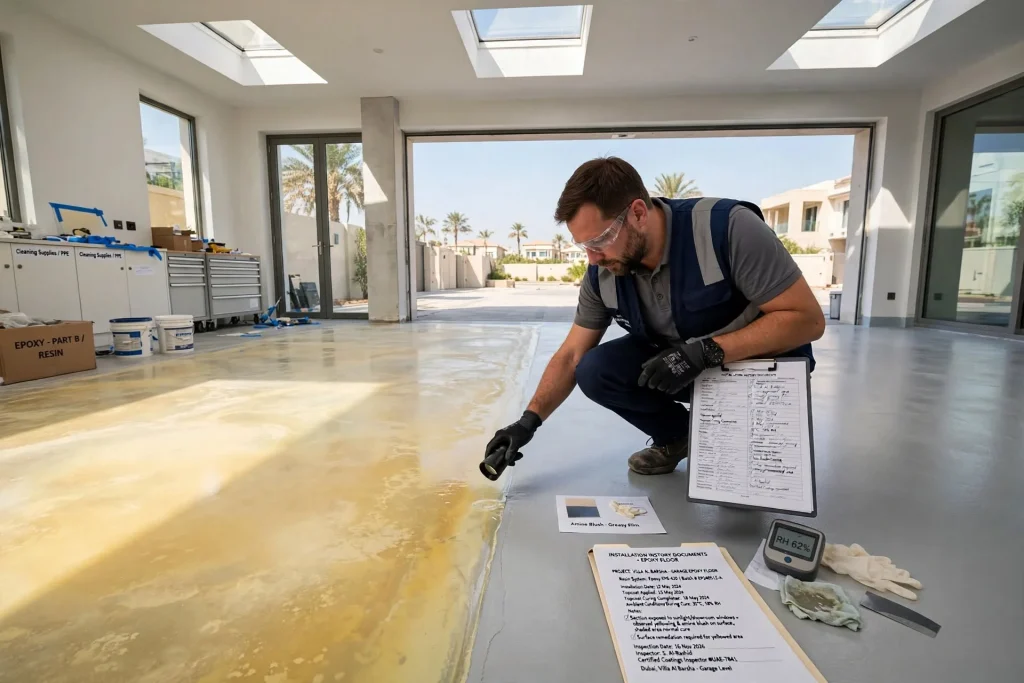
Check sunlight exposure: Identify whether the yellowing is concentrated in areas receiving direct sunlight through windows, doors or skylights.
Compare exposed and shaded sections: A noticeable difference between sunlight-exposed and protected areas may indicate UV-related discolouration.
Inspect the surface texture: A smooth colour change may indicate material ageing, while a cloudy or greasy film could suggest surface contamination or amine blush.
Review the installation history: The original resin system, installation date, topcoat specification and curing conditions can provide useful information.
Check for additional damage: Peeling, blistering, cracking, soft areas or delamination may indicate problems beyond simple colour changes.
A professional inspection can help determine whether cleaning, surface preparation, recoating or complete removal is required.
Can Yellowed Epoxy Flooring Be Restored?
In some cases, yellowed epoxy flooring can be improved, but the correct treatment depends on the reason for the discolouration.
If the problem is caused by surface contamination, suitable cleaning may restore some of the original appearance.
However, when UV radiation has chemically changed the epoxy resin itself, ordinary cleaning will not reverse the colour change.
Depending on the condition, restoration options may include the following.
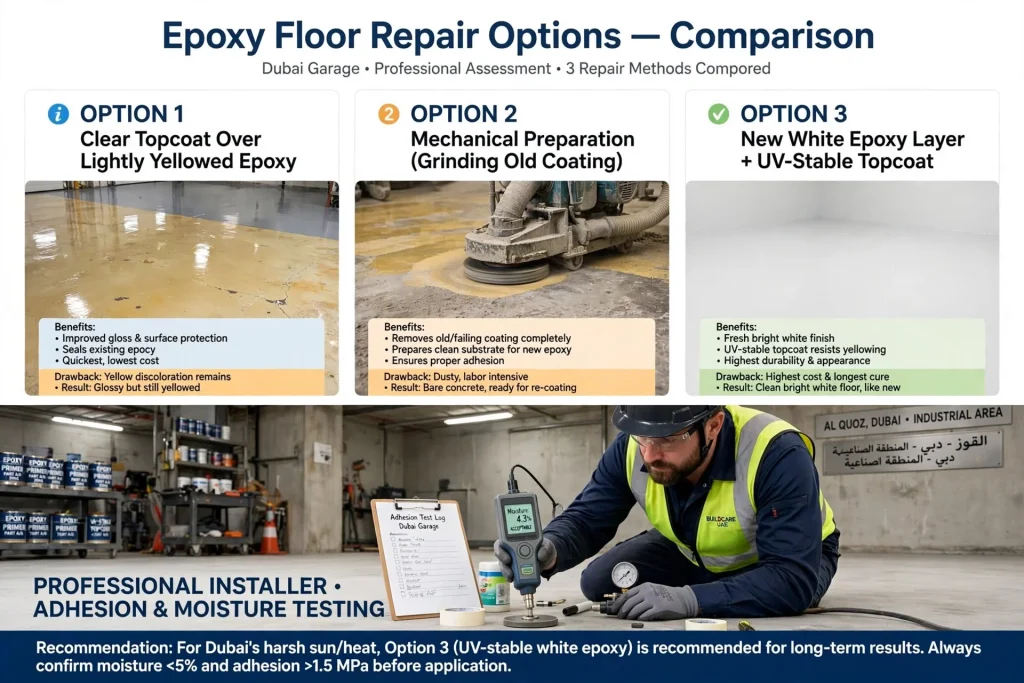
Surface Cleaning
Where the yellow appearance results from dirt, oil or chemical deposits, compatible cleaning products may help restore the original surface appearance.
The cleaning method should be tested in a small area before treating the entire floor.
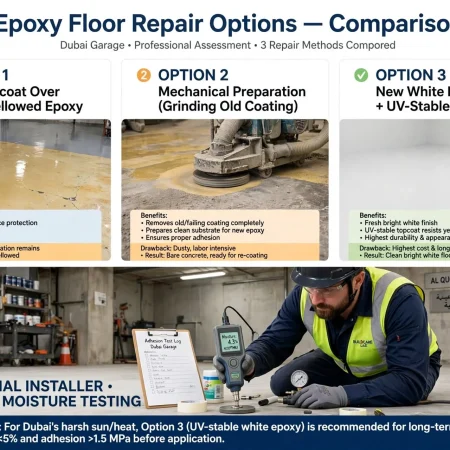
Applying a New Protective Topcoat
If the underlying epoxy remains sound but its surface finish has deteriorated, a compatible protective topcoat may improve the appearance and provide additional protection.
However, applying a clear topcoat over severely yellowed epoxy will not make the underlying coating white again.
Recoating the Existing Floor
If the colour change is extensive, the existing coating may require mechanical preparation and a new flooring layer.
The surface should be checked for adhesion, contamination, moisture and coating compatibility before recoating.
Removing and Replacing the Existing Coating
Where the coating has experienced severe discolouration, delamination or other major defects, complete removal may be the more appropriate option.
The concrete substrate should then be inspected and prepared before installing a new flooring system.
Common Mistakes to Avoid When Preventing Epoxy Yellowing
Some installation and material-selection mistakes can increase the risk of colour changes.
One common mistake is assuming that every epoxy product is UV-resistant. Different resin formulations have different exposure limitations, so product specifications should always be checked.
Another mistake is choosing a flooring system based only on its initial appearance. A bright white decorative finish may look excellent in a showroom, but its long-term colour stability depends on the resin chemistry and protective finish.
Applying an incompatible clear coating is another potential problem. Protective topcoats should be selected according to the manufacturer’s compatibility requirements.
Property owners should also avoid ignoring moisture issues, incorrect curing conditions and unsuitable cleaning chemicals.
Most importantly, contractors should not promise that a coating will never yellow under any circumstances. Even UV-resistant materials have performance limitations, and environmental exposure can affect long-term appearance.
What Should Property Owners Check Before Installing Epoxy Flooring?
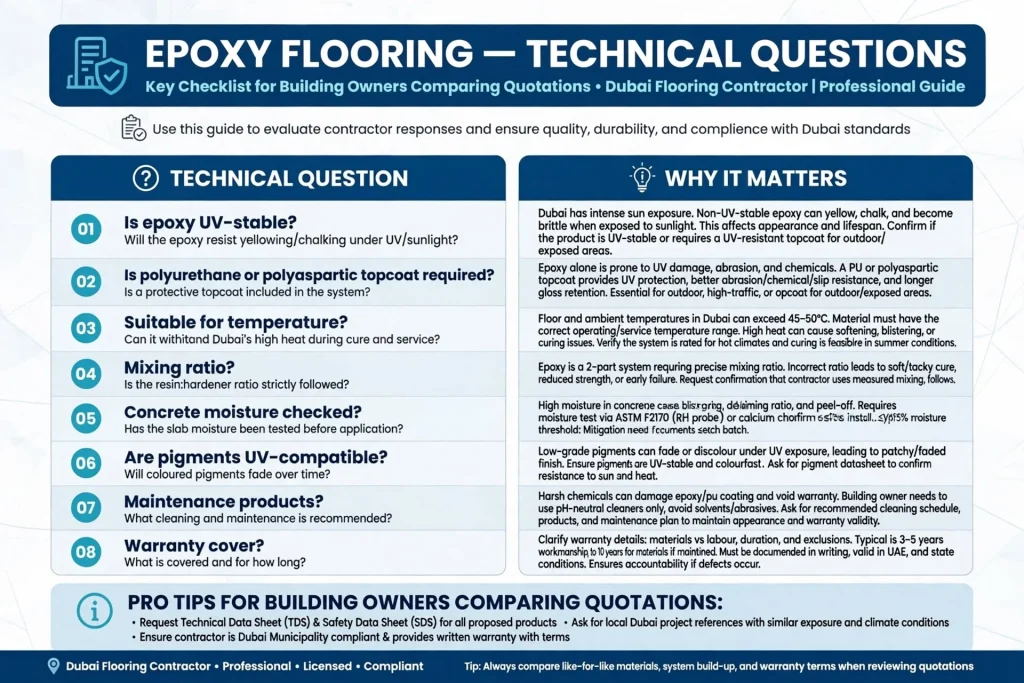
Before approving an epoxy flooring project in Dubai, property owners should ask their contractor several technical questions.
| Inspection question | Why it matters |
|---|---|
| Is the epoxy system UV-stable? | Helps assess colour stability |
| Is a polyurethane or polyaspartic topcoat required? | Provides an additional protective option |
| Is the product suitable for the intended temperature? | Reduces heat-related performance risks |
| What is the recommended mixing ratio? | Supports consistent curing |
| Has concrete moisture been checked? | Helps prevent moisture-related coating failures |
| Are the pigments UV-compatible? | Important for decorative and light-coloured finishes |
| What maintenance products are recommended? | Reduces the risk of chemical damage |
| What does the manufacturer’s warranty cover? | Clarifies performance expectations |
These questions can help building owners compare flooring quotations based on technical quality rather than simply the cost per square metre.
Choosing the Right Epoxy Flooring System for Different Dubai Properties
Different properties require different flooring specifications. A decorative floor in a residential villa does not necessarily need the same system as an industrial workshop.
Residential villas: Garages, utility rooms and selected interior spaces may benefit from decorative epoxy systems. For areas receiving direct sunlight, UV-resistant protective finishing should be considered.
Commercial showrooms: Colour stability and gloss retention are important where flooring forms part of the customer-facing interior design.
Warehouses: Abrasion resistance, forklift traffic, impact resistance and chemical exposure may be more important than decorative appearance.
Retail properties: Flooring should balance appearance, cleaning requirements, foot traffic and slip resistance.
Workshops: Resistance to oil, grease, chemicals and mechanical wear should be considered alongside colour stability.
For properties in Dubai Marina, Business Bay, Downtown Dubai, Al Quoz, Jebel Ali and Dubai Investment Park, a site-specific assessment helps determine the appropriate flooring materials and installation process.
Why Professional Epoxy Flooring Installation Matters
The performance of an epoxy flooring system depends on the complete installation process. Even high-quality materials may experience premature problems when the substrate is poorly prepared or application conditions are unsuitable.
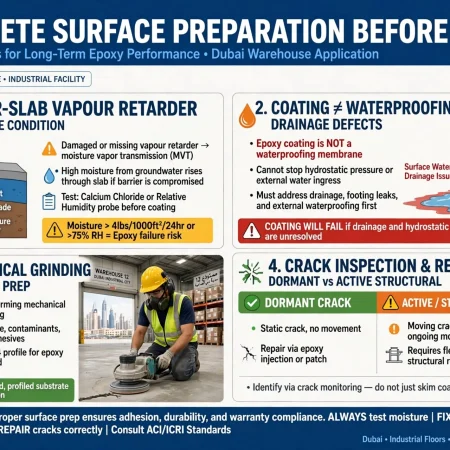
Professional installation should include concrete inspection, mechanical surface preparation, moisture assessment, crack repairs where required, correct primer selection, accurate resin mixing and controlled application.
The protective topcoat should also be selected according to the property’s environmental conditions.
For residential and commercial projects, working with an experienced contractor can help prevent avoidable installation mistakes and improve the consistency of the finished surface.
TriCircle Technical Services provides flooring solutions for different property requirements across Dubai. Property owners planning a new installation or upgrading an existing floor can explore the Epoxy Flooring Service to understand the available flooring applications and discuss suitable options for their property.
Maintaining Colour Stability in Epoxy Floors Across the UAE
Epoxy flooring can provide an attractive and durable finish, but maintaining its original colour requires suitable material selection and correct installation.
In Dubai, direct sunlight, elevated temperatures and demanding building environments make UV resistance an important consideration, especially for white, cream, light grey and decorative flooring systems.
The most effective approach is to select a suitable resin formulation, use compatible pigments, follow the correct mixing and curing procedures, and consider an aliphatic polyurethane or polyaspartic protective finish where appropriate.
Regular cleaning, compatible maintenance products and periodic inspections can also help preserve the floor’s appearance.
Whether the project involves a villa garage in Arabian Ranches, a commercial showroom in Business Bay or an industrial facility in Jebel Ali, the flooring specification should reflect the actual environmental and operational conditions.
A properly selected and professionally installed flooring system can help maintain a consistent appearance while providing the protection and performance required for everyday building use.