Hotels depend on several connected systems to deliver a comfortable guest experience while controlling energy consumption, maintaining building performance and supporting daily operations. Air conditioning, lighting, curtains, access control, fire alarms, ventilation and energy monitoring all contribute to the way a modern hotel operates. Two important technologies behind this infrastructure are the Guest Room Management System (GRMS) and the Building Management System (BMS).
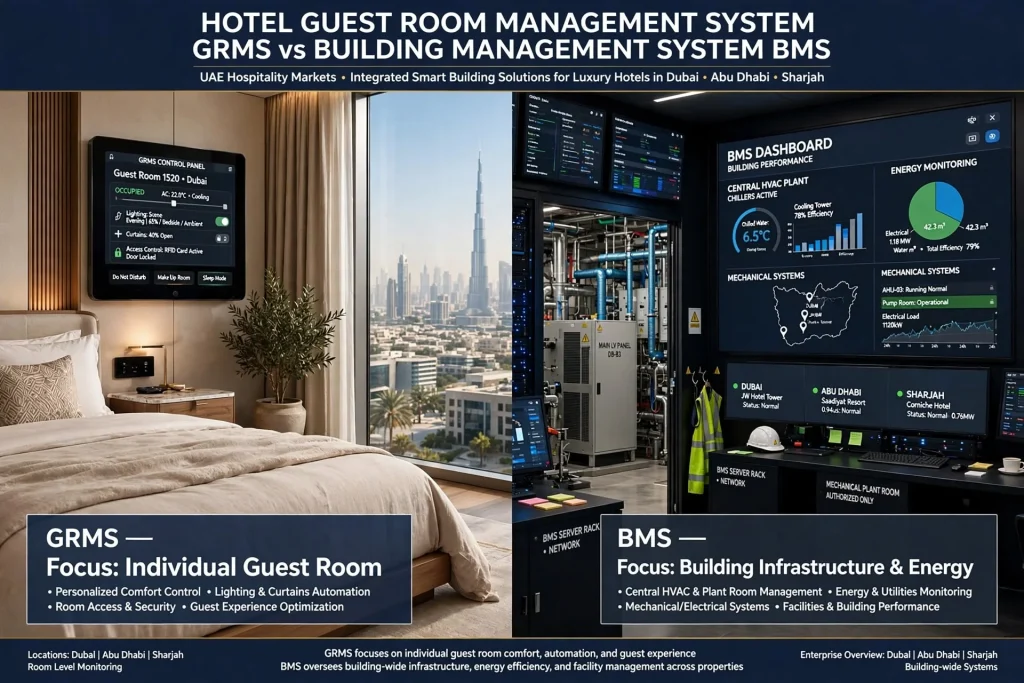
Although GRMS and BMS are closely related, they do not perform exactly the same functions. GRMS focuses primarily on individual guest rooms, allowing guests and hotel staff to control room conditions and automate selected services. BMS manages the wider building infrastructure, including central HVAC equipment, mechanical and electrical systems, plant rooms and shared facilities.
Understanding the difference is important when planning hotel automation in Dubai, Abu Dhabi, Sharjah and other UAE hospitality markets. A properly integrated GRMS and BMS can improve guest comfort, reduce unnecessary energy consumption, support maintenance teams and provide hotel operators with better control over building performance.
What Is a Guest Room Management System (GRMS)?
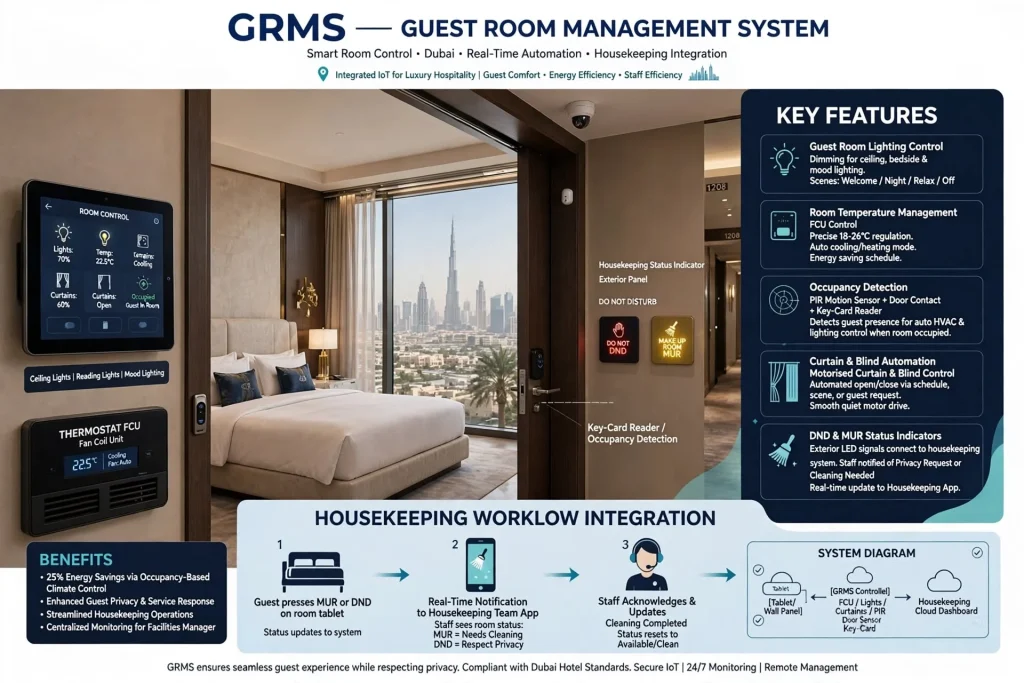
A Guest Room Management System, commonly called GRMS, is an automation platform designed to manage the operating conditions and selected electrical functions inside hotel guest rooms. It connects room-level equipment through controllers, sensors, switches, thermostats and communication networks.
The primary purpose of GRMS is to make each guest room comfortable, convenient and energy-efficient. Guests can use bedside panels, touchscreens, wall switches or approved mobile interfaces to control lighting, air conditioning, curtains and other room features.
For example, a guest staying in a hotel room in Downtown Dubai may use a bedside control panel to switch off the lights, adjust the temperature and close the curtains without moving around the room. When the guest leaves, an occupancy sensor or integration with the hotel’s Property Management System (PMS) can trigger an energy-saving room mode, depending on the configured operating logic.
Main Functions of GRMS in Hotels
GRMS can manage several functions within a guest room. The actual capabilities depend on the selected platform, room design and integration requirements.
Guest room lighting control: GRMS can operate ceiling lights, bedside lights, reading lights, decorative lighting and selected scene settings. A guest may select a welcome, relaxation, reading or all-off scene from a single interface.
Room temperature management: The system can communicate with the room thermostat and fan coil unit (FCU) controller to regulate heating or cooling. Temperature setpoints and operating modes can be adjusted according to occupancy, guest preferences and hotel policies.
Occupancy detection: Door contacts, key-card interfaces, passive infrared (PIR) sensors or other approved occupancy technologies can help identify whether a room is occupied. The system can use this information to adjust lighting and HVAC operation.
Curtain and blind automation: Motorised curtains and blinds can be connected to GRMS, allowing guests to control daylight and privacy through a wall panel or predefined scene.
Do Not Disturb and Make Up Room: GRMS can connect room-status indicators and internal switches to hotel housekeeping workflows. This helps staff understand whether a guest has requested privacy or room cleaning.
Guest comfort scenes: A single command can activate multiple functions. For instance, a welcome scene may switch on selected lights, adjust the thermostat and open the curtains according to the hotel’s preferred configuration.
How GRMS Improves the Guest Experience
Hotel automation should make the room easier to use rather than introduce unnecessary complexity. A well-designed GRMS gives guests convenient control over the main room functions through clearly labelled switches and intuitive interfaces.
This is particularly relevant to luxury hotels, serviced apartments and business hotels in locations such as Dubai Marina, Palm Jumeirah, Business Bay and Abu Dhabi Corniche. Guests may have different preferences for lighting levels, room temperature and privacy. Room automation provides a consistent way to manage these settings while allowing the hotel to maintain its operational policies.
GRMS can also help housekeeping and engineering teams understand room conditions without repeatedly entering the room. However, the exact information available depends on the sensors, integrations and permissions configured by the hotel.
What Is a Building Management System (BMS)?
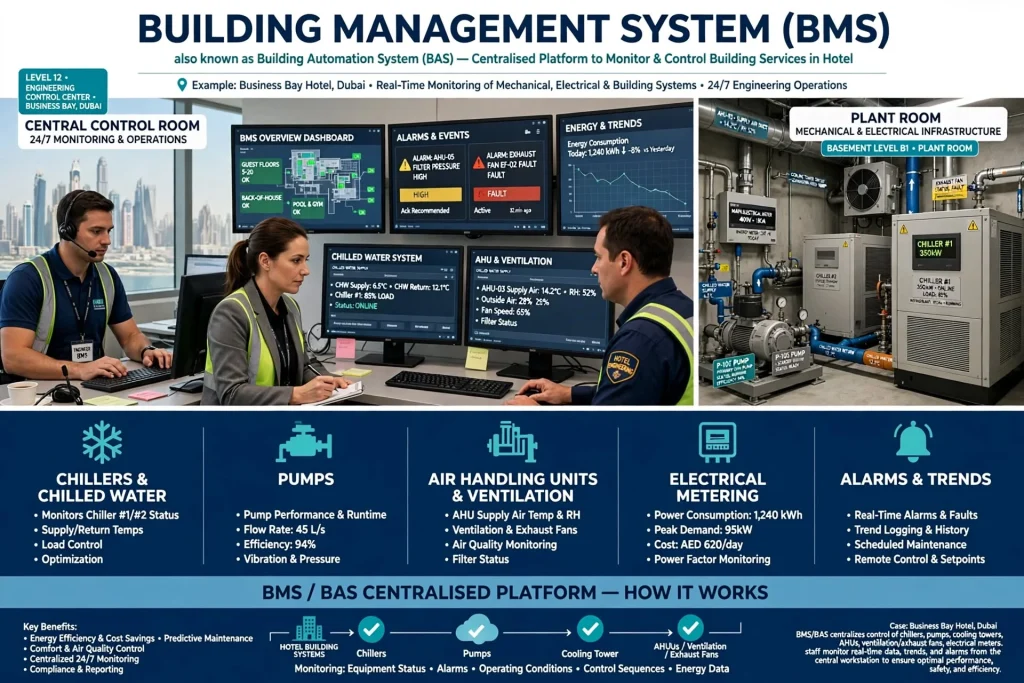
A Building Management System, also known as a Building Automation System (BAS), is a centralised platform used to monitor and control building services. In hotels, BMS typically manages mechanical, electrical and other building infrastructure across guest areas, back-of-house spaces and shared facilities.
Unlike GRMS, which concentrates on individual rooms, BMS operates at a wider building or system level. It provides facility managers and engineering teams with a central interface for monitoring equipment status, responding to alarms, reviewing operating conditions and managing selected control sequences.
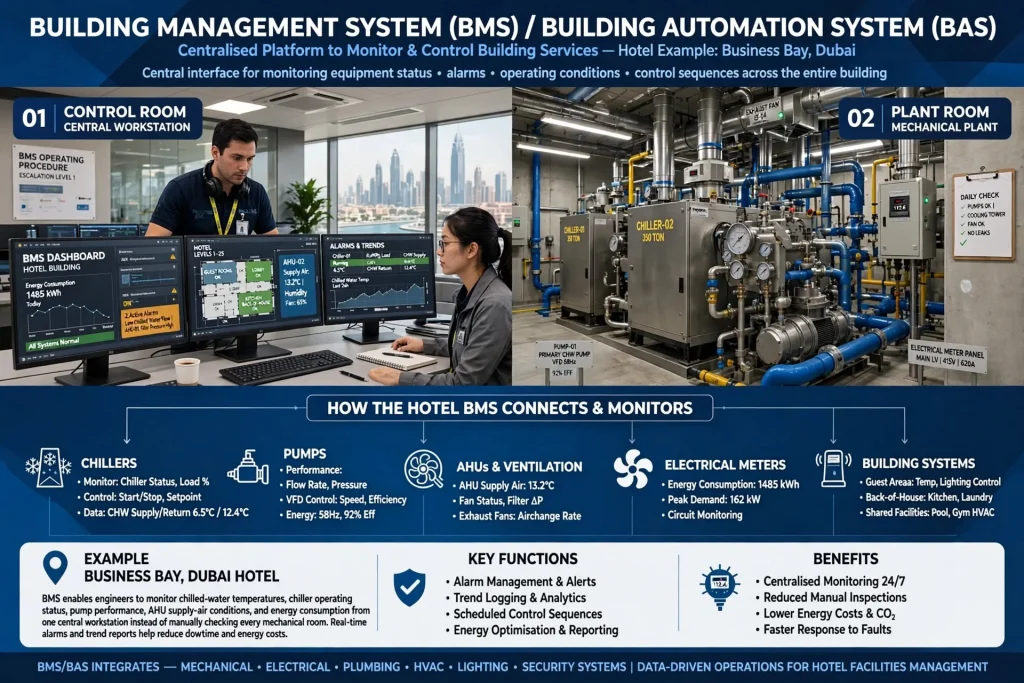
A hotel BMS may connect chillers, pumps, cooling towers, air handling units (AHUs), ventilation systems, exhaust fans, electrical meters and other compatible equipment. Integration depends on the building design, control architecture and equipment communication capabilities.
For example, a hotel in Business Bay may use BMS to monitor chilled-water temperatures, chiller operating status, pump performance, AHU supply-air conditions and energy consumption. Engineering staff can review alarms and operating trends from a central workstation instead of checking every mechanical room manually.
Main Functions of BMS in Hotel Buildings
Central HVAC monitoring: BMS can monitor and control compatible chillers, AHUs, FCUs, ventilation systems, pumps and other HVAC equipment. It helps engineering teams understand whether equipment is operating within its configured parameters.
Chiller plant management: In hotels with central cooling plants, BMS can monitor chiller status, chilled-water temperatures, pump operation, flow conditions and relevant alarms. Advanced control strategies may coordinate equipment operation based on demand and system design.
Ventilation and indoor air quality: BMS can monitor selected ventilation parameters, including temperature, humidity, carbon dioxide levels and fan status where suitable sensors are installed. It can also control ventilation equipment according to approved schedules and sequences.
Energy monitoring: Electrical meters and other compatible monitoring devices can provide consumption data for major building systems. This helps facility managers identify unusual usage patterns and investigate potential energy-saving opportunities.
Electrical system monitoring: Depending on the integration, BMS can monitor selected electrical distribution information, generator status, power consumption and equipment alarms. Critical electrical protection and switching functions remain under their dedicated systems unless specifically designed and approved for integration.
Water system monitoring: BMS may monitor water tank levels, pump operation, pressure and selected water-related alarms. It can help identify abnormal operating conditions, although water quality testing and treatment require separate procedures and equipment.
Alarm and fault management: A central BMS interface can display equipment faults, abnormal temperatures, pressure conditions and communication failures. This helps maintenance teams prioritise inspections and respond more efficiently.
GRMS vs BMS: Key Differences in Hotel Automation
GRMS and BMS are both automation technologies, but they have different operational responsibilities. The most useful distinction is that GRMS focuses on the guest-room experience, while BMS focuses on the wider building infrastructure.
| Comparison Area | GRMS | BMS |
|---|---|---|
| Main purpose | Guest room comfort and automation | Building services monitoring and control |
| Primary coverage | Individual guest rooms | Whole building or selected building systems |
| Main users | Guests, housekeeping and hotel operations | Facility managers and engineering teams |
| HVAC control | Room-level temperature and FCU control | Central HVAC plant and building-level systems |
| Lighting | Guest room lighting and scenes | Common-area and selected building lighting |
| Sensors | Occupancy, door, temperature and room controls | Temperature, humidity, pressure, flow, CO₂ and equipment sensors |
| Curtains | Guest room curtains and blinds | Usually not a primary BMS function |
| Energy management | Room-level energy-saving strategies | Building-wide energy monitoring and optimisation |
| Alarm handling | Room-level faults and status, where configured | Central equipment and building-system alarms |
| Integration | PMS, room controls, access interfaces and BMS | HVAC equipment, meters, GRMS and other building platforms |
| Main objective | Better guest experience and room efficiency | Reliable building operation and energy performance |
The two systems should not be treated as competing technologies. They are designed to address different layers of hotel operations and can work together through a properly planned integration architecture.
How GRMS and BMS Work Together in a Smart Hotel
A hotel can achieve better automation when guest-room controls and central building management share relevant information. GRMS handles room-level actions, while BMS provides wider operational visibility and manages compatible building equipment.
Consider a hotel with 250 guest rooms and a central chilled-water cooling system. Each room has an FCU, thermostat, occupancy sensor and lighting controller. GRMS manages the room’s temperature setpoint, lighting and occupancy-based operating mode. BMS monitors the central chiller plant, chilled-water pumps and AHUs serving public areas.
When a guest checks out, the hotel Property Management System can communicate the room status to the GRMS platform. Depending on the hotel’s control strategy, GRMS may change the room to an unoccupied mode and adjust the cooling setpoint. Relevant room demand or operating information can then be made available to BMS for wider monitoring or demand coordination.
This arrangement can help reduce unnecessary cooling while keeping the central HVAC system responsive to the building’s actual requirements. It is important to remember that room-level energy savings depend on correct sensor placement, control logic, guest comfort limits and commissioning.
Integration with the Property Management System (PMS)
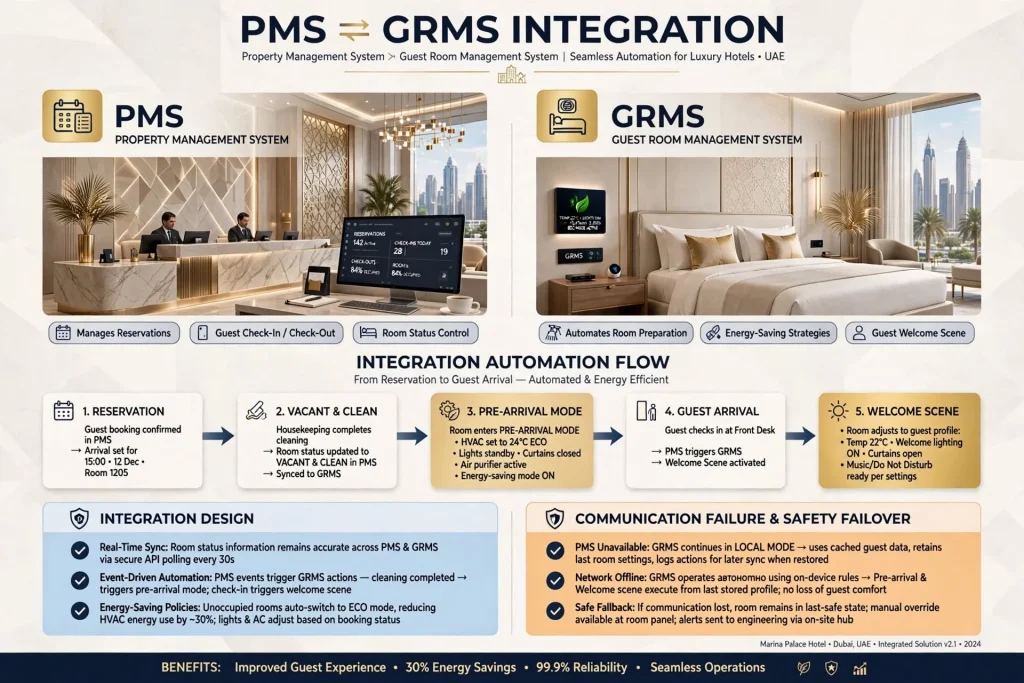
The PMS is an important part of hotel technology because it manages reservations, check-in, check-out and room status. When integrated with GRMS, it can provide information that supports automated room preparation and energy-saving strategies.
For example, a room marked as vacant and clean may be placed into a pre-arrival mode before the next guest checks in. When the guest arrives, the system may activate a welcome scene and adjust room conditions according to the hotel’s configured settings.
The integration should be designed carefully. Room status information must be accurate, communication failures should be handled safely and the hotel should define what happens when the PMS or network becomes unavailable.
Integration with HVAC and Chiller Systems
Hotel HVAC infrastructure often includes chillers, chilled-water pumps, cooling towers, AHUs, ventilation fans and guest-room FCUs. BMS can provide central monitoring and control for compatible equipment, while GRMS manages room-level temperature and fan-coil operation.
This separation is important because guest comfort and central plant performance are connected but not identical. A guest may request a lower room temperature, but the central cooling plant must still operate within its design limits.
A well-engineered system coordinates room demand with central plant operation without allowing guest-level controls to override critical equipment protection or approved operating sequences.
Integration with Lighting and Energy Management
GRMS can control guest-room lighting through occupancy sensors, switches and predefined scenes. BMS may manage lighting schedules in corridors, lobbies, parking areas, meeting rooms and other common spaces.
For example, a hotel in Dubai International Financial Centre may use different lighting schedules for guest rooms, reception areas, restaurants and meeting facilities. GRMS provides personalised room control, while BMS or a dedicated lighting management platform coordinates selected common-area systems.
Energy monitoring can then help hotel management compare consumption patterns and identify areas where operating schedules or control settings may need adjustment.
Benefits of GRMS for Hotels in the UAE
The UAE hospitality sector includes luxury resorts, business hotels, serviced apartments, city hotels and large mixed-use developments. These properties have different room layouts, occupancy patterns and guest expectations. GRMS can support hotel operations by combining room controls into a consistent and manageable platform.
Better Guest Comfort and Convenience
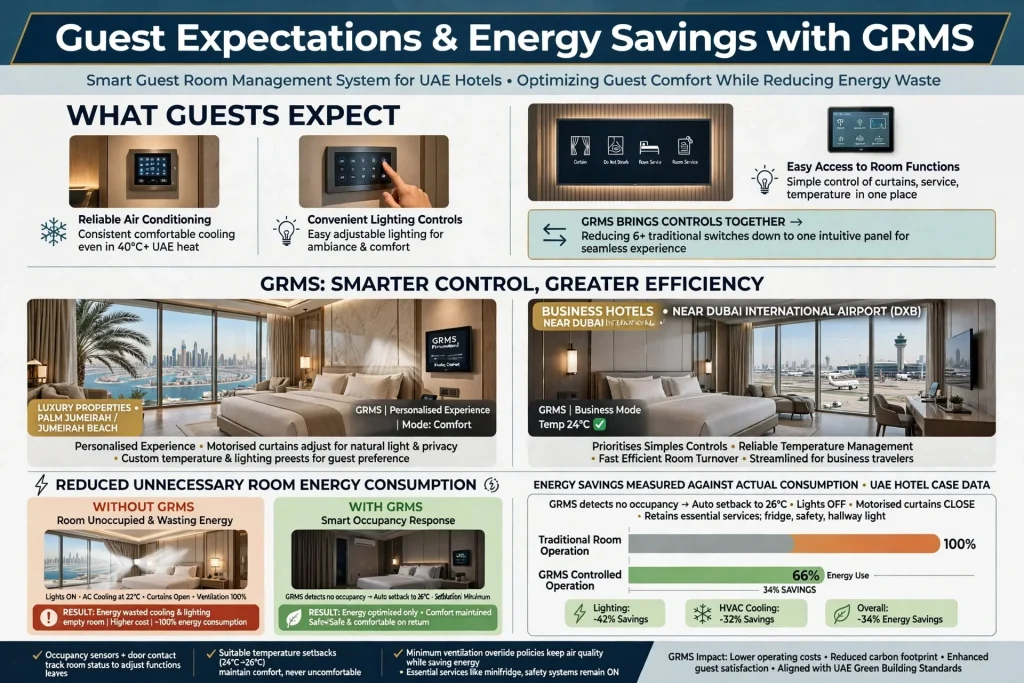
Guests expect reliable air conditioning, convenient lighting controls and easy access to room functions. GRMS brings these controls together, reducing the need for multiple switches and separate interfaces.
In luxury properties on Palm Jumeirah or along Jumeirah Beach, room scenes and motorised curtains can support a more personalised experience. Business hotels near Dubai International Airport may prioritise simple controls, reliable temperature management and efficient room turnover.
Reduced Unnecessary Room Energy Consumption
A room that remains fully illuminated and cooled while unoccupied may consume energy unnecessarily. GRMS can use occupancy information and room status to adjust selected functions when a guest leaves.
The system should not switch off essential services or create uncomfortable conditions. Hotels need suitable temperature setbacks, minimum ventilation requirements and clear override policies. Energy savings should be measured against actual consumption rather than assumed from the presence of automation alone.
Improved Housekeeping Coordination
Room-status indicators can help housekeeping teams identify Do Not Disturb and Make Up Room requests. When integrated with hotel operations software, this information can support more efficient room servicing and reduce unnecessary interruptions.
Consistent Room Operation
Hotels often have many rooms with similar equipment and control requirements. GRMS allows engineering teams to standardise selected settings, monitor compatible room devices and investigate recurring faults. This can be useful during new hotel openings, room renovations and refurbishment projects.
Benefits of BMS for Hotel Operations
BMS provides a broader view of building performance. It helps hotel engineering teams manage complex mechanical and electrical infrastructure through a centralised interface.
Better HVAC Plant Visibility
Cooling is a major operational consideration for hotels in Dubai, Abu Dhabi and other parts of the UAE. BMS can provide visibility into chiller status, pump operation, cooling tower conditions and AHU performance.
When a cooling issue affects multiple areas, central monitoring can help engineers identify whether the problem is related to the chiller plant, water circulation, air handling equipment or another connected system.
Energy Monitoring and Operational Improvements
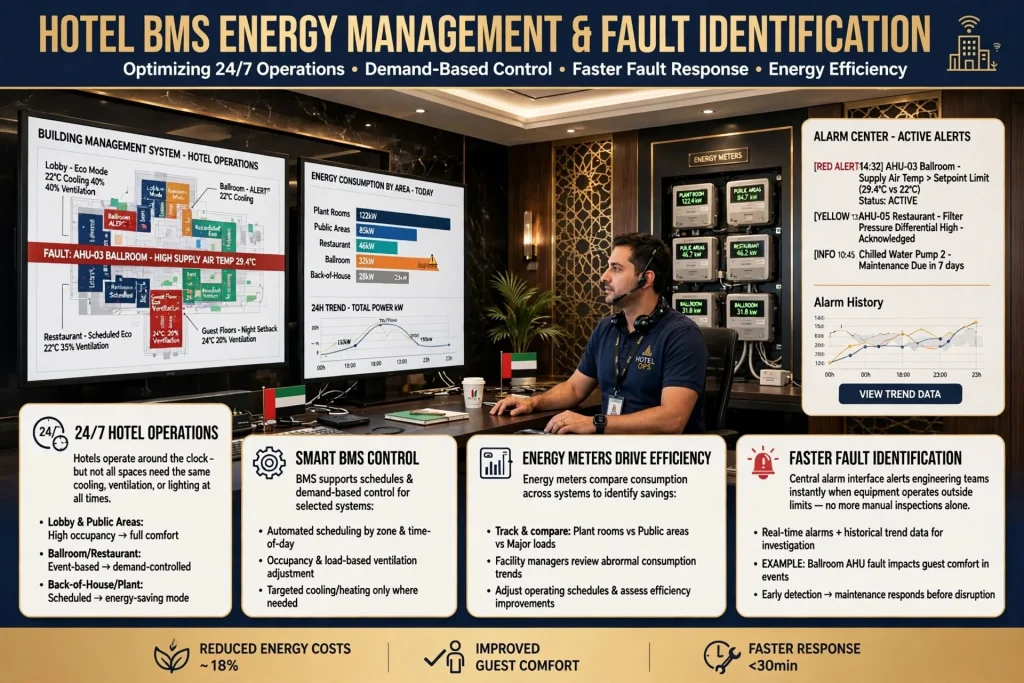
Hotels operate throughout the day, but not every space requires the same level of cooling, ventilation or lighting at all times. BMS can support schedules and demand-based control for selected systems.
Energy meters can help compare consumption across plant rooms, public areas and other major loads. Facility managers can use this information to investigate abnormal consumption, review operating schedules and assess the results of efficiency improvements.
Faster Fault Identification
A central alarm interface can alert engineering teams when monitored equipment operates outside its configured limits. Instead of relying entirely on manual inspections, staff can use alarm histories and trend data to investigate problems.
For example, an AHU fault in a ballroom or restaurant may affect guest comfort and hotel operations. Timely alarms can help maintenance teams respond before the issue becomes more disruptive.
Better Preventive Maintenance Planning
BMS trend logs and equipment status information can support maintenance planning. Repeated temperature deviations, frequent equipment alarms or unusual operating hours may indicate a developing issue.
However, BMS is not a replacement for physical inspections, scheduled servicing or manufacturer-recommended maintenance. It provides operational information that can make these activities more targeted.
GRMS vs BMS: Which System Does a Hotel Need?
Most modern hotels benefit from both systems, but the required configuration depends on the property size, room count, service level, building design and operational objectives.
A small hotel may need straightforward room controls and a limited BMS installation covering essential HVAC equipment. A large resort with hundreds of rooms, restaurants, meeting facilities, swimming pools and extensive mechanical infrastructure may require a more comprehensive automation architecture.
When GRMS Is the Priority
GRMS should be a priority when the main objective is to improve guest-room comfort and automate room functions. It is particularly useful for properties with multiple room types, motorised curtains, integrated lighting scenes and occupancy-based energy strategies.
Hotels undergoing room refurbishment may also consider GRMS upgrades to replace disconnected switches and standalone thermostats with a coordinated room-control platform.
When BMS Is the Priority
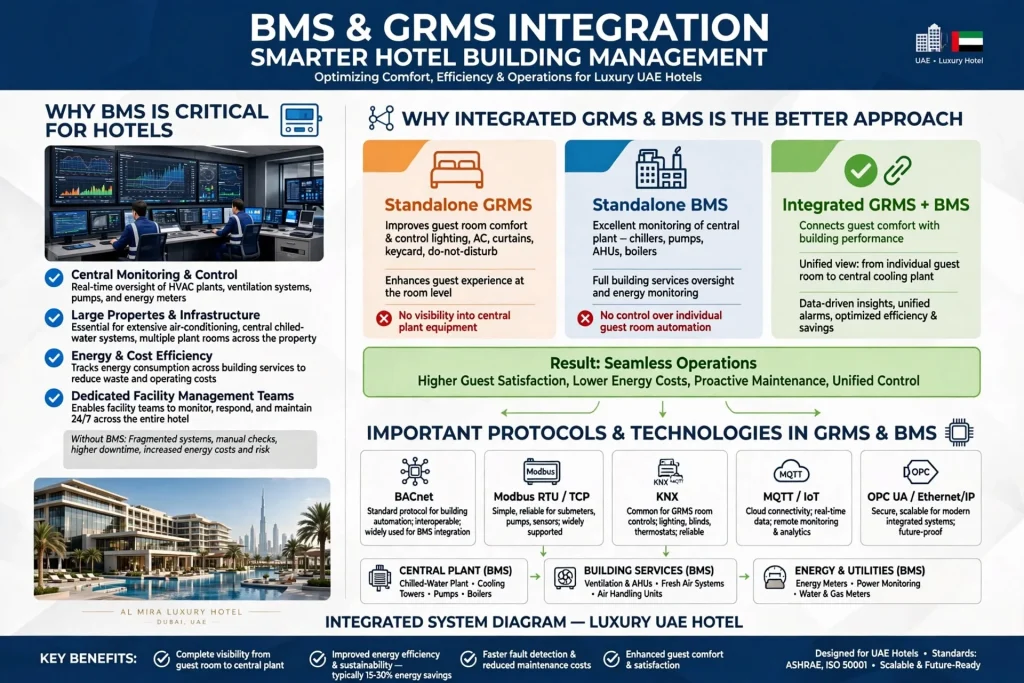
BMS is important when a hotel needs central monitoring and control of HVAC plants, ventilation systems, pumps, energy meters and other building services.
It is particularly valuable for large properties with central chilled-water systems, extensive air-conditioning infrastructure, multiple plant rooms and dedicated facility management teams.
Why Integrated GRMS and BMS Is Usually the Better Approach
GRMS and BMS solve different problems. Installing only GRMS may improve room comfort but leave engineering teams without sufficient visibility into central building equipment. Installing only BMS may provide excellent plant monitoring but fail to deliver convenient room-level automation.
An integrated solution connects guest comfort with building performance. It gives hotel operators a more complete view of how the property functions, from an individual guest room to the central cooling plant.
Important Protocols and Technologies Used in GRMS and BMS
Communication protocols determine how automation devices exchange information. The selected protocols influence system compatibility, integration costs, future expansion and maintenance requirements.
BACnet
BACnet is a widely used communication protocol for building automation. It supports communication between compatible HVAC controllers, BMS platforms and other building automation devices.
BACnet/IP operates over IP networks, while BACnet MS/TP commonly uses serial communication. Hotels may use BACnet to integrate chillers, AHUs, plant controllers and other building services, subject to equipment compatibility.
Modbus
Modbus is commonly used for exchanging data with meters, power analysers, HVAC equipment and industrial controllers. Modbus RTU typically uses serial communication, while Modbus TCP operates over Ethernet networks.
A hotel BMS may use Modbus to collect electrical consumption data or monitor equipment operating parameters.
KNX
KNX is used in building automation and can be applied to lighting, room controls, blinds and other functions. It is particularly relevant to projects where room automation and lighting control need to communicate through a standardised control network.
DALI and DALI-2
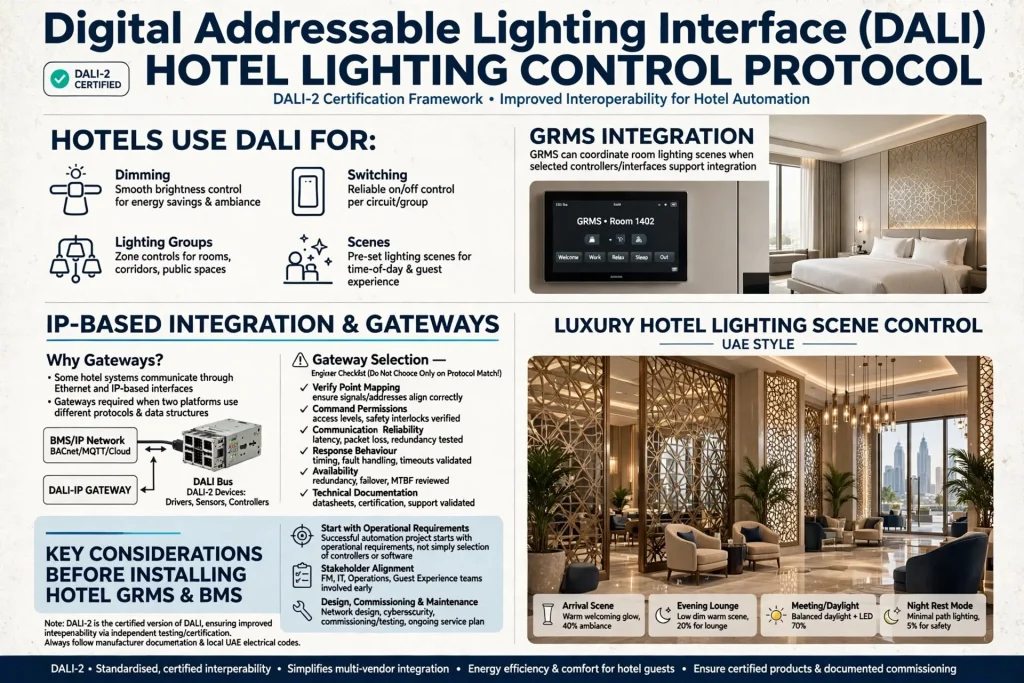
Digital Addressable Lighting Interface (DALI) is a lighting-control protocol used for controlling and monitoring compatible lighting devices. DALI-2 provides a certification framework for improved interoperability between compliant products.
Hotels may use DALI-based systems for dimming, switching, lighting groups and scenes. GRMS can coordinate room lighting scenes when the selected controllers and interfaces support the required integration.
IP-Based Integration and Gateways
Some hotel systems communicate through Ethernet and IP-based interfaces. Gateways may be required when two platforms use different protocols or data structures.
A gateway should not be selected only because two systems advertise support for the same protocol. Engineers must verify point mapping, command permissions, communication reliability, response behaviour and the availability of technical documentation.
Key Considerations Before Installing Hotel GRMS and BMS
A successful automation project starts with the hotel’s operational requirements, not simply the selection of controllers and software.
Room-by-room requirements: Define which functions guests should control, including lighting, temperature, curtains, room status and service requests. Different room categories may require different control sequences.
HVAC equipment compatibility: Confirm that GRMS controllers can communicate with the selected FCUs, thermostats, valves and other room equipment. Verify control signals and operating limits before installation.
BMS integration scope: Prepare a list of equipment, points, alarms, schedules and trends that need to be monitored. Agree on which system has authority over each control function.
Network and cybersecurity: Separate guest Wi-Fi from building automation networks where appropriate. Use controlled access, secure remote connections, updated firmware, documented credentials and network segmentation to reduce cyber risks.
System interoperability: Confirm that the selected GRMS, BMS, PMS and lighting systems can exchange the required information. Obtain protocol documentation and integration requirements before finalising procurement.
Future expansion: Consider whether the platform can support additional rooms, new equipment, upgraded controllers and future hotel facilities without requiring a complete replacement.
Commissioning and testing: Test every room function, sensor, alarm, communication link and operating sequence. Verify that guest controls behave correctly and that central plant equipment remains protected by its own safety and control logic.
Staff training: Hotel engineering, housekeeping and front-office teams need suitable training. Staff should understand room modes, alarm procedures, manual overrides and how to report automation faults.
Common GRMS and BMS Integration Problems in Hotels
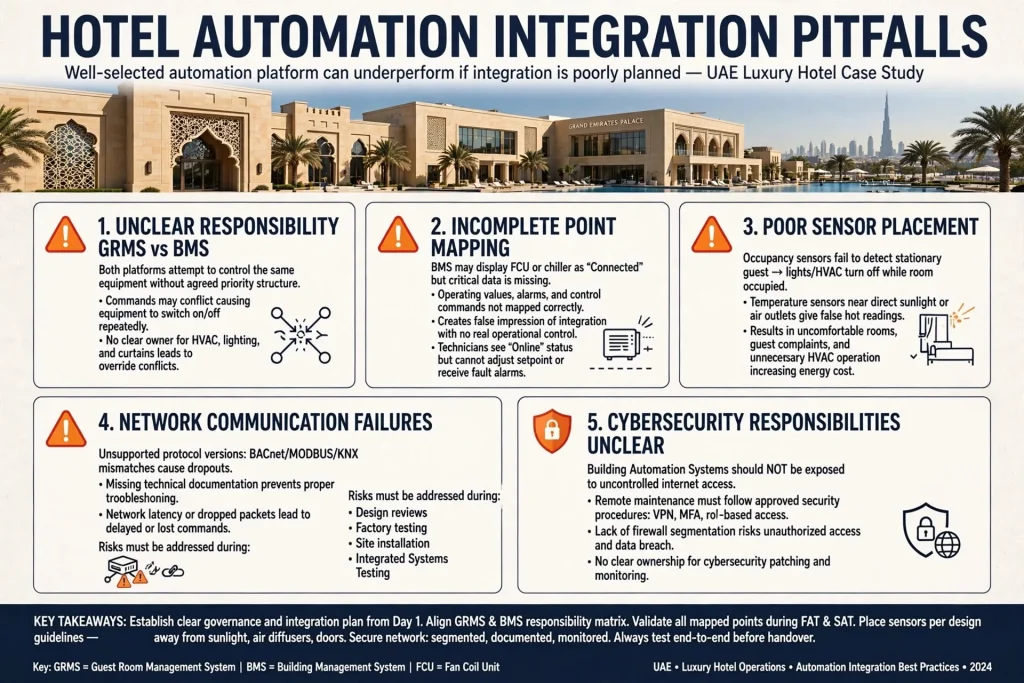
Even a well-selected automation platform can underperform if integration is poorly planned. One common problem is unclear responsibility between GRMS and BMS. If both platforms attempt to control the same equipment without an agreed priority structure, commands may conflict.
Another issue is incomplete point mapping. A BMS may display an FCU or chiller as connected, but important operating values, alarms or control commands may not be mapped correctly. This can create the impression of integration without delivering useful operational control.
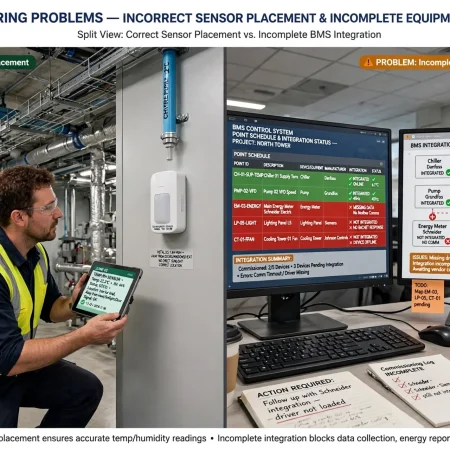
Poor sensor placement can also affect performance. Occupancy sensors may fail to detect a stationary guest, while temperature sensors installed near direct sunlight or air outlets may provide misleading readings. Incorrect settings can result in uncomfortable rooms or unnecessary HVAC operation.
Network communication failures, unsupported protocol versions and missing technical documentation can create further difficulties. These risks should be addressed during design reviews, factory testing where applicable, site installation and integrated systems testing.
Hotels should also establish clear cybersecurity responsibilities. Building automation systems should not be exposed to uncontrolled internet access, and remote maintenance should follow approved security procedures.
GRMS and BMS Applications Across UAE Hotels
Hotel automation requirements vary by property type and location. A beachfront resort on Palm Jumeirah may prioritise guest comfort, lighting scenes and curtain automation. A business hotel in Business Bay may focus on reliable room temperature control, central HVAC monitoring and efficient building operations.
Hotels near Dubai International Airport often operate with high room turnover and continuous building demand. GRMS can support room preparation and occupancy-based control, while BMS provides visibility into air-conditioning and ventilation infrastructure.
Properties in Downtown Dubai and DIFC may include restaurants, conference rooms, retail areas and extensive back-of-house facilities. These spaces require different operating schedules and environmental conditions. BMS can coordinate compatible building systems, while GRMS manages individual guest rooms.
In Abu Dhabi, Sharjah, Ajman and Ras Al Khaimah, the same principles apply. System selection should reflect the building’s mechanical design, room configuration, occupancy patterns, maintenance resources and long-term operating requirements rather than relying on a standard package for every hotel.
How Professional BMS Management Supports Hotel Performance
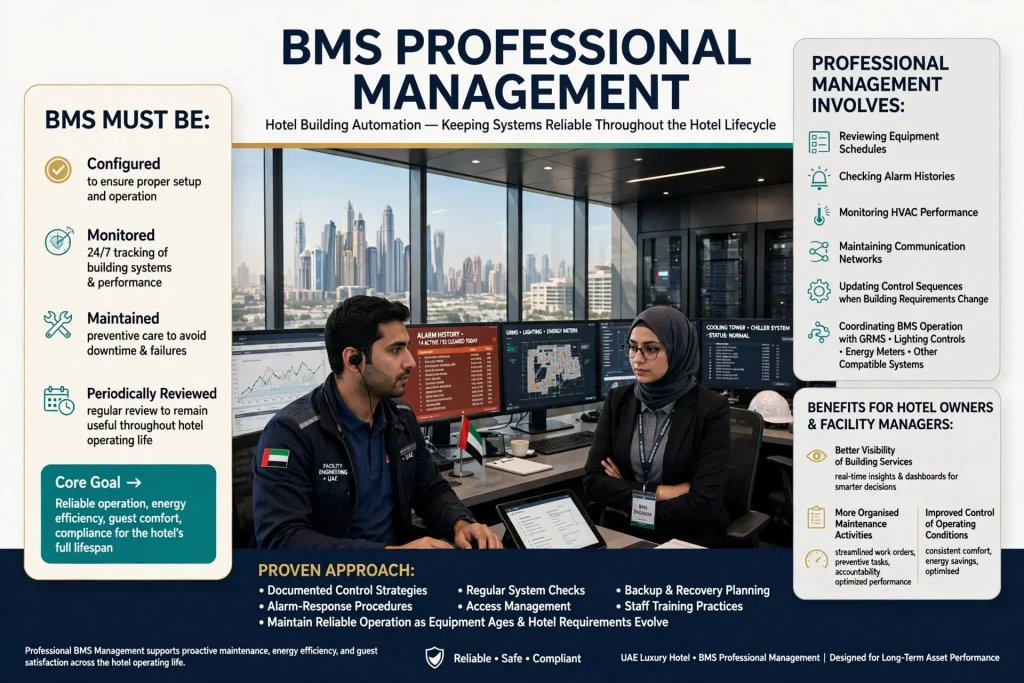
Installing a BMS is only one part of building automation. The system must be configured, monitored, maintained and periodically reviewed to remain useful throughout the hotel’s operating life.
Professional management involves reviewing equipment schedules, checking alarm histories, monitoring HVAC performance, maintaining communication networks and updating control sequences when building requirements change. It also includes coordinating BMS operation with GRMS, lighting controls, energy meters and other compatible systems.
For hotel owners and facility managers, BMS Professional Management can support better visibility of building services, more organised maintenance activities and improved control of operating conditions. The exact benefits depend on the system design, the quality of commissioning and how consistently the hotel team uses the available information.
A professional BMS management approach should include documented control strategies, regular system checks, alarm-response procedures, backup and recovery planning, access management and staff training. These practices help maintain reliable operation as equipment ages and hotel requirements evolve.
Frequently Asked Questions About GRMS and BMS
Is GRMS the same as BMS?
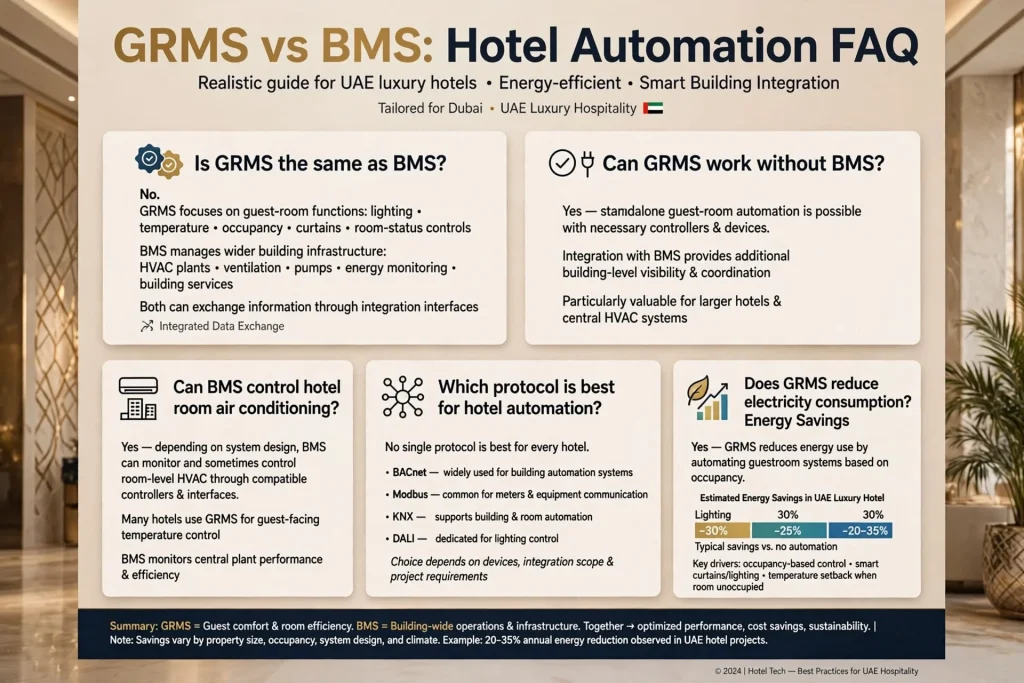
No. GRMS focuses on guest-room functions such as lighting, temperature, occupancy, curtains and room-status controls. BMS manages wider building infrastructure, including HVAC plants, ventilation, pumps, energy monitoring and other building services. Both systems can exchange information through suitable integration interfaces.
Can GRMS work without BMS?
Yes. GRMS can operate as a standalone guest-room automation platform if it has the necessary room controllers and devices. However, integration with BMS can provide additional building-level visibility and coordination, particularly in larger hotels with central HVAC systems.
Can BMS control hotel room air conditioning?
Yes, depending on the design. BMS can monitor and sometimes control room-level HVAC equipment through compatible controllers and interfaces. However, many hotels use GRMS for guest-facing temperature control while BMS monitors central plant performance and selected room-system information.
Which protocol is best for hotel automation?
There is no single protocol that is best for every hotel. BACnet is widely used in building automation, Modbus is common for meters and equipment communication, KNX supports building and room automation, and DALI is designed for lighting control. The appropriate choice depends on the devices, integration scope and project requirements.
Does GRMS reduce hotel electricity consumption?
GRMS can help reduce unnecessary energy use through occupancy-based lighting and HVAC control, room-status integration and temperature setbacks. Actual savings depend on room occupancy, equipment efficiency, sensor accuracy, control settings and guest behaviour. Energy performance should be measured after commissioning.
Can GRMS integrate with a hotel PMS?
Yes. Compatible GRMS platforms can exchange room-status information with a Property Management System. This can support check-in, check-out, room preparation and selected housekeeping workflows. The exact functions depend on the PMS, GRMS platform and integration interface.
Is GRMS necessary for a small hotel?
Not every small hotel needs a complex GRMS installation. However, room automation may still be useful when the property wants centralised room controls, occupancy-based energy management or improved guest convenience. The system should be scaled to the property’s actual requirements.
What should hotel owners check before selecting a BMS contractor?
Hotel owners should review the contractor’s experience with HVAC automation, chiller plants, AHUs, communication protocols, control panel design, integration testing and commissioning. They should also request a clear scope of work, equipment point schedule, network architecture, documentation, training plan and post-installation support arrangements.
Building a Connected and Efficient Hotel
GRMS and BMS play complementary roles in hotel automation. GRMS creates a more convenient and controlled guest-room environment, while BMS helps engineering teams monitor and manage the building’s wider infrastructure. When both platforms are properly designed and integrated, hotels can connect guest comfort with HVAC performance, energy monitoring and maintenance operations.
For hospitality developments across Dubai, Abu Dhabi, Sharjah and the wider UAE, the most effective automation strategy begins with a clear understanding of room-level and building-level requirements. Careful protocol selection, equipment compatibility checks, cybersecurity planning, commissioning and ongoing system management help ensure that hotel automation delivers practical value beyond the initial installation.