Choosing between tile adhesive and traditional cement mortar is an important decision in any tiling project. The material used to fix tiles affects bonding strength, installation quality, moisture resistance, durability, and the risk of tiles becoming loose or hollow over time. In Dubai and across the UAE, where high temperatures, air conditioning, humidity, and demanding construction conditions can affect building materials, selecting the right tile fixing method is particularly important.
Tile adhesive and cement mortar can both be suitable for certain applications, but they are not interchangeable in every situation. Tile size, tile material, substrate condition, room location, and exposure to water all influence which option will deliver better results. Understanding these differences helps homeowners, contractors, property developers, and facility managers make informed decisions for villas, apartments, bathrooms, kitchens, balconies, and commercial spaces.
What Is Tile Adhesive?
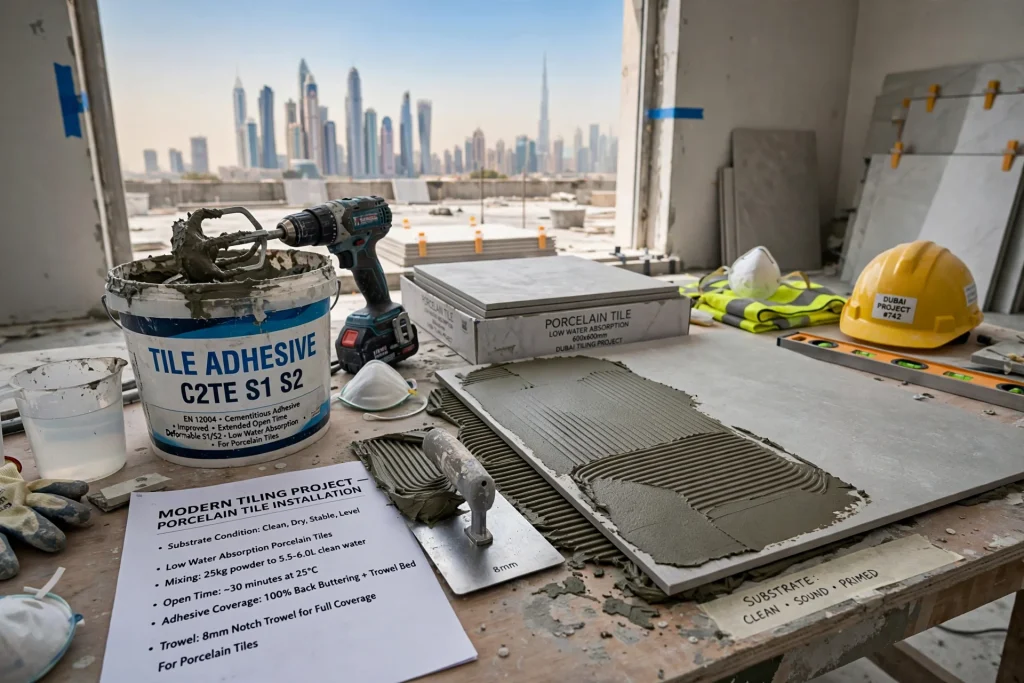
Tile adhesive is a specially formulated bonding material designed to fix ceramic, porcelain, stone, and other compatible tiles to floors and walls. It is commonly supplied as a dry powder that is mixed with water or a specified liquid additive. Some products are ready-mixed, although their suitability depends on the tile type and installation environment.
Cement-based tile adhesives generally contain cement, graded aggregates, and additives that improve workability, water retention, adhesion, and flexibility. Certain formulations include polymers that help the adhesive bond more effectively to suitable substrates and accommodate limited movement. Product performance varies, so installers should select an adhesive according to the manufacturer’s technical data sheet rather than relying on the product name alone.
Tile adhesive is widely used in modern construction because it allows installers to apply a controlled bonding layer. It is especially useful for porcelain tiles, large-format tiles, vertical surfaces, and areas where consistent installation thickness is important. Specialist products are available for wet areas, exterior installations, underfloor heating, and demanding commercial applications.
What Is Traditional Cement Mortar?
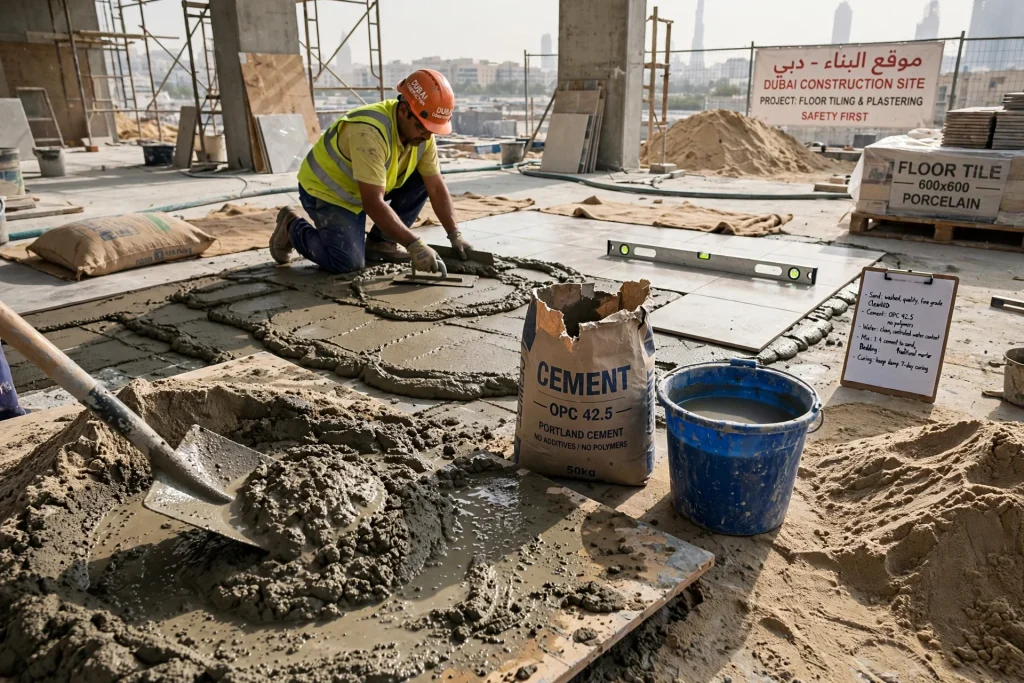
Traditional cement mortar is a mixture of cement, sand, and water. It has been used for decades in masonry, plastering, floor preparation, and tile installation. In traditional thick-bed tiling, the mortar provides a bedding layer that supports the tile and helps establish the required level.
Unlike formulated tile adhesive, ordinary cement-and-sand mortar does not necessarily contain the polymers and performance-enhancing additives found in modern adhesive products. Its bonding characteristics depend on the mixture proportions, sand quality, water content, substrate preparation, curing conditions, and installation technique.
Cement mortar may be appropriate for certain traditional installations, thick-bed applications, and projects where the specified tile system requires a mortar bed. However, ordinary mortar can be less reliable for dense porcelain tiles and other materials that absorb very little water unless the installation method is specifically designed for them.
It is also important to distinguish between ordinary cement mortar and engineered tile-setting mortar. Some specialist mortars are formulated and tested for particular tile applications. The correct comparison therefore depends on the exact products and installation systems being considered.
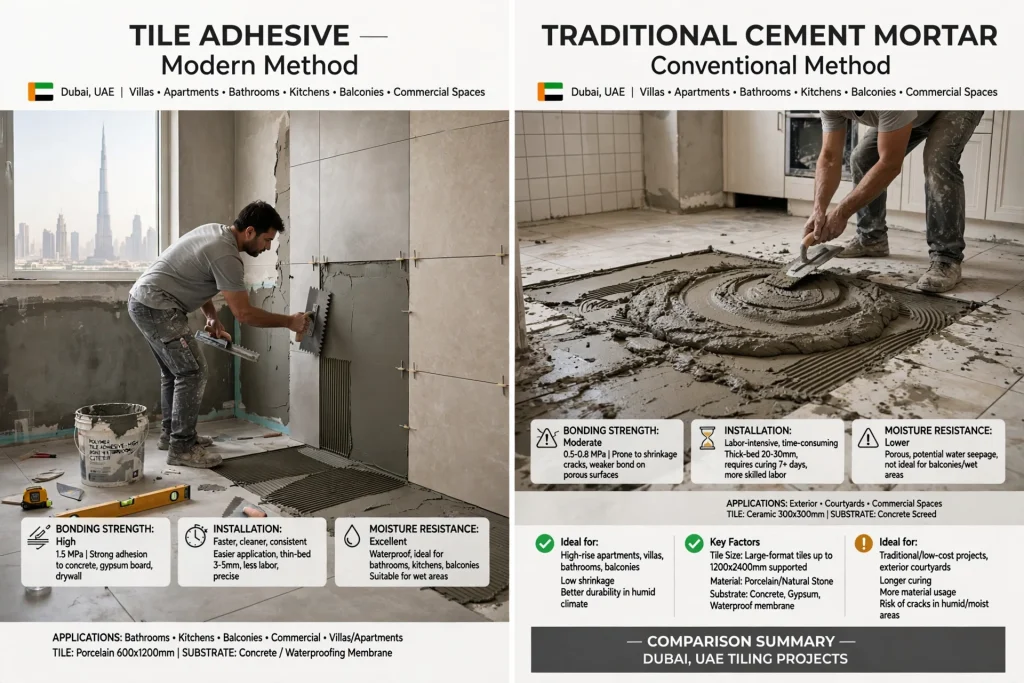
Tile Adhesive vs Cement Mortar: Key Differences
The main difference is that tile adhesive is formulated specifically for tile fixing, while traditional cement mortar is a more general-purpose construction mixture. Their performance depends on the tile, substrate, application thickness, and exposure conditions.
| Comparison factor | Tile adhesive | Traditional cement mortar |
|---|---|---|
| Bonding performance | Formulated for tile adhesion; varies by product class | Depends heavily on mix, preparation, and installation method |
| Installation thickness | Usually designed for a controlled, relatively thin bed | Can be used in thicker bedding applications where specified |
| Porcelain tiles | Often the preferred option when the product is rated for porcelain | Ordinary mortar may struggle to bond reliably to dense porcelain |
| Large-format tiles | Suitable when the adhesive is rated for tile size and weight | May be unsuitable for direct fixing without a designed bedding system |
| Vertical surfaces | Appropriate formulations can support wall tiles | Ordinary mortar can be difficult to use reliably on walls |
| Workability | Consistent when mixed and applied as directed | Depends on the mix proportions and site conditions |
| Curing | Requires the specified setting and curing period | Requires suitable curing and protection against rapid moisture loss |
| Material cost | Often higher per bag | May cost less as a basic material |
| Labour requirements | Controlled application can improve installation efficiency | Thick-bed methods can require more preparation and skill |
| Best use | Many modern ceramic and porcelain tile installations | Suitable traditional bedding and specified mortar-bed systems |
Neither material is automatically better for every project. A correctly specified mortar system can perform well, while an unsuitable adhesive can fail if the substrate is unstable, the product is incorrectly mixed, or the installation is exposed to conditions outside its rating.
Which Material Provides Better Bonding Strength?
For many modern tiling projects, a suitable tile adhesive provides more predictable bonding than ordinary cement mortar. This is particularly relevant when installing porcelain tiles, which typically have low water absorption. Traditional cement mortar often relies partly on mechanical bonding and the characteristics of the tile and bedding system, whereas formulated adhesives are designed to develop adhesion under specified conditions.
Bonding strength is not determined by the material alone. The condition of the substrate, adhesive coverage, mixing procedure, open time, tile back condition, and curing environment all influence the final result.
For example, a porcelain tile installed with an unsuitable adhesive over a dusty or weak screed may detach even if the adhesive itself is marketed as high performance. Similarly, a properly designed mortar-bed system can provide durable support when installed according to the relevant specification.
For demanding installations, look for recognised product classifications such as EN 12004, where applicable. Cementitious adhesives are commonly identified by a C classification, with additional designations indicating characteristics such as improved adhesion, extended open time, reduced slip, or flexibility-related performance. The exact classification required depends on the application and manufacturer’s guidance.
Is Tile Adhesive Better for Porcelain Tiles?
In many cases, yes. Porcelain tiles are dense, durable, and have very low water absorption. Their low porosity makes the choice of fixing material particularly important because conventional mortar may not develop a dependable bond using methods intended for more absorbent ceramic tiles.
A cement-based adhesive specifically rated for porcelain is generally a practical choice for porcelain floor tiles, bathroom walls, kitchen floors, and many commercial installations. Large-format porcelain slabs may require specialist adhesives and carefully controlled installation techniques to achieve the required coverage and support.
Installers should also check the porcelain tile manufacturer’s recommendations. Some products may require a particular adhesive classification, back-buttering, or a specialised system depending on their dimensions, weight, and installation location.
For natural stone, glass mosaics, and other specialist materials, the adhesive must also be compatible with the tile. Light-coloured marble, for example, may require a white adhesive to reduce the risk of discolouration. Resin-backed stone can have additional bonding requirements.
Tile Adhesive vs Cement Mortar for Floor Tiles
Floor installations need stable support, good contact between the tile and bedding material, and a substrate capable of carrying the expected loads. Tile adhesive is widely used for indoor floors in villas, apartments, offices, retail spaces, and hospitality properties.
It can be particularly beneficial when installing ceramic or porcelain tiles over a properly prepared concrete slab or cementitious screed. A suitable adhesive provides a controlled layer and can simplify the installation of tiles that require consistent support.
Traditional mortar beds can still be appropriate where a project requires a thicker build-up, slope formation, or a specified traditional flooring system. However, installers should not assume that ordinary mortar can simply replace a thin-bed adhesive on every floor.
Before fixing tiles, check that the floor is sufficiently strong, clean, and dry within the limits of the specified system. Unevenness should be corrected with an appropriate levelling compound or screed rather than using a standard thin-bed adhesive beyond its permitted thickness.
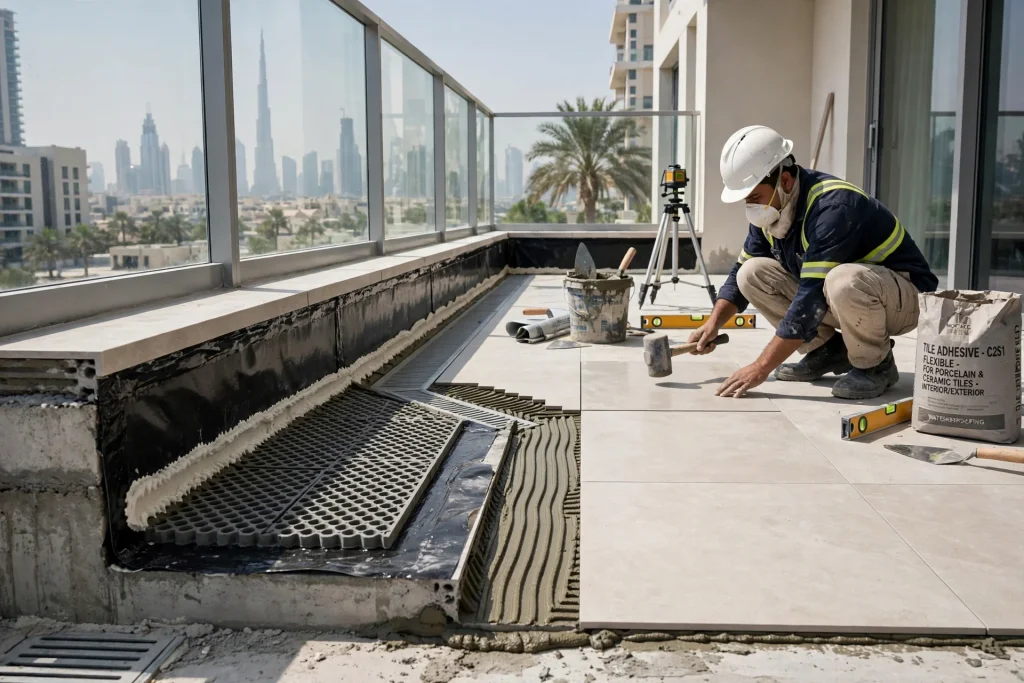
For exterior floors, terraces, and balconies, the installation must also account for drainage, waterproofing, thermal movement, and weather exposure. Selecting a stronger adhesive cannot compensate for poor falls, inadequate expansion joints, or a defective waterproofing layer.
Which Is Better for Bathroom and Kitchen Tiling?
Bathrooms and kitchens require particular attention because water, cleaning chemicals, temperature changes, and regular use can place additional demands on tile installations. A suitable tile adhesive is often the preferred choice for wall and floor tiles in these rooms.
However, water resistance in a tile adhesive does not automatically make the complete tiled assembly waterproof. Grout, movement joints, corners, penetrations, and the substrate all need appropriate detailing. Shower areas, wet rooms, and other regularly saturated locations may require a dedicated waterproofing membrane beneath the tiles.
In Dubai villas and apartments, installers should confirm that the adhesive is compatible with the waterproofing system. Some membranes require specific bonding products, primers, or installation procedures. Using incompatible materials can compromise the bond even when each product is suitable on its own.
Kitchen backsplashes may use a different adhesive from large porcelain bathroom floors. The correct choice depends on tile weight, surface condition, moisture exposure, and whether the tile is ceramic, porcelain, glass, or natural stone.
For reliable results, specify the full tiling system rather than selecting adhesive and grout independently without checking compatibility.
Tile Adhesive vs Cement Mortar in Dubai and the UAE
The UAE construction environment presents several practical challenges for tile installation. High outdoor temperatures, direct sunlight, air-conditioned interiors, coastal humidity, and rapid changes in surface temperature can affect materials and workmanship.
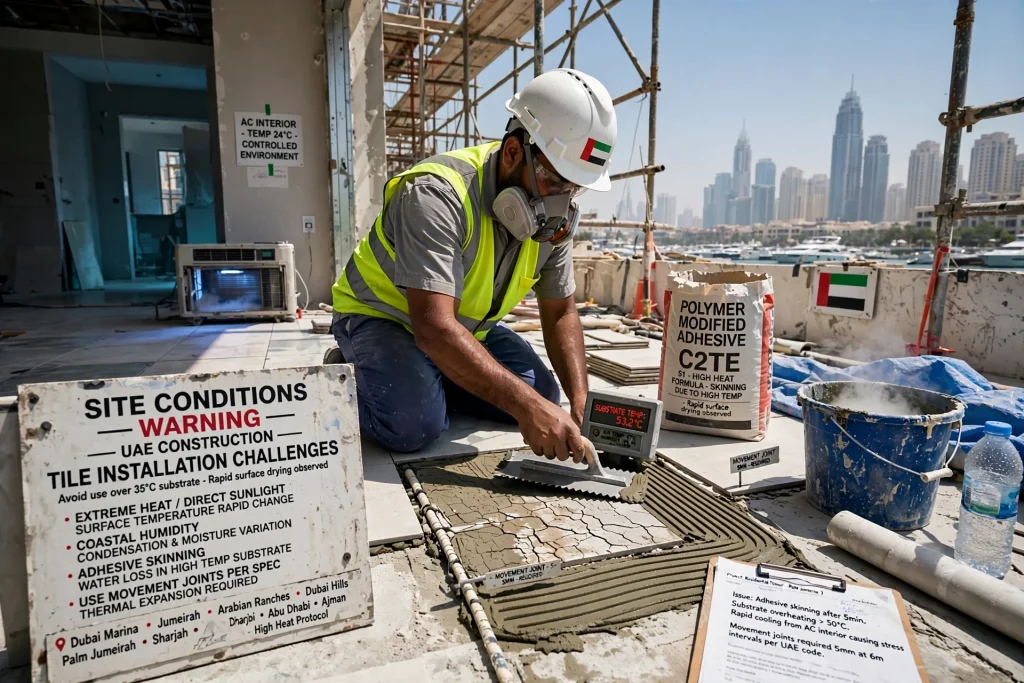
In Dubai, temperatures can rise substantially during summer. When tile adhesive is applied to a hot substrate, water may be lost more quickly, reducing the available time for placing tiles and potentially affecting adhesion. Adhesive that has developed a surface skin may no longer transfer adequately to the back of the tile.
Contractors should therefore follow the manufacturer’s temperature limits, avoid unsuitable installation conditions, protect materials from excessive heat, and mix only quantities that can be used within the specified working time. Adding water to material that has begun to set is not an acceptable way to restore its original performance.
In areas such as Dubai Marina, Jumeirah, Arabian Ranches, Dubai Hills Estate, and Palm Jumeirah, tile installations may also experience different combinations of indoor cooling, outdoor heat, moisture, and building movement. These conditions make appropriate substrate preparation, movement joints, and product selection important.
For properties in Sharjah, Abu Dhabi, and Ajman, the same principle applies: the adhesive or mortar system should be selected for the specific site conditions, tile material, and intended use. A product suitable for an air-conditioned living room may not be suitable for an exposed balcony or swimming pool surround.
What About Large-Format Tiles?
Large-format tiles are increasingly common in contemporary villas, luxury apartments, hotels, offices, and retail interiors. They create a continuous visual appearance with fewer grout lines, but their size makes installation more demanding.
Large tiles need an appropriate substrate, accurate setting-out, careful handling, and sufficient adhesive coverage. The adhesive must be approved for the tile’s dimensions and the installation orientation. Some applications may require a specialist deformable adhesive or another engineered system.
Installers often use a compatible back-buttering technique, applying adhesive to the back of the tile in addition to the substrate when specified. This helps achieve the required contact and reduces the risk of unsupported areas. The goal is not simply to use more adhesive but to obtain the coverage required by the applicable installation standard.
Ordinary cement mortar is not a universal substitute for a large-format tile adhesive system. Where a thick-bed installation is proposed, the contractor should confirm that the method is suitable for the tile and supported by the project specification.
Cost Comparison: Tile Adhesive vs Cement Mortar
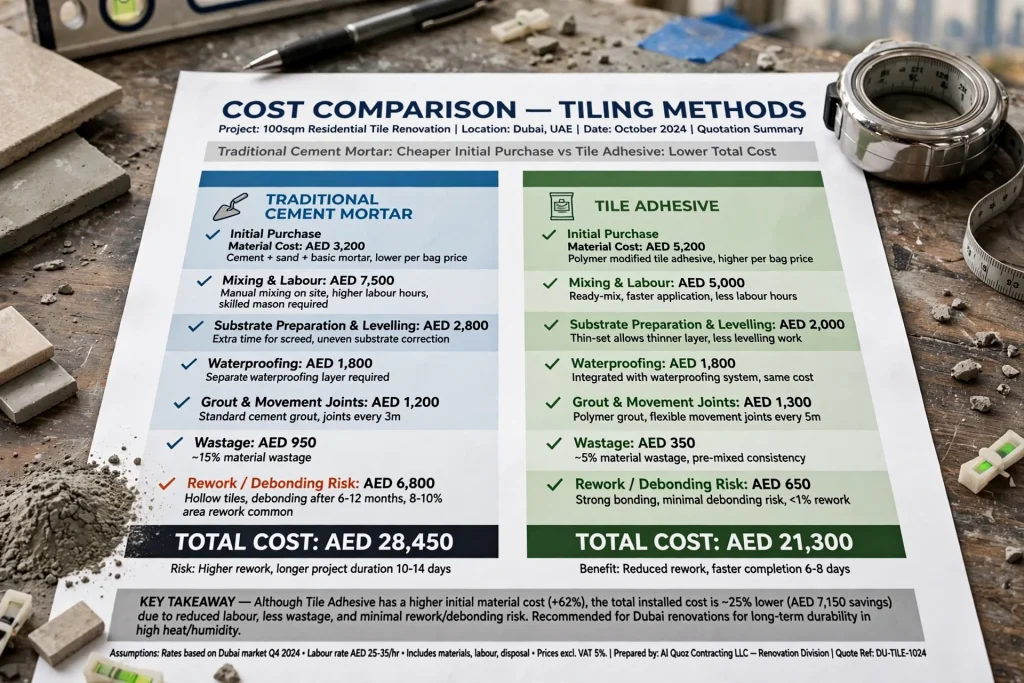
Traditional cement mortar can appear cheaper because cement and sand are widely available and their initial purchase price may be lower than that of a formulated adhesive. However, material cost alone does not determine the total cost of tiling.
Tile adhesive may reduce the amount of on-site mixing, improve installation consistency, and simplify work on suitable substrates. The actual savings depend on tile size, floor condition, labour rates, installation speed, and the product selected.
Cement mortar may be cost-effective in a properly designed thick-bed system, especially where substantial bedding or levelling is required. It can become less economical when inconsistent mixing, extended labour, rework, or tile debonding leads to additional expense.
A realistic quotation should consider the tile fixing material, substrate preparation, levelling, waterproofing, grout, movement joints, labour, wastage, and removal of defective work if necessary. It should also state whether floor preparation and slope correction are included.
For Dubai renovation projects, compare quotations based on the complete installation specification rather than choosing a contractor simply because the quoted adhesive or mortar cost is lower.
Common Tile Installation Problems and How to Prevent Them
Loose tiles, hollow-sounding areas, cracked grout, lippage, and adhesive failure can result from several different problems. The fixing material is only one part of the installation.
Loose or detached tiles can result from poor surface preparation, insufficient adhesive coverage, incompatible materials, or movement in the substrate. The solution is to identify the cause before replacing the tile.
Hollow-sounding tiles may indicate voids beneath the tile, but sound alone does not always prove that a tile has failed. The installer should assess the location, extent, movement, and condition of the installation before deciding on repairs.
Cracked grout can result from substrate movement, missing movement joints, excessive deflection, or poor grout selection. Replacing grout without addressing the underlying movement may not solve the problem.
Uneven tile surfaces can result from an unlevel substrate, inconsistent adhesive thickness, or poor installation technique. Correct the substrate before tiling instead of exceeding the adhesive’s specified thickness.
Adhesive failure in hot weather may occur when the material is applied outside its recommended temperature range or allowed to skin over before the tiles are placed. Follow the product’s open time and environmental requirements.
Proper surface preparation, correct mixing, suitable tools, adequate adhesive coverage, and compliance with technical instructions help prevent many of these issues.
How to Choose the Right Tile Adhesive or Mortar
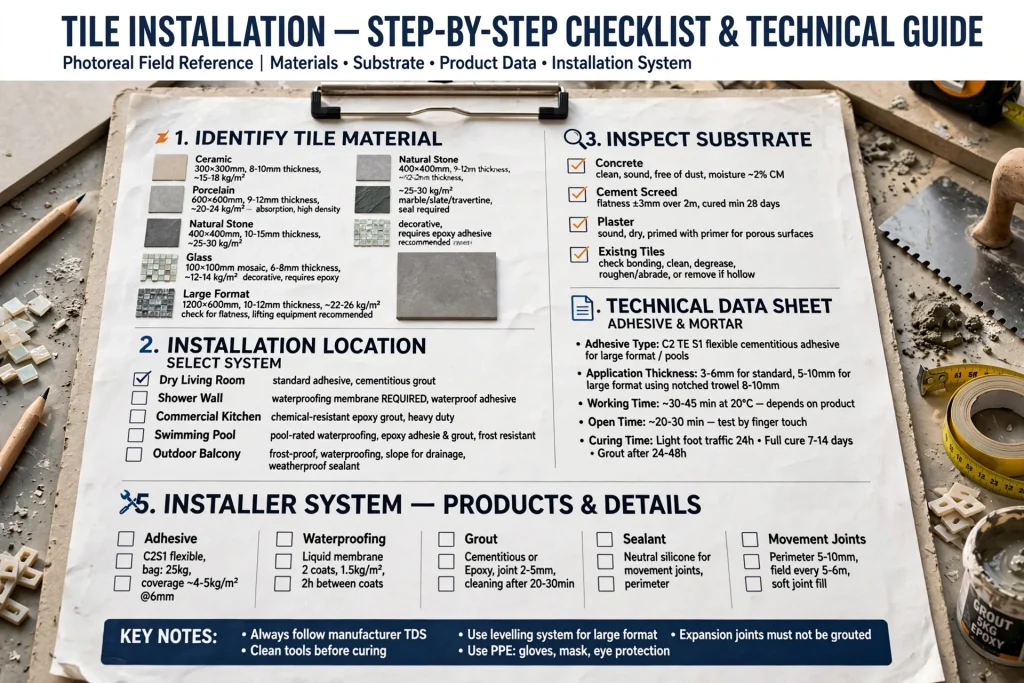
Start by identifying the tile material, size, thickness, and weight. Ceramic, porcelain, natural stone, glass, and large-format slabs may require different products. Confirm that the selected material is suitable for both the tile and the substrate.
Next, identify the installation location. A dry internal living room, a shower wall, a commercial kitchen, a swimming pool, and an outdoor balcony have different performance requirements. Exposure to water, chemicals, temperature variation, and movement must be considered.
Inspect the substrate to determine whether it is concrete, cement screed, plaster, an existing tiled surface, or another material. Check its strength, flatness, cleanliness, moisture condition, and compatibility with the proposed bonding system. Primers or preparation products may be necessary.
Review the technical data sheet for the adhesive or mortar. Important details include application thickness, working time, open time, curing requirements, permitted substrates, tile size limitations, and relevant performance classifications.
Finally, make sure the installer understands the entire system. Adhesive, waterproofing, grout, sealant, movement joints, and substrate preparation should work together. A qualified tiling contractor can help identify the appropriate products and installation method for the project.
Why Professional Tiling Installation Matters in Dubai
Professional tiling involves much more than spreading adhesive and placing tiles. A durable finish depends on measuring, setting-out, substrate inspection, cutting, levelling, joint alignment, waterproofing details, and appropriate curing.
In villa renovation projects, the contractor may also need to remove existing tiles, inspect the screed, repair damaged surfaces, adjust floor levels, or coordinate with plumbing and waterproofing work. These steps should be planned before new tiles are installed.
For homeowners planning bathroom upgrades, kitchen renovations, living room flooring, or full-villa improvements, selecting an experienced contractor can help reduce avoidable installation defects. If you are planning a renovation, explore a Professional Tiling Service in Dubai villa to understand the tiling support available for residential projects.
A reliable contractor should explain why a particular adhesive or mortar system is being recommended, identify any substrate preparation requirements, and provide a clear quotation covering labour, materials, and relevant finishing work. Product selection should be based on the installation conditions, not simply on whichever material has the lowest initial price.
Frequently Asked Questions
Is tile adhesive stronger than cement mortar?
A suitable tile adhesive can provide more consistent bonding for many modern tile installations, particularly porcelain tiles and wall applications. However, actual performance depends on the product, substrate, installation method, and exposure conditions. A correctly designed mortar-bed system can also be durable.
Can I use cement mortar instead of tile adhesive?
Sometimes. Cement mortar may be suitable for specified traditional bedding methods and certain installations. It should not automatically replace tile adhesive, especially for dense porcelain tiles, vertical surfaces, or large-format tiles. Check the tile manufacturer’s recommendations and the installation specification.
Which is better for porcelain tiles in Dubai?
A tile adhesive specifically rated for porcelain is generally a suitable starting point. The required product classification depends on tile dimensions, substrate, location, and exposure. High temperatures during installation must also be managed according to the manufacturer’s instructions.
Is tile adhesive waterproof?
Not necessarily. Some adhesives are suitable for wet environments, but they do not replace a dedicated waterproofing membrane where one is required. Bathrooms, showers, balconies, and swimming pools need a properly designed system with compatible products and correctly detailed joints.
Can tile adhesive be used on existing tiles?
Certain adhesives are designed for installing new tiles over existing tiles, provided the old surface is stable, clean, and compatible with the system. Loose tiles, contamination, poor adhesion, and changes in floor height must be assessed before work begins.
Why do tiles become loose after installation?
Common causes include inadequate adhesive coverage, dusty or weak substrates, incorrect mixing, exceeding the open time, moisture-related problems, and movement in the building or substrate. Identifying the cause is essential before carrying out repairs.
Is cement mortar cheaper than tile adhesive?
Cement and sand may have a lower initial material cost, but the total project cost also includes labour, surface preparation, installation time, wastage, and the risk of repairs. Compare complete installation costs rather than material prices alone.
How long should tile adhesive cure before grouting?
The waiting period depends on the adhesive formulation, tile size, substrate, temperature, humidity, and whether the installation is on a wall or floor. Follow the manufacturer’s technical data sheet rather than using a single curing time for every project.
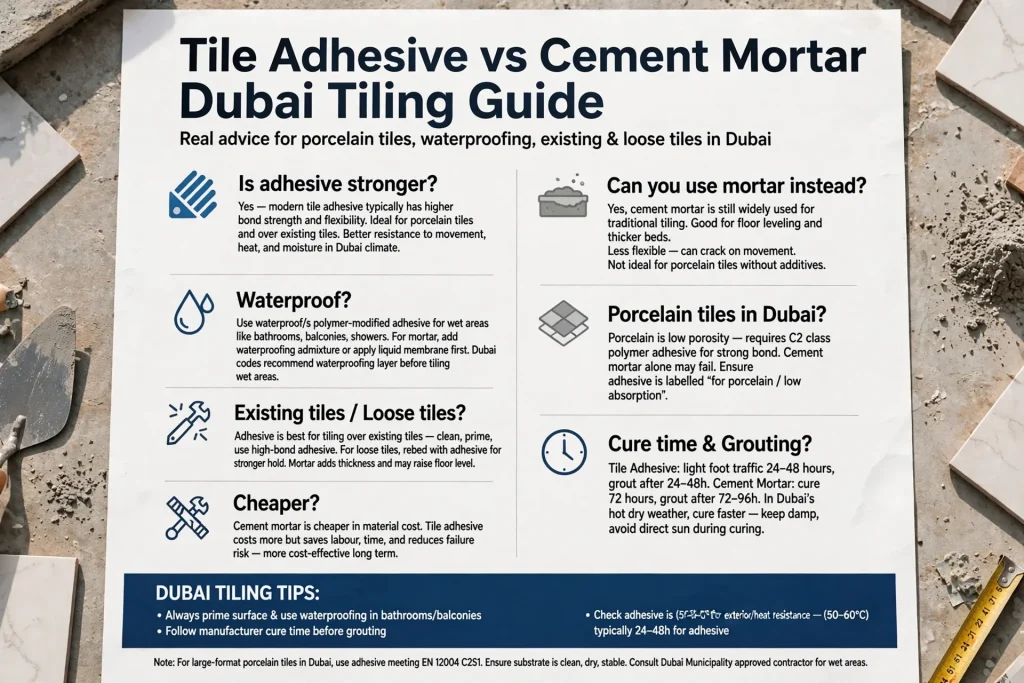
Final Verdict: Tile Adhesive or Cement Mortar?
For most modern ceramic and porcelain tile installations in Dubai villas, apartments, bathrooms, kitchens, and commercial interiors, a correctly selected tile adhesive is often the more practical option. Its formulated bonding properties, controlled application thickness, and availability of specialist products make it well suited to many contemporary tiling systems.
Traditional cement mortar remains useful for appropriate thick-bed applications and other specified construction methods. It should not, however, be treated as a direct replacement for tile adhesive in every installation.
The best choice depends on the tile, substrate, location, exposure conditions, and installation method. Selecting compatible materials, preparing the surface properly, achieving adequate coverage, and following manufacturer instructions are essential to a durable result. A properly specified installation system can help minimise loose tiles, reduce avoidable repairs, and deliver a reliable finish for years to come.