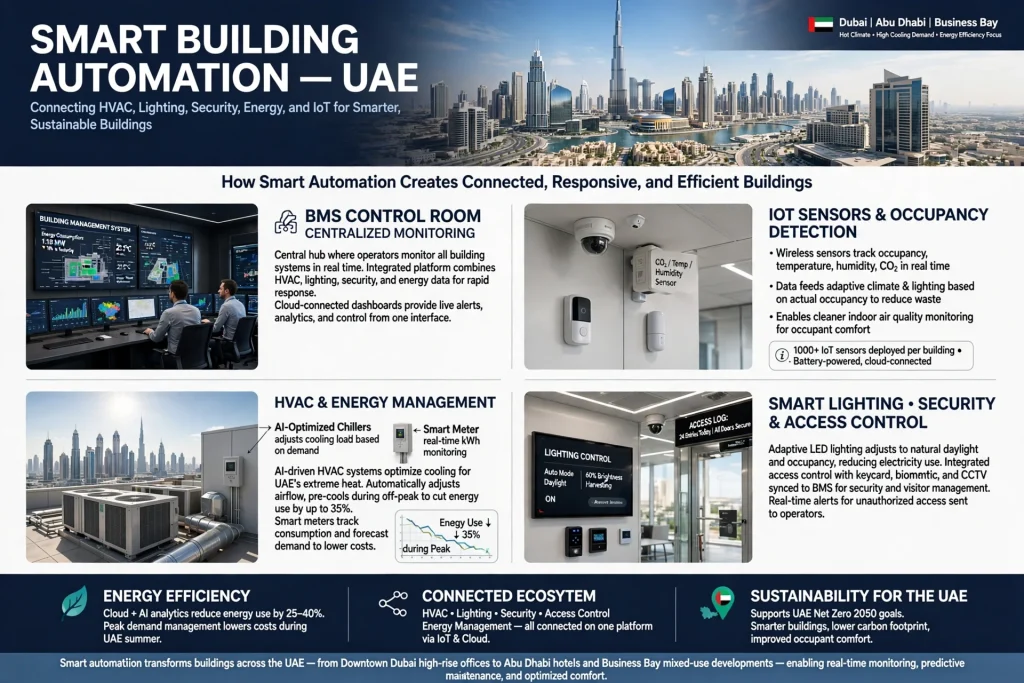
Smart building automation is changing how modern buildings across the UAE operate, consume energy, manage indoor environments, and respond to occupants. From high-rise offices in Downtown Dubai to hotels in Abu Dhabi and mixed-use developments in Business Bay, automated building systems are increasingly connecting HVAC, lighting, security, energy management, access control, and other building services through centralized and intelligent controls.
The UAE’s rapid development, hot climate, high cooling demand, and growing focus on energy efficiency make building automation particularly relevant. Modern Building Management Systems (BMS), Internet of Things (IoT) sensors, artificial intelligence, cloud platforms, smart meters, occupancy detection, and automated HVAC controls can work together to make buildings more responsive and easier to monitor.
Rather than treating every building service as an independent system, smart automation creates a connected environment where equipment can exchange information and building operators can make decisions based on real-time data.
What Is Smart Building Automation?
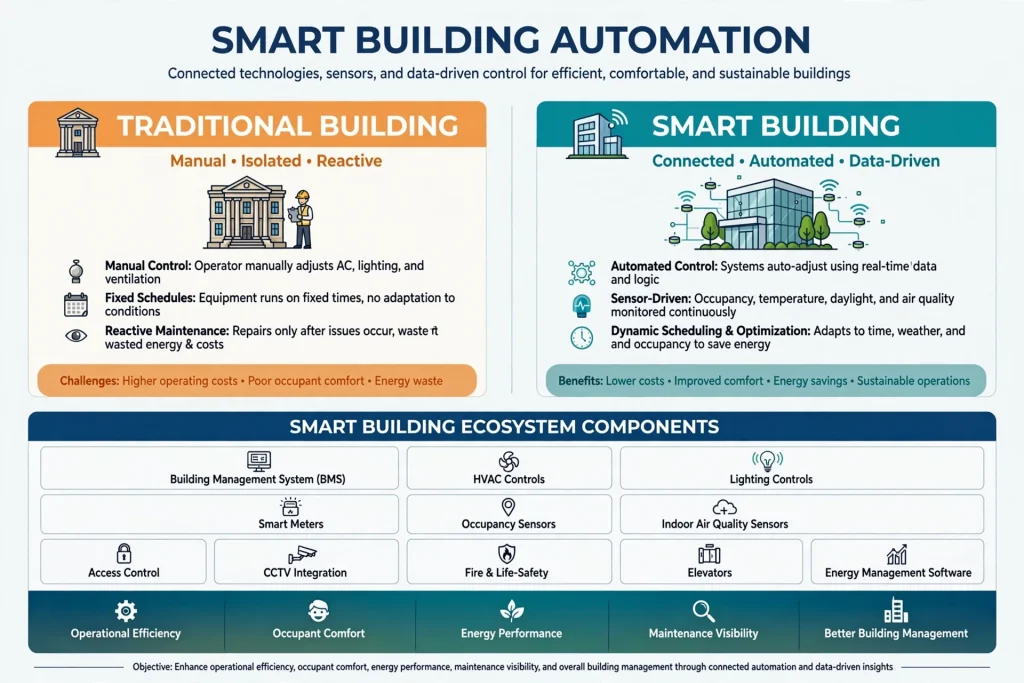
Smart building automation refers to the use of connected technologies, sensors, controllers, software, and communication networks to monitor and control building systems automatically.
A traditional building may require operators to manually adjust air-conditioning, lighting, ventilation, or equipment schedules. A smart building can use occupancy data, temperature sensors, time schedules, energy readings, daylight levels, and equipment status to automatically adjust these systems.
A typical smart building ecosystem may include a Building Management System, HVAC controls, lighting controls, smart meters, occupancy sensors, indoor air quality sensors, access control, CCTV integration, fire and life-safety interfaces, elevators, and energy management software.
The objective is not simply automation for its own sake. Effective building automation should improve operational efficiency, occupant comfort, energy performance, maintenance visibility, and building management.
Why Smart Building Automation Matters in the UAE
The UAE presents particular challenges for building owners and facility managers. Air-conditioning can represent a major part of building energy consumption because cooling is required for much of the year.
A commercial building in Dubai, Abu Dhabi, Sharjah, or another major UAE city may contain multiple chillers, air handling units, fan coil units, pumps, ventilation systems, lighting zones, elevators, and other mechanical and electrical equipment.
Without centralized monitoring, identifying inefficient operation can become difficult.
Smart automation allows facility teams to see operating conditions through dashboards and alarms. For example, a BMS can identify abnormal temperatures, equipment faults, excessive runtime, or unusual energy consumption.
This makes automation especially relevant for offices, shopping centres, hotels, hospitals, schools, warehouses, residential towers, airports, and mixed-use developments.
Building Management Systems and Smart Automation
The Building Management System remains one of the most important technologies within a smart building.
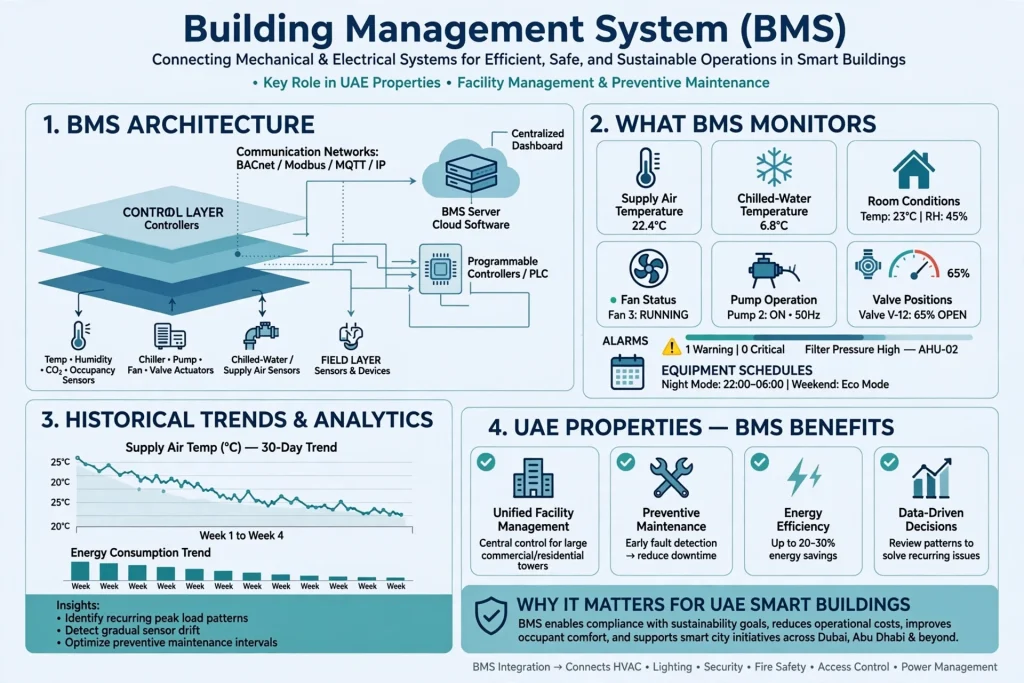
A BMS connects and supervises selected mechanical and electrical systems through controllers, sensors, communication networks, and software. HVAC is often a major part of the system, but modern BMS platforms can integrate many additional building functions.
Operators can monitor supply air temperature, chilled-water temperature, room conditions, fan status, pump operation, valve positions, alarms, and equipment schedules from a centralized interface.
A well-designed system can also provide historical trends. Instead of only seeing what is happening at a particular moment, facility managers can review operating patterns and identify recurring problems.
For larger UAE properties, BMS integration can become an important part of facility management and preventive maintenance.
IoT Sensors in Smart Buildings
The Internet of Things has expanded the amount of information that buildings can collect.
IoT sensors can monitor temperature, humidity, occupancy, carbon dioxide, air quality, light levels, energy consumption, water usage, equipment vibration, and other conditions.
Instead of relying on a small number of fixed measurements, a building can use distributed sensors to create a more detailed picture of its operating environment.
For example, occupancy sensors can help determine whether meeting rooms, offices, classrooms, or common areas are actually being used. HVAC and lighting controls can then respond to occupancy conditions where the system has been properly designed and commissioned.
IoT connectivity can also make data available through cloud-based dashboards, depending on the building’s network architecture and cybersecurity requirements.
AI and Predictive Building Automation
Artificial intelligence and machine learning are increasingly being applied to building data.
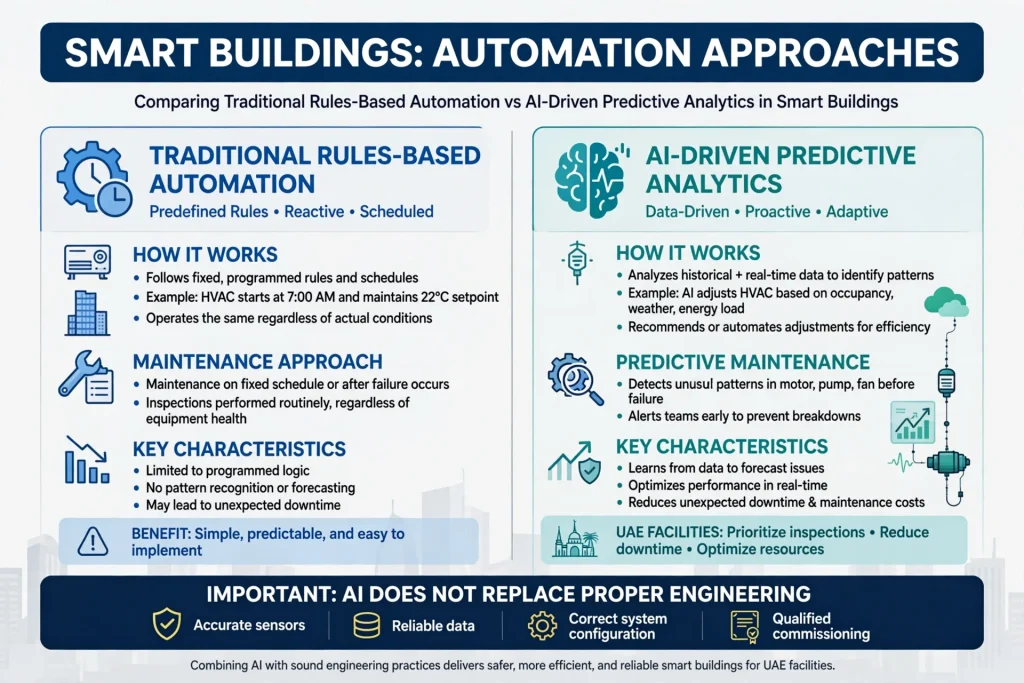
Traditional automation follows predefined rules. For example, an HVAC system may start at a scheduled time and maintain a specified temperature.
AI-assisted systems can analyze historical and real-time information to identify patterns and recommend or automate adjustments.
Predictive analytics can also support maintenance. If a motor, pump, fan, or other component begins showing unusual operating characteristics, software may identify the pattern before a complete failure occurs.
For UAE facilities with extensive mechanical equipment, predictive maintenance can help teams prioritize inspections and reduce unexpected downtime.
However, AI does not replace proper engineering. Accurate sensors, reliable data, correct system configuration, and qualified commissioning remain essential.
Smart HVAC Controls for UAE Buildings
HVAC automation is particularly important in the UAE because cooling systems operate under demanding environmental conditions.
Smart HVAC controls can coordinate chillers, pumps, cooling towers, AHUs, FCUs, VAV systems, thermostats, dampers, and valves depending on the building design.
Variable frequency drives can adjust motor speed according to demand rather than continuously operating equipment at full capacity.
Demand-based ventilation can use occupancy or carbon dioxide information to adjust outside-air ventilation where appropriate.
Zone-level controls can also prevent unnecessary cooling in unoccupied spaces.
In large Dubai developments, intelligent HVAC coordination can provide facility teams with greater visibility into chilled-water systems, air distribution, temperatures, pressure conditions, and equipment schedules.
Smart Lighting and Automated Lighting Controls
Smart lighting is another important component of building automation.
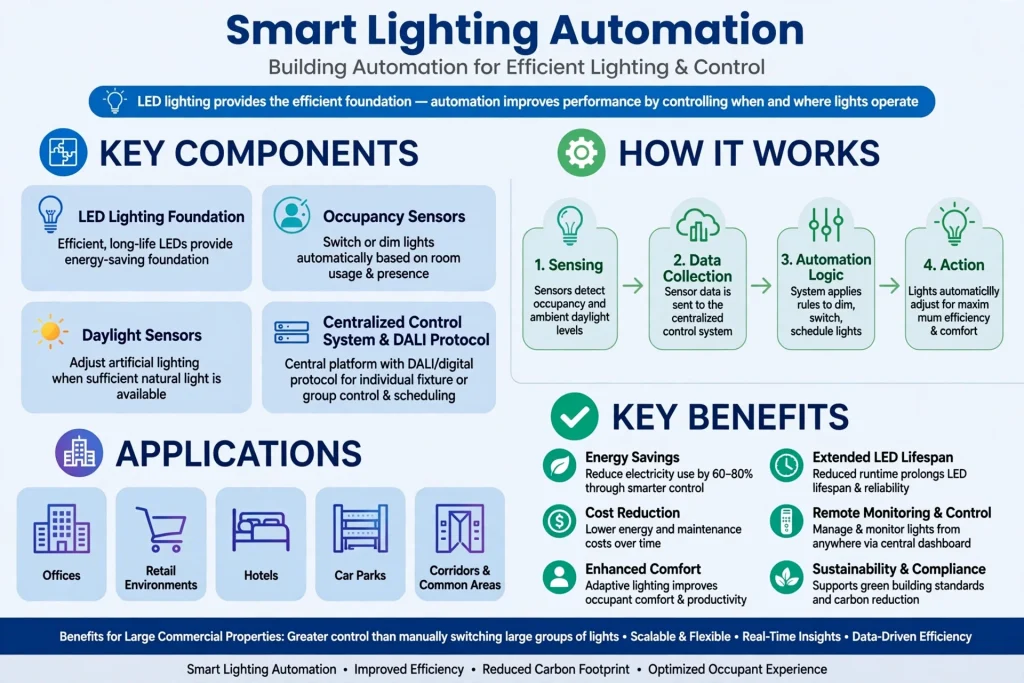
LED lighting already provides an efficient lighting platform, but automation can improve performance further by controlling when and where lights operate.
Occupancy sensors can switch or dim lights based on room usage. Daylight sensors can adjust artificial lighting when sufficient natural light is available.
Centralized lighting control systems can create schedules for offices, retail environments, hotels, car parks, corridors, and common areas.
Technologies such as DALI and other digital lighting-control protocols can allow individual fixtures or groups of fixtures to be monitored and controlled.
For a large commercial property, this provides greater control than manually switching large groups of lights.
Occupancy Detection and Space Management
Occupancy data is becoming increasingly valuable in modern buildings.
Traditional building design often assumes that rooms are occupied according to fixed schedules. Smart sensors provide more accurate information about how spaces are actually used.
Meeting rooms can be monitored for occupancy. Office areas can respond to changing usage. Retail spaces can collect anonymous footfall information where appropriate systems and privacy requirements allow.
Facility managers can use occupancy data to identify underused spaces, optimize cleaning schedules, adjust HVAC operation, and improve space planning.
In flexible workplaces across Dubai and Abu Dhabi, occupancy analytics can also support hybrid working strategies and more efficient use of office floors.
Smart Energy Management Systems
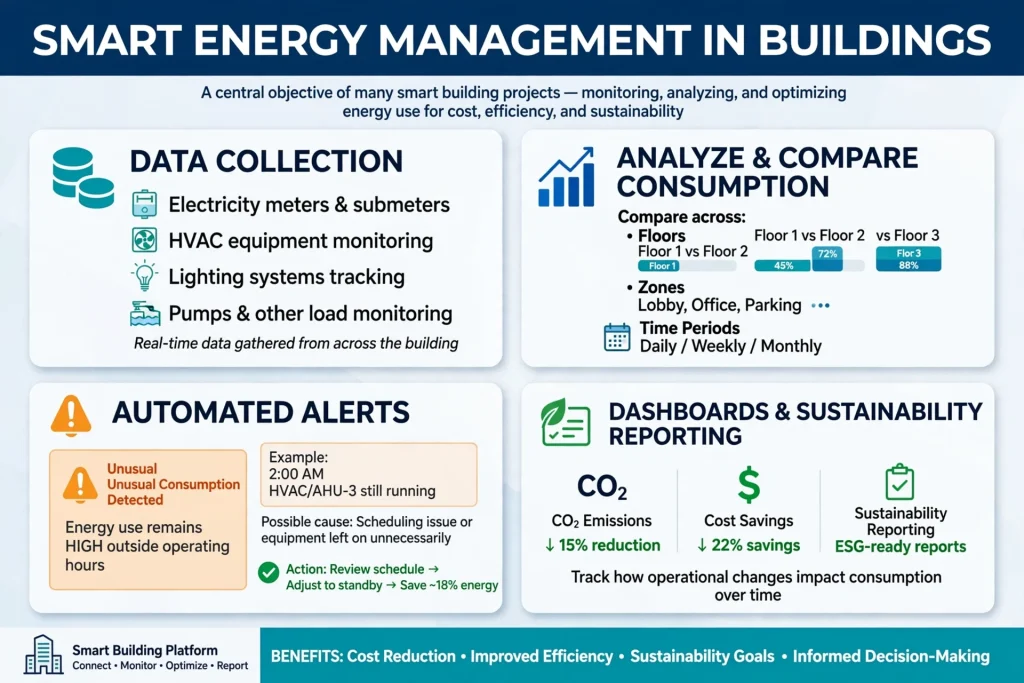
Energy management is a central objective of many smart building projects.
A smart energy management platform can collect information from electricity meters, submeters, HVAC equipment, lighting systems, pumps, and other loads.
Facility managers can compare consumption across floors, zones, equipment groups, or time periods.
Automated alerts can identify unusual consumption patterns. For example, energy use that remains high outside normal operating hours may indicate scheduling issues or equipment that has been left running unnecessarily.
Energy dashboards can also support sustainability reporting and help property managers understand how operational changes affect consumption.
Smart Meters and Real-Time Energy Monitoring
Smart meters provide more detailed information than conventional utility meters.
Electricity consumption can be measured at different levels depending on the building’s metering architecture. Submetering can separate major loads such as HVAC, lighting, tenant areas, kitchens, elevators, or data centres.
Real-time or near-real-time data makes it easier to identify unusual consumption.
For commercial buildings in Dubai International Financial Centre, Business Bay, Downtown Dubai, Dubai Internet City, and Dubai Design District, energy monitoring can help operators understand how different spaces and systems contribute to total building demand.
Water metering can also be integrated into broader building analytics to identify unusual consumption or potential leakage.
Digital Twins for UAE Buildings
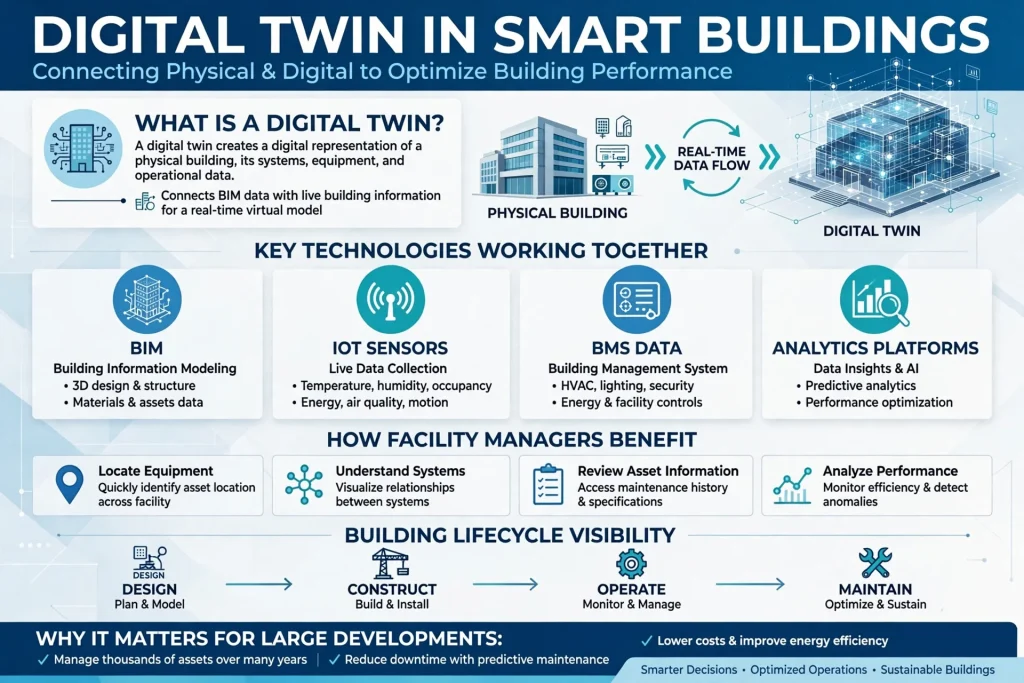
A digital twin creates a digital representation of a physical building, its systems, equipment, and operational data.
For a complex facility, a digital twin may connect Building Information Modeling data with live building information.
Technologies such as BIM, IoT sensors, BMS data, and analytics platforms can work together to improve visibility across the building lifecycle.
Facility managers can potentially use digital models to locate equipment, understand system relationships, review asset information, and analyze building performance.
Digital twins can be particularly valuable for large developments where thousands of assets need to be managed over many years.
Smart Access Control and Security Integration
Building automation is not limited to HVAC and lighting.
Access control systems can integrate with building management platforms to provide information about authorized access, doors, zones, and occupancy conditions.
For example, access information can support building operating schedules, while security systems can provide alerts when unusual activity occurs.
CCTV, visitor management, intercom systems, turnstiles, parking systems, and access cards can form part of a wider smart building ecosystem.
Security integration should always be designed with appropriate cybersecurity, privacy, and access-control policies.
Indoor Air Quality Monitoring
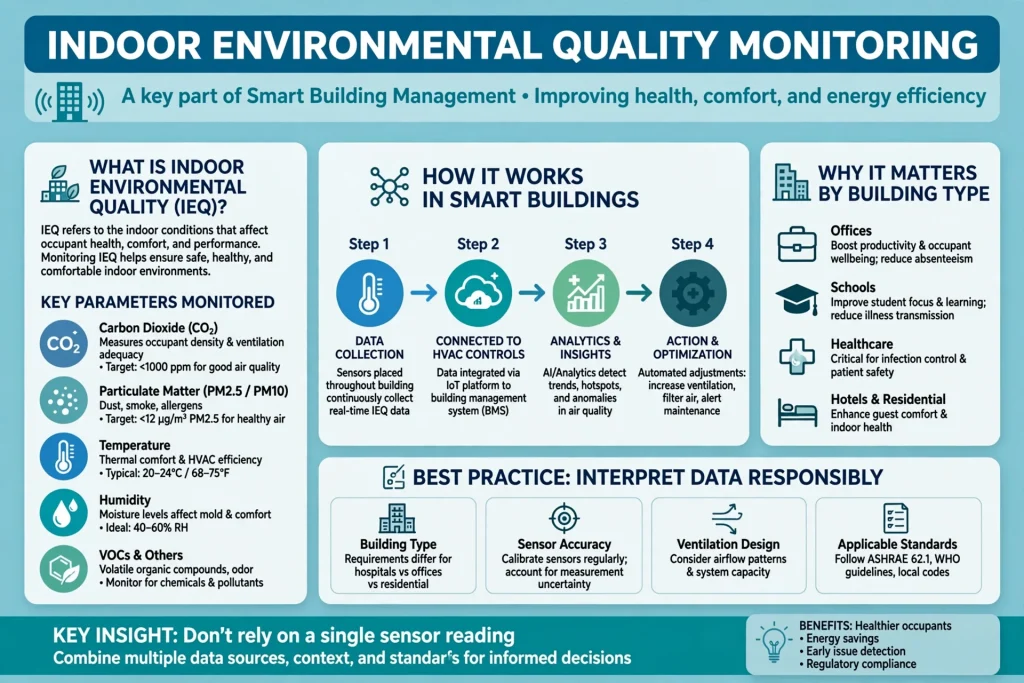
Indoor environmental quality is becoming an increasingly important part of smart building management.
Sensors can monitor carbon dioxide, particulate matter, temperature, humidity, and other indoor environmental conditions depending on the system specification.
When indoor air quality data is connected to HVAC controls, operators can identify areas that require additional ventilation or investigation.
In offices, schools, healthcare facilities, hotels, and residential buildings, indoor air quality monitoring can provide useful information about ventilation performance.
The data should be interpreted according to the building type, sensor accuracy, ventilation design, and applicable requirements rather than relying on a single sensor reading.
Smart Water Management
Water management can also be automated.
Smart water meters, leak detection sensors, pump monitoring, tank-level sensors, and automated valves can provide better visibility into water systems.
This can be particularly useful for hotels, residential towers, commercial buildings, landscaped properties, and large villas.
A sudden change in water consumption may indicate a leak or equipment problem. Automated alerts can help maintenance teams investigate before a small issue becomes a major loss.
In a water-conscious environment such as the UAE, monitoring consumption can support broader facility-management objectives.
Automated Fault Detection and Diagnostics
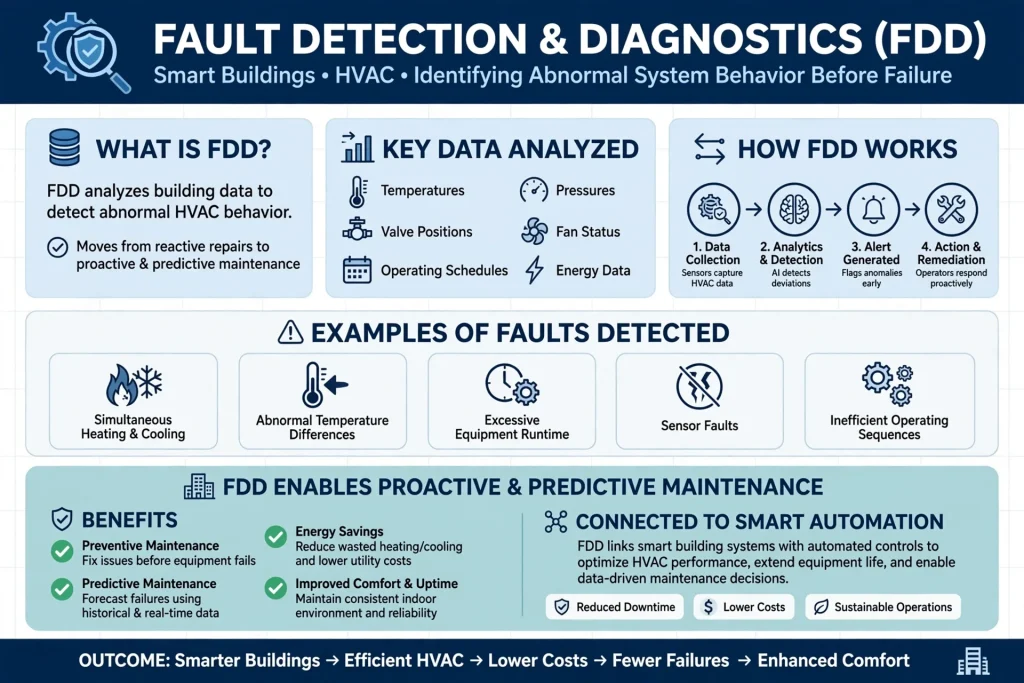
Fault detection and diagnostics, often called FDD, uses building data to identify abnormal system behavior.
For HVAC systems, an FDD platform may analyze temperatures, pressures, valve positions, fan status, operating schedules, and energy data.
Instead of waiting for equipment to fail completely, operators can receive alerts when system performance deviates from expected conditions.
Examples include simultaneous heating and cooling, abnormal temperature differences, excessive equipment runtime, sensor faults, or inefficient operating sequences.
FDD can therefore connect smart automation with preventive and predictive maintenance.
Smart Buildings and Preventive Maintenance
Maintenance teams traditionally rely on scheduled inspections and reactive repairs. Smart building systems can add condition-based information to this process.
If sensors show that a pump is operating outside its normal range, maintenance personnel can investigate the equipment before a serious failure occurs.
Similarly, abnormal chiller performance, unusual fan vibration, excessive filter pressure drop, or repeated HVAC alarms can trigger investigation.
This does not eliminate routine maintenance. Filters still need replacement, equipment still requires servicing, and safety inspections remain necessary.
Instead, automation provides additional information that helps maintenance teams prioritize their work.
Cloud-Based Building Management Platforms
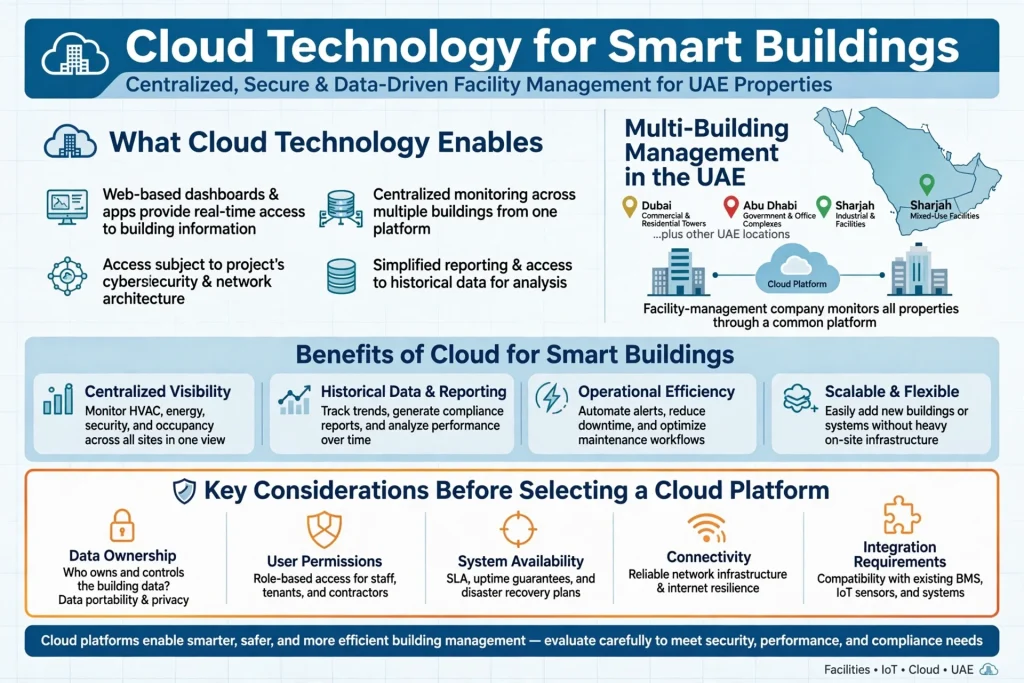
Cloud technology allows building information to be accessed through web-based dashboards and applications, subject to the project’s cybersecurity and network architecture.
Cloud platforms can support centralized monitoring across multiple buildings.
A facility-management company responsible for properties in Dubai, Abu Dhabi, Sharjah, and other UAE locations may be able to review selected operational information through a common platform.
Cloud systems can also simplify reporting and provide access to historical data.
However, building owners should evaluate data ownership, cybersecurity, connectivity, user permissions, system availability, and integration requirements before selecting a cloud-based platform.
Open Protocols and System Integration
Interoperability is critical to successful building automation.
Buildings may contain equipment from many manufacturers. Chillers, AHUs, lighting systems, meters, access control, and other systems need appropriate communication methods if they are expected to exchange information.
Common building automation protocols include BACnet, Modbus, KNX, DALI, and other communication technologies.
BACnet is widely associated with building automation and control applications, while Modbus is commonly used for industrial and equipment-level communication.
The selected protocol is less important than ensuring that the complete system architecture is properly engineered and that the required data points can be exchanged reliably.
Smart Building Automation in Dubai
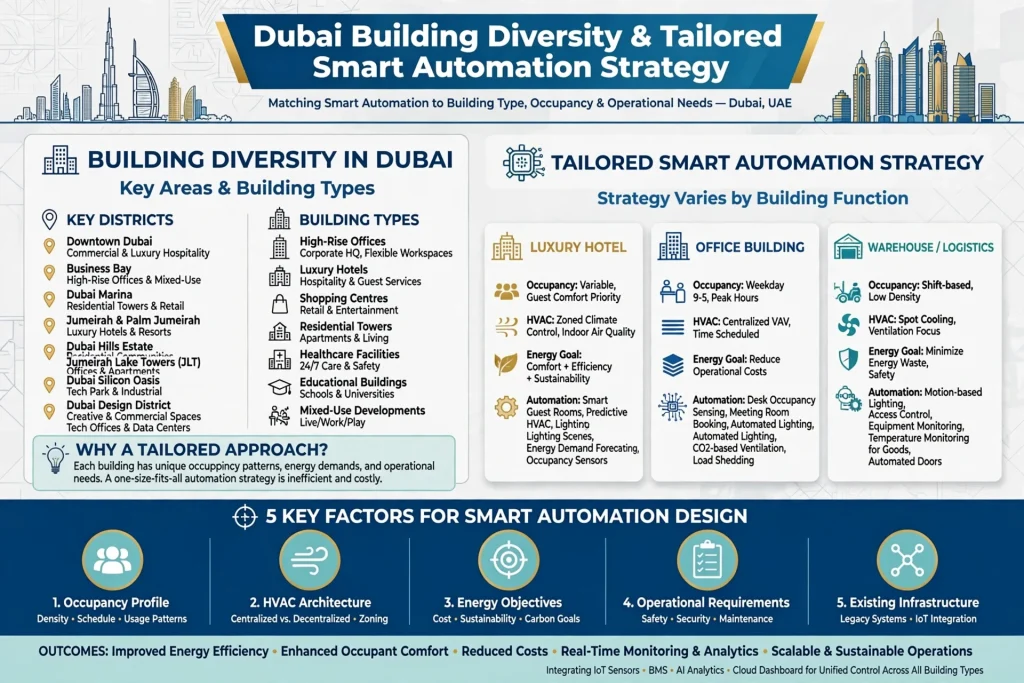
Dubai is home to a wide range of high-rise offices, luxury hotels, shopping centres, residential towers, healthcare facilities, educational buildings, and mixed-use developments.
Areas such as Downtown Dubai, Business Bay, Dubai Marina, Jumeirah, Palm Jumeirah, Dubai Hills Estate, Jumeirah Lake Towers, Dubai Silicon Oasis, Dubai Design District, and Dubai Internet City contain different building types and operational requirements.
A smart automation strategy for a luxury hotel will differ from one designed for a warehouse or office.
The system should therefore be based on the building’s occupancy profile, HVAC architecture, energy objectives, operational requirements, and existing infrastructure.
Smart Building Automation in Abu Dhabi
Abu Dhabi also has a significant range of commercial, residential, hospitality, healthcare, educational, and government facilities where building automation can support centralized operations.
Areas such as Al Reem Island, Al Maryah Island, Saadiyat Island, Yas Island, and central Abu Dhabi contain modern developments with complex mechanical and electrical systems.
Large buildings may benefit from centralized HVAC monitoring, energy management, lighting control, access integration, and automated fault detection.
Integration with existing infrastructure is particularly important when smart technology is introduced into an occupied building rather than a new construction project.
Smart Buildings in Sharjah and Other UAE Emirates
Smart automation is not limited to Dubai and Abu Dhabi.
Commercial, residential, industrial, hospitality, and institutional properties in Sharjah, Ajman, Ras Al Khaimah, Fujairah, and Umm Al Quwain can also use automation technologies.
The scale of the system may vary considerably.
A small commercial building may require basic HVAC scheduling, lighting control, and energy monitoring, while a large mixed-use development may require a fully integrated BMS, centralized command centre, IoT sensors, advanced analytics, and multiple communication networks.
The right system should match the building rather than adding technology that provides little operational value.
Smart Building Automation for New Construction
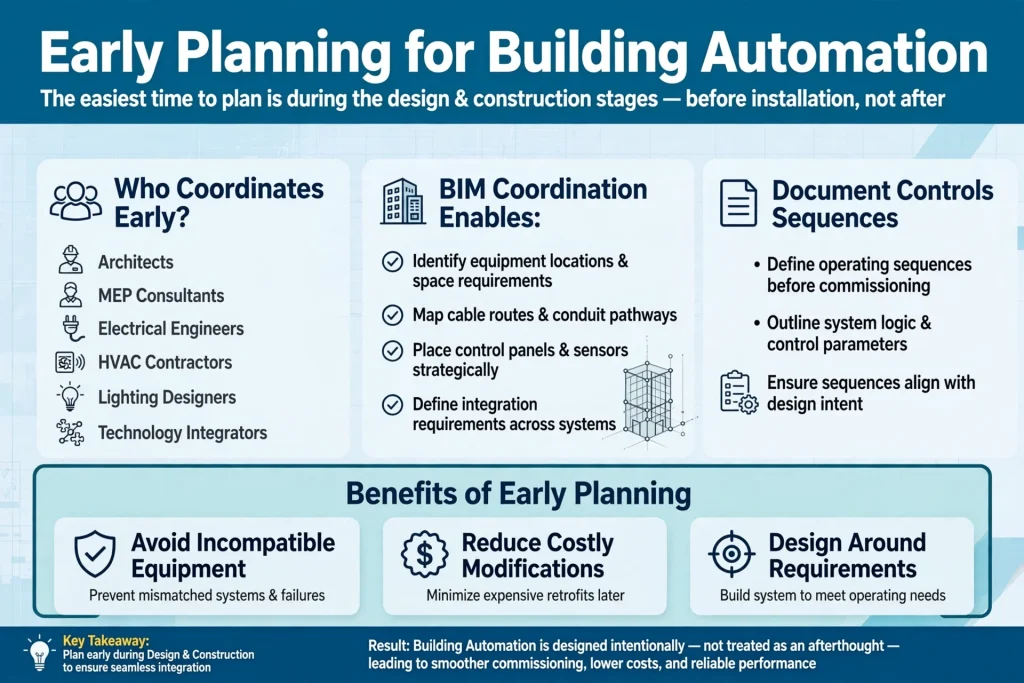
The easiest time to plan building automation is usually during the design and construction stages.
MEP consultants, electrical engineers, HVAC contractors, lighting designers, architects, and technology integrators can coordinate system requirements before installation.
BIM coordination can help identify equipment locations, cable routes, control panels, sensors, and integration requirements.
Controls sequences should also be documented before commissioning. This ensures that the building automation system is designed around defined operating requirements rather than being treated as an afterthought.
Early planning can also reduce the risk of incompatible equipment and expensive modifications later.
Retrofitting Smart Automation Into Existing Buildings
Existing UAE buildings can also be upgraded with smart technologies.
A retrofit may begin with energy monitoring, smart thermostats, occupancy sensors, lighting controls, or BMS upgrades before expanding to other systems.
The existing control architecture should be assessed first. Older chillers, AHUs, pumps, meters, and lighting systems may use different communication protocols or may have limited integration capabilities.
A phased retrofit can allow property owners to prioritize systems with the greatest operational impact.
Before upgrading, facility teams should document existing equipment, control points, communication protocols, electrical infrastructure, network requirements, and current maintenance issues.
Cybersecurity in Smart Buildings
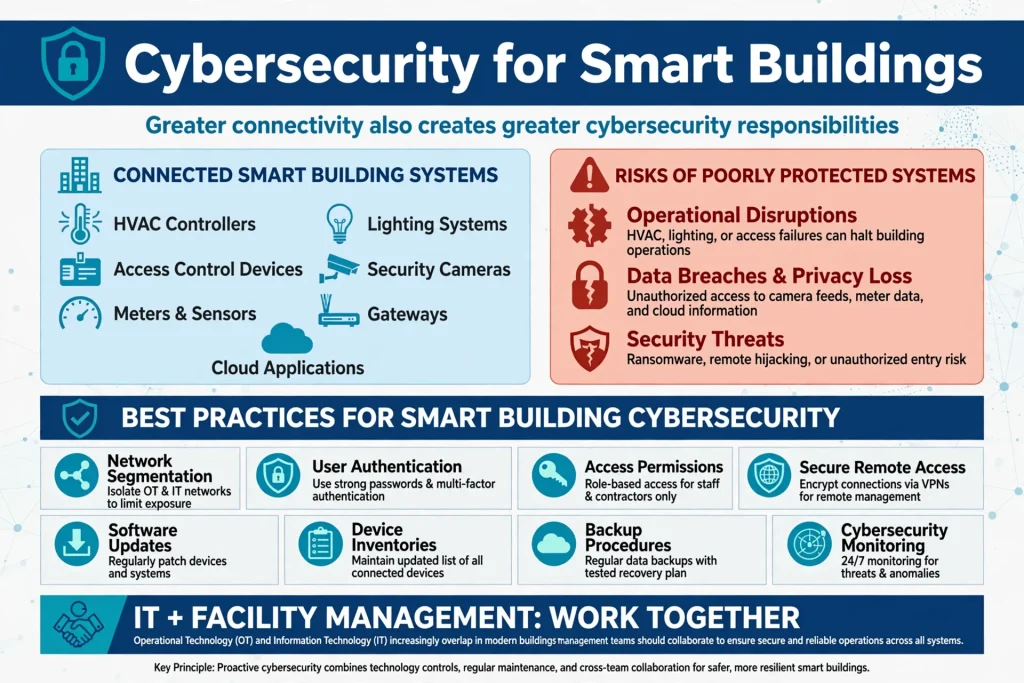
Greater connectivity also creates greater cybersecurity responsibilities.
A smart building may contain network-connected HVAC controllers, lighting systems, access control devices, cameras, meters, gateways, and cloud applications.
Poorly protected systems can create operational and security risks.
Building owners should consider network segmentation, user authentication, access permissions, secure remote access, software updates, device inventories, backup procedures, and cybersecurity monitoring.
IT and facility-management teams should work together because operational technology and information technology increasingly overlap in modern buildings.
What Makes a Smart Building Truly Intelligent?
Adding sensors does not automatically make a building intelligent.
The value comes from what the building does with the information.
A useful smart building can collect accurate data, interpret operating conditions, identify problems, automate suitable responses, and provide actionable information to facility teams.
For example, knowing that a room is occupied is useful. Automatically adjusting lighting and HVAC according to occupancy can provide greater operational value when the control strategy is correctly configured.
The quality of commissioning is therefore just as important as the technology itself.
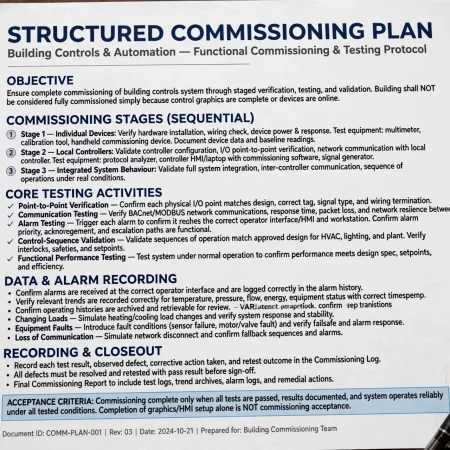
Commissioning Smart Building Automation Systems
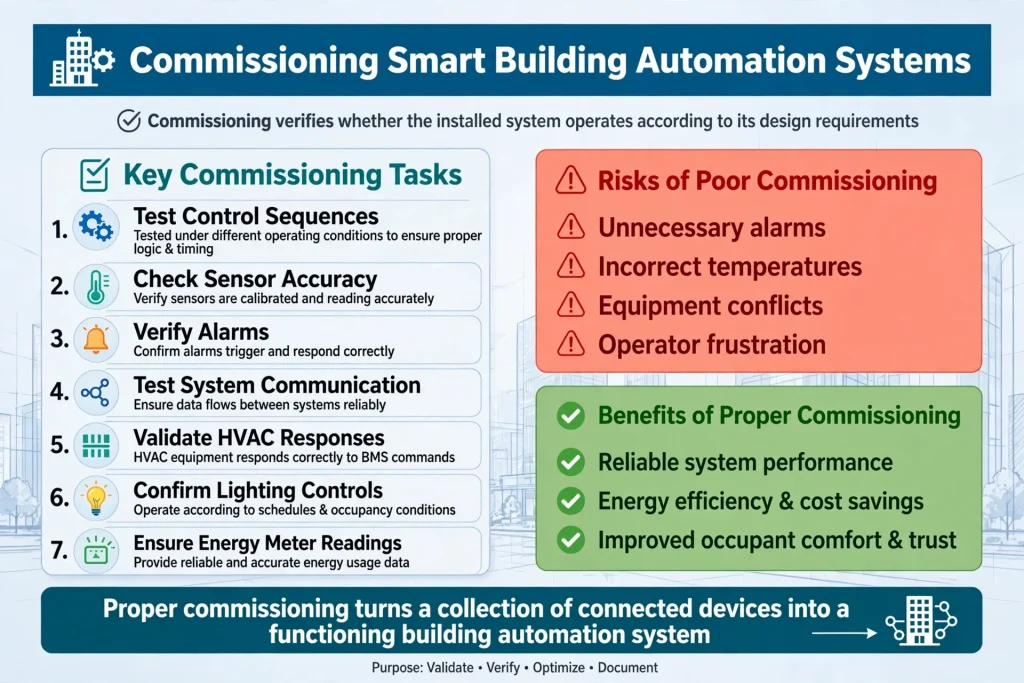
Commissioning verifies whether the installed system operates according to its design requirements.
Controls sequences should be tested under different operating conditions. Sensors should be checked for accuracy. Alarms should be verified. Communication between systems should be tested.
HVAC equipment should respond correctly to commands from the BMS. Lighting controls should operate according to schedules and occupancy conditions. Energy meters should provide reliable readings.
A poorly commissioned automation system can create unnecessary alarms, incorrect temperatures, equipment conflicts, and operator frustration.
Proper commissioning helps turn a collection of connected devices into a functioning building automation system.
How Smart Automation Can Improve Building Operations
Smart automation can provide several operational benefits when properly designed and maintained.
Energy monitoring helps identify consumption patterns. Automated controls can reduce unnecessary equipment runtime. Occupancy information can improve space management. Centralized alarms can help maintenance teams respond to equipment problems.
Building operators can also use historical data to compare performance over time.
The benefits vary from building to building, and actual savings depend on equipment efficiency, controls strategy, occupancy, maintenance quality, operating schedules, and other factors.
Automation should therefore be evaluated using measurable building objectives rather than broad claims about guaranteed energy savings.
Frequently Asked Questions About Smart Building Automation
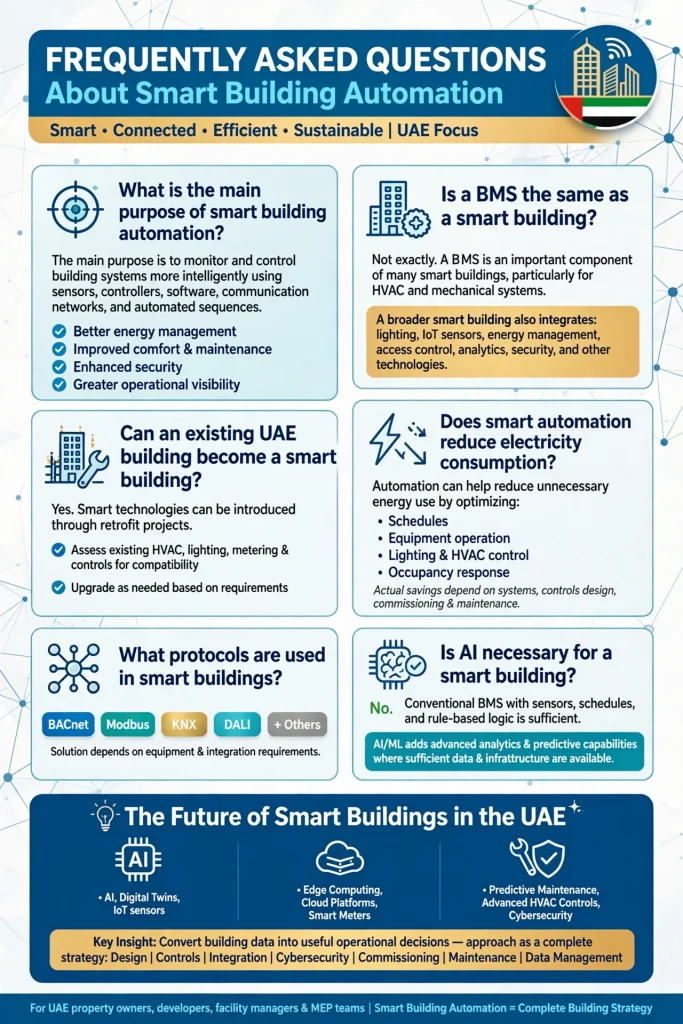
What is the main purpose of smart building automation?
The main purpose is to monitor and control building systems more intelligently using sensors, controllers, software, communication networks, and automated sequences. The goal can include better energy management, comfort, maintenance, security, and operational visibility.
Is a BMS the same as a smart building?
Not exactly. A BMS is an important component of many smart buildings, particularly for HVAC and mechanical systems. A broader smart building may also integrate lighting, IoT sensors, energy management, access control, analytics, security, and other technologies.
Can an existing UAE building become a smart building?
Yes. Smart technologies can be introduced through retrofit projects. Existing HVAC, lighting, metering, and control systems should first be assessed to determine their compatibility and upgrade requirements.
Does smart automation reduce electricity consumption?
Automation can help reduce unnecessary energy use by optimizing schedules, equipment operation, lighting, HVAC control, and occupancy response. Actual savings depend on the building’s systems, operating conditions, controls design, commissioning, and maintenance.
What protocols are used in smart buildings?
Common technologies include BACnet, Modbus, KNX, DALI, and other communication protocols. The appropriate solution depends on the equipment and integration requirements.
Is AI necessary for a smart building?
No. A building can provide substantial automation using conventional BMS controls, sensors, schedules, and rule-based logic. AI and machine learning can add advanced analytics and predictive capabilities where sufficient data and suitable infrastructure are available.
The Future of Smart Buildings in the UAE
The next generation of UAE buildings is likely to become increasingly connected, data-driven, and automated. Advances in artificial intelligence, digital twins, IoT sensors, edge computing, cloud platforms, smart meters, predictive maintenance, and advanced HVAC controls are creating new opportunities for building operators.
The most useful systems will not necessarily be those with the largest number of connected devices. They will be systems that convert building data into useful operational decisions.
For UAE property owners, developers, facility managers, and MEP teams, smart building automation should therefore be approached as a complete building strategy involving design, controls, integration, cybersecurity, commissioning, maintenance, and long-term data management.
Conclusion
Smart building automation is transforming modern UAE buildings by connecting HVAC, lighting, energy management, occupancy sensing, security, water systems, maintenance analytics, and other building services.
Technologies such as BMS platforms, IoT sensors, AI analytics, smart meters, digital twins, automated lighting controls, predictive maintenance, and cloud-based monitoring can give building operators a clearer understanding of how their properties perform.
Dubai, Abu Dhabi, Sharjah, and other UAE markets contain increasingly complex buildings where centralized monitoring and intelligent controls can support efficient and responsive facility operations.
The most successful approach is not simply to install more technology. It is to select the right systems, coordinate them properly, commission them carefully, protect them with appropriate cybersecurity, and continuously use the resulting data to improve building performance.