Sewer lines are one of the most important hidden systems in any residential or commercial property. They carry wastewater away from toilets, sinks, showers, kitchens, and other drainage points and connect the building’s internal drainage system to the wider sewer network. Because most sewer pipes are underground or concealed inside walls and floors, problems can develop for a long time before they become visible.
Recognising the early warning signs of sewer line problems can help Dubai property owners address drainage issues before they become major blockages, sewage backups, unpleasant odours, or costly property damage. Slow drains, repeated toilet blockages, gurgling sounds, foul smells, wet patches, and unexplained changes in drainage performance can all indicate that something is wrong with the sewer or wastewater system.
In Dubai’s villas, apartments, commercial buildings, hotels, restaurants, and mixed-use properties, sewer problems can have different causes depending on the age of the building, pipe material, drainage design, ground conditions, usage, maintenance history, and connection to the municipal wastewater network.
What Is a Sewer Line?
A sewer line is a pipe that transports wastewater away from a building or property toward a larger sewer system or approved wastewater treatment infrastructure.
Inside a building, different fixtures connect to branch drainage pipes. These branches eventually connect to larger drainage or sewer lines.
A typical wastewater system may include toilet drainage, bathroom waste pipes, kitchen drainage, floor drains, soil stacks, vent pipes, inspection chambers, cleanouts, underground drainage pipes, and connections to the external sewer network.
The system must maintain appropriate pipe gradients and ventilation so wastewater can flow efficiently without excessive pressure, blockages, or odour problems.
When one part of the system becomes restricted or damaged, symptoms may appear at multiple fixtures.
Why Sewer Line Problems Are Serious
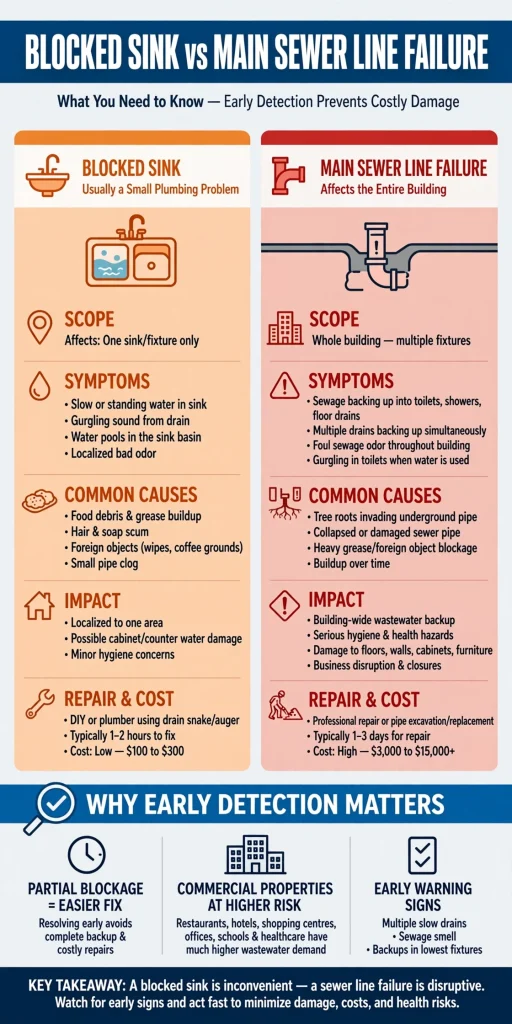
A blocked sink is usually a relatively small plumbing problem. A damaged or blocked main sewer line can affect an entire building.
If wastewater cannot leave the property properly, it may back up into toilets, floor drains, showers, or other low-level fixtures.
Sewage backups can create hygiene concerns and damage floors, walls, cabinets, furniture, and other building finishes.
In commercial properties, a sewer problem can also disrupt operations. Restaurants, hotels, shopping centres, offices, schools, and healthcare facilities may have much higher wastewater demand than typical residential properties.
Early detection is therefore important because resolving a partial blockage is usually easier than dealing with a complete sewer backup or damaged underground pipe.
What Are the Early Warning Signs of a Sewer Problem?
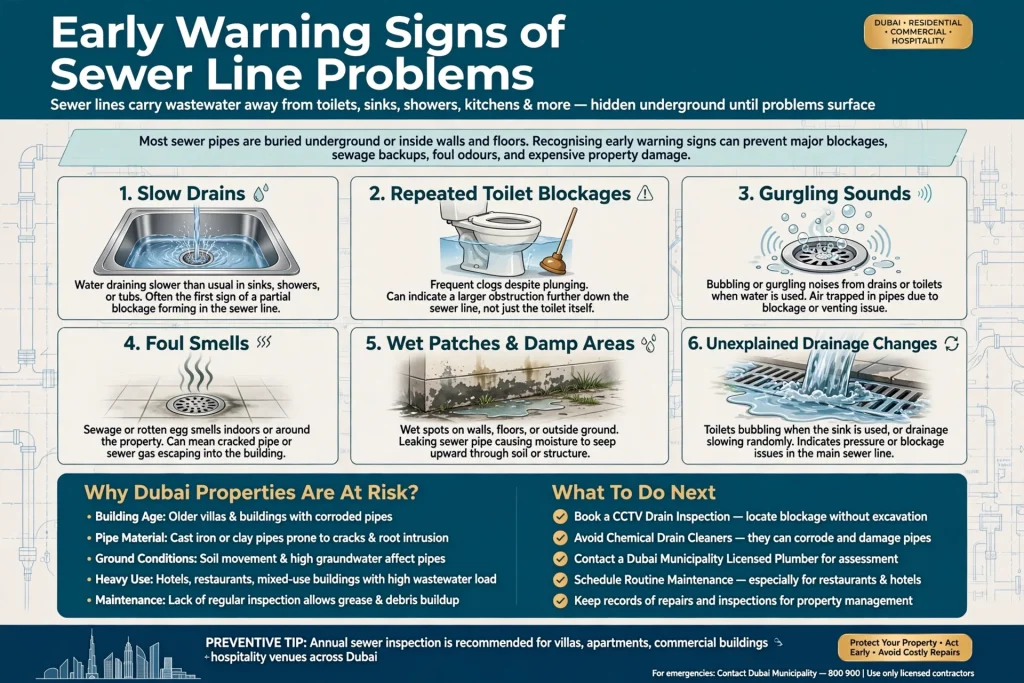
Sewer problems rarely appear without any warning. Several symptoms can indicate that a drainage system requires inspection.
Common warning signs include:
- Multiple slow drains
- Repeated toilet blockages
- Gurgling sounds from drains
- Persistent sewage odours
- Water backing up into showers or floor drains
- Unexplained wet patches
- Changes in toilet water levels
- Drainage problems affecting several fixtures
- Sewage pooling outdoors
- Repeated use of drain-cleaning products
- Unusually lush vegetation over an underground pipe route
- Sink or toilet water moving when another fixture is used
One isolated slow drain may be caused by a local blockage. When several fixtures experience problems at the same time, however, the main drainage system should be investigated.
Slow Drains Throughout the Property
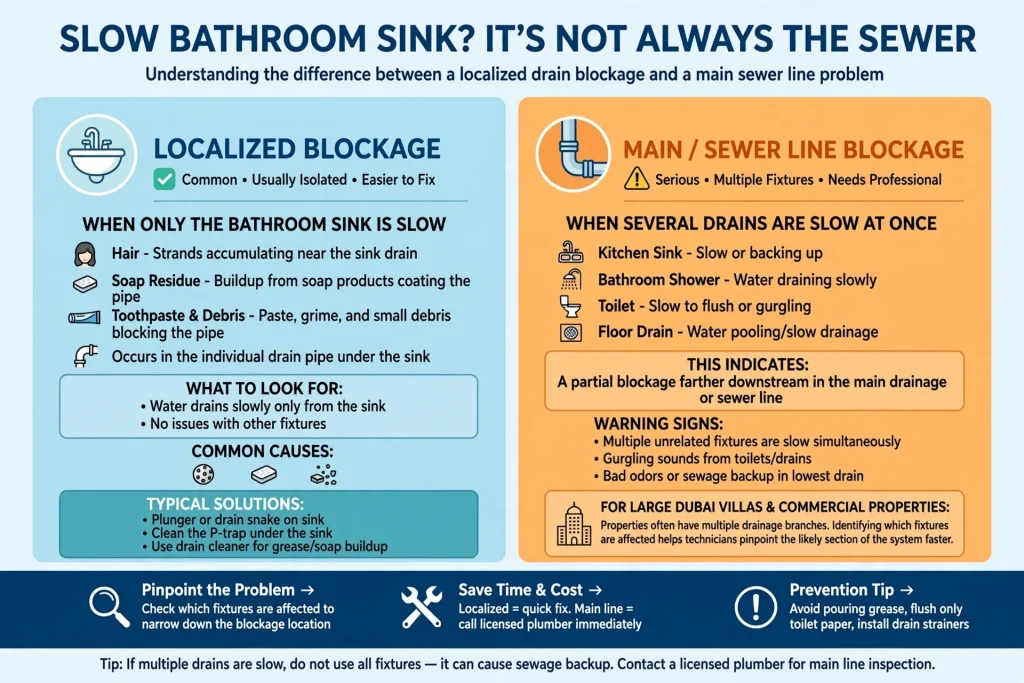
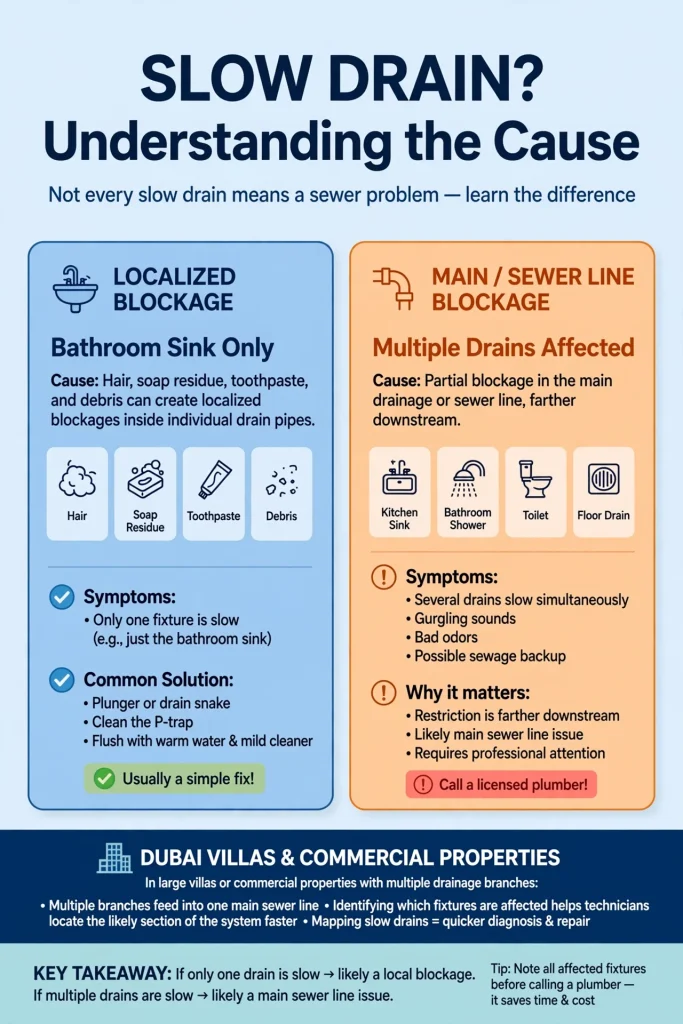
A slow bathroom sink does not necessarily mean there is a sewer problem.
Hair, soap residue, toothpaste, and debris can create localized blockages inside individual drain pipes.
The situation becomes more concerning when several unrelated drains become slow simultaneously.
For example, if the kitchen sink, bathroom shower, toilet, and floor drain all begin draining slowly, the restriction may be farther downstream.
This can indicate a partial blockage in a main drainage or sewer line.
In large Dubai villas or commercial properties with multiple drainage branches, identifying which fixtures are affected can help technicians locate the likely section of the system.
Repeated Toilet Blockages
A toilet that blocks occasionally may have a localized obstruction.
Repeated blockages, especially when accompanied by slow drains or gurgling sounds, can indicate a larger drainage problem.
The main sewer line carries wastewater from multiple fixtures. If it becomes partially blocked, flushing one toilet can cause water to move slowly through the drainage system.
Property owners should avoid repeatedly using chemical drain cleaners to address recurring toilet problems. These products may not remove a substantial obstruction and can create additional risks for plumbing components.
Persistent toilet blockages should be investigated to identify the actual cause.
Gurgling Sounds From Drains
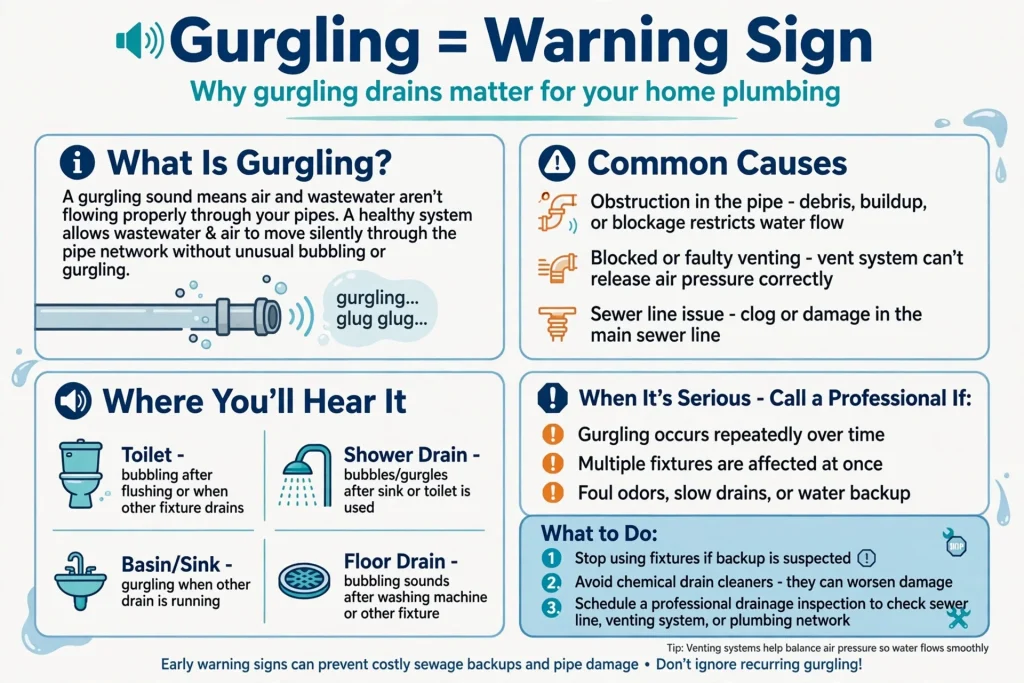
Gurgling is one of the more useful warning signs to watch for.
A healthy drainage system should generally allow wastewater and air to move through the pipe network without unusual bubbling or gurgling.
Gurgling can occur when water encounters an obstruction or when the drainage and venting system is not functioning correctly.
You may hear bubbling from a toilet, shower drain, basin, or floor drain after another fixture is used.
If gurgling occurs repeatedly and affects multiple fixtures, a professional drainage inspection can determine whether the problem involves the sewer line, venting system, or another part of the plumbing network.
Foul Sewer Odours
Persistent sewage smells inside a property should never be ignored.
Odours can originate from dry traps, damaged seals, blocked vents, leaking drainage pipes, or sewer line problems.
A floor drain that is rarely used may lose its water seal, allowing odours from the drainage system to enter the room.
However, if the smell continues after checking traps and drainage fixtures, the system should be investigated further.
In commercial buildings and hospitality properties, sewer odours can have an immediate impact on customers, employees, and occupants.
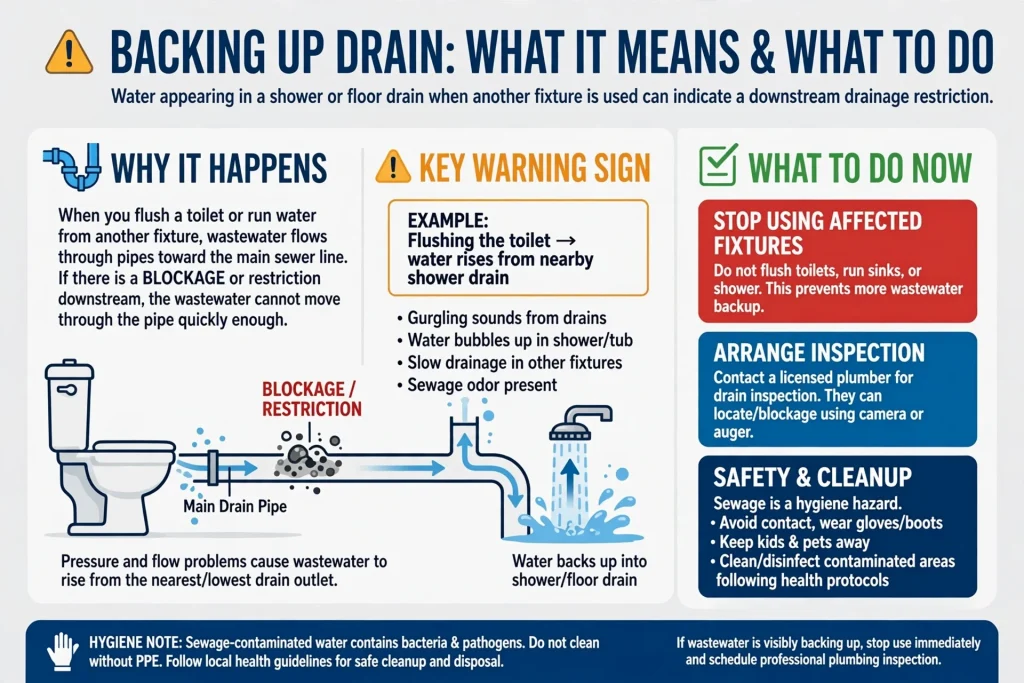
Water Backing Up Into the Bathroom
Water appearing in a shower or floor drain when another fixture is used can indicate a downstream drainage restriction.
For example, flushing a toilet may cause water to rise from a nearby shower drain.
This happens because wastewater cannot move through the downstream pipe quickly enough, causing pressure and flow problems within the system.
If wastewater is visibly backing up, stop using affected fixtures as much as possible and arrange an inspection.
Sewage-contaminated water should be treated as a hygiene concern and cleaned using appropriate procedures.
Wet Patches Near Underground Sewer Lines
Underground sewer pipes can develop cracks, joint failures, or other defects.
When wastewater escapes from a damaged pipe, the surrounding soil may become saturated.
A property owner may notice unexplained wet areas, soft ground, standing water, or unusual vegetation near the suspected pipe route.
Outdoor drainage problems can be difficult to diagnose visually because underground pipe routes are not always obvious.
Professional inspection methods can help identify whether the moisture is related to sewer leakage, irrigation, groundwater, or another source.
Unusually Green Vegetation
A sudden area of unusually lush vegetation above an underground sewer route can sometimes indicate a leaking wastewater pipe.
The moisture and nutrients escaping into the surrounding soil can affect plant growth.
This is not definitive proof of a sewer leak because irrigation patterns, soil conditions, and landscaping can create similar effects.
However, when unusual vegetation appears together with foul odours, wet ground, or drainage problems, the underground sewer line should be considered as a possible cause.
Common Causes of Sewer Line Blockages
Sewer blockages can develop for several reasons.
One of the most common causes is the accumulation of unsuitable materials inside the pipe.
Grease and cooking fats can build up in kitchen drainage. Wipes, sanitary products, paper towels, and other non-flushable materials can create obstructions in wastewater pipes.
Sediment, mineral deposits, scale, and debris can also reduce the internal diameter of older pipes.
In outdoor drainage systems, soil, roots, and damaged pipe sections can contribute to blockages.
The cause matters because clearing the immediate obstruction without addressing the underlying problem may only provide temporary relief.
Grease and Fat Buildup
Restaurants and commercial kitchens can experience significant grease-related drainage problems.
Cooking oils, fats, and grease can enter wastewater systems and gradually adhere to the internal surfaces of drainage pipes.
Over time, the buildup can restrict wastewater flow and collect additional debris.
Commercial kitchens may require grease traps or grease management systems designed for their specific operations.
Pouring cooking oil directly into a sink can contribute to blockages even in residential properties.
Proper disposal of fats and oils is therefore an important part of sewer maintenance.
Tree Root Intrusion
Tree roots can enter underground drainage pipes through small cracks, defective joints, or damaged connections.
Once inside, roots can grow and create a physical obstruction.
Root intrusion can also cause repeated blockages because clearing the pipe may remove the immediate roots without repairing the damaged pipe.
Professional drainage inspection can determine whether roots are present and whether the pipe itself has structural defects.
This issue is more relevant to properties with landscaping and mature vegetation near underground drainage routes.
Cracked or Collapsed Sewer Pipes
A sewer pipe can become structurally damaged for several reasons.
Age, ground movement, poor installation, external loading, corrosion of certain pipe materials, construction activity, or deterioration of joints can affect underground drainage.
A cracked pipe may allow wastewater to escape into surrounding soil, while a collapsed section can completely prevent normal flow.
Symptoms may include recurring blockages, foul smells, wet ground, sinkholes, or persistent drainage problems.
In such cases, simply clearing the line may not provide a permanent solution.
Misaligned or Disconnected Pipe Joints
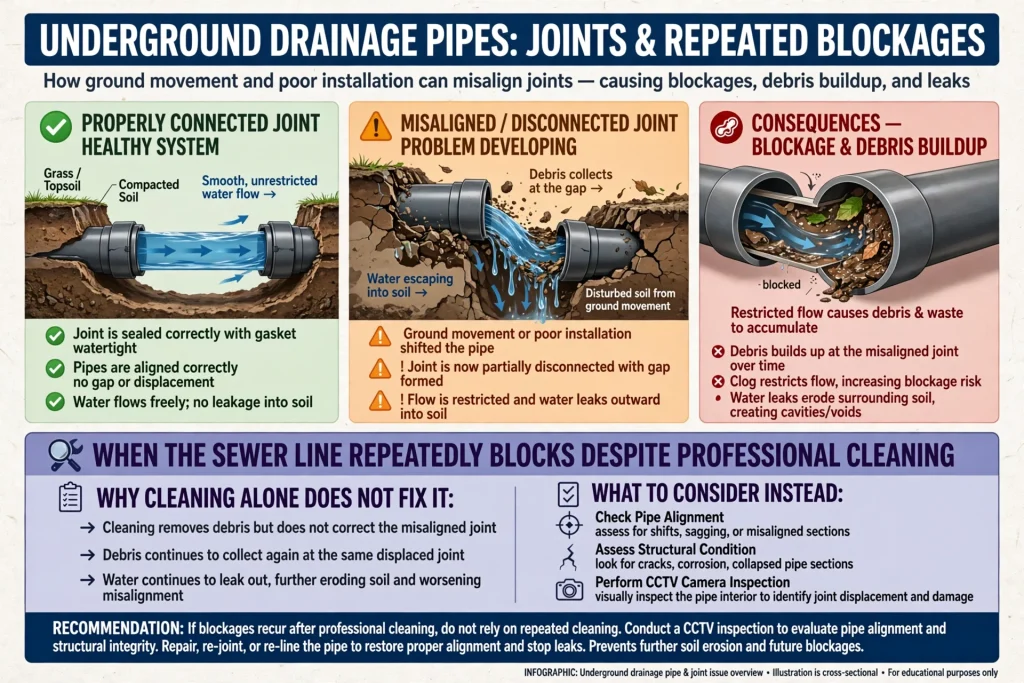
Underground drainage pipes depend on properly connected joints.
Ground movement or poor installation can cause sections to become misaligned or partially disconnected.
A displaced joint can restrict flow and create a location where debris accumulates.
Water may also escape from the joint into surrounding soil.
When a sewer line repeatedly blocks despite professional cleaning, pipe alignment and structural condition should be considered.
Sewer Pipe Corrosion and Material Deterioration
The service life of a sewer pipe depends on its material, installation conditions, wastewater characteristics, and maintenance.
Older systems may experience corrosion, cracking, scaling, or joint deterioration.
Different pipe materials have different failure modes.
This is why the age of a building alone does not determine whether its sewer lines require replacement.
A proper inspection should identify the actual condition of the pipe and distinguish between a minor obstruction and a structural problem.
How CCTV Sewer Inspection Works
CCTV inspection is one of the most useful technologies for investigating underground drainage problems.
A small waterproof camera is inserted into the drainage pipe through an appropriate access point.
The camera allows technicians to view the inside of the pipe and identify problems such as:
- Blockages
- Cracks
- Root intrusion
- Pipe deformation
- Misaligned joints
- Sediment buildup
- Foreign objects
- Collapsed sections
- Grease accumulation
The footage can help determine whether cleaning is sufficient or whether a more extensive repair is necessary.
This is particularly valuable when repeated blockages occur without an obvious cause.
Hydro Jetting for Sewer Line Cleaning
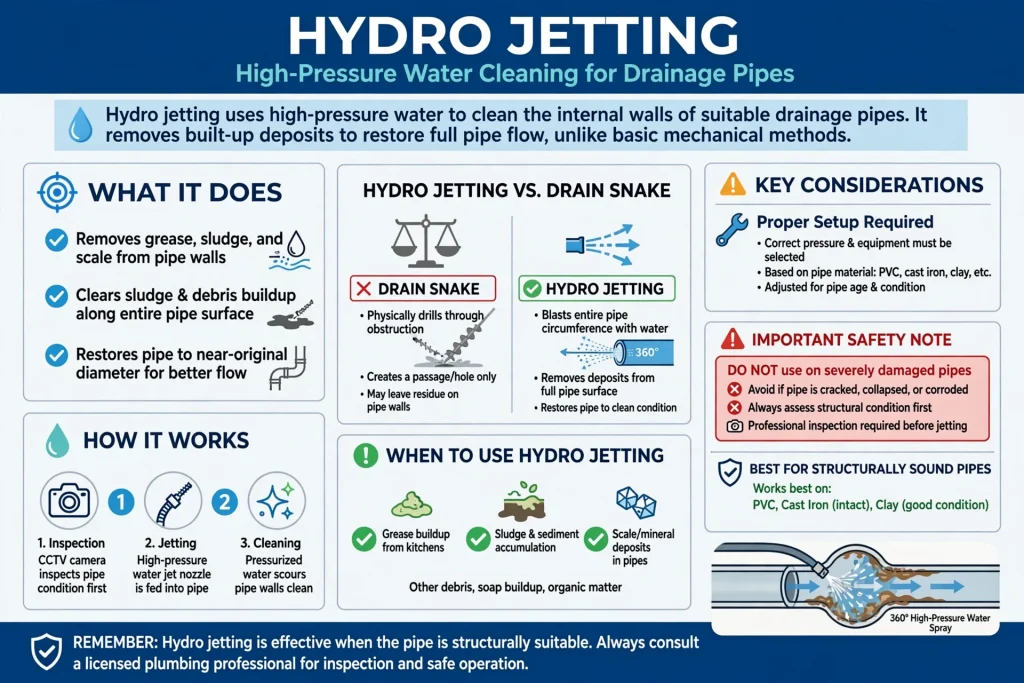
Hydro jetting uses high-pressure water to clean the internal walls of suitable drainage pipes.
Unlike a basic drain snake, which may create a passage through an obstruction, hydro jetting can remove certain accumulations from the internal pipe surface.
It can be useful for grease, sludge, scale, and other deposits when the pipe is structurally suitable for the method.
The correct pressure and equipment must be selected according to the pipe material and condition.
Hydro jetting should not automatically be used on severely damaged pipes without first considering the structural condition of the line.
Drain Snaking and Mechanical Cleaning
Mechanical drain cleaning uses specialized cables or cutting heads to break through or remove certain blockages.
This can be effective for localized obstructions.
However, if a sewer line repeatedly blocks after mechanical cleaning, further diagnosis may be required.
Repeatedly clearing the same blockage without identifying the cause can result in unnecessary maintenance costs and continuing disruption.
Sewer Line Problems in Dubai Villas
Dubai villas often have multiple bathrooms, kitchens, outdoor drainage points, landscaping, and extensive underground service networks.
Areas such as Jumeirah, Palm Jumeirah, Emirates Hills, Arabian Ranches, Dubai Hills Estate, and Al Barsha contain properties with different ages, layouts, and drainage configurations.
Large villas may also have guest houses, staff facilities, outdoor kitchens, swimming pools, and multiple wastewater connections.
Because several drainage branches can connect to a common sewer line, one blockage can sometimes affect several parts of the property.
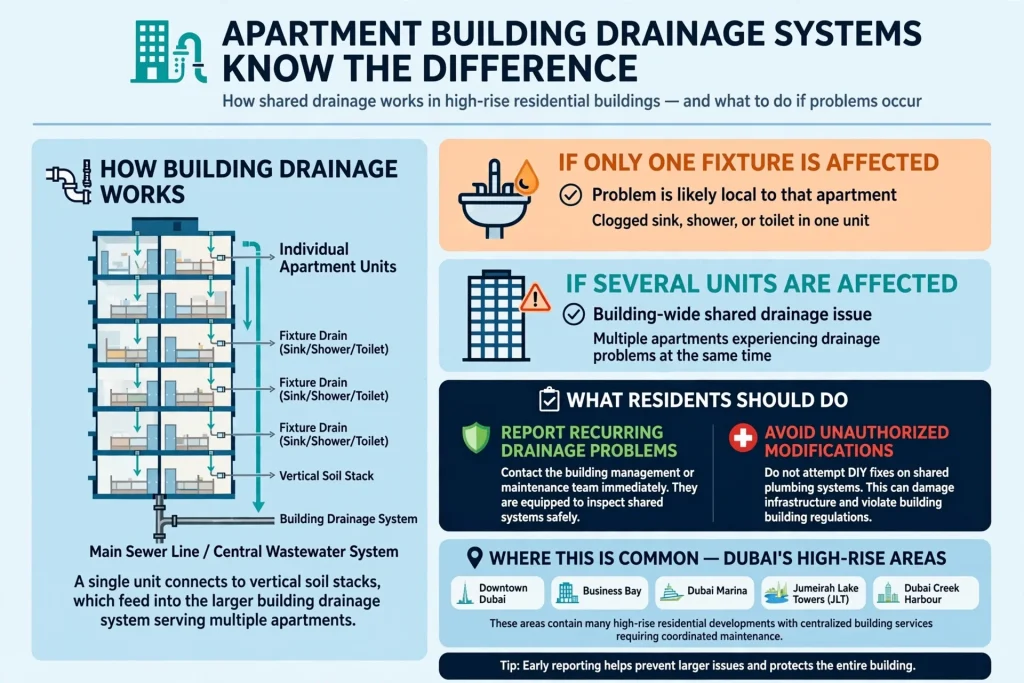
Sewer Problems in Dubai Apartments
Apartment buildings have more complex shared drainage arrangements.
A single unit may connect to vertical soil stacks and larger building drainage systems serving multiple apartments.
If only one fixture is affected, the problem may be local to that apartment.
If several units experience drainage problems at the same time, the building’s shared drainage infrastructure may need investigation.
Residents should report recurring drainage problems to the appropriate building management or maintenance team rather than making unauthorized modifications to shared plumbing systems.
Areas such as Downtown Dubai, Business Bay, Dubai Marina, Jumeirah Lake Towers, and Dubai Creek Harbour contain many high-rise residential developments with centralized building services.
Sewer Problems in Commercial Buildings
Commercial properties can experience higher wastewater loads than residential buildings.
Restaurants generate grease and food waste. Hotels have large numbers of bathrooms. Shopping centres have high public restroom usage. Offices may have concentrated demand during working hours.
This makes preventive drainage maintenance particularly important.
Commercial property managers should monitor recurring blockages, odours, slow drainage, grease buildup, and wastewater backups.
A planned inspection and cleaning programme can help identify problems before they cause major disruption.
Sewer Line Problems in Restaurants
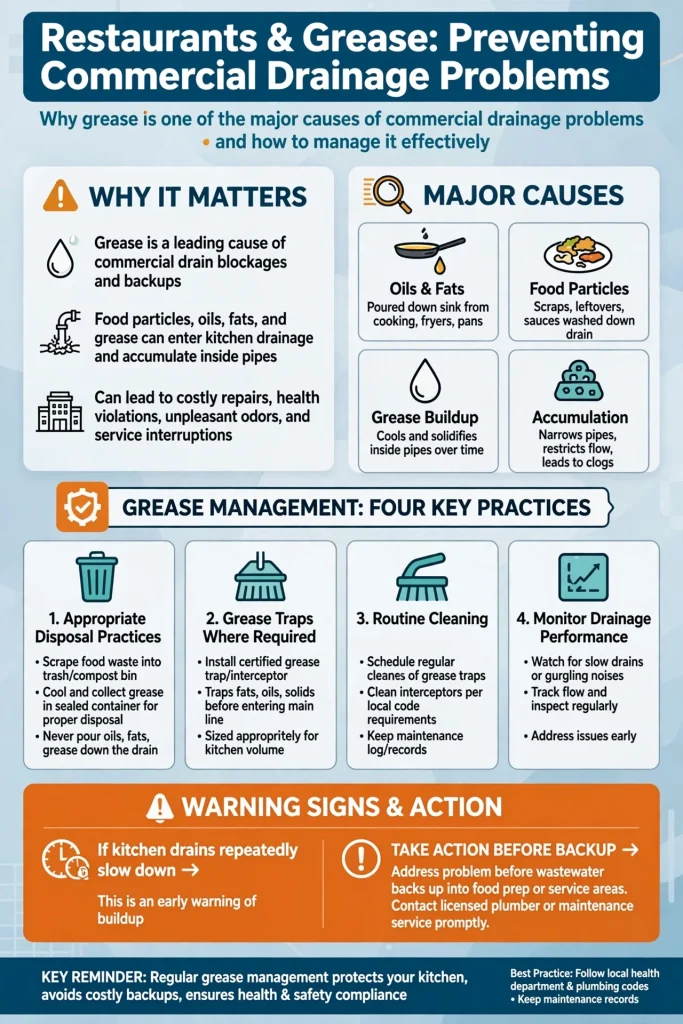
Restaurants deserve special attention because grease is one of the major causes of commercial drainage problems.
Food particles, oils, fats, and grease can enter kitchen drainage and accumulate inside pipes.
Grease management should include appropriate disposal practices, grease traps where required, routine cleaning, and monitoring of drainage performance.
If kitchen drains repeatedly slow down, the problem should be addressed before wastewater backs up into food preparation or service areas.
How Dubai’s Environment Can Affect Drainage Systems
Dubai’s climate creates demanding conditions for buildings, although sewer line performance is primarily determined by the plumbing system itself.
High temperatures, intensive air-conditioning, construction activity, landscaping, and irrigation can all influence the surrounding environment of underground services.
For external drainage, landscaping and irrigation should be considered when investigating unexplained wet areas.
The important point is to diagnose the source rather than assuming every drainage issue has the same cause.
Preventing Sewer Line Problems
Preventive maintenance can reduce the likelihood of major drainage failures.
Property owners should avoid flushing unsuitable materials down toilets and should never dispose of grease and cooking oil through kitchen sinks.
Drain strainers can help prevent hair, food particles, and other debris from entering smaller drainage lines.
Commercial kitchens should maintain grease management systems properly.
Trees and large plants should be considered when planning landscaping near underground drainage routes.
Repeated blockages should also be investigated rather than treated as isolated events.
When Should You Call a Plumber for a Sewer Problem?
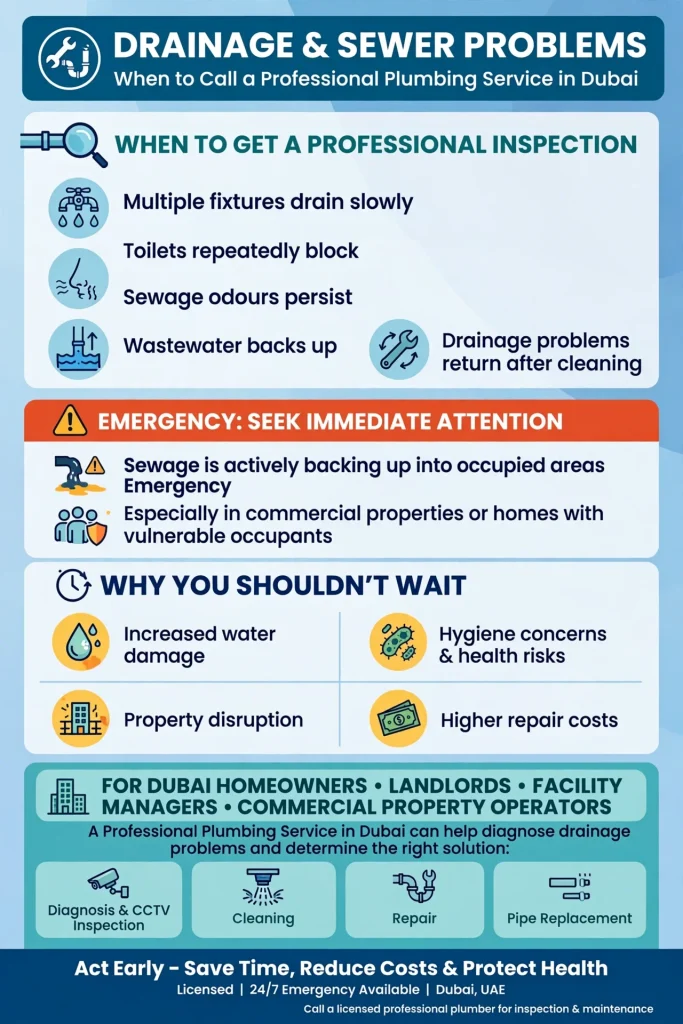
A professional inspection is advisable when multiple fixtures drain slowly, toilets repeatedly block, sewage odours persist, wastewater backs up, or drainage problems return after cleaning.
Emergency attention may be required when sewage is actively backing up into occupied areas, especially in commercial properties or homes with vulnerable occupants.
Waiting until a sewer line completely fails can increase the extent of water damage, hygiene concerns, property disruption, and repair costs.
For Dubai homeowners, landlords, facility managers, and commercial property operators, a Professional Plumbing Service in Dubai can help diagnose drainage problems and determine whether the appropriate solution is cleaning, repair, pipe replacement, or further inspection.
Sewer Line Repair or Replacement?
Not every damaged sewer line requires complete replacement.
A localized blockage can often be cleared. Some minor pipe defects may be repaired using suitable methods depending on accessibility and pipe condition.
More serious structural damage may require excavation, pipe section replacement, or other rehabilitation methods.
The appropriate solution depends on the location, severity, pipe material, accessibility, surrounding structures, and long-term condition.
A proper diagnosis should come before deciding on a repair strategy.
Trenchless Sewer Repair
Trenchless technologies can sometimes reduce the need for extensive excavation.
Depending on the pipe condition and project requirements, methods such as pipe lining or pipe bursting may be considered.
Pipe lining can create a new internal pipe surface within an existing pipeline, while pipe bursting replaces a damaged pipe by breaking apart the existing section and installing a new one.
These methods are not suitable for every situation. The pipe’s diameter, alignment, structural condition, access points, and surrounding infrastructure must be evaluated.
Sewer Line Maintenance Checklist
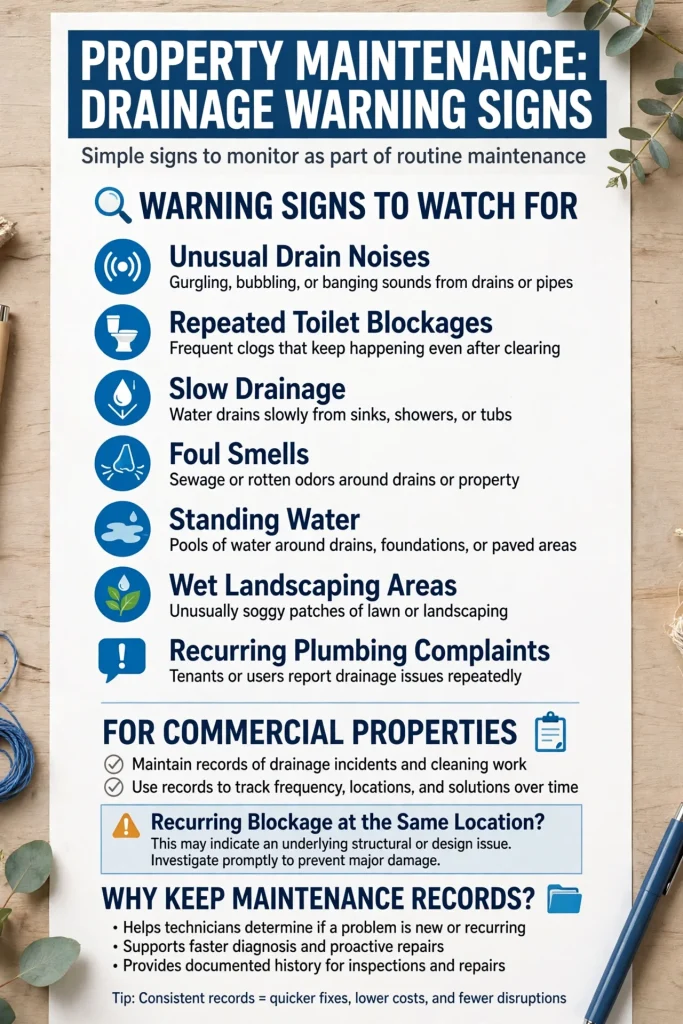
Property owners can monitor several simple warning signs as part of routine maintenance.
Pay attention to unusual drain noises, repeated toilet blockages, slow drainage, foul smells, standing water, wet landscaping areas, and recurring plumbing complaints.
Commercial properties should maintain records of drainage incidents and cleaning work.
A recurring blockage at the same location is especially important because it may indicate an underlying structural or design issue.
Keeping maintenance records also helps technicians understand whether a problem is new or recurring.
Frequently Asked Questions About Sewer Line Problems
What is the first sign of a sewer line problem?
A common early warning sign is when multiple fixtures begin draining slowly at approximately the same time. Repeated toilet blockages, gurgling, and sewage odours can also indicate a developing problem.
Why do several drains back up at once?
When several drains are affected, the blockage may be located in a shared downstream drainage or sewer line rather than inside an individual fixture.
Can a sewer blockage clear itself?
A partial obstruction may temporarily move or allow water through, but recurring symptoms usually indicate that the underlying problem remains.
How do I know if a sewer pipe is broken?
Possible signs include recurring blockages, foul smells, unexplained wet ground, sewage pooling, sinkholes, and persistent drainage problems. CCTV inspection can help confirm the condition of the pipe.
Are chemical drain cleaners suitable for sewer blockages?
Chemical drain cleaners are generally not a substitute for diagnosing a main sewer problem. Repeated use may also create risks for plumbing components and technicians working on the system.
How often should sewer lines be inspected?
There is no single interval suitable for every property. Inspection frequency depends on building type, pipe age, usage, previous problems, landscaping, and maintenance history. Properties with recurring blockages may benefit from more frequent professional inspections.
Can tree roots damage sewer pipes?
Yes. Tree roots can enter damaged or poorly sealed underground pipes and create obstructions. Repeated root intrusion may indicate that the pipe itself requires repair.
Conclusion
Sewer line problems often provide warning signs before they become major failures. Slow drains, repeated toilet blockages, gurgling, sewage smells, wastewater backups, wet ground, and unusual vegetation can all justify further investigation.
The most important distinction is between an isolated fixture blockage and a problem affecting the main drainage system. When several fixtures are affected simultaneously, the issue may be farther downstream.
Modern diagnostic methods such as CCTV sewer inspection can help identify blockages, root intrusion, cracks, collapsed sections, and other pipe defects. Depending on the findings, solutions can include mechanical cleaning, hydro jetting, localized repair, trenchless rehabilitation, or pipe replacement.
For Dubai properties, proactive maintenance is especially valuable in villas, apartments, hotels, restaurants, offices, and commercial buildings where drainage problems can quickly affect occupants and operations.
The best approach is to address recurring symptoms early rather than waiting for a complete sewer backup. Proper drainage use, routine maintenance, professional inspection, and timely repairs can help keep sewer systems operating reliably for longer.