Cooling is one of the largest contributors to electricity consumption in many commercial and residential buildings across Dubai. With the hot UAE climate requiring air conditioning for much of the year, the efficiency of a building’s HVAC system can have a direct impact on monthly electricity expenses. For properties using central chilled-water air conditioning, improving chiller efficiency can be one of the most effective ways to reduce DEWA bills without compromising indoor comfort.
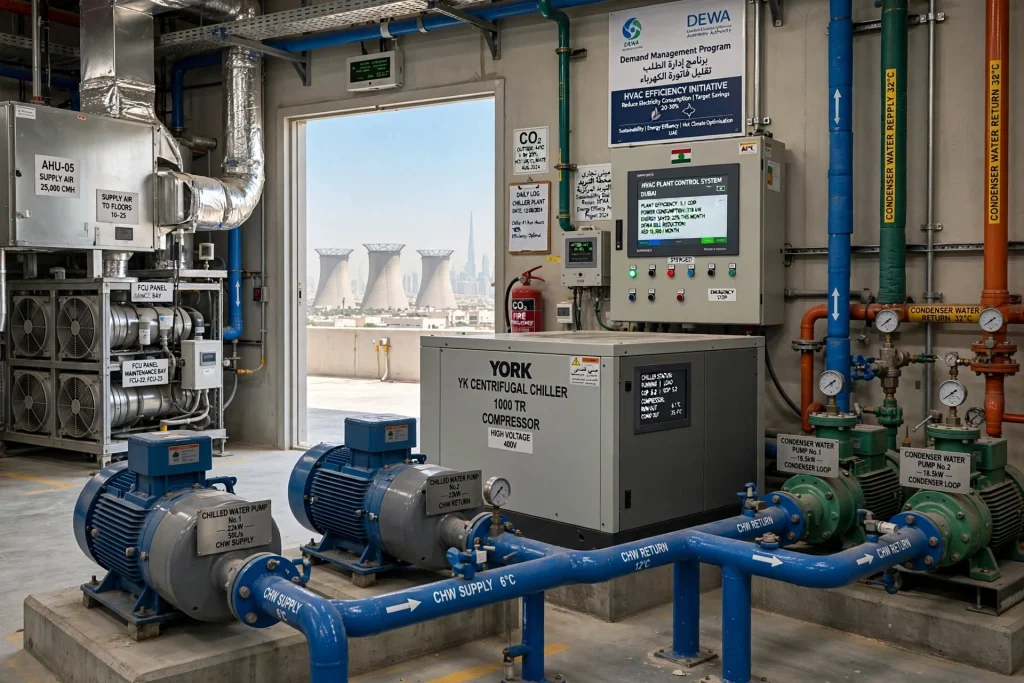
A chiller produces chilled water that circulates through air handling units (AHUs), fan coil units (FCUs), and other cooling equipment to remove heat from occupied spaces. When the chiller, pumps, cooling towers, controls, or heat exchangers operate inefficiently, the system consumes more electricity to deliver the same cooling capacity. Regular maintenance, correct system operation, and energy-focused upgrades can therefore make a significant difference to overall building performance.
Why Chillers Have a Major Impact on DEWA Electricity Costs
A central chilled-water system can contain several major electrical loads, including the chiller compressor, chilled-water pumps, condenser-water pumps, cooling tower fans, AHU fans, and associated control equipment. The chiller itself may represent a substantial portion of the HVAC electricity consumption, particularly in large offices, hotels, shopping centres, hospitals, warehouses, and mixed-use developments.
In Dubai, cooling demand changes throughout the year, but high outdoor temperatures can place considerable pressure on air conditioning equipment. When a chiller operates continuously at inefficient conditions, even a relatively small increase in energy consumption can become significant over an entire billing cycle.
Improving the efficiency of the complete chilled-water system is therefore more valuable than focusing only on the compressor. A well-maintained chiller connected to poorly balanced pumps, dirty cooling towers, inefficient air-side equipment, or incorrect controls can still produce unnecessarily high electricity consumption.
Understanding Chiller Efficiency
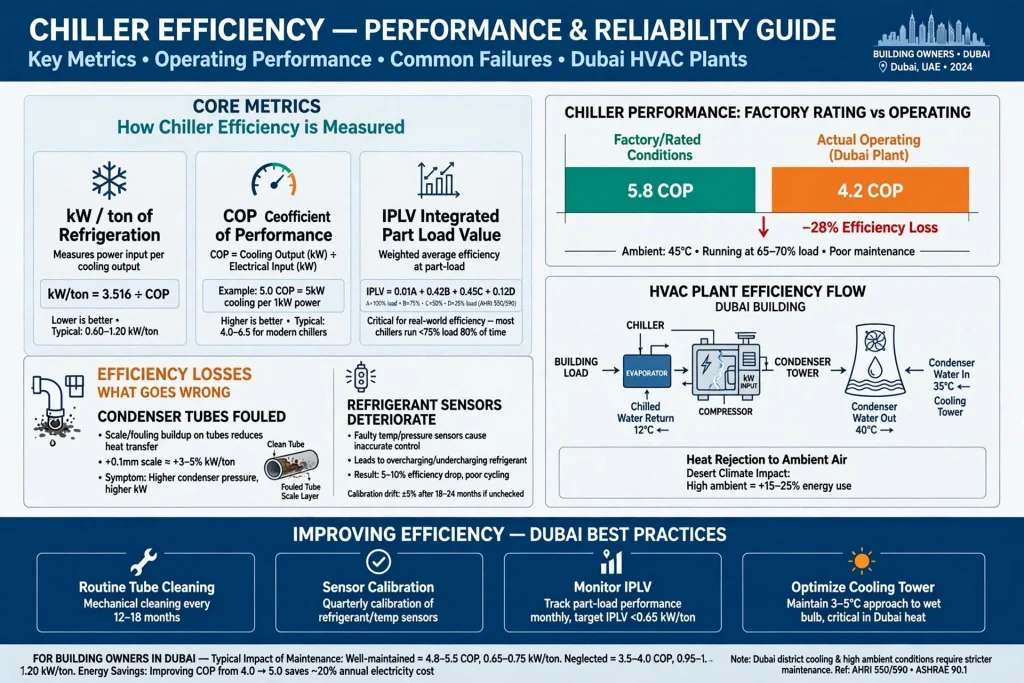
Chiller efficiency describes how effectively a cooling machine converts electrical energy into useful cooling. Energy performance is commonly assessed using measures such as kW per ton of refrigeration (kW/RT), coefficient of performance (COP), and integrated part-load value (IPLV), depending on the equipment and application.
Lower kW/RT generally indicates that a chiller requires less electrical power to produce a given amount of cooling. COP represents the relationship between cooling output and electrical input, while part-load performance becomes particularly important because chillers rarely operate at their full rated capacity throughout the entire day.
For building owners in Dubai, looking at actual operating performance is more useful than relying only on the original factory rating. A chiller that was efficient when new may consume substantially more electricity after years of operation if condenser tubes become fouled, refrigerant conditions change, sensors drift, or components deteriorate.
Keep Chiller Condenser Tubes Clean
One of the most important maintenance activities for water-cooled chillers is keeping condenser tubes clean. Scale, corrosion, biological deposits, and other forms of fouling can reduce heat transfer between the refrigerant and condenser water.
When heat cannot be rejected efficiently, the chiller may need to work harder to maintain the required chilled-water temperature. This can increase compressor power consumption and reduce overall cooling efficiency.
Tube cleaning should be included in a planned preventive maintenance programme based on equipment condition, water quality, operating hours, and manufacturer recommendations. In Dubai buildings, proper condenser-water treatment is also important because poor water management can accelerate fouling and corrosion.
Improve Cooling Tower Performance
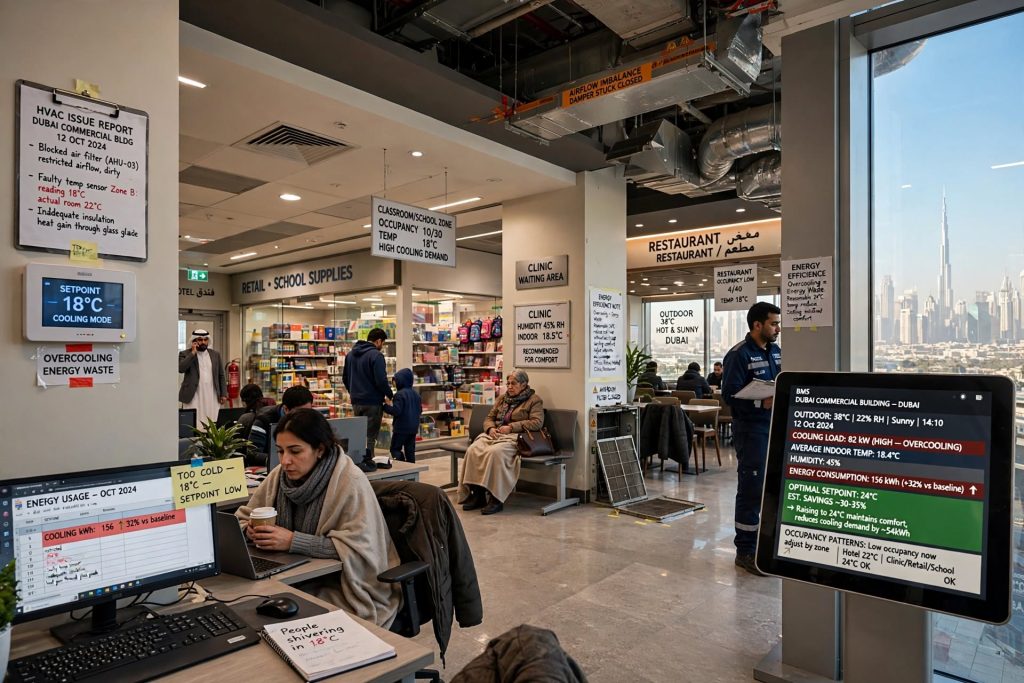
For water-cooled chillers, the cooling tower plays an important role in rejecting heat from the condenser-water loop. A cooling tower that is dirty, poorly maintained, incorrectly controlled, or operating with inadequate airflow can increase condenser-water temperature.
Higher entering condenser-water temperature can increase compressor lift and electrical consumption. Maintaining clean fill media, proper water distribution, functional fans, suitable approach temperatures, and appropriate water treatment can therefore contribute to lower energy consumption.
Variable-speed cooling tower fans can also help reduce electricity use during periods when full airflow is unnecessary. Instead of operating fans continuously at maximum speed, a properly controlled system can adjust fan speed according to condenser-water temperature and actual cooling demand.
Optimise Chilled-Water Temperature
Chilled-water supply temperature is another important factor in chiller energy performance. Operating at an unnecessarily low temperature can increase compressor workload and reduce efficiency.
However, increasing chilled-water temperature must be done carefully. AHUs, FCUs, humidity control, indoor temperature requirements, and building usage all need to be considered. In some applications, a modest increase in chilled-water supply temperature may reduce compressor energy while still maintaining acceptable indoor conditions.
Modern building management systems can monitor supply and return temperatures and help operators identify opportunities for temperature reset strategies. The objective is not simply to make chilled water warmer, but to find the most efficient operating point for the complete HVAC system.
Use Variable Speed Drives on Pumps and Fans
Chilled-water pumps and condenser-water pumps can consume significant electricity, particularly in large buildings. Traditional constant-speed systems may continue operating at high output even when cooling demand decreases.
Variable frequency drives (VFDs), also called variable speed drives, allow motor speed to respond to actual system requirements. Because fan and pump power can fall substantially as speed decreases, reducing unnecessary flow can produce meaningful energy savings.
VFDs can be applied to chilled-water pumps, condenser-water pumps, cooling tower fans, and selected AHU or ventilation fans. The correct control strategy should be designed around differential pressure, flow requirements, temperature conditions, and equipment limitations.
Avoid Overcooling the Building
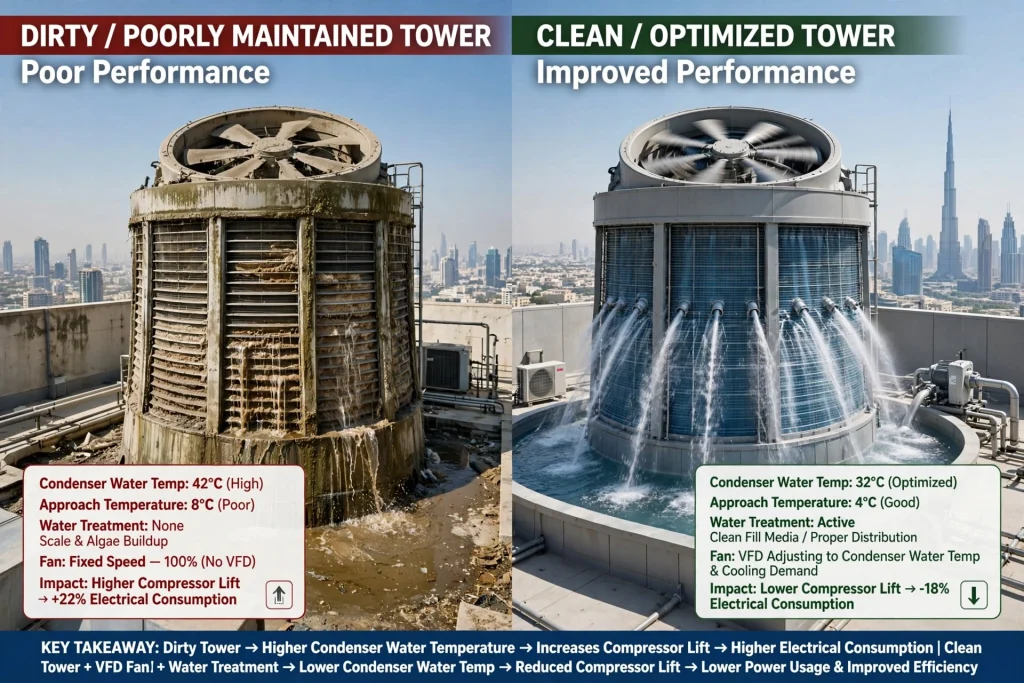
Overcooling is a common source of unnecessary energy consumption in commercial buildings. When thermostats are set significantly lower than necessary, the HVAC system has to remove additional heat continuously.
A building that maintains reasonable indoor temperature conditions can reduce cooling demand without sacrificing occupant comfort. This is particularly relevant for offices, retail spaces, schools, hotels, clinics, restaurants, and other properties with changing occupancy.
Temperature setpoints should be reviewed together with humidity requirements, outdoor conditions, occupancy patterns, and building use. Simply lowering the thermostat when a space feels warm may not solve the underlying problem if there is an airflow imbalance, blocked filter, faulty sensor, or inadequate insulation.
Balance Chilled-Water Flow
Hydronic balancing is essential for efficient chilled-water distribution. If some AHUs or FCUs receive excessive flow while others receive insufficient flow, the system may operate inefficiently even though the chiller itself is functioning correctly.
Balancing valves, differential pressure controls, pump settings, control valves, and system design should be reviewed to ensure chilled water reaches the equipment according to actual requirements.
Poor balancing can lead to comfort complaints, low temperature differences between supply and return water, unnecessary pump energy, and inefficient chiller operation. Correcting these issues can improve both comfort and energy performance.
Pay Attention to Delta T
The temperature difference between chilled-water supply and return is commonly referred to as Delta T. It is an important indicator of chilled-water system performance.
A low Delta T can indicate that the building is not extracting enough useful cooling from the water before it returns to the chiller. This may be caused by excessive flow, control valve issues, poorly performing coils, incorrect equipment selection, or other hydraulic problems.
A low Delta T condition can cause pumps to circulate more water than necessary and may force additional equipment to operate. Monitoring supply and return temperatures across the system can help identify these problems before they become major energy issues.
Maintain AHUs and FCUs
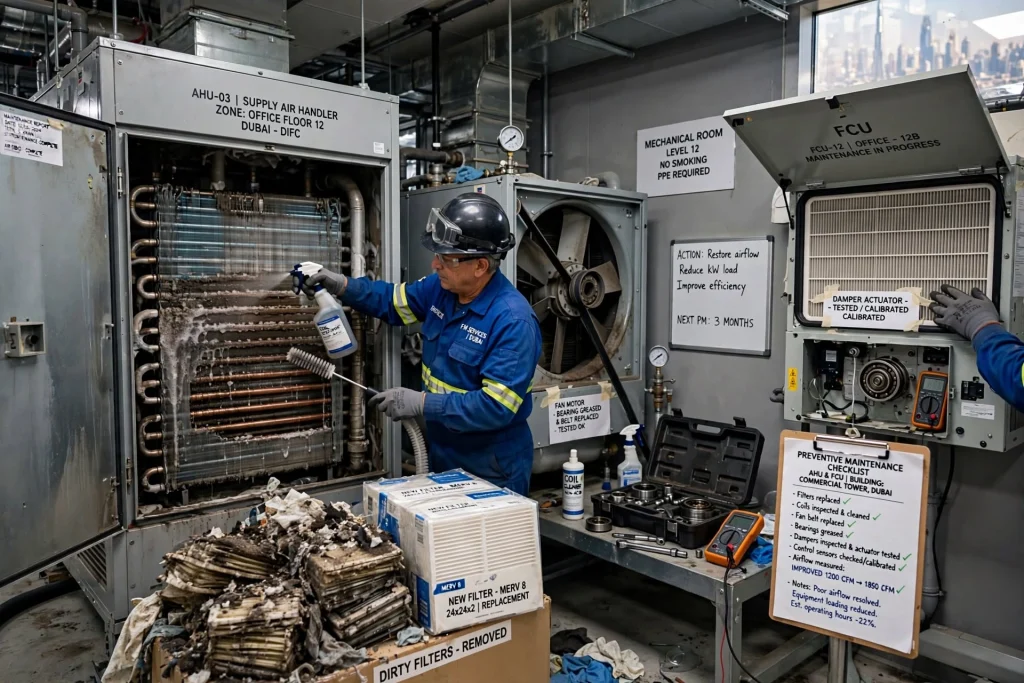
Chiller efficiency cannot be considered separately from the air-side equipment. Dirty filters, blocked coils, malfunctioning dampers, worn fan motors, and poor airflow can increase the energy required to maintain indoor conditions.
AHU and FCU coils should be inspected and cleaned as necessary. Filters should be replaced or cleaned according to their condition and manufacturer requirements. Fan operation, belts, bearings, dampers, actuators, and control sensors should also be checked during preventive maintenance.
Improving air-side performance allows the chilled-water system to deliver cooling more effectively, potentially reducing operating hours and unnecessary equipment loading.
Use Building Management Systems for Better Chiller Control
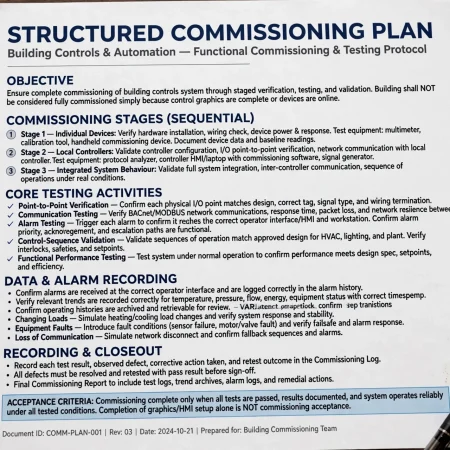
A Building Management System (BMS) can provide valuable visibility into HVAC energy performance. Instead of relying only on manual checks, facility teams can monitor chilled-water temperatures, condenser-water temperatures, pump status, cooling tower operation, valve positions, occupancy schedules, alarms, and other operating conditions.
Advanced controls can sequence multiple chillers according to actual cooling demand. For example, running one efficient chiller at an appropriate load may be more economical than operating several chillers at very low loads.
BMS-based scheduling can also reduce unnecessary cooling during periods when buildings are unoccupied. Offices, meeting rooms, retail units, and other spaces can be programmed around actual operating schedules rather than running the entire HVAC system continuously.
Chiller Sequencing Can Reduce Energy Waste
Buildings with multiple chillers should use an intelligent sequencing strategy. Starting every available chiller regardless of demand can create inefficient part-load operation and unnecessary pump and tower energy.
A properly designed sequence determines when chillers should start or stop based on cooling load, efficiency, chilled-water temperature, equipment capacity, and operating conditions.
Modern control systems can also prioritise equipment based on efficiency and operating hours. This helps distribute runtime appropriately while keeping the overall system within an efficient operating range.
Replace Ageing Chillers When Appropriate
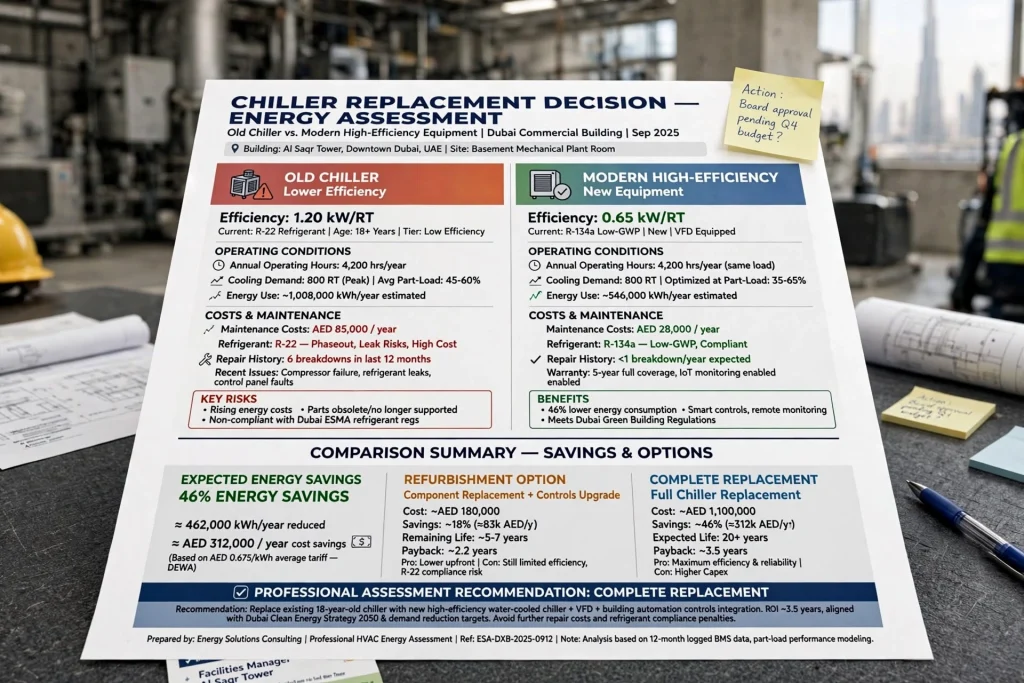
Maintenance can improve the performance of an existing chiller, but there may be a point where replacement becomes more economical. Older chillers can have lower efficiency compared with modern high-efficiency equipment, especially when operating under part-load conditions.
A replacement decision should not be based solely on the age of the equipment. Building owners should compare current kW/RT, annual operating hours, maintenance costs, cooling demand, refrigerant considerations, repair history, and expected energy savings.
A professional energy assessment can help determine whether refurbishment, component replacement, controls upgrades, or complete chiller replacement offers the strongest financial return.
Consider Free Cooling and Economiser Strategies
Certain buildings may be able to benefit from economiser or free-cooling strategies when outdoor conditions allow. These approaches reduce dependence on mechanical refrigeration by using favourable ambient conditions to assist with cooling.
The suitability of such systems depends on climate, humidity, building design, chilled-water temperatures, cooling requirements, and system configuration. Dubai’s climate means traditional free cooling opportunities may be limited during hot periods, but appropriate strategies can still be evaluated for specific applications and seasonal conditions.
Reduce Heat Gain Inside the Building
The chiller is not the only factor affecting cooling demand. Building envelope performance has a direct relationship with HVAC energy consumption.
Solar heat entering through glazing, poorly insulated walls or roofs, air leakage, inefficient doors, and heat-producing equipment can increase the cooling load. Improving window performance, shading, insulation, air sealing, and internal heat management can reduce the amount of cooling required.
In Dubai villas, offices, warehouses, hotels, and commercial properties, reducing unnecessary heat gain can complement chiller efficiency improvements and create a more sustainable overall cooling strategy.
Use Preventive Maintenance Instead of Reactive Repairs
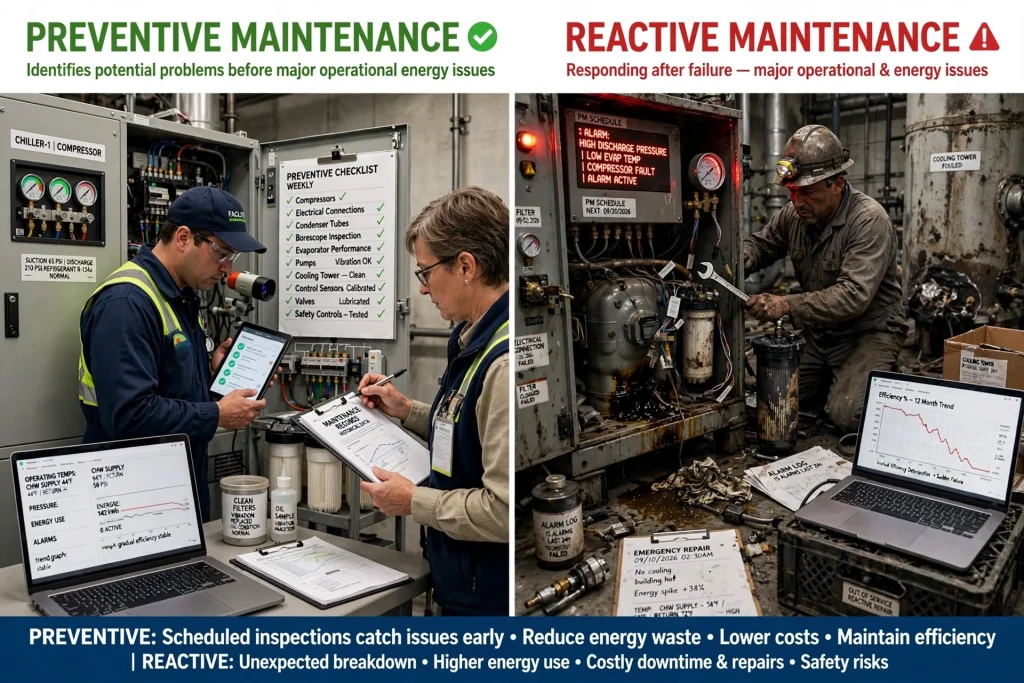
Reactive maintenance often means equipment is repaired only after performance has already deteriorated or a component has failed. Preventive maintenance takes a different approach by identifying potential problems before they create major operational or energy issues.
A proper chiller maintenance programme may include inspection of compressors, electrical connections, refrigerant conditions, condenser tubes, evaporator performance, pumps, cooling towers, control sensors, vibration, oil conditions, filters, valves, and safety controls.
Facility managers should maintain records of operating temperatures, pressures, electrical consumption, alarms, maintenance activities, and equipment performance. Historical data makes it easier to identify gradual efficiency deterioration.
Choose the Right Chiller Service Contractor
Professional maintenance is especially important for large central cooling systems where small performance issues can translate into substantial electricity costs. A qualified chiller Service Contractor can assess equipment condition, identify efficiency problems, inspect associated pumps and cooling towers, and recommend maintenance or optimisation measures based on the actual system.
For commercial properties, service planning should include preventive maintenance, emergency response, performance monitoring, spare-parts planning, and coordination with the building’s facility management team.
The best approach is not simply to repair a chiller when it stops working. Regular inspections can identify developing problems and help maintain stable cooling performance throughout Dubai’s demanding summer conditions.
Monitor DEWA Consumption After HVAC Improvements
Energy-saving measures should be measured after implementation. Building owners can compare electricity consumption before and after chiller optimisation while considering weather, occupancy, operating hours, and changes in building use.
For example, a lower DEWA bill after a maintenance programme may indicate improved performance, but it is important to determine whether the reduction resulted from HVAC efficiency, lower occupancy, seasonal conditions, or another factor.
Submetering can provide even greater visibility. Separate monitoring of chillers, pumps, cooling towers, AHUs, and other major loads allows facility teams to identify where electricity is being consumed and where improvements are most likely to deliver savings.
Chiller Energy Efficiency in Dubai Buildings
Dubai properties have different cooling requirements depending on their size, construction, occupancy, and usage. A high-rise office in Business Bay may have a very different load profile from a villa in Jumeirah, a hotel in Downtown Dubai, a warehouse in Al Quoz, or a retail property in Deira.
The same applies across other UAE locations such as Abu Dhabi, Sharjah, Ajman, and Ras Al Khaimah. Climate conditions, building design, occupancy, district cooling availability, and HVAC configuration all influence energy performance.
For this reason, chiller optimisation should be based on actual site conditions rather than a generic energy-saving checklist.
How Much Can Efficient Chillers Reduce DEWA Bills?
There is no single percentage that applies to every building. Potential savings depend on the existing chiller condition, cooling load, operating schedule, maintenance history, controls, water temperatures, pump efficiency, cooling tower performance, and building envelope.
A poorly maintained system may offer significant opportunities through relatively simple corrective work, while a modern and well-optimised installation may have less room for improvement.
The most reliable approach is to establish a baseline, measure actual system performance, identify the largest energy losses, implement improvements, and then verify the results. This creates a practical energy-management process rather than relying on estimated savings alone.
Frequently Asked Questions About Chiller Energy Efficiency
What is the most effective way to reduce chiller electricity consumption?
The most effective measure depends on the building. Common opportunities include improving condenser heat rejection, cleaning heat-transfer surfaces, optimising chilled-water temperatures, balancing water flow, improving pump and fan control, maintaining AHUs and FCUs, and using BMS-based equipment sequencing.
Does chiller maintenance reduce electricity consumption?
Yes, proper maintenance can help maintain efficient operation by addressing issues such as dirty condenser tubes, poor heat transfer, faulty sensors, blocked filters, inefficient pumps, cooling tower problems, and incorrect controls. Actual savings depend on the system’s condition before maintenance.
How does BMS help reduce HVAC electricity use?
A BMS can monitor equipment performance and automate schedules, temperature control, chiller sequencing, pump operation, cooling tower control, and other HVAC functions. This can reduce unnecessary operation and improve coordination between different components of the chilled-water system.
Is replacing an old chiller worth the investment?
It can be, particularly when an ageing chiller has high electricity consumption, frequent breakdowns, expensive repairs, or poor part-load efficiency. A lifecycle cost assessment should compare the existing system’s energy and maintenance costs against the expected performance of replacement equipment.
Can improving pumps reduce chiller energy costs?
Yes. Efficient pump operation can reduce the electricity consumed by the chilled-water and condenser-water systems. Variable-speed drives and proper hydraulic balancing can help pumps respond to actual cooling requirements instead of operating unnecessarily at high output.
Conclusion: Make Chiller Efficiency Part of Your Energy Strategy
Reducing DEWA electricity bills does not necessarily require sacrificing indoor comfort. For buildings using chilled-water HVAC systems, the most sustainable approach is to improve the efficiency of the complete cooling system.
Chiller maintenance, condenser cleaning, cooling tower optimisation, pump control, chilled-water temperature management, Delta T improvement, AHU maintenance, BMS automation, equipment sequencing, and building-envelope improvements can all contribute to lower energy consumption.
Dubai’s hot climate makes cooling an essential building service, so improving HVAC efficiency can have long-term financial and operational benefits. Rather than waiting for a chiller to fail, property owners and facility managers can use preventive maintenance, energy monitoring, and performance-based optimisation to keep cooling equipment operating efficiently and control unnecessary electricity consumption.