Chillers are among the most important components of large-scale air conditioning systems across the United Arab Emirates. Shopping malls, hotels, hospitals, commercial towers, industrial facilities, residential communities, airports and other large buildings depend on reliable chilled-water systems to maintain comfortable indoor temperatures throughout the year. Because the UAE experiences extremely high outdoor temperatures, particularly during the summer, chiller performance directly affects building comfort, energy consumption, operating costs and equipment reliability.
Professional [HVAC Chiller Services in the UAE] are therefore not limited to repairing a failed compressor or topping up refrigerant. A complete chiller service strategy involves preventive maintenance, fault diagnosis, heat-transfer optimization, water treatment, electrical inspections, controls, chilled-water balancing and performance monitoring. Properly maintained equipment can operate more efficiently and provide stable cooling while reducing the likelihood of unexpected shutdowns.
Dubai’s cooling infrastructure also places considerable emphasis on energy efficiency. The Dubai Supreme Council of Energy identifies efficient cooling and district cooling as important parts of the emirate’s energy strategy, while Dubai’s cooling regulator notes that cooling represents a substantial portion of electricity demand.
Why Chiller Systems Are Critical for UAE Buildings
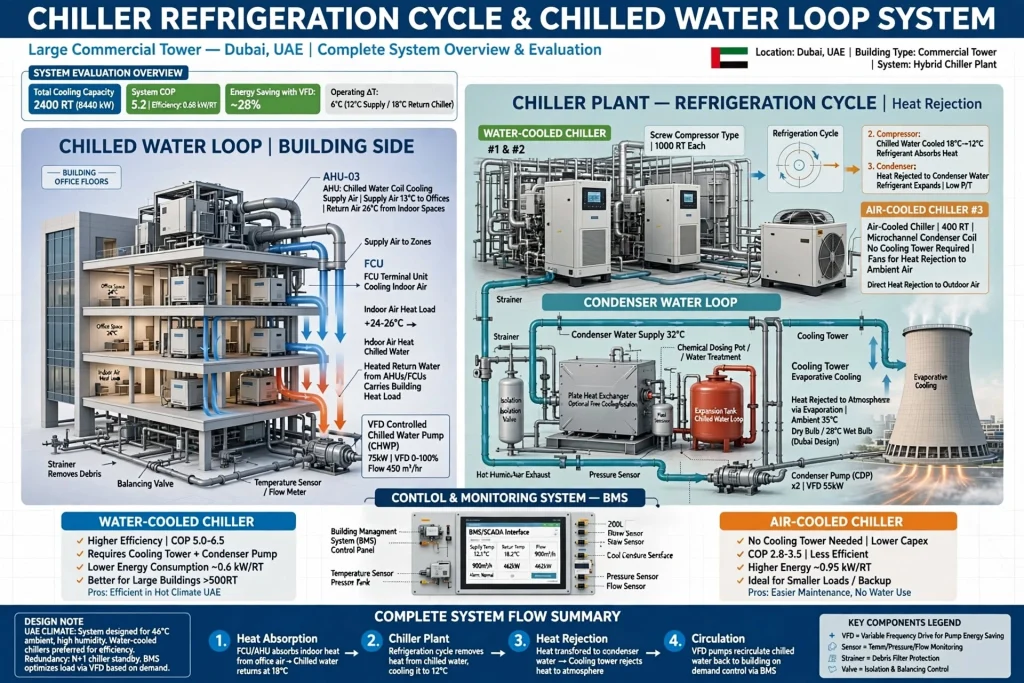
A chiller removes heat from water and produces chilled water that circulates through a building’s cooling system. This chilled water normally travels through air handling units (AHUs), fan coil units (FCUs) or other terminal equipment, where heat is transferred from indoor air to the chilled-water loop.
The heated return water then travels back to the chiller plant, where the refrigeration cycle removes the absorbed heat before the water is circulated again. Depending on the installation, the system may use a water-cooled or air-cooled chiller.
In large UAE buildings, a chiller plant can include multiple chillers, chilled-water pumps, condenser-water pumps, cooling towers, expansion tanks, valves, strainers, heat exchangers, variable frequency drives (VFDs), sensors and a building management system (BMS). A problem with any one of these components can influence overall cooling performance.
This is why professional chiller maintenance should evaluate the complete system rather than focusing only on the main chiller.
Water-Cooled and Air-Cooled Chiller Maintenance
Water-cooled chillers are commonly used in larger commercial and industrial applications because they can provide efficient cooling when supported by properly maintained cooling towers and condenser-water systems. The refrigeration circuit typically includes the compressor, evaporator, condenser and expansion device, while the cooling tower rejects heat from the condenser-water loop.
Air-cooled chillers reject heat directly into the surrounding air through condenser coils and fans. They can be suitable where cooling towers or large condenser-water systems are impractical.
Both technologies require different maintenance approaches. Water-cooled systems require attention to cooling tower cleanliness, condenser-water quality, tube scaling, pumps, water treatment and approach temperatures. Air-cooled equipment requires regular condenser coil cleaning, fan inspection, airflow verification and electrical checks.
The right maintenance strategy therefore depends on the chiller type, capacity, operating schedule, building load and site conditions.
Preventive Chiller Maintenance in Dubai and Across the UAE
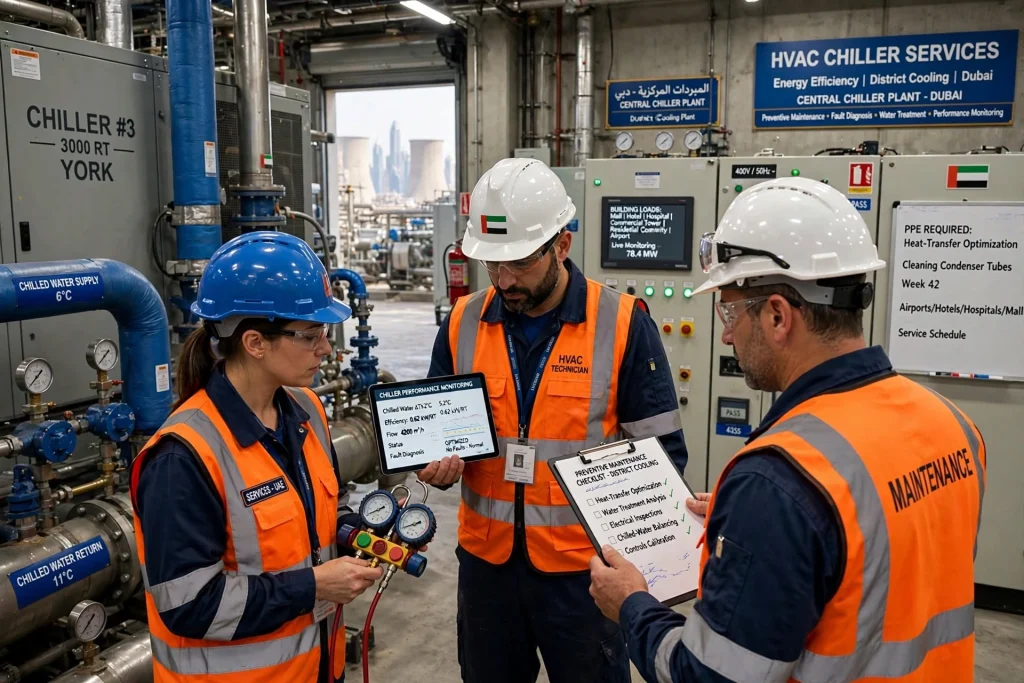
Preventive maintenance is one of the most effective ways to protect a commercial chiller installation. Instead of waiting for equipment to fail, technicians inspect the system at planned intervals and identify developing problems before they become expensive breakdowns.
A preventive maintenance program can include compressor inspection, refrigerant circuit checks, electrical testing, oil analysis, condenser and evaporator inspection, chilled-water flow verification, pump inspection, vibration monitoring and control-system testing.
Filters, strainers and coils also need attention because restricted airflow or reduced water flow can increase the operating load on the system. Fouling on heat-transfer surfaces can reduce heat exchange and force the chiller to consume more energy to deliver the same cooling capacity.
In Dubai, where cooling demand can remain high for extended periods, preventive maintenance is especially important for commercial properties in areas such as Business Bay, Downtown Dubai, Dubai Marina, Jumeirah, Al Barsha, Deira, Bur Dubai, Dubai Investment Park and Al Quoz.
Chiller Repair and Fault Diagnosis
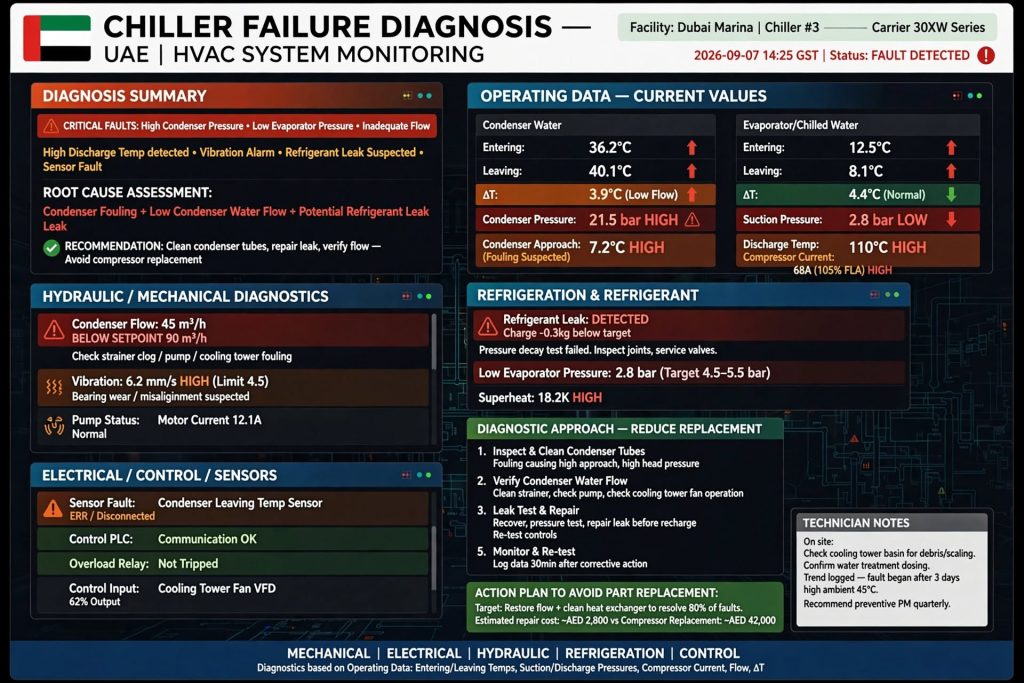
Chiller failures can originate from mechanical, electrical, hydraulic, refrigeration or control problems. Simply resetting an alarm without identifying its cause can allow the underlying problem to return.
Common chiller problems include high condenser pressure, low evaporator pressure, inadequate chilled-water flow, high compressor discharge temperature, abnormal vibration, refrigerant leakage, compressor failure, sensor faults, pump problems and insufficient heat rejection.
Technicians can use operating data to establish the likely cause of a fault. Important readings include entering and leaving chilled-water temperatures, condenser-water temperatures, suction and discharge pressures, compressor current, flow rates and temperature differentials.
For example, an unexpected change in chilled-water Delta T can indicate problems with water flow, building load, control settings or terminal equipment. A high condenser approach may point toward fouling, inadequate water flow or cooling-tower performance issues.
This diagnostic approach helps reduce unnecessary component replacement and allows repairs to address the actual cause of the problem.
Compressor Inspection and Overhauling
The compressor is one of the most critical components in a refrigeration chiller. Depending on the equipment, a system may use centrifugal, screw, scroll or reciprocating compressor technology.
Compressor problems can result from inadequate lubrication, electrical issues, refrigerant abnormalities, excessive operating temperatures, mechanical wear or incorrect system conditions.
Compressor maintenance can involve checking oil condition, vibration, operating pressures, motor current, temperature and control parameters. Where required, technicians may perform compressor repair or overhaul procedures according to the manufacturer’s technical requirements.
Centrifugal chiller maintenance requires particular attention to compressor operating conditions, refrigerant pressures, lubrication, controls and surge-related operating issues. Screw chiller repair may involve inspection of the compressor assembly, oil circuit, bearings, motor and capacity-control mechanisms.
Regular monitoring can identify deterioration before a major compressor failure causes extended downtime.
Condenser and Evaporator Performance
The condenser and evaporator are central to the chiller’s heat-transfer process. When either heat exchanger becomes inefficient, the entire refrigeration cycle can suffer.
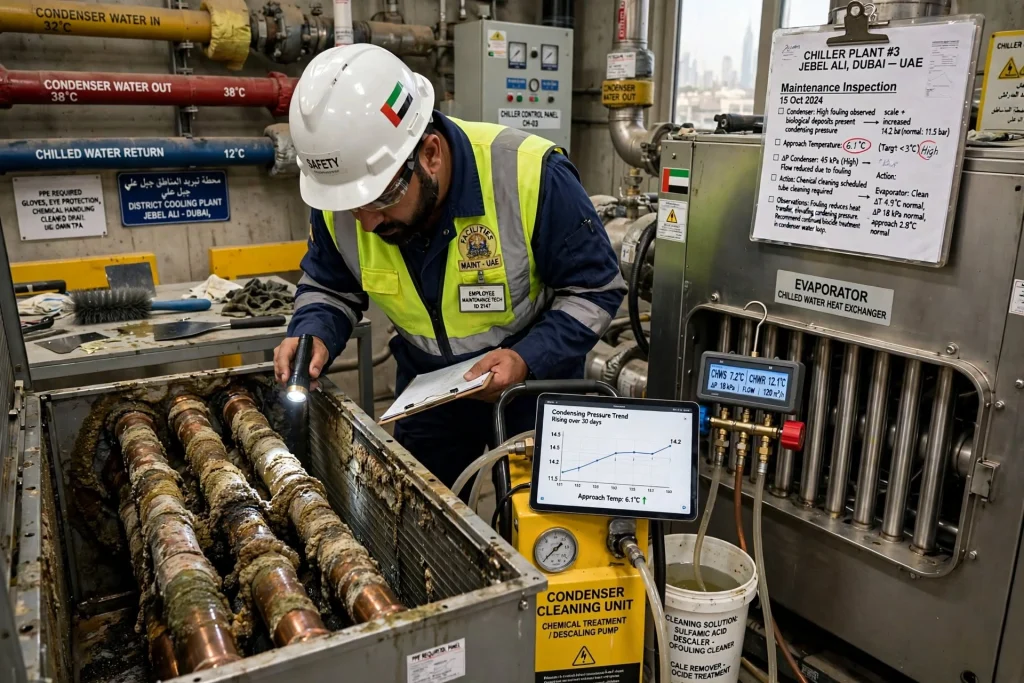
In water-cooled chillers, condenser tubes may accumulate scale, biological deposits or other contaminants. This reduces heat transfer and can increase condensing pressure. Condenser cleaning and water treatment are therefore important elements of industrial chiller maintenance.
The evaporator also requires appropriate chilled-water flow and clean heat-transfer surfaces. Poor flow, fouling or incorrect water conditions can reduce cooling capacity and affect compressor operation.
Technicians may evaluate temperature differences, pressure drops, approach temperatures and flow conditions to determine whether a heat exchanger is performing correctly.
Cooling Tower Maintenance for Water-Cooled Chillers
A water-cooled chiller plant cannot operate efficiently without an effective heat-rejection system. Cooling towers transfer heat from condenser water to the atmosphere and therefore have a direct influence on chiller efficiency.
Cooling tower maintenance can include basin cleaning, nozzle inspection, fan and motor checks, fill inspection, drift eliminator inspection, water treatment and verification of condenser-water temperatures.
Poor cooling-tower performance can cause elevated condenser temperatures and pressures. The chiller may then consume more electricity while providing the same cooling output.
For large commercial buildings, hotels, hospitals and industrial facilities, cooling-tower maintenance should therefore be treated as part of the overall chiller maintenance program rather than as a separate activity.
Chilled-Water Pumps, Valves and Hydronic Balancing
A chiller can be mechanically healthy and still perform poorly if the chilled-water distribution system is incorrectly balanced.
Chilled-water pumps must deliver the required flow and pressure to the building. Problems such as clogged strainers, worn impellers, incorrect valve positions, air in the system or pump-control issues can reduce circulation.
Variable frequency drives can adjust pump speed according to demand and are an important tool for improving HVAC system efficiency. Dubai’s energy-conservation guidance specifically identifies chiller plant managers, VFDs for chilled-water pumps and differential-pressure optimization as useful HVAC control measures.
Hydronic balancing can also help distribute chilled water more effectively between AHUs, FCUs and other terminal units. Correct balancing can improve comfort while preventing some areas from receiving excessive or insufficient flow.
Chiller Plant Optimization and Energy Efficiency
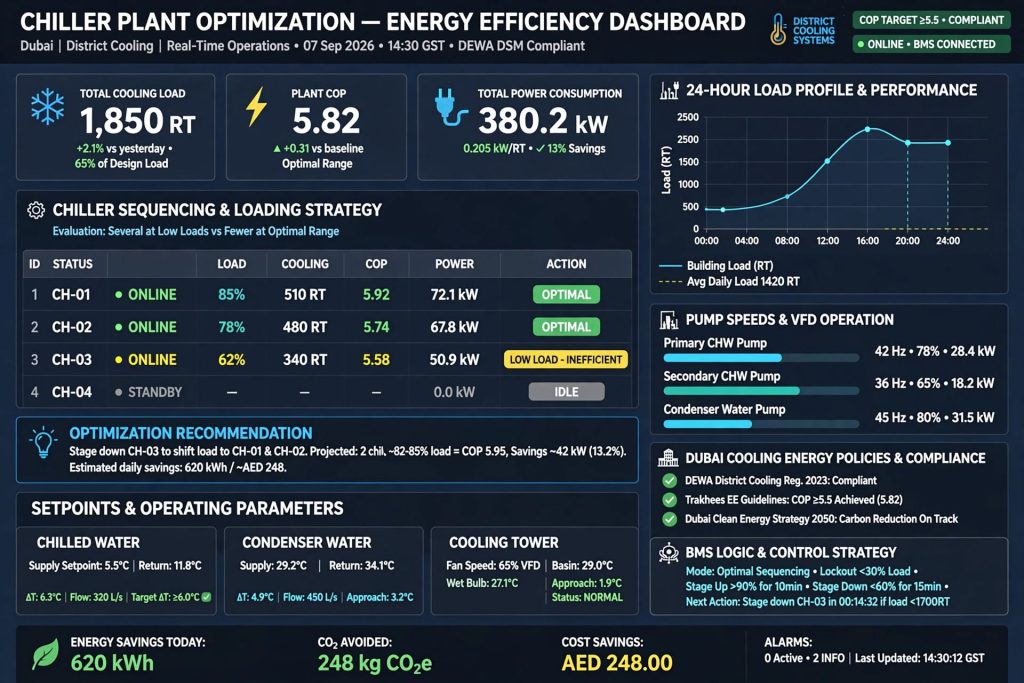
Chiller optimization is more than making the chiller produce colder water. The objective is to deliver the required cooling capacity while using the minimum practical amount of energy.
A professional optimization strategy can evaluate chiller sequencing, chilled-water temperature setpoints, condenser-water temperature, pump speeds, cooling-tower operation, building load and BMS control logic.
For example, operating several chillers at inefficient low loads may consume more energy than running fewer chillers closer to their optimal operating range. Chiller sequencing can therefore have a significant effect on plant performance.
The coefficient of performance (COP), kW per ton, Delta T, chilled-water flow and load profile are useful performance indicators. Monitoring these parameters helps facility managers understand how efficiently the plant is operating.
Dubai’s official cooling policies place significant emphasis on energy-efficient cooling, and the emirate’s regulatory framework specifically includes objectives related to energy efficiency and operational performance of cooling systems.
BMS Integration and Smart Chiller Controls
Modern commercial buildings increasingly rely on building management systems to monitor and control HVAC equipment. A BMS can collect information from chillers, pumps, AHUs, FCUs, cooling towers, temperature sensors, pressure sensors and energy meters.
When properly integrated, the system can provide operators with real-time information about plant performance. It can also support automated chiller sequencing, pump-speed control, temperature management and alarm notifications.
BMS integration is particularly valuable for large buildings in Dubai, Abu Dhabi and Sharjah where HVAC equipment may operate continuously or according to complex occupancy schedules.
A properly configured BMS can also help facility teams identify abnormal operating conditions before they develop into major failures.
Industrial and Commercial Chiller Services
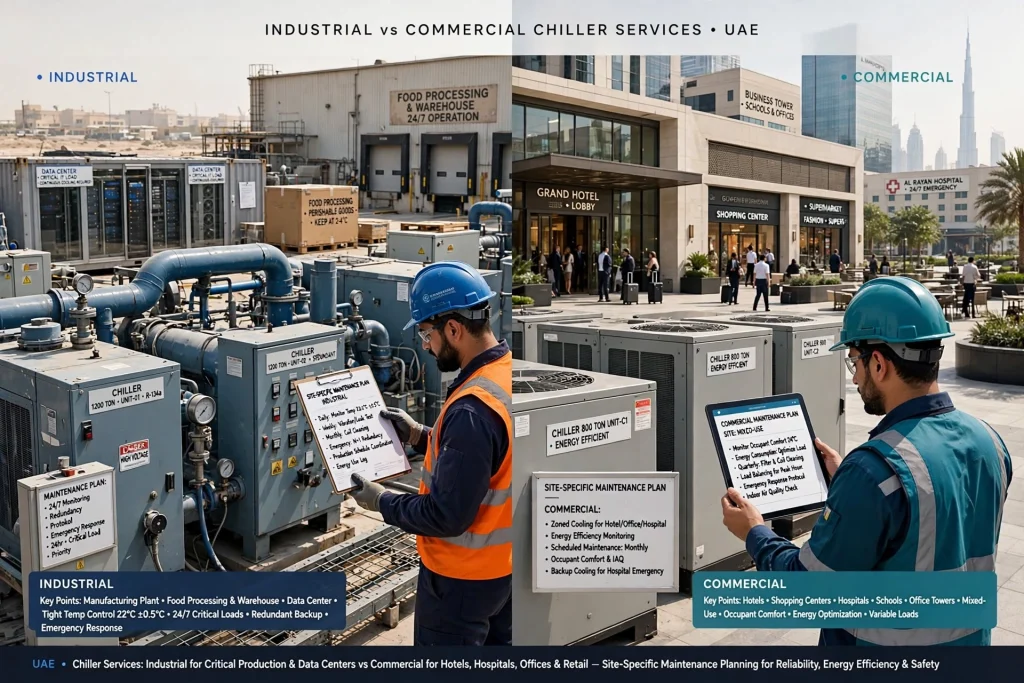
Industrial facilities often have different cooling requirements from offices or residential buildings. Manufacturing plants, warehouses, food-processing facilities, data centers and other industrial operations may require continuous cooling and tight temperature control.
Commercial chiller services are commonly required in hotels, shopping centers, hospitals, schools, office towers and mixed-use developments. These facilities may have several chillers operating as part of a central plant.
For industrial applications, maintenance planning should consider production schedules, critical cooling loads, redundancy and emergency response requirements. For commercial properties, the focus may include occupant comfort, energy consumption, equipment reliability and minimizing disruption to tenants.
A site-specific maintenance plan is therefore more valuable than a generic checklist.
Chiller Maintenance in Abu Dhabi, Sharjah and Other Emirates
Although Dubai has a particularly large district and central cooling infrastructure, professional chiller maintenance is important throughout the UAE.
In Abu Dhabi, central cooling systems support offices, hotels, residential towers, healthcare facilities and major developments. Sharjah has extensive commercial, residential and industrial properties requiring dependable air conditioning. Ajman, Ras Al Khaimah, Fujairah and Umm Al Quwain also have hotels, commercial buildings, warehouses and industrial facilities where reliable cooling is essential.
UAE-specific maintenance planning should account for high ambient temperatures, dust, humidity, operating hours and the cooling requirements of each facility.
For properties in Dubai, areas such as Business Bay, Downtown Dubai, Dubai Marina, Jumeirah, Deira, Al Quoz, Al Barsha, Jebel Ali and Dubai South represent diverse commercial and industrial environments where different chiller configurations may be found.
Why Regular Chiller Maintenance Reduces Operating Costs
Chiller maintenance should be viewed as an investment in equipment performance rather than simply an expense. A poorly maintained system may consume more electricity, experience more frequent breakdowns and require expensive emergency repairs.
Dirty heat exchangers, inefficient pumps, incorrect control settings, refrigerant problems and cooling-tower issues can all reduce system performance.
Routine inspection allows these problems to be identified earlier. Cleaning, calibration, balancing and control optimization can help the plant operate closer to its intended design conditions.
DEWA also emphasizes the importance of efficient cooling and regular AC maintenance as part of energy conservation in Dubai. Its guidance highlights factors such as temperature settings, equipment age and dirty filters when discussing cooling efficiency.
Emergency Chiller Repair and Breakdown Response
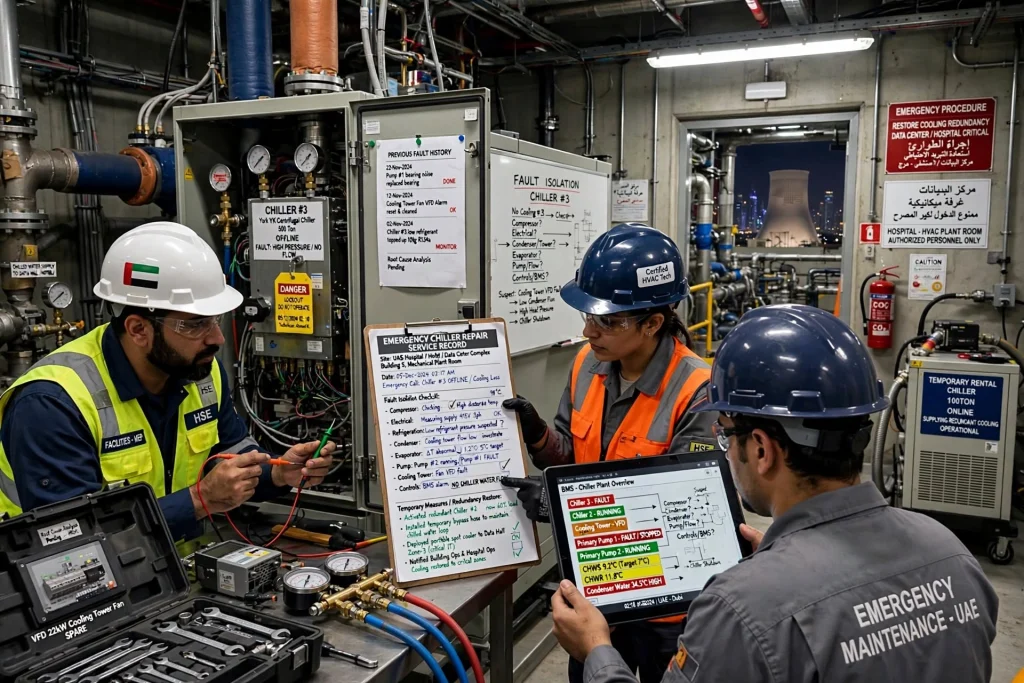
Even well-maintained chillers can experience unexpected failures. Emergency chiller repair becomes particularly important in hospitals, hotels, data centers, retail facilities and industrial plants where cooling interruption can have serious operational consequences.
An effective emergency response begins with fault isolation. Technicians should identify whether the problem originates from the compressor, electrical system, refrigeration circuit, condenser, evaporator, pump, cooling tower, controls or another part of the plant.
Temporary measures may restore cooling while permanent repairs are planned, depending on the nature of the failure and the redundancy available within the plant.
Maintaining accurate service records can make emergency troubleshooting faster because technicians can review previous faults, operating conditions and replaced components.
Chiller Maintenance Contracts and Annual Service Plans
For large UAE properties, an annual maintenance contract can provide a structured approach to chiller reliability. Instead of relying entirely on emergency callouts, facility managers can schedule inspections, preventive maintenance and performance assessments throughout the year.
A comprehensive service plan may include routine inspections, electrical checks, refrigeration diagnostics, pump maintenance, cooling-tower inspection, heat-exchanger cleaning, control-system checks and performance reporting.
The maintenance frequency should depend on equipment type, operating hours, cooling load, manufacturer recommendations and site conditions.
A well-designed maintenance contract should also clearly define response times, included services, spare parts responsibilities and emergency support.
Choosing a Professional Chiller Service Provider in the UAE
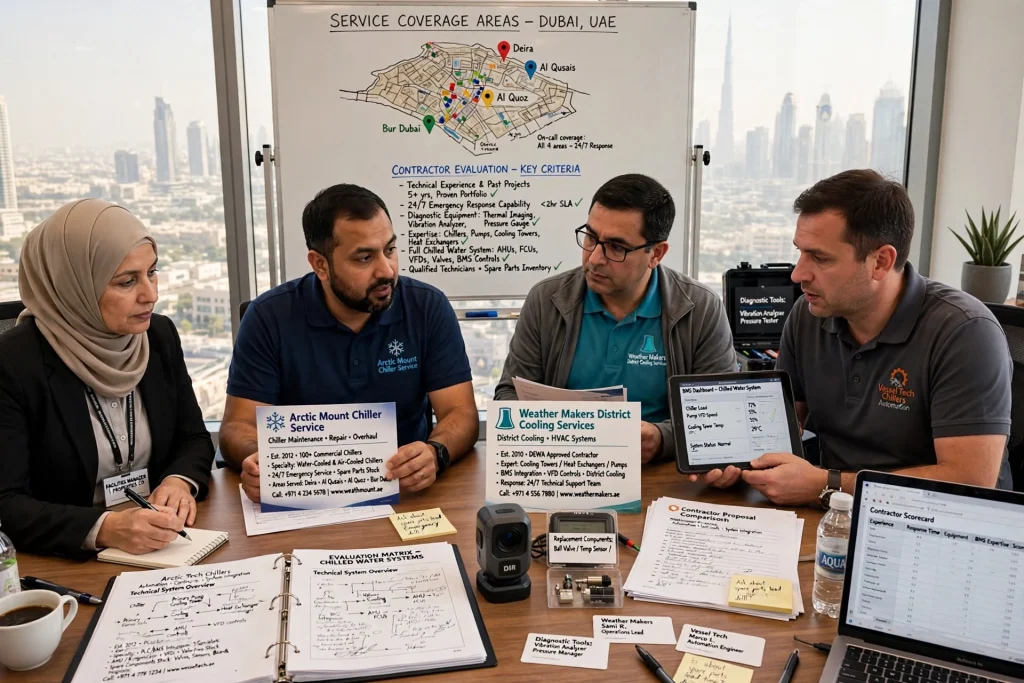
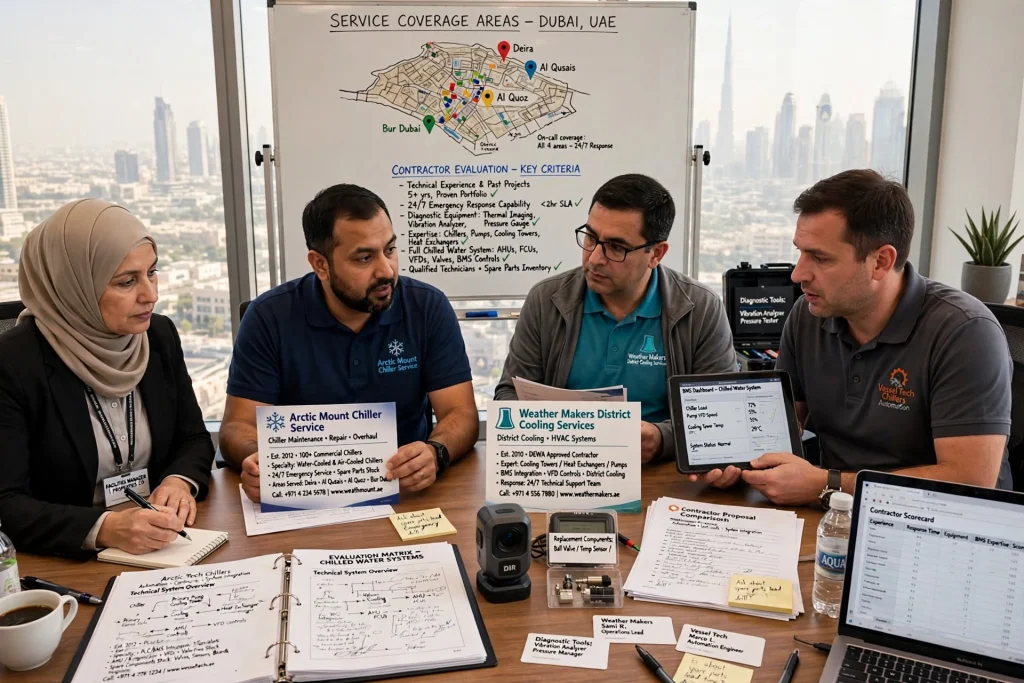
Selecting the right chiller contractor requires more than comparing service prices. Facility managers should evaluate technical experience, response capability, diagnostic equipment, knowledge of different chiller technologies and familiarity with commercial HVAC systems.
The contractor should understand the complete chilled-water system, including chillers, pumps, cooling towers, heat exchangers, AHUs, FCUs, VFDs, valves and BMS controls.
For critical facilities, it is also useful to consider emergency response capability and the availability of qualified technicians and replacement components.
Dubai’s market includes specialized HVAC contractors and chiller-focused service providers across areas such as Deira, Al Quoz, Al Qusais, Bur Dubai and other commercial and industrial districts. Arctic Mount Chiller Service / Compressor overhauling, Weather Makers District Cooling Services LLC Chiller Service / Compressor overhauling – Branch 2 and Vessel Tech Chillers & Automation | Dubai are examples of businesses appearing in local search results for chiller-related services; their inclusion here is not an endorsement.
The Future of Chiller Optimization in the UAE
The future of commercial cooling is moving toward smarter controls, energy monitoring, predictive maintenance and integrated building automation.
Artificial intelligence, machine learning, IoT sensors and advanced BMS platforms can help analyze equipment behavior and identify patterns associated with developing faults. Instead of relying solely on fixed maintenance intervals, facility teams can increasingly use real-time operating data to determine when equipment requires attention.
Digital monitoring can also help identify changes in COP, kW per ton, Delta T, compressor loading, condenser performance and pump efficiency.
These technologies are particularly relevant in the UAE as building owners and facility managers continue to look for ways to reduce energy consumption without compromising occupant comfort.
Conclusion
Reliable chiller operation is fundamental to modern commercial and industrial buildings across the United Arab Emirates. From Dubai skyscrapers and shopping malls to Abu Dhabi offices, Sharjah industrial facilities and UAE-wide hospitality properties, chilled-water systems need consistent maintenance, accurate diagnostics and intelligent optimization.
Effective HVAC Chiller Services in the UAE should cover the complete cooling ecosystem, including compressors, evaporators, condensers, cooling towers, chilled-water pumps, heat exchangers, AHUs, FCUs, VFDs and BMS controls. Preventive maintenance can reduce unexpected breakdowns, while performance optimization can help improve energy efficiency and operating reliability.
For facility managers, the best approach is to combine preventive maintenance with condition monitoring, system balancing and performance analysis. Rather than waiting for a chiller to fail, regular technical inspections can identify problems early and keep the cooling plant operating closer to its intended performance.
As UAE cities continue developing high-rise buildings, hospitality projects, healthcare facilities, industrial sites and large mixed-use developments, demand for efficient and dependable cooling will remain essential. A professionally maintained chiller plant is therefore not simply an HVAC asset, it is a critical part of the building’s overall operational infrastructure.