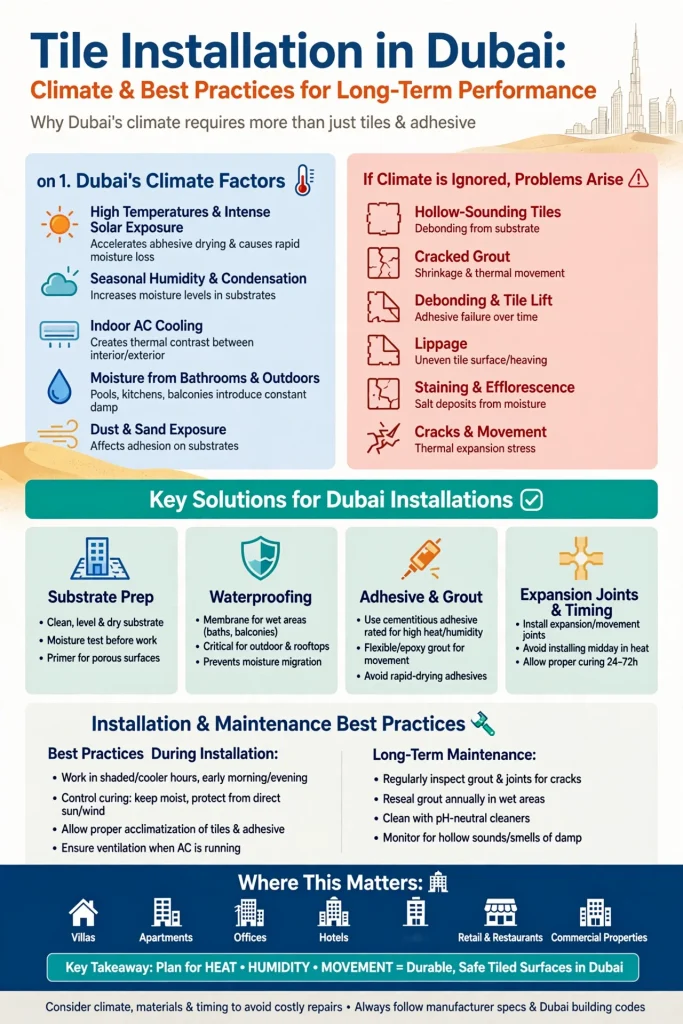
Tile installation in Dubai requires more than selecting attractive tiles and a suitable adhesive. The local climate can influence substrate conditions, adhesive performance, curing, grout, moisture levels, thermal movement, and the long-term stability of a tiled surface. High temperatures, intense solar exposure, seasonal humidity, air conditioning, and moisture from bathrooms or outdoor areas can all affect how a tile installation performs.
This is particularly important for villas, apartments, offices, hotels, retail spaces, restaurants, and commercial properties across Dubai. A tiled surface may look perfect immediately after installation but develop hollow-sounding tiles, cracked grout, debonding, lippage, staining, or movement-related problems if environmental conditions are not considered during preparation and installation.
Understanding the relationship between Dubai’s climate and tile installation helps homeowners and property managers make better decisions about materials, installation timing, substrate preparation, waterproofing, expansion joints, grout, and maintenance.
Why Dubai’s Climate Matters for Tile Installation
Dubai has a hot desert climate with very high summer temperatures and significant humidity, particularly during warmer months. Outdoor surfaces can become extremely hot under direct sunlight, while indoor spaces are often maintained at much lower temperatures through air conditioning.
This creates different thermal conditions within the same property.
A balcony exposed to direct sunlight can experience substantial temperature changes compared with an air-conditioned living room. Roof terraces, pool decks, façades, outdoor walkways, and entrance areas can therefore experience more thermal movement than interior spaces.
Tile installation needs to account for these environmental conditions from the beginning. The tile itself is only one part of the system. Adhesive, grout, substrate, waterproofing, movement joints, and installation conditions all influence performance.
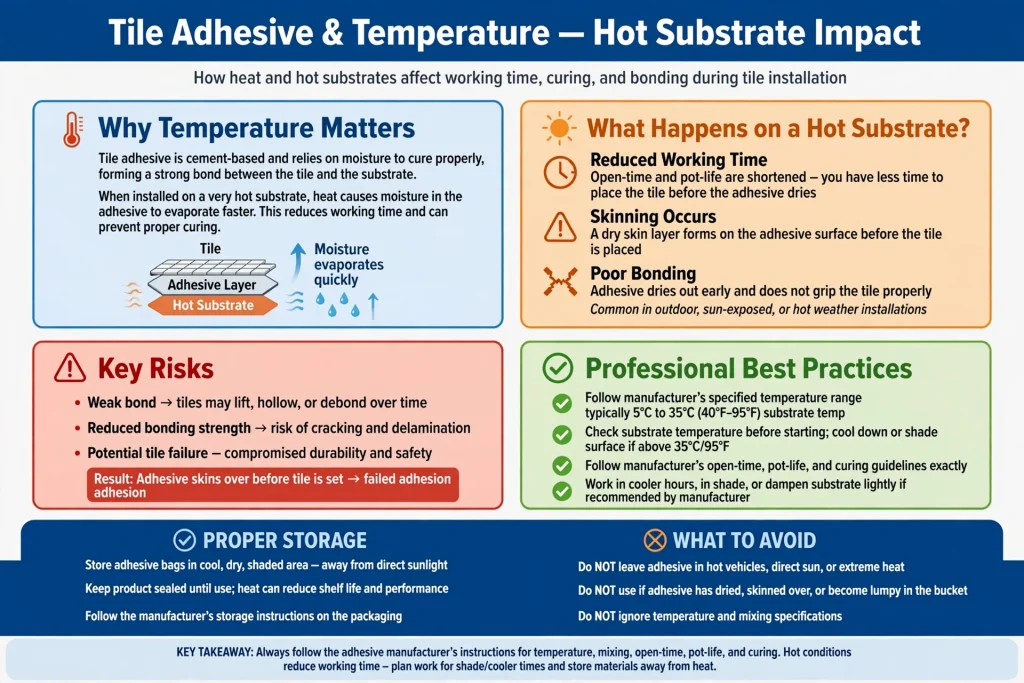
How Heat Affects Tile Adhesive
Tile adhesive is designed to provide a strong bond between the tile and substrate, but its working and curing characteristics can be affected by temperature.
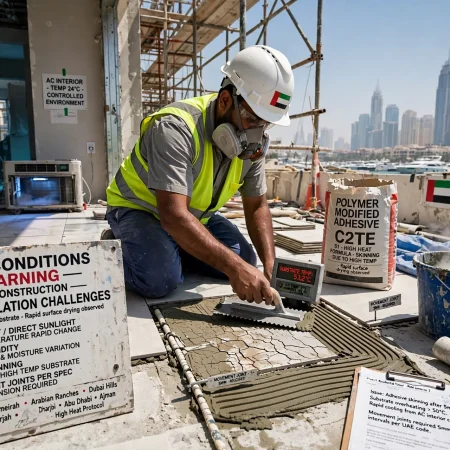
When installation takes place on a very hot substrate, moisture within cement-based adhesive can evaporate more quickly. This can reduce the available working time and potentially affect proper bonding if the adhesive skins over before the tile is correctly placed.
This is particularly relevant when tiles are installed outdoors or on surfaces exposed to direct sunlight.
Professional installers should follow the adhesive manufacturer’s specified temperature, mixing, open-time, pot-life, and curing requirements. Materials should also be stored according to the manufacturer’s instructions rather than being left exposed to extreme heat.
Rapid Drying and Adhesive Open Time
One of the practical challenges of working in hot conditions is reduced open time.
Open time refers to the period during which an applied adhesive remains suitable for fixing tiles. If an installer spreads too much adhesive over a large area in hot or windy conditions, the surface can begin to dry before the tiles are placed.
The result may be reduced contact between adhesive and tile.
For this reason, experienced installers often work in manageable sections and monitor the adhesive surface during installation. The manufacturer’s technical data sheet should always determine the appropriate working conditions and installation procedure.
Why Substrate Preparation Is Important
A tile installation is only as reliable as the surface underneath it.
Concrete slabs, cement screeds, renders, existing tiles, gypsum boards, cement boards, and other substrates may require different preparation methods. The substrate needs to be sufficiently sound, clean, flat, and compatible with the selected tile adhesive.
In Dubai renovation projects, installers may encounter old adhesive, cracks, dust, contaminants, uneven screeds, moisture problems, or previous waterproofing systems.
Applying new tiles directly over an unsuitable substrate can create problems regardless of the quality of the tile.
Heat can make some substrate conditions more difficult to manage because surface moisture may change quickly. A professional assessment is therefore important before installation begins.
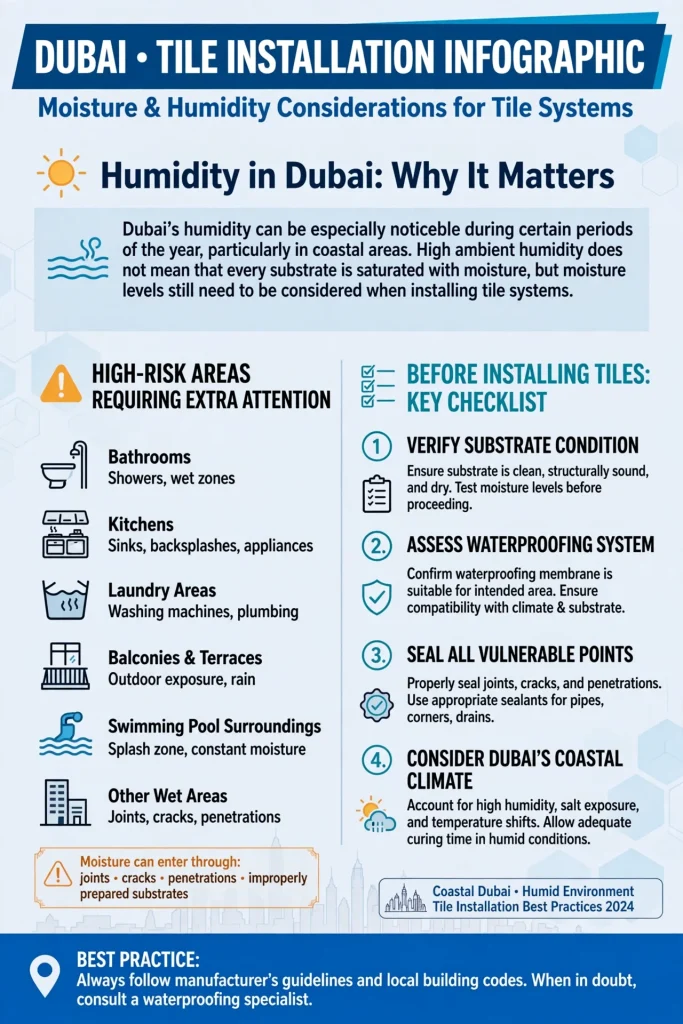
Humidity and Moisture in Dubai
Dubai’s humidity can be especially noticeable during certain periods of the year, particularly in coastal areas.
High ambient humidity does not mean that every substrate is saturated with moisture, but moisture levels still need to be considered when installing tile systems.
Bathrooms, kitchens, laundry areas, balconies, swimming pool surroundings, terraces, and other wet areas require additional attention because moisture can enter through joints, cracks, penetrations, or improperly prepared substrates.
Before installing tiles in moisture-sensitive areas, installers should verify that the substrate and waterproofing system are suitable for the intended application.
Waterproofing Before Tile Installation
Tiles and grout should not be considered a substitute for waterproofing.
Bathrooms, shower areas, balconies, terraces, podiums, wet rooms, and other exposed areas may require a dedicated waterproofing system beneath the tile assembly.
Waterproofing may include cementitious coatings, liquid-applied membranes, sheet membranes, or other systems designed for the specific application.
Corners, floor-to-wall junctions, pipe penetrations, drains, niches, and changes of plane require particular attention.
In Dubai villas and apartments, waterproofing is especially important in bathrooms and balconies because water infiltration can cause damage below the tiled surface.
Thermal Expansion and Tile Movement
Materials expand and contract as temperatures change. Tile assemblies can therefore experience movement caused by thermal changes.
This is particularly important on external surfaces exposed to direct sunlight.
A tiled terrace in Dubai may become significantly hotter during the day than an interior floor. Repeated temperature cycles can place stress on the tile assembly if movement is not properly accommodated.
Movement joints and perimeter joints can help manage this movement when designed and installed correctly.
The location and spacing of movement joints depend on the project, substrate, tile system, environmental exposure, and applicable installation guidance.
What Happens When Movement Is Not Accommodated?
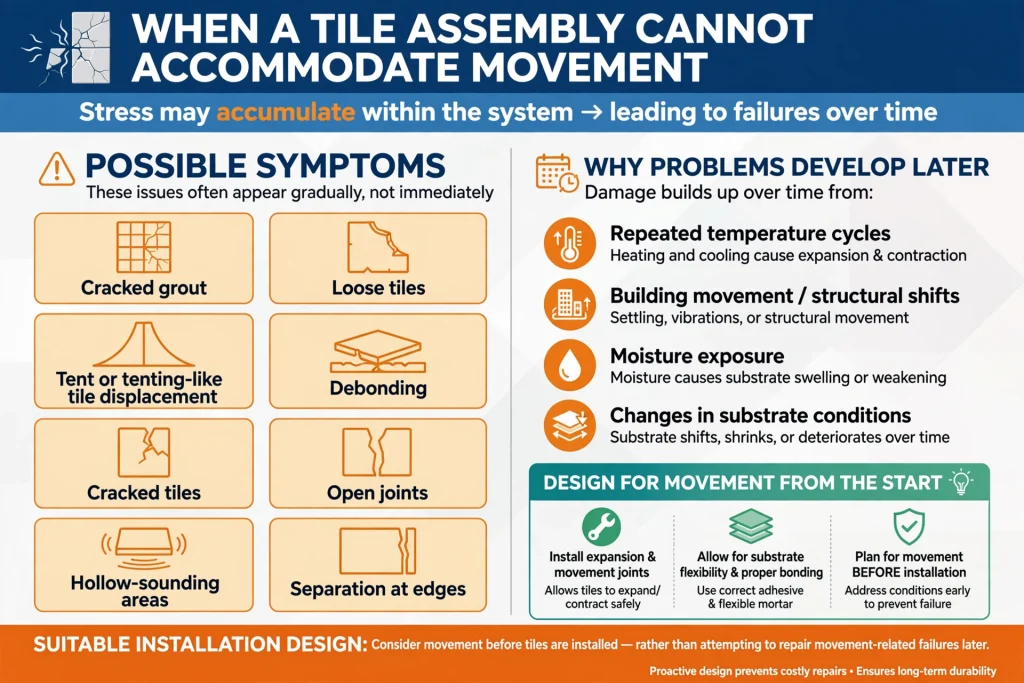
When a tile assembly cannot accommodate movement, stress may accumulate within the system.
Possible symptoms include:
- Cracked grout
- Loose tiles
- Debonding
- Tent or tenting-like tile displacement
- Cracked tiles
- Open joints
- Hollow-sounding areas
- Separation at edges
These problems may not appear immediately. They can develop after repeated temperature cycles, building movement, moisture exposure, or changes in substrate conditions.
A suitable installation design should therefore consider movement before tiles are installed rather than attempting to repair movement-related failures later.
Dubai’s Outdoor Areas Need Extra Attention
Outdoor tile installation is more demanding than many interior applications.
Balconies, terraces, pool decks, roof areas, garden paths, outdoor kitchens, and villa entrances can be exposed to direct sunlight, high temperatures, humidity, dust, rain, cleaning water, and repeated thermal cycles.
Tile selection should therefore consider outdoor suitability, slip resistance, water absorption, surface finish, and expected traffic.
The adhesive and grout system should also be compatible with the environmental conditions.
Drainage is another major consideration. Water should be able to flow toward appropriate drainage points rather than accumulating beneath or around the tile system.
Heat and Large-Format Tiles
Large-format porcelain and stone-look tiles are popular in contemporary Dubai interiors.
Their larger dimensions can create a clean, spacious appearance, but they also require greater installation precision.
Large-format tiles need suitable substrate flatness, proper adhesive coverage, careful handling, accurate alignment, and appropriate joint planning.
On large surfaces, small substrate variations can become more noticeable. If adhesive coverage is inadequate, voids beneath the tile can create weak areas.
Back-buttering may be recommended for certain large-format installations depending on the tile, substrate, adhesive, and manufacturer’s instructions.
Tile Adhesive Coverage Matters
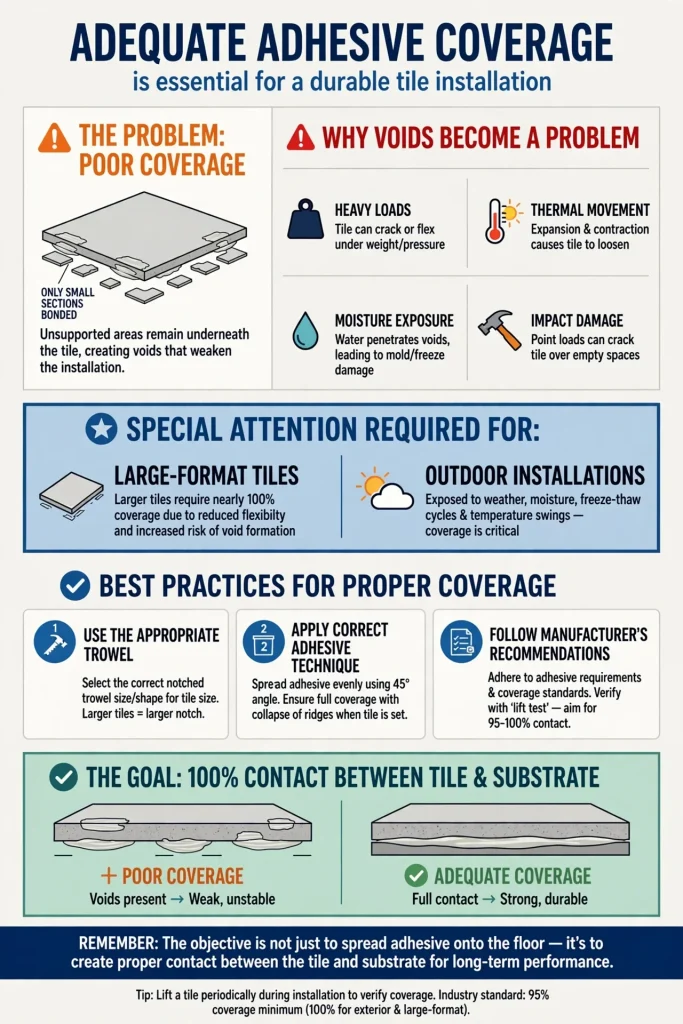
Adequate adhesive coverage is essential for a durable tile installation.
If only small sections of the tile are bonded, unsupported areas can remain underneath the tile. These voids may become more problematic under heavy loads, thermal movement, moisture exposure, or impact.
Large-format tiles and outdoor installations generally require particularly careful attention to coverage.
Installers should use the appropriate trowel and adhesive technique and follow the manufacturer’s recommendations.
The objective is not simply to spread adhesive onto the floor but to create the appropriate contact between the tile and substrate.
How Heat Can Affect Grout
Grout is another part of the tile system affected by installation conditions.
Cement-based grout requires appropriate hydration and curing. Excessive heat or rapid moisture loss can interfere with the intended curing process if installation conditions are outside the manufacturer’s recommendations.
Premature drying may contribute to surface defects, colour inconsistencies, shrinkage, or reduced performance.
Grout should therefore be mixed and installed according to the product instructions, with particular attention to water ratios, working time, cleaning, curing, and environmental conditions.
Choosing Grout for Dubai Conditions
The correct grout depends on the location and expected exposure.
Cementitious grout can be suitable for many residential and commercial applications when correctly selected and installed. Epoxy grout may be considered where enhanced resistance to staining, moisture, or chemicals is required.
Bathrooms, kitchens, commercial kitchens, swimming pool areas, healthcare spaces, and other demanding environments may require more specialized grout solutions.
The grout joint itself also needs to be correctly sized. Extremely narrow joints may not be appropriate for every tile, while excessively wide joints may affect appearance and maintenance.
Epoxy Tile and High-Performance Flooring Systems
Some residential and commercial projects may consider epoxy-based flooring or tile-related solutions where specific performance characteristics are required.
An Epoxy Tile Flooring Service may be considered for suitable residential applications where durability, maintenance, surface finish, and moisture resistance are important factors.
However, epoxy systems should not be selected simply because they are marketed as a universal solution. The substrate, existing floor, intended use, chemical exposure, moisture conditions, traffic level, and manufacturer’s system requirements should all be evaluated before installation.
Humidity and Tile Curing
Curing conditions are an important part of installation quality.
Cement-based materials require controlled hydration and should be allowed to cure according to the manufacturer’s instructions. Excessively dry, hot, or otherwise unsuitable conditions can affect the curing process.
At the same time, high humidity does not automatically mean that every cementitious product will cure incorrectly. The actual conditions, product chemistry, ventilation, substrate, and installation environment all matter.
Professional installers should follow the product-specific technical data rather than relying on assumptions about Dubai’s climate.
Air Conditioning and Interior Tile Installation
Air conditioning creates an interesting contrast in Dubai buildings.
An interior room may be maintained at a comfortable temperature while the exterior wall, balcony, or façade experiences intense heat.
During renovation, excessive air movement from HVAC systems can also influence the drying of certain installation materials.
For interior work, installers should maintain the environmental conditions recommended by the adhesive, grout, waterproofing, and other product manufacturers.
The building should also be sufficiently protected from dust and uncontrolled environmental exposure during the installation process.

Tile Installation During Renovation
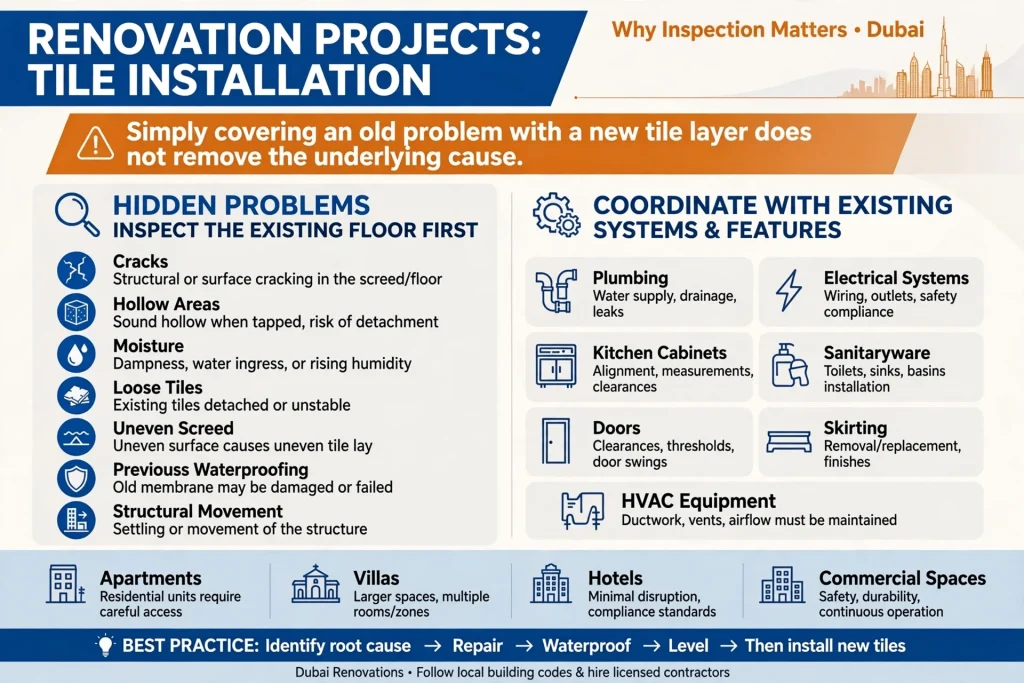
Renovation projects require particular care because existing buildings can contain hidden problems.
Before installing new tiles, contractors may need to inspect the existing floor for cracks, hollow areas, moisture, loose tiles, uneven screed, previous waterproofing, or structural movement.
Simply covering an old problem with a new tile layer does not remove the underlying cause.
In Dubai apartments, villas, hotels, and commercial spaces, renovation work may also need to coordinate with plumbing, electrical systems, kitchen cabinets, sanitaryware, doors, skirting, and HVAC equipment.
Tile Installation in Dubai Villas
Dubai villas often contain a combination of indoor and outdoor tiled areas.
Living rooms, kitchens, bathrooms, entrances, swimming pool decks, terraces, balconies, garages, and outdoor entertainment areas can all have different installation requirements.
Luxury villas in Palm Jumeirah, Jumeirah, Emirates Hills, Arabian Ranches, and Dubai Hills Estate may use large-format porcelain, natural stone, marble-look tiles, decorative mosaics, and outdoor pavers.
Each material and location should be assessed individually rather than applying one installation method throughout the property.
Tile Installation in Dubai Apartments
Apartment projects in Downtown Dubai, Dubai Marina, Business Bay, Jumeirah Lake Towers, Dubai Creek Harbour, and Al Barsha often have more limited working areas and strict building-management requirements.
Floor height is an important consideration during renovation.
The combined thickness of tile, adhesive, levelling materials, and any underlayment can affect door clearance, thresholds, kitchen appliances, and transitions to existing flooring.
Before installation begins, the finished floor level should therefore be checked carefully.
Tile Installation in Bathrooms
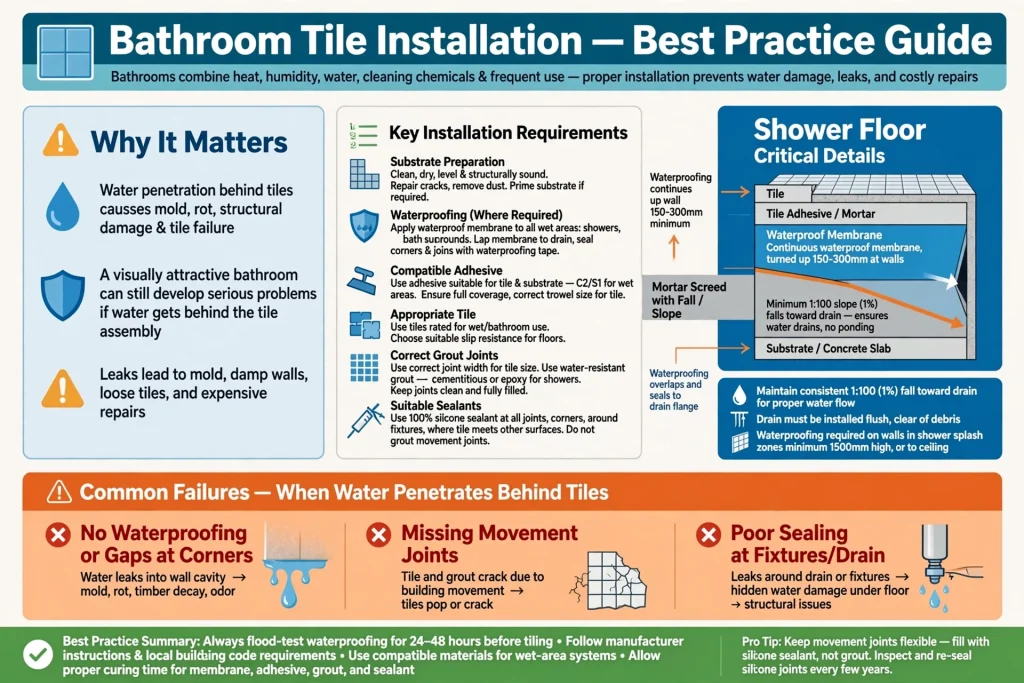
Bathrooms combine heat, humidity, water, cleaning chemicals, and frequent use.
The complete installation should include suitable substrate preparation, waterproofing where required, compatible adhesive, appropriate tile, correctly designed grout joints, movement accommodation, and suitable sealants.
Shower floors also require appropriate falls toward the drain.
A visually attractive bathroom can still develop serious problems if water is allowed to penetrate behind the tile assembly.
Tile Installation in Kitchens
Kitchens require resistance to spills, grease, cleaning, foot traffic, and frequent temperature changes.
Floor tiles should be selected according to expected traffic and maintenance requirements. Backsplash installations need proper preparation around worktops, cabinets, sockets, plumbing connections, and appliances.
Grout selection is also important because kitchen joints can accumulate food residues and stains.
A practical combination of tile finish, grout colour, joint width, and cleaning routine can make long-term maintenance easier.
Common Tile Installation Problems in Dubai
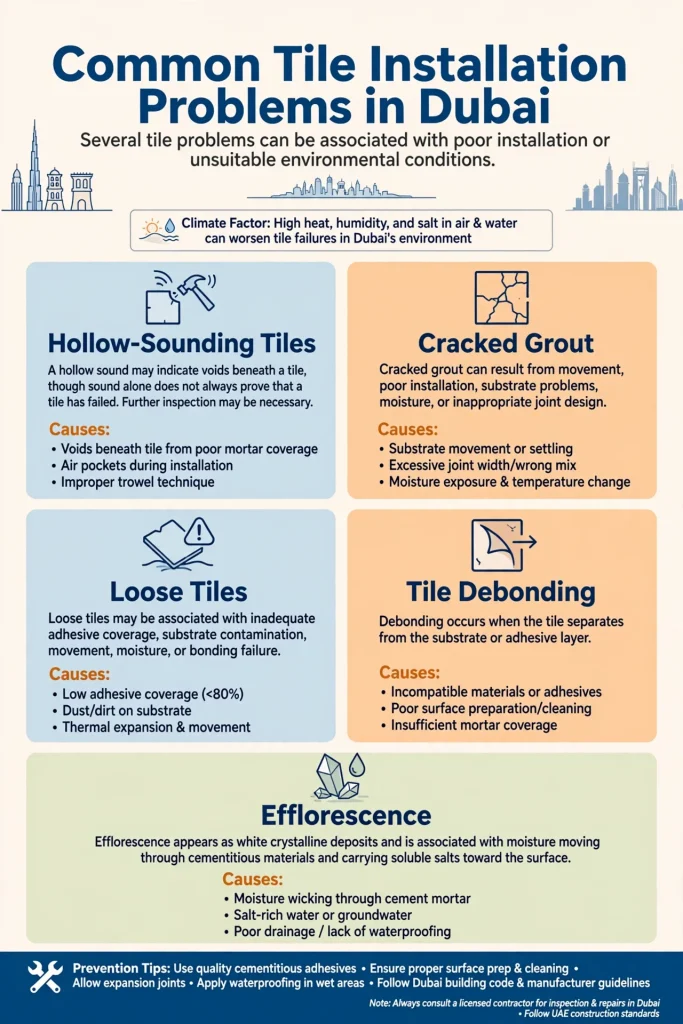
Several tile problems can be associated with poor installation or unsuitable environmental conditions.
Hollow-Sounding Tiles
A hollow sound may indicate voids beneath a tile, although sound alone does not always prove that a tile has failed. Further inspection may be necessary.
Cracked Grout
Cracked grout can result from movement, poor installation, substrate problems, moisture, or inappropriate joint design.
Loose Tiles
Loose tiles may be associated with inadequate adhesive coverage, substrate contamination, movement, moisture, or bonding failure.
Tile Debonding
Debonding occurs when the tile separates from the substrate or adhesive layer. It may be caused by incompatible materials, inadequate preparation, insufficient coverage, or movement.
Efflorescence
Efflorescence appears as white crystalline deposits and is associated with moisture moving through cementitious materials and carrying soluble salts toward the surface.
How to Prevent Heat-Related Tile Problems
Prevention begins before installation.
The substrate should be inspected and prepared properly. Tiles, adhesives, grout, waterproofing products, and sealants should be selected according to the application.
Installers should follow product-specific environmental limits and avoid unnecessary exposure of materials to extreme heat.
Outdoor work should be carefully managed when surfaces are exposed to intense sunlight.
Movement joints, perimeter joints, drainage, waterproofing, and correct adhesive coverage should all be incorporated into the design where required.
Selecting Tiles for Dubai’s Climate
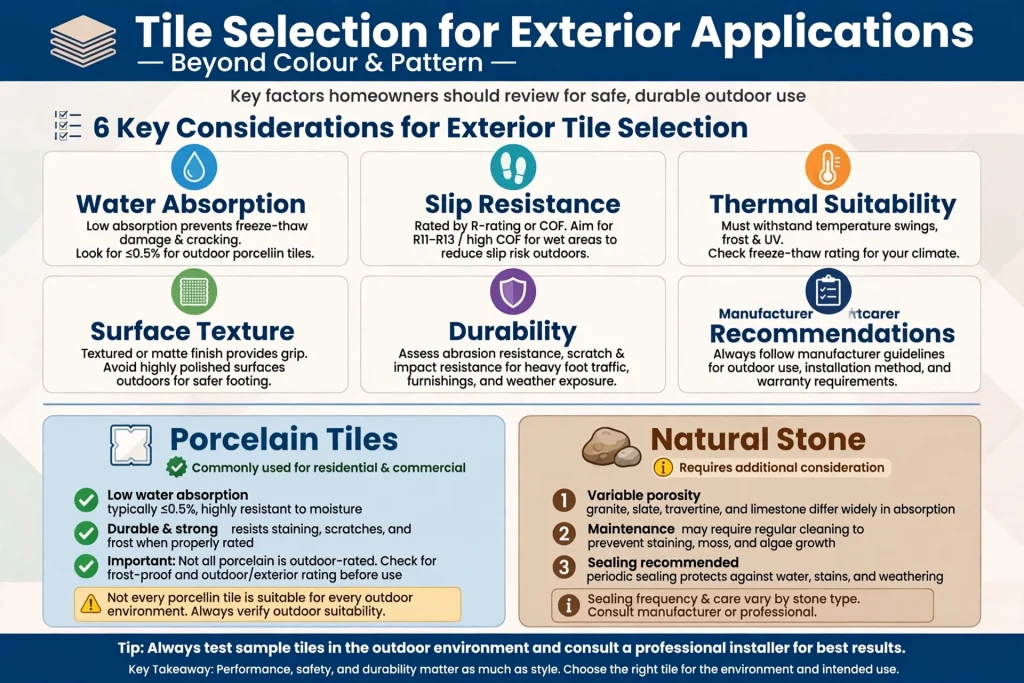
Tile selection should consider more than colour and pattern.
For exterior applications, homeowners should review water absorption, slip resistance, thermal suitability, surface texture, durability, and manufacturer recommendations.
Porcelain tiles are commonly used for many residential and commercial applications because of their low water absorption and durability, but not every porcelain tile is automatically suitable for every outdoor environment.
Natural stone requires additional consideration because different stones have different porosity, maintenance, and sealing requirements.
Maintenance After Tile Installation
Correct installation reduces the likelihood of problems, but regular maintenance remains important.
Homeowners should clean tiled surfaces using products suitable for the specific tile and grout. Standing water should not be allowed to remain unnecessarily on surfaces where drainage is required.
Outdoor areas should be inspected periodically for cracked grout, failed sealant, loose tiles, damaged movement joints, and drainage problems.
Bathrooms should be checked for deteriorated silicone joints around showers, bathtubs, sinks, and changes of plane.
Early repairs can help prevent small defects from becoming larger problems.
When Should a Tile Installation Be Inspected?
An inspection may be appropriate when homeowners notice repeated grout cracking, loose tiles, hollow areas, water staining, dampness, movement, or visible gaps.
Inspection is also useful after water damage, major renovation, or before purchasing a property where tiled areas show signs of deterioration.
Commercial property managers may benefit from scheduled inspections because tile defects in high-traffic areas can create maintenance and safety concerns.
The purpose of an inspection is to identify the likely cause rather than simply repair the visible symptom.
Frequently Asked Questions
Does Dubai heat damage floor tiles?
Heat does not automatically damage suitable floor tiles, but extreme temperature changes can place stress on the complete tile assembly. Poor substrate preparation, inadequate movement joints, unsuitable adhesive, or insufficient coverage can increase the risk of failure.
Can tiles be installed in summer in Dubai?
Tile installation can be carried out during hot periods, but installers need to follow the environmental requirements of the tile adhesive, grout, waterproofing system, and other products. Outdoor work requires particular attention to direct sunlight and substrate temperature.
Does humidity affect tile installation?
Humidity can influence drying and curing conditions for some installation materials. Moisture in the substrate is also important, especially in bathrooms, balconies, kitchens, and other wet areas.
Why do outdoor tiles crack in Dubai?
Cracking can have several causes, including thermal movement, substrate cracking, inadequate movement accommodation, unsuitable materials, poor installation, or impact. The underlying cause should be identified before replacing individual tiles.
Is epoxy suitable for Dubai homes?
Epoxy-based systems can be suitable for certain residential applications, but suitability depends on the substrate, location, moisture conditions, traffic, intended use, and selected product system.
How can I prevent loose tiles?
Proper substrate preparation, compatible adhesive, sufficient adhesive coverage, correct installation technique, suitable joints, movement accommodation, and appropriate curing conditions can all help reduce the risk of loose tiles.
Do bathrooms in Dubai need waterproofing under tiles?
Where a waterproofing system is required, tiles and grout should not be relied upon as the primary waterproofing layer. Wet-area waterproofing should be designed and installed according to the project requirements and suitable product specifications.
Conclusion
Dubai’s heat and humidity can influence almost every stage of a tile installation, from substrate preparation and adhesive application to grout curing, waterproofing, movement management, and long-term maintenance.
The most important point is that tiles should be treated as part of a complete flooring or wall system. The tile, substrate, adhesive, grout, waterproofing, sealants, movement joints, drainage, and environmental conditions all work together.
Interior and exterior installations also require different considerations. A living room in an air-conditioned apartment has very different environmental exposure from a Palm Jumeirah terrace, Dubai villa pool deck, or rooftop installation.
By selecting suitable materials, preparing the substrate correctly, following manufacturer requirements, controlling installation conditions, providing appropriate movement accommodation, and addressing moisture before tiling, homeowners can reduce the risk of premature tile failure.
For Dubai properties, professional planning is particularly valuable because the local climate creates conditions that should be considered from the beginning rather than after problems appear.