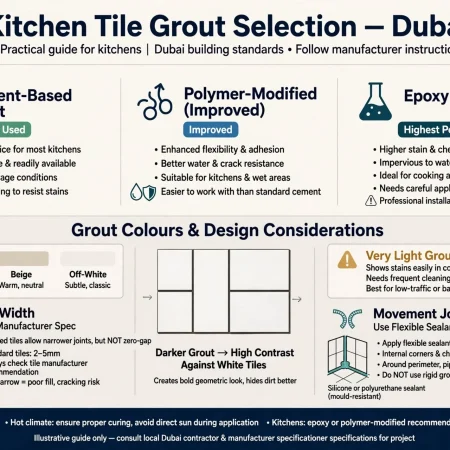
Choosing the right grout is an important part of bathroom tiling. While tiles create the visible finish, grout protects the joints between them, helps maintain a clean appearance, and contributes to the durability of the tiled surface. In Dubai, where bathrooms are exposed to frequent water use, humidity, cleaning chemicals, and temperature changes, selecting the right grout can make a noticeable difference to long-term maintenance.
Two common options are epoxy grout and cement grout. Both are used in residential and commercial tiling projects, but they have different compositions, installation requirements, water resistance, maintenance needs, and costs. Cement grout is widely used because it is affordable and relatively straightforward to apply. Epoxy grout offers stronger resistance to water penetration, stains, and many household chemicals when correctly installed.
The right choice depends on the bathroom’s design, tile material, joint width, expected usage, budget, and maintenance expectations. A family bathroom in Arabian Ranches may have different requirements from a luxury apartment bathroom in Downtown Dubai or a hotel bathroom on Palm Jumeirah.
This guide explains the differences between epoxy grout and cement grout, their advantages and limitations, installation considerations, and which option is suitable for different bathroom environments in Dubai.
What Is Grout and Why Does It Matter in Bathroom Tiling?
Grout is the material used to fill the joints between tiles after they have been installed. It creates a finished surface, helps prevent debris from collecting in tile gaps, and supports the overall appearance of the tiled installation.
Bathroom grout is exposed to conditions that are different from those in many other indoor spaces. Shower floors, bathroom walls, vanity areas, and wet-room floors regularly encounter water, soap, shampoo, body oils, and cleaning products.
Poor-quality grout, incorrect mixing, or improper installation can result in problems such as:
- Staining and discolouration.
- Cracking or crumbling grout joints.
- Mould and mildew growth on surface contamination.
- Water passing through damaged joints.
- Difficult cleaning and ongoing maintenance.
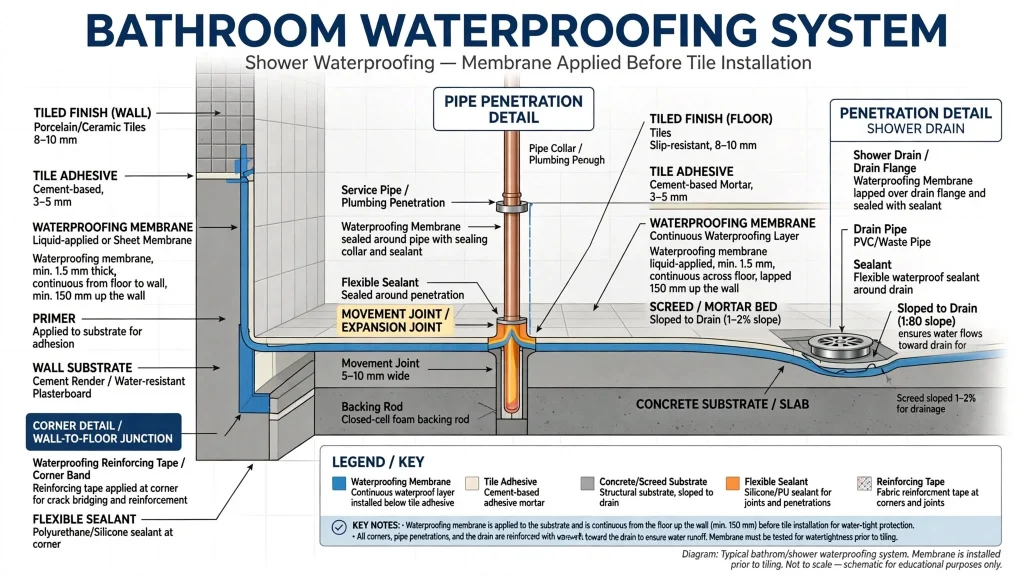
It is important to understand that grout alone does not waterproof a bathroom. Waterproofing membranes, correctly installed drainage systems, suitable tile adhesives, movement joints, and properly sealed penetrations all contribute to protecting the underlying structure.
Selecting the right grout is therefore one part of a complete bathroom tiling and waterproofing system.
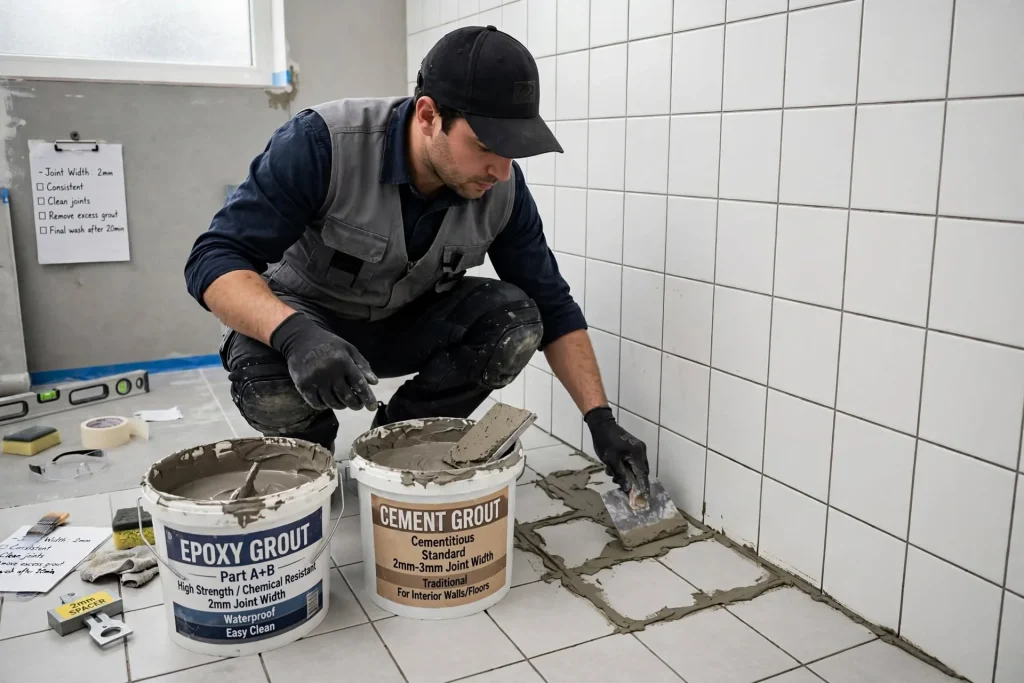
What Is Cement Grout?
<AsyncImage query=”close up cement based tile grout application between ceramic bathroom tiles professional tiler grout float” aspectRatio=”16:9″ width=”100%”/>
Cement grout is a traditional tile-joint material made primarily from cement, graded fillers, and other additives. Depending on the product, it may also contain polymers and water-retaining or performance-enhancing ingredients.
It is commonly mixed with water or a specified liquid additive before application. The installer spreads the grout across the tiled surface and presses it into the joints using a grout float.
Cement grout is available in different formulations, including sanded, unsanded, and polymer-modified varieties. The correct product depends on tile type, joint width, surface finish, and manufacturer recommendations.
Advantages of Cement Grout
Lower initial cost: Cement grout is generally more affordable than epoxy grout. This can make it suitable for large residential projects, rental properties, and bathrooms where budget is a major consideration.
Straightforward application: Experienced tile installers are familiar with cement grout installation. It can be mixed and applied using standard grouting tools, although correct water ratios and curing procedures remain important.
Suitable for different tile applications: Depending on the formulation, cement grout can be used with ceramic tiles, porcelain tiles, and many natural stone installations.
Easy to repair: Damaged cement grout joints can often be removed and replaced without regrouting the entire tiled surface.
Wide product availability: Cement grout is available in many colours and formulations through building-material suppliers across Dubai and the UAE.
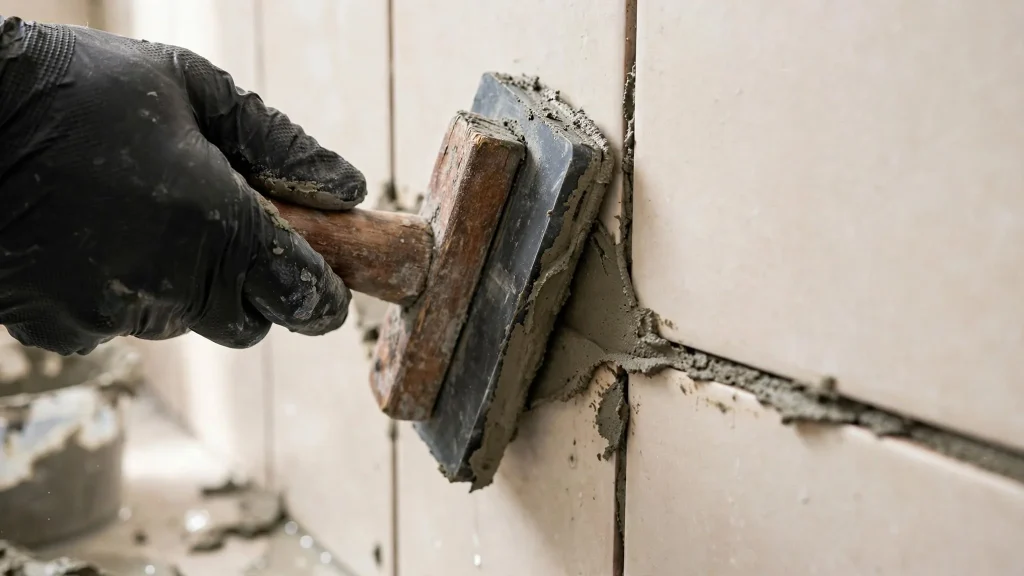
Limitations of Cement Grout
Cement grout is generally more porous than epoxy grout. It can absorb moisture and become stained if it is not properly maintained or protected with a compatible grout sealer where recommended.
Over time, cement-based grout may develop discolouration, particularly in shower areas, around bathtubs, and near bathroom vanity units. Soap deposits, dirt, and cleaning chemicals can affect its appearance.
Incorrect mixing, excessive water during application, poor joint preparation, and insufficient curing can also contribute to weak grout joints, cracking, or powdering.
For bathrooms with frequent water exposure, the product specification and installation quality are particularly important.
What Is Epoxy Grout?
<AsyncImage query=”professional epoxy grout application between porcelain bathroom tiles close up installer rubber grout float” aspectRatio=”16:9″ width=”100%”/>
Epoxy grout is a two-component or multi-component tile-joint material generally made from epoxy resin, a hardener, and specially selected fillers or aggregates.
Unlike conventional cement grout, epoxy grout hardens through a chemical reaction between its components. This produces a dense, durable joint with low water absorption and strong resistance to many stains and chemicals.
Epoxy grout is commonly used in commercial kitchens, swimming pools, hospitals, food preparation facilities, and bathrooms where easy cleaning and resistance to contamination are important.
However, not every epoxy grout product has identical properties. Performance depends on the manufacturer’s formulation, chemical resistance ratings, joint dimensions, installation method, and curing conditions.
Advantages of Epoxy Grout
Low water absorption: Properly installed epoxy grout has very low water absorption compared with conventional cement grout. This makes it useful in shower areas and other frequently exposed wet locations.
Strong stain resistance: Epoxy grout generally resists many common bathroom stains, including soap residue, shampoo, cosmetics, and other household contaminants.
Easier cleaning: Its dense surface makes routine cleaning easier because dirt and many contaminants are less likely to penetrate the grout itself.
Chemical resistance: Many epoxy grout products offer resistance to a range of cleaning chemicals. The exact resistance depends on the product’s technical documentation.
Colour consistency: Epoxy grout can provide consistent colour because it does not rely on the same cement hydration process as traditional cement grout.
Durability: When correctly specified and installed, epoxy grout can maintain its appearance and joint performance for many years under suitable conditions.
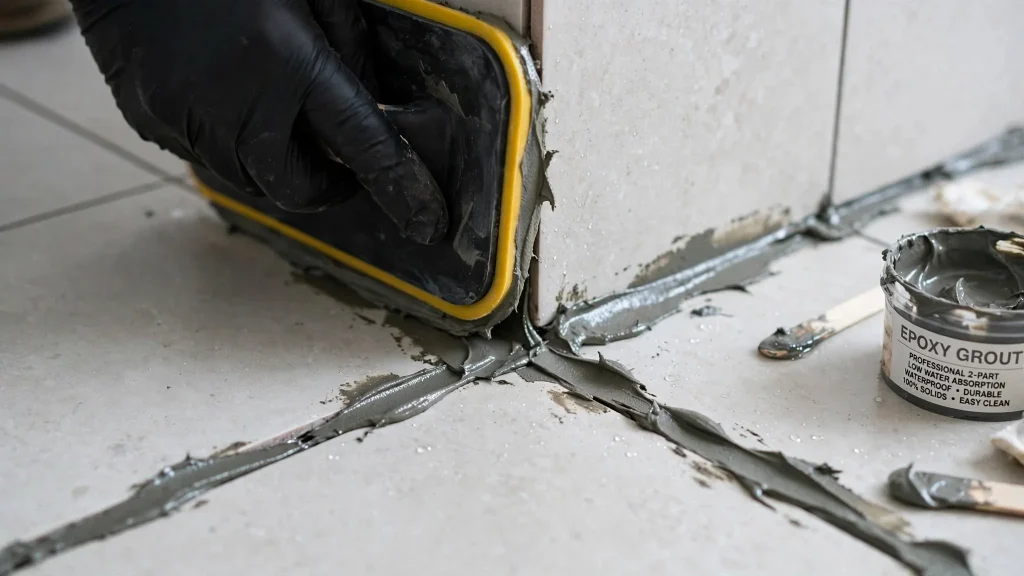
Limitations of Epoxy Grout
Epoxy grout usually costs more than cement grout. Material prices and installation labour can both be higher, particularly when installers need specialised experience.
Application is also more demanding. Epoxy products have defined working times, and installers must follow mixing ratios, application procedures, and cleaning instructions carefully.
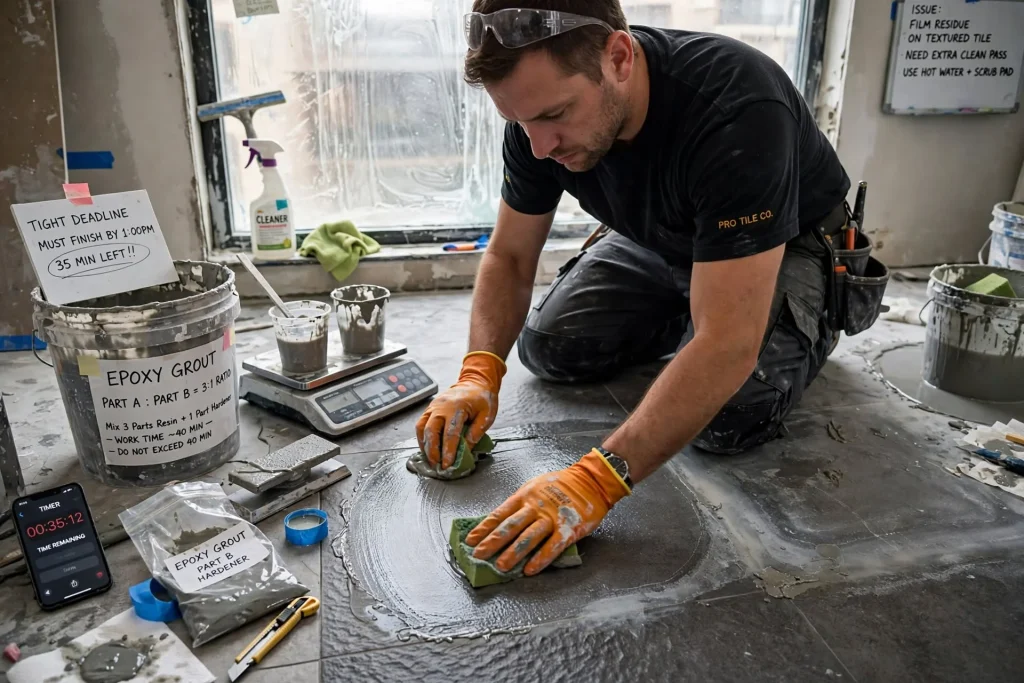
If excess epoxy residue is not removed within the manufacturer’s recommended cleaning window, it may leave a difficult film on the tile surface. This can be especially problematic with textured porcelain, natural stone, and tiles with a porous or delicate finish.
Some epoxy formulations can also be unsuitable for certain natural stones, resin-backed tiles, or temperature conditions. Compatibility must be checked before installation.
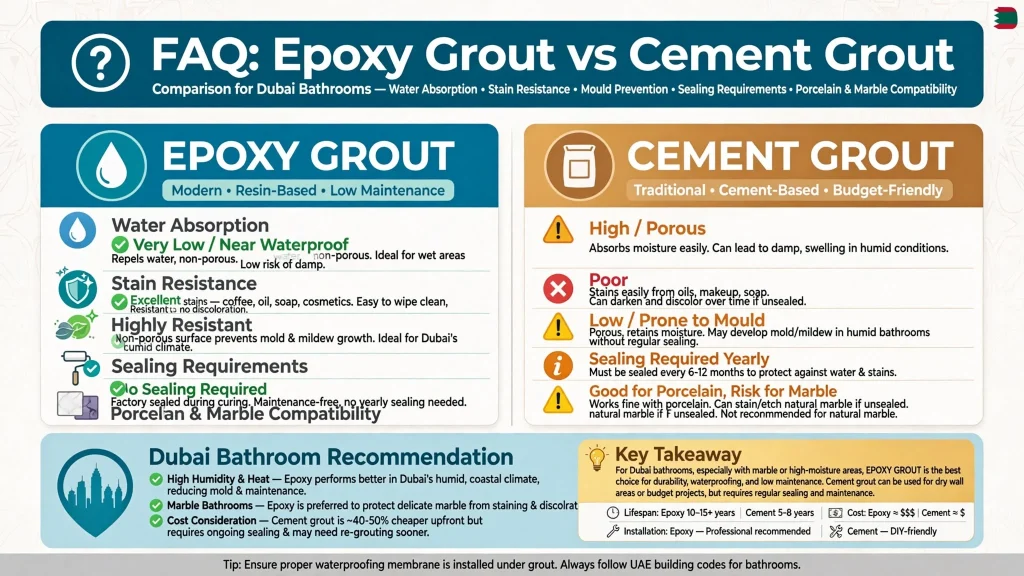
Epoxy Grout vs Cement Grout: Main Differences
The two materials serve the same basic purpose, but their performance characteristics are different.
| Comparison factor | Epoxy grout | Cement grout |
|---|---|---|
| Composition | Epoxy resin, hardener and fillers | Cement, fillers and additives |
| Water absorption | Very low for suitable products | Generally higher |
| Stain resistance | Usually excellent | Depends on formulation and sealing |
| Chemical resistance | High for specified chemicals | More limited |
| Cleaning | Generally easier | May require more maintenance |
| Installation | Requires careful mixing and application | Generally more straightforward |
| Initial cost | Usually higher | Usually lower |
| Colour consistency | Generally very good | Can vary with mixing and curing |
| Repair | Can require more specialist removal | Usually easier to repair |
| Best applications | Wet areas and demanding environments | General tile installations |
The most suitable option depends on the bathroom’s expected use and the installation requirements. Epoxy grout is often a strong choice for shower floors and heavily used bathrooms, while quality cement grout can be appropriate for general bathroom walls and floors when correctly specified and maintained.
Which Grout Is Better for Dubai Bathrooms?
Dubai bathrooms experience frequent water use, regular cleaning, and indoor humidity. Some properties also have limited natural ventilation, making moisture management important.
For these conditions, epoxy grout can provide practical benefits, especially in shower areas, wet rooms, and bathrooms used by multiple occupants.
However, cement grout should not automatically be considered unsuitable. High-quality polymer-modified cement grout can perform well when installed correctly and maintained according to the manufacturer’s instructions.
The choice should be based on the location of the tiled surface, exposure to water, cleaning requirements, and the expected service life of the installation.
Shower Floors and Shower Walls
<AsyncImage query=”modern luxury Dubai bathroom walk in shower porcelain tiles glass enclosure floor tile grout detail” aspectRatio=”16:9″ width=”100%”/>
Shower floors and walls are exposed to repeated water contact, soap, shampoo, and cleaning products. Epoxy grout is often a suitable choice because of its low absorption and stain resistance.
On shower floors, the grout must also be compatible with the selected tile and joint dimensions. Small-format mosaic tiles have many grout joints, so ease of cleaning and product compatibility are important considerations.
For shower walls, epoxy grout can help maintain a consistent appearance and reduce staining. However, waterproofing behind the tiles remains essential because grout is not a replacement for a waterproofing membrane.
Bathroom Floors
Bathroom floors experience water splashes, cleaning, foot traffic, and occasional spills from toiletries.
Epoxy grout can be useful in family bathrooms and high-traffic residential properties because it resists many stains and is easier to maintain. Cement grout can also work well, particularly where the budget is limited and the floor is not subject to unusually demanding conditions.
The grout should be compatible with the floor tiles, especially where large-format porcelain tiles or natural stone are used.

Bathroom Walls and Vanity Areas
Bathroom walls around washbasins, mirrors, and vanity counters generally experience less direct water exposure than shower interiors.
A good-quality cement grout may be sufficient for these locations. Epoxy grout can still be selected where the owner wants greater stain resistance and easier cleaning.
The decision should also consider the tile finish, joint width, and desired colour consistency.
Luxury Bathrooms in Villas and Apartments
High-end residential properties in Palm Jumeirah, Emirates Hills, Dubai Hills Estate, and Downtown Dubai often feature large-format porcelain, marble-effect tiles, natural stone, and designer bathroom finishes.
In these properties, grout colour and joint consistency can influence the overall appearance of the bathroom.
Epoxy grout may be preferred where the design requires durable, stain-resistant joints. However, natural stone needs special attention because epoxy residue can be difficult to remove from some porous surfaces.
A product compatibility test is advisable before applying grout across an entire natural stone installation.
How Dubai’s Climate Affects Bathroom Grout Selection
Dubai’s climate is hot for much of the year, but indoor bathroom conditions are influenced more directly by water exposure, air conditioning, ventilation, and cleaning routines.
Bathrooms in apartments, villas, hotels, and commercial buildings may experience different moisture conditions.
In bathrooms with limited ventilation, moisture can remain on surfaces for longer. This can encourage mould and mildew growth on soap residue and organic deposits, including on grout surfaces.
Epoxy grout offers an advantage because its dense structure absorbs very little water. However, mould can still develop on dirt, soap deposits, silicone sealants, and other bathroom surfaces.
Cement grout may require more frequent cleaning and, depending on the product, periodic resealing.
The best long-term approach combines suitable grout with effective bathroom ventilation, properly installed waterproofing, functional drainage, and regular cleaning.

Is Epoxy Grout Completely Waterproof?
No. Although epoxy grout has very low water absorption, it should not be treated as a complete waterproofing system.
Water can still pass through cracks, movement joints, failed silicone seals, poorly installed drains, or gaps around plumbing fixtures.
A properly waterproofed bathroom normally includes a suitable waterproofing membrane beneath the tiled finish, compatible tile adhesive, correctly detailed corners and penetrations, and appropriate movement joints.
In shower areas, waterproofing should be completed before tile installation and tested according to the project specification.
Using epoxy grout can improve the performance of the tiled surface, but it cannot correct defective waterproofing or poor drainage.
Epoxy Grout Installation vs Cement Grout Installation
<AsyncImage query=”professional tile installer grouting bathroom floor porcelain tiles using grout float close up construction” aspectRatio=”16:9″ width=”100%”/>
Both grout types require proper surface preparation, but their installation methods are different.
Cement Grout Installation Process
Cement grout installation begins with checking that the tile adhesive has cured sufficiently and that the joints are clean.
The installer mixes the grout with the specified amount of water or additive. The mixture is then spread diagonally across the tile surface using a rubber grout float.
Excess grout is removed, and the joints are cleaned using the manufacturer’s recommended procedure. The grout is then allowed to cure for the specified period.
Where the product requires sealing, a compatible grout sealer can be applied after the recommended curing time.
Epoxy Grout Installation Process
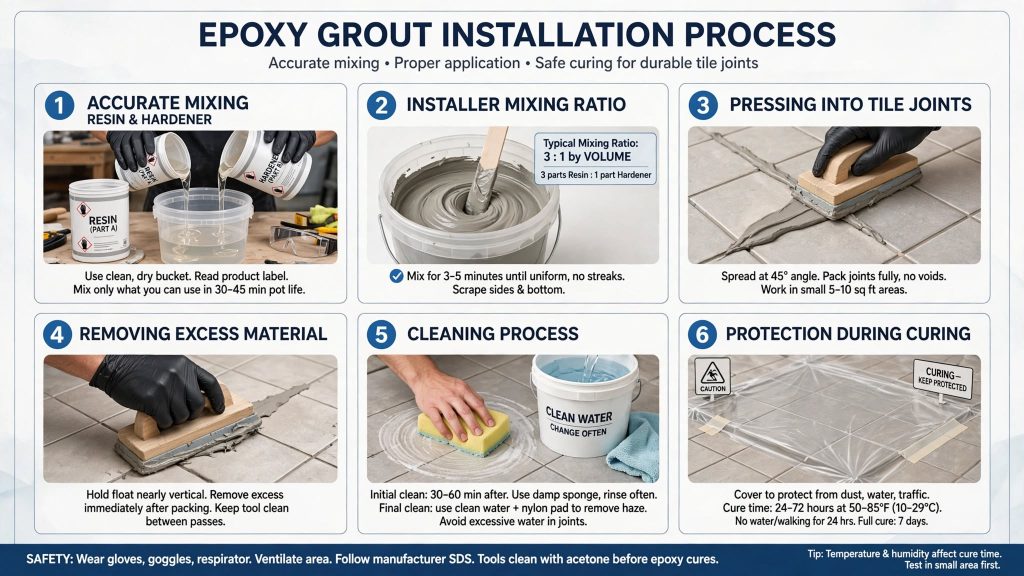
Epoxy grout installation requires accurate mixing of the resin and hardener components. The installer must follow the manufacturer’s mixing ratio and working-time instructions.
The mixed material is pressed into the tile joints using suitable tools. Excess material must be removed promptly, followed by the recommended cleaning process.
Cleaning is especially important because cured epoxy residue can be difficult to remove. Installers may need approved cleaning solutions and suitable pads depending on the product and tile surface.
The finished installation should be protected during curing, and the area should not be exposed to water or traffic until the manufacturer’s specified conditions are met.
Common Grouting Mistakes in Dubai Bathrooms
Even a high-quality grout product can fail to deliver the expected performance when installation is poor.
One common mistake is choosing grout without checking the tile manufacturer’s recommendations. Certain natural stones, glass tiles, and delicate finishes require specific grout formulations.
Another mistake is using incorrect mixing ratios. Too much water in cement grout can affect its strength and colour consistency. Incorrect epoxy mixing can prevent the material from curing properly.
Poor joint preparation can also create problems. Dust, adhesive residue, and other materials inside the joints can interfere with grout placement and bonding.
Other common problems include:
- Applying grout before tile adhesive has cured.
- Using unsuitable grout for the joint width.
- Leaving epoxy residue on textured or porous tiles.
- Failing to provide movement joints.
- Using aggressive cleaning chemicals that damage the grout or tile finish.
- Assuming grout alone provides bathroom waterproofing.
- Ignoring ventilation and ongoing moisture management.
Professional installation and adherence to technical product instructions are essential for a durable finish.
Maintenance: How to Keep Bathroom Grout Clean
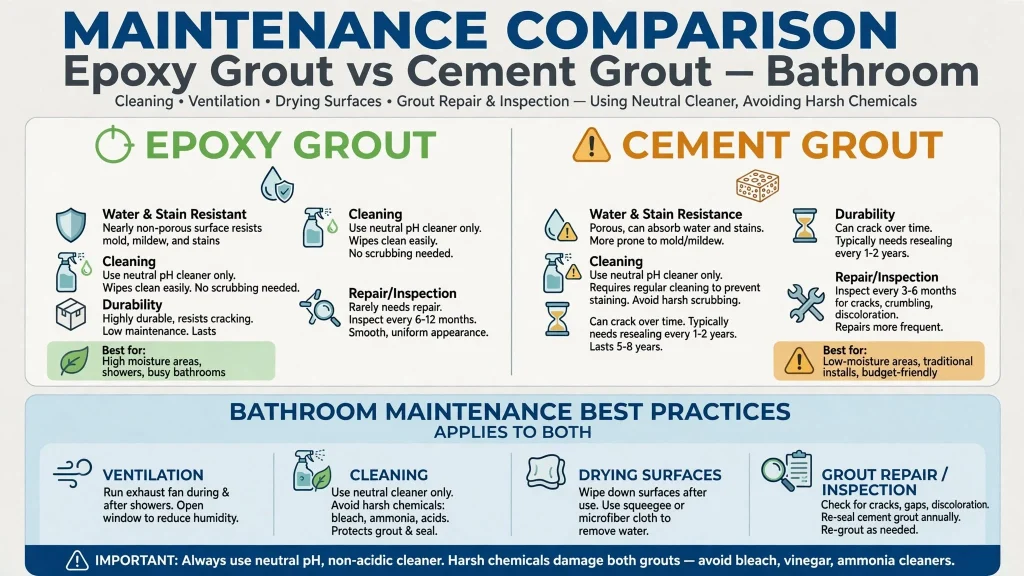
The maintenance requirements of epoxy and cement grout are different.
Epoxy grout generally needs less intensive maintenance because its dense surface resists many stains. Regular cleaning with a suitable neutral or manufacturer-approved cleaner is usually sufficient.
Cement grout may need more attention, especially in shower areas. Routine cleaning helps remove soap residue and dirt before they become difficult to remove. A compatible grout sealer may be recommended depending on the product.
For both grout types, avoid using harsh chemicals or abrasive cleaning tools unless the manufacturer confirms that they are suitable.
Good bathroom ventilation also helps reduce moisture accumulation. After showering, removing standing water and allowing surfaces to dry can help maintain the appearance of grout and silicone joints.
If grout begins to crack, crumble, or detach, the affected area should be inspected. Repeatedly applying new grout over damaged material is not a reliable long-term repair.
Epoxy Grout vs Cement Grout: Which Is More Cost-Effective?
The initial material and installation cost of epoxy grout is generally higher than cement grout. However, comparing products only by purchase price does not provide a complete picture of long-term value.
Cement grout may be economical for large projects, particularly where bathrooms have moderate usage and maintenance teams can perform regular cleaning and resealing when required.
Epoxy grout may offer better long-term value in heavily used bathrooms because it can reduce staining, simplify cleaning, and minimise some maintenance tasks.
The final cost depends on the bathroom size, tile format, joint width, product brand, labour rates, substrate condition, and installation complexity.
For a fair comparison, property owners should request quotations that identify the grout product, preparation requirements, installation method, cleaning procedure, and warranty conditions.
Choosing the Right Grout for Different Dubai Properties
Residential Apartments
Apartments in Business Bay, Dubai Marina, Jumeirah Village Circle, and Downtown Dubai may have compact bathrooms with daily shower use.
Epoxy grout is worth considering for shower floors and heavily used wet areas. Cement grout may be suitable for less exposed walls and other general bathroom surfaces.
Luxury Villas
Villas in Arabian Ranches, Dubai Hills Estate, Emirates Hills, and Palm Jumeirah may include multiple bathrooms with different tile materials and usage patterns.
Natural stone, large-format porcelain, and designer finishes require careful product selection. The grout specification should be coordinated with the tile supplier and installation team.
Hotels and Hospitality Properties
Hotels in Downtown Dubai, Deira, Jumeirah, and Dubai Marina experience frequent bathroom use and regular housekeeping cleaning.
Epoxy grout can be beneficial in selected wet areas because of its stain resistance and cleaning advantages. Product selection should account for the hotel’s maintenance procedures, cleaning chemicals, and refurbishment schedule.
Commercial and Public Bathrooms
Bathrooms in offices, shopping centres, restaurants, and public facilities can experience heavy daily traffic.
Epoxy grout is often worth evaluating in high-use areas where durability and easier cleaning are priorities. The selected product should be suitable for the expected cleaning regime and surface conditions.

How to Select a Professional Grouting Contractor in Dubai
Choosing the right contractor is just as important as selecting the grout material. Incorrect application can affect even premium epoxy and cement products.
Before appointing a contractor, check their experience with the specific grout type, tile material, and bathroom environment. Ask whether they understand waterproofing systems, tile joint preparation, movement joints, and manufacturer installation instructions.
A professional contractor should also be able to explain the product specification, colour selection, application procedure, curing requirements, and maintenance recommendations.
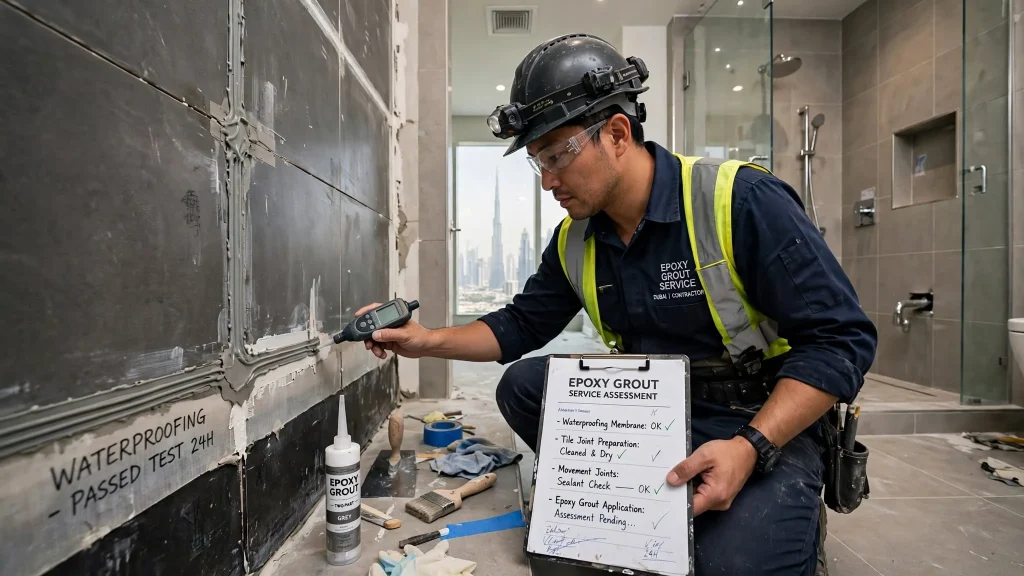
For renovation projects, the contractor should inspect existing grout and identify whether the problem is limited to the joints or caused by deeper issues such as failed waterproofing, loose tiles, or drainage defects.
Property owners planning bathroom upgrades or grout repairs can explore a professional Epoxy Grout Service to assess the condition of tiled surfaces and determine whether epoxy grout is suitable for the application.
Frequently Asked Questions About Epoxy Grout vs Cement Grout
Is epoxy grout better than cement grout for Dubai bathrooms?
Epoxy grout is often better for shower areas and bathrooms exposed to frequent water, stains, and intensive cleaning because it has very low water absorption and strong stain resistance. Quality cement grout can still be suitable for general bathroom applications when correctly installed and maintained.
Does epoxy grout prevent mould?
Epoxy grout itself is less likely to absorb moisture than cement grout, but it does not make a bathroom mould-proof. Mould can grow on soap deposits, dirt, silicone sealants, and other damp surfaces. Ventilation and regular cleaning remain important.
Does cement grout need sealing?
Many cement-based grout products benefit from a compatible sealer, but requirements vary by formulation. Always follow the manufacturer’s technical instructions regarding sealing and maintenance.
Can epoxy grout be used on porcelain tiles?
Yes. Epoxy grout is commonly used with porcelain tiles when the product is compatible with the tile surface and joint dimensions. A test application may be necessary for textured, polished, or specially finished tiles.
Is epoxy grout suitable for marble bathrooms?
It can be suitable for some marble installations, but compatibility must be checked carefully. Porous or sensitive natural stone may absorb resin or develop surface staining if the wrong product or cleaning method is used. Always follow the stone and grout manufacturer’s recommendations.
How long does epoxy grout last?
Its service life depends on product quality, installation, exposure, cleaning methods, and movement in the tiled structure. Properly installed epoxy grout can remain serviceable for many years, but no fixed lifespan can be guaranteed for every bathroom.
Can cement grout be replaced with epoxy grout?
Yes, in many situations, but the existing grout must generally be removed to the depth recommended by the epoxy grout manufacturer. The tile joints must be clean and suitable for the new material. A professional inspection can determine whether replacement is practical.
Is epoxy grout more expensive to install?
Usually, yes. Epoxy grout often has a higher material cost and requires more specialised installation and cleaning. However, its reduced staining and maintenance requirements may provide value over time in demanding bathroom environments.
Making the Right Grout Choice for Your Dubai Bathroom
Epoxy grout and cement grout both have a place in modern bathroom tiling. Cement grout remains a practical and economical choice for many general applications, while epoxy grout offers advantages in areas where low water absorption, stain resistance, and easier cleaning are important.
For Dubai bathrooms, the decision should consider shower exposure, daily usage, tile material, cleaning routines, waterproofing quality, and the expected maintenance budget.
Rather than selecting grout based only on price, property owners should consider the complete tiling system. Correct surface preparation, compatible tile adhesive, proper waterproofing, suitable movement joints, and professional application all contribute to a durable bathroom finish.
With the right product and installation approach, bathrooms in Dubai apartments, villas, hotels, and commercial buildings can maintain their appearance and performance for years.