Air conditioning is essential for comfortable villa living in Dubai. With high outdoor temperatures for much of the year, villa HVAC systems can operate for long periods to maintain comfortable indoor conditions. Behind the walls, ceilings, and service areas of a villa, however, is an extensive network of air ducts, filters, cooling coils, return-air grilles, supply diffusers, fan coil units, air handling equipment, condensate drains, and ventilation components.
Over time, dust and airborne particles can accumulate in parts of this system. Renovation work, construction dust, outdoor air, poor filtration, moisture, and long HVAC operating hours can also affect the condition of ductwork and related components.
Professional Duct Cleaning for Villas in Dubai should therefore be considered as part of a broader HVAC maintenance strategy. The purpose is not simply to make ducts look clean. A proper inspection should determine whether contamination, airflow restrictions, moisture, damaged insulation, or other problems are affecting the HVAC system.
For villa owners, landlords, property managers, and residents, understanding how ductwork interacts with the rest of the air-conditioning system can help prevent unnecessary energy consumption, poor airflow, unpleasant odors, and avoidable HVAC problems.
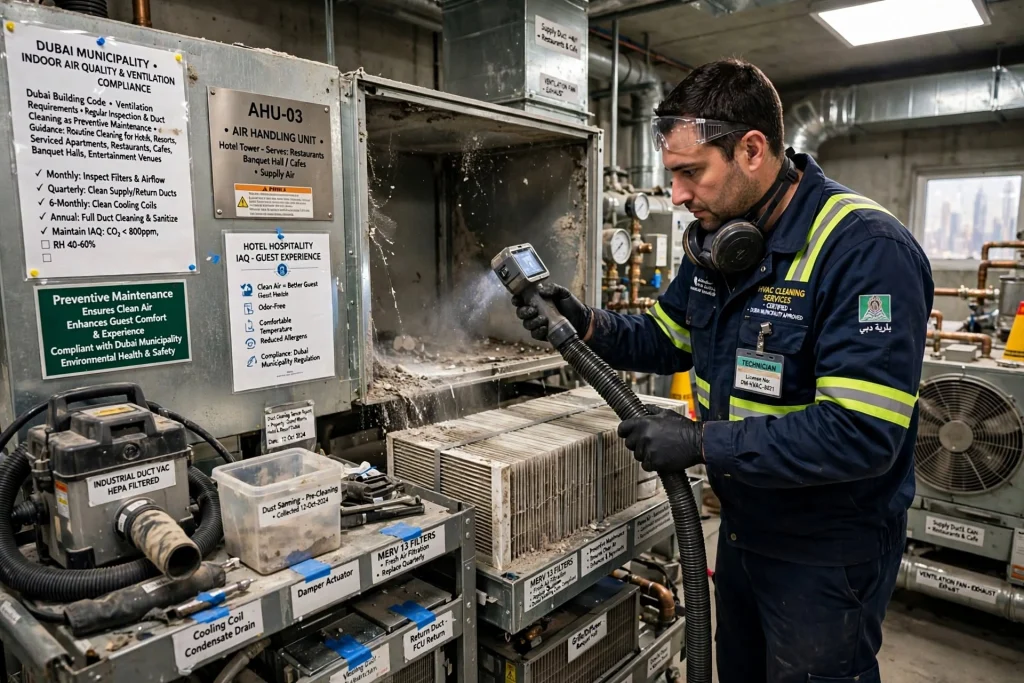
Why Villa Ductwork Requires Regular Attention
Villa HVAC systems are often more complex than a basic single-room split air conditioner. Larger properties may have several air-conditioning zones, concealed ducted units, fan coil units, fresh-air systems, return-air pathways, exhaust fans, and multiple thermostats.
The duct network distributes conditioned air from the HVAC equipment to bedrooms, living rooms, dining areas, kitchens, corridors, offices, entertainment rooms, and other spaces. Return-air ducts transport indoor air back toward the cooling equipment.
When ducts are poorly maintained, several issues can develop. Dust may accumulate around accessible sections, flexible ducts can become damaged or compressed, insulation can deteriorate, and joints can develop leakage.
The condition of the duct system can also influence how effectively the HVAC equipment delivers conditioned air.
A villa may therefore experience poor cooling even when the air-conditioning unit itself appears to be operating normally.
Dubai’s Climate and Its Impact on Villa HVAC Systems
Dubai’s hot and dusty environment creates demanding operating conditions for residential air-conditioning systems. Outdoor air contains fine particles that can enter buildings through doors, windows, fresh-air systems, and other openings.
Construction activity can introduce additional dust into residential communities. Villas located near ongoing development, major roads, or construction sites may experience greater particulate exposure.
Humidity can also affect HVAC components. When warm humid air meets a cold evaporator coil, condensation naturally occurs. Proper drainage is therefore essential to prevent water accumulation around the indoor unit.
Dubai Building Code provisions for villas specifically address ventilation, indoor air quality, condensation, duct insulation, and outdoor-air requirements. The code states that adequate outdoor air should be provided for occupant health and comfort and that space pressurization should help reduce moisture and contaminant transfer.
These requirements demonstrate why villa HVAC maintenance involves more than simply checking whether an air conditioner produces cold air.
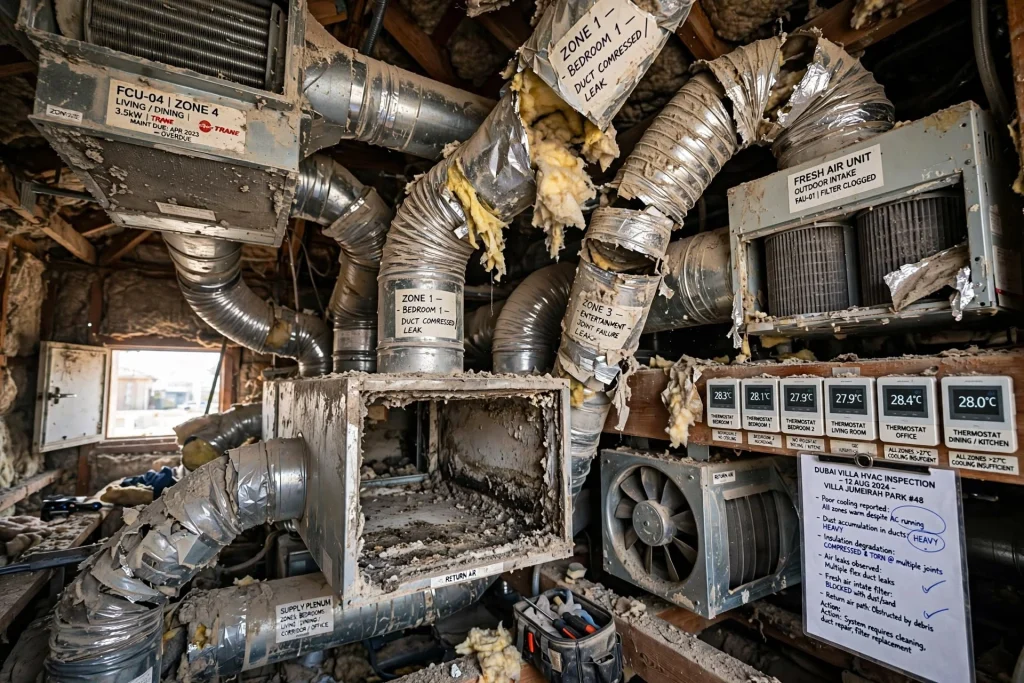
What Actually Accumulates Inside Villa Ducts?
Ductwork does not automatically become heavily contaminated simply because it has been operating for several years. The condition depends on filtration, building use, construction history, leakage, moisture, outdoor-air exposure, and maintenance.
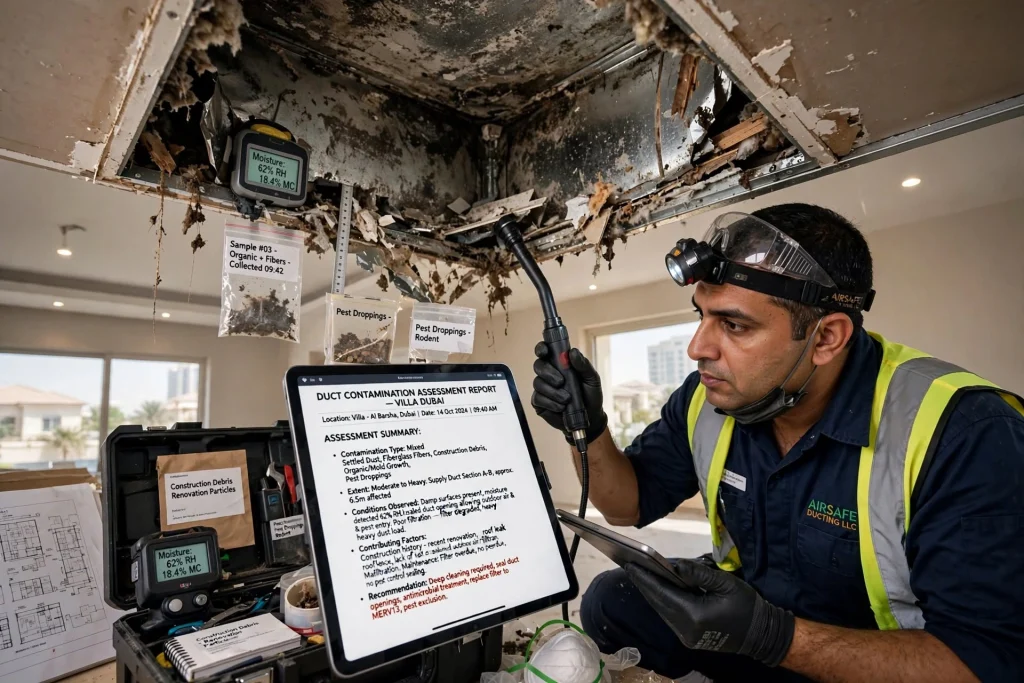
Potential materials found during an inspection can include settled dust, fibers, construction debris, particles from renovation work, and other airborne material.
In systems affected by moisture, contamination can behave differently because damp surfaces may allow dust and organic material to adhere more strongly.
Pest activity can also become relevant if duct openings or building penetrations are not properly sealed.
For this reason, a professional duct-cleaning assessment should identify the type and extent of contamination rather than automatically recommending the same cleaning process for every villa.
The Relationship Between Air Filters and Duct Cleanliness
Air filters are one of the most important components protecting an HVAC system. Their job is to capture airborne particles before they reach the cooling coil, blower assembly, and downstream air distribution system.
A filter that is clogged or unsuitable for the HVAC equipment can restrict airflow. A damaged or incorrectly installed filter can allow more particles to bypass the intended filtration pathway.
Villa owners should therefore pay attention to filter maintenance before assuming that duct cleaning alone will solve recurring dust problems.
Dubai’s villa building requirements specify that general-ventilation air filters should meet an ISO 16890-based efficiency classification.
Proper filtration, regular filter replacement, source control, coil cleaning, and appropriate duct inspection work together. Cleaning the ducts without addressing a consistently overloaded filter may allow contamination to return relatively quickly.
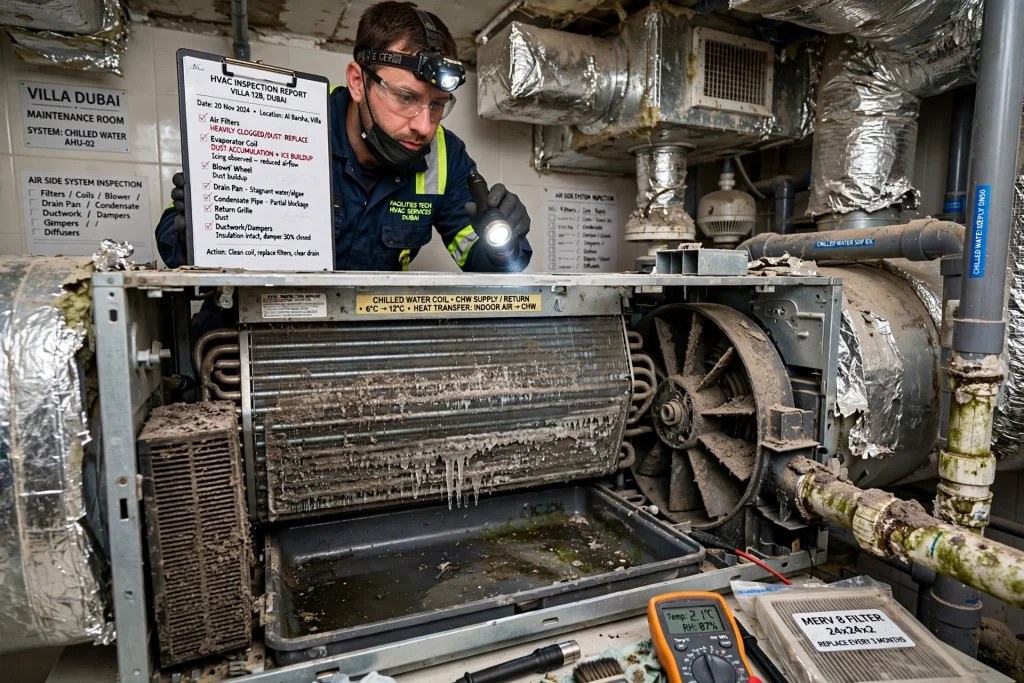
Dirty Cooling Coils Can Affect Villa Airflow
The evaporator or cooling coil is responsible for transferring heat from indoor air to the refrigeration system or chilled-water circuit, depending on the HVAC design.
Dust accumulation on the coil can reduce effective heat transfer and increase resistance to airflow. If the coil becomes significantly contaminated, the HVAC system may need to operate for longer periods to achieve the thermostat setting.
In some systems, inadequate airflow can also contribute to coil icing.
For villa owners, this means that a professional HVAC inspection should look at the complete airside system rather than focusing exclusively on duct interiors.
An inspection may include filters, evaporator coils, blower wheels, drain pans, condensate pipes, return-air grilles, supply diffusers, ductwork, dampers, and insulation.
Signs Your Villa May Need Duct Inspection
There is no single symptom that proves duct cleaning is required. However, several conditions can justify a professional inspection.
Weak airflow from several supply vents may indicate an airflow restriction, duct leakage, fan problem, filter issue, or other HVAC fault. Dust appearing repeatedly around diffusers may also warrant investigation.
Other signs include persistent unusual odors when the HVAC system starts, visible contamination inside accessible duct sections, unexplained airflow differences between rooms, damaged duct insulation, evidence of water intrusion, renovation debris, or a long period without HVAC inspection.
It is important not to assume that every odor originates inside ductwork. Sources can include carpets, furniture, drain pans, microbial growth, cooking activities, bathrooms, wall cavities, or other parts of the building.
Professional diagnosis can prevent unnecessary cleaning and identify the actual source of the problem.
Duct Leakage and Uneven Cooling in Villas
Duct leakage is a separate issue from duct contamination, but the two can sometimes exist together.
If supply ducts have damaged joints or gaps, conditioned air can escape before reaching the intended room. In a villa with multiple floors or long duct runs, this may result in noticeable differences between rooms.
For example, bedrooms on an upper floor may receive insufficient cooling while the HVAC unit appears to operate normally.
Poor insulation can also contribute to unwanted heat gain when conditioned air travels through hot ceiling or service spaces.
Dubai Building Code requirements for villas address insulation of ducts supplying conditioned air, including ducts passing through conditioned and unconditioned spaces.
Therefore, a duct inspection should consider both cleanliness and physical condition.
Why Villa Renovations Can Increase Duct Contamination
Renovation is one of the most common reasons for a post-project HVAC inspection.
Cutting walls, sanding surfaces, drilling ceilings, painting, installing flooring, and other construction activities can generate significant quantities of dust and debris.
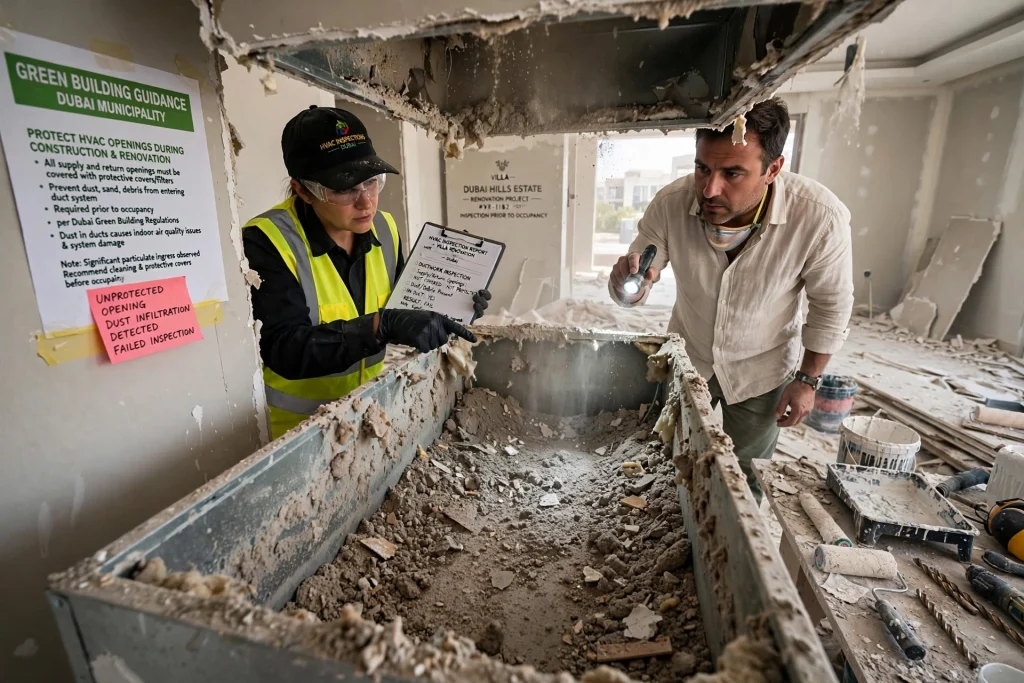
If HVAC supply and return openings are not properly protected during renovation, particles can enter the air distribution system.
Dubai’s green-building guidance specifically addresses protection of HVAC openings and air-distribution components during construction and renovation to prevent dust and other airborne contaminants from collecting in the system.
For villa owners who have recently completed a renovation, professional inspection of accessible HVAC components and ductwork can therefore be worthwhile before normal occupancy resumes.
Duct Cleaning and Indoor Air Quality
Indoor air quality depends on a combination of ventilation, filtration, humidity control, pollutant sources, building materials, cleaning practices, and HVAC maintenance.
Duct cleaning is only one part of this equation.
A clean duct system cannot compensate for inadequate outdoor-air ventilation, a clogged filter, persistent moisture, poor housekeeping, or an indoor pollution source.
Dubai’s 2025 public-health law establishes requirements concerning indoor air quality, ventilation, cleaning and periodic maintenance within the built environment. It also gives the relevant authority responsibility for establishing environmental and health requirements for indoor air quality and related systems.
For villa owners, this reinforces the importance of maintaining the complete indoor environment rather than treating duct cleaning as a standalone solution.
How Professional Villa Duct Cleaning Works
A professional duct-cleaning project should begin with inspection rather than immediately opening every duct section.
Technicians should identify the HVAC equipment, understand the duct layout, inspect accessible sections, evaluate contamination, and determine the appropriate cleaning method.
Depending on the system, professional equipment may include negative-air machines, HEPA filtration, rotary brushes, air whips, inspection cameras, specialized vacuum systems, and controlled-access tools.
The HVAC system should be isolated appropriately during cleaning to prevent loosened material from spreading into occupied areas.
Access openings should be created or used in locations that allow technicians to clean relevant duct sections without causing unnecessary damage.
After cleaning, access panels should be properly sealed, insulation should be restored where required, and the system should be checked for normal airflow and operation.
Cleaning AHUs, FCUs, and Other HVAC Components
Villa duct cleaning should not ignore the equipment connected to the ductwork.
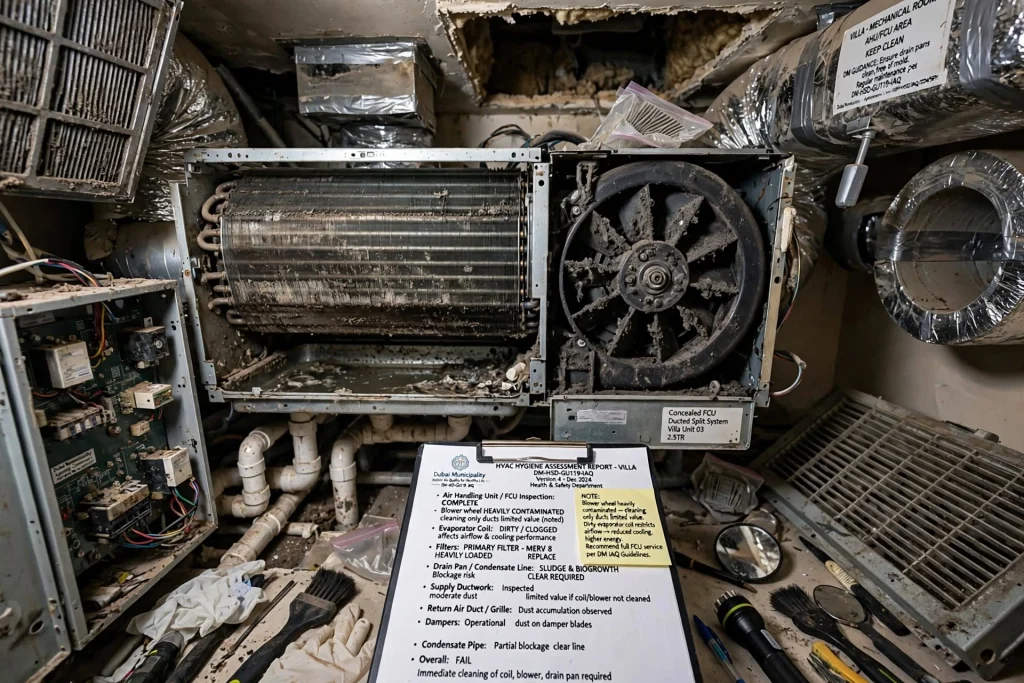
Many villas use concealed fan coil units or ducted split systems. These systems contain components such as filters, blower fans, evaporator coils, drain pans, condensate lines, and electrical controls.
If the blower wheel is heavily contaminated, cleaning only the downstream ducts may provide limited value.
Similarly, a dirty evaporator coil can continue to affect airflow and cooling performance even after the ducts have been cleaned.
A complete HVAC hygiene assessment should therefore consider the air-handling equipment, return-air pathway, supply ducts, grilles, diffusers, filters, coils, drainage system, and accessible ductwork.
Dubai Municipality’s indoor-air-quality guidance recommends maintaining HVAC and AHU areas so cleaning and maintenance do not adversely affect indoor air quality. It also discusses regular cleaning of fans and dampers, proper filter maintenance, and checking cooling coils, condensate pipes, and water trays for buildup and leaks.
Villa Duct Cleaning and Energy Efficiency
Duct cleaning should not be marketed as a guaranteed method of dramatically reducing electricity bills. Energy savings depend on the actual condition of the HVAC system.
However, restricted or contaminated airflow pathways can make HVAC operation less effective. Dirty filters and cooling coils can increase resistance or reduce heat-transfer performance, while duct leakage can cause conditioned air to be lost before reaching occupied spaces.
Other factors such as thermostat settings, refrigerant charge, compressor efficiency, fan performance, insulation, equipment age, building envelope, and outdoor temperature also influence energy consumption.
A sensible approach is therefore to combine duct inspection with general AC maintenance.
A technician can check airflow, temperature difference, coil condition, filter condition, electrical readings, condensate drainage, duct integrity, and equipment operation.
This provides a more accurate understanding of why a villa may be consuming more electricity or cooling unevenly.
Duct Cleaning for Large Luxury Villas
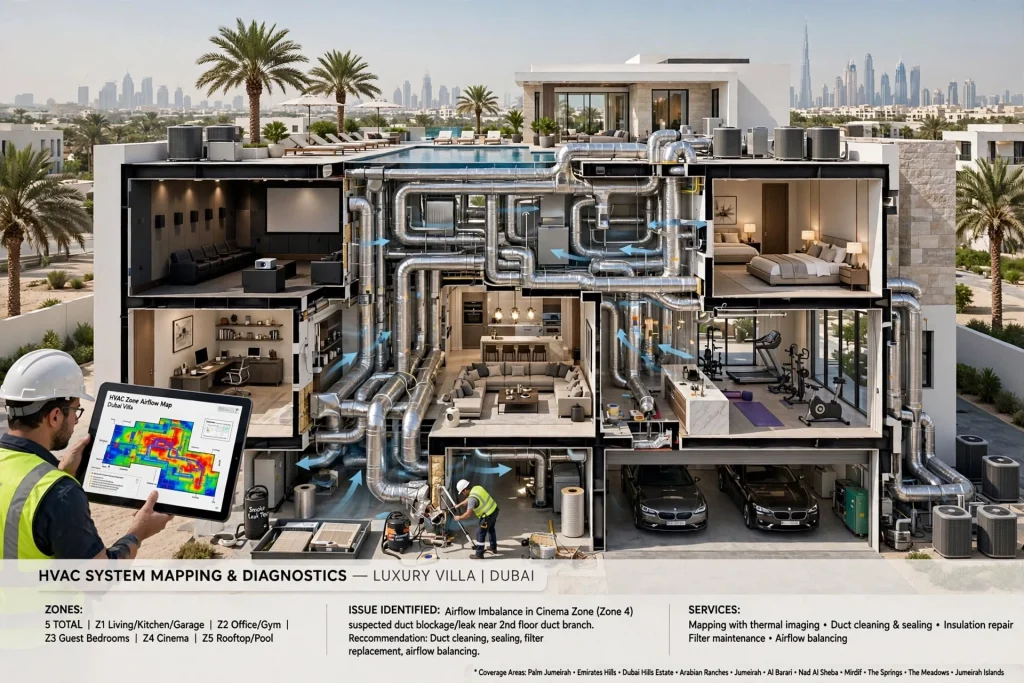
Large villas in Dubai often contain more extensive HVAC systems than standard residential properties. Luxury villas may include multiple floors, guest bedrooms, home offices, gyms, cinema rooms, kitchens, staff areas, garages, swimming-pool facilities, and large living spaces.
Such properties can have multiple air-conditioning units serving different zones.
Palm Jumeirah, Emirates Hills, Dubai Hills Estate, Arabian Ranches, Jumeirah, Al Barari, Nad Al Sheba, Mirdif, The Springs, The Meadows, and Jumeirah Islands contain residential properties with varying architectural layouts and HVAC configurations.
Large duct networks can make it more difficult for homeowners to identify where airflow problems originate.
Professional inspection can help map the system and identify areas requiring cleaning, sealing, insulation repair, filter maintenance, or airflow balancing.
Villa Duct Cleaning After Water Leakage or Moisture Problems
Moisture is one of the conditions that deserves particular attention in HVAC systems.
A blocked condensate drain can cause water to accumulate around an indoor unit. Damaged insulation can result in condensation on duct surfaces under certain conditions. Roof or ceiling leaks can also affect ductwork passing through service spaces.
Simply cleaning a duct does not solve the underlying moisture source.
If moisture intrusion has occurred, the first priority should be identifying and correcting the source. Affected materials should then be assessed to determine whether cleaning, drying, repair, replacement, or further investigation is appropriate.
Dubai’s villa building requirements specifically address condensation prevention, duct insulation, ventilation, and moisture control.
This is particularly relevant in concealed ceiling spaces where problems may remain unnoticed until odors, staining, or HVAC performance issues appear.
Duct Cleaning After Construction and Interior Renovation
Newly renovated villas often require special attention because construction dust can enter HVAC systems.
Before renovation begins, supply and return openings should ideally be protected. HVAC equipment may need to be isolated depending on the nature of the work.
After completion, the system should be inspected before normal occupancy.
A post-renovation HVAC check can include filters, evaporator coils, blower assemblies, return-air grilles, supply diffusers, accessible ductwork, dampers, and condensate systems.
Dubai’s environmental and building guidance recognizes construction and renovation dust as a potential source of airborne contamination and recommends protecting HVAC openings during such work.
For villa owners, this is particularly valuable after major gypsum, painting, flooring, carpentry, or demolition work.
How Often Should Villa Ducts Be Cleaned?
There is no universal rule that every Dubai villa needs duct cleaning once or twice a year.
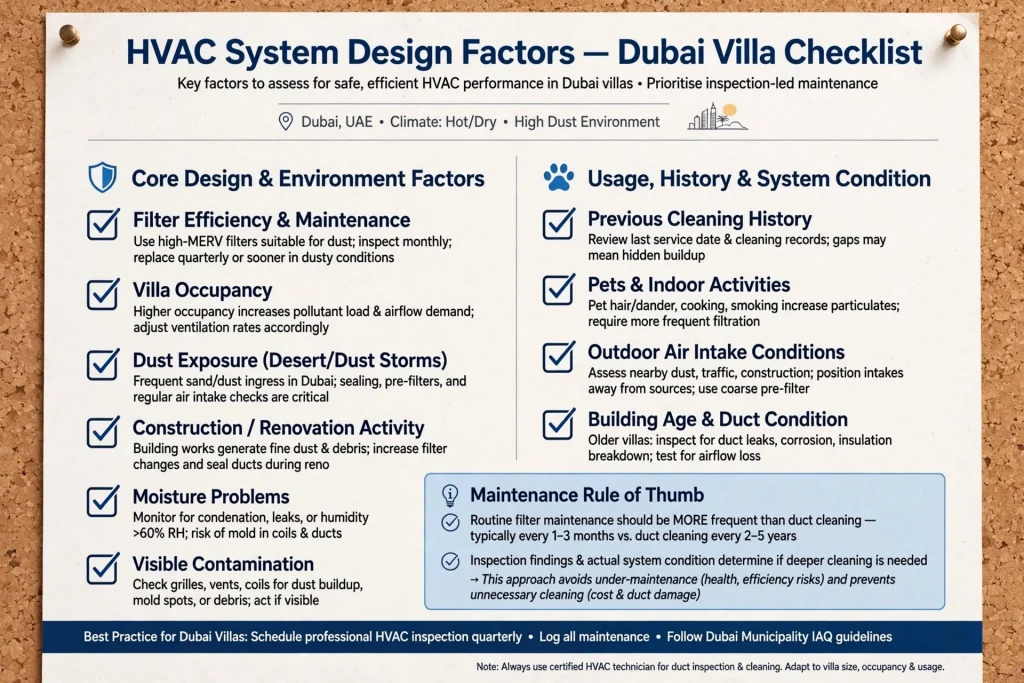
The appropriate frequency depends on factors such as:
- HVAC system design
- Filter efficiency and maintenance
- Villa occupancy
- Dust exposure
- Construction or renovation
- Moisture problems
- Visible contamination
- Previous cleaning history
- Pets and indoor activities
- Outdoor-air intake conditions
- Building age and duct condition
Routine filter maintenance may be needed much more frequently than professional duct cleaning.
Instead of following an arbitrary schedule, property owners should use inspection findings and system condition to determine when deeper cleaning is appropriate.
This approach avoids both under-maintenance and unnecessary cleaning.
Choosing a Duct Cleaning Company in Dubai
Property owners should evaluate duct-cleaning contractors based on their technical approach rather than choosing solely on price.
A professional provider should be able to explain what will be inspected, which HVAC components will be cleaned, what equipment will be used, how occupied areas will be protected, and how the system will be returned to service.
It is also useful to ask whether the quotation includes cleaning of filters, grilles, diffusers, cooling coils, blower assemblies, and accessible duct sections, because companies may define “duct cleaning” differently.
Dubai has a substantial market for residential duct-cleaning services. Current local listings include providers such as Pro Clean AC, Enviro Clean, Chill Clean Ac, The Healthy Home UAE, and Aero Fresh | Ac Maintenance | Ac Servicing | Ac Duct Cleaning | AC Coil Servicing. These examples demonstrate the active local market; they are not endorsements or recommendations.
What Property Owners Should Ask Before Booking
Before approving a villa duct-cleaning project, owners should ask for a clear scope of work.
The contractor should explain whether the service covers supply ducts, return ducts, grilles, diffusers, filters, fan coil units, cooling coils, blower assemblies, drain pans, and accessible fresh-air components.
It is also reasonable to ask how technicians will prevent dust from spreading inside the property and whether before-and-after photographs or an inspection report will be provided.
For expensive villas, documentation can be useful because it gives property owners a record of the HVAC system’s condition and maintenance history.
If a contractor recommends extensive cleaning, owners should also ask what contamination was observed and why the proposed method is appropriate.
Building a Preventive HVAC Maintenance Plan for Your Villa
Duct cleaning works best when included in a broader preventive maintenance program.
A villa HVAC plan can include routine filter inspection, evaporator coil cleaning, condenser cleaning, condensate-drain maintenance, duct inspection, airflow checks, thermostat testing, electrical inspection, refrigerant-system diagnostics, blower maintenance, insulation inspection, and periodic professional duct cleaning when necessary.
Large villas may also benefit from checking individual zones and measuring temperature differences between rooms.
Maintenance records can help identify recurring issues. If a particular bedroom repeatedly experiences weak airflow, for example, the cause may be a damper, duct restriction, leakage, insulation issue, or airflow-balancing problem rather than dirty ductwork.
This diagnostic approach helps property owners spend money where it can provide the greatest practical benefit.
Conclusion
Ductwork is an important but often hidden part of a Dubai villa’s HVAC system. It connects air-conditioning equipment with the rooms where occupants live, sleep, work, and relax. When filters, cooling coils, blowers, ducts, dampers, and drainage components are properly maintained, the entire system has a better opportunity to deliver consistent airflow and comfortable indoor conditions.
Professional Duct Cleaning for Villas in Dubai should not be treated as a universal annual requirement or a guaranteed cure for every HVAC problem. The better approach is inspection-based maintenance that considers the actual condition of the duct system and the equipment connected to it.
Dubai’s climate, dust exposure, renovation activity, high cooling demand, and villa-specific ventilation requirements make preventive HVAC care particularly valuable. Property owners should pay attention to weak airflow, unusual odors, visible contamination, moisture problems, repeated dust accumulation, uneven cooling, and post-renovation conditions.
A complete maintenance strategy should combine appropriate filtration, coil and blower cleaning, condensate management, duct inspection, airflow assessment, insulation checks, and professional cleaning when contamination or system conditions justify it.
Ultimately, the goal is not simply cleaner ducts. It is a well-maintained HVAC system that supports comfortable indoor spaces, effective airflow, reliable cooling, and better long-term property maintenance.