Introduction
Dubai’s hot desert climate places exceptional demands on heating, ventilation, and air conditioning (HVAC) systems. With temperatures often exceeding 45°C during the summer, residential villas, apartments, commercial towers, hotels, hospitals, retail outlets, and industrial facilities rely on HVAC systems almost every day of the year. Continuous operation under extreme environmental conditions makes HVAC equipment more susceptible to wear, reduced efficiency, and unexpected breakdowns.
Whether you own a villa in Dubai Hills Estate, manage an office in Business Bay, operate a hotel on Palm Jumeirah, or maintain a warehouse in Jebel Ali, understanding common HVAC problems is essential for ensuring reliable cooling, lower energy consumption, and improved indoor comfort.
Modern HVAC systems consist of interconnected components such as Air Handling Units (AHU), Fan Coil Units (FCU), Compressors, Evaporator Coils, Condenser Coils, Refrigerant Lines, Thermostats, Variable Frequency Drives (VFD), Building Management Systems (BMS), Variable Air Volume (VAV) boxes, Cooling Towers, Chiller Plants, Air Filters, and Ductwork. When one component fails, it can affect the overall performance of the entire cooling system.
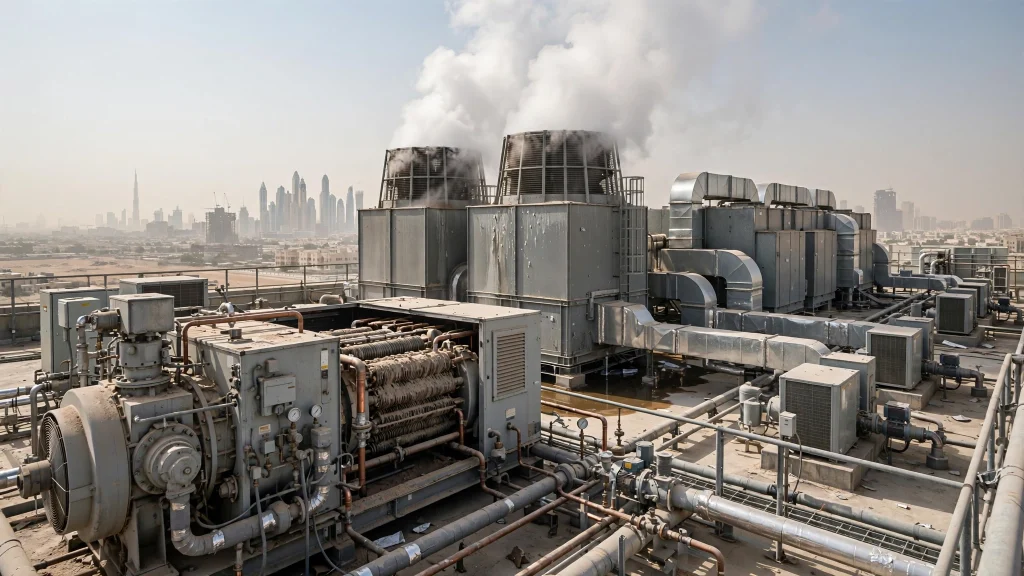
This guide explains the most common HVAC problems in Dubai, their causes, practical prevention methods, and why regular preventive maintenance is one of the best investments for homeowners and businesses.
Why HVAC Systems Face More Problems in Dubai
Unlike countries with seasonal cooling needs, Dubai experiences prolonged periods of high temperatures, humidity, and airborne dust. These environmental conditions increase the workload on HVAC systems and accelerate component wear.
Several factors contribute to HVAC issues in the UAE:
- Continuous year-round air conditioning operation.
- Fine desert sand entering ventilation systems.
- High humidity during coastal summer months.
- Construction dust from ongoing developments.
- Heavy cooling demand in residential and commercial buildings.
- Poor preventive maintenance practices.
- Dirty air filters and clogged ductwork.
Areas such as Dubai Marina, Downtown Dubai, Jumeirah, Business Bay, DIFC, JVC, Arabian Ranches, Al Barsha, and Dubai Silicon Oasis all experience unique HVAC challenges depending on building type, occupancy, and environmental exposure.
Problem 1: Dirty Air Filters
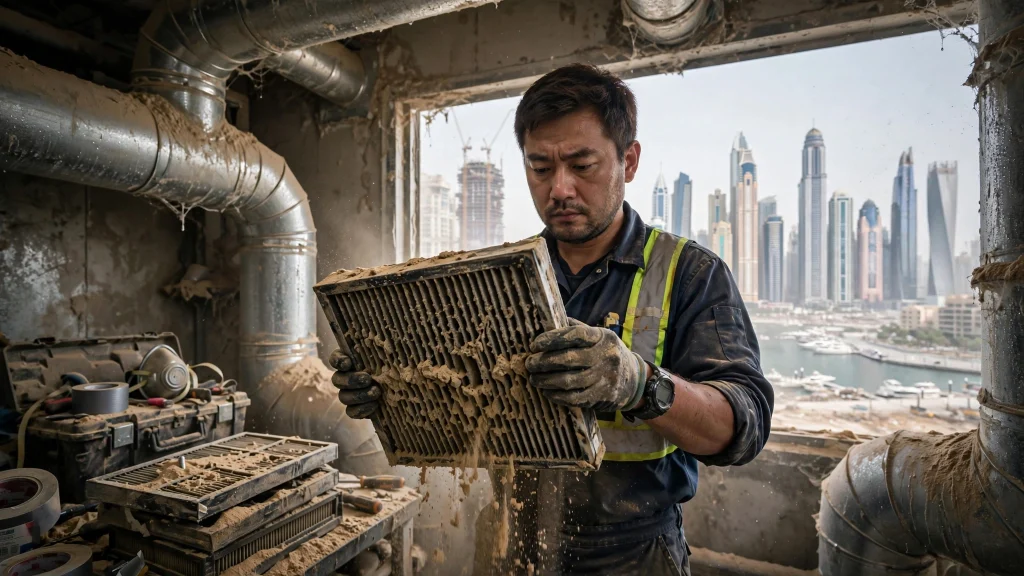
One of the most common HVAC problems in Dubai is clogged air filters. Air filters are designed to trap dust, sand, pollen, lint, pet dander, and airborne contaminants before they enter the HVAC system.
Because Dubai experiences frequent dust storms and high airborne particle levels, filters become dirty much faster than in many other regions.
Common Symptoms
- Weak airflow from supply vents.
- Reduced cooling performance.
- Increased electricity consumption.
- Dust accumulation inside rooms.
- Longer AC operating cycles.
Prevention
Replace or clean HVAC filters according to manufacturer recommendations and building usage. Commercial facilities, restaurants, hotels, and industrial properties may require more frequent filter inspections than residential homes.
High-efficiency filters improve Indoor Air Quality (IAQ) while protecting sensitive HVAC components from excessive contamination.
Problem 2: Dirty Evaporator and Condenser Coils
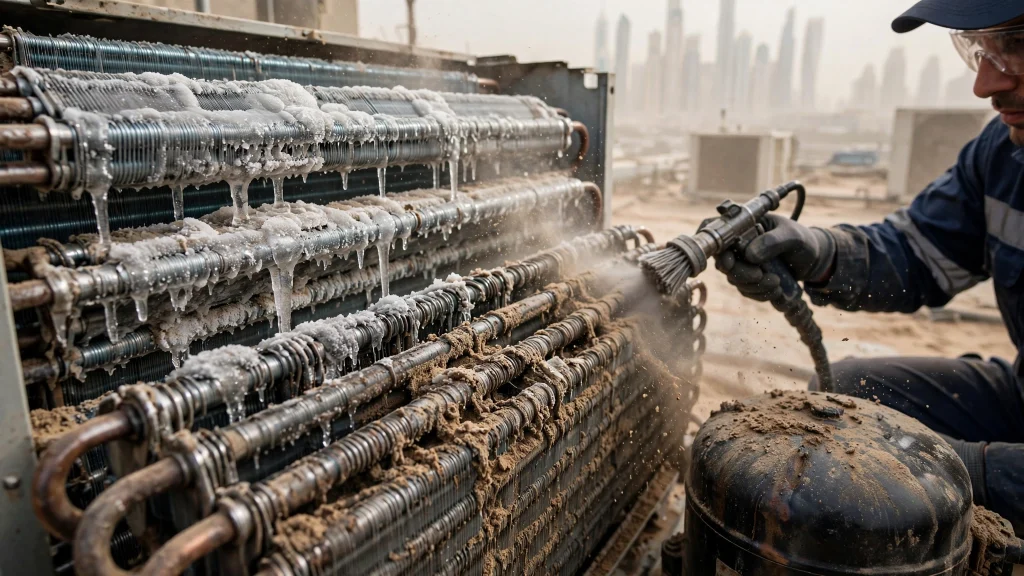
The evaporator coil absorbs heat from indoor air, while the condenser coil releases heat outdoors. Over time, both coils collect dust, dirt, and debris that reduce heat transfer efficiency.
In Dubai’s dusty environment, coil contamination is one of the leading causes of poor cooling performance.
Signs of Dirty Coils
- Warm air coming from vents.
- Higher electricity bills.
- Frozen evaporator coils.
- Compressor overheating.
- Reduced cooling capacity.
Prevention
Routine coil cleaning improves heat exchange efficiency, reduces compressor workload, and extends HVAC system lifespan.
Professional maintenance technicians use specialized cleaning equipment to remove stubborn dirt without damaging delicate coil fins.
Problem 3: Refrigerant Leaks
Refrigerant plays a vital role in the cooling cycle by absorbing and releasing heat through the evaporator and condenser.
Leaks can develop due to corrosion, damaged pipe connections, vibration, or aging components.
Symptoms
- Insufficient cooling.
- Ice formation on refrigerant lines.
- Continuous AC operation.
- Higher indoor temperatures.
- Hissing sounds near refrigerant piping.
Operating an HVAC system with low refrigerant can seriously damage the compressor, one of the most expensive components to replace.
Prevention
Annual HVAC inspections help identify refrigerant leaks before they become major mechanical failures.
Only qualified HVAC technicians should recharge refrigerant after repairing the leak, as incorrect refrigerant levels reduce system efficiency.
Problem 4: Blocked HVAC Ductwork
Air ducts distribute conditioned air throughout residential and commercial buildings.
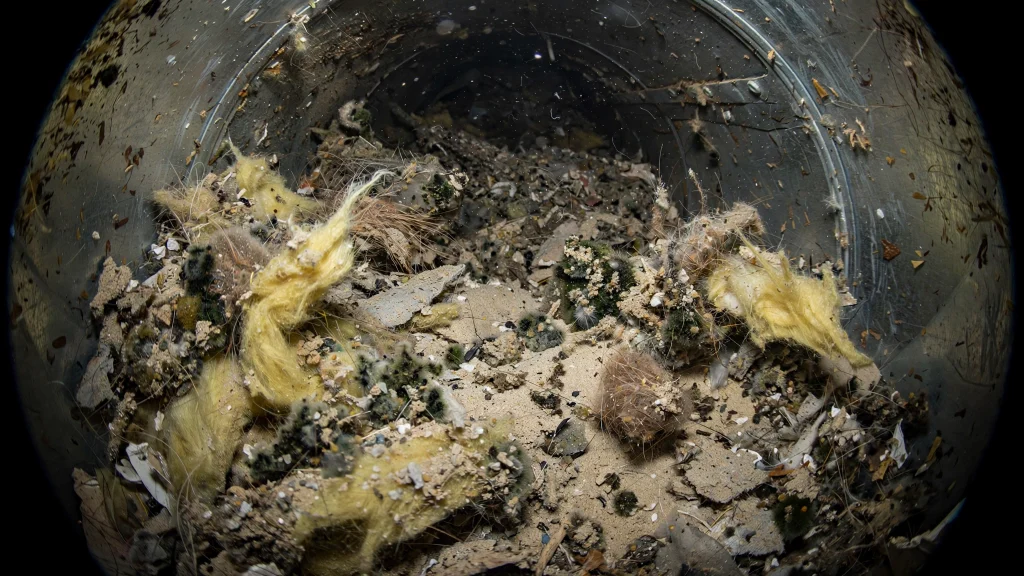
Over time, ductwork may accumulate:
- Dust
- Sand particles
- Construction debris
- Mold spores
- Insulation fibers
- Pet hair
Blocked ducts reduce airflow and force HVAC equipment to work harder.
Common Warning Signs
- Uneven room temperatures.
- Excessive dust indoors.
- Weak airflow.
- Increased energy bills.
- Poor indoor air quality.
Regular duct inspection and cleaning improve airflow while helping maintain healthier indoor environments.
Problem 5: Thermostat Malfunctions
The thermostat acts as the control center of an HVAC system.
If it fails to measure temperature accurately, the HVAC equipment may:
- Run continuously.
- Turn off too early.
- Overcool rooms.
- Waste electricity.
Modern smart thermostats use Wi-Fi connectivity, occupancy sensors, and programmable schedules to optimize cooling while reducing unnecessary energy consumption.
Regular calibration ensures accurate temperature readings and efficient HVAC operation.
Problem 6: Compressor Failure
The compressor is often considered the heart of an air conditioning system.
It circulates refrigerant between indoor and outdoor components, allowing heat transfer to occur.
Because compressors operate under high pressure, they can fail due to:
- Dirty coils.
- Low refrigerant.
- Electrical faults.
- Overheating.
- Poor maintenance.
Replacing a compressor can be costly, making preventive maintenance essential.
Routine inspections help detect early warning signs before complete failure occurs.
Problem 7: Drain Line Blockages
Air conditioning systems remove humidity from indoor air through condensate drain lines.
Dubai’s humid summer months increase condensate production.
If drain lines become blocked by algae, dust, or debris, water may overflow and cause:
- Ceiling stains.
- Water leaks.
- Mold growth.
- Indoor humidity problems.
Routine drain cleaning prevents costly water damage and maintains proper moisture removal.
Problem 8: Poor Indoor Air Quality (IAQ)
Indoor Air Quality has become increasingly important for homes, offices, schools, hospitals, and hotels.
Poor IAQ may result from:
- Dirty filters.
- Contaminated ductwork.
- High humidity.
- Poor ventilation.
- Mold growth.
Modern HVAC systems equipped with CO₂ sensors, humidity sensors, UV air purification, and Energy Recovery Ventilators (ERV) help maintain cleaner indoor environments while improving energy efficiency
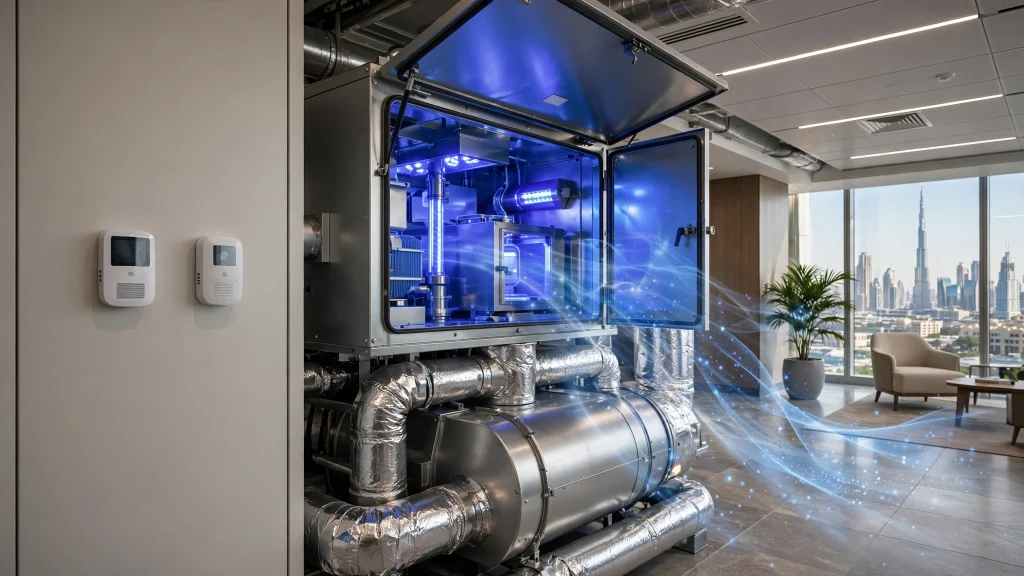
Problem 9: Air Handling Unit (AHU) Performance Issues
The Air Handling Unit (AHU) is one of the most important components in commercial HVAC systems. It is responsible for circulating, filtering, cooling, and distributing conditioned air throughout the building. AHUs are commonly installed in shopping malls, hospitals, hotels, schools, office towers, and large residential developments across Dubai.
When an AHU is not maintained properly, the entire HVAC system can lose efficiency.
Common Causes
- Dirty air filters
- Clogged cooling coils
- Damaged blower motors
- Worn drive belts
- Faulty dampers
- Sensor failures
- Poor airflow balancing
Warning Signs
- Uneven cooling between rooms
- Weak airflow
- Unusual vibration
- Increased operating noise
- Rising electricity consumption
Prevention
Regular AHU inspections should include filter replacement, coil cleaning, motor lubrication, fan balancing, and sensor calibration. Monitoring airflow and static pressure helps ensure the AHU delivers conditioned air efficiently to every occupied space.
Problem 10: Fan Coil Unit (FCU) Failures
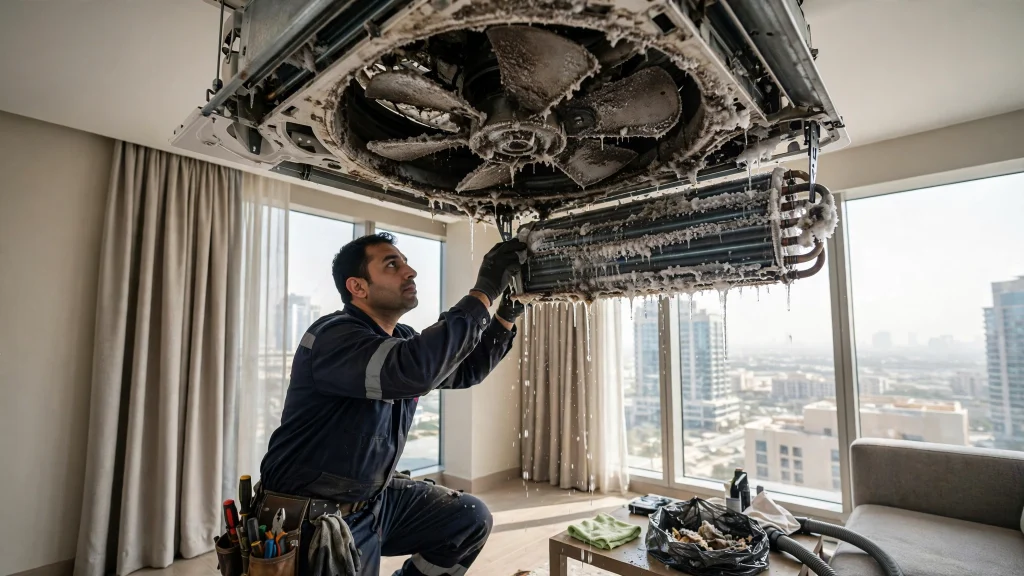
Fan Coil Units (FCUs) are widely used in apartments, hotels, villas, and office buildings across Dubai Marina, Downtown Dubai, Business Bay, and Palm Jumeirah.
Each FCU controls the temperature of an individual room or zone. Over time, poor maintenance can reduce its performance.
Common Problems
- Dirty blower fans
- Blocked condensate drains
- Frozen cooling coils
- Faulty thermostats
- Water leakage
- Restricted airflow
Prevention
Routine servicing includes cleaning blower assemblies, inspecting drain trays, checking chilled water valves, and ensuring thermostats communicate correctly with the HVAC control system.
A properly maintained FCU improves cooling efficiency while reducing unnecessary energy consumption.
Problem 11: Building Management System (BMS) Errors
Modern commercial buildings depend on Building Management Systems (BMS) to monitor HVAC equipment, lighting, fire protection, electrical systems, and energy consumption.
When communication errors occur, HVAC equipment may operate inefficiently.
Possible Issues
- Incorrect scheduling
- Sensor communication failures
- Software errors
- Calibration problems
- Network interruptions
- Controller faults
These problems can result in excessive cooling, higher electricity bills, and reduced occupant comfort.
Prevention
Regular BMS software updates, controller testing, sensor calibration, and system diagnostics help maintain reliable HVAC automation.
Problem 12: Variable Frequency Drive (VFD) Malfunctions
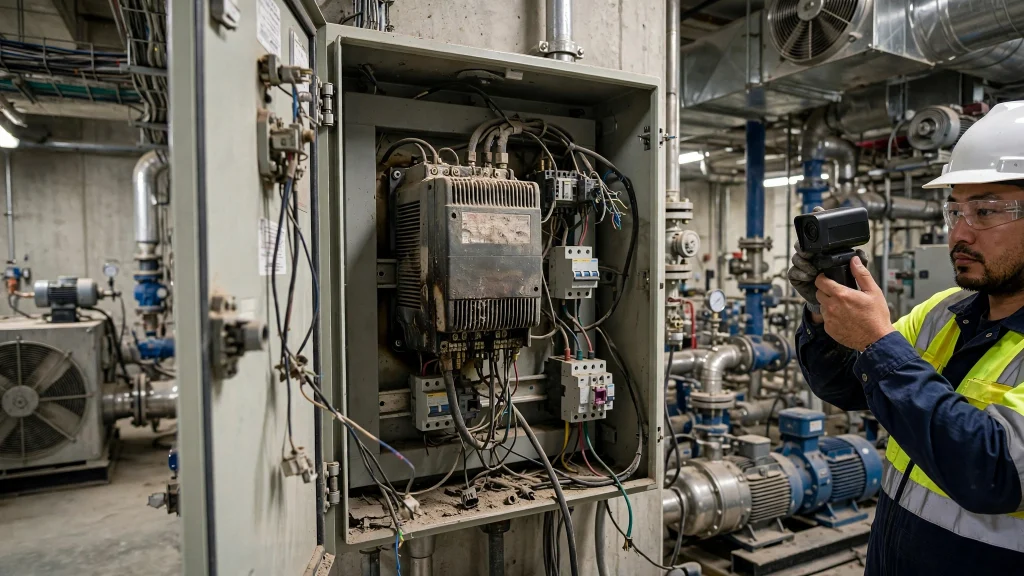
Variable Frequency Drives control the speed of HVAC motors such as pumps, cooling tower fans, and AHU supply fans.
A faulty VFD can force equipment to operate continuously at full speed, significantly increasing electricity consumption.
Common Causes
- Electrical surges
- Dust accumulation
- Overheating
- Loose wiring
- Improper programming
Prevention
Electrical inspections, ventilation cleaning, firmware updates, and thermal monitoring help extend VFD lifespan while maintaining energy-efficient HVAC operation.
Problem 13: Chiller Plant Inefficiency
Many commercial developments throughout Business Bay, DIFC, Expo City Dubai, and Jebel Ali rely on centralized Chiller Plants for cooling.
A typical chiller plant includes:
- Water-cooled chillers
- Air-cooled chillers
- Cooling towers
- Condensers
- Evaporators
- Primary pumps
- Secondary pumps
- Plate heat exchangers
- Expansion tanks
Without regular maintenance, chiller efficiency gradually decreases.
Warning Signs
- Increased electricity usage
- Poor chilled water temperature
- High condenser pressure
- Frequent shutdowns
- Compressor overload
Prevention
Routine water treatment, condenser cleaning, cooling tower maintenance, refrigerant analysis, and equipment monitoring help maximize chiller efficiency.
Problem 14: Cooling Tower Problems
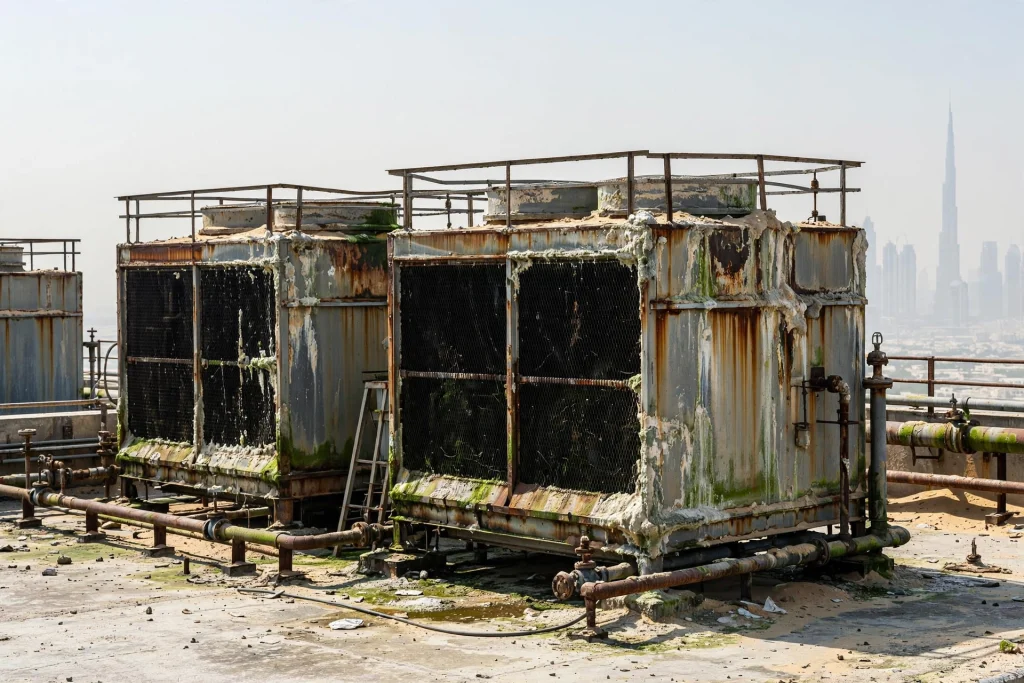
Cooling towers reject unwanted heat from chilled water systems.
Dubai’s climate exposes cooling towers to:
- Dust
- Sand
- Mineral deposits
- Scale formation
- Corrosion
- Biological growth
Neglecting cooling tower maintenance reduces heat rejection efficiency.
Prevention
Regular chemical water treatment, cleaning fill media, inspecting drift eliminators, checking fan motors, and monitoring water quality help maintain efficient operation.
Problem 15: Poor Airflow Distribution
Many homeowners complain that one room feels comfortable while another remains warm.
Uneven airflow usually results from:
- Dirty ducts
- Closed dampers
- Improper HVAC balancing
- Blocked supply vents
- Damaged insulation
- Leaking ductwork
Poor airflow forces HVAC equipment to operate longer than necessary.
Prevention
Professional airflow balancing, duct inspections, and vent cleaning help distribute conditioned air evenly throughout the building.
Problem 16: High Indoor Humidity
Although Dubai is generally dry, coastal areas experience high humidity during summer.
Improper humidity control may lead to:
- Condensation
- Mold growth
- Musty odors
- Reduced comfort
- Poor indoor air quality
Advanced HVAC systems use humidity sensors, dedicated ventilation systems, and Energy Recovery Ventilators (ERV) to maintain balanced indoor moisture levels.
Why Preventive Maintenance Is Better Than Emergency Repairs
Many HVAC failures begin as small issues that remain unnoticed for months.
Preventive maintenance identifies these problems before they become expensive repairs.
Routine maintenance typically includes:
- Filter replacement
- Coil cleaning
- Refrigerant pressure testing
- Thermostat calibration
- Electrical inspections
- Lubrication of moving parts
- Duct inspection
- Condensate drain cleaning
- Airflow testing
- Sensor verification
These services improve equipment reliability while reducing unexpected downtime.
Choosing a Reliable HVAC Service Provider
Proper installation and maintenance directly affect HVAC performance, energy efficiency, and equipment lifespan.
Whether you manage a commercial tower in Downtown Dubai, operate a retail outlet in Al Quoz, or own a villa in Arabian Ranches, working with experienced professionals ensures your HVAC system operates safely and efficiently.
For reliable installation, inspections, repairs, and preventive maintenance, consider working with an Affordable HVAC Company in Dubai that understands local climate conditions, modern HVAC technologies, and industry best practices.
Predictive Maintenance Reduces Unexpected Breakdowns
Traditional maintenance follows a fixed schedule, but modern HVAC systems use predictive maintenance to determine when equipment actually requires servicing.
Using sensors, analytics, and cloud-based monitoring, predictive maintenance identifies abnormalities before they become serious failures.
For example, the system can detect:
- Rising compressor temperatures
- Increasing motor vibration
- Reduced airflow
- Declining cooling efficiency
- Higher electrical current
- Abnormal refrigerant pressure
- Fan imbalance
- Pump performance issues
Maintenance teams receive alerts before complete equipment failure occurs.
This proactive approach reduces emergency repairs, lowers maintenance costs, and extends the service life of HVAC equipment.
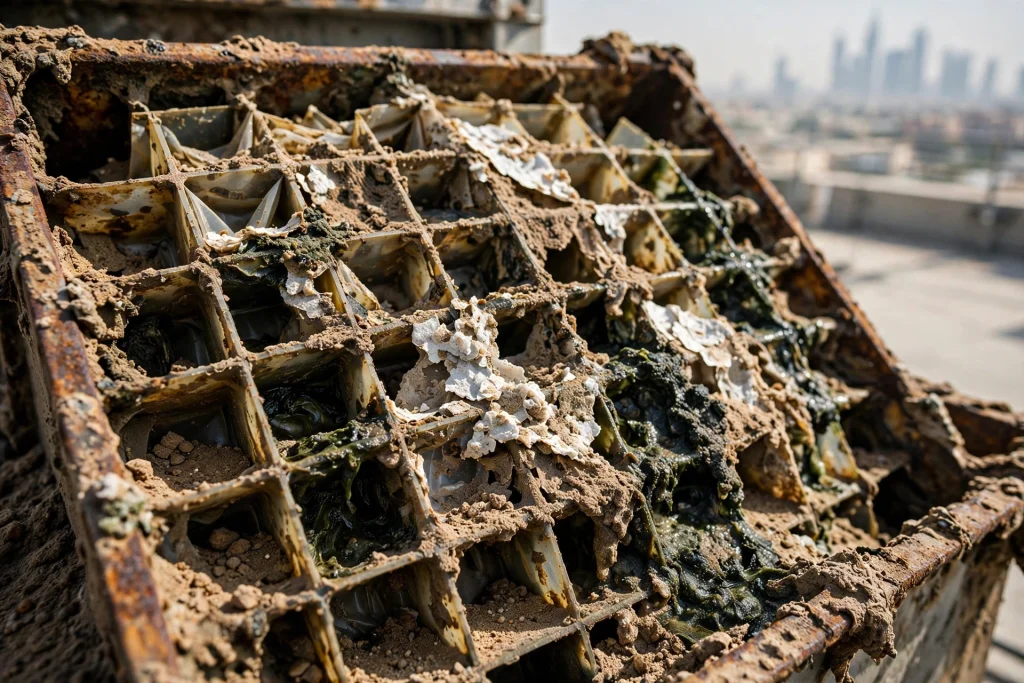
Indoor Air Quality Should Never Be Ignored
Cooling performance is only one part of an efficient HVAC system. Indoor Air Quality (IAQ) is equally important, especially in Dubai, where buildings remain closed for much of the year due to high outdoor temperatures.
Poor indoor air quality can result from:
- Dirty air filters
- Dust-filled ductwork
- Mold spores
- High humidity
- Poor ventilation
- Bacteria and airborne contaminants
Modern HVAC systems improve IAQ through:
- HEPA filtration
- UV-C air purification
- Activated carbon filters
- Fresh air ventilation
- Humidity control
- CO₂ monitoring
- Energy Recovery Ventilators (ERV)
These technologies help create healthier indoor environments for homes, offices, schools, hospitals, and hotels.
Energy Efficiency Starts with Proper HVAC Design
Many HVAC problems begin long before the system is installed. Poor system design often leads to inefficient cooling, uneven airflow, excessive electricity consumption, and premature equipment failure.
Professional HVAC engineers evaluate:
- Building orientation
- Heat load calculations
- Occupancy levels
- Solar heat gain
- Ventilation requirements
- Air distribution
- Duct sizing
- Equipment capacity
Oversized equipment cycles on and off too frequently, while undersized systems struggle to maintain indoor temperatures.
Correct system design ensures every component works efficiently from the beginning.
Common Mistakes That Shorten HVAC Lifespan
Many property owners unknowingly reduce the lifespan of their HVAC systems through poor maintenance practices.
Some of the most common mistakes include:
- Ignoring dirty air filters
- Delaying annual maintenance
- Blocking supply or return air vents
- Using incorrect thermostat settings
- Skipping duct cleaning
- Ignoring unusual noises
- Operating damaged equipment
- Delaying refrigerant leak repairs
- Failing to clean outdoor condenser units
Even small maintenance issues can place additional stress on compressors, motors, and cooling components, leading to expensive repairs.
Best Practices to Keep Your HVAC System Running Efficiently
Preventive maintenance remains the most effective way to improve HVAC reliability.
Property owners should:
- Replace or clean air filters regularly.
- Schedule professional HVAC inspections at least once or twice each year.
- Keep condenser units free from dust and debris.
- Inspect ductwork for leaks and contamination.
- Monitor thermostat accuracy.
- Check refrigerant pressure.
- Clean evaporator and condenser coils.
- Test electrical connections.
- Lubricate moving mechanical parts.
- Verify airflow throughout the building.
Following these best practices helps reduce operating costs while improving comfort and equipment performance.
Frequently Asked Questions
Why do HVAC systems fail more often in Dubai?
Dubai’s high temperatures, continuous air conditioning usage, airborne desert dust, humidity, and ongoing construction activities place significant stress on HVAC equipment throughout the year.
How often should HVAC systems be serviced?
Most residential HVAC systems should be professionally serviced at least twice a year. Commercial buildings, hotels, healthcare facilities, and industrial sites may require more frequent maintenance depending on operating conditions.
Does duct cleaning improve HVAC performance?
Yes. Clean ductwork improves airflow, reduces dust circulation, enhances Indoor Air Quality (IAQ), and allows HVAC equipment to operate more efficiently.
Can smart HVAC systems reduce electricity bills?
Yes. Smart HVAC technologies such as Building Management Systems (BMS), Variable Frequency Drives (VFD), smart thermostats, occupancy sensors, and predictive maintenance help reduce unnecessary energy consumption while maintaining indoor comfort.
What are the signs that an HVAC system needs immediate attention?
Seek professional inspection if you notice:
- Weak airflow
- Warm air from vents
- Water leakage
- Ice on refrigerant lines
- Unusual noises
- Burning smells
- Frequent system shutdowns
- Rapidly increasing electricity bills
Early diagnosis often prevents expensive equipment failures.