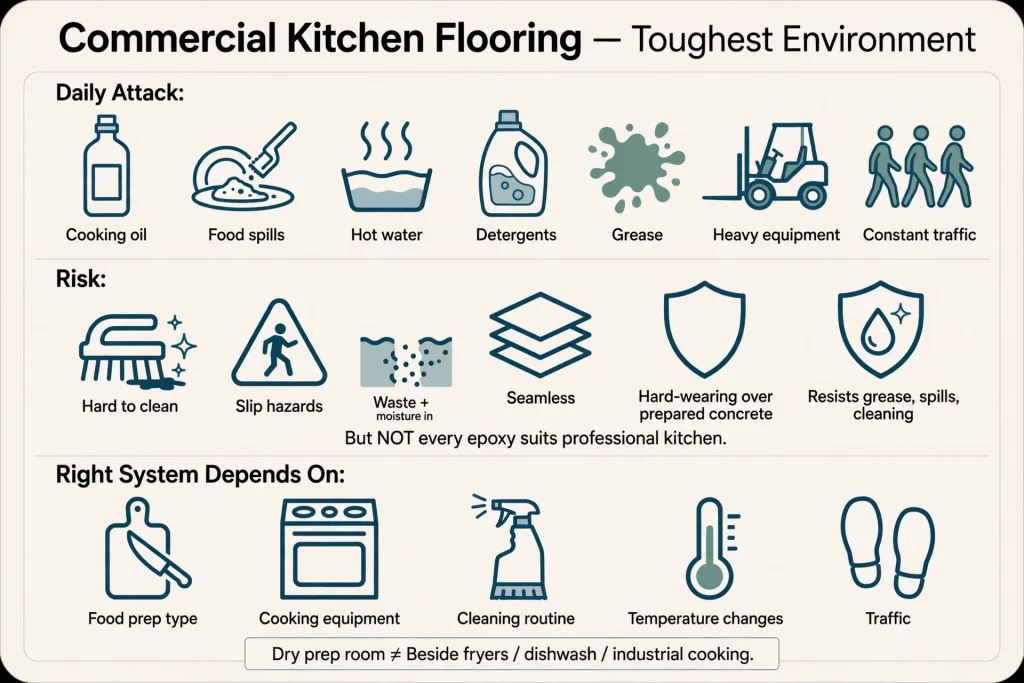
A commercial kitchen has one of the toughest working environments for any type of flooring. Every day, the floor is exposed to cooking oil, food spills, hot water, detergents, grease, heavy equipment and constant foot traffic. In busy restaurants and hotel kitchens, these conditions can quickly damage an unsuitable floor.
The problem is not just appearance. A damaged or poorly designed kitchen floor can become difficult to clean, create slip hazards and allow food waste and moisture to collect in small gaps. This can make it harder for kitchen operators to maintain proper hygiene.
For restaurants, hotels, catering companies and food production facilities in Dubai, choosing the right flooring system is an important part of kitchen planning. The floor needs to support daily cleaning, resist the chemicals used by cleaning teams and provide a safe surface for staff working around hot equipment and wet areas.
Epoxy flooring is a popular option for commercial kitchens because it creates a seamless, hard-wearing surface over properly prepared concrete. It can help protect the floor against grease, food spills and regular cleaning. However, not every epoxy product is suitable for a professional kitchen.
The right system depends on the type of food preparation, cooking equipment, cleaning routine, temperature changes and expected traffic. A floor used in a dry food preparation room may have different requirements from one installed beside deep fryers, dishwashing stations or industrial cooking equipment.
This guide explains how to choose and maintain epoxy flooring for commercial kitchens in Dubai, with practical advice on hygiene, grease resistance, slip safety, cleaning and installation.
Why Commercial Kitchens Need Specialist Flooring
A commercial kitchen is different from an ordinary indoor space. It operates for long hours and may experience repeated spills, regular washdowns and continuous movement between preparation, cooking, washing and storage areas.
Standard floor tiles, ordinary concrete and basic floor coatings may struggle under these conditions if they are not designed for commercial food environments.
For example, cooking oil can spread across the floor near fryers and cooking stations. Water and detergent can collect around sinks and dishwashing areas. Food particles may fall beneath equipment, while heavy refrigerators, ovens and preparation tables place pressure on the floor.
A suitable commercial kitchen floor needs to deal with several demands at the same time.
It should have a sealed surface that supports routine cleaning. It should resist the oils, fats and cleaning chemicals used in the kitchen. It should provide suitable slip resistance when wet or contaminated. It should also withstand the physical demands of staff movement, equipment and regular maintenance.
Hygiene is another major concern. Cracked surfaces, damaged grout and open joints can become difficult to clean. Food debris and moisture may collect in these areas, making routine sanitation less effective.
A correctly specified seamless resin floor can reduce these problems by creating a continuous surface with fewer places for dirt and grease to collect.
However, the flooring material alone does not guarantee a hygienic kitchen. Correct installation, drainage, coving, cleaning procedures and regular inspections are equally important.
What Makes Epoxy Flooring Suitable for Commercial Kitchens?
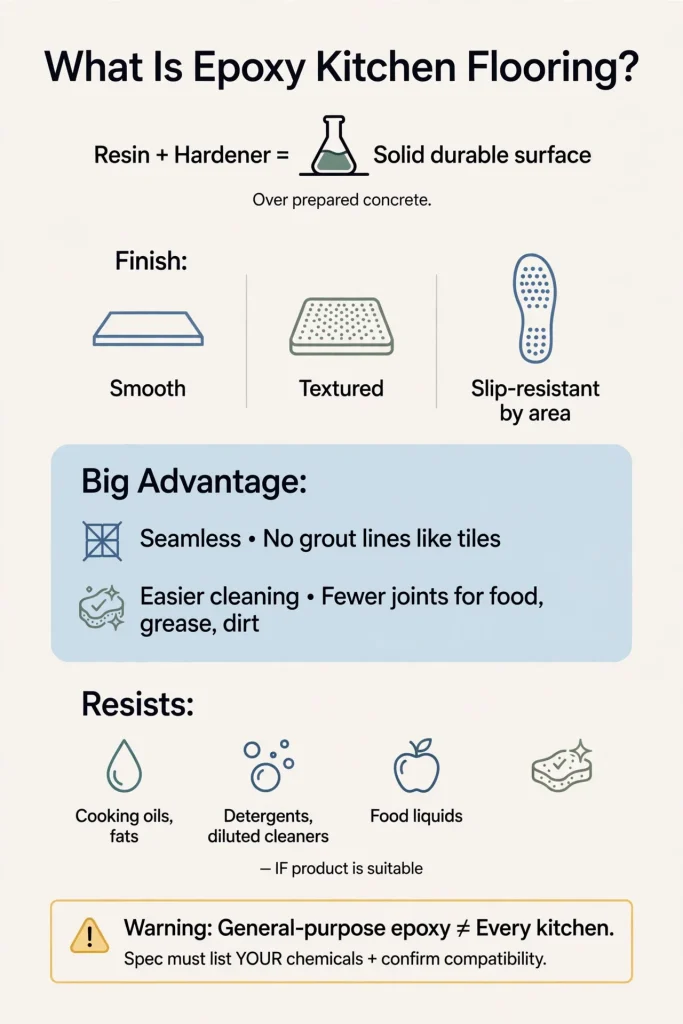
Epoxy flooring is made by combining an epoxy resin with a hardener. Once mixed and applied, the materials react and form a solid, durable surface.
For commercial kitchens, epoxy systems are usually installed over prepared concrete. The final floor can be smooth, textured or designed with different levels of slip resistance depending on the area.
One of the main advantages is that epoxy can create a seamless finish. Unlike traditional tiled flooring, a properly installed resin floor does not have regular grout lines across the main surface.
This makes cleaning more straightforward and reduces the number of joints where food particles, grease and dirt can collect.
Epoxy flooring can also provide good resistance to many common kitchen substances when the selected product is suitable for the exposure. These may include cooking oils, fats, detergents, diluted cleaning chemicals and certain food-related liquids.
Its performance still depends on the product formulation. A general-purpose epoxy coating should not automatically be treated as suitable for every commercial kitchen.
The flooring specification should identify the chemicals used on site and confirm that the proposed system is compatible with them.
Hygiene Requirements for Commercial Kitchen Flooring
Hygiene should be one of the first considerations when selecting a kitchen floor.
Restaurants and food businesses need surfaces that can be cleaned regularly without leaving hidden areas for food waste and dirt to collect. A floor that looks attractive but has damaged joints or a rough, difficult-to-clean finish may create problems during daily operations.
Seamless flooring reduces dirt collection points
Traditional tiles have joints filled with grout. Over time, grout can become stained, worn or damaged, especially in areas exposed to grease and repeated washing.
A seamless epoxy floor removes most of these regular joints from the main floor surface.
This creates a more continuous area that can be cleaned using suitable detergents, floor scrubbers and other approved cleaning equipment.
There may still be construction joints, movement joints, drains and service penetrations. These must be detailed properly rather than simply covered with rigid resin.
Non-porous surface for easier cleaning
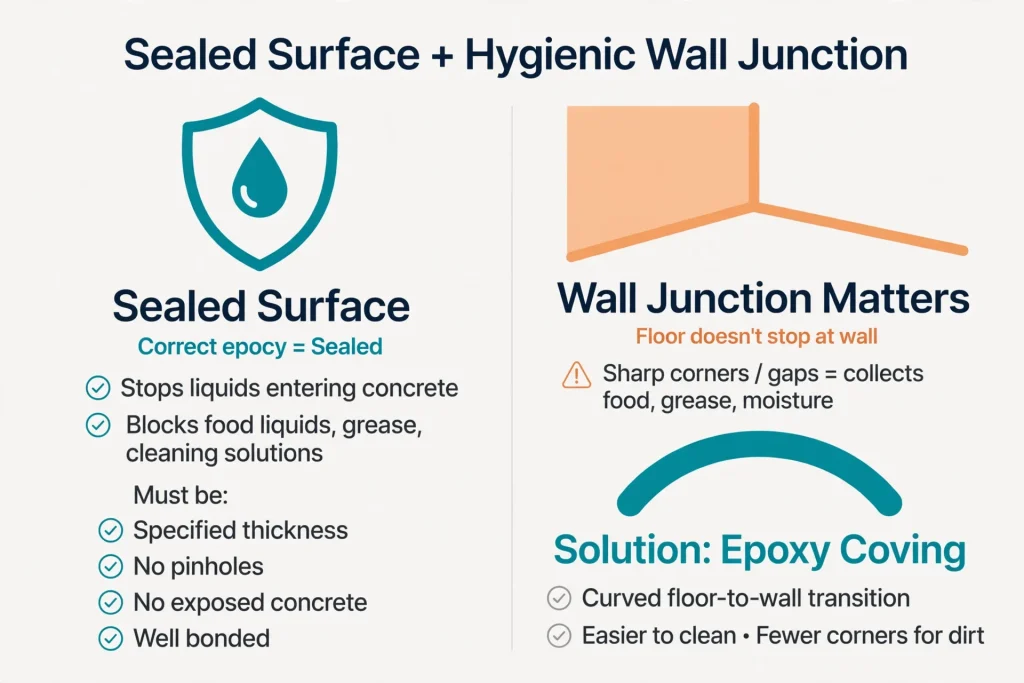
A correctly installed epoxy system creates a sealed surface that helps prevent liquids from entering the concrete underneath.
This is useful in commercial kitchens because food liquids, grease and cleaning solutions can otherwise soak into an untreated or damaged substrate.
The floor should be installed at the specified thickness and without pinholes, exposed concrete or poorly bonded areas.
Hygienic wall-to-floor junctions
The floor does not stop being important at the wall.
The junction between the floor and wall can collect food waste, grease and moisture if it contains sharp corners or gaps.
Epoxy coving can create a curved transition between the floor and wall. This makes the junction easier to clean and reduces the number of sharp corners where dirt may collect.
Coving is particularly useful behind cooking equipment, around preparation areas and in rooms that receive regular washdowns.
The coving material and its joint with the main floor should be compatible with the selected flooring system.
Proper drainage and water management
A hygienic floor should not allow water and cleaning liquids to remain in unwanted areas.
Commercial kitchens often have floor drains near dishwashing stations, pot-wash areas and other wet working zones.
The floor may need suitable falls towards these drains to help water move away from work areas.
Drain covers, channels and surrounding floor details should be selected to suit the cleaning process and expected liquids.
Standing water can make cleaning less effective and increase slip risks. Good drainage should therefore be considered during kitchen design, not added as an afterthought.
Grease Resistance: A Major Requirement for Kitchen Floors
Grease is one of the biggest challenges in a commercial kitchen.
Cooking oil, animal fats and food residues can spread across the floor during normal operations. Areas around fryers, grills, ovens and food preparation stations are especially likely to experience grease contamination.
When grease reaches the floor, it can create a slippery film. If it is not removed properly, it may build up and become harder to clean.
The selected epoxy system should be suitable for the oils and fats used in the kitchen. The manufacturer should provide information about its resistance to relevant substances.
Areas with the highest grease exposure
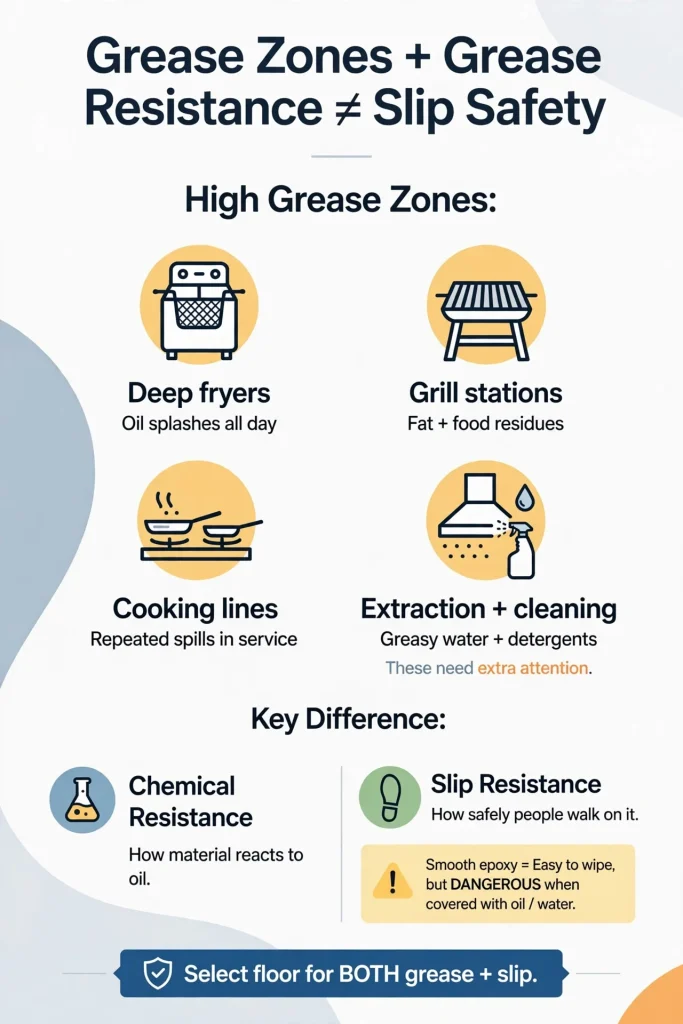
Some parts of a commercial kitchen experience more grease than others.
The floor around deep fryers may receive small oil splashes throughout the working day. Grill stations can collect fat and food residues. Cooking lines may experience repeated spills during busy service periods.
Extraction and cleaning areas may also be exposed to greasy water and detergents.
These locations should receive particular attention during the flooring assessment.
Why grease resistance alone is not enough
A floor may resist oil without providing sufficient slip resistance.
This is an important difference. Chemical resistance describes how the material reacts to a substance, while slip resistance relates to how safely people can walk across the surface under particular conditions.
A smooth epoxy finish may be easy to wipe clean, but it can become dangerous when covered with cooking oil or water.
For this reason, kitchen flooring should be selected by considering grease resistance and slip performance together.
Cleaning grease from epoxy flooring
Grease should be removed using a cleaning product approved for the installed resin system.
The cleaning team should follow the recommended dilution, contact time, scrubbing method and rinsing instructions.
Using a stronger chemical does not always produce better results. An unsuitable degreaser may damage the floor’s protective finish or affect its appearance.
Regular cleaning is more effective than allowing grease to build up over several days.
Choose the Right Slip-Resistant Epoxy Finish
Slip resistance is one of the most important safety requirements in commercial kitchens.
Workers regularly move between hot cooking equipment, preparation tables, sinks, refrigerators and storage areas. They may carry heavy containers, trays and food supplies while walking across wet or greasy surfaces.
A slippery floor increases the risk of falls, injuries and disruption to kitchen operations.
Epoxy flooring can be installed with a textured finish to improve grip. This is usually achieved by adding suitable graded aggregates or using a purpose-designed anti-slip system.
The correct texture depends on the type of kitchen activity.
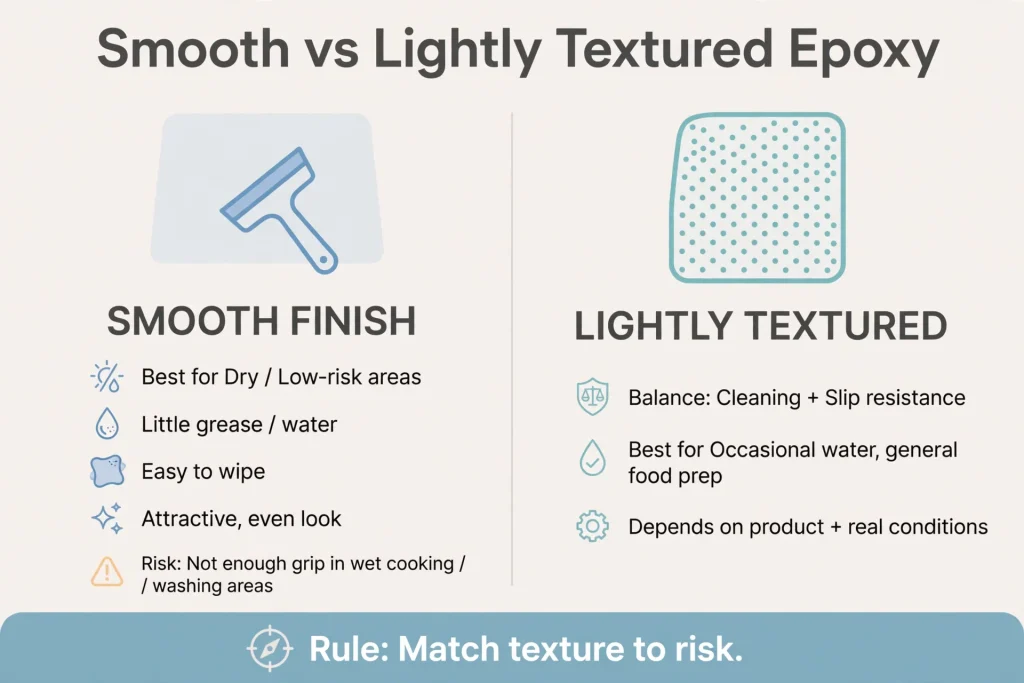
Smooth epoxy finish
A smooth finish can be suitable for some dry or low-risk areas where regular grease and water contamination are unlikely.
It is easier to wipe clean and can provide an attractive, even appearance.
However, a smooth surface may not provide enough grip in wet cooking or washing areas.
Lightly textured epoxy finish
A lightly textured surface can provide a balance between cleaning and slip resistance.
It may be suitable for areas with occasional water exposure or general food preparation, depending on the product and actual operating conditions.
Heavy-duty anti-slip epoxy flooring
Areas around commercial fryers, pot-wash stations and wet processing equipment may need a more pronounced textured finish.
The texture should provide suitable grip under the expected conditions while still allowing the cleaning team to remove grease, food waste and detergent residues.
A very rough floor is not automatically safer or more hygienic. Deep surface texture can trap dirt and make cleaning more difficult.
The correct finish should be selected after considering the type of contamination, footwear, cleaning method and movement of staff.
How should slip resistance be checked?
Do not rely only on a supplier’s statement that a floor is anti-slip.
Ask which test method and rating are being used and whether the results apply to the expected wet or contaminated conditions.
Pendulum testing, for example, can be used to assess slip potential under defined test conditions. Other test methods may also be relevant depending on the project specification.
The results should be interpreted by a competent flooring or safety professional. A test result for a clean, dry sample does not automatically describe performance when the floor is covered with cooking oil.
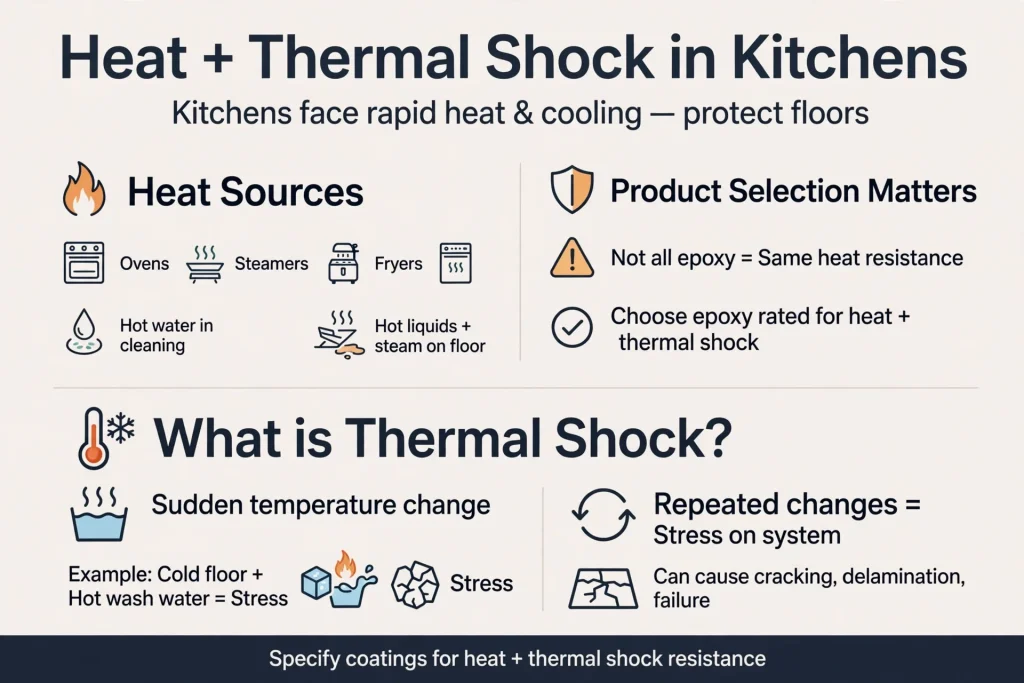
Epoxy Flooring Must Handle Hot Water and Temperature Changes
Commercial kitchens use ovens, steamers, fryers, dishwashers and other equipment that can create demanding temperature conditions.
Some areas experience hot water during cleaning, while others may have hot liquids or steam reaching the floor.
This is where product selection becomes especially important.
Not all epoxy flooring systems have the same resistance to heat or thermal shock.
What is thermal shock?
Thermal shock happens when a floor experiences a sudden temperature change.
For example, a concrete floor may be exposed to hot wash water after spending several hours at a lower temperature. Repeated temperature changes can place stress on the flooring system.
If the selected resin cannot handle these conditions, it may develop cracks, loss of adhesion or other surface defects.
Check the temperature limits
Before selecting epoxy flooring, ask the manufacturer for the permitted service temperature and cleaning conditions.
Check whether the product can tolerate:
- Hot water used during cleaning.
- Steam from commercial cooking equipment.
- Hot oil and food spills.
- Temperature changes around ovens and dishwashers.
- Regular washdown procedures.
The expected conditions should be compared with the manufacturer’s technical data.
When polyurethane-cement flooring may be better
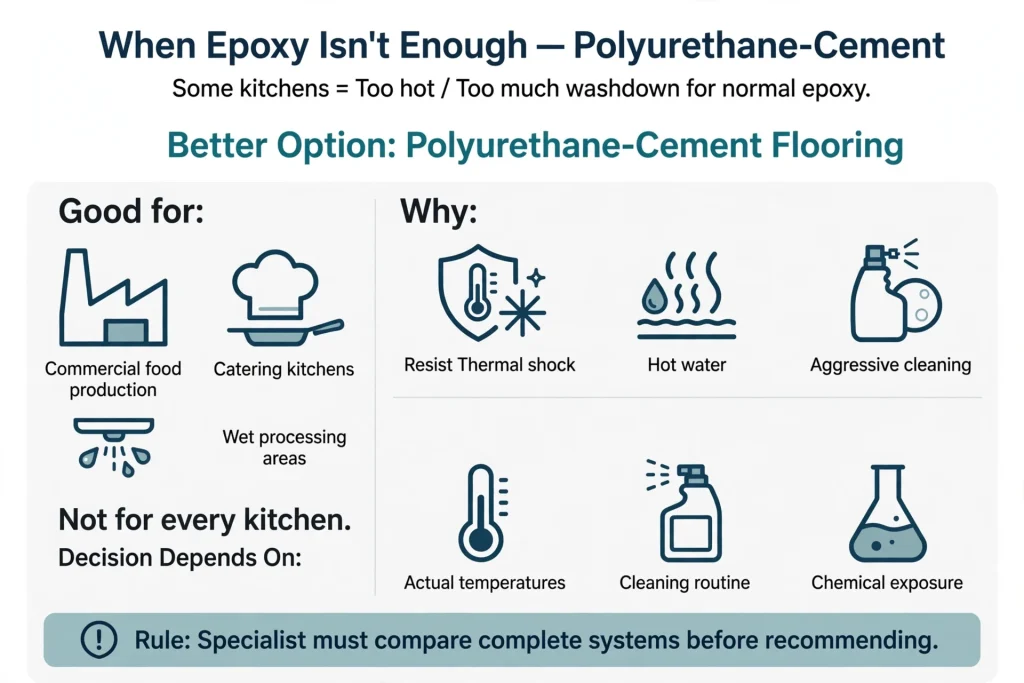
Some commercial kitchens experience more demanding heat and washdown conditions than a conventional epoxy system is designed to handle.
In these situations, polyurethane-cement flooring may be a better option.
This type of resin flooring is commonly considered for commercial food production, catering kitchens and wet processing areas because specialist formulations can offer good resistance to thermal shock, hot water and aggressive cleaning.
It is not necessary for every kitchen. The decision should depend on the actual temperatures, cleaning routine and chemical exposure.
A flooring specialist should compare the complete systems before recommending one.
Select the Correct Epoxy Flooring System for Each Kitchen Area
A commercial kitchen is not one uniform working space.
Different sections have different cleaning routines, equipment and exposure levels. Using the same flooring specification throughout the building may not be the most practical approach.
Food preparation areas
Food preparation areas need floors that are easy to clean and suitable for regular hygiene procedures.
These areas may experience water, food liquids, mild detergents and regular foot traffic.
A suitable seamless epoxy system with an appropriate finish can help support cleaning and everyday use.
The slip resistance should match the risk of spills and the cleaning routine.
Cooking areas
Cooking areas usually experience higher temperatures, oil splashes, grease and heavy daily use.
The floor around fryers, grills and cooking ranges should be assessed carefully.
A suitable textured resin finish may be needed to improve grip. The selected system must also be compatible with the oils, cleaning products and temperatures found in the area.
Dishwashing and pot-wash areas
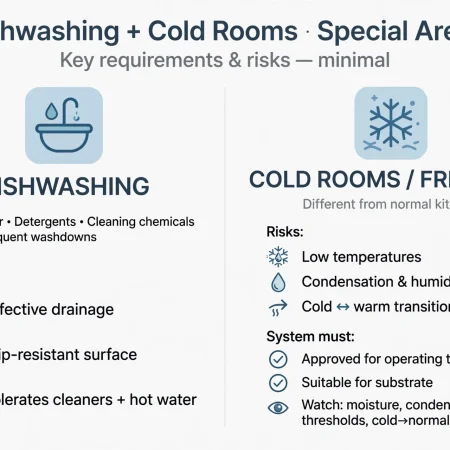
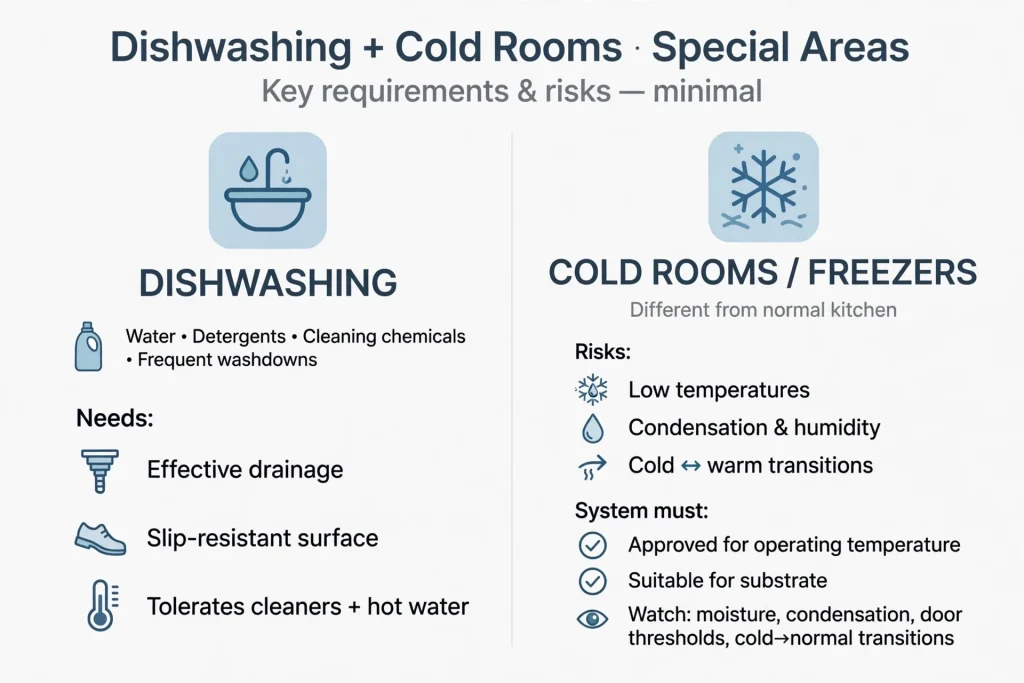
Dishwashing areas often experience water, detergents, cleaning chemicals and frequent washdowns.
These floors need effective drainage and suitable slip resistance.
The flooring system should also tolerate the cleaning products and water temperatures used during normal operation.
Cold rooms and freezer areas
Cold rooms have different requirements from ordinary kitchen floors.
Low temperatures, condensation and changes between cold and warmer conditions can affect flooring performance.
The system must be approved for the expected operating temperature and substrate conditions.
Special attention should be given to moisture, condensation, door thresholds and the transition between refrigerated and normal-temperature areas.
Dry storage areas
Dry food storage rooms may experience less water and grease than cooking areas.
A durable, sealed epoxy floor can be suitable where it meets the expected traffic and cleaning requirements.
The surface should also be appropriate for pallet trucks, storage equipment and regular movement of stock.
Waste and cleaning rooms
Waste storage and cleaning rooms can experience water, detergents, food residues and stronger cleaning chemicals.
The flooring system should be selected according to the actual chemicals used and the frequency of washdowns.
Drainage and wall coving are particularly important in these locations.
How to Choose the Right Epoxy Flooring Thickness
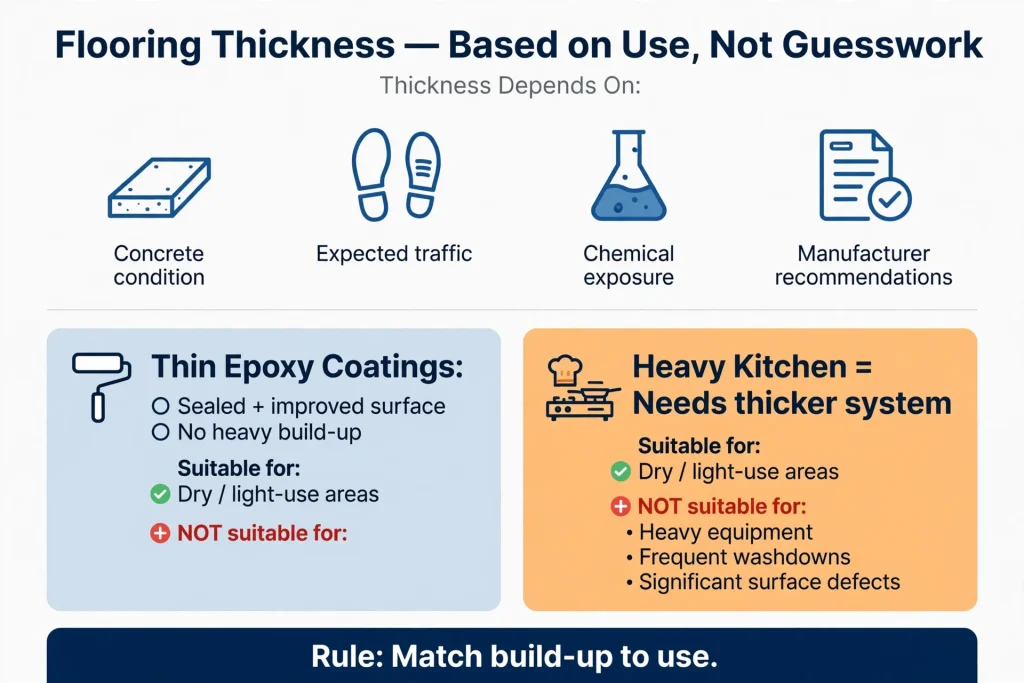
Flooring thickness should be based on the use of the area rather than selected by guesswork.
A thin coating may be suitable for some light-duty spaces, while a commercial kitchen with heavy equipment and frequent cleaning may need a thicker system.
The correct build-up depends on the concrete condition, expected traffic, chemical exposure and manufacturer recommendations.
Thin epoxy coatings
Thin epoxy coatings are generally used where the floor needs a sealed and improved surface without a heavy-duty build-up.
They may be suitable for certain dry or light-use areas.
However, a thin coating may not be appropriate for a kitchen with demanding mechanical loads, frequent washdowns or significant surface defects.
High-build epoxy systems
High-build epoxy flooring creates a thicker protective layer.
It may be considered for busy commercial kitchens where the floor needs greater durability and a more substantial resin build-up.
The thickness and number of layers should follow the manufacturer’s specification.
Epoxy mortar systems
Epoxy mortar flooring combines resin with graded aggregates to form a thicker, stronger floor system.
It may be useful where the substrate needs repair or the area experiences heavy equipment and mechanical wear.
The contractor should confirm that the chosen mortar system is suitable for food-related cleaning conditions and the expected chemical exposure.
A thicker floor is not automatically better. Correct resin chemistry, preparation, application and curing are just as important.
Surface Preparation Before Epoxy Flooring Installation
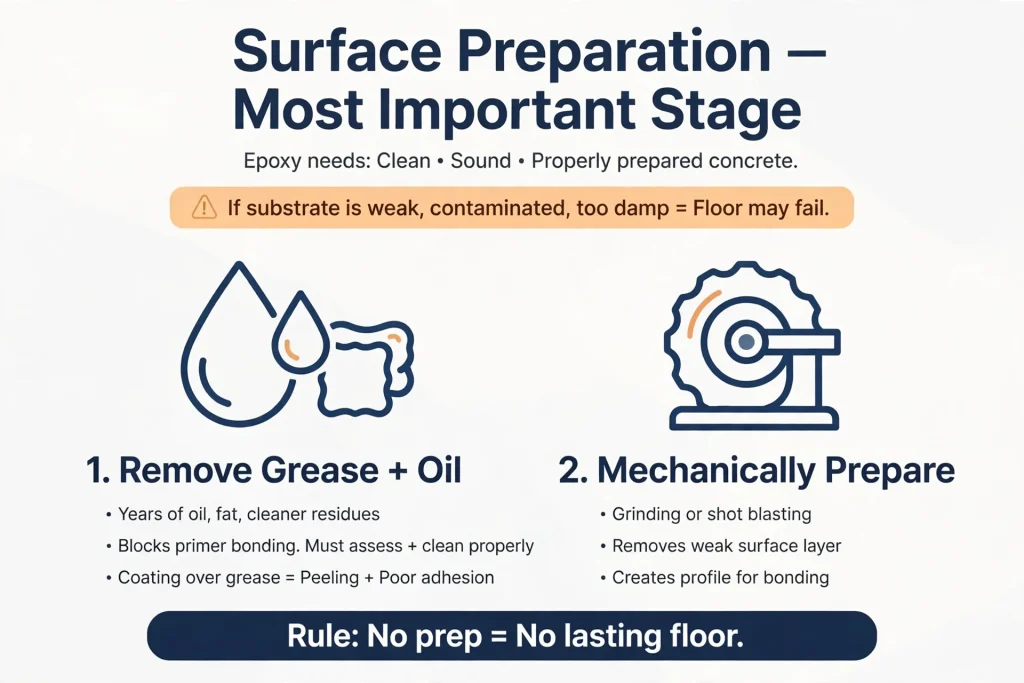
Surface preparation is one of the most important stages of any commercial kitchen flooring project.
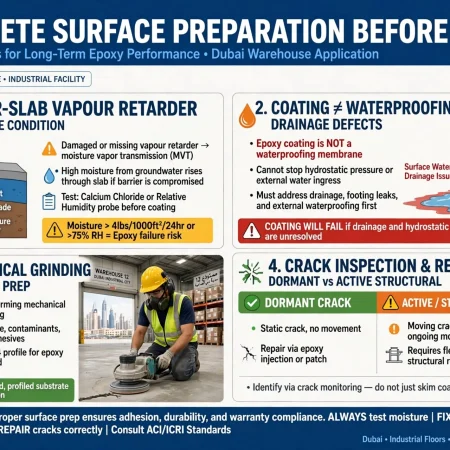
The epoxy system needs a clean, sound and properly prepared concrete base. If the substrate is weak, contaminated or damp beyond the product’s limits, the new floor may fail.
Remove grease and oil contamination
Existing kitchen floors may contain years of oil, fat and cleaning product residues.
These substances can prevent the epoxy primer from bonding with the concrete.
The contractor should assess the contamination and use suitable cleaning and mechanical preparation methods.
Simply applying a new coating over a greasy floor can lead to peeling and poor adhesion.
Mechanically prepare the concrete
Mechanical grinding or shot blasting is commonly used to remove weak surface material and create the required surface profile.
The correct preparation method depends on the condition of the slab and the selected resin system.
After preparation, the surface should be cleaned using suitable industrial vacuum equipment to remove dust and loose particles.
Repair cracks and damaged areas
Cracks, holes and uneven sections should be inspected and repaired before application.
The contractor must identify whether cracks are stable or moving. Active movement joints should be treated using a suitable detail rather than covered with rigid epoxy.
Test for moisture
Concrete can hold moisture even when its surface looks dry.
Excessive moisture may cause bubbles, blistering or loss of adhesion in some epoxy systems.
The contractor should carry out suitable moisture testing and compare the results with the manufacturer’s limits.
If the moisture level is too high, the floor may need additional drying or a compatible moisture-control system.
Apply the correct primer
Once the concrete has been prepared and approved, the specified primer is applied.
The primer helps the resin system bond with the substrate. Its compatibility with the body coat and other flooring layers should be confirmed.
The Epoxy Flooring Installation Process in a Commercial Kitchen
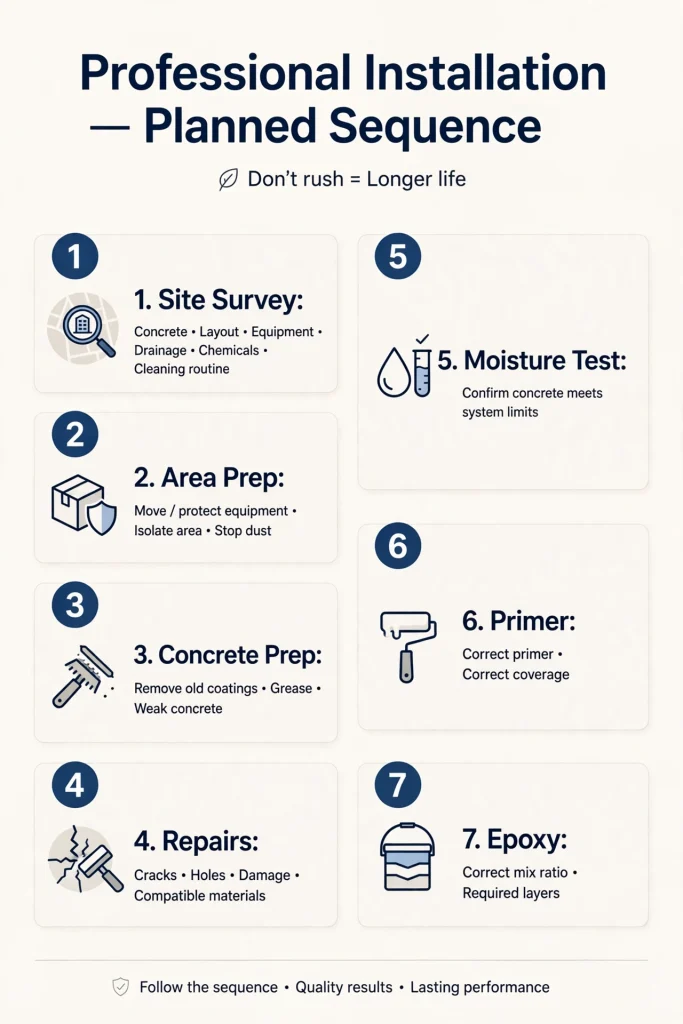
A professional installation should follow a planned sequence. Rushing the work can affect the final finish and reduce the expected service life.
1. Site survey: The contractor checks the concrete, kitchen layout, equipment, drainage, chemical exposure and cleaning routine.
2. Area preparation: Kitchen equipment is moved or protected as required. The work area is isolated to prevent dust and other contamination.
3. Concrete preparation: Existing coatings, grease, weak concrete and contaminants are removed using suitable methods.
4. Repairs: Cracks, holes and damaged sections are repaired with compatible materials.
5. Moisture assessment: The concrete is tested to confirm that it meets the flooring system’s requirements.
6. Primer application: The correct primer is applied at the specified coverage rate.
7. Epoxy application: The resin and hardener are mixed in the correct ratio and applied in the required layers.
8. Anti-slip finish: Suitable aggregate or a textured finish is incorporated where required.
9. Coving and joint detailing: Wall junctions, drains and movement joints are completed using compatible materials.
10. Curing and inspection: The floor is protected while curing and inspected before the kitchen returns to service.
The contractor should provide a clear handover explaining when the floor can accept foot traffic, equipment, cleaning and normal kitchen operations.
Cleaning Requirements for Epoxy Commercial Kitchen Floors
A good cleaning routine helps maintain the appearance and performance of epoxy flooring.
Although a sealed resin surface is easier to clean than damaged concrete or worn grout, it still needs regular care.
The cleaning method should follow the product manufacturer’s recommendations.
Daily cleaning
Kitchen floors should be cleaned according to the facility’s food safety and sanitation procedures.
Loose food waste should be removed first. Grease and spills should then be cleaned using an approved degreaser or detergent.
The surface should be rinsed where required and left in a condition that is safe for staff.
Pay special attention to areas beneath cooking equipment, around fryers, near sinks and along wall edges.
Remove grease as soon as possible
Allowing grease to build up makes cleaning harder and can increase slip risks.
Spills should be dealt with promptly using the kitchen’s approved cleaning and spill response procedures.
Staff should use suitable protective equipment and follow the safety data sheet for the cleaning product.
Use compatible cleaning chemicals
Not every industrial cleaner is suitable for every epoxy system.
Strong acids, concentrated alkalis, aggressive solvents and unsuitable cleaning agents may damage certain coatings.
The facility should keep a list of approved cleaning products and dilution instructions.
Cleaning teams should not change products without checking their compatibility with the flooring system.
Use suitable cleaning equipment
Commercial kitchens may use floor scrubbers, wet vacuums, mops and other cleaning equipment.
The equipment should be suitable for the floor texture and should not cause unnecessary abrasion.
For textured anti-slip surfaces, brushes may be more effective than smooth cleaning pads because they can reach into the surface profile.
The cleaning method should remove grease and food residue without damaging the resin.
Regular deep cleaning
Some areas may need scheduled deep cleaning in addition to normal daily maintenance.
The frequency depends on the type of cooking, grease levels, food handling and cleaning requirements.
A maintenance plan should identify high-risk areas and explain how they will be inspected and cleaned.
Dubai Food Safety and Commercial Kitchen Considerations
Commercial kitchens in Dubai operate within a regulated food safety environment.
Businesses should consider the applicable requirements of Dubai Municipality and the relevant food safety guidance for their type of operation. Requirements may vary according to the facility, activity and approval process.
The flooring design should support hygienic food handling and effective cleaning.
A suitable floor should be in good repair, easy to maintain and appropriate for the work being carried out. Damaged surfaces, open gaps and areas that hold dirt or standing water can create hygiene concerns.
For restaurant and hotel projects, flooring decisions should be considered alongside the wider kitchen design.
This includes:
- Food preparation and cooking layouts.
- Dishwashing and pot-wash stations.
- Floor drainage and wastewater arrangements.
- Wall and floor finishes.
- Equipment positioning.
- Cleaning chemical storage.
- Staff access and safe movement.
- Waste handling areas.
- Cold rooms and storage spaces.
Food businesses should also coordinate flooring work with their kitchen designer, food safety consultant and relevant approval professionals where necessary.
A resin floor should not be selected only because it is marketed as hygienic. Its full installation and maintenance details need to support the facility’s actual food safety procedures.
Common Epoxy Flooring Problems in Commercial Kitchens
Even a high-quality flooring product can develop problems if it is installed or maintained incorrectly.
Understanding common defects can help kitchen operators recognise issues early.
Peeling and loss of adhesion
Peeling may occur when the concrete is contaminated, weak or poorly prepared.
Excessive moisture, incorrect primer selection and application errors can also affect bonding.
The damaged area should be investigated before a repair is attempted.
Blistering and bubbles
Bubbles or blisters may develop because of moisture, trapped air, unsuitable application conditions or other substrate problems.
The cause should be identified rather than simply covering the affected area with another coat.
Greasy or slippery surface
A greasy floor may become slippery even when the epoxy coating itself is in good condition.
This is often a cleaning and maintenance issue, but the floor texture may also be unsuitable for the working environment.
The cleaning procedure and slip performance should be reviewed.
Cracks and surface damage
Cracks can develop due to concrete movement, impact, structural problems or unsuitable joint detailing.
A rigid resin coating should not be expected to bridge every moving crack.
The contractor should inspect the affected area and select a repair method that suits the cause.
Discolouration and surface wear
Cleaning chemicals, heat, sunlight and regular abrasion can affect the appearance of some epoxy finishes.
The selected product should be suitable for the operating conditions, and the maintenance team should follow the recommended cleaning procedure.
How to Choose an Epoxy Flooring Contractor in Dubai
The quality of installation has a direct effect on the performance of the finished kitchen floor.
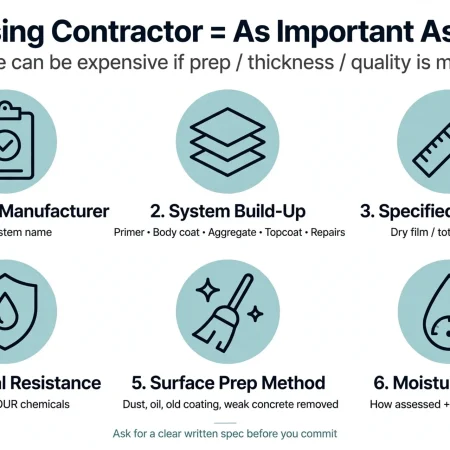
When comparing flooring contractors in Dubai, ask them to explain how they will handle the actual kitchen conditions.
A suitable contractor should inspect the site rather than recommend a product based only on floor area.
Ask for details about the proposed system, manufacturer, thickness, primer, surface preparation and anti-slip finish.
The contractor should also understand grease contamination, moisture testing, drainage details, coving and cleaning requirements.
Before accepting a quotation, check the following:
Experience with commercial kitchens: Ask whether the contractor has completed similar restaurant, hotel, catering or food production projects.
Product information: Request the manufacturer’s technical data sheet and details of the proposed flooring system.
Chemical compatibility: Confirm that the system is suitable for the cleaning products, cooking oils and other substances used in the kitchen.
Slip resistance: Ask how the selected texture will perform under the expected wet and greasy conditions.
Temperature performance: Check the system’s limits where hot water, steam or thermal shock may be present.
Surface preparation: Make sure the quotation explains how the concrete will be cleaned, ground, repaired and tested.
Installation schedule: Confirm the expected installation and curing period, including when the kitchen can safely return to service.
Maintenance guidance: Request written cleaning instructions and a list of compatible cleaning products.
A detailed quotation should describe the complete flooring system rather than simply state that epoxy coating will be applied.
How Much Does Epoxy Flooring for a Commercial Kitchen Cost in Dubai?
The cost of commercial kitchen epoxy flooring in Dubai depends on several factors. There is no reliable single price that applies to every kitchen.
The size of the floor is one factor, but the condition of the concrete and the type of flooring system can have a major effect on the final quotation.
A kitchen with clean, sound concrete may need less preparation than an older kitchen with oil contamination, damaged areas and existing coatings.
The main cost factors include:
Floor area: Larger projects may have different material and labour requirements.
Concrete condition: Grinding, oil removal, crack repair and moisture treatment can increase preparation costs.
Epoxy system: Thin coatings, high-build systems and epoxy mortar flooring have different material and application requirements.
Anti-slip finish: The type and amount of aggregate can affect the system cost and installation time.
Coving and drainage: Wall coving, floor channels and drain details require additional materials and workmanship.
Working conditions: Restricted access, operating hours and the need to work in stages may affect labour costs.
Shutdown time: Commercial kitchens may need to close during installation and curing. The project schedule should account for this.
When comparing quotations, make sure each contractor is pricing the same system build-up and preparation requirements. A low-cost coating may not provide the performance needed for a busy commercial kitchen.
Final Checks Before Installing Epoxy Flooring in Your Dubai Kitchen
Before approving a flooring system, review the kitchen’s daily operations and cleaning requirements.
Identify where grease, hot water, detergents and food spills are most likely to reach the floor. Check whether different sections need different levels of slip resistance or chemical protection.
Make sure the selected product is suitable for the expected temperatures and cleaning chemicals. Confirm that the concrete has been inspected, mechanically prepared and moisture-tested before installation.
Drainage, coving and movement joints should also be included in the project specification.
Finally, agree on the curing period and cleaning procedure before the kitchen returns to normal operation.
The most suitable floor is not simply the one with the smoothest finish or the highest quoted thickness. It is the one that supports hygiene, safe movement, effective cleaning and the everyday demands of the kitchen.
A Practical Flooring Choice for Busy Commercial Kitchens
Commercial kitchens in Dubai need flooring that can handle more than normal indoor use. Cooking grease, food spills, hot water, cleaning chemicals and heavy daily traffic all place pressure on the floor.
A properly selected epoxy system can provide a seamless, durable and easy-to-clean surface when the product and installation method match the working environment.
However, the specification should always consider the full kitchen operation. A dry storage room, cooking line and dishwashing area may need different finishes and performance requirements.
For restaurant owners, hotel operators, catering companies and commercial kitchen designers, getting the flooring specification right from the beginning can help reduce maintenance problems and support better hygiene practices.
A professional site inspection, suitable product selection and correct installation are the foundation of a kitchen floor that can handle daily work. When planning a new kitchen or upgrading an existing one, Epoxy Flooring for Commercial Kitchens should be considered as part of the wider approach to food-safe surfaces, grease control, slip resistance and long-term floor protection.