Dirty condenser tubes are one of the most common causes of declining chiller performance in commercial and industrial cooling systems. A chiller may continue operating when its condenser tubes are covered with scale, corrosion deposits, biological growth, sludge, or other contaminants, but the equipment usually has to work harder to reject the same amount of heat.
For buildings in Dubai and across the UAE, condenser cleanliness is especially important because cooling systems often operate for long periods under high ambient temperatures. Poor condenser-water quality, dust, inadequate water treatment, and continuous operation can gradually reduce heat-transfer performance.
Understanding how dirty tubes affect the refrigeration cycle helps facility managers recognize early warning signs, reduce energy consumption, and plan effective preventive maintenance.
What Are Chiller Condenser Tubes?
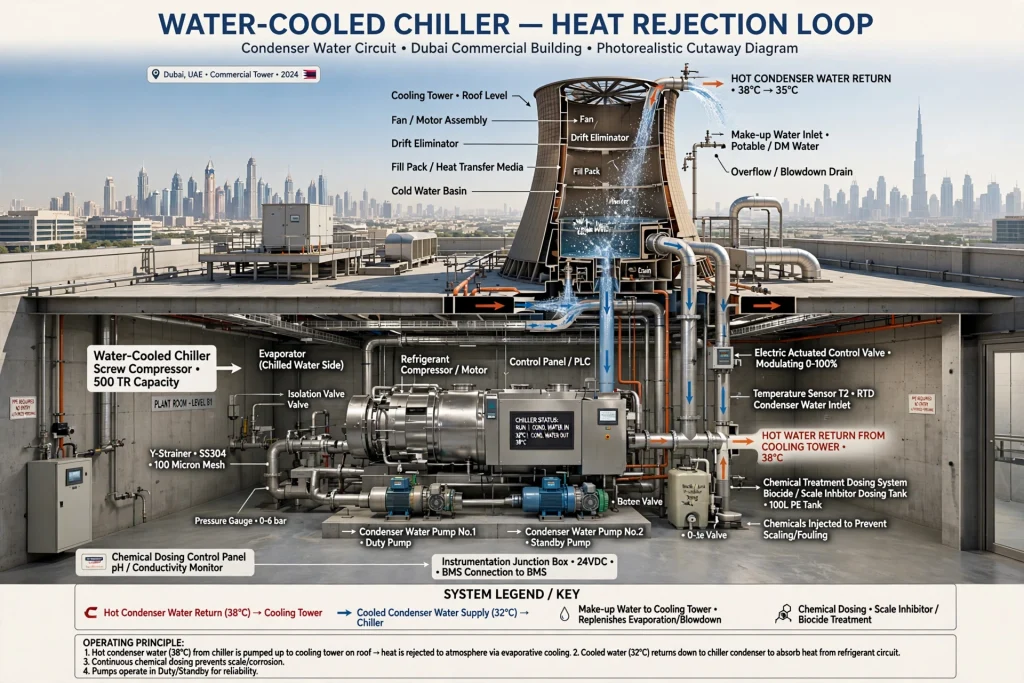
Condenser tubes are part of the heat exchanger inside a water-cooled chiller. During normal operation, refrigerant releases heat through the condenser while condenser water flows through the tubes and carries that heat toward the cooling tower.
The condenser therefore provides an essential connection between the refrigeration system and the cooling tower. Its performance depends on effective heat transfer between the hot refrigerant and the circulating condenser water.
A typical water-cooled chiller plant may include a compressor, condenser, evaporator, expansion valve, cooling tower, condenser-water pump, chilled-water pump, control system, sensors, and BMS. The condenser tubes are only one component, but their condition can influence the performance of the entire plant.
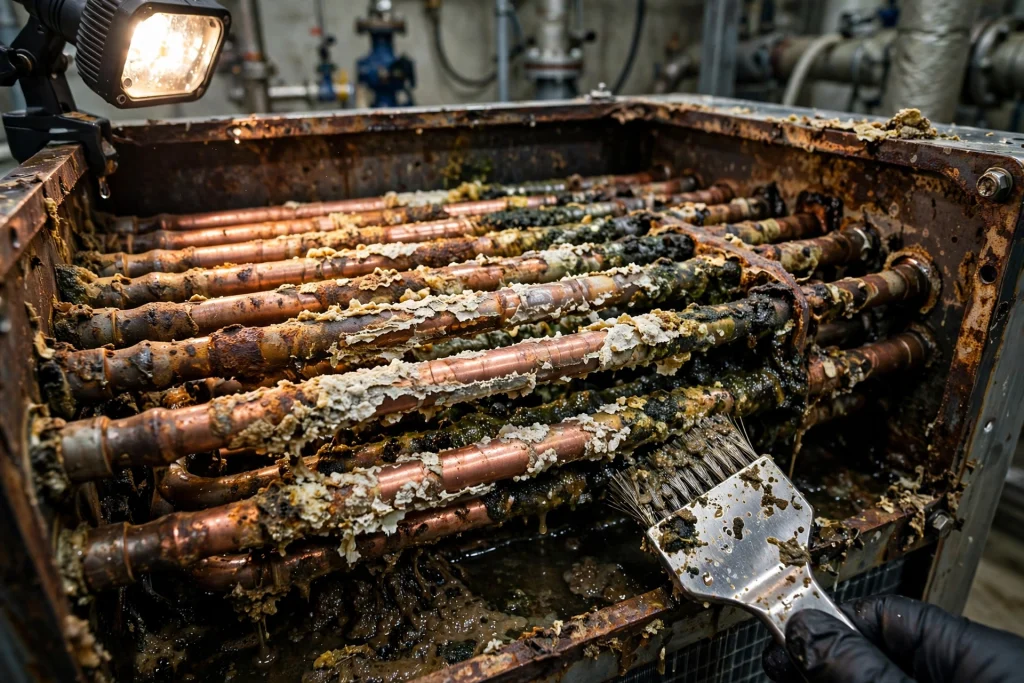
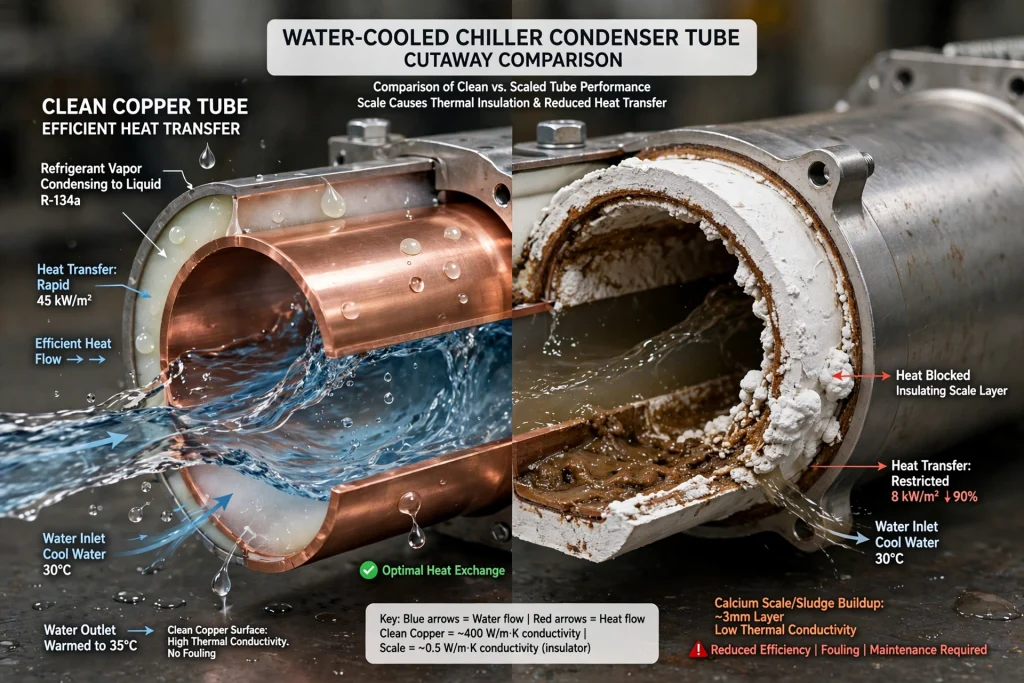
When deposits build up inside the tubes, the thermal resistance between the refrigerant and condenser water increases. The chiller then needs more energy to reject the same amount of heat.
Why Clean Condenser Tubes Matter
The purpose of the condenser is to remove heat efficiently. Clean tube surfaces allow heat to move from the refrigerant to the condenser water with relatively low resistance.
When scale or other deposits accumulate, the effective heat-transfer surface becomes less efficient. The water may still flow, but the heat transfer is no longer occurring as effectively as it should.
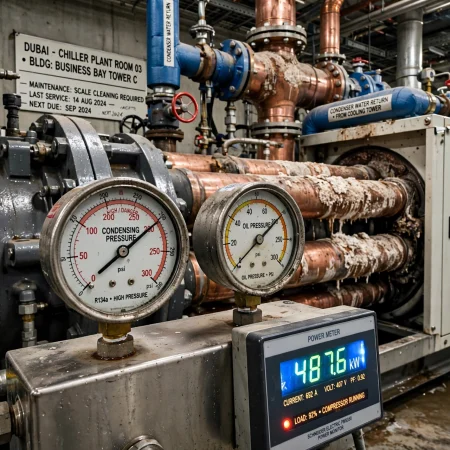
This can lead to higher condensing temperatures and pressures. The compressor must then work against a greater pressure difference, increasing its power requirement.
In simple terms, a dirty condenser makes the compressor work harder.
The problem can become more significant as fouling increases. A small amount of contamination may initially have a limited effect, but continued accumulation can progressively increase operating costs and reduce cooling capacity.
How Scale Builds Up Inside Condenser Tubes
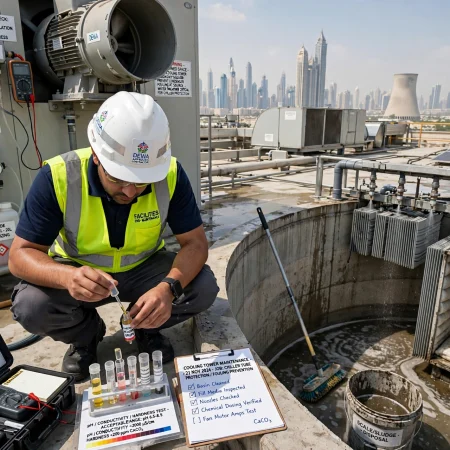
Scale formation is commonly associated with the minerals present in condenser water. When water circulates through the cooling tower and condenser system, changes in temperature, evaporation, concentration, and water chemistry can encourage minerals to precipitate onto heat-transfer surfaces.
Calcium carbonate deposits are a common example of scale that can form under unsuitable water conditions. Other deposits may also develop depending on the source water and treatment conditions.
The cooling tower is particularly relevant because water is continuously exposed to the atmosphere and loses water through evaporation. Minerals do not evaporate with the water, so their concentration can increase unless the system is properly managed through blowdown and water treatment.
This is why condenser-water treatment should be considered part of overall chiller maintenance rather than a separate issue.
Biological Growth and Sludge Can Also Reduce Heat Transfer
Not all condenser fouling is mineral scale. Cooling towers can also create conditions where biological growth, algae, bacteria, suspended solids, and organic material become problems.
If water treatment is inadequate, biological deposits can accumulate on surfaces and contribute to fouling. Sediment and sludge can also enter the condenser-water circuit and collect inside tubes or other components.
These contaminants can restrict water flow and create an additional thermal barrier.
For this reason, maintaining the cooling tower, condenser-water loop, strainers, filtration, chemical treatment, and blowdown strategy is important for protecting condenser performance.
Higher Condenser Pressure Increases Compressor Work
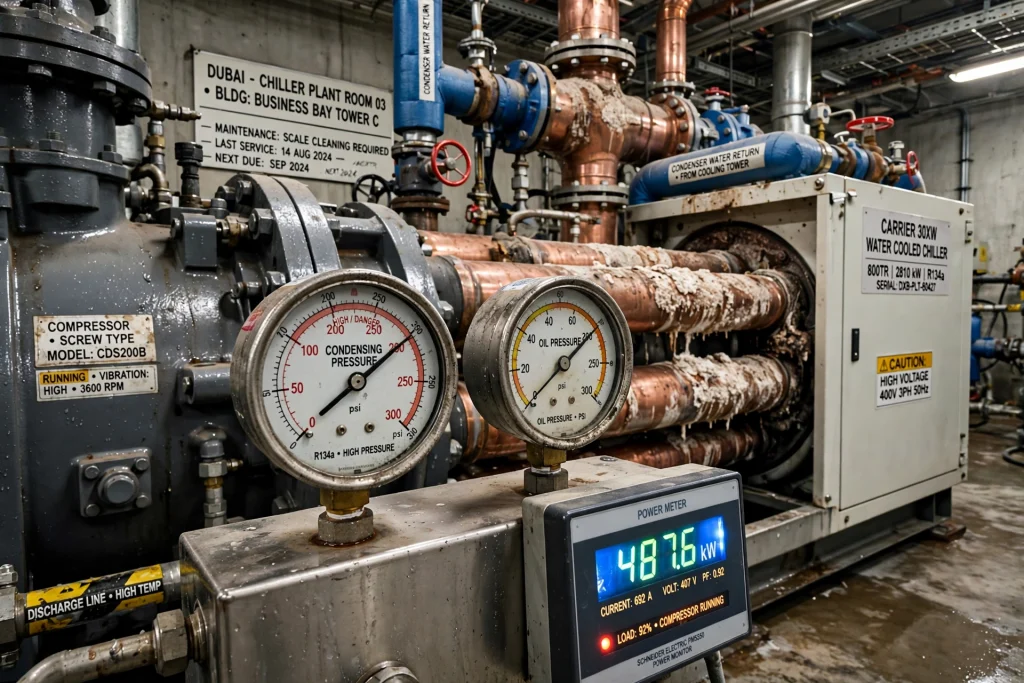
One of the most important consequences of dirty condenser tubes is increased condensing pressure.
The compressor has to raise the refrigerant pressure so that heat can be rejected through the condenser. If the condenser cannot transfer heat efficiently, the refrigerant temperature and pressure can rise.
The compressor then consumes more electrical power to maintain the required refrigeration cycle.
This means a chiller can continue producing chilled water while consuming significantly more electricity. For a large commercial property operating a chiller plant for many hours each day, even a relatively small efficiency loss can become a substantial operating expense over time.
Facility managers should therefore consider condenser cleanliness when investigating unexplained increases in chiller power consumption.
Dirty Tubes Can Reduce Chiller Cooling Capacity
Energy consumption is not the only concern. Excessive condenser fouling can also reduce the chiller’s ability to provide the required cooling capacity.
When condensing conditions become unfavorable, the refrigeration cycle becomes less efficient. Under severe conditions, the chiller may struggle to maintain the required chilled-water supply temperature.
During peak summer conditions in Dubai, this can become particularly important because buildings may already be operating close to their maximum cooling demand.
Commercial towers, hotels, shopping centres, hospitals, schools, and industrial facilities depend on reliable cooling during these periods. Reduced condenser performance can affect occupant comfort, equipment operation, and production processes.
Signs of Dirty Condenser Tubes
Several operating symptoms may indicate condenser fouling. However, these symptoms can have multiple causes, so professional diagnosis is required before assuming that dirty tubes are responsible.
Common warning signs include increasing condenser-water temperature difference, rising condensing pressure, higher compressor amperage, increased energy consumption, reduced cooling capacity, and difficulty maintaining the required chilled-water temperature.
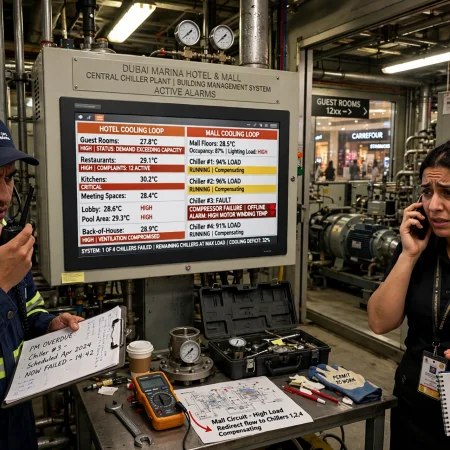
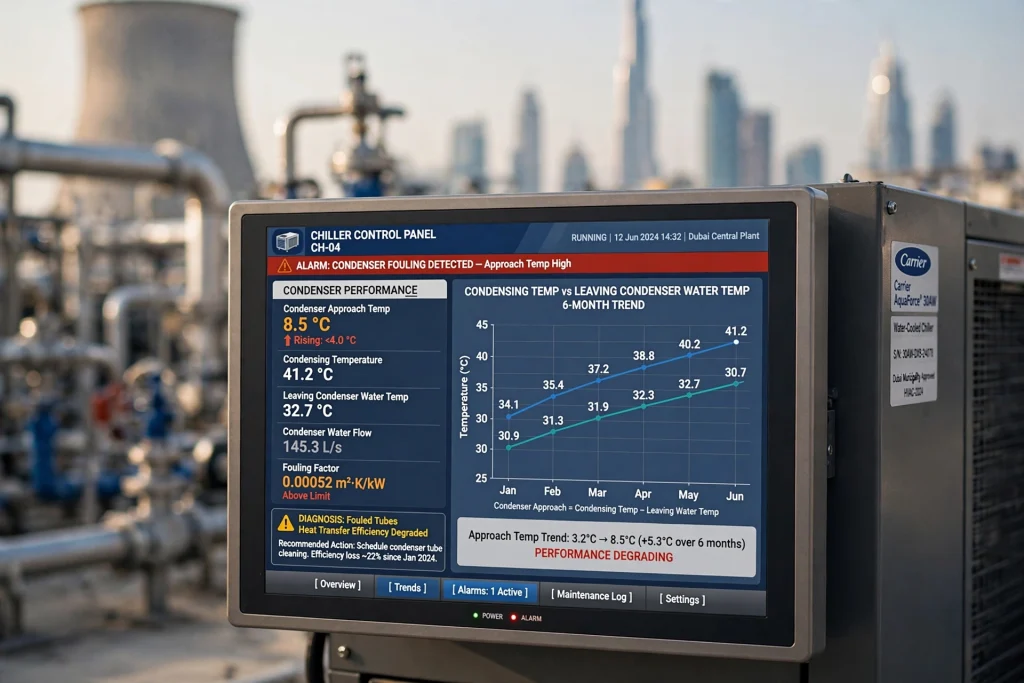
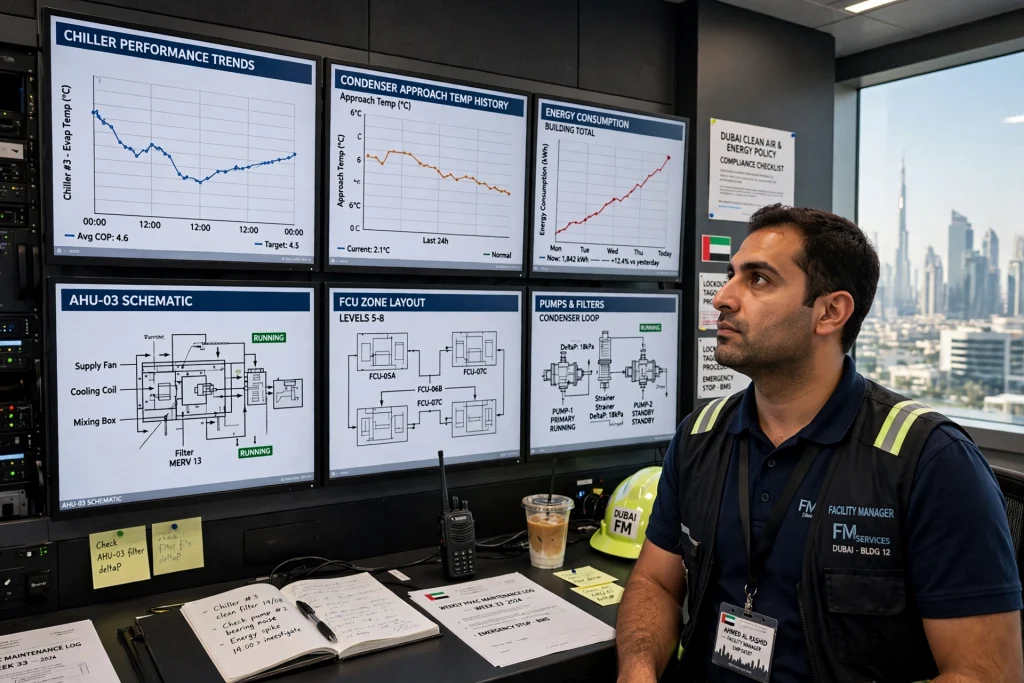
The BMS can be particularly useful for identifying these trends. Historical data from temperature sensors, pressure sensors, flow meters, and power meters can help facility teams compare current performance with previous operating conditions.
A gradual increase in condenser approach temperature can also indicate declining heat-transfer performance, although water flow, ambient conditions, refrigerant charge, and sensor accuracy should also be considered.
What Is Condenser Approach Temperature?
Condenser approach is a useful performance indicator when assessing a water-cooled chiller.
It generally refers to the difference between the refrigerant condensing temperature and the leaving condenser-water temperature. If heat-transfer surfaces become fouled, this temperature difference can increase because the condenser is no longer transferring heat as effectively.
Approach temperature should not be evaluated in isolation. Chiller manufacturers provide operating parameters and performance expectations, and technicians should compare readings against the equipment’s design conditions.
A trend showing progressively worsening approach can provide an early indication that condenser tubes require inspection or cleaning.
How Dirty Tubes Affect Energy Consumption in Dubai
Dubai’s climate places substantial demand on cooling infrastructure. Commercial and residential buildings commonly operate air-conditioning systems for extended periods, particularly during the hotter months.
High outdoor temperatures can already increase condenser heat-rejection requirements. If condenser tubes are also fouled, the chiller may experience an additional efficiency penalty.
This makes condenser maintenance particularly relevant for properties in Dubai, Abu Dhabi, Sharjah, Ajman, Ras Al Khaimah, and other UAE locations.
Large cooling plants serving Downtown Dubai, Business Bay, Dubai Marina, Jumeirah, Palm Jumeirah, Dubai Silicon Oasis, Jebel Ali, and Al Quoz may operate for long hours and therefore benefit from structured preventive maintenance.
Cooling Tower Performance and Condenser Cleanliness
The condenser and cooling tower work as part of the same heat-rejection system.
A dirty cooling tower, inadequate airflow, poor water distribution, high condenser-water temperature, or insufficient water flow can affect condenser performance even when the tubes themselves are relatively clean.
Similarly, dirty condenser tubes can increase the temperature of water returning to the cooling tower.
Effective maintenance should therefore evaluate the entire heat-rejection loop, including:
- Cooling tower fill and basin
- Condenser-water pumps
- Water flow
- Strainers and filtration
- Chemical treatment
- Blowdown
- Condenser tubes
- Temperature sensors
- Control valves
- Fans and motors
Looking at the complete system provides a more accurate understanding of why a chiller is losing efficiency.
How Condenser Tubes Are Cleaned
The appropriate cleaning method depends on the type and severity of fouling, tube construction, equipment manufacturer’s recommendations, and site conditions.
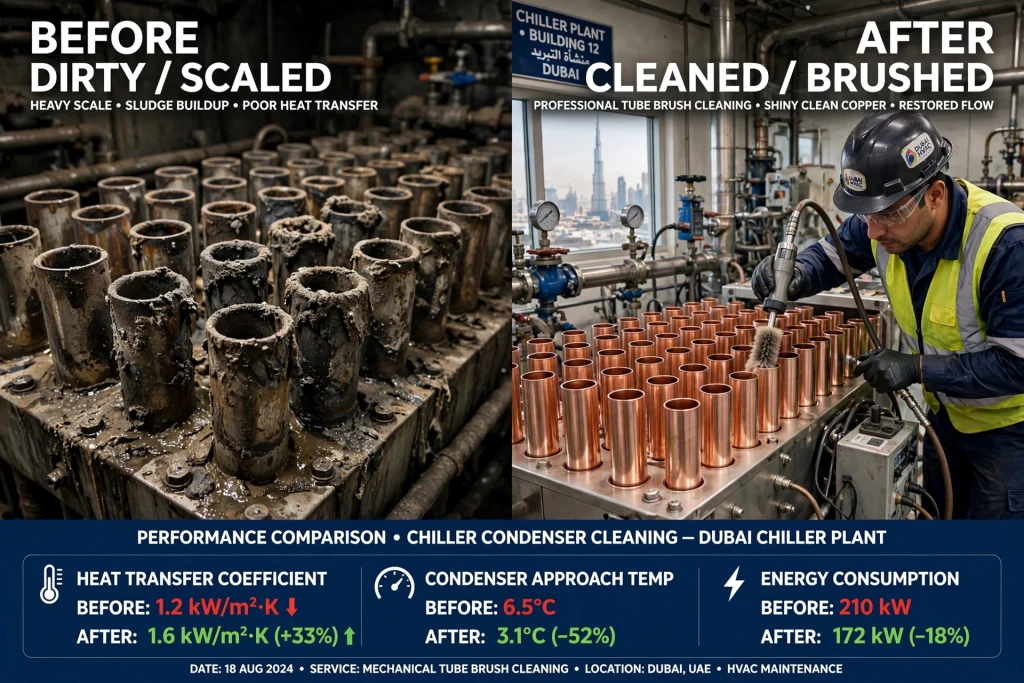
Mechanical tube cleaning may use specialized brushes or cleaning tools to remove deposits from the internal surfaces. Some systems may require chemical cleaning where scale or deposits cannot be adequately removed through mechanical methods.
Chemical cleaning should be carefully controlled because unsuitable chemicals, concentrations, or procedures can damage tube materials or other components.
Professional technicians should inspect the condenser before deciding on a cleaning method. After cleaning, the system can be checked for water flow, temperatures, pressure conditions, and overall performance.
Preventive Condenser Maintenance
Preventive maintenance is generally more effective than waiting until a chiller experiences a major performance problem.
A maintenance program can include condenser-water quality monitoring, regular tube inspection, cooling tower cleaning, strainer inspection, water treatment, temperature and pressure checks, and periodic tube cleaning according to operating conditions.
The correct frequency depends on factors such as water quality, cooling tower design, operating hours, environmental conditions, filtration, and previous fouling history.
A facility that experiences rapid scale formation may require more frequent inspection than a system with effective water treatment and stable operating conditions.
Water Treatment Helps Prevent Tube Fouling
Water treatment plays an important role in protecting condenser tubes. Proper treatment can help control scale, corrosion, suspended solids, and biological growth.
A typical cooling-tower water management program may involve monitoring conductivity, pH, chemical concentrations, microbiological conditions, and blowdown requirements.
The exact treatment strategy should be developed according to the site’s water characteristics and system design. Water-treatment records can also help maintenance teams understand whether recurring condenser fouling is associated with changes in system chemistry.
Cleaning the tubes without addressing the underlying water-quality problem may provide only temporary improvement.
Ductwork and HVAC Performance Should Also Be Considered
Although condenser tubes are part of the chiller plant, overall cooling performance depends on the complete HVAC system.
Air handling units, fan coil units, ductwork, pumps, control valves, filters, thermostats, and building automation can all influence how effectively cooling is delivered to occupied spaces.
For example, a chiller may be producing the correct chilled-water temperature while a dirty air filter or poorly balanced air-distribution system prevents adequate cooling in certain areas.
This is why chiller troubleshooting should consider both the water-side and air-side systems rather than focusing on a single component.
When Should Condenser Tubes Be Inspected?
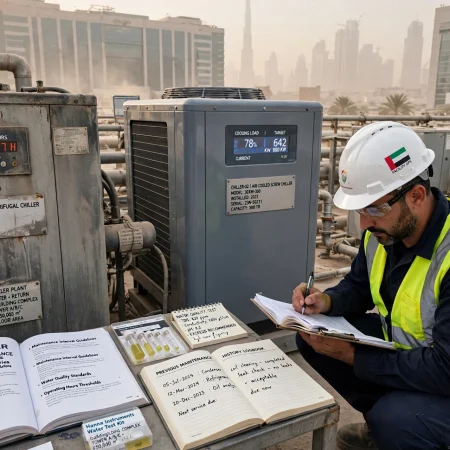
There is no universal cleaning interval that applies to every chiller. Inspection should be based on manufacturer recommendations, operating conditions, water quality, and observed performance.
Inspection becomes particularly important when the facility notices increasing energy consumption, higher condenser pressure, reduced cooling capacity, unusual temperature readings, or worsening condenser approach.
Historical BMS data can make this process easier. Comparing current operating conditions with previous periods under similar loads can reveal gradual performance deterioration.
A professional inspection can then determine whether tube fouling, water flow, refrigerant conditions, cooling-tower performance, or another issue is responsible.
Why Professional Chiller Maintenance Matters
Water-cooled chillers are complex systems containing expensive mechanical and electrical components. Incorrect cleaning methods or poor troubleshooting can create additional problems.
Professional technicians can evaluate condenser performance using operating measurements and manufacturer specifications. They can also coordinate condenser cleaning with cooling-tower maintenance, water treatment, pump inspection, and BMS monitoring.
For large commercial and industrial facilities, working with experienced Chillar Contractors in UAE can help establish a structured approach to chiller inspection, maintenance, repair, and performance optimization.
Professional service is particularly important when a chiller is responsible for critical cooling loads or when repeated performance problems continue after basic maintenance.
Chiller Efficiency After Condenser Cleaning
Cleaning condenser tubes can restore heat-transfer performance when fouling is the actual cause of reduced efficiency. After cleaning, technicians can compare operating conditions before and after the work.
Useful measurements may include condenser-water temperatures, chilled-water temperatures, compressor power, refrigerant pressures, flow rates, and approach temperatures.
The improvement will depend on the severity and type of fouling. Cleaning does not automatically solve every chiller efficiency problem because performance can also be affected by compressor condition, refrigerant charge, water flow, controls, cooling-tower performance, and system load.
A proper before-and-after assessment helps determine whether cleaning produced the expected improvement.
Frequently Asked Questions
How do dirty condenser tubes affect a chiller?
Dirty condenser tubes increase resistance to heat transfer. The chiller may experience higher condensing pressure, greater compressor power consumption, reduced cooling capacity, and increased operating costs.
Can dirty condenser tubes increase electricity consumption?
Yes. When heat cannot be rejected efficiently, compressor work can increase. The actual energy impact depends on the degree of fouling, chiller design, operating load, condenser-water conditions, and ambient temperature.
What causes condenser tubes to become dirty?
Common causes include mineral scale, corrosion products, suspended solids, biological growth, algae, sludge, and inadequate cooling-tower water treatment.
How can condenser tube fouling be prevented?
Effective prevention combines suitable water treatment, cooling-tower maintenance, filtration where appropriate, blowdown control, regular inspection, and cleaning based on actual operating conditions.
Does cleaning condenser tubes improve chiller efficiency?
If tube fouling is causing poor heat transfer, cleaning can restore condenser performance and reduce the additional compressor work associated with high condensing conditions.
Conclusion
Dirty condenser tubes can have a significant effect on the efficiency, capacity, reliability, and operating cost of a water-cooled chiller. Scale, biological growth, sludge, and other deposits create additional resistance to heat transfer, forcing the refrigeration system to operate under less favorable conditions.
The result can include higher condensing pressure, increased compressor power, reduced cooling capacity, and greater energy consumption. These effects are particularly important in Dubai and across the UAE, where cooling systems frequently operate under demanding conditions.
The most effective strategy combines regular condenser inspection, cooling-tower maintenance, water treatment, performance monitoring, and professional tube cleaning when required. Using BMS data and operating measurements can also help identify performance deterioration before it develops into a major failure.
For commercial towers, hotels, hospitals, shopping centres, industrial facilities, and other properties with critical cooling requirements, maintaining clean condenser tubes should be considered an important part of the overall chiller maintenance strategy. A clean and properly maintained heat-rejection system allows the chiller plant to work more effectively while supporting reliable cooling and better long-term operational performance.