Smart HVAC systems are becoming an important part of modern commercial building design as businesses look for better indoor comfort, lower energy consumption, predictive maintenance, and greater control over building operations. Heating, ventilation, and air conditioning systems are no longer isolated mechanical installations. They increasingly operate as connected systems that communicate with building management systems (BMS), sensors, variable frequency drives (VFDs), cloud platforms, artificial intelligence, occupancy systems, and energy-management software.
For commercial properties in Dubai and across the UAE, this transition is particularly relevant. The region’s hot climate creates substantial cooling requirements for offices, shopping centres, hotels, hospitals, warehouses, schools, restaurants, and mixed-use developments. A smart HVAC strategy can help building owners understand how cooling systems perform and identify opportunities to improve efficiency without compromising occupant comfort.
From Downtown Dubai and Business Bay to Dubai Hills Estate, Dubai Marina, Jumeirah, Abu Dhabi, Sharjah, and other growing commercial districts, intelligent HVAC technology is becoming increasingly relevant to modern building operations.
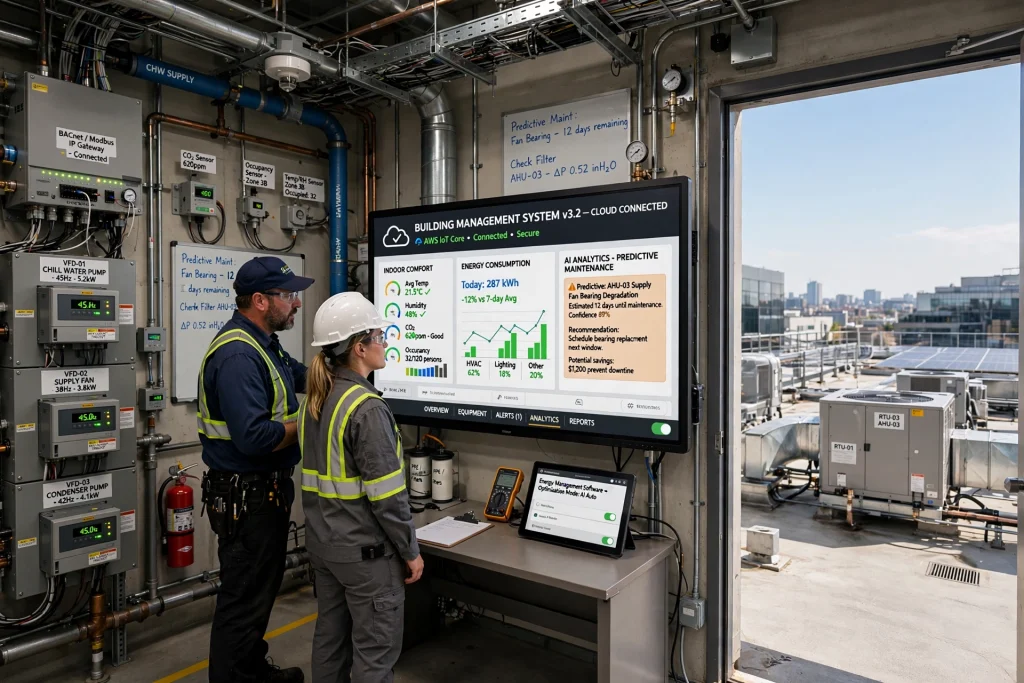
What Is a Smart HVAC System?
A smart HVAC system combines conventional heating, ventilation, and air-conditioning equipment with connected controls, sensors, automation, monitoring, and data analysis.
A traditional HVAC system may operate according to fixed schedules or manually adjusted thermostats. A smart system can respond dynamically to conditions inside and outside the building.
It may monitor:
- Indoor temperature
- Relative humidity
- Occupancy
- Air quality
- CO₂ concentration
- Airflow
- Static pressure
- Chilled-water temperature
- Refrigerant conditions
- Equipment runtime
- Energy consumption
- Filter condition
- Equipment performance
This information can be transmitted to a central control platform, allowing facility teams to monitor performance and make adjustments based on actual operating conditions.
Why Smart HVAC Matters for Commercial Buildings
HVAC systems can represent a significant portion of a commercial building’s energy consumption, particularly in hot climates where cooling operates for long periods.
A smart HVAC strategy aims to ensure that cooling is provided where and when it is needed rather than operating equipment unnecessarily.
For example, an office building may have different occupancy levels throughout the day. A conference room may remain empty for several hours and then become heavily occupied for a meeting. Instead of maintaining exactly the same conditions continuously, an intelligent control system can use occupancy information to adjust HVAC operation.
This approach can improve energy management while maintaining suitable indoor conditions.
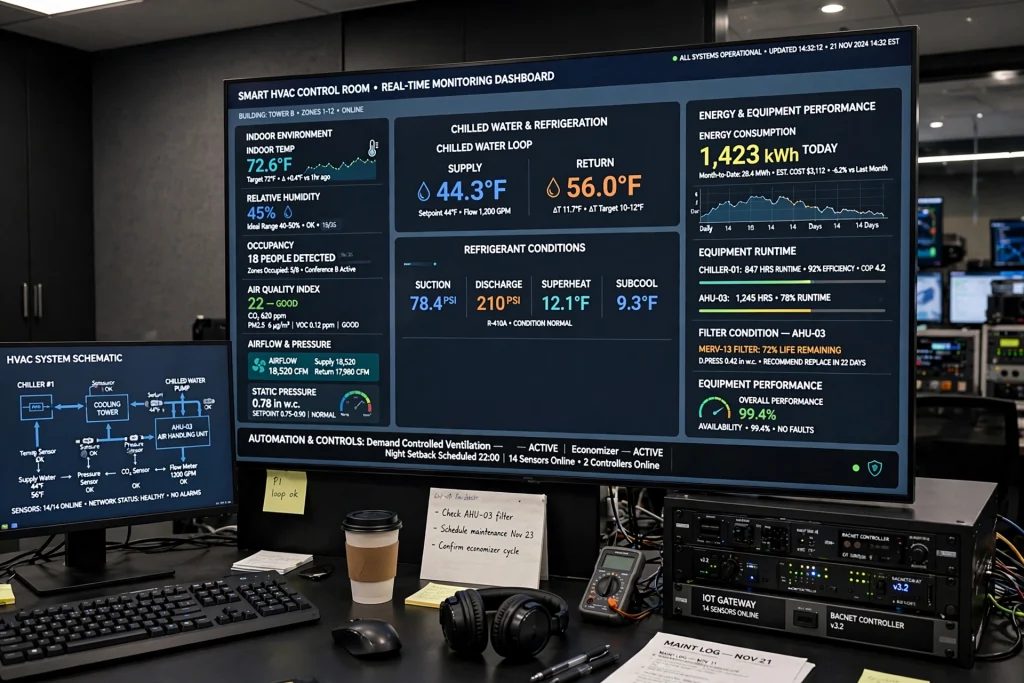
Building Management Systems and HVAC
The Building Management System (BMS) is central to many smart commercial HVAC installations.
A BMS can connect HVAC equipment with other building systems, including:
Chillers, AHUs, FCUs, pumps, cooling towers, VFDs, thermostats, sensors, ventilation systems, lighting controls, energy meters, and alarm systems.
Through a centralized interface, facility managers can view equipment status, temperatures, alarms, schedules, and other operational information.
Modern BMS platforms can also support automated sequences that respond to changing building conditions.
For example, if occupancy increases in a particular zone, the control system can adjust airflow or temperature according to programmed parameters.
IoT Sensors in HVAC Systems
The Internet of Things (IoT) is expanding the amount of information available from commercial HVAC equipment.
Small sensors can measure temperature, humidity, pressure, occupancy, vibration, airflow, and other conditions. These devices can communicate with controllers or cloud platforms.
Instead of relying on periodic inspections alone, facility teams can receive continuous information about equipment performance.
In a large commercial building, hundreds or thousands of data points can potentially be monitored. This creates a much more detailed picture of how the HVAC system behaves throughout the day.
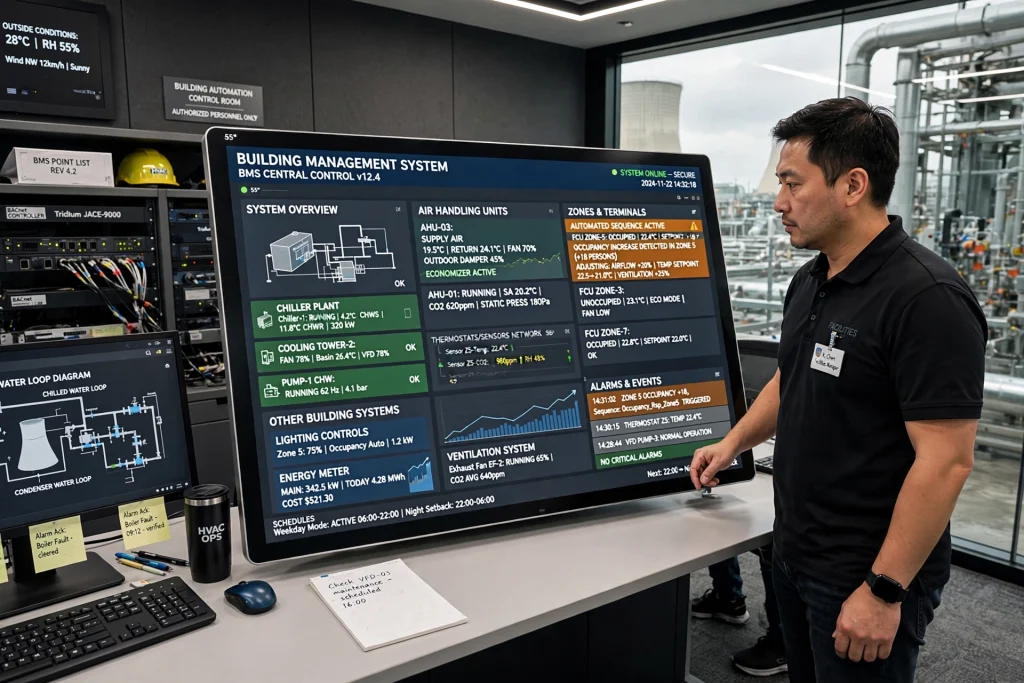
Artificial Intelligence and HVAC Optimization
Artificial intelligence is expected to play a larger role in commercial HVAC management.
AI-based systems can analyze historical and real-time information to identify patterns that may not be obvious through manual monitoring.
For example, an intelligent platform may identify that a building consistently reaches its cooling setpoint earlier than necessary in the morning. The system could then optimize startup schedules.
AI can also compare factors such as:
Outdoor temperature + occupancy + historical energy consumption + indoor conditions + equipment performance
to recommend or automatically implement more efficient operating strategies.
The value of AI is not simply automation. It is the ability to process large amounts of operational data and turn it into actionable decisions.
Predictive HVAC Maintenance
One of the most important developments in smart HVAC technology is the move from reactive maintenance toward predictive maintenance.
Traditional reactive maintenance occurs after equipment develops a fault. Preventive maintenance follows a scheduled routine regardless of the equipment’s actual condition.
Predictive maintenance uses operational data to identify potential problems before they result in major failures.
Sensors can monitor equipment behaviour such as:
- Motor vibration
- Temperature changes
- Pressure variations
- Electrical consumption
- Compressor performance
- Fan operation
- Pump efficiency
- Filter pressure drop
An abnormal pattern can trigger an alert for further inspection.
This can help facility teams address developing problems before they become major breakdowns.
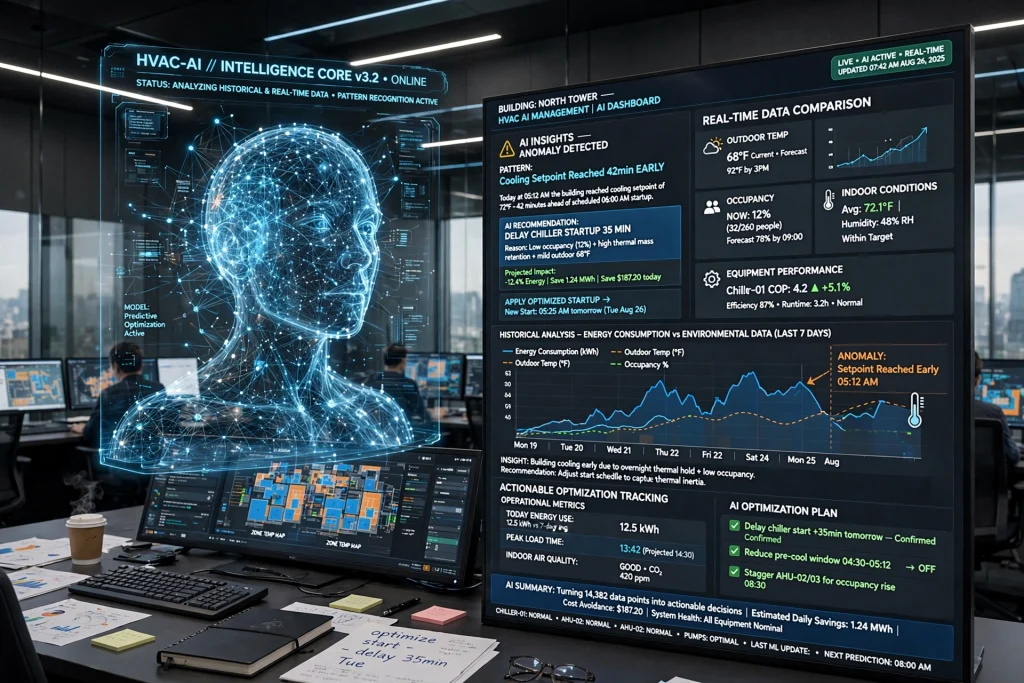
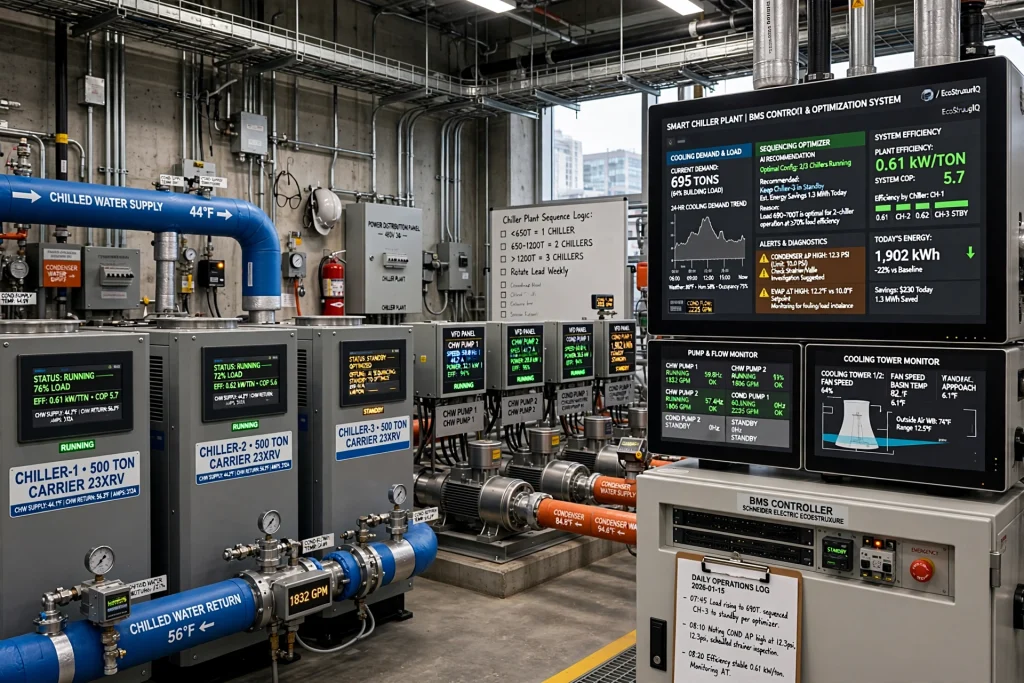
Smart Chiller Management
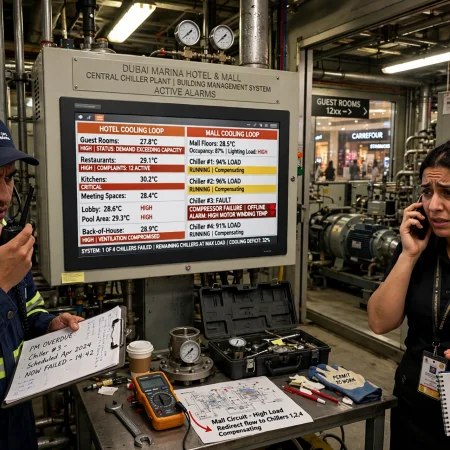
Chillers are particularly important in large commercial buildings because they can consume substantial amounts of energy.
A smart chiller plant can integrate chillers, cooling towers, chilled-water pumps, condenser-water pumps, VFDs, sensors, flow meters, and BMS controls.
The control strategy can consider cooling demand and equipment efficiency when deciding how many chillers should operate.
Instead of running several chillers at unsuitable loads, the system can optimize equipment sequencing according to demand and programmed operating conditions.
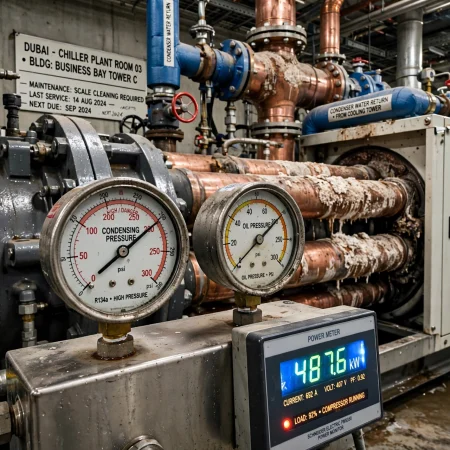
Chiller monitoring can also identify unusual temperature differences, pressure conditions, flow problems, and performance changes that may require investigation.
Variable Frequency Drives and Energy Efficiency
Variable Frequency Drives (VFDs) allow motors to operate at different speeds rather than simply running continuously at full speed.
They can be applied to:
- AHU fans
- FCU systems
- Chilled-water pumps
- Condenser-water pumps
- Cooling tower fans
- Ventilation systems
Smart controls can adjust motor speed according to actual demand.
For example, if airflow requirements decrease, an AHU fan may not need to operate at maximum speed. The VFD can reduce speed according to the control strategy.
This can improve energy efficiency while supporting stable indoor conditions.
Smart Air Handling Units
Air Handling Units (AHUs) are another important part of intelligent HVAC systems.
An AHU may include filters, fans, coils, dampers, sensors, and control components. Smart monitoring can help facility teams understand how these components are performing.
Pressure sensors can monitor filter loading, while temperature sensors can measure supply and return air conditions.
Variable-speed fans can respond to demand, while fresh-air dampers can be adjusted according to ventilation requirements.
Integration with occupancy and indoor air-quality sensors can make ventilation more responsive to actual building conditions.
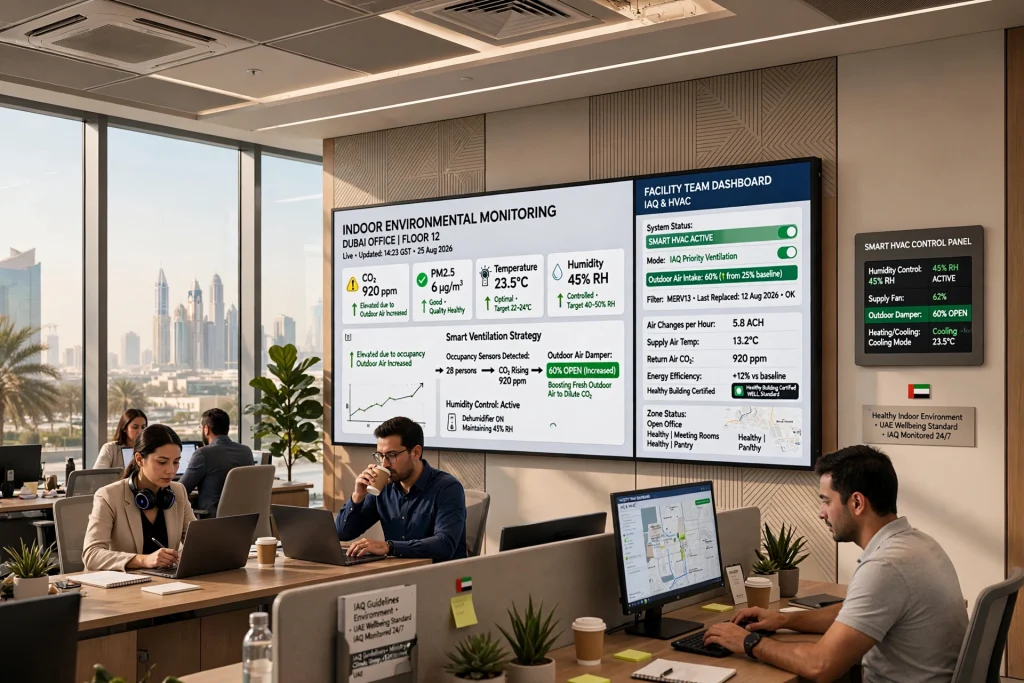
Indoor Air Quality and Healthy Buildings
Energy efficiency is important, but commercial HVAC systems must also support healthy indoor environments.
Smart HVAC systems can monitor CO₂, particulate matter, humidity, temperature, and other indoor environmental conditions depending on the sensors and system design.
If CO₂ levels increase because of higher occupancy, a smart ventilation strategy may increase outdoor-air delivery according to programmed requirements.
Humidity control is also important in the UAE because excessive indoor humidity can affect comfort and contribute to moisture-related problems.
Smart monitoring can provide facility teams with visibility into indoor environmental conditions rather than relying solely on occupant complaints.
Smart HVAC for Office Buildings
Modern offices have variable occupancy patterns. Employees may work from different locations, meeting rooms may remain empty for long periods, and certain areas may have higher cooling loads than others.
Smart HVAC systems can use occupancy information to adjust conditions by zone.
Meeting rooms, executive offices, open-plan work areas, reception zones, and support spaces can have different operating schedules.
This creates opportunities for more precise HVAC control.
Commercial buildings can also integrate HVAC with access control, room booking platforms, lighting systems, and occupancy sensors to create a more coordinated building environment.
Smart HVAC in Hotels
Hotels present unique HVAC requirements because rooms can be occupied at different times and guests expect immediate comfort.
Smart room controls can allow guests to adjust temperature according to personal preference while the building system monitors overall energy use.
When a room becomes unoccupied, the system can use programmed strategies to reduce unnecessary cooling while maintaining conditions appropriate for the property’s operating requirements.
Hotels can also integrate room controls with property management systems and central building automation.
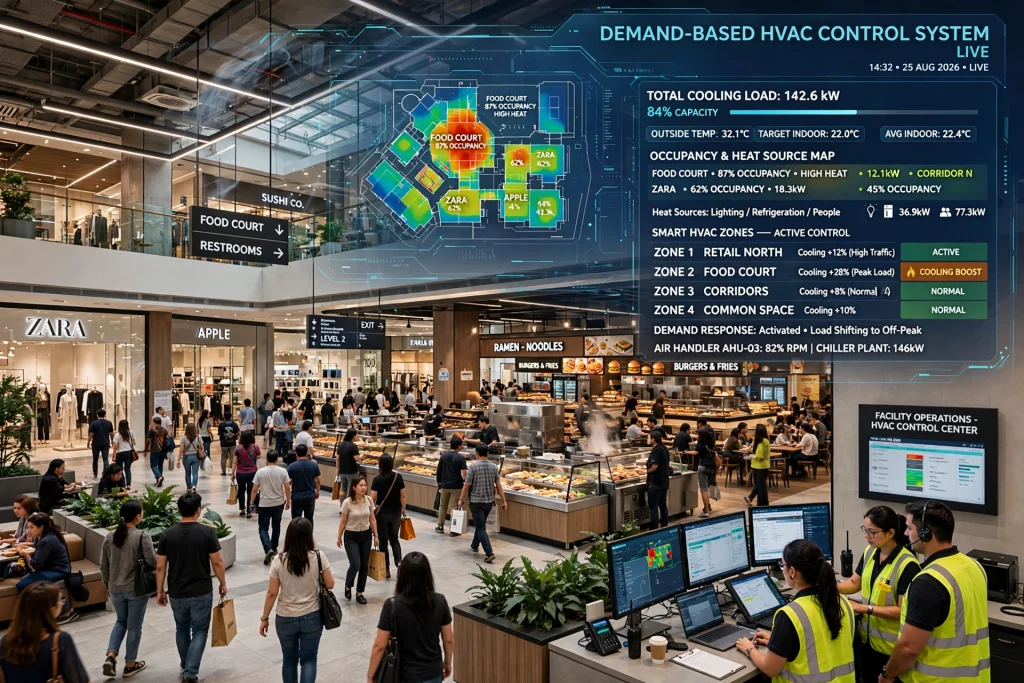
Smart HVAC in Retail and Shopping Centres
Retail environments have changing occupancy patterns and significant cooling requirements.
Stores may experience high customer traffic during certain hours and lower occupancy during others. Shopping centres also contain different tenants with different operational schedules.
Smart HVAC controls can help facility teams monitor tenant areas, common spaces, food courts, corridors, and other zones.
Retail environments also generate heat from lighting, refrigeration, equipment, and people, making demand-based HVAC control particularly valuable.
Smart HVAC for Hospitals and Healthcare Facilities
Healthcare buildings require careful environmental control because temperature, humidity, ventilation, and air quality can be critical to building operations.
Smart monitoring can provide facility teams with greater visibility into HVAC conditions.
However, healthcare HVAC systems require specialized engineering, compliance, filtration, pressure relationships, and operational controls. Smart technology should therefore support—not replace—appropriate engineering and healthcare requirements.
Smart HVAC in Dubai’s Climate
Dubai’s climate presents specific HVAC challenges because cooling demand can remain high for extended periods.
High outdoor temperatures can place substantial loads on chillers, condensers, cooling towers, pumps, and air-handling equipment.
Smart HVAC systems can help building operators understand how outdoor conditions affect equipment performance.
Weather information can potentially be integrated with building controls so that operating strategies respond to changing conditions.
For commercial buildings in Dubai Hills Estate, Downtown Dubai, Business Bay, Dubai Marina, Jumeirah, Palm Jumeirah, and other rapidly developing areas, intelligent HVAC planning can be considered during both new construction and retrofit projects.
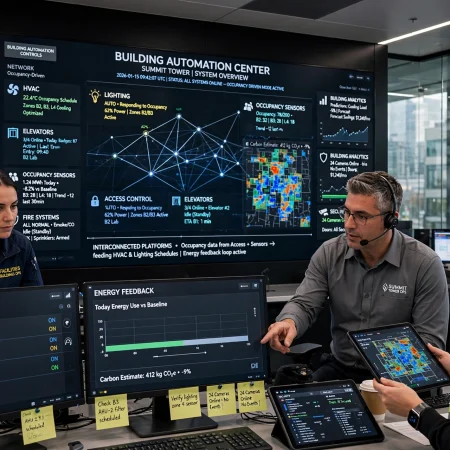
Smart HVAC and Building Automation
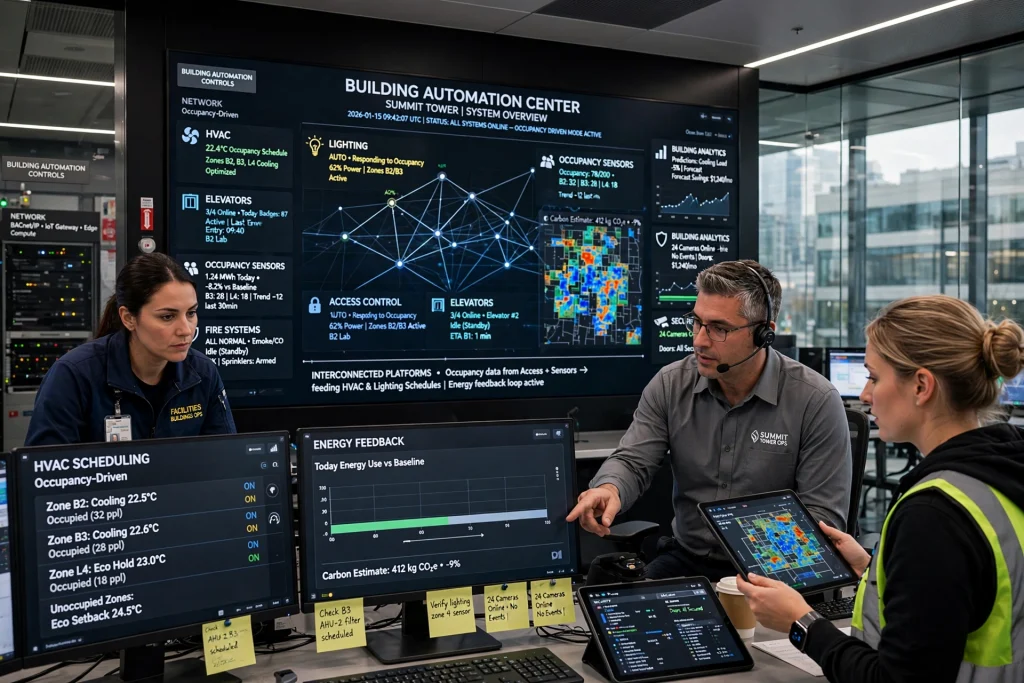
The future of HVAC is increasingly connected to wider building automation.
A modern commercial building may integrate:
HVAC + lighting + access control + elevators + energy meters + occupancy sensors + fire systems + security + building analytics
through centralized or interconnected platforms.
This creates a more coordinated building environment.
For example, occupancy information collected by access systems can potentially support HVAC scheduling. Lighting and HVAC can respond to the same occupancy information. Energy meters can provide feedback about the impact of operational changes.
The result is a building where individual systems are no longer operating completely independently.
Cloud-Based HVAC Monitoring
Cloud technology allows building operators and facility managers to access HVAC information remotely, depending on the system architecture and cybersecurity requirements.
A facility manager may be able to review:
- Equipment status
- Temperature trends
- Energy consumption
- Active alarms
- Maintenance notifications
- Historical performance
- Operating schedules
from a centralized dashboard.
Remote monitoring can be particularly useful for organizations managing multiple properties across Dubai or the wider UAE.
Digital Twins for HVAC Systems
Digital twin technology is another emerging area.
A digital twin creates a digital representation of a physical building or system and can use real-world operational data to support analysis.
For HVAC systems, this could allow engineers and facility teams to compare expected performance with actual operation.
Digital models can potentially support commissioning, fault analysis, energy optimization, maintenance planning, and future upgrades.
As building information modelling and operational data become more connected, digital twins may become increasingly useful for large commercial properties.
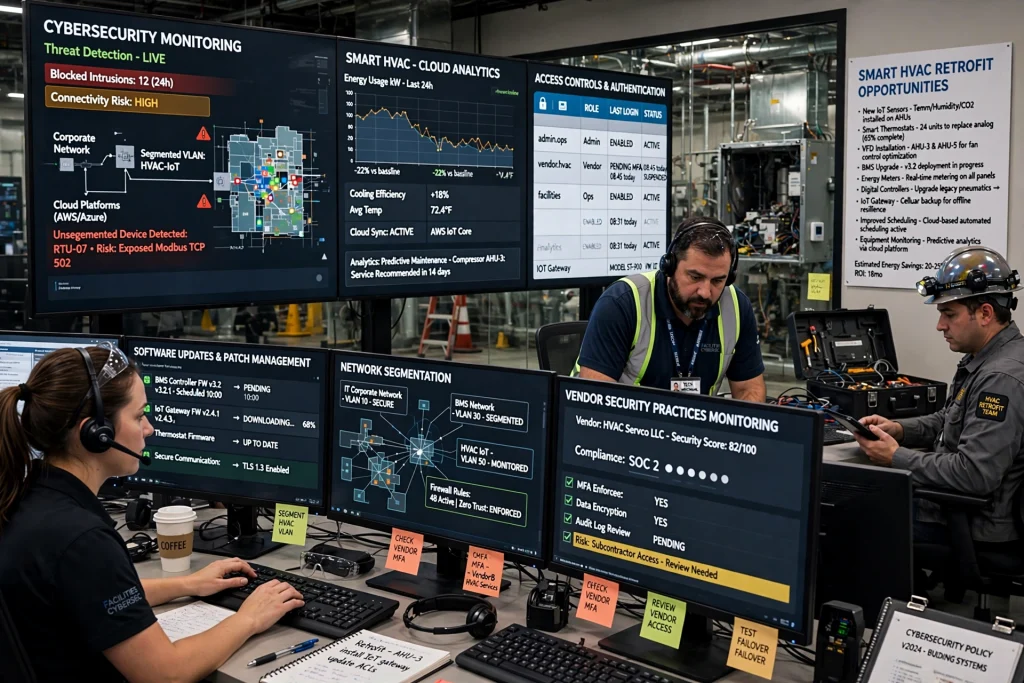
Cybersecurity in Smart HVAC Systems
Greater connectivity also introduces cybersecurity considerations.
A traditional HVAC controller with limited connectivity has a different risk profile from a system connected to cloud platforms, remote monitoring tools, corporate networks, and other building systems.
Commercial building owners should therefore consider:
Access controls, secure communication, software updates, network segmentation, authentication, user permissions, monitoring, and vendor security practices.
Cybersecurity should be considered during system selection and design rather than after installation.
Smart HVAC Retrofit Opportunities
Smart HVAC technology is not limited to newly constructed buildings.
Existing commercial properties can potentially be upgraded through:
- New sensors
- Smart thermostats
- VFD installation
- BMS upgrades
- Energy meters
- Digital controllers
- IoT gateways
- Improved scheduling
- Equipment monitoring
- Cloud-based analytics
A retrofit strategy should begin with an assessment of the existing HVAC infrastructure.
Older chillers, AHUs, pumps, controls, and sensors may have different communication protocols and capabilities. Integration should therefore be planned carefully.
The Role of HVAC Contractors
Smart HVAC technology requires more than software. The physical HVAC system must be correctly designed, installed, commissioned, balanced, and maintained.
Professional contractors need to understand both mechanical systems and controls.
For example, integrating a BMS with a chiller plant requires appropriate sensors, control sequences, communication protocols, actuators, valves, pumps, and commissioning.
For projects in Dubai Hills and surrounding areas, working with experienced HVAC Contractors in Dubai Hills can help property owners coordinate HVAC installation, maintenance, controls, and automation requirements as part of the wider building system.
Commissioning Smart HVAC Systems
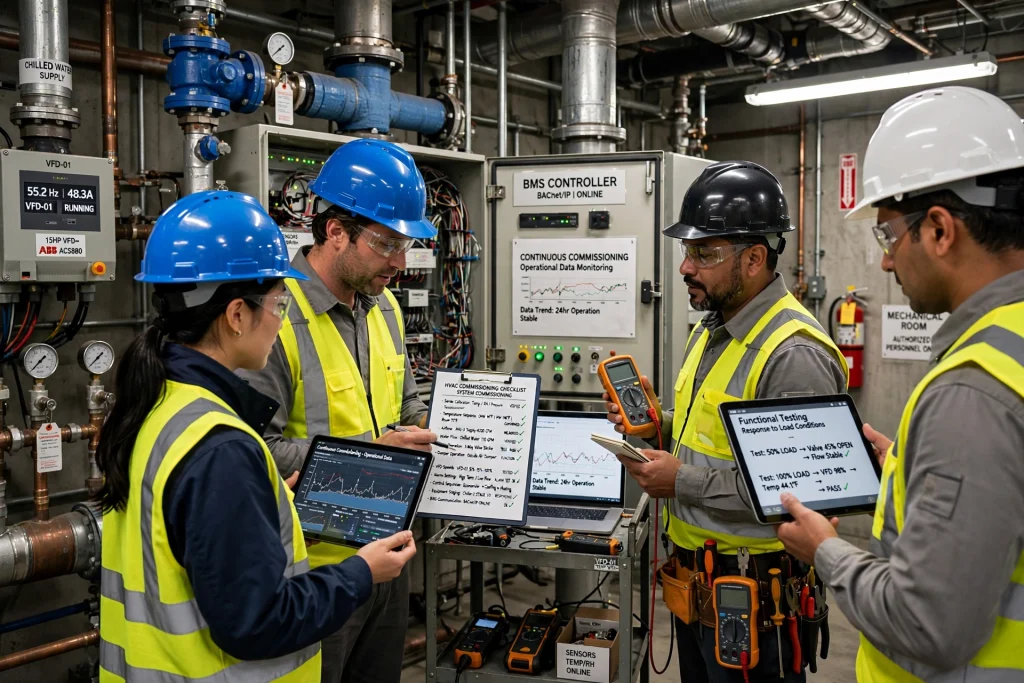
Commissioning is essential because a technically advanced system can still perform poorly if controls are incorrectly configured.
Commissioning may involve checking:
- Sensor calibration
- Temperature setpoints
- Airflow
- Water flow
- Valve operation
- Damper operation
- VFD speeds
- Alarm settings
- Control sequences
- Equipment staging
- BMS communication
Functional testing should confirm that equipment responds correctly to different operating conditions.
Continuous commissioning can take this further by using operational data to identify performance changes over time.
Data-Driven HVAC Maintenance
Smart HVAC systems create large amounts of operational data. The future challenge will be turning that data into useful information.
Facility teams can establish performance benchmarks and monitor trends over time.
For example, increasing energy consumption at similar cooling loads may indicate a developing efficiency issue. A change in pressure differential may suggest a filter or airflow problem.
Data should therefore be presented in a way that supports practical maintenance decisions rather than overwhelming operators with unnecessary information.
Energy Management and Sustainability
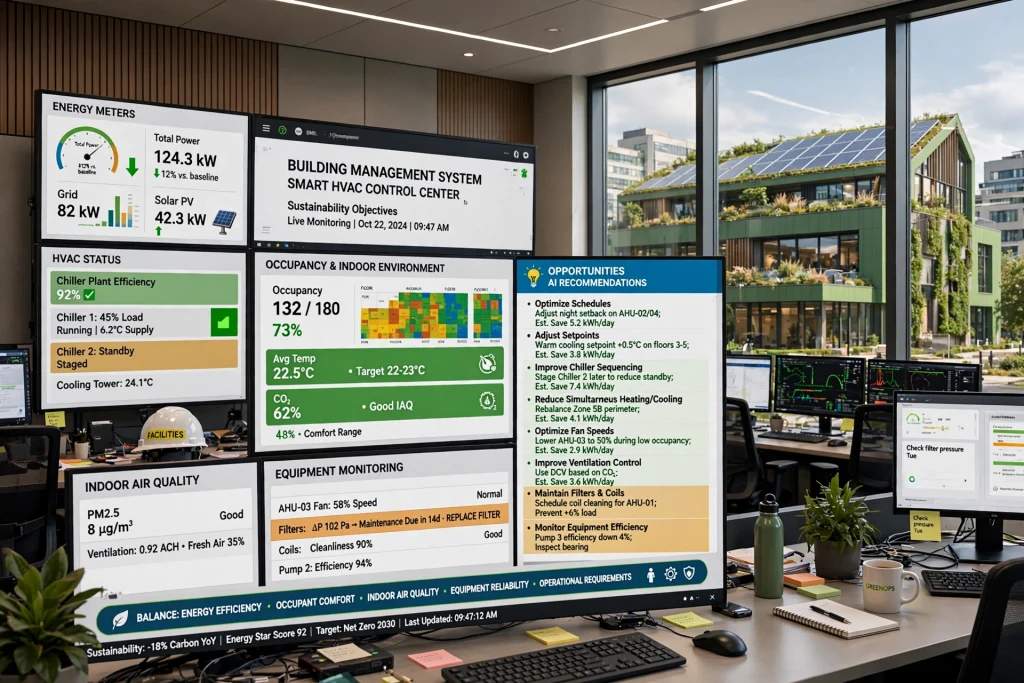
Smart HVAC systems can contribute to broader building sustainability objectives.
Energy meters, BMS analytics, occupancy data, and equipment monitoring can help identify where energy is being consumed.
Building operators can then investigate opportunities such as:
- Optimizing schedules
- Adjusting setpoints
- Improving chiller sequencing
- Reducing simultaneous heating and cooling
- Optimizing fan speeds
- Improving ventilation control
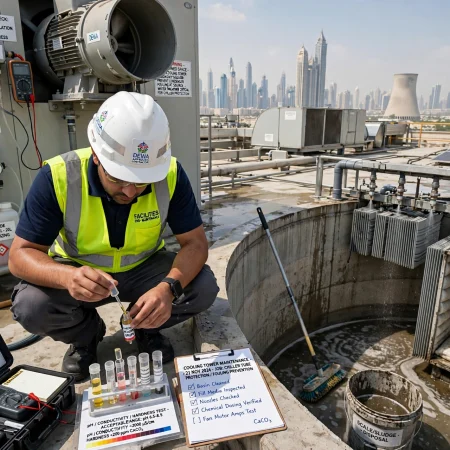
- Maintaining filters and coils
- Monitoring equipment efficiency
The goal should always be to achieve the appropriate balance between energy efficiency, occupant comfort, indoor air quality, equipment reliability, and operational requirements.
What the Future of Smart HVAC Looks Like
The next generation of commercial HVAC systems will likely become increasingly connected, predictive, automated, and data-driven.
Instead of simply responding to temperature changes, future systems can potentially consider multiple variables simultaneously, including occupancy, weather, energy prices, equipment performance, indoor air quality, and historical building behaviour.
AI-assisted analytics may identify unusual patterns automatically. Digital twins may support complex building optimization. Edge computing can allow some decisions to happen closer to equipment rather than relying entirely on remote platforms.
However, advanced technology will not eliminate the need for experienced engineers and technicians. Physical inspection, commissioning, maintenance, cleaning, calibration, and repairs will remain essential.
Frequently Asked Questions
What is the main advantage of smart HVAC?
The main advantage is greater visibility and control over HVAC operation. Smart systems can help improve comfort, energy management, maintenance planning, and equipment monitoring.
Can an existing HVAC system become smart?
In many cases, existing systems can be upgraded with sensors, controls, VFDs, meters, BMS integration, and monitoring platforms. The feasibility depends on the existing equipment and control architecture.
How does AI help HVAC systems?
AI can analyze operational data to identify patterns, optimize schedules, detect anomalies, and support predictive maintenance. Its effectiveness depends on the quality and quantity of available data.
Are smart HVAC systems suitable for Dubai?
Yes. Dubai’s high cooling demand makes efficient HVAC operation particularly important. Smart controls can help commercial buildings monitor and optimize cooling according to actual operating conditions.
Does smart HVAC eliminate maintenance?
No. Smart technology can support predictive and condition-based maintenance, but physical inspection, cleaning, testing, calibration, and servicing remain necessary.
Conclusion
The future of commercial HVAC is moving toward systems that are connected, intelligent, measurable, predictive, and responsive. BMS platforms, IoT sensors, VFDs, AI analytics, cloud monitoring, digital twins, smart controls, and indoor air-quality sensors are changing how commercial buildings operate their cooling and ventilation infrastructure.
For the UAE, this evolution is especially significant because commercial buildings operate in a climate where cooling performance and energy management are major operational considerations.
From Downtown Dubai, Business Bay, Dubai Hills Estate, Dubai Marina, Jumeirah, and Palm Jumeirah to Abu Dhabi and Sharjah, smart HVAC technology can support different types of commercial properties, including offices, hotels, retail centres, healthcare facilities, restaurants, educational buildings, and mixed-use developments.
The most effective approach is not simply to install the latest technology. Building owners should first understand their cooling requirements, existing equipment, occupancy patterns, operational objectives, maintenance capabilities, and energy priorities.
When properly designed, installed, commissioned, and maintained, a smart HVAC system can become an important part of a building’s wider automation strategy—helping facility teams make better decisions, detect problems earlier, manage energy more intelligently, and provide a more consistent indoor environment for occupants.